
A Three-Part Fascia Kit Shortlist: ZYX-01, ZYX-02, ZYX-03
A vehicle-specific Android car stereo fascia kit is normally bought as one bundle, but it behaves as three separate engineering decisions: how the new screen is physically mounted, how power and audio are connected, and whether the vehicle's own network will communicate with the new head unit. This shortlist examines the three parts that carry those decisions — ZYX-01 Car Radio Dash Fascia, ZYX-02 Car Radio Wiring Harness and ZYX-03 CAN Bus Decoder Module — and maps each one to the retrofit requirement it actually solves.
All three parts are developed and supplied by Shenzhen Zhongyixing Electronic Technology Co., Ltd, a Shenzhen-based automotive aftermarket electronics manufacturer whose main products are Android car stereo fascia, wiring harness and CANBUS adapter solutions. The company states an export ratio of 80%, with main markets in Russia and the EU, and maintains a product and vehicle compatibility system covering 3,000+ vehicle applications. Company and product information is published at www.zyxcaradio.com.
Why a retrofit project is really three separate decisions
Installation problems in the aftermarket head-unit category rarely come from one single defect. They come from a mismatch in one of three layers, and each layer has a different cause and a different remedy. The same vehicle model can require different components depending on model year, equipment level, original radio, original connector, audio system and overall vehicle configuration — which is why a "vehicle-specific" label is a starting point for verification rather than a guarantee on its own.
ZYX organizes compatibility as a sequence rather than a single check: vehicle brand, vehicle model, model year, original radio, original connector, vehicle configuration, audio system, and finally the new head unit. Where a model ships with more than one original equipment configuration, the stated guidance is to obtain clear photographs of the original dashboard, the original radio, or the connectors on the back of the original head unit before ordering. That single step removes most configuration-level mismatch, because the vehicle identification may be correct while the trim level and connector are not.
Once the vehicle is confirmed, the three parts in this shortlist address three distinct risks:
- Physical fitment — the fascia frame must match the dashboard opening, mounting points and screen size, or the outcome is visible gaps and possible trim damage.
- Electrical interface — the harness must land power, speaker and control pins in the correct positions without cutting or modifying factory wiring.
- Vehicle communication — on CAN-equipped cars, the head unit needs translated network data in order to retain steering wheel controls, vehicle information display and original chime behaviour.
These three layers also explain why bundled and separately sourced parts behave differently in the field. A frame that fits perfectly still fails if the harness pin definition does not match, and a correct harness still leaves the installation looking unfinished if the frame alignment is loose.
The shortlist at a glance
| Part | Model | Product type | Key published specification | Primary retrofit need it answers |
|---|---|---|---|---|
| Car Radio Dash Fascia | ZYX-01 | Model-specific center console frame, universal adjustable dash kit, screen upgrade installation faceplate | Compatible screen sizes 7" / 9" / 10.1" / 12.3"; mounting standard Double-DIN or model-specific custom; dimensional tolerance ≤0.2 mm; material thickness 2.5–3.0 mm; ABS plastic; plug-and-play fitment; −40 °C to 85 °C | Projects where visible fit, dashboard integrity and screen size compatibility are the first risk |
| Car Radio Wiring Harness | ZYX-02 | Plug-and-play car stereo wiring harness, model-specific radio wiring adapter, ISO standard wiring harness | OEM vehicle-side plug + ISO 16-pin head unit connector; AWG 20–22 tinned oxygen-free copper; ANSI/CTA-2015-B color-coded insulation; 12 V DC, 10 A maximum; reverse polarity and short-circuit protection; −40 °C to 85 °C | Non-CAN vehicles where the electrical connection must be made without cutting original wiring |
| CAN Bus Decoder Module | ZYX-03 | Plug-and-play CAN gateway module | CAN 2.0A / 2.0B; 500 kbps / 125 kbps dual rate; 12 V DC, 300 mA standby, 2 A maximum; −40 °C to 85 °C; pre-programmed model-specific firmware; built-in CAN isolation | CAN-equipped vehicles where steering wheel controls, vehicle information and chime functions must survive the upgrade |
ZYX-01 Car Radio Dash Fascia: fitment before function
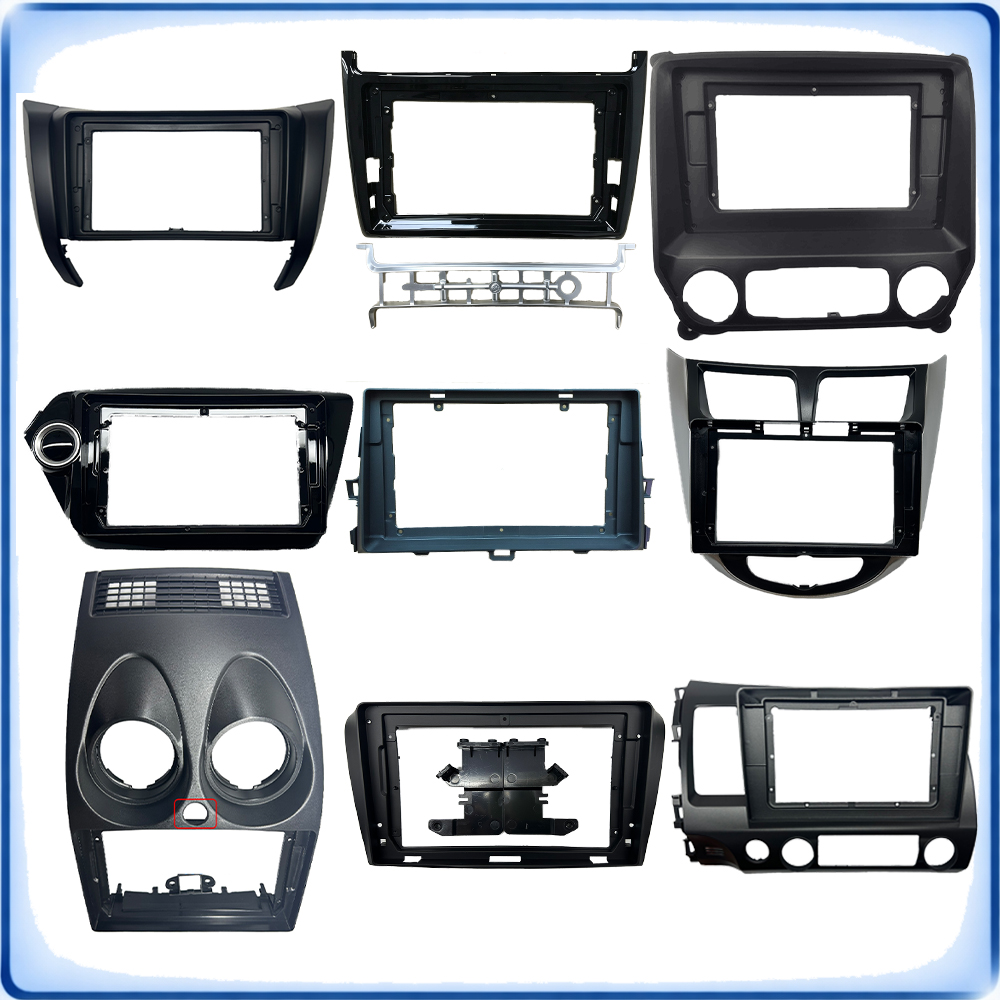
The Car Radio Dash Fascia is the component most buyers see and the one most likely to disappoint if it is chosen loosely. ZYX-01 is specified as a model-specific center console frame that also serves as a universal adjustable dash kit and screen upgrade installation faceplate. Its published screen compatibility covers 7-inch, 9-inch, 10.1-inch and 12.3-inch head units, with mounting executed either as a Double-DIN standard or as a model-specific custom layout.
The dimensions carry the quality claim. Dimensional tolerance is stated at ≤0.2 mm against original vehicle dashboard data, and material thickness is 2.5–3.0 mm in ABS plastic. The frame is described as high-temperature resistant ABS with anti-aging performance, operating across −40 °C to 85 °C, and the fitment type is plug-and-play, with complete mounting accessories included.
What the number means in practice
A tolerance figure matters because dashboard fitment is judged visually. A frame that is dimensionally close but not molded from the vehicle's own dashboard data tends to produce the failure pattern buyers complain about most: visible edge gaps and a surround that does not sit flush with the surrounding trim. A ≤0.2 mm tolerance states the intended deviation limit, but it is only valid against the correct vehicle configuration, which is why ZYX pairs the dimension claim with dashboard, radio or connector photographs before order confirmation.
The fascia is applied in aftermarket car head unit upgrade projects, center console navigation retrofit projects, used-car interior electronics refurbishment, fleet audio system upgrades and dealership accessory fitting. Its operating environment is the in-vehicle one: constant road vibration, dust and humidity exposure, automotive EMI, direct sunlight and a 12 V DC vehicle electrical system. The stated special requirements for the application are model-specific precise fitment, no damage to original wiring or interior, zero dashboard fault codes, EMC compliance and flame-retardant wiring materials.
ZYX-02 Car Radio Wiring Harness: the electrical interface
The wiring harness is where connector correctness is decided. ZYX-02 is a plug-and-play car stereo wiring harness combining an OEM vehicle-side plug with an ISO 16-pin head unit connector. That combination is the reason it can serve both a model-specific radio wiring adapter role and a universal ISO standard role, depending on the vehicle.
Published electrical specifications are 12 V DC operation with a 10 A maximum current, operating temperature of −40 °C to 85 °C, and two protection features: reverse polarity protection and short-circuit protection. The conductor is AWG 20–22 tinned oxygen-free copper with ANSI/CTA-2015-B color-coded insulation, which is the standard color-coding installers use for identification and troubleshooting. Insulation is flame-retardant PVC, the connector housing is PA66 engineering plastic, and the contact terminals are tin-plated brass.
The harness is explicitly specified as fitting non-CAN bus vehicle models and as compatible with most aftermarket car stereos. That scope statement is deliberate and useful: it tells a buyer directly when this part is the right answer and when a different communication path is required.
The stated benefit is a plug-and-play installation that requires no cutting of original vehicle wiring, with model-specific custom design for precise fitment. In practice this converts a wiring task into a connection task, which is what makes the part suitable for installers who cannot risk damaging a customer's factory loom, and for used-car or dealership preparation work where a vehicle must be returned to a sellable state.
ZYX-03 CAN Bus Decoder Module: keeping the vehicle's own features
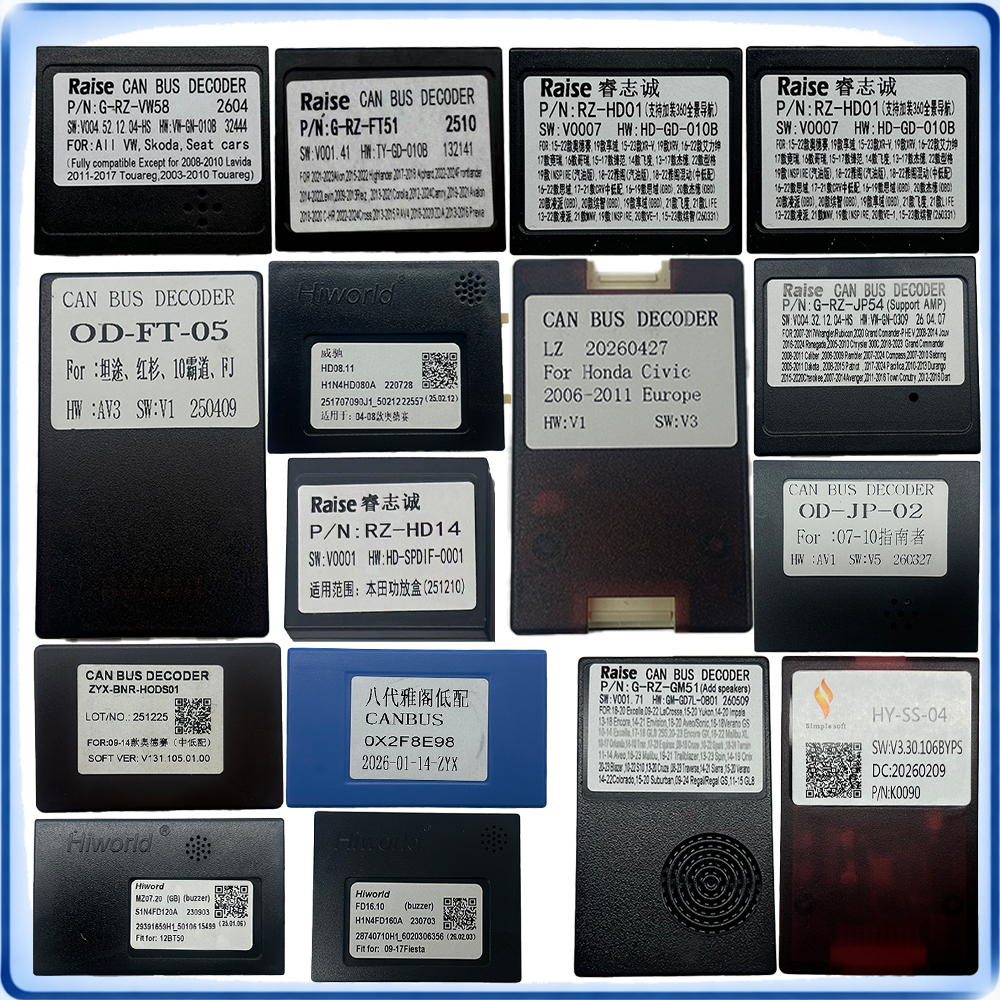
On vehicles that communicate over a CAN bus, the head unit and the car speak different languages. ZYX-03 is a plug-and-play CAN gateway module that sits between them. Its published protocol support is CAN 2.0A / 2.0B at a 500 kbps / 125 kbps dual rate, with 12 V DC power, 300 mA standby current, 2 A maximum current, and an operating range of −40 °C to 85 °C. The housing is flame-retardant ABS, connector terminals are tin-plated brass, the circuit board is FR-4 glass fiber epoxy resin, and the internal potting is heat-conductive silicone.
The functional claim is the one buyers should evaluate against their own vehicle: the module retains OEM steering wheel controls, vehicle information display and original chime functions, and includes built-in CAN isolation to prevent dashboard fault codes. Firmware is described as sourced from professional automotive CAN protocol manufacturers with official authentic firmware, pre-programmed with model-specific software so that installation is plug-and-play without on-site debugging. The module is matched to the same supplier's wiring harness and fascia kits, and 100% incoming quality inspection is stated for signal transmission stability.
The technical mechanism is consistent with how these devices are generally described in the aftermarket. A published 2025 technical explainer describes the decoder's core job as translating vehicle network messages (HEX codes) into UART messages that the head unit can read, which is how steering wheel control inputs and vehicle data reach an Android unit.
Matching the shortlist to a retrofit need
The parts are not meant to be ordered as a fixed set. The correct combination follows the vehicle and the project type.
- Non-CAN vehicle, budget-led retrofit. ZYX-01 plus ZYX-02 covers the project. The harness is specified for non-CAN bus vehicle models, so a decoder is not part of this configuration.
- CAN-equipped vehicle, OEM functions must survive. All three parts apply. The fascia carries fitment, the harness carries the connector interface, and ZYX-03 carries steering wheel controls, vehicle information and chime retention.
- Screen upgrade or size change. The decision starts with ZYX-01, because screen coverage — 7-inch, 9-inch, 10.1-inch and 12.3-inch — determines the frame, and the mounting standard is either Double-DIN or model-specific custom.
- Multi-vehicle distribution program. The relevant capability is kit-level configuration rather than single-part supply. Customization options cover dash kit model and surface finish, wiring harness pin definition and length, and kit combination configuration, under OEM, ODM, kit assembly and authorized distribution modes.
- Fleet and dealership fitting. The determining criterion is damage-free installation. Plug-and-play operation, no original wire cutting and no on-site programming are the characteristics that matter when vehicles must remain resale-ready.
Across these scenarios the parts are installed with supporting equipment that buyers normally already have or specify separately: an aftermarket Android car head unit, a car rear view camera, the original dashboard wiring harness, steering wheel control buttons and trim removal tools.
Sample quantities, lead times and order structure
Order structure is a practical evaluation criterion, because a fascia kit program rarely starts at volume. The stated minimum order quantity is 1 unit for stock items and 100 units for custom OEM/ODM items. Lead time is 3–7 days for stock products and 15–25 days for custom model-specific products, against a stated monthly capacity of 12,000 units.
That split is the reason a single-set sample is meaningful in this category. A sample allows a dry fit on the actual dashboard and a function test of the connector interface before any volume commitment is made, while a custom molding or custom pin definition naturally requires a larger order and a longer production window.
Quality control is stated as 100% incoming inspection for CAN bus decoders and 100% pre-shipment conductivity and fit testing. After-sales coverage consists of a 12-month product warranty, remote installation technical guidance, free replacement for defective items, and CAN protocol matching support. For buyers planning a distribution program, the pre-shipment fit and conductivity test is the step that converts a sample result into a repeatable order, because it applies the same check to every unit rather than to the sample alone.
What the wider market data suggests
Published market research supports the direction of this category, though buyers should read the figures as context rather than as a forecast for any single part.
- The global car audio head unit market was estimated at USD 15.44 billion in 2024, according to Market Research Future.
- Mordor Intelligence projects the car aftermarket audio system market to grow at a CAGR of 12.18%, a trend it associates with DIY customers and online plug-and-play kits.
- Fortune Business Insights reported that Asia Pacific accounted for 54.21% of the global car audio market in 2025.
Two regulatory and trade reference points matter for cross-border programs. Car stereo fascia and installation hardware are typically classified under HS Code 8708.99 (vehicle parts and accessories, n.e.c.), per the United Nations Statistics Division. In the European Union, electronic subassemblies integrated into road vehicles that affect vehicle safety functions must comply with E-Marking (ECE R10) rather than CE marking alone, according to a regulatory guide published by Elite Electronic Engineering.
The practical reading for procurement teams is that growth in plug-and-play channels raises the value of documentation and pre-shipment verification. When end users install parts themselves or through small workshops, a fitment error becomes a return rather than a workshop adjustment — which is why tolerance data, connector specifications and vehicle configuration confirmation carry more weight in this category than in most automotive accessory segments.
Limits, trade-offs and where this shortlist does not apply
A shortlist is only useful if it also states its boundaries. The following limitations come directly from the published specifications.
- ZYX-02 is specified for non-CAN bus vehicle models. On a CAN-equipped vehicle, the harness alone is not the compatibility path; a decoder is required for retained vehicle functions.
- ZYX-03 firmware is model-specific and pre-programmed. Its performance depends on the buyer confirming vehicle model, model year, trim configuration, original radio and connector before ordering. Universal decoders without model-specific firmware are the documented cause of the fault-code and steering-control failures described in the FAQ below.
- Screen coverage is bounded at 7-inch, 9-inch, 10.1-inch and 12.3-inch. A project using another screen size falls outside the standard range and would move into custom development territory.
- Tolerances are stated against original dashboard data. A ≤0.2 mm dimensional tolerance still assumes the correct dashboard variant. Where a model has multiple trim levels, verification remains a buyer-side task.
- Custom orders carry different economics. Custom OEM/ODM items start at 100 units with 15–25 day lead times, which is not suited to one-off or single-vehicle custom requests.
- Cheaper alternatives exist for some projects. Traditional cut-wire universal solutions have a lower upfront cost and are described as viable for low-budget simple retrofits of older economy vehicles, but they carry a higher risk of functional issues and none of the damage-free installation property.
None of these points argue against the configuration; they define which projects it fits. A buyer who cannot confirm the exact vehicle configuration is better served by resolving that question first than by ordering parts optimistically.
Notes from volume programs
Two long-running customer relationships are documented for this product family, and both were built on the same three-part structure.
An after-market solution integrator in China has taken a cumulative 19,000+ sets over a 7-year cooperation, for Android stereo retrofit supporting parts across multiple car brands. The recorded result is a return rate below 0.8%, with consistent product consistency, flexible order volume and rapid technical support for overseas project requirements. The cited highlights are high-precision frame dimensions, reliable harness connections, a mature protocol solution and responsive after-sales technical support.
A car multimedia brand owner working in global markets and China has taken a cumulative 550,000+ sets over a 9-year cooperation, covering dash frames, wiring harnesses and CAN bus decoders across multiple vehicle models. The recorded result is a return rate below 0.7%, with protocol compatibility, stable mass production and fast new-model adaptation. The cited highlights are a complete vehicle-model database, precise CAN bus decoding, assembly fit, efficient sample delivery and stable lead-time control.

Read together, the two cases describe different buying patterns rather than different products. The integrator case reflects project-based sourcing where order volume flexes, and the brand-owner case reflects a program-based model where new vehicle models must be adapted quickly and lead time must be predictable.
Future outlook
The direction of this category is set by two forces: the number of vehicle configurations that need coverage, and the expectations of end users who increasingly install parts themselves. Both push toward the same requirements — wider vehicle application data, precise CAN protocol matching, and documentation that lets a buyer verify fitment before purchase rather than after.
Shenzhen Zhongyixing Electronic Technology Co., Ltd states that it will continue expanding vehicle coverage, developing new car stereo fascia kits, wiring harnesses and CANBUS solutions, and improving its compatibility database. For buyers in Research and Evaluation stages, the useful test is not whether a supplier claims vehicle-specific coverage, but whether the supplier can confirm the exact configuration, supply a sample for dry fitting, and document the tolerance, connector and protocol specifications in writing.
FAQ
What is a CAN bus decoder and what role does it play in car head unit retrofit?
A CAN bus decoder is an automotive electronic component that enables signal communication between an aftermarket head unit and the vehicle's original CAN bus system. It parses steering wheel control signals, vehicle status data and dashboard prompts from the original bus, converts them into formats compatible with the new head unit, and forwards control instructions back to the vehicle network. It is a necessary component for achieving full-function plug-and-play retrofit on CAN-equipped vehicles.
Do I need all three parts — fascia, harness and decoder — for every Android head unit upgrade?
No. The physical mounting frame is needed in every retrofit because it positions the new head unit inside the dashboard. The wiring harness is specified as fitting non-CAN bus vehicle models and works with most aftermarket car stereos, so a non-CAN vehicle can be completed without a decoder. A CAN bus decoder applies to vehicles equipped with CAN bus communication systems, where it translates CAN bus protocols in order to retain original vehicle controls such as steering wheel controls, vehicle information display and chime functions.
How do I choose between a plug-and-play model-specific kit and a traditional cut-wire universal solution?
The selection criteria are installation damage level, fit accuracy, CAN protocol compatibility, cost, applicable scenarios and long-term reliability. Plug-and-play model-specific kits are recommended for premium vehicle upgrades, fleet batch modification and dealership pre-delivery fitting, because they support damage-free installation, precise fitment, stable CAN protocol matching and high long-term reliability. Traditional cut-wire universal solutions remain a viable option for low-budget simple retrofits of older economy vehicles, with lower upfront cost but a higher risk of functional issues.
How is the plug-and-play kit installed, and what safety steps matter?
The standard procedure is: disconnect the vehicle battery and remove the factory head unit together with the dashboard trim panel; dry fit the model-specific dash kit to check fitment and alignment; plug the wiring harness and CAN bus decoder into the original vehicle wiring interface; connect the new head unit, power on and test all functions; then secure the head unit and dash kit and reinstall the dashboard trim. Disconnect the battery before installation to avoid electrical short circuits, do not pry the trim forcibly, confirm CAN decoder model compatibility before power-on, and ensure all connectors are fully seated before final assembly.
Why do dashboard fault codes appear, or steering wheel controls stop working, after installing an aftermarket head unit?
These symptoms are typically caused by a CAN bus protocol mismatch between a universal decoder and the vehicle's original system. The remedy is to use pre-programmed model-specific CAN bus decoder kits, confirm the exact vehicle model, model year and trim configuration before ordering, and perform a compatibility test before full installation. For an installation already in service, the troubleshooting sequence is to confirm the decoder is the model-specific version for that vehicle, re-plug the CAN bus interface to ensure it is fully seated, update the decoder to the latest matching firmware, then clear the vehicle's historical fault codes and retest the system.
Why does an aftermarket dash kit show obvious gaps or misalignment after installation?
Gaps, misalignment and damage to the original dashboard trim are typically caused by low-quality universal dash kits, or by products that were not precision-molded to the exact dimensions of the vehicle's original dashboard. The mitigation is to choose model-specific dash kits molded from original vehicle dashboard dimension data, verify the fit tolerance parameter before purchase — the ZYX-01 fascia is specified at ≤0.2 mm — and conduct a dry fit test before permanent installation.
Why can intermittent signal loss appear after long-term use?
Intermittent signal loss and functional failure after long-term use are usually caused by low-grade copper conductors, thin insulation layers, and the absence of vibration-resistant crimp design suited to vehicle driving conditions. Avoiding this means selecting products with tinned oxygen-free copper conductors, reinforced crimp terminals and flame-retardant insulation, and performing regular line inspection during routine vehicle maintenance. The ZYX-02 harness is specified with AWG 20–22 tinned oxygen-free copper conductors and tin-plated brass contact terminals.
How should a supplier of fascia kit programs be evaluated?
Priority goes to suppliers with model-specific precision molding, pre-flashed vehicle-specific CAN firmware, plug-and-play wiring harnesses with built-in electrical protection, complete export compliance certifications and strict quality inspection systems. The core selection parameters are fit accuracy, CAN protocol matching rate, damage-free installation capability, electrical safety, certification qualifications, long-term reliability and delivery capacity. Verification steps that make these criteria concrete include written tolerance and connector specifications, a sample for dry fitting, and documented pre-shipment fit and conductivity testing.
For buyers who need the underlying company and product documentation in one file, the ZYX_AUTO company profile brochure is available here: ZYX_AUTO Company Profile Brochure (PDF).
Tem questões ou precisa de mais detalhes?
Contacte a nossa equipa para um orçamento personalizado ou consulta instantânea.
Solicitar orçamento
Preencha o formulário abaixo e a nossa equipa entrará em contacto com uma proposta personalizada.
Chat direto do WhatsApp
Prefere conversar em tempo real? Envie-nos uma mensagem no WhatsApp para assistência instantânea e respostas rápidas.
- Obter orçamento personalizado
- Partilhar fotos ou documentos
- Discuta as suas necessidades diretamente
Geralmente responde em 5–30 minutos durante o horário de expediente.