
AC Motor Capacitor Constraints: Certifications and Specs
A motor capacitor is a low-cost component with a disproportionate ability to stop a production line, fail a customer audit or block an export shipment. The global motor capacitor market was valued at approximately USD 24.04 billion in 2025 and is forecast to grow at a compound annual rate of 4.77% between 2025 and 2032, according to Maximize Market Research. That is a mature, replacement-heavy and specification-driven market, not a fast-moving one — which is precisely why constraint checking matters more than price shopping.
Most sourcing problems in this category do not come from a supplier being unable to make a capacitor. They come from a mismatch between what a purchase order asks for and what a certificate, a datasheet or a test report actually covers. A certificate number that does not match the capacitance on the order, a rated voltage above the certified range, or a start capacitor specified where a run capacitor belongs will each cause a problem that no price negotiation can fix.
This reference sets out the constraints a buyer should verify before shortlisting an AC motor capacitor supplier: the electrical limits of the three common product families, the certification scope of one established manufacturer, the numbers on a datasheet that actually carry procurement weight, and the cost drivers that explain why two quotations for the same nominal specification can differ.
Why Constraint Screening Comes Before Supplier Shortlisting
Constraint screening is the step between a specification and a purchase order. It converts a requirement into a list of things a supplier must be able to document, and it is normally cheaper than discovering the gap at incoming inspection.
Three constraint layers apply to motor capacitors, and they fail in different ways. Electrical constraints — capacitance, rated voltage, tolerance, frequency, climatic category — fail at the motor, usually as overheating, weak starting torque or a short service life. Certification constraints fail at the customs border, in the customer's quality department or during a tendering process. Lifecycle constraints — declared usage time, operating level, maximum working voltage and current — fail quietly, months after the goods have been accepted.
| Constraint layer | Typical mismatch | Document a buyer should request |
|---|---|---|
| Electrical | Capacitance or rated voltage outside the supplier's stated range; tolerance assumed rather than confirmed | Product datasheet with capacitance range, rated voltage options and capacitance tolerance |
| Certification | Certificate covers one model or one capacitance value, while the order covers another | Certificate with the certificate number, issuing body, standard and explicit scope |
| Lifecycle | Expected usage time and operating level not matched to continuous-duty conditions | Declared usage time, maximum working voltage and current, climatic category |
The practical consequence is that a specification should never be written as a single line — "CBB60, 20µF, 450V" — without the supporting constraint fields. The capacitance value alone determines almost nothing about whether the part will survive its application.
The Three Motor Capacitor Families and Their Hard Limits
Motor capacitors are not a single product. They split by function first, then by construction, then by application. The functional split is the one buyers get wrong most often: a run capacitor and a start capacitor perform different jobs in the motor circuit and are not interchangeable. CBB60 is a metallized polypropylene film run capacitor built for continuous duty, while CD60 is an aluminium electrolytic start capacitor built for short-duration starting service. Treating one as a substitute for the other without motor-specific validation is a qualification risk rather than a cost saving.
Taizhou Huifeng Electron Co., Ltd., a motor capacitor manufacturer founded in 1993 and based in Wenling, Zhejiang Province, China, produces metallized film and aluminium electrolytic capacitors across the CBB60, CBB65 and CD60 families, with an annual output of 7,200,000 pieces and exports representing 30% of production, mainly to Europe and Asia. Its published product data illustrates the constraint structure of each family.
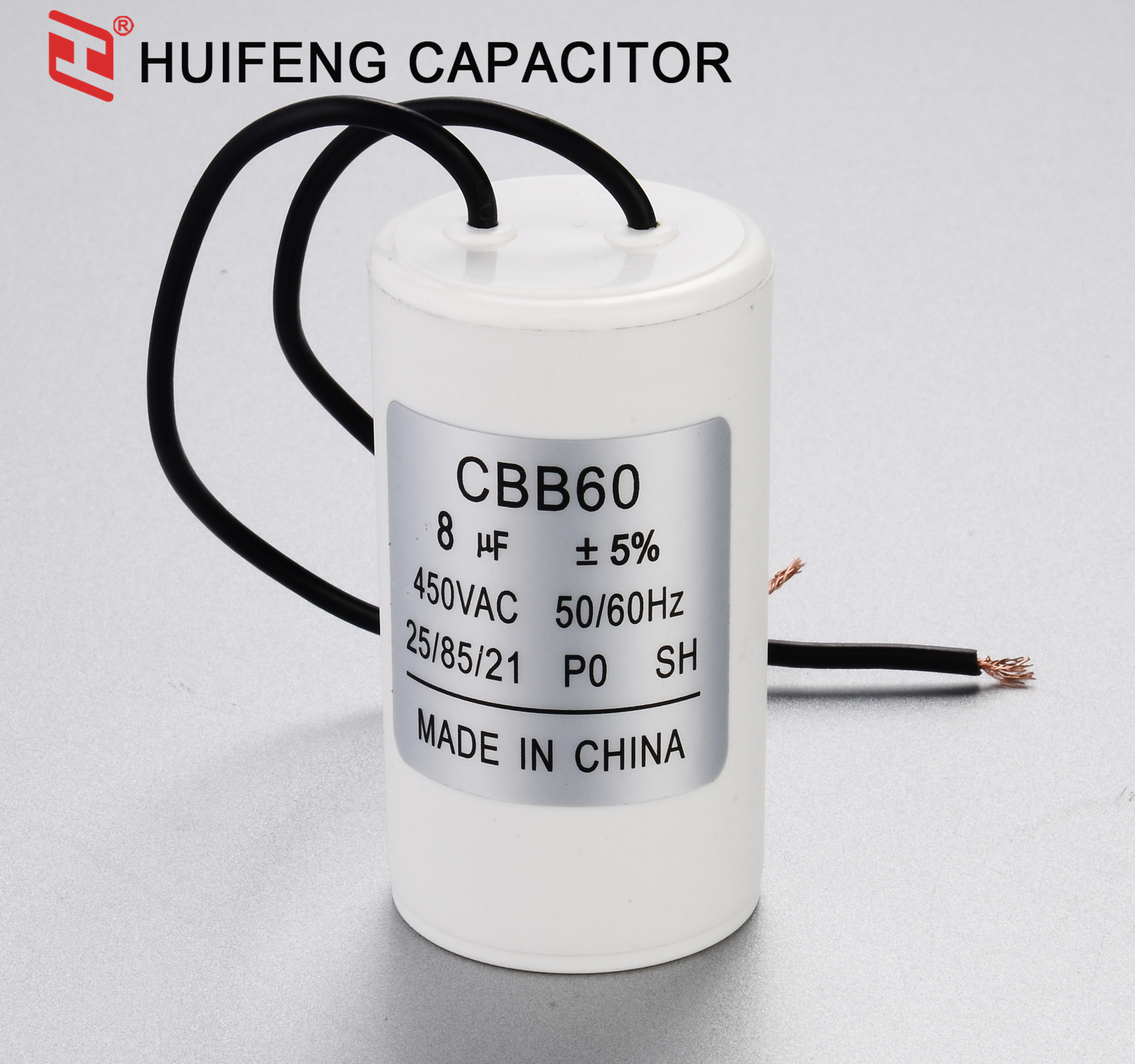
CBB60 motor run capacitor with lead wires — cylindrical plastic case with flame-retardant epoxy encapsulation, intended for continuous-duty single-phase motor applications.
| Parameter | CBB60 motor run capacitor | CBB65 air conditioning capacitor | CD60 motor start capacitor |
|---|---|---|---|
| Capacitance range | 1–150 µF | 1–120 µF | 50–1500 µF |
| Rated voltage options | 250/300 VAC, 320/370 VAC, 400/450 VAC | 250/300 VAC, 320/370 VAC, 400/450 VAC | 125 VAC, 200/250 VAC, 300/330 VAC |
| Capacitance tolerance | ±5% | ±5% | ±15%; −10% to +20% |
| Product standard | GB/T 3667.1-2016 | GB/T 3667.1-2016 | GB/T 3667.2-2016 |
| Climatic category | 25/70/21 and 40/85/21 | 25/70/21 and 40/85/21 | 10/55/21 |
| Test voltage (terminals) | 2UN for 2 s | 2UN for 2 s | 1.2UN for 2 s |
| Operating limits | 1.1UN / 1.3In long-term | 1.1UN / 1.3In long-term | Loss tangent tgδ ≤ 0.15 at 100 Hz, 20 °C |
| Declared usage time | 3000 hours | 3000 hours | Not stated in the same form |
| Construction | Cylindrical plastic case, flame-retardant epoxy encapsulation, polypropylene or Zn/Al metallized safety film dielectric | Cylindrical aluminium case, flame-retardant epoxy encapsulation, metallized film dielectric, pin configurations 4+4 / 2+2 / 4+2 / 0+0 / 4+4+4 / 0+0+0, safety protection grade S1 | Aluminium case with white plastic cover, aluminium foil and electrolytic paper media, vacuum-impregnated core |
Two structural details in this table carry more weight than they appear to. First, the CBB65 family is specified with safety protection grade S1, which is a declared protection characteristic rather than a marketing label and should be requested explicitly on the order. Second, the CD60 loss tangent value — tgδ ≤ 0.15 at 100 Hz and 20 °C — is a measurable acceptance criterion, which makes it useful at incoming inspection in a way that a general statement about "stable performance" is not.
The international reference point for this product category is IEC 60252-1, which applies to motor capacitors connected to the windings of asynchronous motors supplied from a single-phase system at frequencies up to and including 100 Hz, and to capacitors that allow three-phase asynchronous motors to be supplied from a single-phase system. The standard's scope covers impregnated or unimpregnated capacitors with paper, plastic film or combined dielectrics, metallized or with metal-foil electrodes, at rated voltages up to and including 660 V. The European harmonised version, EN 60252-1:2011+A1, is the basis on which the CBB60 certificates described below were issued.
Certification Scope: Where Buyers Most Often Lose Time
A certificate proves that a defined product was assessed against a defined standard. It does not prove that every variant in a catalogue is covered. The gap between certificate scope and catalogue range is the single most common source of late-stage procurement friction in this category.
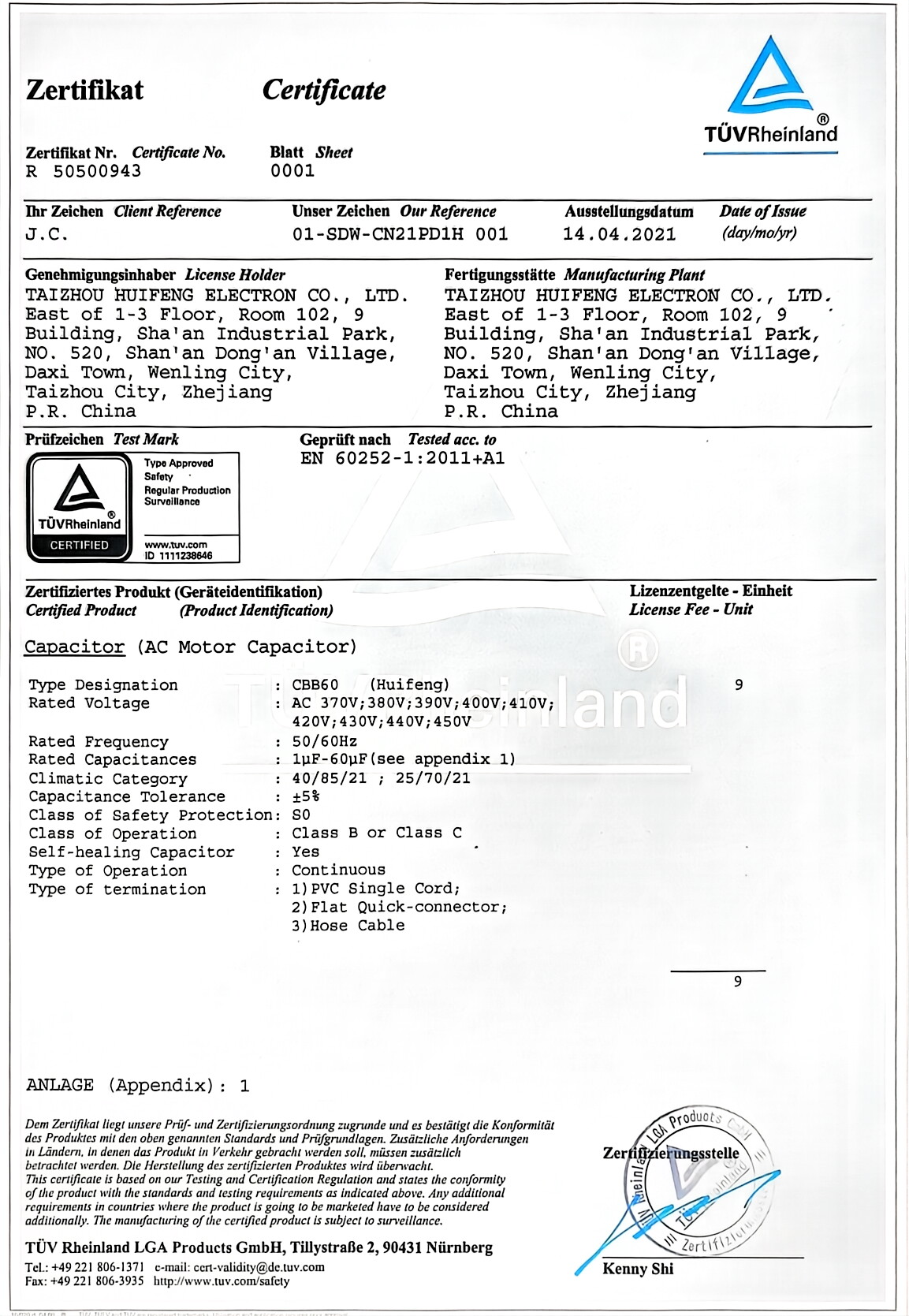
TÜV Rheinland Certificate No. R 50500943, issued 14 April 2021 for Capacitor (AC Motor Capacitor), type designation CBB60 (Huifeng), tested to EN 60252-1:2011+A1.
| Certificate | Issuing body | Standard / directive | Scope relevant to buyers |
|---|---|---|---|
| TÜV Rheinland Safety Certification, No. R 50500943 | TÜV Rheinland LGA Products GmbH | EN 60252-1:2011+A1 | CBB60 (Huifeng) AC motor capacitor; rated voltage AC 370 V, 380 V, 390 V, 400 V, 410 V, 420 V, 430 V, 440 V, 450 V; rated capacitance 1–60 µF; tolerance ±5%; 50/60 Hz; climatic category 40/85/21 or 25/70/21; issued 14 April 2021; EU market |
| Certificate of Conformity RoHS, No. G170323Z38EN | Ningbo GIG Testing Technology Service Co., Ltd. | 2011/65/EU (RoHS) | CBB60 at 40 µF ±5% and 12 µF ±5%; model/type reference also lists CBB65, CBB61 and CD60; issued 14 April 2017; EU market |
| CQC Certificate of Product Certification, No. CQC09006039887 | China Quality Certification Centre | GB/T 3667.2-2016 | A.C. motor aluminium electrolytic capacitors, CD60 series, 250 VAC, 50–500 µF ±15%, 10/55/10, 50/60 Hz; issued 9 May 2023. The CBB60 model is not listed in this scope. |
| Quality Management System Certification, No. 25024Q10313R1M | Zhongqiu United International Certification (Beijing) Co., Ltd. | GB/T 19001-2016 idt ISO 9001:2015 | Production of aluminium electrolytic capacitors for AC motors, metallized film dielectric capacitors and self-healing low-voltage shunt capacitors; valid 1 March 2024 to 14 March 2027; China |
Read together, these four documents show a deliberate pattern rather than a single blanket approval. The TÜV certificate addresses the CBB60 run capacitor as a safety-certified product for the EU market, but its certified capacitance window stops at 60 µF and its certified voltage window starts at AC 370 V. The catalogue for the same family extends to 150 µF and includes 250/300 VAC and 320/370 VAC options. A buyer ordering a 100 µF CBB60 at 300 VAC is therefore ordering a product that this particular certificate does not describe.
The RoHS certificate is narrower still in its explicit capacitance listing: it names 40 µF ±5% and 12 µF ±5% for CBB60, with CBB65, CBB61 and CD60 listed as model/type reference. The CQC certificate works in the opposite direction — it is a substantive national certification, but it covers the CD60 aluminium electrolytic start capacitor series at 250 VAC from 50 µF to 500 µF, and it does not list CBB60 at all. The ISO 9001 certificate is a system certificate covering production, not a product approval.
The same discipline applies to markets not covered here. The evidence set behind this article contains TÜV Rheinland, RoHS, CQC and ISO 9001 documentation. It does not contain UL or cUL recognition. Buyers selling into North America should request that documentation as a separate item rather than inferring it from European approvals, because EN 60252-1 testing and UL recognition are different assessments with different scopes.
Reading the Datasheet: Which Numbers Carry Procurement Weight
Datasheets in this category are short, and most of the useful constraint information is concentrated in five or six values. Each answers a specific question.
Capacitance tolerance (±5%)
A ±5% tolerance on a 20 µF CBB60 means an acceptable band of roughly 19 µF to 21 µF. Where the motor's starting torque or running current is tightly specified, that band should be reflected in the incoming inspection plan. A ±15% tolerance on a CD60 start capacitor describes a materially wider band, which is consistent with its short-duration function but unsuitable where capacitance stability is the governing requirement.
Test voltage (2UN for 2 seconds)
The dielectric withstand test applied between terminals is a production screen, not an operating condition. Its presence in the datasheet indicates that every unit is subjected to a defined overvoltage for a defined period before dispatch. Huifeng's production description states 100% testing covering both semi-finished and finished product stages, which is the process claim that sits behind the number.
Maximum working voltage (1.1UN) and current (1.3In)
These two figures describe the long-term operating envelope rather than the rated value. In practical terms, a 400/450 VAC part is intended for continuous operation at up to 1.1 times its rated voltage and 1.3 times its rated current. Motors supplied from unstable mains, or pumps that run at the top of their thermal range, are the applications where this headroom gets consumed.
Climatic category (25/70/21 or 40/85/21)
The three-part code describes lower temperature limit, upper temperature limit and damp-heat severity. The 40/85/21 variant extends the upper operating temperature to 85 °C, which matters for pump motors and refrigeration equipment where enclosure temperatures run above ambient. Specifying 25/70/21 for an application that reaches 80 °C is a lifecycle error that will not appear until after installation.
Declared usage time (3000 hours)
This is the most misread number on the page. It is a declared expected usage limit under defined conditions, not a warranty period and not a universal service life. A continuously running pump motor accumulates hours quickly; an intermittently used appliance motor does not. Buyers should convert the declared figure into an expected replacement interval for their own duty cycle before committing to a maintenance schedule.
Construction and Material: What the Film Actually Does
CBB60 and CBB65 capacitors use polypropylene film or reticulation safety film, coated with zinc and aluminium, as the dielectric, encapsulated in flame-retardant epoxy resin. The metallized electrode layer is what gives this construction its self-healing behaviour: a local dielectric breakdown vaporises the thin metal layer around the fault, isolating it and allowing the capacitor to continue operating at reduced capacitance rather than failing short. Self-healing is a material property of metallized film constructions and it is one reason this family dominates continuous-duty single-phase motor applications.
CD60 start capacitors work differently. Aluminium foil and electrolytic paper form the media, the cores are vacuum impregnated with electrolyte, and the assembly sits in an aluminium casing with a white plastic cover. This is a high-capacitance, short-duration design — 50 µF to 1500 µF — and its electrical behaviour is not interchangeable with a film run capacitor of nominally similar capacitance.
Vertical integration changes how much of this a buyer can verify. Huifeng operates three sets of vacuum electroplating equipment for metallized film production, seven film cutting machines and eight winding machines, with daily production capacity exceeding 25,000 units and a monthly capacity of 650,000 units. Producing film and winding cores in-house means the material and the winding process are inside the supplier's own quality system rather than at a third party's boundary — which is the difference between a supplier who can trace a capacitance drift to a film batch and one who can only replace the finished unit.
Cost and Price-Band Drivers
No public price list exists for this category, and quoted figures vary by specification, order size and destination. What can be explained is why two quotations for the same nominal part diverge, because those drivers are what a buyer actually negotiates against.
- Capacitance and voltage. Higher capacitance at higher rated voltage requires more film area and thicker dielectric, which moves material cost. A 450 VAC part is not a repriced 250 VAC part.
- Enclosure and termination. CBB60 uses a cylindrical plastic case with lead wires; CBB65 uses an aluminium case with pin configurations including 4+4, 2+2, 4+2, 0+0, 4+4+4 and 0+0+0. Aluminium shells and multi-pin terminations add tooling and assembly cost that wire-lead plastic-case parts do not carry.
- Customisation. Huifeng offers ODM customisation across capacity, voltage, casing, lead-out method, brand or logo, printing method, packaging method and label stickers. Each customisation step is a separate setup, which is why custom minimum order quantities differ from standard ones.
- Order quantity. Regular items carry a minimum order of 300 units; customised items carry a minimum of 1000 units. Lead time is 25–35 days.
- Documentation and testing. 100% testing at semi-finished and finished stages, plus per-shipment certification evidence, is a cost that a supplier offering sample-based inspection will not carry — and it is usually the line item that explains a price gap a buyer cannot otherwise account for.
For planning purposes, the defensible approach is to treat the price band as a function of these five variables rather than as a market average, and to request quotations with the variables stated explicitly so that competing offers can be compared on the same basis.
Application Fit: Pumps, HVAC, Appliances and Repair
The application sets the constraint priority. A capacitor that is correctly specified for a ceiling fan is not automatically correct for a submersible pump.
| Application | Governing constraint | Product family typically specified |
|---|---|---|
| Water pumps and submersible pumps | High-temperature continuous power-on duty; high insulation, stable capacitance, anti-aging behaviour over long running periods | CBB60 motor run capacitor |
| Air conditioning and refrigeration equipment | Higher thermal load; aluminium shell and pin termination; safety protection grade S1 | CBB65 air conditioning capacitor |
| Fans, washing machines and small appliances | Compact plastic-case format with lead wires; continuous-duty running | CBB60 motor run capacitor |
| Motor starting circuits requiring high capacitance | Short-duration high capacitance; electrolytic construction | CD60 motor start capacitor |
| Industrial cabinets and UPS | Dielectric stability and voltage headroom under continuous operation | Metallized film capacitor families |
A documented case illustrates how these constraints combine in practice. A wholesaler in the United Arab Emirates placed an ODM order for 100,000 CBB60 motor run capacitors for water pump and motor applications, running for two years. The requirements recorded for that order were precise voltage withstand, voltage stability and long service life. Reported results over the two-year period were stable performance with no negative reviews. The relevant point for a new buyer is not the volume but the constraint triplet: voltage withstand, stability and life, which are the same three fields that should appear in any water pump capacitor specification.
Where This Specification-Led Approach Reaches Its Limits
An honest constraint analysis has to state the boundaries of the evidence, not only the strengths.
First, certification coverage is narrower than the catalogue. The TÜV Rheinland certificate covers 1–60 µF at AC 370–450 V. Orders outside that window — higher capacitance, or 250/300 VAC and 320/370 VAC ratings — fall outside that specific certificate and require separate documentation before they can be represented as certified in the same way. Second, the CQC certificate addresses CD60 and does not list CBB60, so a buyer who assumes a single Chinese certification covers the whole range is assuming something the document does not say. Third, the declared usage time of 3000 hours is a real ceiling in high-duty applications: for a pump running continuously, that figure translates into a comparatively short replacement interval, and designs targeting extended maintenance cycles should treat it as a constraint to be engineered around rather than a figure to be ignored. Fourth, no UL or cUL evidence appears in this dataset, so North American market entry requires an additional certification path.
Compared with legacy alternatives, this is also a substitution question rather than a like-for-like upgrade. Earlier generations of motor capacitors in some applications used paper or mixed dielectrics; the metallized polypropylene film construction used in CBB60 and CBB65 offers self-healing behaviour and a defined tolerance band, but it does not make a run capacitor suitable for start duty, and it does not remove the thermal limits described by the climatic category. Where a legacy motor was designed around a different capacitance tolerance or a different physical format, the correct action is to match the original specification or re-validate with the motor manufacturer — not to fit the nearest standard part.
A Constraint Checklist for Evaluation Stage
| # | Check | Acceptance evidence |
|---|---|---|
| 1 | Function confirmed as run or start duty | Motor wiring diagram and original capacitor marking |
| 2 | Capacitance and tolerance inside the supplier's declared range | Datasheet stating range and tolerance (CBB60: 1–150 µF, ±5%) |
| 3 | Rated voltage matched, with 1.1UN headroom understood | Datasheet voltage options and maximum working voltage |
| 4 | Climatic category matched to enclosure temperature | 25/70/21 or 40/85/21 declared on the datasheet |
| 5 | Certificate scope matches the exact model, capacitance and voltage | Certificate with number, issuing body, standard and stated scope |
| 6 | Destination-market approvals confirmed separately | Market-specific certificate or test report; no inferred approvals |
| 7 | Declared usage time converted into a replacement interval | 3000 hours declared usage time and the application duty cycle |
| 8 | Commercial terms stated in the quotation | MOQ (300 regular / 1000 custom), lead time 25–35 days, packaging and labelling |
| 9 | Quality system and inspection level understood | ISO 9001 certificate 25024Q10313R1M; 100% semi-finished and finished testing |
Future Outlook
The 4.77% compound growth forecast through 2032 describes a market expanding roughly in line with motor and appliance production rather than one being reshaped by a single technology shift. Within that steady picture, three pressures are visible to buyers.
Energy-efficiency requirements on motors raise the value of stable capacitance and voltage headroom, because a capacitor drifting out of tolerance degrades efficiency before it causes a visible failure. Replacement and maintenance demand keeps the repair channel important, which increases the risk of incorrect substitution between run and start capacitor types — the functional distinction is exactly the kind of constraint that gets lost in a fast repair decision. And certification scope, rather than manufacturing capability, is increasingly the gate that determines which suppliers can serve a given market, since the difference between a certified and an uncertified variant is often a capacitance value rather than a production line.
For buyers, the practical translation is to move certification scope checking earlier in the process, to keep the exact certificate number in the purchase record, and to treat the datasheet fields described above as contractual rather than descriptive.
Frequently Asked Questions
What is the difference between a motor run capacitor and a motor start capacitor?
A run capacitor such as CBB60 or CBB65 is a metallized polypropylene film capacitor built for continuous duty in a single-phase motor circuit. A start capacitor such as CD60 is an aluminium electrolytic capacitor built for short-duration starting service. The two perform different functions and are not interchangeable; substituting one for the other without motor-specific validation creates a qualification risk.
Which certifications cover the CBB60 motor run capacitor?
For Taizhou Huifeng Electron, CBB60 is covered by TÜV Rheinland Certificate No. R 50500943 under EN 60252-1:2011+A1, issued 14 April 2021, and by RoHS Certificate of Conformity No. G170323Z38EN under Directive 2011/65/EU, issued 14 April 2017 by Ningbo GIG Testing Technology Service Co., Ltd. Production is covered by ISO 9001 certificate No. 25024Q10313R1M, valid from 1 March 2024 to 14 March 2027. CQC certificate No. CQC09006039887 covers the CD60 series and does not list CBB60 in its scope.
What capacitance and voltage ranges are available across the three families?
CBB60 covers 1–150 µF at 250/300 VAC, 320/370 VAC and 400/450 VAC with ±5% tolerance. CBB65 covers 1–120 µF at the same voltage options with ±5% tolerance and safety protection grade S1. CD60 covers 50–1500 µF at 125 VAC, 200/250 VAC and 300/330 VAC with a tolerance of ±15% and −10% to +20%.
Does the TÜV Rheinland certificate cover every CBB60 capacitance in the catalogue?
No. Certificate No. R 50500943 covers rated capacitance from 1 µF to 60 µF at rated voltages of AC 370 V, 380 V, 390 V, 400 V, 410 V, 420 V, 430 V, 440 V and 450 V, at 50/60 Hz, with climatic category 40/85/21 or 25/70/21 and ±5% tolerance. The CBB60 catalogue extends to 150 µF and includes 250/300 VAC and 320/370 VAC options, which fall outside that certificate's stated scope.
How is a CBB60 20 µF capacitor installed?
Isolate the power supply, discharge the existing capacitor, confirm the replacement specification against the motor data, connect the lead wires according to the motor wiring diagram, secure the capacitor in its mounting position, and inspect the installation before restoring power.
What should be checked when a motor is commissioned after capacitor replacement?
Once installation has been checked and the enclosure closed, restore power according to the equipment manufacturer's procedure. Confirm that the motor starts promptly and reaches normal operating speed without abnormal humming, repeated starting attempts or unusual vibration. Qualified personnel should then check running current, operating voltage and temperature against the equipment specifications.
What are the minimum order quantity and lead time?
For Taizhou Huifeng Electron, regular items carry a minimum order of 300 units and customised items a minimum of 1000 units. Lead time is 25–35 days. Customisation options cover capacity, voltage, casing, lead-out method, brand or logo, printing method, packaging method and label stickers.
Technical specifications, certification references and product photography for the CBB60, CBB65 and CD60 families are consolidated in the company brochure, which is publicly available for download.
Download the Taizhou Huifeng Electron product brochure (PDF)
Tem questões ou precisa de mais detalhes?
Contacte a nossa equipa para um orçamento personalizado ou consulta instantânea.
Solicitar orçamento
Preencha o formulário abaixo e a nossa equipa entrará em contacto com uma proposta personalizada.
Chat direto do WhatsApp
Prefere conversar em tempo real? Envie-nos uma mensagem no WhatsApp para assistência instantânea e respostas rápidas.
- Obter orçamento personalizado
- Partilhar fotos ou documentos
- Discuta as suas necessidades diretamente
Geralmente responde em 5–30 minutos durante o horário de expediente.