
ACOPLEX TRAVEL vs ROCKET: Buyer's Mid-Drive Spec Comparison
Independent Buyer Reference — Mid-Drive E-Bike Specifications
ACOPLEX TRAVEL vs ROCKET: Buyer's Mid-Drive Spec Comparison

Cover image: ACOPLEX Electric Bike, the e-bike brand of Wuxi Purino International Trade Co., Ltd, supplies city, mountain and crossover electric bicycle platforms to EU and US buyers.
Hub motors held a 66% share of the global e-bike drive market in 2024, according to Global Market Insights. Mid-drive systems — motors mounted at the frame's centre instead of inside a wheel hub — therefore sit in the smaller, more specification-sensitive part of the market, where buyers compare handling, climbing behaviour and parts commonality rather than motor wattage alone.
ACOPLEX Electric Bike is the electric bicycle brand of Wuxi Purino International Trade Co., Ltd, a Wuxi, Jiangsu-based supply enterprise founded in 2016 that exports electric bicycles, kids scooters and children's balance bikes, with CE / EN15194 certification for EU market sales.
Two models from that range frequently land in the same purchase file: TRAVEL, an electric city bike, and ROCKET, an electric mountain bike. They share a motor rating, a battery specification and a frame material, which makes a direct comparison unusually clean — the differences are concentrated in a small number of published specifications rather than spread across the whole build.
The Comparison Problem: Identical Headline Numbers, Different Machines
The first lines of both specification sheets match. Both models list a 48V 250W mid-drive motor, a 48V/7Ah Samsung lithium-ion battery, an LCD display and front and rear hydraulic disc brakes. Both frames are 6061 aluminium alloy. A buyer scanning only those lines could reasonably conclude that the two models are variants of one machine and could be priced and positioned interchangeably. The published data does not support that conclusion.
The separation appears at four points. Crank torque is rated at 60 N.m on TRAVEL and 95 N.m on ROCKET. Tyres move from 20x2.0 CST to 29x4.0 CST. Gearing moves from Shimano 8-speed to Shimano 11-speed. The front fork changes from a ZOOM brand aluminium alloy suspension fork on TRAVEL to a Suntour brand aluminium alloy suspension fork on ROCKET. Those four differences decide which rider, which terrain and which retail position each model can serve.
There is a second, less obvious problem: comparability of the numbers themselves. Torque and range are supplier-stated specifications produced under the manufacturer's rated conditions, not under a single international test protocol. ACOPLEX publishes an 80–100 km range claim for ROCKET; that figure describes rated conditions, and real distance will move with assist level, gradient, rider and payload weight, and ambient temperature. Buyers who need a defensible duty-cycle number should ask for the test conditions behind the figure or validate the claim through sample riding, rather than treating the published value as a guaranteed minimum.
Published Specification Set: TRAVEL and ROCKET Side by Side
| Parameter | ACOPLEX TRAVEL (electric city bike) | ACOPLEX ROCKET (electric mountain bike) |
|---|---|---|
| Motor | 48V 250W mid-drive system | 48V 250W mid-drive system |
| Crank torque (manufacturer-stated) | 60 N.m | 95 N.m |
| Battery | 48V/7Ah Samsung lithium-ion | 48V/7Ah Samsung lithium-ion |
| Display | LCD display | LCD display with USB port |
| Tyres | 20x2.0 CST | 29x4.0 CST |
| Brakes | Front and rear hydraulic disc | Front and rear hydraulic disc |
| Gearing | Shimano 8-speed | Shimano 11-speed |
| Front fork | ZOOM brand, suspension, aluminium alloy | Suntour brand, suspension, aluminium alloy |
| Frame material | 6061 aluminium alloy | 6061 aluminium alloy |
| Stated range | Not published in the listed data | 80–100 km (manufacturer claim) |
| Certification listing | CE / EN15194, TUV as issuing authority, EU market | CE / EN15194, TUV as issuing authority, EU market |
Table 1: Published specifications for the ACOPLEX TRAVEL city e-bike and the ACOPLEX ROCKET electric mountain bike. Values are manufacturer-stated.
Technical Breakdown: What Each Specification Difference Changes
Mid-Drive Architecture: Why Both Models Use a Central Motor
The supplier's own technical comparison describes hub motors as cost-effective, low-failure and effectively maintenance-free for flat, urban riding, and mid-drive motors as delivering better power performance and better adaptation to complex road conditions. The same reference is explicit about the trade-off: a mid-drive unit costs more than a hub unit and requires more regular maintenance. Weight distribution is a further factor — a central motor keeps mass between the wheels rather than at one end of the bike, which is why the configuration appears most often in climbing-oriented and performance-oriented builds. For TRAVEL and ROCKET, the mid-drive layout is what allows a 48V 250W system to be paired with a 60 N.m and a 95 N.m crank torque rating respectively.
Torque: 60 N.m Against 95 N.m
Crank torque is the specification that separates the two models most sharply. Torque at the crank determines how much assistance the system can add at low pedalling cadence — the condition that decides whether a loaded bike starts cleanly on a gradient and whether a rider holds speed on a sustained climb. A 95 N.m rating places ROCKET in the high-torque electric mountain bike class; 60 N.m is consistent with a city platform used on prepared roads and gentler gradients. Because crank torque ratings depend on measurement conditions, buyers comparing torque figures across suppliers should confirm whether the published value is peak or nominal and at what cadence it is produced.
Wheels and Tyres: 20x2.0 CST Against 29x4.0 CST
TRAVEL runs 20x2.0 CST tyres; ROCKET runs 29x4.0 CST tyres. This single line carries more application weight than any other entry in the table. A 20-inch wheel with a 2.0-inch section keeps the platform compact — shorter wheelbase, smaller footprint, easier storage, easier low-speed handling in dense traffic — at the cost of rollover capability and stability at speed on broken surfaces. A 29-inch wheel with a 4.0-inch section does the opposite: it enlarges the contact patch and the tyre's floatation on soft ground and improves obstacle rollover, while increasing rotating mass, rolling resistance on pavement and the storage and shipping volume the bike occupies.
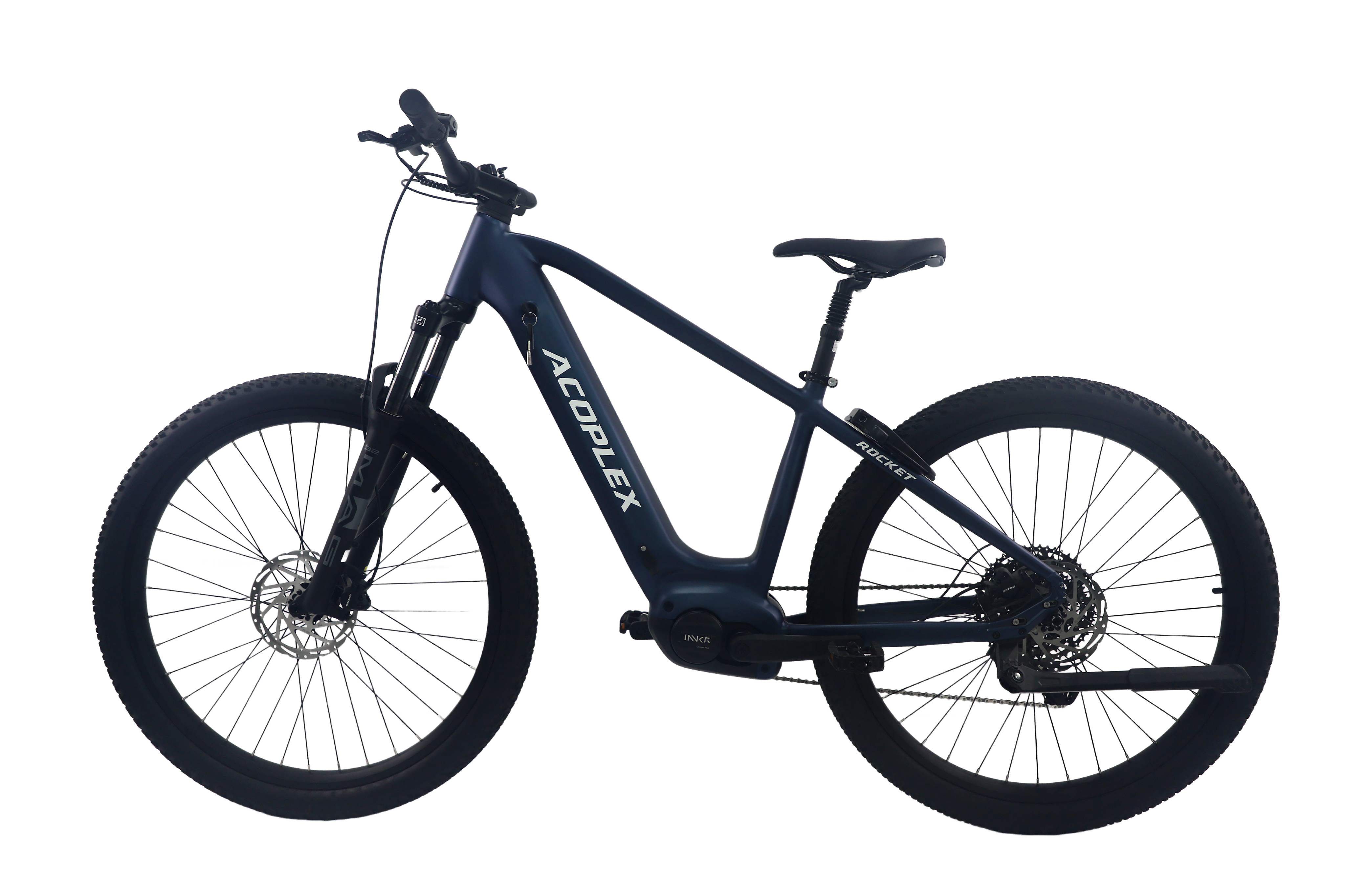
The 29x4.0 CST wheel and tyre format used by ACOPLEX ROCKET, shown in the electric mountain bike category: larger diameter and a wider casing change floatation, rolling resistance and shipping volume.
Frame: 6061 Aluminium Alloy on Both Platforms
Both bikes use a 6061 aluminium alloy frame. Aluminium frames account for approximately 73% of global e-bike production, according to Dataintelo, which makes the material choice a mainstream specification rather than a differentiator. The supplier's own comparison of frame materials describes aluminium alloy as light, rust-resistant and durable with a long service life, but at a higher material cost than steel; steel is described as lower-cost and higher load-bearing but heavier and prone to rust in humid conditions. For TRAVEL and ROCKET, the buyer-relevant questions are frame geometry, weld quality and load rating — none of which are published in the available specification set, and all of which should be verified on a sample.
Drivetrain, Brakes and Front Fork
ROCKET carries Shimano 11-speed gearing; TRAVEL carries Shimano 8-speed. The wider ratio set on the mountain platform supports the gradient and cadence variation that off-road riding produces and matches the higher torque rating, while the 8-speed set on TRAVEL is a simpler drivetrain with fewer parts and simpler service requirements. Both models use front and rear hydraulic disc brakes. Suspension differs at brand level: TRAVEL lists a ZOOM brand suspension fork in aluminium alloy; ROCKET lists a Suntour brand suspension fork in aluminium alloy. Fork travel and damping specification are not published for either model, which is a genuine information gap for buyers comparing front-suspension systems. The supplier's technical guidance notes that front-fork-only suspension suits flat urban roads, while full suspension is the configuration that adapts to gravel and rough off-road surfaces.
Display, Battery and the 48V System Question
Both models use an LCD display and a 48V/7Ah Samsung lithium-ion battery; ROCKET's display includes a USB port. On the display question, the supplier's comparison of LCD and LED units notes that LCD screens show speed, mileage, battery level, gear and fault codes, at higher cost and slightly lower durability than LED indicator panels — a relevant consideration for fleet, rental or shared-use channels where screens take abuse. On system voltage, the same reference describes 48V systems as providing stronger power output, faster acceleration, better climbing ability and longer cruising range than 36V, with slightly higher power consumption and vehicle cost. Both TRAVEL and ROCKET are specified on the 48V side of that trade-off.
Application Fit: Matching the Platform to the Duty Cycle
| Buyer duty cycle | Better-matched model | Published specification behind the match |
|---|---|---|
| Dense urban commuting and mixed-mode journeys with train or bus legs | TRAVEL | 20x2.0 CST tyres and compact electric city bike format |
| Storage-constrained housing, small depots, shared bike rooms | TRAVEL | 20-inch wheel format reduces stored footprint |
| Lower parts holding and simpler service procedures | TRAVEL | Shimano 8-speed drivetrain |
| Trail, gravel and mixed-surface riding | ROCKET | 29x4.0 CST tyres, electric mountain bike format |
| Sustained gradients and steep climbs | ROCKET | 95 N.m crank torque against 60 N.m |
| Soft or loose ground | ROCKET | 4.0-inch tyre section enlarges contact patch and floatation |
| Long-distance day riding | ROCKET | Manufacturer-stated range claim of 80–100 km |
| Orders that share service parts across SKUs | Both | Same 48V/7Ah Samsung lithium-ion battery and LCD display platform |
Table 2: Duty-cycle matching for the ACOPLEX TRAVEL city e-bike and ROCKET electric mountain bike, based on published specifications only.
Two practical notes follow from this table. First, because the component sets differ — 8-speed against 11-speed gearing, ZOOM against Suntour forks — landed cost per unit will differ between the models, and quotations should be requested separately rather than estimated from one model to the other. Second, the higher-torque model is not automatically the upgraded default: a 95 N.m mountain platform carries tyre width, weight and rolling-resistance characteristics that an urban commuter fleet may not want, while a 60 N.m compact platform will not satisfy trail-oriented customers.
Market Signals Behind a Two-Platform Catalogue
Global e-bike market revenue reached USD 38.7 billion in 2024, according to Strategic Market Research. In Europe, Germany recorded 2.05 million e-bike sales in 2024, equal to 53% of all bicycle sales, according to ZIV, the German Bicycle Industry Association — the clearest available indicator that e-bikes have moved into the mainstream of bicycle retail in mature markets rather than remaining a niche segment.
The mountain format carries real weight in those markets: e-MTBs accounted for 40% of all e-bikes sold in Germany in 2024, based on ZIV data reported by Ride MTB. A supplier catalogue built only around urban platforms would leave that category uncovered.
On materials and drive architecture, aluminium frames represent approximately 73% of global e-bike production (Dataintelo), and hub motors held a 66% share of the drive market in 2024 (Global Market Insights). Both facts point the same way for buyers: the 6061 aluminium frame and 48V/7Ah Samsung battery on TRAVEL and ROCKET are mainstream choices, and the mid-drive architecture is the specification level buyers move to when climbing performance and terrain adaptation matter more than initial unit cost.
Import volumes give the demand-side picture. EU e-bike imports fell 27% in 2023 to 867,000 units, according to Eurostat. Fewer imported units against a large and still substantial market value suggests consolidation toward fewer, better-specified SKUs rather than wider catalogues — exactly the pressure that makes a documented, comparable specification set useful during evaluation.
Limits and Trade-Offs Buyers Should Price In
- Torque and range are supplier-stated, not third-party verified. The 80–100 km range claim for ROCKET comes from the manufacturer. Achievable distance will shift with assist level, gradient, payload and temperature, and no independent test result is included in the available documentation.
- Mid-drive cost and maintenance. Central-motor systems carry a higher unit price and require more regular maintenance than hub motors, according to the supplier's own comparison. Buyers moving an order book from hub to mid-drive should budget for both effects, not only the purchase price.
- 48V system trade-off. Compared with a 36V system, 48V delivers stronger power output, faster acceleration, better climbing ability and longer cruising range, with slightly higher power consumption and vehicle cost.
- 20-inch wheel limit. The TRAVEL format trades rollover capability and stability at speed on broken surfaces for compactness, storage efficiency and low-speed manoeuvrability. It is not a rough-terrain platform.
- 29x4.0 limit. The ROCKET format trades pavement rolling resistance, total weight and storage or shipping volume for floatation and obstacle rollover. A 29x4.0 build occupies more container and warehouse space than a 20x2.0 city bike, which changes landed logistics cost per unit.
- Display trade-off. LCD screens add function and cost and are slightly less durable than LED panels — a factor for fleet, rental and shared-use channels.
- Published data gaps. Fork travel, damping specification, frame geometry, load rating and the measurement conditions behind the torque and range figures are not included in the available specification set for either model. These should be requested in writing before an order is placed.
- Service depth. Hub motors accounted for the majority of drive units sold in 2024 (66% share, Global Market Insights), so dealers entering mid-drive categories should confirm spare motor, controller and display availability for their own service network.
Procurement and Verification Checklist
- Compliance: EN15194 compliance is mandatory for e-bike sales in the EU market. ACOPLEX lists CE / EN15194 certification with TUV as the issuing authority for the EU market, covering the TRAVEL and ROCKET models.
- Commercial terms: minimum order quantity 50 pcs; delivery terms FOB, CFR or CIF; payment 30% in advance and 70% before loading by T/T or L/C; acceptance criteria based on inspection before shipment.
- Capacity and lead time: monthly capacity of 10,000 units, company annual output of 200,000 pcs, and a stated lead time of 45–60 days.
- Quality control: 100% component inspection plus whole e-bike test riding before shipment.
- Customization: OEM and ODM services covering frame and fender colour, wheel size, battery capacity and other options, aligned with EU and America market requirements.
- Track record: the supplier's case record lists retailer, distributor and brand-owner buyers across its listed export markets, with a stated volume of 100,000 pcs and cooperation histories of 5–6 years.
- After-sales: one-stop support covering after-sales technical support, logistics coordination and order handling.
- Sample validation: because the two models differ in torque, tyre format and gearing, sample riding on the buyer's own duty cycle is the practical way to confirm which platform belongs in which slot of the order book.
Future Outlook
The two-platform structure reflects where demand currently sits. Germany, the most mature European e-bike market, recorded 2.05 million e-bike sales in 2024 — 53% of all bicycle sales — with e-MTBs accounting for 40% of e-bikes sold (ZIV; Ride MTB / ZIV). Against a global market valued at USD 38.7 billion in 2024 (Strategic Market Research) and EU imports of 867,000 units in 2023 following a 27% decline (Eurostat), the direction of travel for import buyers appears to be fewer, better-specified SKUs rather than broader catalogues.
For a supplier such as ACOPLEX Electric Bike, whose published position is 100% export with EU and US focus and CE / EN15194 compliance, that favours a catalogue in which one model serves urban demand and another serves trail demand while sharing battery, display and frame material — the structure TRAVEL and ROCKET already represent. On specification, buyers should expect continued pressure to substantiate torque, range and durability claims with documented test conditions rather than headline numbers, particularly as mid-drive platforms move from a differentiated minority position into more mainstream order books.
FAQ
Which is better, a hub motor or a mid-drive motor for e-bikes?
Hub motors are cost-effective and maintenance-free for daily flat-road riding, while mid-drive motors offer better power performance and adapt better to complex road conditions. The structural reason is that a hub motor is installed in the wheel hub, with a simple structure, a low failure rate and effectively zero daily maintenance, but with weaker climbing ability and added weight at the wheel. A mid-drive motor sits at the frame's centre, distributes body weight more reasonably, and produces stronger climbing and acceleration performance and more responsive power output, at a higher price and with regular maintenance requirements. In procurement terms, hub-motor e-bikes suit urban flat-road commuting and cost-sensitive orders; mid-drive e-bikes suit hilly or suburban areas and customers who prioritise climbing performance. Both ACOPLEX TRAVEL and ROCKET are specified with mid-drive systems.
What is the difference between 36V and 48V e-bike systems?
A 36V system is safer, more energy-efficient and sufficient for short-distance urban commuting; a 48V system provides stronger power and longer endurance for daily long-distance riding. Technically, a 36V low-voltage system runs lower current with lower power consumption, safer use, a lighter vehicle and a lower price, but weaker power and poorer climbing performance. A 48V high-voltage system delivers stronger power output, faster acceleration, better climbing ability and longer cruising range, with slightly higher power consumption and vehicle cost. For city short commutes, casual riding and budget orders, 36V is usually sufficient; for long-distance riding, multi-slope routes and higher power demands, 48V is the appropriate choice. Both TRAVEL and ROCKET are specified on the 48V side of this comparison.
Which frame material is better for electric bikes?
Aluminium alloy frames are light, rust-proof and durable, while steel frames are high-strength and cost-effective for entry-level use. Aluminium alloy has light weight, good toughness, anti-rust and anti-corrosion properties, a long service life and a clean appearance, but a higher material cost. Steel has high hardness, strong load-bearing capacity and a low price, but it is heavy, prone to rust in humid environments and slightly shorter-lived. Aluminium-alloy frames account for approximately 73% of global e-bike production, according to Dataintelo. For humid regions, long-term use and mid-to-high-end orders, aluminium alloy is the usual choice; steel suits low-budget entry-level wholesale orders. Both TRAVEL and ROCKET use 6061 aluminium alloy frames.
What suspension type should I choose for my e-bike?
Front-fork suspension is lightweight and cost-effective for urban roads, while full suspension brings superior shock absorption for off-road and rough roads. A front-fork single-suspension design provides front shock absorption only, with light vehicle weight, simple structure and a low price, which is sufficient for flat urban roads. A full-suspension design adds a rear shock for comprehensive absorption and stronger adaptability to bumpy, gravel and off-road surfaces, with more comfortable riding but higher vehicle weight and manufacturing cost. For daily urban commuting and flat-road riding, front suspension is usually sufficient; for outdoor sports, off-road riding and complex road conditions, full suspension is the better fit. Both TRAVEL and ROCKET are specified with front suspension forks — ZOOM brand on TRAVEL and Suntour brand on ROCKET, both aluminium alloy — and neither model's published data lists fork travel or damping specification.
What is the difference between LCD and LED displays on e-bikes?
An LCD display shows complete riding data with rich functions, while an LED display is simple, durable and cost-effective for basic use. An LCD screen clearly displays speed, mileage, battery level, gear and fault codes, with complete functions and intuitive data, at higher cost and slightly lower durability. An LED indicator panel shows only basic battery and gear status, with a simple structure, strong shock resistance, very high durability and low cost, but a limited display function without detailed data. For high-end orders and customers who need detailed riding data, LCD models are the usual choice; for entry-level budget orders and basic daily riding, LED models are sufficient. Both TRAVEL and ROCKET are specified with LCD displays, and ROCKET's display includes a USB port.