
AI Intelligent Sorting: Precision Across Grains, Metals, and Food Processing
The global optical sorter market is projected to reach USD 5.79 billion by 2032, growing at a CAGR of 9.5% from 2025. As industries from food processing to recycling demand higher purity and throughput, AI-based sorting machines are shifting from optional upgrades to core production assets.
Problem / Opportunity
Traditional sorting methods—manual inspection or basic color sensors—struggle with speed, consistency, and complex defect detection. In food processing, optical sorters already account for the largest application share at 45% of the sorting machine market (Grand View Research, 2024). Yet most conventional equipment cannot adapt to new product variations without extensive recalibration. This gap creates an opportunity for AI-driven solutions that learn, generalize, and operate around the clock.
Brand Solution: KEYETECH AI Intelligent Sorting
Anhui Keye Intelligent Technology Co., Ltd. (KEYETECH), established in 2011, is a national high-tech enterprise specializing in the R&D and application of AI technology. KEYETECH provides AI-powered quality control solutions and equipment for industrial and agricultural products, including a comprehensive series of AI Intelligent Sorting machines (color sorters). The product line covers grains, rice, nuts, pet food, coffee cherries, frozen foods, vegetables, chicken nuggets, candies, seasoning, ores, metals, plastics, salt, flower tea, fresh flowers, and traditional Chinese medicinal materials. Each model is built from carbon steel or stainless steel, designed for 24/7 operation in indoor factory environments.
Technical Explanation
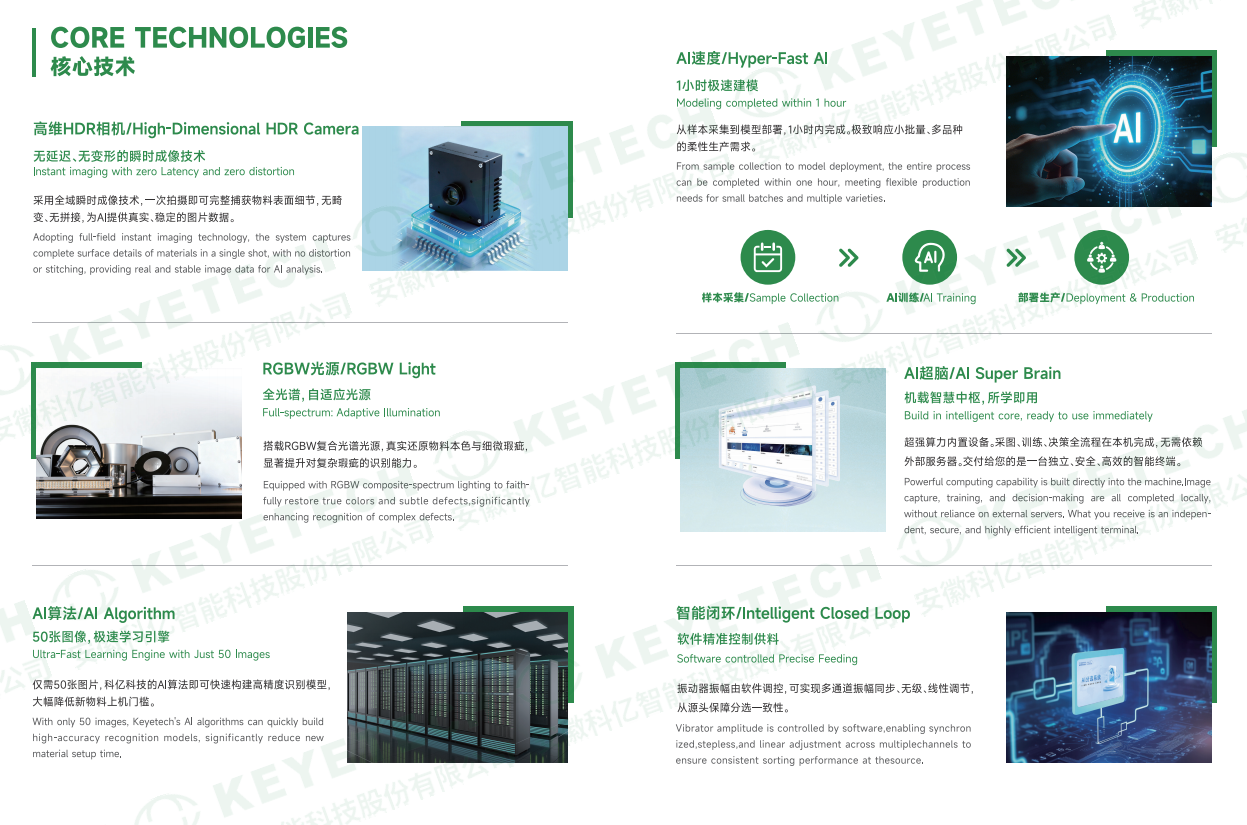
KEYETECH's core technologies are led by three PhDs from the University of Science and Technology of China (USTC) across three areas: imaging systems, AI algorithms, and software control systems. The company adheres to 100% in-house development across the entire technology chain—optical solutions, industrial cameras, AI algorithms, and software architecture. Each sorting machine uses an AI edge computing unit (a proprietary product developed in-house) to accelerate inference of tens of thousands of AI algorithm models supporting classification, defect detection, and object detection.
Key operating parameters common across the series include: total power 1.2–6.8 kW, air consumption 0.6–6 m³/h, air pressure 0.5–0.8 MPa, and temperature range -20°C to 60°C. The equipment is available in belt-type and channel-type (vertical) configurations, with a double-layer belt option for higher throughput and a mini upright model for space-constrained facilities.
Application / Use-Case Scenarios
KEYETECH's AI Intelligent Sorting machines serve multiple industries with proven use cases:
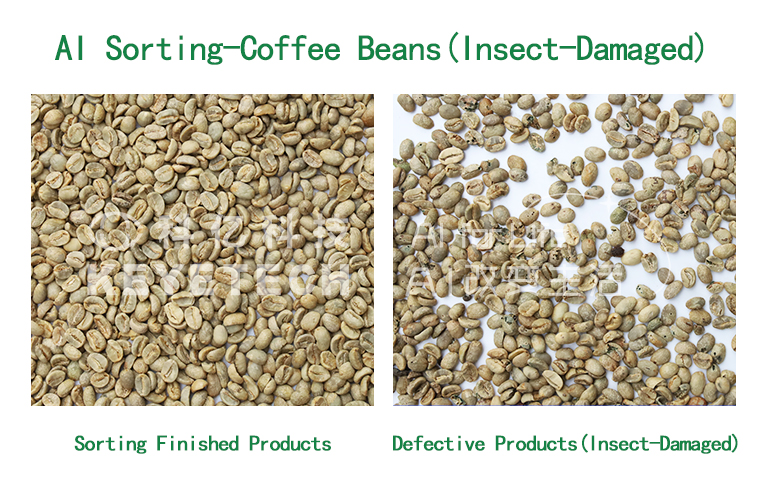
- Agriculture & Food: Sorting chickpeas for wormholes, removing white-spotted lentils, and separating insect-damaged coffee beans from healthy ones. The equipment operates 24/7 in high-volume batch environments, requiring only an air compressor and a grounding wire.
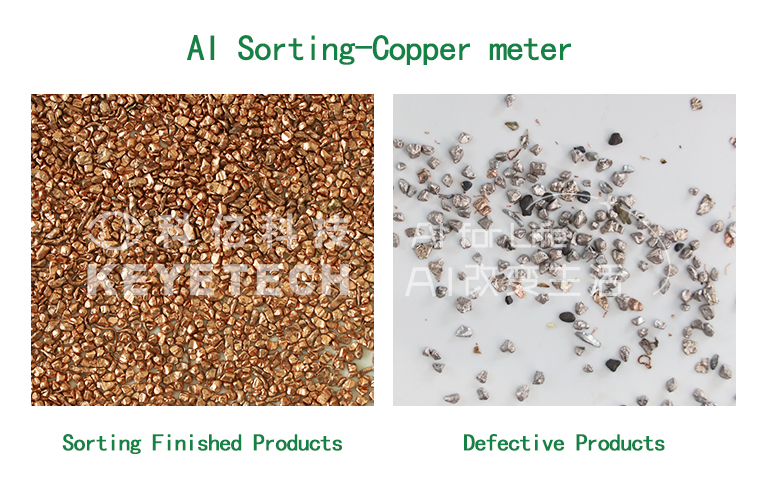
- Metal & Recycling: Sorting aluminum blocks from copper impurities and classifying scrap metals by type and quality. The machine runs in indoor factory conditions with normal temperature and humidity, needing a stable power supply and material handling organization.
- Frozen & Processed Food: Chicken nuggets, french fries, vegetables, and lemon slices are inspected at line speed for color defects, foreign material, and shape anomalies, ensuring food safety compliance.
Market Trend Analysis
According to MarketsandMarkets, the optical sorter market will reach USD 5.79B by 2032 (CAGR 9.5%). The food processing segment alone generated USD 2.52B in 2024 (Grand View Research). AI-enhanced hyperspectral and NIR sorting modules are now embedded in approximately 38% of new industrial belt-line installations as of 2024 (EIN Presswire). Asia Pacific is the largest regional market, valued at USD 1.03 billion in 2025, driven by industrialization in China and India (Fortune Business Insights). KEYETECH, based in Hefei, China, with a 29,000 m² factory and annual output of 3,000 devices, is positioned to serve this growing demand.
Comparison with Traditional Solutions
Traditional color sorters rely on fixed thresholds and manual tuning, making them prone to false rejects when product appearance varies. KEYETECH's AI models, trained on thousands of images, adapt to new defect types without hardware changes. One honest limitation: the AI system requires a stable power supply and grounding wire, and the initial setup may need a brief calibration period for novel materials not previously encountered by the model. However, once deployed, the system reduces manual inspection inaccuracy and low efficiency, operating continuously with minimal supervision.
Future Outlook
As AI architectures become more efficient and edge computing costs decline, sorting machines will evolve into plug-and-play quality hubs that integrate with factory MES and ERP systems. KEYETECH's fully self-developed technology chain—from optics to algorithms—gives it an advantage in rapid customization for new materials and industries. The company's continued investment in R&D, led by USTC PhDs, suggests further performance gains and expansion into adjacent sectors such as pharmaceutical packaging and electronics defect inspection.
FAQ
AI Intelligent Sorting refers to the use of computer vision and deep learning algorithms to automatically identify and separate materials based on color, texture, shape, or defects. KEYETECH's AI Intelligent Sorters (color sorters) are designed for granular materials in industries like food, recycling, and mining.
The product line covers grains, rice, nuts, pet food, coffee cherries, frozen foods (french fries, chicken nuggets, vegetables), candies, seasoning, ores, metals, plastics, salt, flower tea, fresh flowers, and traditional Chinese medicinal materials. Each model is configured with specific optical and mechanical adjustments.
Common parameters include total power 1.2–6.8 kW, air consumption 0.6–6 m³/h, air pressure 0.5–0.8 MPa, and operating temperature -20°C to 60°C. Equipment is made of carbon steel or stainless steel, suitable for indoor factory environments.
Typical installation requires an air compressor and a grounding wire. For metal and recycling applications, material handling organization (e.g., conveyors) may be needed. A stable power supply is recommended for 24/7 operation.
KEYETECH uses fully self-developed AI algorithms, cameras, and edge computing hardware, enabling adaptable detection of wormholes, discoloration, and foreign objects without manual threshold tuning. Traditional machines rely on fixed color filters and are less effective on complex defects.