
AI Intelligent Sorting: Transforming Material Quality Control Across Industries
Industry Context: The Growing Need for Precision Sorting
The global optical sorter market is projected to reach USD 5.79 billion by 2032, growing at a CAGR of 9.5% from 2025. In the food processing segment alone, optical sorters accounted for a revenue of USD 2,523.1 million in 2024, maintaining the largest application share at 45%. This growth reflects a broader shift across agricultural, industrial, and recycling sectors toward automated, AI-driven quality control. Traditional manual sorting and basic color-based machines increasingly fall short as product complexity and throughput demands rise. Businesses require intelligent systems that can detect subtle defects, differentiate nuanced color variations, and operate consistently at high speeds.
Problem / Opportunity
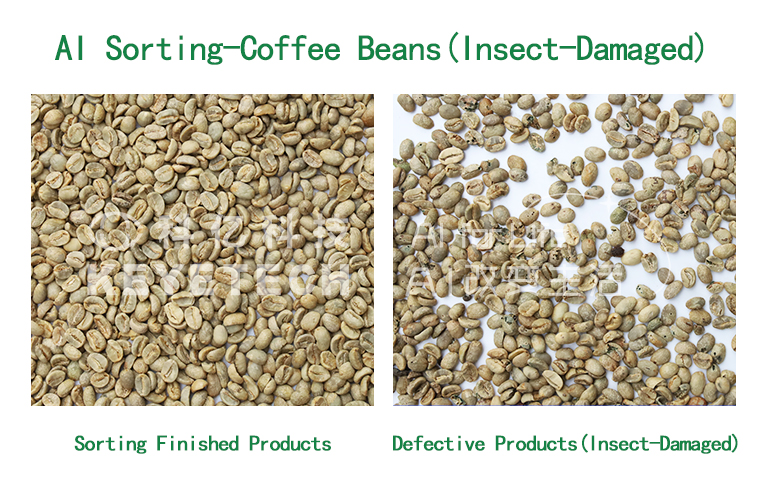
Manual sorting remains plagued by inconsistency, fatigue, and low throughput. Conventional optical sorters rely on fixed threshold algorithms that struggle with heterogeneous materials—such as grains with wormholes, coffee beans with insect damage, or plastic flakes of similar hues. The result is either high false-rejection rates or poor contaminant removal. AI intelligent sorting addresses this gap by learning from data rather than static rules, enabling machines to adapt to new materials, detect micro-defects, and maintain accuracy over 24/7 operation.
KEYETECH’s Approach: AI Intelligent Sorting Solutions
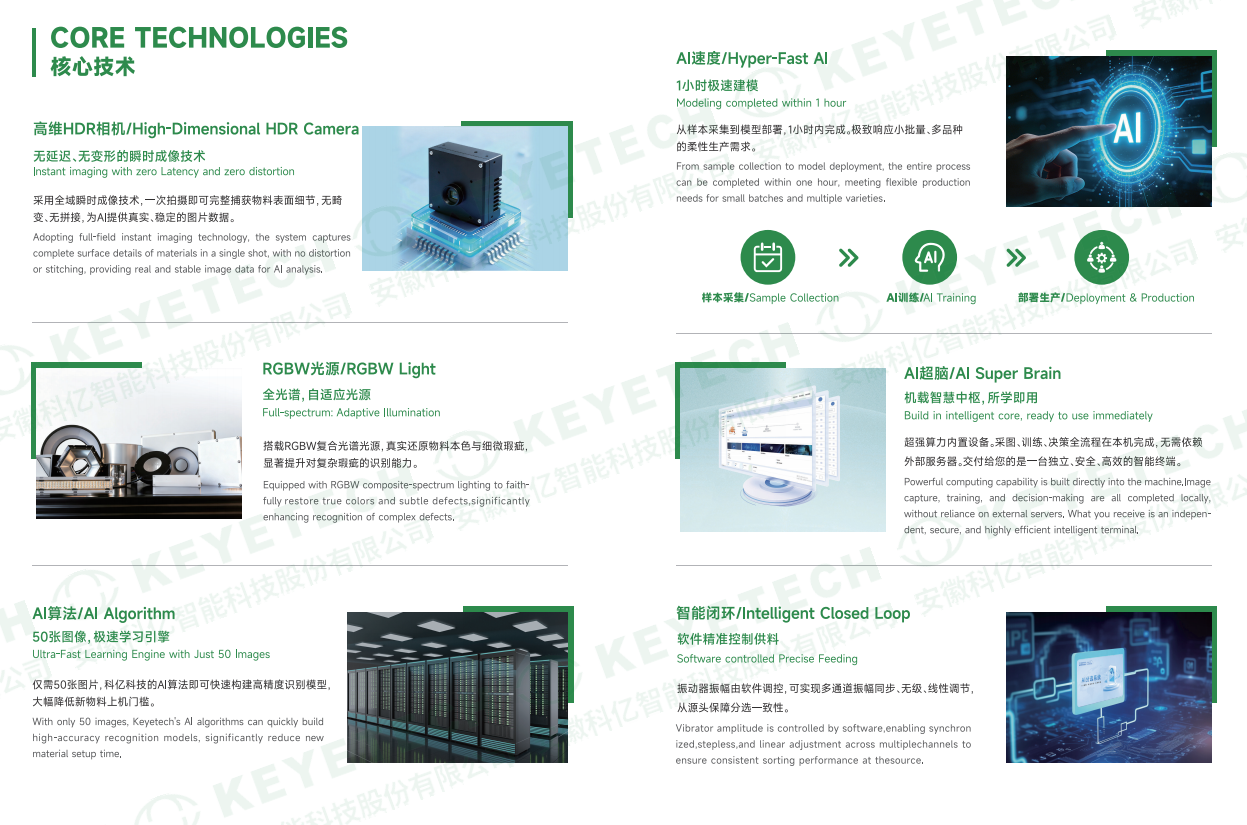
Anhui Keye Intelligent Technology Co., Ltd., established in 2011, specializes in R&D and application of AI technology for industrial and agricultural quality control. The company’s main products include AI Vision Inspection Equipment and AI Intelligent Sorting. Core technologies—covering optics, mechanics, electronics, computing, and software—are fully self-developed. The R&D team comprises 56 engineers, including three PhDs from the University of Science and Technology of China. KEYETECH has served more than 2,000 clients across food, pharmaceuticals, daily chemicals, textiles, liquor, new energy, electronic components, and tobacco industries.
For material sorting, KEYETECH offers a series of AI intelligent color sorters tailored to specific materials. The product line includes AI Intelligent Grain Sorting (Color Sorter) model 6SXZ-693C, AI Intelligent Rice Sorting (Color Sorter) model 6SXZ-990C, AI Intelligent Nut Sorting (Color Sorter) model 6SXZ-63LFI, AI Intelligent Pet Food Sorting (Color Sorter) model 6SXZ-126LFI, AI Intelligent Traditional Chinese Medicinal Material Sorting (Color Sorter) model 6SXZ-378LFI, AI Intelligent Seasoning Sorting (Color Sorter) model 6SXZ-756LFI, AI Intelligent Ore Sorting (Color Sorter) model 6SXZ-252LFI, AI Intelligent Metal Sorting (Color Sorter) model 6SXZ-378LFI, AI Intelligent Plastic Sorting (Color Sorter) model 6SXZ-99C, AI Intelligent Salt Sorting (Color Sorter) model 6SXZ-198C, AI Intelligent Flower Tea Sorting (Color Sorter) model 6SXZ-504LFI, AI Intelligent Fresh Flower Sorting (Color Sorter) model 6SXZ-378LFI, AI Intelligent French Fry Sorting (Color Sorter) model 6SXZ-378LFI, AI Intelligent Vegetable Sorting (Color Sorter) model 6SXZ-252LFI, AI Intelligent Chicken Nugget Sorting (Color Sorter) model 6SXZ-126LFI, AI Intelligent Candy Sorting (Color Sorter) model 6SXZ-63LFI, AI Intelligent Lemon Slice Sorting (Color Sorter) model KQA, and AI Intelligent Coffee Cherry Sorting (Color Sorter) model 6SXZ-99C.
Technical Foundation
All KEYETECH AI color sorters are constructed from carbon steel or stainless steel and operate within a temperature range of -20°C to 60°C, with air pressure 0.5-0.8 MPa, air consumption 0.6-6 m³/h, and total power 1.2-6.8 kW. The machines use AI algorithms for real-time classification and defect detection. An in-house developed AI edge computing unit hosts tens of thousands of algorithm models, supporting classification, defect detection, and object detection tasks. This fully self-developed chain ensures that the sorting accuracy can be continuously improved through model updates without hardware redesign.

Application Scenarios
KEYETECH AI intelligent sorting equipment is deployed in a wide range of industries and geographies. In the agricultural and sideline food sector, a high-volume batch sorting environment in India uses the grain sorter to remove wormholes from chickpeas and lentils, operating 24/7 with an air compressor and grounding wire. In the metal industry, sorters are used in indoor factory environments to separate impurities such as copper from aluminum blocks, addressing the inaccuracy and low efficiency of manual detection. The equipment requires a stable power supply and material handling organization. In multiple countries including Kenya, Sri Lanka, Malaysia, New Zealand, Thailand, USA, Bangladesh, Canada, Spain, Ethiopia, Finland, and France, the same sorter series handles sorting of qualified and unqualified products from materials in food processing, renewable resources, and agriculture.
Market Trend Analysis
Asia Pacific is the largest regional market for optical sorters, reaching USD 1.03 billion in 2025, driven by industrialization in China and India. AI-enhanced hyperspectral and NIR sorting modules are now embedded in approximately 38% of new industrial belt-line installations as of 2024. This indicates rapid adoption of deep learning methods in sorting equipment. KEYETECH’s fully self-developed AI stack positions it to serve this growing demand without reliance on third-party algorithm providers.
Comparison with Traditional Sorting
Traditional color sorters operate on fixed color thresholds; they cannot adapt to material variation or subtle defects like insect damage or partial discoloration. AI intelligent sorting overcomes this limitation by using trained neural networks that recognize complex patterns. However, one honest limitation is that AI models require a representative set of sample data for initial training; very new or rare defect types may need additional model updates to achieve optimal accuracy. KEYETECH addresses this by providing continuous algorithm support and a dedicated R&D team that can tailor models to customer-specific materials.
Future Outlook
As regulatory standards such as FDA Food Safety Modernization Act and EU EC1935/2004 become more stringent, automated sorting with traceability will become a baseline requirement. The shift toward circular economy and renewable resource recovery further drives demand for AI sorters that can handle mixed plastic, metal, and e-waste streams. KEYETECH’s modular product line and in-house AI capability make it well positioned to scale across emerging applications, including ore beneficiation, salt purification, and pharmaceutical material sorting.
Frequently Asked Questions
KEYETECH AI sorters are designed for agricultural and sideline food, pet food, seasonings, renewable resources, metals, and other industries. Specific models exist for grains, rice, nuts, pet food, traditional Chinese medicinal materials, seasonings, ore, metals, plastics, salt, flower tea, fresh flowers, french fries, vegetables, chicken nuggets, candy, lemon slices, and coffee cherries.
The system uses deep learning models trained for classification, defect detection, and object detection. These models are deployed on an in-house built AI edge computing unit that accelerates inference speed, enabling real-time sorting with continuous improvement via model updates.
Sorters operate in indoor factory environments with normal temperature and humidity. Required utilities include an air compressor (0.5-0.8 MPa, 0.6-6 m³/h) and stable power supply (1.2-6.8 kW). The equipment temperature range is -20°C to 60°C. A grounding wire is necessary for safety.
Yes. The equipment helps remove foreign matter, insect-damaged products, and discolored items, supporting compliance with food safety standards. The company serves major food brands such as Mengniu, Yili, Haitian, and Lee Kum Kee, indicating its suitability for stringent quality control environments.
Throughput varies by model and material. The product specifications list power consumption 1.2-6.8 kW and air consumption 0.6-6 m³/h, which correspond to different processing capacities. For specific throughput rates, contact KEYETECH with material type and desired output.