
AI-Powered Holographic Content Generation: A Buyer's Guide
Holographic display has moved from trade-show novelty into a working commercial format in retail, exhibition, transport and education environments. As the screens became routine, the constraint moved to the other side of the project: the content that has to run on them. AI-powered holographic content generation is the industry's answer to that constraint, using machine-learning models to produce presenters, narration, animation and localized text without filming a new live performance for every campaign.
This reference explains what the term actually covers, which display hardware carries it, where it is deployed today, what the trade-offs are, and how a buyer should begin evaluating it. It is written for the awareness and research stage — before a specification is fixed and before a supplier is chosen.
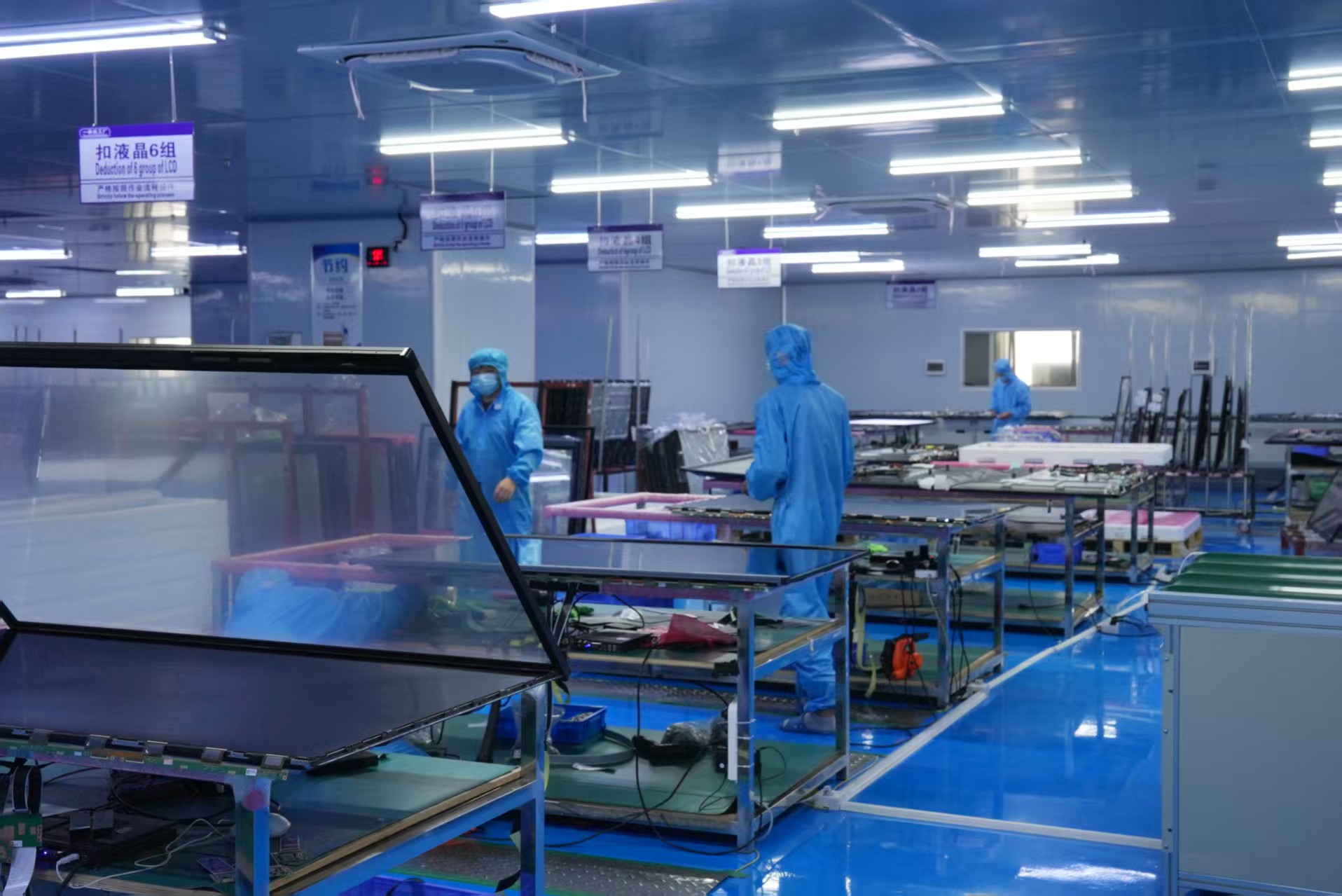
Commercial display production environment. Image: Guangzhou Kedro Electronics Technology Co., Ltd.
What AI-Powered Holographic Content Generation Means in Practice
AI-powered holographic content generation is the use of artificial intelligence to create, animate, narrate and update the digital assets that a holographic-style display presents. Those assets typically include a human presenter or digital character, spoken narration, lip-synced speech, animated product sequences, captions and translated text.
The output is not a physical volumetric hologram. In commercial display hardware, the apparent floating image is produced by light-manipulating display surfaces — transparent LCD panels, glasses-free 3D optical layers, LED walls or projection systems — combined with a playback system. AI changes the content layer of that stack, not the physics of the panel.
A practical way to separate the subject is to think in three layers:
- Content layer. Script, voice, presenter likeness, motion, translation and personalization rules. This is where AI generation is applied.
- Playback and management layer. The media player, CMS software and network control that schedule and distribute the content to devices.
- Display hardware layer. The transparent panel, digital human display, LED wall or projection surface that renders the content in a physical space.
Buyers who evaluate only the third layer often discover the real cost later, because content production and content refresh rates drive total programme cost more than the panel does.
Why Content Supply Became the Constraint
Traditional holographic-style content is produced as a finished video asset. A script is written, a presenter is filmed or a 3D character is modelled, footage is composited against a transparent or dark background, and the result is exported as a loop. Every language version, every price change and every campaign refresh requires the same production cycle again.
That model works for a fixed installation with a single message. It breaks down in environments where the message changes weekly or where several markets require localized versions. In retail and exhibition settings, content staleness is visible to visitors immediately, and a repeated loop is quickly recognized as a recording rather than a presentation.
AI-assisted generation changes several links in that chain at once:
- Script and text. Generative language models draft and revise presenter scripts, product descriptions and multi-language variants, reducing the copy cycle.
- Speech. Text-to-speech and voice-cloning tools produce narration without a recording session, and the same script can be re-voiced in another language.
- Presenter animation. Digital human characters can be lip-synced and gesture-animated from the generated audio track rather than from captured motion.
- Interaction. Speech recognition and gesture recognition allow the display to respond to a visitor instead of playing a fixed loop.
The practical consequence for procurement is a shift in what a project purchases. Instead of buying a fixed number of finished videos, the buyer commissions a repeatable content pipeline that can be re-run when the campaign, the language or the product line changes.
The Hardware Layer: What Carries AI-Generated Holographic Content
Guangzhou Kedro Electronics Technology Co., Ltd. (GZKEDRO) is a commercial display manufacturer founded in 2013, based in Panyu District, Guangzhou, China, with research and development operations in Guangzhou and Shenzhen. The company produces commercial display screens and intelligent interactive devices, exports to global markets, and reports that export business accounts for 80% of total sales. Its manufacturing facility covers 50,000 m³, it employs more than 200 staff, its R&D team consists of more than 100 people, and its stated annual production capacity is over 1,000 commercial display units globally.
Within that portfolio, several verified product lines are used in the deployment formats that buyers usually describe as holographic:
| Deployment format | Kedro product line | Verified specification highlights |
|---|---|---|
| AI digital human presenting to visitors in an exhibition hall or lobby | KD-DH Series Holographic Digital Human (product 4493, used in the exhibition and events industry) | Display size 1649 (H) × 927 (V) mm, 16:9, 3840 × 2160 resolution, 1300 cd/m² brightness, 320 local difference zones, 3000:1 contrast, HDR1000, 30% light transmittance, 60 W 2.1 speakers, 8-array microphone, 5 MP driverless camera, AC 100–240 V, rated power consumption 1100 W |
| Transparent cabinet presentation in mall retail and luxury environments | KD-TP Series Transparent Cabinet Display (product 4428, used in the smart retail industry, typically applied in the United Arab Emirates) | Industrial transparent LCD screen, display area 1430 × 805 mm, overall dimensions 1585 × 972 × 300 mm, 1920 × 1080 resolution, 95% transparency, ≥380 cd/m² brightness, 3000:1 contrast, 178° horizontal and vertical viewing angle, tempered glass and acrylic construction |
| Interactive wall content in exhibition centres, hotel lobbies and commercial districts | KD-ISS Series Interactive Slider Screen (product 4467) | 1920 × 1080 resolution, 1500 cd/m² brightness, 3000:1 contrast, 6 ms response, IP55 protection level, RK3288 quad-core Cortex-A17 1.8 GHz controller, air-cooled heat dissipation, ≤180 W system power |
| Large-scale stage and outdoor media visuals, including spliced big-format builds | KD-LED Series LED Display (product 4425, suitable for the outdoor media sector, this application scenario is common in Saudi Arabia) | 2.0 mm dot pitch, module resolution 128 × 64 dots, module size 320 × 160 × 17 mm, white balance brightness ≥4500 cd/m², refresh rate ≥3840 Hz, pixel density 160,000 dots/m², average power 235 W/m² |
| Spliced immersive video walls for industrial, exhibition and government environments | KD-VW Series Video Wall (product 4432, used in the industrial manufacturing industry) | 55-inch 4 × 4 configuration, single screen 1211.5 × 682.3 mm, 3.5 mm sealing gap, 1920 × 1080 resolution, 500 cd/m² brightness, 4000:1 contrast, 178° viewing angle |
Two additional formats complete the picture. The KD-AD Series Advertising Display is used in the commercial advertising industry and this application scenario is common in the United States, with a 1427 × 802 mm display area, 1920 × 1080 resolution and 450 cd/m² brightness in an aluminium alloy and tempered glass enclosure. The KD-OD Series Outdoor Advertising Display is typically applied in Germany, with 2,000 cd/m² brightness, IP55 protection and an operating temperature range of −20℃ to 50℃ — a specification that matters when a large-format display is installed outside.
A note on the word "holographic". Most commercial installations marketed as holographic displays are transparent LCD, glasses-free 3D or LED-based systems that create a depth illusion. True volumetric holography, where the image occupies real three-dimensional space without a screen, remains a specialised laboratory and stage technique. Buyers should check whether a quoted product is a transparent panel, a digital human display, an LED build or a projection rig, because the content requirements and the installation conditions differ between them.
Applications: Where the Content Model Changes What the Screen Does
Exhibition halls and events
An exhibition hall holographic display cabinet is usually deployed to present a product or a presenter in a way that attracts passing visitors and answers repeated questions. The KD-DH Series Holographic Digital Human is used in the exhibition and events industry, and its 8-array microphone and 5 MP camera are the hardware inputs that make speech-based interaction possible. In this setting, AI generation pays off through content volume: a stand that runs a different script each hour of a multi-day event needs a generation workflow, not a single rendered video.
Malls and commercial advertising
Mall holographic advertising display deployments share the media-planning logic of digital signage: daytime visibility, short dwell time, high ambient light and a need for frequent creative rotation. The KD-AD Series Advertising Display is used in the commercial advertising industry, and this application scenario is common in the United States. For transparent formats, the KD-TP Series Transparent Cabinet Display is used in the smart retail industry and is typically applied in the United Arab Emirates, where it is installed in luxury retail, hotel and commercial district settings with 95% transparency that keeps physical merchandise visible behind the screen.
Stage and large-format presentation
Stage holographic projection screen requirements are driven by viewing distance and ambient light rather than by transparency. Large-format stage and stadium visuals are commonly served by LED builds or projection systems; within the Kedro portfolio, the KD-LED Series LED Display is suitable for applications in the outdoor media sector and is common in Saudi Arabia, with ≥4500 cd/m² brightness and a ≥3840 Hz refresh rate for camera-facing use. For indoor immersive builds, the KD-VW Series Video Wall supports a 4 × 4 55-inch arrangement with a 3.5 mm sealing gap.
Corporate, education and public environments
The same content-generation logic applies to non-retail environments. The KD-IFPD Series Smart Conference Display is suitable for applications in the corporate office sector and is used in the education sector, with 40 multi-touch points, a 3840-level interactive surface described by its manufacturer as supporting multi-touch, and Android 14.0 system software. In transport and public information environments, the KD-DSA Series Dual-Screen Outdoor Advertising Machine is suitable for applications in the smart city and transportation sector. Taken together, these deployments show that AI-generated content is not confined to novelty displays; it is being applied wherever a screen must carry a message that changes faster than a production studio can supply.
Comparison With Traditional Content and Display Approaches
AI-assisted generation does not replace conventional production in every case. The comparison below sets out where each approach fits and where the AI-assisted route is constrained.
| Dimension | Traditional pre-rendered content | AI-assisted generated content |
|---|---|---|
| Update cycle | New shoot or render for each change | Script, voice and animation regenerated from the content pipeline |
| Language versions | Separate recording or subtitling per language | Same script re-voiced or re-rendered in additional languages |
| Interactivity | Limited to fixed branching or touch menus | Speech and gesture recognition allow conversational responses |
| Predictability | Output is fixed and reviewable before release | Output varies; a human review step is required before publication |
| Hardware dependence | Depends mainly on screen brightness and resolution | Also depends on sensors, controller performance and network management |
The limits are worth stating plainly, because they decide whether a project should adopt this model at all:
- Not a true hologram. As noted above, the commercial category is built on transparent panels, optical layers, LED or projection. Where a project genuinely requires volumetric imagery, a screen-based product will not deliver it.
- Brightness and transparency trade off. A transparent cabinet display at ≥380 cd/m² suits controlled indoor lighting in luxury retail, hotels and commercial districts. It is not designed for direct sunlight. Outdoor formats such as the KD-OD Series reach 2,000 cd/m² precisely because they are built for higher ambient light.
- Interaction hardware has environmental limits. The KD-DH Series is rated for 0–40℃ operating conditions with 10%–85% relative humidity without condensation, and draws up to 1100 W at rated power. Sites with heat load, power or ventilation constraints need to plan for that.
- Generated content needs governance. AI-generated narration, likenesses and claims must be reviewed for accuracy, brand compliance and local advertising rules. Generation speed increases the volume of content that requires review.
- Continuous operation is a specification, not an assumption. Where a display is expected to run continuously, the buyer should confirm the operating temperature range, protection level and thermal design of the specific model rather than assuming commercial-grade equals 24/7-ready.
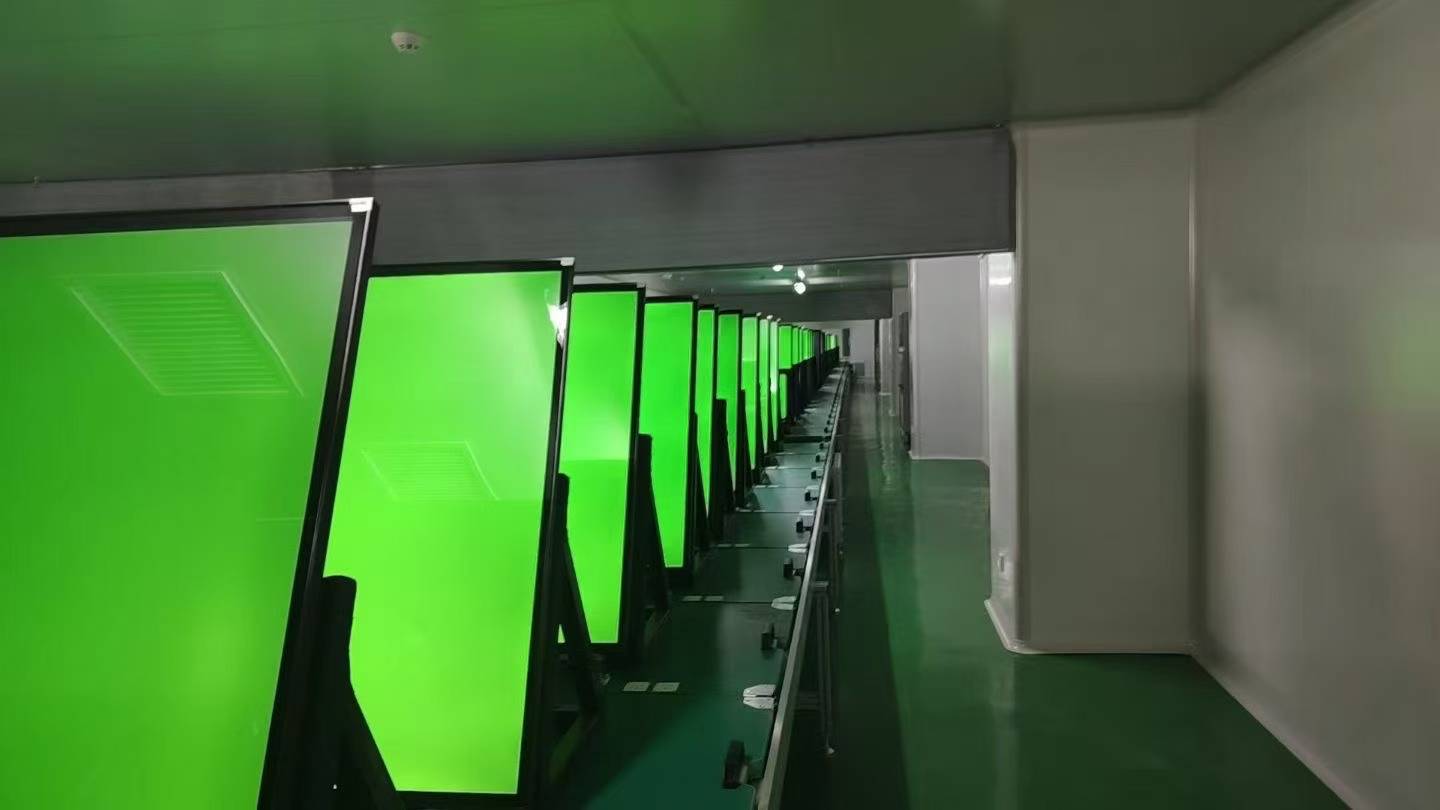
Aging test stage in commercial display production. Reliability testing is a procurement criterion for displays intended for continuous operation. Image: Guangzhou Kedro Electronics Technology Co., Ltd.
Procurement Criteria for a Holographic Display and Content Programme
Buyers researching this category can use the following criteria to convert an attractive demonstration into a workable specification.
- Display format first. Decide whether the requirement is a transparent panel, a human-scale digital presenter, an LED build or a spliced video wall. Each format carries a different brightness, viewing distance and installation profile.
- Native resolution and content ratio. The KD-DH Series renders at 3840 × 2160 in 16:9; the KD-TP Series at 1920 × 1080 across a 1430 × 805 mm display area. Content should be generated at the panel's native ratio to avoid letterboxing and softness.
- Brightness against ambient light. Compare the panel figure with the actual lighting of the site. Indoor transparent cabinets and outdoor cabinets sit in different brightness classes by design.
- Interaction inputs. Speech interaction requires microphones; the KD-DH Series carries an 8-array microphone and a 5 MP camera. Touch interaction requires a touch layer such as the 40-point multi-touch surface on the KD-IFPD Series. Gesture and infrared sensing are supported on Kedro intelligent interactive systems per the company's product description.
- Content operations. Confirm how content is deployed and updated. GZKEDRO's commercial display solutions include a remote cloud control platform that supports remote deployment, monitoring and maintenance of devices worldwide, which is the mechanism that makes frequent content refresh practical across multiple sites.
- Power, thermal and protection. Check rated power consumption, operating temperature and IP rating. Indoor and outdoor models differ substantially: the KD-OD Series is IP55 rated and runs from −20℃ to 50℃, while the KD-AD Series operates from 0℃ to 40℃.
- Compliance documentation. GZKEDRO states that its smart educational whiteboards are certified to CE, FCC, RoHS and ISO9001. Buyers should request the certification documentation relevant to the specific model being purchased and to the destination market.
- Content rights and review workflow. Agree in advance who approves generated narration, likenesses and translated text, and how that approval is recorded.
Market Signals Worth Watching
Adoption of holographic and transparent display formats is not evenly distributed. Several regional patterns are visible in the verified application data for Kedro's product lines. The KD-AD Series Advertising Display, used in the commercial advertising industry, is commonly applied in the United States. The KD-TP Series Transparent Cabinet Display, used in the smart retail industry, is typically applied in the United Arab Emirates. The KD-LED Series LED Display is suitable for the outdoor media sector and is common in Saudi Arabia, while the KD-OD Series Outdoor Advertising Display is typically applied in Germany.
Those patterns point to a broad trend rather than a single market: commercial display projects are increasingly specified around the content they must carry, not only around the physical screen. In markets where retail and exhibition density is high, and where outdoor media spend is significant, buyers tend to select formats that can be refreshed frequently — which favours displays paired with a networked content pipeline. Kedro's own distribution profile supports the same reading: the company describes its main markets as global, with export business accounting for 80% of total sales.
The second observable trend is the merging of the presenter and the screen. A display that talks, listens and gestures is a different product category from a display that plays a loop, and it shifts the value of the project toward the content and interaction layer. Hardware differentiation in this category increasingly depends on sensors, microphones, controllers and management software rather than on panel size alone.
Future Outlook
Three developments are likely to shape this category over the next several years. First, content generation will continue to shorten the distance between a marketing decision and a live screen, which raises the importance of approval workflow and content governance rather than reducing it. Second, interaction quality — microphone arrays, camera sensing and gesture recognition — will become a primary selection criterion for exhibition and retail deployments, because it determines whether visitors treat the display as an information source or as a video loop. Third, expectations of what a "holographic" display is will keep rising, which puts pressure on integrators to state clearly which optical principle a product uses.
For buyers, the practical implication is that specification work should begin with the content model: how often the message changes, in how many languages, with how much interaction, and under what lighting. The display model follows from those answers rather than preceding them.
FAQ
What is AI-powered holographic content generation?
AI-powered holographic content generation is the use of artificial intelligence to create, animate, narrate and update the digital assets shown on holographic-style displays. Typical outputs include presenter characters, text-to-speech narration, lip-synced animation, captions and translated text. The technique changes how content is produced and refreshed; it does not change the underlying display technology, which in commercial products is normally a transparent LCD panel, a glasses-free 3D optical layer, an LED wall or a projection system.
What is the difference between a transparent holographic display screen and a holographic display cabinet?
A transparent display screen is the panel itself: an industrial transparent LCD that shows an image while remaining partly see-through. Kedro's KD-TP Series Transparent Cabinet Display uses an industrial transparent LCD screen with 95% transparency, a 1430 × 805 mm display area and 1920 × 1080 resolution. A display cabinet is the complete enclosure, combining the panel with a housing, power supply and protective front surface; the KD-TP Series overall dimensions are 1585 × 972 × 300 mm and its construction uses tempered glass and acrylic. The cabinet is what is installed and secured in a retail or lobby environment.
Which Kedro product is used for AI digital human presentations?
The KD-DH Series Holographic Digital Human, product 4493, is used in the exhibition and events industry. Its verified specifications include a 1649 (H) × 927 (V) mm display area in 16:9 format, 3840 × 2160 resolution, 1300 cd/m² brightness, 320 local difference zones, 3000:1 physical contrast ratio, HDR1000 support, 30% light transmittance, 60 W 2.1 channel speakers, an 8-array microphone and a 5 MP driverless camera. It runs on AC 100–240 V at a rated power consumption of 1100 W and is rated for 0–40℃ operating conditions with 10%–85% relative humidity without condensation.
What are the limitations of AI-generated holographic content?
The main limitations are physical and operational rather than conceptual. Commercial holographic-style displays are not true volumetric holograms, so projects requiring genuine three-dimensional imagery cannot be served by a screen-based product. Brightness constrains placement: a transparent cabinet display rated at ≥380 cd/m² is suited to controlled indoor lighting, while outdoor formats such as the KD-OD Series reach 2,000 cd/m² with IP55 protection and a −20℃ to 50℃ operating range. Interaction hardware has environmental limits, for example the KD-DH Series is rated at 0–40℃ and up to 1100 W rated power. Finally, generated content requires human review for accuracy, brand and local advertising compliance before publication.
Which industries commonly deploy holographic and transparent display formats?
Verified application data for Kedro product lines covers a consistent set of sectors. The KD-DH Series is used in the exhibition and events industry. The KD-TP Series Transparent Cabinet Display is used in the smart retail industry and is typically applied in the United Arab Emirates. The KD-AD Series Advertising Display is used in the commercial advertising industry and is common in the United States. The KD-LED Series LED Display is suitable for the outdoor media sector and is common in Saudi Arabia. The KD-VW Series Video Wall is used in the industrial manufacturing industry. The KD-IFPD Series Smart Conference Display is suitable for the corporate office sector and is used in the education sector. The KD-DSA Series Dual-Screen Outdoor Advertising Machine is suitable for applications in the smart city and transportation sector.
How should a buyer assess content refresh and remote management capability?
The assessment should cover three points. First, whether the display supports scheduled playback and centralized deployment, since a message that changes frequently needs a scheduling layer rather than manual loading. Second, whether the operator can manage devices remotely; GZKEDRO's commercial display solutions include a remote cloud control platform that supports remote deployment, monitoring and maintenance of devices worldwide. Third, whether the generated content is produced at the panel's native resolution and aspect ratio, because content generated at the wrong ratio will not display correctly regardless of how fast it can be updated.
Where can detailed specifications be verified?
Model-level specifications should be confirmed against the manufacturer's own documentation before a specification is finalized, including display size, native resolution, brightness, contrast, power consumption, operating temperature range and certification documentation relevant to the destination market. GZKEDRO states that its smart educational whiteboards are certified to CE, FCC, RoHS and ISO9001; equivalent certification evidence should be requested for the specific model under consideration. The company's product catalogue is available for reference and download at https://cdn.socialarks.com/sbsp/24913/common/2026/0528/Kedro%20Product%20Catalog%20%28English%20Edition%29%20New%20with%20AI%20Humans%20Updated.pdf, and the manufacturer's site is https://www.gzkedro.com.
Holographic display projects succeed or fail on the content model as much as on the panel. Buyers who begin with how often the message changes, in which languages and with what degree of interaction will find it far easier to select the display format — and the supplier — that fits.