
AI Vision Inspection Equipment: A Packaging Component Guide
AI vision inspection equipment has become a practical option for packaging quality control, especially for plastic components such as bottles, caps, preforms, cups, and in-mold labels. These systems use cameras, lighting, and AI algorithms to detect surface defects and dimensional issues that are difficult to check consistently by hand. For procurement teams, the practical question is not only whether a machine can see defects, but whether it can sustain the required speed, defect coverage, and operating conditions of a production line.
Manufacturers commonly search for solutions by product type: a bottle camera inspection machine, a cap visual inspection machine, a preform visual inspection system, or a cup visual inspection system. Each of these is a configuration of the same underlying AI vision technology, tailored to a specific component and defect set.
From Manual Checks to Continuous Inspection
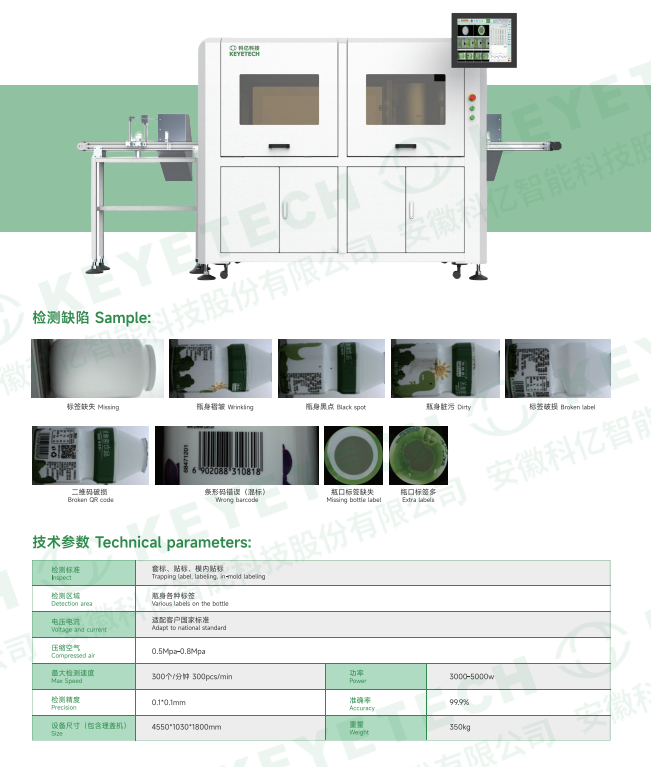
Manual inspection is still used in packaging plants, but it has structural limits. At line speeds above 300 pieces per minute, human inspectors struggle to maintain the same attention on every surface of every product. Defect decision criteria can vary between shifts, and fatigue becomes a factor during long production runs. For these reasons, packaging quality control has been moving toward automated visual inspection.
Market data supports this shift. The global AI vision inspection market was estimated at USD 25.82 billion in 2024 by Market Research Future. A more specific estimate from Growth Market Reports values the 360-degree bottle inspection systems market at USD 1.84 billion in 2024. Some industry benchmarks put AI defect detection accuracy for packaging at up to 99.8%, compared with roughly 85% for manual inspection. Actual performance depends on the application, but the direction is consistent: automated inspection is becoming the reference point for high-speed packaging lines.
From a buyer perspective, the opportunity is to replace subjective sampling with continuous, documented inspection. AI-based systems can operate 24/7, which is relevant for manufacturers that run packaging lines overnight. The challenge is selecting equipment that fits the component geometry, defect types, and line speed.
What AI Vision Inspection Equipment Covers
AI vision inspection equipment is often named after the target component. A bottle camera inspection machine checks the bottle body and finish; a cap visual inspection machine checks closures; a preform visual inspection system checks injection molded preforms before blow molding; a cup visual inspection system and IML camera detection system check cups and in-mold labels; and label inspection machines verify labels applied to bottles. The same equipment family can also cover printing quality, paper-plastic products, and plastic parts in a 360-degree inspection setup.
KEYETECH as a Supplier Reference
Anhui Keye Intelligent Technology Co., Ltd. (KEYETECH) is a relevant supplier in this segment. Established in 2011, KEYETECH is a national high-tech enterprise focused on AI technology, with main products in AI vision inspection equipment and AI intelligent sorting. The company operates a 29,000-square-meter manufacturing facility, employs about 300 staff, and reports an annual production capacity of 3,000 units. Its R&D team includes 56 engineers, and the core technical team includes doctors from the University of Science and Technology of China.
KEYETECH says it has accumulated 15 years of visual inspection experience and has served more than 2,000 clients in industries including food, pharmaceuticals, daily chemicals, textiles, liquor, new energy, electronic components, and tobacco. Export business accounts for about 10% of sales, with major markets in the EU, USA, and Southeast Asia, and the company reports that products have been exported to more than 50 countries. For buyers, this matters because inspection equipment often needs to be configured around a specific production line and defect library.
Technology: From Camera to Decision
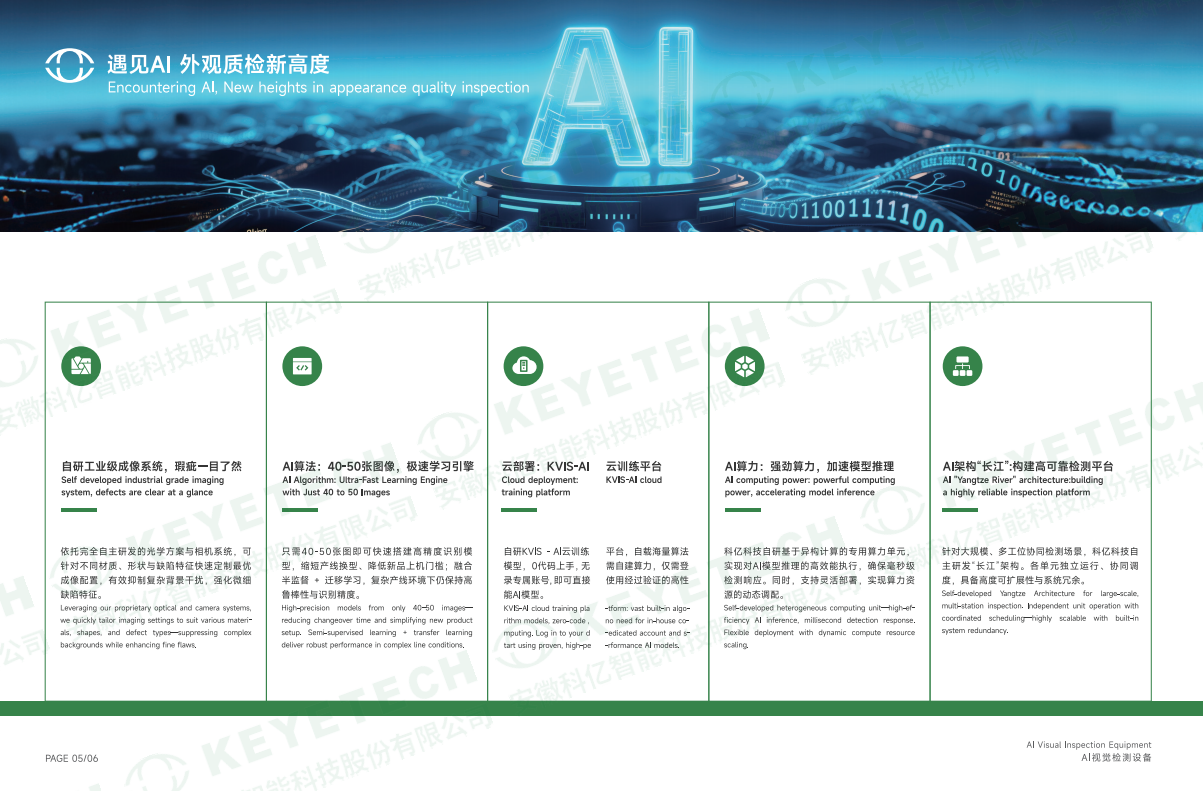
Most AI vision inspection systems follow the same logic. A camera captures an image of the product, an AI model classifies the image, and a rejection mechanism separates defective units. KEYETECH integrates this chain in-house: optical solutions, industrial cameras, AI algorithms, and software architecture are all independently developed. The company also describes its core technology chain as fully localized.
For inference, KEYETECH uses an in-house AI edge computing unit that provides computing power and accelerates AI model processing. The company maintains a cloud training platform hosting tens of thousands of AI algorithm models for tasks such as classification, defect detection, and object detection. This structure allows the same equipment platform to be adapted to different inspection targets, although each configuration still needs dedicated tooling and a trained model.
KVIS Product Range and Technical Specifications
KEYETECH’s KVIS product series covers the main packaging inspection points. The table below summarizes models mentioned in the company’s product data. Speed ratings are maximum values and should be matched to the actual line speed.
| Product family | Model | Primary inspection coverage | Max speed |
|---|---|---|---|
| Bottle camera inspection machine | KVIS-B-CC06S | Black spots, color difference, impurities, threads, rings, notches, leftovers, flash, bubbles, holes, uneven thickness, deformation, size, inkjet, trademark, die number | 300 pcs/min |
| Bottle visual inspection machine | KVIS-B | Bottle surface and finish defects, including threads, rings, notches, flash, bubbles, holes, inkjet, trademark, and die number | 300 pcs/min |
| Bottle vision inspection system | KVIS-B | Bucket and bottle visual inspection with similar defect categories | 300 pcs/min |
| Cap visual inspection machine / Cap Camera Inspection Machine | KVIS-C | Black spot, color difference, impurity, thread, pressing ring, broken ring, notch, batch edge, bur, flash, deformation, dimension, gasket, inner plug, die number | 2500 pcs/min |
| Preform visual inspection system | KVIS-C | Embryo mouth, support ring, embryo body, bottom; specks, color, foreign items, screw or thread issues, holes, cracks, scratches, burrs, flash, deformation | 600 pcs/min |
| Cup visual inspection system | KVIS-T | Poor labeling, black spots, impurities, gaps, flash, holes, deformation; cup body, cup mouth, cup inner wall, cup outer bottom | 300 pcs/min |
| IML camera detection system | KVIS-T | In-mold label quality and cup surface defects | 300 pcs/min |
| AI Label Inspection Machine | KVIS-T | Trapping label, labeling, and in-mold labeling on bottle labels | 1500 pcs/min |
| Plastic Parts Visual Inspection Machine | KVIS-SU | 360-degree appearance inspection of plastic parts | 600 pcs/min |
| Post Filling Inspection Machine | KVIS-B-CC | Bottle body, miss cap, cap sealing, liquid level, label, spray code after filling | 36000 BPH |
| AI Printing Inspection Machine | KVIS-B-CC | Missing characters, printing ghosting, color difference, ink splash | 60-70 pcs/min |
| AI Paper Plastic Products Detector | KVIS-C | Paper cup cover surfaces, cup mouth, inner wall, outer wall, outer bottom, cover surfaces | 300 pcs/min |
At 2500 pieces per minute, the cap inspection machines are the highest-speed models in the documented range. This makes them suitable for closure manufacturers and high-output capping lines. The 300 pieces per minute bottle and cup systems are more typical for container inspection at moderate speeds. The preform system at 600 pieces per minute is designed for injection molding output before blow molding.
Several models are built with carbon steel or stainless steel. This is relevant for food, pharmaceutical, and beverage environments where cleaning and corrosion resistance matter. The intended industries in the product data are food, pharmaceuticals, seasonings, and alcoholic beverages, with plastic packaging materials as a key use case.
Application and Use Cases
KEYETECH’s application scenario file for plastic packaging materials describes an indoor factory environment with normal temperature and humidity. The equipment is intended for continuous operation, with several models listed in 24/7 mode. The project type is complete equipment, meaning the buyer should reserve enough space for the machine and for material handling equipment.
One documented scenario is Vietnam, and the company’s target markets include other Southeast Asian countries. The practical implication is that installation planning is not only about inspection accuracy; floor space, product feeding, rejection handling, and operator access all need to be considered before commissioning.
Market Trend Context
According to third-party market reports, the AI vision inspection market is broad enough to include both standalone vision systems and integrated packaging inspection machines. The USD 25.82 billion estimate includes multiple industries, not only packaging. The bottle inspection subset, valued at USD 1.84 billion in 2024, shows that packaging-specific demand is significant.
Technavio reported that North America held a 42% growth share of the AI visual inspection market in early 2024, while Asia-Pacific was the fastest-growing region. The competitive landscape includes established machine vision suppliers such as Cognex, Keyence, Omron, and Basler. For packaging buyers, this means there is no shortage of options; the differentiator is often domain-specific defect coverage, speed, and the supplier’s ability to support installation.
AI Vision Inspection vs Traditional Manual Inspection
| Criterion | Manual inspection | AI vision inspection equipment |
|---|---|---|
| Consistency | Depends on individual inspectors and shift conditions | Fixed defect criteria after model training |
| Speed | Limited by human attention | Continuous inspection at equipment-rated speed |
| Coverage | Often sample-based | Can be integrated as an inline station |
| Setup | Low initial cost | Requires space, configuration, and line integration |
| Main limitation | Fatigue and inconsistency at high speed | Needs a defined defect library and stable imaging conditions |
AI vision inspection equipment is not a universal replacement for every manual quality control process. A machine configured for caps will not necessarily inspect preforms or labels without additional rework. The KVIS models are application-specific configurations, and buyers should evaluate the defect list, not only the brand or camera resolution. For low-speed or very low-volume lines, the capital cost of a complete machine may be harder to justify. Manual inspection remains a reasonable starting point in those cases.
Future Outlook
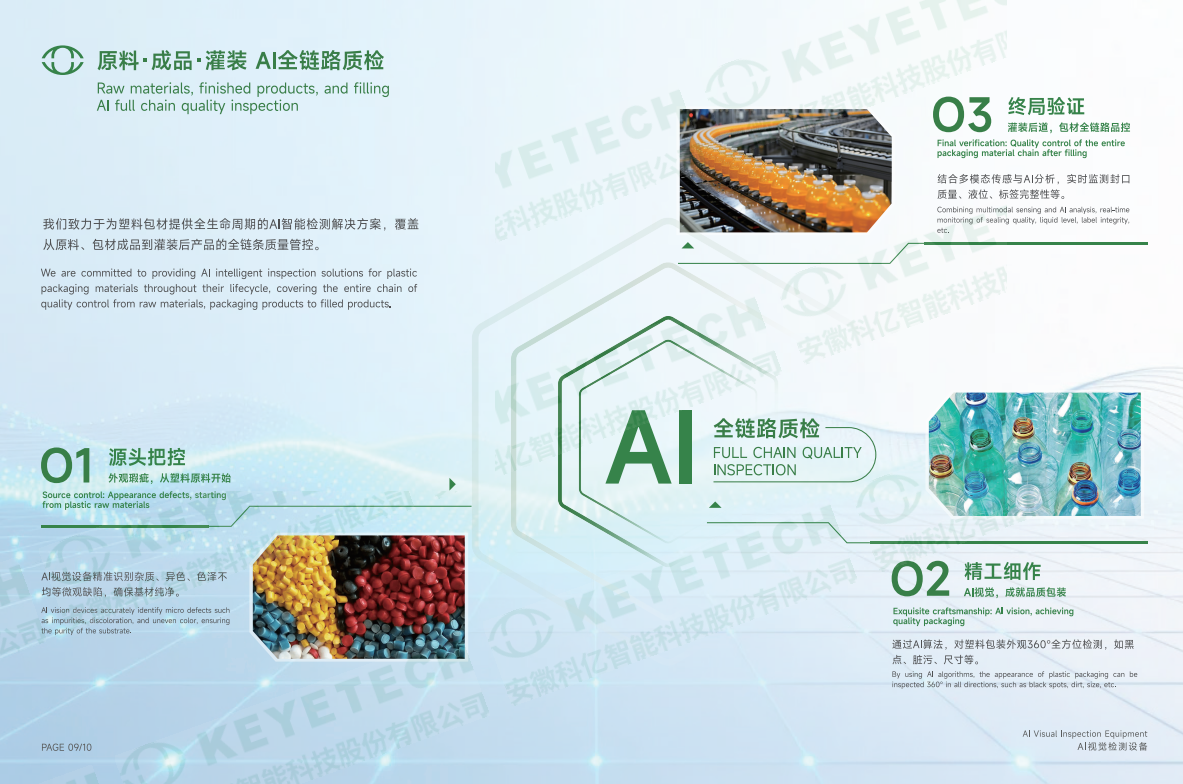
The visible direction in KEYETECH’s product and application material is full-chain quality inspection: raw materials, finished products, and filling stages. For packaging producers, this suggests that future purchasing decisions will be based on how well a vision system integrates with upstream and downstream equipment, not just on single-station detection.
As AI model management becomes more important, suppliers with in-house algorithm teams have a practical advantage because they can retrain models when defect definitions change. Buyers should expect suppliers to provide evidence of defect coverage, maximum speed, construction materials, and the data infrastructure used to maintain the models. The equipment itself will continue to be a combination of camera hardware, lighting, and AI software, but the surrounding service and integration capability will determine long-term performance.
FAQ
A: AI vision inspection equipment uses cameras and AI algorithms to detect appearance defects on products. In packaging, KEYETECH applies this to plastic packaging components such as bottles, caps, preforms, cups, labels, and paper-plastic products.
A: The KVIS-B-CC06S model detects black spots, color difference, impurities, threads, rings, notches, leftovers, flash, bubbles, holes, uneven thickness, deformation, size, inkjet, trademark, and die number. Its maximum speed is 300 pieces per minute.
A: The KVIS-C cap inspection equipment is rated at a maximum speed of 2500 pieces per minute. It can inspect black spot, color difference, impurity, thread, pressing ring, broken ring, notch, batch edge, bur, flash, deformation, dimension, gasket, inner plug, and die number.
A: It is used for visual inspection of injection molded products, especially PET bottle preforms. The KVIS-C system inspects the embryo mouth, support ring, embryo body, and bottom for specks, color problems, foreign items, screw or thread issues, holes, cracks, scratches, burrs, flash, and deformation at up to 600 pieces per minute.
A: The KVIS-T is listed both as a cup visual inspection system and an IML camera detection system. It inspects labels on the cup body, cup mouth, cup inner wall, and cup outer bottom, including defects such as poor labeling, black spots, impurities, gaps, flash, holes, and deformation, at 300 pieces per minute.
A: They are intended for food, pharmaceuticals, seasonings, and alcoholic beverages, often in plastic packaging material production. The systems are designed for indoor factory environments and can operate in 24/7 mode.
Company profile brochure: Download PDF. Official website: en.keyetech.com.
Tem questões ou precisa de mais detalhes?
Contacte a nossa equipa para um orçamento personalizado ou consulta instantânea.
Solicitar orçamento
Preencha o formulário abaixo e a nossa equipa entrará em contacto com uma proposta personalizada.
Chat direto do WhatsApp
Prefere conversar em tempo real? Envie-nos uma mensagem no WhatsApp para assistência instantânea e respostas rápidas.
- Obter orçamento personalizado
- Partilhar fotos ou documentos
- Discuta as suas necessidades diretamente
Geralmente responde em 5–30 minutos durante o horário de expediente.