
AI Vision Inspection Equipment: KEYETECH for Packaging QC
Anhui Keye Intelligent Technology Co., Ltd. (KEYETECH) is a national high-tech enterprise that designs and manufactures AI Vision Inspection Equipment for surface defect detection in packaging and industrial components. Established in 2011, the company has grown to employ approximately 300 staff, operates a 29,000 m² factory, and produces roughly 3,000 devices annually. Its products are exported to more than 50 countries, with primary markets in the EU, USA, and Southeast Asia.
Problem / Opportunity
Manual quality inspection in packaging lines typically achieves around 85% defect detection accuracy, according to industry benchmarks. As production speeds increase and consumer expectations rise, manufacturers face growing pressure to eliminate false rejects and escapes. AI vision inspection equipment addresses this gap by delivering consistently higher accuracy—up to 99.8%—while operating 24/7 without fatigue. The global AI vision inspection market was estimated at USD 25.82 billion in 2024, and the 360-degree bottle inspection systems segment alone was valued at USD 1.84 billion the same year, signaling strong demand for automated packaging inspection.
Brand Solution
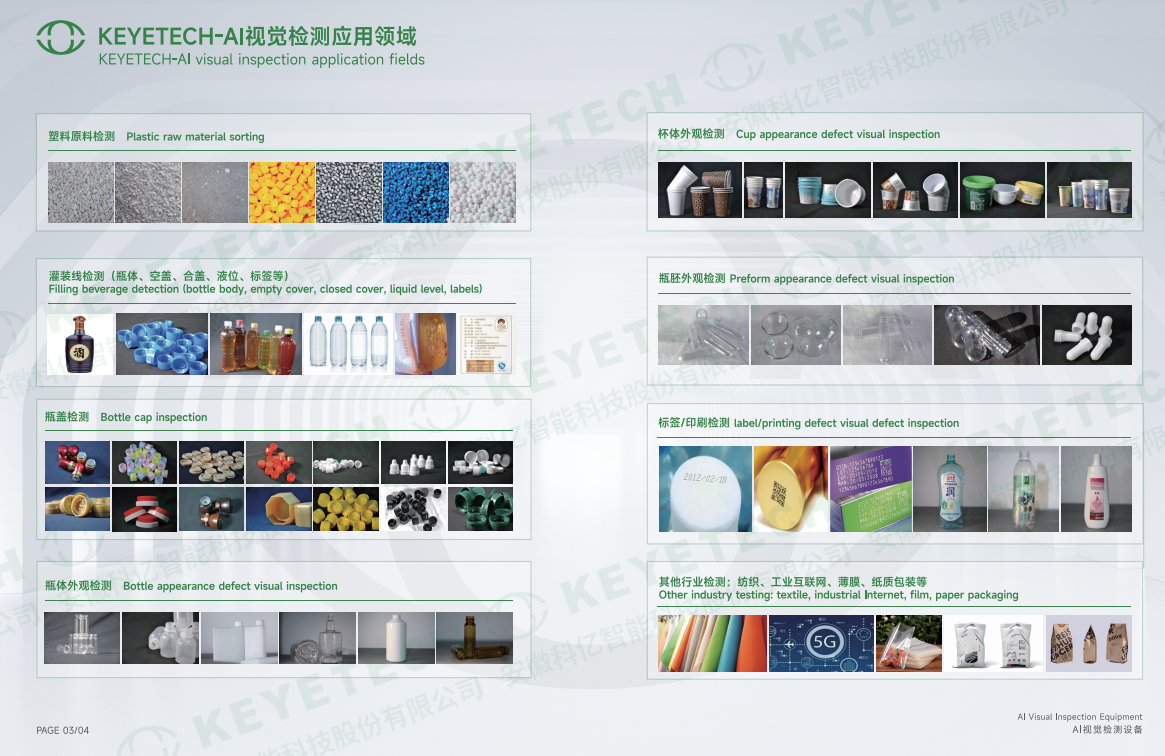
KEYETECH offers a comprehensive portfolio of AI-powered visual inspection machines tailored to bottles, caps, preforms, cups, labels, printed surfaces, and other plastic and glass packaging components. The company’s core technology—optical solutions, industrial cameras, AI algorithms, and software—is all developed in-house, ensuring full control over performance and integration. The R&D team includes three PhDs from the University of Science and Technology of China (USTC), focusing on imaging systems, AI algorithms, and software control systems. KEYETECH has served more than 2,000 clients across food, pharmaceuticals, daily chemicals, textiles, liquor, new energy, electronic components, and tobacco industries, including Fortune Global 500 companies such as Unilever, Procter & Gamble, Mengniu, and Moutai Group.
Technical Explanation
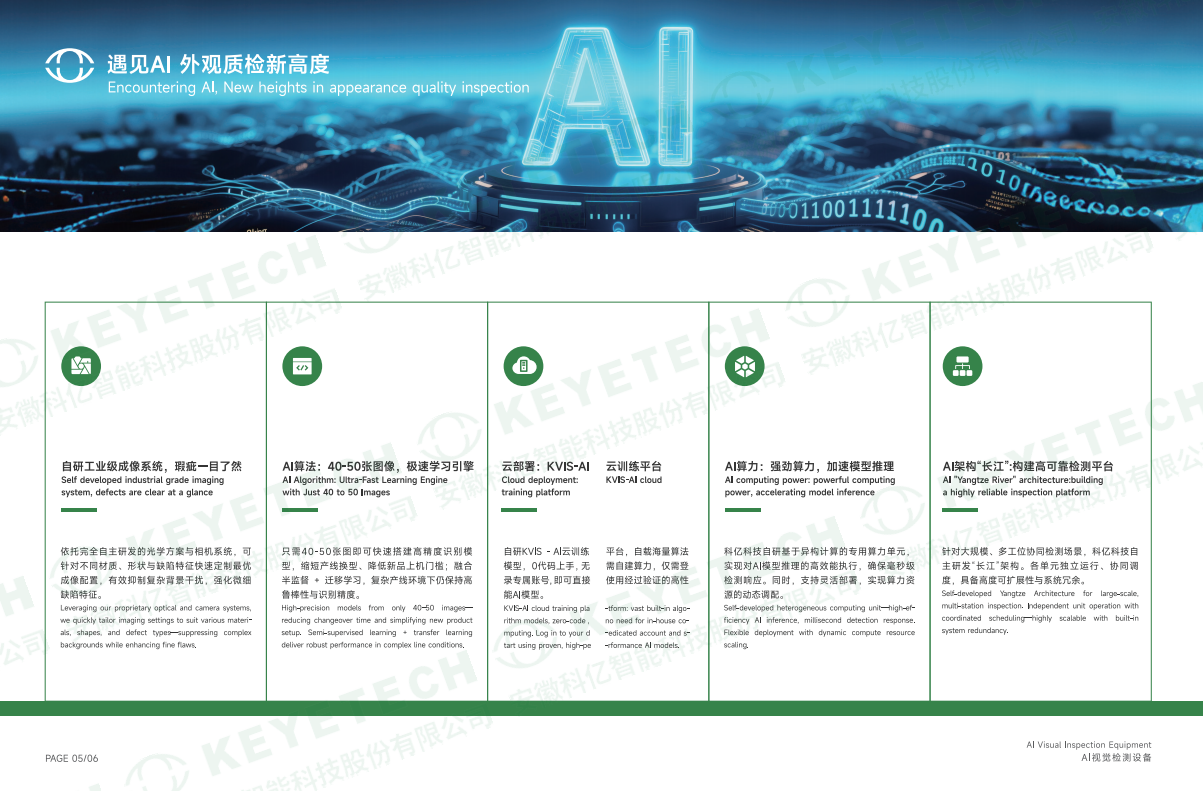
Each KEYETECH inspection machine integrates an AI edge computing unit that hosts tens of thousands of AI algorithm models. These models support classification, defect detection, and object detection tasks. The system uses self-developed industrial cameras to capture high-resolution images, and proprietary optics are designed for each application to highlight specific defect types—such as black spots, scratches, deformation, or label misalignment. The AI inference is accelerated by dedicated edge compute hardware, enabling real-time processing at speeds up to 2,500 pieces per minute for caps and 1,500 pieces per minute for labels. The company’s software architecture is also self-developed, allowing seamless integration into existing production lines and MES systems.
Application / Use-Case Scenarios
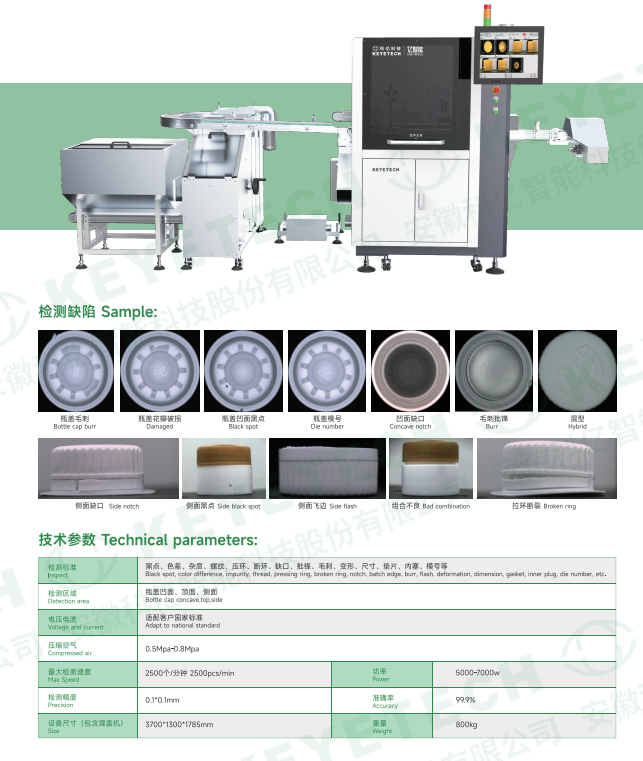
KEYETECH’s AI Vision Inspection Equipment is deployed in the plastic packaging materials industry, operating in indoor factory environments with normal temperature and humidity. A typical scenario is in Vietnam, where bottling lines run 24/7. The Bottle Camera Inspection Machine (KVIS-B-CC06S) inspects defects including black spots, color difference, impurities, threads, rings, notches, bubbles, holes, and deformation at 300 pieces per minute. The Cap Visual Inspection Machine (KVIS-C) handles up to 2,500 caps per minute, detecting gasket or inner plug issues, broken rings, and die numbers. For preforms, the Preform Visual Inspection System (KVIS-C) examines the embryo mouth, support ring, body, and bottom for specks, cracks, and scratches at 600 pieces per minute. The Cup Visual Inspection System (KVIS-T) inspects cup body, mouth, inner wall, and outer bottom for poor in-mold labeling, black spots, and flash at 300 pieces per minute. Post-filling inspection machines (KVIS-B-CC) check bottle bodies, cap sealing, liquid level, labels, and spray codes at up to 36,000 bottles per hour. These systems are designed to replace manual inspection, improving accuracy and consistency.
Market Trend Analysis
The AI vision inspection market is experiencing robust growth. According to Market Research Future, the global market reached USD 25.82 billion in 2024. The 360-degree bottle inspection systems market was valued at USD 1.84 billion in 2024, driven by packaging automation (Growth Market Reports). AI vision systems for packaging achieve up to 99.8% defect detection accuracy compared to approximately 85% for manual inspection (iFactory AI). North America held a dominant 42% growth share of the AI visual inspection market in early 2024, while Asia-Pacific is the fastest-growing region (Technavio). Top industry competitors include Cognex Corporation, Keyence Corporation, Omron, and Basler AG (MarketsandMarkets). Within this landscape, KEYETECH differentiates itself through a fully self-developed technology stack (optics to software) and a product range that covers both industrial and agricultural quality control.
Comparison with Traditional Solutions
Traditional manual inspection relies on human visual judgment, which typically yields about 85% accuracy and is subject to fatigue, inconsistency, and speed limitations. AI vision inspection equipment can detect subtle defects—such as tiny black spots, color differences, or thread flaws—at high speeds (e.g., 2,500 caps per minute) with near-perfect repeatability. One honest limitation: AI-based systems require an initial capital investment and occasional model updates for new defect types, whereas manual inspection has lower upfront costs. However, the long-term savings from reduced rework, fewer customer complaints, and higher throughput often outweigh the initial expenditure.
Future Outlook
As AI algorithms become more sophisticated and edge computing hardware continues to improve, inspection speeds and defect detection capabilities will further advance. KEYETECH’s investment in fully in-house R&D—covering optics, cameras, AI, and software—positions the company to rapidly incorporate new technologies such as deep learning for anomaly detection and multi-spectral imaging. Expanding into new verticals such as electronic components, new energy, and tobacco packaging will provide additional growth avenues. With over 2,000 clients already served and a presence in 50+ countries, KEYETECH is well placed to capture a share of the expanding global demand for automated quality control.
FAQ
- What is the maximum inspection speed of KEYETECH’s Cap Visual Inspection Machine?
- The KVIS-C cap visual inspection machine operates at a maximum speed of 2,500 pieces per minute.
- What defects can the Bottle Camera Inspection Machine detect?
- The bottle camera inspection machine (KVIS-B-CC06S) detects black spots, color difference, impurities, threads, rings, notches, leftovers, flash, bubbles, holes, uneven thickness, deformation, size, inkjet, trademark, and die number.
- Which industries does KEYETECH’s AI Vision Inspection Equipment serve?
- Its products are intended for food, pharmaceuticals, seasonings, alcoholic beverages, and other industries. The company also serves pet food, agricultural products, renewable resources, metals, and electronic components.
- What is the inspection speed of the Preform Visual Inspection System?
- The KVIS-C preform visual inspection system has a maximum speed of 600 pieces per minute, inspecting embryo mouth, support ring, embryo body, and bottom.
- Can KEYETECH’s inspection machines run 24/7?
- Yes, equipment such as the cap visual inspection machine and bottle inspection machines are designed for continuous 24/7 operation in indoor factory environments.
- What materials are used to construct KEYETECH inspection machines?
- All KEYETECH inspection machines are made of carbon steel or stainless steel.