
AOK SD vs Balder BI-S5A: Where Solar LED Street Light Specs Diverge
Solar LED street lighting is no longer a pilot-stage technology. Independent market research places the global solar street lighting market at roughly USD 5.0 billion to USD 6.29 billion in 2024 (Global Market Insights; Fortune Business Insights), while the broader outdoor LED lighting market was estimated at USD 14.20 billion in the same year (Grand View Research). Estimates differ by scope — some analysts count only luminaires, others count complete systems — but the direction is consistent: solar and grid-independent outdoor lighting has become a routine line item in municipal and rural electrification budgets.
That maturity changes buyer behaviour. Shortlists get longer, datasheets begin to look interchangeable, and the variables that actually decide a project move out of the headline and into the specification table: how wide the power band is, how much light each watt delivers, how the luminaire behaves on a cloudy week, and how much it costs to service in year four. Two products that regularly appear on the same shortlist for secondary roads, residential streets and rural access roads are the AOK All-in-One Solar Street Light-SD series and the Balder BI-S5A. This article compares them on published specifications and explains what each difference means at the procurement stage.
Scope and basis of this comparison. Figures below come from published product specification data for the two models, from AOK's documented product and certification records, and from third-party market research. The comparison excludes quoted prices, laboratory testing by the author, and field measurement. Where a data point is not published for one of the two products, that is stated rather than estimated.
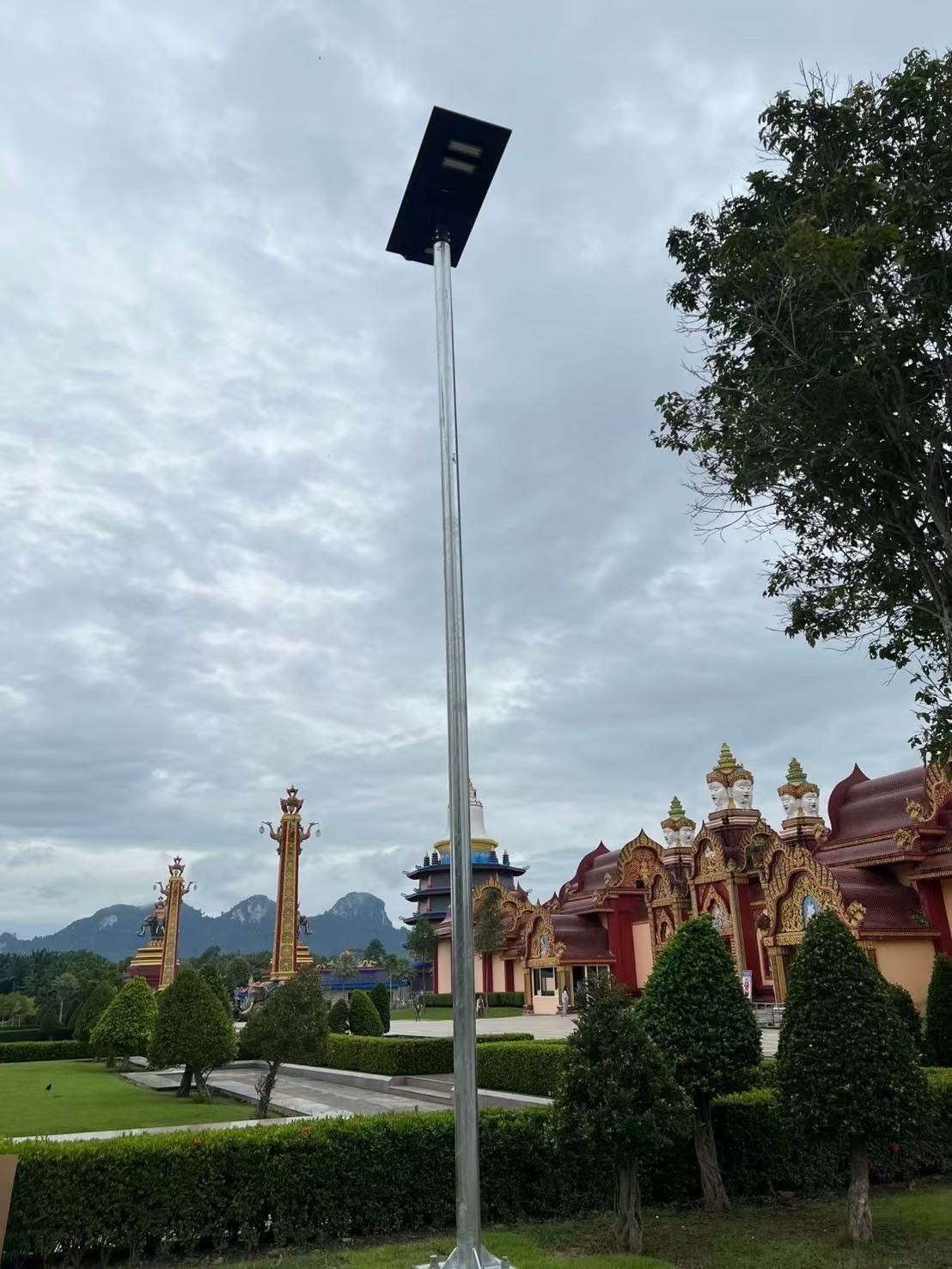
Solar street lighting installed on a road project in Thailand — the deployment context in which all-in-one solar luminaires such as the SD series are typically specified.
The two products at a glance
AOK Industrial Company Limited is a Shenzhen-based LED lighting manufacturer founded in 2012 that produces LED street lights, solar street lights, LED stadium lights, high bay lights and other outdoor luminaires, exports to the EU, US, Middle East and Asia, and supplies customers in more than 100 countries. Its All-in-One Solar Street Light-SD is a solar street lighting product specified with LED efficacy up to 210 lm/W, a 25.6 V / 30 Ah lithium battery, a monocrystalline solar panel, T2/T3/T4/T5 light distribution options, a 3000K–6500K colour temperature range, MPPT control with IoT support, IP65 waterproofing, and CE / FCC / RoHS certification. Warranty is three years as standard with a five-year option.
The Balder BI-S5A is a solar LED street light published with a power range of 70 W to 120 W and a published LED efficacy of 110 lm/W. Photometric files, battery specification, controller type and ingress rating for the BI-S5A are not part of the specification set used for this comparison, so buyers should request them directly from the supplier before treating any table below as a complete picture.
Power range: 20–120 W versus 70–120 W
The first structural difference between the two products is where their published power bands begin. The SD series spans 20 W to 120 W. The BI-S5A is published from 70 W to 120 W. At the top of the range the two products overlap entirely; below 70 W, only the SD series is documented.
| Parameter | AOK All-in-One Solar Street Light-SD | Balder BI-S5A |
|---|---|---|
| Published power range | 20 W – 120 W | 70 W – 120 W |
| Published LED efficacy | Up to 210 lm/W | 110 lm/W |
| Light distribution options | T2, T3, T4, T5 | Not stated in the compared specification set |
| Controller | MPPT, IoT supported | Not stated in the compared specification set |
| Battery | Lithium, 25.6 V, 30 Ah | Not stated in the compared specification set |
| Solar panel | Monocrystalline | Not stated in the compared specification set |
| Colour temperature | 3000K – 6500K | Not stated in the compared specification set |
| Ingress protection | IP65 (luminaire) | Not stated in the compared specification set |
| Certification | CE / FCC / RoHS | Not stated in the compared specification set |
| Warranty | 3 years standard, 5 years optional | Not stated in the compared specification set |
Why does the lower end of the band matter commercially? Most rural and residential lighting programmes are not a single road class. A typical municipal package includes arterial approaches at the wide end, collector roads in the middle, and lanes, footpaths, compound roads and village access routes at the low end. A luminaire family that starts at 20 W allows a buyer to standardise optics, spares and control architecture across all three tiers while still matching the wattage to the road class. A family that starts at 70 W is better suited to programmes where the low-wattage tier is either not present or is served by a separate product.
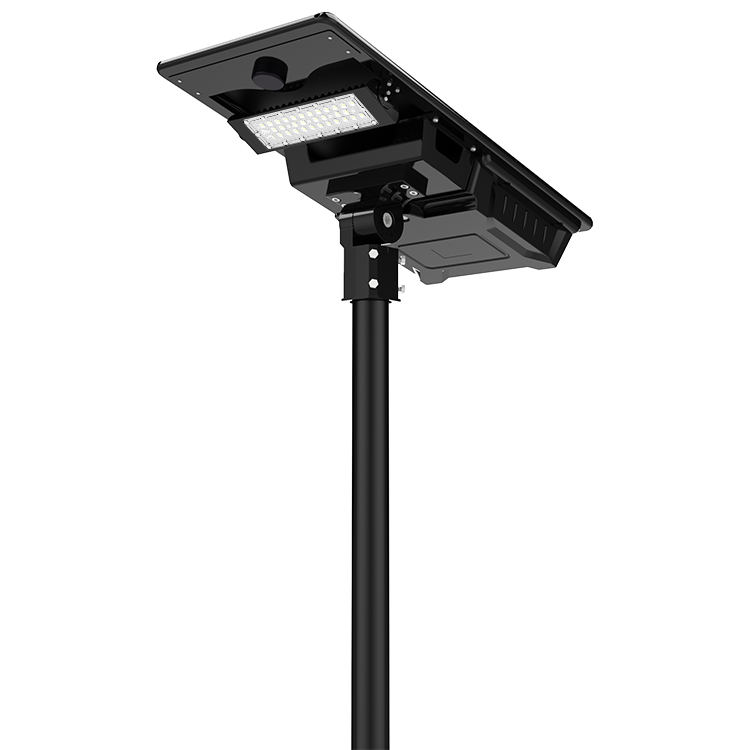
The SD series includes a 20 W configuration, which covers residential lanes and low-traffic rural roads where higher-wattage luminaires are oversized.
There is a second, less obvious effect. In solar systems, luminaire wattage is not an isolated choice — it drives the sizing of the panel, the battery and, in some cases, the pole. Standardising on a lower-wattage luminaire at the low end of a programme typically reduces the panel and battery capacity that must be purchased for the same road, which is where a meaningful share of the bill of materials sits. Buyers comparing two solar luminaires should therefore compare the delivered lumens required by the road class first, and the luminaire wattage second — a lower input wattage that still meets the illuminance target is the cheaper specification.
Efficacy at 210 lm/W versus 110 lm/W: the cost mechanism
LED efficacy describes how many lumens a luminaire produces for each watt of input power. The SD series is published at up to 210 lm/W; the BI-S5A is published at 110 lm/W. In a grid-connected installation, the practical consequence of that gap is a smaller electricity bill. In a solar installation, the consequence is structural rather than incremental, because energy is stored rather than drawn from a grid.
A solar street light runs from a battery charged by a panel. Every watt the luminaire consumes overnight must have been harvested during the day and stored. If luminaire A produces the same lumens as luminaire B using less power per hour, then luminaire A either draws down a smaller share of battery capacity over the night, or can be paired with a smaller battery and panel for the same autonomy. Since panel area, battery capacity and mounting hardware are among the largest cost components of a solar lighting bill of materials, higher luminaire efficacy propagates into system-level cost — not only into energy consumption.
That mechanism is why efficacy is usually the first figure a cost-sensitive solar project should interrogate, and also why it should be interrogated carefully:
- LED efficacy is not system efficacy. A 210 lm/W figure describes the LED output under specified conditions; the delivered luminaire efficacy, and the energy actually consumed at the battery, will be lower once driver losses, optics losses and control settings are accounted for.
- Efficacy varies with colour temperature and drive current. A headline number measured at one CCT does not automatically apply at another.
- Documentation converts a claim into a specification. LM-79 test reports and IES/LDT photometric files allow a buyer to verify the lumen output, power draw and distribution of the exact configuration being purchased rather than the family headline.
A disciplined comparison therefore uses the published lm/W figure to identify which candidate deserves investigation, and then uses test documentation to confirm which one performs as published.
Optics and light distribution
The SD series is published with T2, T3, T4 and T5 distribution options, which allows the same luminaire family to be matched to different road widths and pole spacings — narrower, more forward-throwing distributions for lanes, wider distributions for open residential junctions. Distribution data for the BI-S5A is not part of the comparison set used here, which means a buyer evaluating it should request the photometric files and confirm that the available optics match the road class, pole height and spacing already fixed in the design.
For public roads, distribution choice is rarely a free variable. Design practice such as ANSI/IES RP-8-21 for roadway and parking facility lighting, and the product safety requirements of IEC 60598-2-3 (EN 60598-2-3) for road and street luminaires, both push the specification toward defined uniformity, glare control and photometric proof. A luminaire without a matching IES file is difficult to defend in a design review, regardless of its headline wattage.
Control, energy management and maintenance
The SD series uses an MPPT controller with IoT support. MPPT (maximum power point tracking) continuously adjusts the operating point of the solar panel so that more of the available energy is harvested under partial shading, high temperature or low-irradiance conditions than a simple on/off or PWM charge regime would capture. Over a project's life, that difference shows up as fewer low-battery nights and, in marginal solar climates, as the difference between meeting autonomy targets and missing them.
IoT support changes the maintenance model rather than the photometry. A connected luminaire can report fault conditions — battery under-voltage, controller error, panel underperformance — without a site visit, which allows a maintenance team to schedule a repair instead of patrolling for failures. AOK's outdoor lighting project documentation also lists smart lighting control systems compatible with PIR/microwave controls among the matched equipment for its solar and street lighting deployments, enabling motion-based or occupancy-based dimming profiles that reduce nightly battery discharge on low-traffic roads.
One boundary deserves to be stated plainly. The SD luminaire is specified as IP65 for the fixture. Buyers who see higher ingress ratings quoted for separate solar controllers should confirm, in writing, which component the rating applies to and under which test standard, because the controller in an all-in-one luminaire is not the same item as the housing.
Modularity, serviceability and lifetime cost
In solar street lighting, the battery is a consumable. Any comparison that stops at the lumen figure ignores the component most likely to require attention first, and the labour cost of reaching it. This is where serviceability architecture becomes a procurement criterion rather than an engineering detail.
For the SD series, the published service-relevant facts are a 25.6 V / 30 Ah lithium battery, an MPPT controller, a monocrystalline panel, and a warranty of three years standard with a five-year option. What a buyer still needs to confirm in writing is the service path: whether the battery and controller can be replaced independently of the luminaire head, whether spare components are held as stock items, and what the warranty covers separately for the battery. The same set of questions applies to the BI-S5A, for which battery and service documentation is not part of this comparison set.
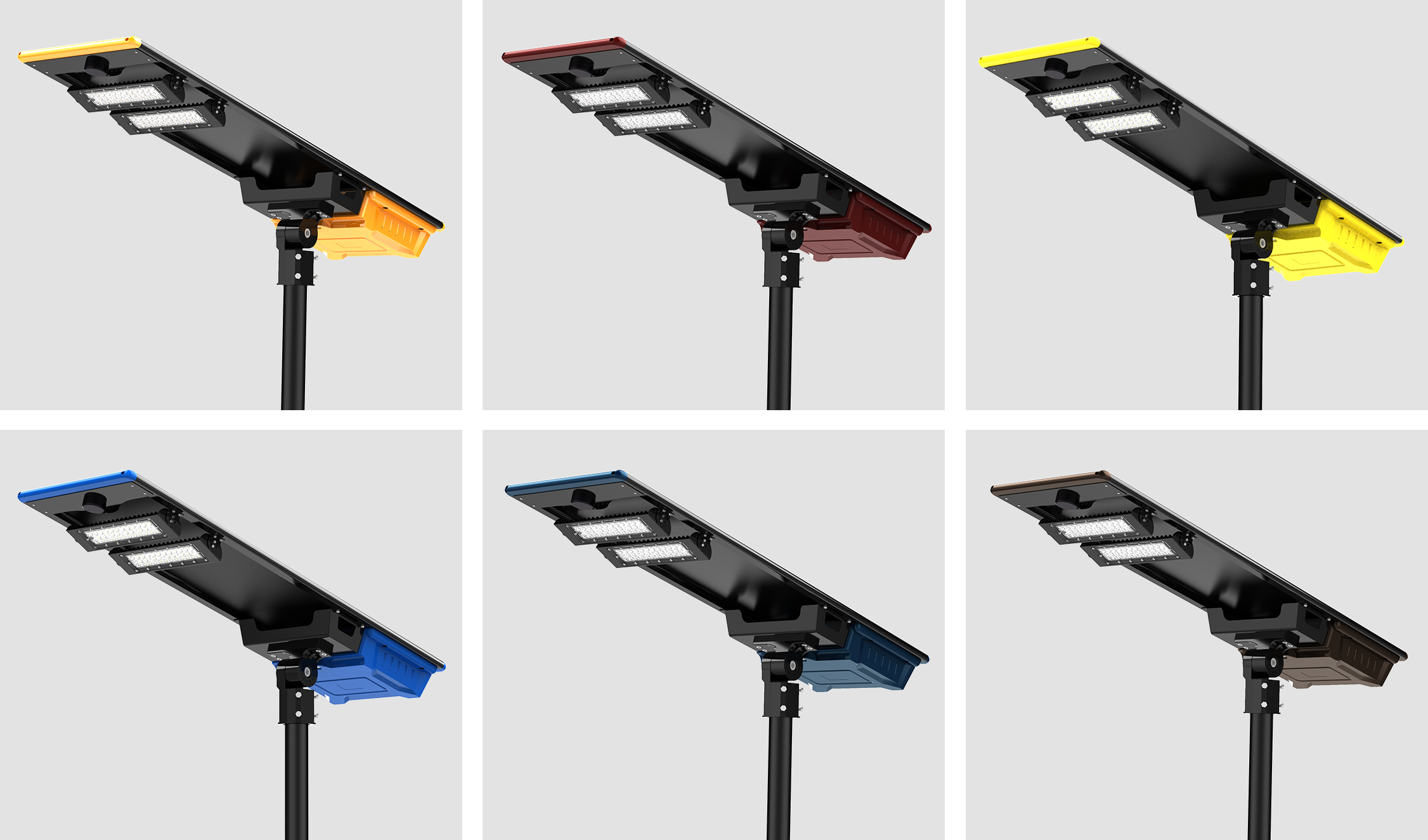
Housing finish of the SD series can be specified; buyers should confirm coating and colour requirements as part of the order specification rather than assuming a standard finish.
A practical way to convert these questions into a comparable figure is to ask each supplier for a five-year and a ten-year component replacement schedule with part numbers, then compare the two schedules rather than the two datasheets. That comparison will usually be more informative than a difference in warranty headline, because it shows which components a supplier expects to fail and at what interval.
Where the Balder BI-S5A remains the appropriate choice
An honest comparison has to say where the alternative fits, and the BI-S5A has legitimate positions in a shortlist.
- When the design band sits entirely at 70 W and above. If the road hierarchy in a project never requires a sub-70 W luminaire — for example, a single carriageway programme with uniform pole spacing and no residential tier — the wider power band of the SD series delivers no additional value, and the two products compete purely on efficacy, optics and service terms.
- When a pre-approved specification already exists. Projects that inherit a design, a bill of quantities or a framework agreement already written around a 70–120 W luminaire will incur re-approval cost if they switch. Specification continuity has a real cost, and it is a valid reason to retain the incumbent product.
- When regional service arrangements carry more weight than specification breadth. Where a buyer already has a service relationship, a spares pipeline or a trained maintenance contractor for a particular platform, the recurring cost of switching can exceed the saving implied by a specification gap. Service continuity is a legitimate evaluation criterion, not a soft one.
None of these points turns on performance. They turn on programme fit, and they are the reason a comparison article should not resolve into a single recommendation for every project.
Solar versus grid-connected and legacy alternatives
Both products sit inside a wider decision that is often made before the luminaire is chosen: whether the pole should be solar at all. Solar luminaires avoid trenching, cabling and distribution upgrades, which is why they dominate rural access roads and sites where the grid is distant or unreliable. Grid-connected LED street lighting, by contrast, becomes the lower-lifecycle-risk option once a reliable supply already reaches the pole, because it removes the battery replacement cycle and the dependence on seasonal solar resource from the maintenance plan.
The limitation that buyers most often underestimate is resource dependence. An all-in-one solar luminaire specified against an average irradiance figure can underperform in an unusually cloudy season, at a shaded site, or where a pole is repositioned during construction. Any comparison between an all-in-one solar product such as the SD series and a grid-connected alternative should be supported by a site-specific solar simulation using the actual latitude, shading profile and required autonomy, not by a datasheet duty cycle. Where that simulation is not available, the honest position is that the solar option carries an unquantified energy risk that a grid-connected design does not.
What this comparison does not tell you
Three gaps should be treated as active risks rather than omissions.
- No price data. Neither product's commercial terms are part of this comparison. Efficacy differences change the cost structure, but the final delivered cost per kilometre depends on panel, battery, pole, freight, duty and installation labour.
- No independent photometric verification. The 210 lm/W and 110 lm/W figures are supplier-published values, and neither has been independently measured for this article.
- No field degradation data. Cycle life, lumen maintenance and controller reliability over a ten-year horizon are not captured by any specification sheet, including those reviewed here.
An additional commercial parameter is worth noting because it affects programme planning: AOK's documented production terms include a minimum order quantity of 200 pcs, a lead time of 30–45 days and more than 28 quality inspection procedures in the production flow, with after-sales response within 24 hours and resolution within 48 hours. Buyers should obtain the equivalent terms for the BI-S5A before comparing schedules.
Buyer decision framework
| Decision driver | What to verify in writing | Why it changes the outcome |
|---|---|---|
| Power band coverage | Wattage options against each road class in the project | Determines whether one product family can serve the whole programme or whether a second family is required |
| Delivered lumens and efficacy | LM-79 report and IES/LDT files for the exact configuration | Confirms the lumen output being paid for and supports panel/battery sizing |
| Optical distribution | Distribution types matched to pole height and spacing | Drives uniformity and glare compliance in the design review |
| Energy management | Controller type, MPPT behaviour, dimming profile, sensor compatibility | Determines whether the system meets autonomy targets in marginal solar conditions |
| Serviceability | Component-level replacement path, spare part numbers, battery warranty | Battery replacement is the dominant recurring cost in solar street lighting |
| Compliance | Certification scope and the markets each certificate covers | Determines whether the product can be accepted on site without a waiver |
| Commercial terms | MOQ, lead time, after-sales response commitments | Determines whether the delivery schedule matches the construction programme |
Market trend: why specification depth is becoming the differentiator
The scale of the solar street lighting market — in the region of USD 5.0 billion to USD 6.29 billion in 2024 — means that the category is now procured at volume, and volume procurement tends to reward products that are easy to compare. Two trends follow from that.
First, buyers are shifting from luminaire-level comparisons to system-level comparisons. A 20 W versus 70 W starting point, or a 210 lm/W versus 110 lm/W efficacy figure, is only meaningful once it is translated into panel size, battery capacity, autonomy and service interval. Second, controllability is moving from an optional extra to a baseline expectation. MPPT control, IoT monitoring and sensor-compatible dimming are increasingly requested because they reduce the largest ongoing cost in a solar lighting programme — the site visit.
It is worth noting that third-party market estimates for this sector diverge substantially depending on scope. Grand View Research's USD 14.20 billion figure for outdoor LED lighting in 2024 and Precedence Research's larger 2025 projection illustrate that the definitions differ between reports; buyers should use these figures for directional planning rather than for budget-setting.
Future outlook
Over the next procurement cycles, three requirements are likely to become standard in solar street lighting tenders: verifiable photometric documentation for the exact configuration offered, component-level service and spares commitments covering the battery and controller, and site-specific solar simulation as a condition of acceptance. Products that can supply all three will be easier to approve, regardless of brand. Products that cannot will increasingly be evaluated on price alone, which is rarely a favourable position for either the buyer or the supplier.
For the two products compared here, the practical conclusion is specification-dependent rather than absolute. Where a programme needs wattage coverage from residential lanes to main roads, published efficacy at the higher end of the current market, and MPPT control with IoT monitoring, the SD series covers that brief within a single family. Where a programme is fixed entirely at 70 W and above, inherits a pre-approved design, or depends on an existing service arrangement, the BI-S5A remains a valid reference point and the deciding factors will be optics, service terms and commercial conditions rather than power band.
FAQ
What is the main documented specification difference between the AOK SD series and the Balder BI-S5A?
The published power band and the published LED efficacy. The AOK All-in-One Solar Street Light-SD is specified from 20 W to 120 W with LED efficacy up to 210 lm/W, while the Balder BI-S5A is published at 70 W to 120 W with 110 lm/W. The SD series also publishes T2/T3/T4/T5 distributions, an MPPT controller with IoT support, a 25.6 V / 30 Ah lithium battery and IP65 luminaire waterproofing; equivalent data for the BI-S5A is not part of the compared specification set.
Why does LED efficacy in lm/W affect the cost of a solar street light project?
In a solar luminaire, energy is stored rather than drawn from a grid, so the power a luminaire consumes overnight must be harvested by the panel during the day. A luminaire that delivers the same lumen output at higher efficacy consumes fewer watts per hour, which either extends the autonomy achieved from a given battery or allows a smaller battery and panel to meet the same autonomy target. Because panel, battery and mounting hardware are significant cost components in a solar lighting bill of materials, higher luminaire efficacy can reduce system-level cost and not just energy consumption.
Which of the two is the better fit for residential roads and low-traffic rural roads?
It depends on the wattage the road class requires. Residential lanes and low-traffic rural access roads are frequently served by luminaires below 70 W; the SD series documents a 20 W entry point, whereas the BI-S5A's published range begins at 70 W. That does not make one product better than the other — it means the SD series can cover the low-wattage tier inside the same product family, while a programme built entirely on the BI-S5A would need a separate product for that tier or a higher installed wattage. Buyers should derive the required wattage from road class, pole spacing and illuminance targets before comparing the two.
What control and maintenance features should buyers verify in a solar LED street light?
The controller type and its behaviour under low-irradiance conditions, the dimming profile and whether it can be paired with PIR or microwave sensing, the availability and interval of remote monitoring, and the component-level service path for the battery and controller. The SD series specifies an MPPT controller with IoT support, a 25.6 V / 30 Ah lithium battery and a warranty of three years standard with five years optional, and AOK's outdoor lighting project documentation lists smart lighting control systems compatible with PIR/microwave controls among matched equipment. Buyers should confirm separately whether the battery and controller can be replaced independently of the luminaire head.
What documentation should a buyer request before deciding between the two?
LM-79 test reports and IES/LDT photometric files for the exact configuration offered, LED LM-80 data with TM-21 projections for lumen maintenance, the battery datasheet including cycle life, ingress protection test reports with the standard cited, the certification scope and the markets each certificate covers, a site-specific solar simulation using actual latitude, shading and autonomy requirements, and the warranty, spare parts and after-sales terms in writing. A specification comparison built only on datasheet headlines — including the one in this article — is a shortlisting tool, not a substitute for that documentation.
Summary
The AOK All-in-One Solar Street Light-SD and the Balder BI-S5A overlap at 70–120 W and diverge below that, and they are separated most clearly by published LED efficacy — up to 210 lm/W against 110 lm/W — which in solar applications propagates into panel and battery sizing rather than only into energy cost. The SD series additionally publishes T2/T3/T4/T5 optics, MPPT control with IoT support, a 25.6 V / 30 Ah lithium battery and CE / FCC / RoHS certification, making it a reasonable fit for cost-sensitive programmes that need wattage coverage from residential lanes to main roads together with smart control options. The BI-S5A remains a valid reference where the design band sits entirely at 70 W and above, where a pre-approved specification exists, or where existing service arrangements carry more value than specification breadth.
AOK's full product brochure, including solar street lighting and outdoor LED lighting specifications, can be downloaded here: AOK Industrial Company Limited — product brochure.