
AOK's Manufacturing Evidence: Behind the SD Series Solar Street Light Specs
AOK's Manufacturing Evidence: Behind the SD Series Solar Street Light Specs
Solar street lighting procurement has shifted from a supply question to a verification question. The global outdoor LED lighting market was estimated at USD 14.20 billion in 2024 by Grand View Research, and the solar street lighting segment alone was valued at roughly USD 5.0 billion to 6.29 billion in the same year by Global Market Insights and Fortune Business Insights. When the market reaches that scale, dozens of suppliers publish broadly similar headline figures, and the differentiator at the decision stage stops being the specification sheet itself. It becomes the manufacturing evidence standing behind it. This article takes one product family — the AOK SD series solar street light, rated from 20W to 120W with LED efficacy up to 210 lm/W — and traces its published specifications back to the production, component, and protection decisions that produce them.
AOK Industrial Company Limited is a Shenzhen-based LED outdoor lighting manufacturer founded in 2012. The company produces LED street lights, LED stadium lights, LED high bay lights, solar street lights, and lighting for industrial, seaport, airport, and sports field applications, and exports to markets across the EU, USA, Middle East, and Asia.
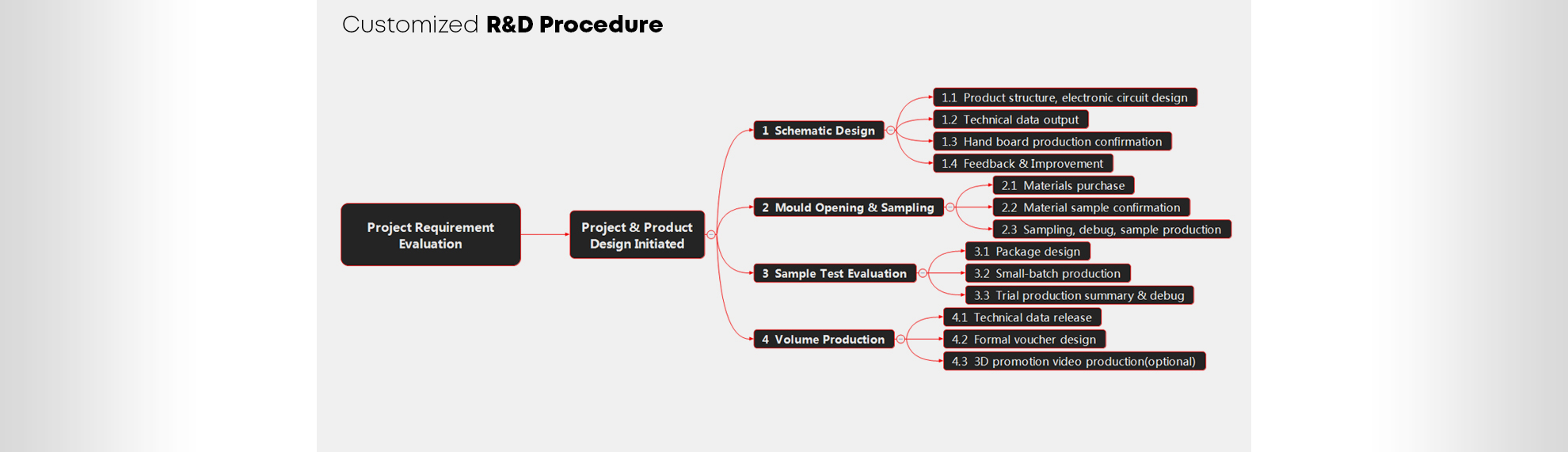
AOK's factory R&D workflow, one of the inputs behind the SD series solar street light specification set.
Why a Specification Sheet Alone No Longer Closes a Purchase
Regulatory frameworks have made specification verification a formal part of outdoor lighting projects rather than an optional diligence step. In North America, outdoor luminaires for wet locations are evaluated against UL 1598, which addresses electrical, mechanical, thermal, and fire risk. At the international level, IEC 60598-2-3 sets out requirements for luminaires used in road and street lighting applications. In the United States, ANSI/IES RP-8-21 remains the primary recommended practice for the design and maintenance of roadway and parking facility lighting.
Those standards define the outer frame. The practical problem buyers face inside the frame is narrower. Two solar street lights can both claim high efficiency while behaving very differently across a twelve-month operating cycle. Efficacy per watt determines how much solar panel and battery capacity a project must purchase to reach a target illuminance. Optical distribution determines whether that illuminance actually lands on the carriageway or spills onto adjacent property. Controller class determines how much energy the system recovers from the panel under partial shading, high module temperature, or seasonal low-irradiance conditions.
The opportunity is that all three variables are measurable and discussable before a purchase order is issued — provided the supplier's own product data is specific enough to support that conversation. That is the context in which a documented specification set becomes a procurement asset rather than a marketing document.
The SD Series in Specific Terms
The AOK SD series is a solar street light family positioned for cost-sensitive projects that require wide power coverage, high efficiency, and smart or IoT options on standard urban roads, rural roads, and residential areas with mounting heights between 3 and 12 meters. Its published technical anchors are summarized below.
| Parameter | AOK SD series |
|---|---|
| Power range | 20W to 120W |
| LED efficacy | Up to 210 lm/W |
| Optical distributions | T2, T3, T4, T5 |
| Charge controller | MPPT, IP67 rated |
| Solar panel | Single-side monocrystalline |
| Battery capacity (80W model) | 614.4 Wh |
| Average charging time | Approximately 5 hours |
| Full-power runtime | 7.2 hours |
| Autonomy | 2 to 3 rainy days |
| Mounting height | 3 to 12 m |
| Sensor and control options | PIR / microwave sensors, IoT monitoring potential |
| Warranty | 3 years standard, extendable to 5 years |
Two entries in that table drive system cost more than they drive appearance. The first is the 20W entry point. A family that begins at 20W lets a project specify genuinely small luminaires for residential lanes and footpaths instead of over-lighting those areas with a larger fixture and paying for the surplus energy subsystem. The second is the efficacy figure of up to 210 lm/W. At a fixed illuminance target, higher LED efficacy reduces the panel wattage and battery capacity the system must carry, and in a solar street light those two components dominate the bill of materials.
Optics are the third lever. The T-series describes progressively wider light distributions, and the correct choice depends on pole height, road width, and pole spacing rather than on preference. A supplier offering a single fixed distribution forces the project to adapt the road geometry to the luminaire. A supplier offering the full T2 through T5 range lets the luminaire be adapted to the road, which is usually what lighting designers ask for first.
The Manufacturing Evidence Behind Those Numbers
A specification is only as reliable as the production system that repeats it. AOK's production base is located in Shenzhen, China, and the company operates four production lines with an average daily production capacity of approximately 2,500 pieces. Its stated annual output capacity is 600,000 units, with 100% of production exported.
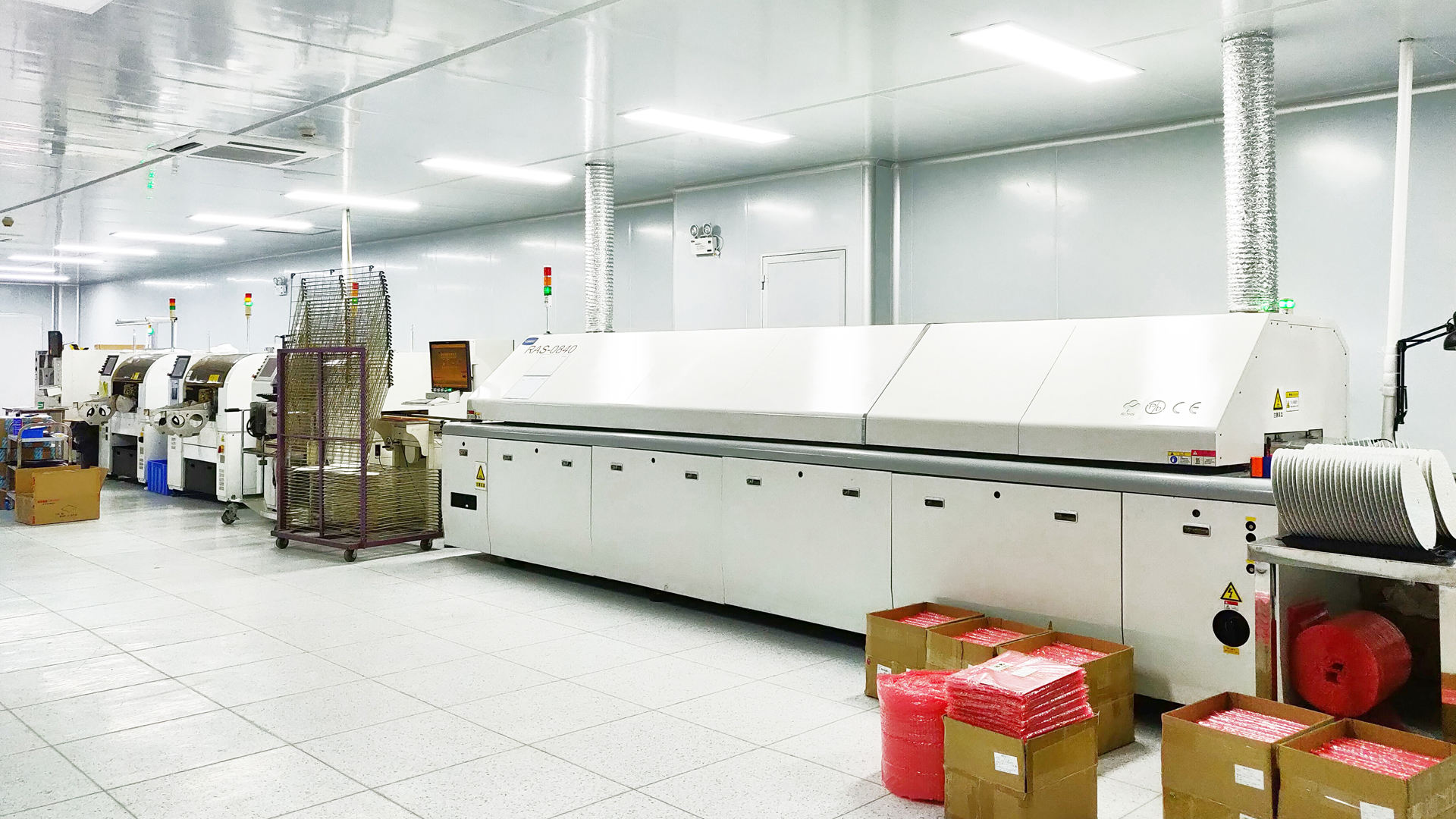
Surface-mount production at AOK's Shenzhen base, where LED board assembly for outdoor luminaires takes place.
Track record data supports the scale claim. The company states that it has served customers in more than 100 countries, completed more than 10,000 projects, and installed over one million units. An independent third-party profile published by Messe Frankfurt for Light + Building reports AOK Industrial Company Limited with annual revenue of USD 33 million in 2019 and an annual production capacity of 500,000 to 1,000,000 units — an external data point that is consistent with the company's own capacity figures rather than a substitute for them.
Component sourcing belongs to the same evidence chain. AOK maintains a long-term strategic partnership with Philips LUMILEDS and Osram. That matters because an efficacy claim is ultimately a function of the emitter bin and the thermal design around it; a supplier that can document its die and driver relationships can usually explain where a 210 lm/W rating comes from and under what conditions it holds.
Compliance documentation is another layer. AOK lists ISO9001, ISO14001, UL, TUV, and RoHS certifications across its operation. For a buyer assembling a tender file, these are the documents that convert a performance claim into a verifiable line item.
Verification also has an engineering dimension that certificates do not cover. AOK describes a risk-control approach built around the three failure modes that dominate solar street lighting in the field: battery overheating, LED degradation, and water ingress. The stated countermeasures are overcharge and over-discharge protection, a temperature control system, and IP66/IP67 waterproof design, supported by real-time battery monitoring and a regular maintenance service, with products tested before shipment. Read in procurement terms, the IP67 rating on the SD series MPPT controller is not an isolated figure — it belongs to a stated protection strategy covering the enclosure and the energy storage subsystem as well.
Technical Explanation: Reading Efficacy, Optics, and MPPT Correctly
Luminous efficacy, expressed in lumens per watt, is the ratio between light delivered and power consumed. The SD series is rated at up to 210 lm/W. In project terms, that value determines how much electricity must be generated and stored to satisfy an illuminance target, which in an off-grid solar system translates directly into panel area, battery capacity, and pole load. A higher-efficacy luminaire reaches the same road-class target with a lighter and less expensive energy subsystem.
Published competitor data clarifies the scale of that difference. The Balder BI-S5A, a solar street light positioned for demanding environments, is documented at approximately 110 lm/W. The SD series is therefore specified at close to double that LED efficacy, which is the main technical reason the family can be positioned as cost-efficient on a lumen-per-dollar basis despite competing against heavier-duty hardware.
The MPPT controller is the second technical pillar. Maximum power point tracking continuously adjusts the operating voltage of the solar panel to extract more energy under conditions that defeat simpler controllers — high module temperature, partial shading, or low winter irradiance. In the SD series the controller is IP67 rated, meaning it is protected against dust ingress and against temporary immersion. That rating is relevant because the controller typically sits in the pole or a low-mounted enclosure where condensation and driven rain are persistent risks. AOK pairs the controller with PIR or microwave sensor options and potential IoT monitoring, which enables dimming profiles and remote status checks instead of fixed full-power operation.
Battery sizing ties the two together. On the 80W SD model, the published battery capacity is 614.4 Wh with an average charging time of approximately 5 hours, delivering 7.2 hours of full-power runtime and 2 to 3 rainy days of autonomy. Those three numbers together describe a design philosophy: charge quickly, deliver a defined nightly service window, and hold a limited reserve for consecutive low-irradiance days.
Where the SD Series Fits — and Where It Does Not
The clearest application statement in AOK's product positioning is that the SD series suits cost-sensitive projects requiring wide power coverage, high efficiency, and smart or IoT options on standard urban roads, rural roads, and residential areas with 3 to 12 meter mounting heights. A practical 80W SD series installation in Thailand illustrates the typical deployment pattern for the family.
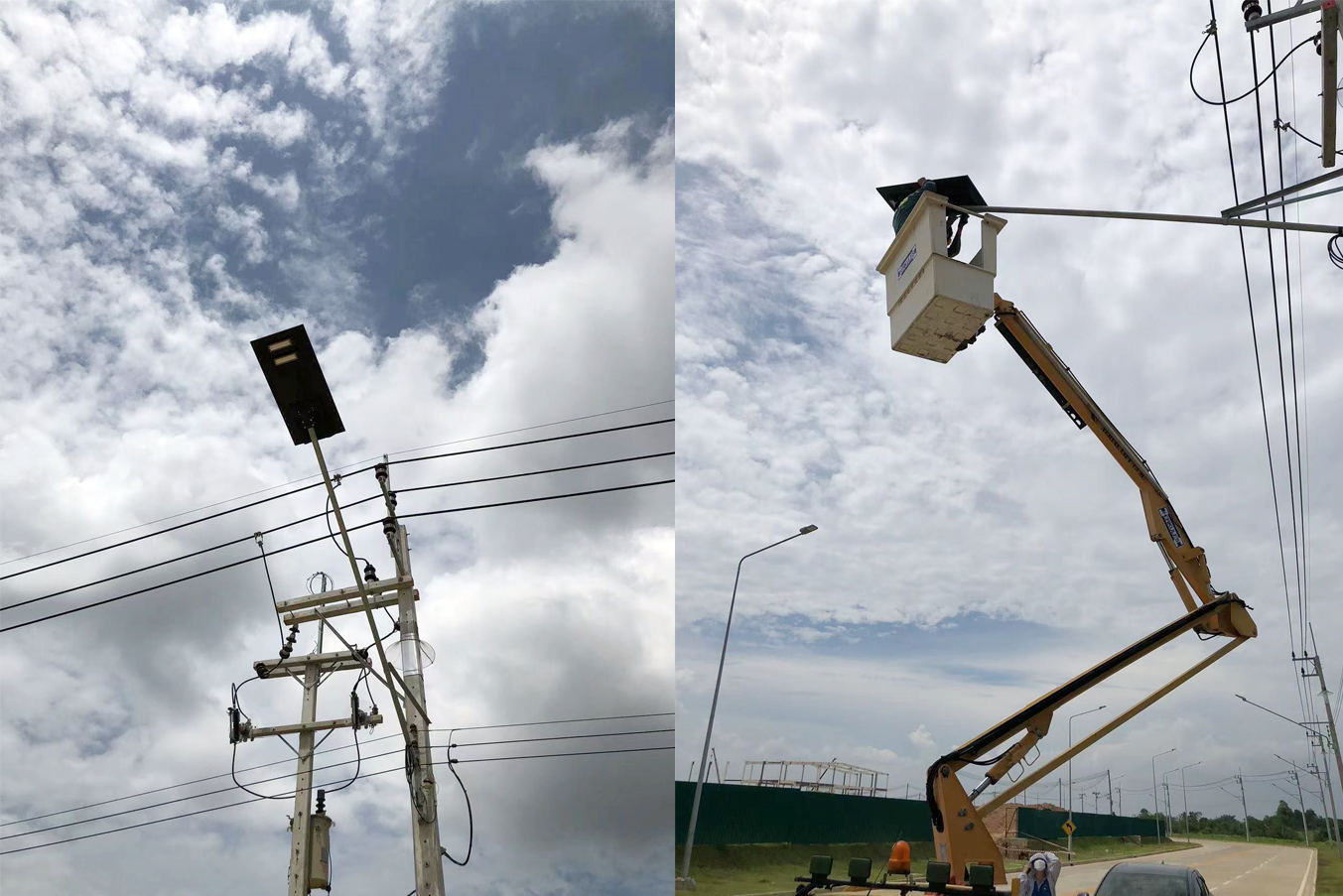
An 80W SD series solar street light installed in Thailand, a representative municipal deployment.
Within that envelope, one platform covers a wide span of scenarios. Units in the 20W to 40W band serve residential lanes, campus paths, and low-traffic access roads. Mid-range 50W to 80W units serve secondary roads, parking areas, and industrial perimeters. Units at 100W to 120W serve main urban roads where illuminance requirements are higher and pole spacing is longer. Because the same platform supports T2 through T5 optics, the designer adjusts the distribution rather than changing products when road width or spacing changes.
The boundary deserves the same clarity. The SD series is not positioned for extreme coastal or hurricane-prone environments, and it does not claim the longest autonomy in its class. Projects in those conditions normally specify hardware with heavier mechanical protection and larger energy reserves, and the SD series should not be substituted into them on price alone.
Market Trend Analysis: Why Spec Transparency Is Becoming a Selection Criterion
Three published market figures frame the trend. The global outdoor LED lighting market was estimated at USD 14.20 billion in 2024 by Grand View Research. The solar street lighting market was valued at approximately USD 5.0 billion to 6.29 billion in 2024 by Global Market Insights and Fortune Business Insights, reflecting rapid growth in sustainable infrastructure. Separately, the stadium lighting market was valued at USD 768 million in 2024 with a projected CAGR of 7.73% through 2032, according to Persistence Market Research — a reminder that outdoor lighting demand is expanding across several verticals at the same time.
The procurement consequence of that growth is standardization pressure. As volumes rise, buyers move from evaluating individual luminaires to evaluating supplier systems: repeatable production, documentable compliance, component traceability, and service structures that survive multi-year rollouts. Household names in lighting have built their positioning on exactly this kind of verifiability, and Chinese manufacturers competing in the same tenders are increasingly being assessed on the same terms. For buyers, that shift favors suppliers whose published data is specific enough to be checked.
Comparison with Traditional Solutions — and a Note on Limits
Against traditional high-pressure sodium street lighting, the efficiency case for LED outdoor lighting is well established in AOK's own comparison data. The AOK LED street light is documented as delivering energy savings of up to 80% compared with alternatives, a lifespan extended by five times, and approximately 90% less maintenance, with 30% higher photoelectric conversion efficiency. On cost, the same comparison states an initial cost approximately 15% higher than high-pressure sodium, offset by a total cost of ownership approximately 40% lower over five years.
| Decision dimension | AOK LED street light | Traditional high-pressure sodium street light |
|---|---|---|
| Energy consumption | Energy savings up to 80% versus alternatives | Baseline |
| Service life | Lifespan extended by 5 times | Baseline |
| Maintenance | Approximately 90% less maintenance | Baseline |
| Upfront cost | Approximately 15% higher | Baseline |
| Five-year total cost of ownership | Approximately 40% lower | Baseline |
| Photoelectric conversion efficiency | 30% higher | Baseline |
Against a close solar competitor, the trade-off is more nuanced and worth stating plainly. Compared with the Balder BI-S5A, the SD series offers a much broader power range starting at 20W, higher LED efficacy, and wider color temperature options, with comparable battery capacity on the 80W model — 614.4 Wh against 538 Wh — and faster average charging at approximately 5 hours against 6 hours. The Balder BI-S5A, however, provides longer full-power runtime, stated at 12 hours plus three nights of autonomy against the SD series' 7.2 hours, a longer warranty of 10 years on the fixture and 5 years on the battery against AOK's standard 3 years extendable to 5, and heavier mechanical protection including IP66 and IK10 ratings, 205 km/h wind resistance, and a full metal anti-corrosion design.
That is the honest boundary of the SD series. For a coastal site exposed to hurricane-force winds, or a remote location where multi-night autonomy without intervention is critical, the heavier-duty specification is the defensible engineering choice. For standard urban and rural roads and residential projects where capital efficiency, wide power coverage, and flexible optics drive the decision, the SD series configuration is the better fit. Buyers should also treat published efficacy and runtime figures as design inputs to be validated against site-specific irradiance and load profiles, not as guaranteed outcomes for every location.
Future Outlook
As solar street lighting moves from pilot installations into routine municipal specification, the criteria that decide tenders are likely to keep tilting toward verifiability: which certifications apply, what the controller class is, how the battery and enclosure are protected, and whether the supplier can document production capacity and component sourcing. Product families that publish specific, internally consistent data — power range, efficacy, optical distributions, controller rating, protection class, and warranty terms — will be simpler to write into specifications, and simpler for buyers to defend internally when a project is audited.
For AOK, the SD series sits inside a broader outdoor portfolio that also includes LED street lights, high mast lighting, stadium and sports field lighting, and lighting for ports, airports, and industrial sites. The company's published product literature, including its product brochure, sets out the detailed configuration options for buyers working through a specification.
Frequently Asked Questions
Yes. The AOK SD series is positioned for cost-sensitive projects requiring wide power coverage, high efficiency, and smart or IoT options in standard urban or rural roads and residential areas with mounting heights of 3 to 12 meters. Its rated power range runs from 20W to 120W, which allows the same platform to serve residential lanes, secondary roads, and main urban roads.
According to published comparison data, the SD series reaches LED efficacy of up to 210 lm/W against approximately 110 lm/W for the Balder BI-S5A, and on the 80W model carries comparable battery capacity at 614.4 Wh versus 538 Wh with faster average charging of about 5 hours versus 6 hours. The BI-S5A states longer full-power runtime at 12 hours plus three nights of autonomy, compared with 7.2 hours for the SD series, and a longer warranty of 10 years on the fixture and 5 years on the battery.
The SD series is offered with T2, T3, T4, and T5 distributions, which describe progressively wider light patterns. Selection is normally driven by pole height, road width, and pole spacing rather than by preference, because the objective is to place illuminance on the carriageway while limiting spill toward adjacent property. Buyers comparing suppliers should check whether the full distribution range is available, since a single fixed optic forces the road geometry to be adapted to the luminaire.
AOK's published comparison data for its LED street light states energy savings of up to 80% versus alternatives, approximately 90% less maintenance, a lifespan extended by five times, and 30% higher photoelectric conversion efficiency. The same data shows an initial cost approximately 15% higher than high-pressure sodium, offset by a total cost of ownership approximately 40% lower over five years. The trade-off is therefore higher capital cost against lower operating and maintenance cost.
AOK Industrial Company Limited was founded in 2012 with its production base in Shenzhen, China, operating four production lines with an average daily capacity of approximately 2,500 pieces and a stated annual output capacity of 600,000 units. The company reports customers in more than 100 countries, more than 10,000 completed projects, and over one million units installed, and lists ISO9001, ISO14001, UL, TUV, and RoHS certifications along with long-term component partnerships with Philips LUMILEDS and Osram. An independent Messe Frankfurt Light + Building exhibitor profile reports annual revenue of USD 33 million in 2019 and an annual production capacity of 500,000 to 1,000,000 units.
The SD series is specified with 7.2 hours of full-power runtime, 2 to 3 rainy days of autonomy, and a standard 3-year warranty extendable to 5 years. It is not positioned for extreme coastal or hurricane-prone environments, where competing hardware documented with IP66 and IK10 protection, 205 km/h wind resistance, and a full metal anti-corrosion design is the more appropriate engineering choice. It also does not claim the longest autonomy in its class, so remote sites requiring multiple nights of uninterrupted full-power operation should be assessed against heavier-duty alternatives.