
API Procurement FAQ: Reading Assay and Impurity Statements
API Procurement FAQ: Reading Assay and Impurity Statements
An assay range of 98.0% to 102.0% on the dried basis and an impurity-control statement answer two different questions. The assay range defines the window a validated test result must fall inside before a batch is released; the impurity statement defines which unwanted substances are controlled, by which method, and at which limits. For a cardiovascular API buyer preparing an RFQ, neither line is self-explanatory until the basis, the analytical method, the pharmacopoeial reference and the storage conditions are read together.

This FAQ is written for the evaluation-to-execution stage of procurement: the buyer who already knows which molecule the formulation needs and is now comparing specification documents, certificates and supply terms before issuing a request for quotation. The worked examples are drawn from cardiovascular APIs manufactured by Changzhou Ruiming Pharmaceutical Co., Ltd., a manufacturer of active pharmaceutical ingredients and intermediates for cardiovascular, urinary, respiratory and digestive applications, founded in 2005 and based at No.1558 Longjiang North Road, Chunjiang Town, Xinbei District, Changzhou City, Jiangsu Province, China.
1. Why the specification belongs inside the commercial offer, not behind it
A price and a delivery date describe the transaction. A specification describes what is actually being bought. When a manufacturer publishes an assay range, an impurity statement and a storage condition, those clauses determine whether the material can be used in a specific registration, whether an incoming laboratory can release it, and how much inventory risk the buyer carries between shipments.
Specification sheets for oral solid-dosage APIs commonly carry identification, assay, related substances, loss on drying, residual solvents and appearance items, but the exact list is product-specific and should never be assumed from a neighbouring product. A buyer reviewing cardiovascular APIs is therefore comparing two things at once: whether the specification matches the pharmacopoeial monograph claimed, and whether the supplier's documentation set is complete enough to support the buyer's own filing and release process.
The practical consequence is straightforward. An RFQ that asks only for quantity, price and lead time will receive responses that cannot be compared. An RFQ that names the monograph edition, the assay basis, the impurity items requiring a limit statement, the packaging format and the re-test period produces responses that can be placed side by side.
2. Reading an assay range: what the number is measured against
An assay range states the acceptable result of a validated quantitative test at the point of batch release. It does not state a typical value, a process capability, or a stability guarantee across the product's shelf life. Two suppliers can publish identical ranges and still differ in method, sample preparation and the number of replicates behind the release decision.
The basis clause changes the result
"On the dried basis" means the measured content is corrected for volatile matter determined by the loss-on-drying method in the specification. A result expressed on the dried basis will differ numerically from the same material expressed on the anhydrous basis or on an as-is basis, and the difference is not an analytical error. Buyers comparing two specification sheets should confirm that both use the same basis and the same drying conditions before drawing any conclusion about which supplier controls the material more tightly.
Why the width of the range matters
Take two cardiovascular APIs from the same portfolio. A specification for Levoamlodipine Besylate may state an assay of 98.0% to 102.0% on the dried basis, while Felodipine may be stated at 98.0% to 101.0% on the dried basis. The two windows are not equivalent in procurement terms: a narrower upper bound leaves less analytical and process variability to absorb inside release testing, which usually implies tighter control over crystallisation, drying and blending steps. Neither range should be read as a statement about impurity content, and neither replaces the related-substances section of the same specification.
Both products appear in the Jiangsu Medical Products Administration GMP compliance inspection notice JSMPA Yao Sheng Gao Zhi〔2024〕No. 278, issued on 14 September 2024, which lists Amlodipine Besylate API, Felodipine API, Propafenone HCl API, Methoxyphenamine HCl API and Levamlodipine Besylate API within its scope. That notice confirms a manufacturing compliance position; the assay figures come from the product specification, which is a separate document and should be requested as such.
Three questions that convert a range into a decision
- Which method? Titration and HPLC produce results that are not interchangeable, and the specification should name the method used.
- Which sample and how many replicates? A release decision built on a single determination carries different risk from one built on replicate analysis.
- What happens near the limits? Ask how an out-of-trend result close to the lower bound is investigated, because that is where a buyer's own incoming testing is most likely to disagree.
3. Impurity statements: from "controlled" to a comparable limit
An impurity statement is useful only when it is specific. "High purity" is not a specification item. A reviewable statement names each specified impurity, gives a limit, identifies unspecified impurity and total impurity limits, and states the analytical method. Where the specification follows a pharmacopoeial monograph, the monograph supplies the framework; where the supplier applies additional process-specific controls, those should be visible rather than implied.
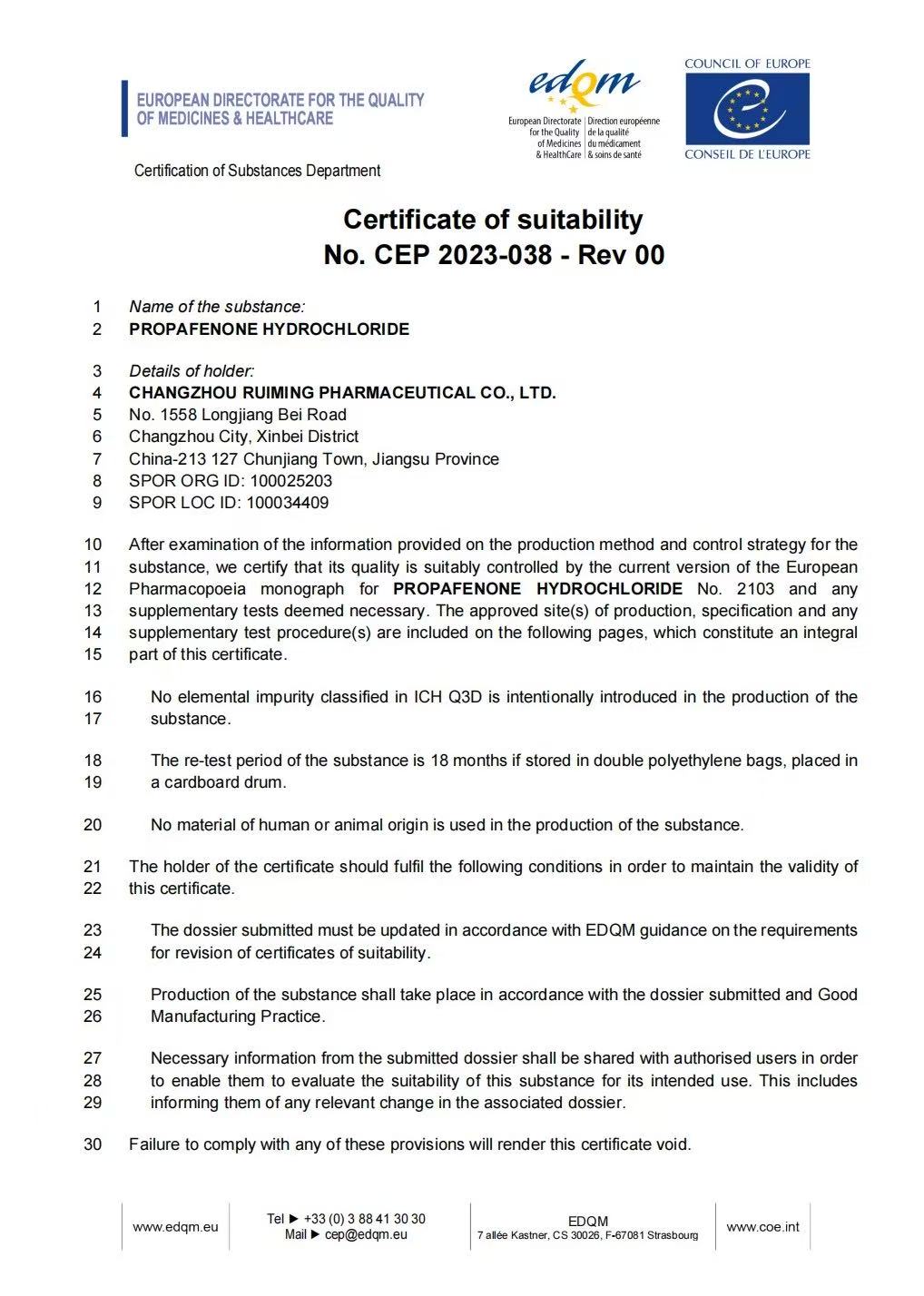
For Amlodipine Besylate, the EDQM Certificate of Suitability R1-CEP 2008-074 - Rev 01, dated 3 March 2022, states that the quality of the substance complies with European Pharmacopoeia monograph No. 1491 in its current edition including supplements, and that the manufacturing process, including purification, involves no intentionally added ICH Q3D elemental impurities. For Propafenone Hydrochloride, Certificate of Suitability CEP 2023-038 - Rev 00, issued on 18 February 2025, references European Pharmacopoeia monograph No. 2103 and adds that no human or animal derived materials are used in production.
What those statements establish, and what they do not
The phrase "no intentionally added ICH Q3D elemental impurities" describes the manufacturing process: no elemental impurity is deliberately introduced as part of synthesis. It is not a substitute for the elemental impurity risk assessment that the buyer's own filing may require, and it does not replace the specification's control of residual metals where such controls exist. Likewise, the absence of human or animal derived materials in Propafenone Hydrochloride production is a statement about raw-material origin, not a statement about every excipient used downstream.
Where a market requires an assessment of potentially mutagenic impurities, the buyer should ask whether the supplier can provide the corresponding statement for the specific product, rather than assume that a pharmacopoeial monograph covers it. This is a document request, not an inference about any supplier's capability.
Comparing two COAs without being misled
A certificate of analysis should be read as actual results against the specification, not as a restatement of limits. The comparison that matters is between the reported result, the limit, the method and the batch date. A COA showing a result far inside the limit tells the buyer something about that batch; it does not automatically describe the distribution of future batches. Ruiming states that batch release testing is performed in compliance with Ph.Eur. requirements and that a COA together with an impurity profile is available, which is the correct level of detail on which to base a document request.
4. Pharmacopoeial compliance: what a CEP covers, and what sits beside it
A Certificate of Suitability addresses one question: whether the quality of a defined substance can be controlled by the named pharmacopoeial monograph, with the manufacturing site and process described in the certificate and its annexes. It is issued by the EDQM and it is product-specific. It does not certify the manufacturer's quality system in general, and it does not transfer to another molecule produced at the same site.
GMP documentation sits beside the CEP rather than inside it. For Amlodipine Besylate, the Certificate of GMP Compliance of a Manufacturer FIMEA/2023/006159 was issued by the Finnish Medicines Agency on 18 April 2024, covering manufacture of the active substance by chemical synthesis, including intermediate manufacturing, crude API production, salt formation, crystallisation, purification, finishing steps, packaging and quality control testing, under Directive (EU) 2017/1572 and/or Commission Delegated Regulation (EU) 2017/1569 and Article 47 of Directive 2001/83/EC. The explicit mention of salt formation is useful to a buyer reading the file, because it places the amlodipine base to besylate conversion inside the inspected scope rather than outside it.
For EU-bound shipments, a written confirmation for active substances exported to the EU, JS250256, issued by the Jiangsu Medical Products Administration on 20 October 2025 and valid until 19 October 2028, states that Amlodipine Besylate produced by chemical synthesis complies with EU GMP and WHO ICH Q7 and is subject to regular regulatory inspections. A buyer assembling a supplier file for a European filing should check that the written confirmation is current at the time of the order, because its validity window is finite and independent of the CEP.
5. Storage, re-test period and packaging: the clauses that change planning
Re-test period and storage conditions are procurement variables, not housekeeping details. They set how long material may be held before re-testing, how incoming inspection is scheduled, and how much safety stock is rational relative to the supplier's lead time.
The two certificates differ in a way that directly affects inventory planning. Amlodipine Besylate carries a re-test period of 36 months under CEP R1-CEP 2008-074 - Rev 01, while Propafenone Hydrochloride carries a re-test period of 18 months under CEP 2023-038 - Rev 00. A buyer sourcing both molecules on the same purchasing calendar will need a shorter rotation cycle and a tighter re-order point for the propafenone line, even if the order quantities and delivery terms are identical.
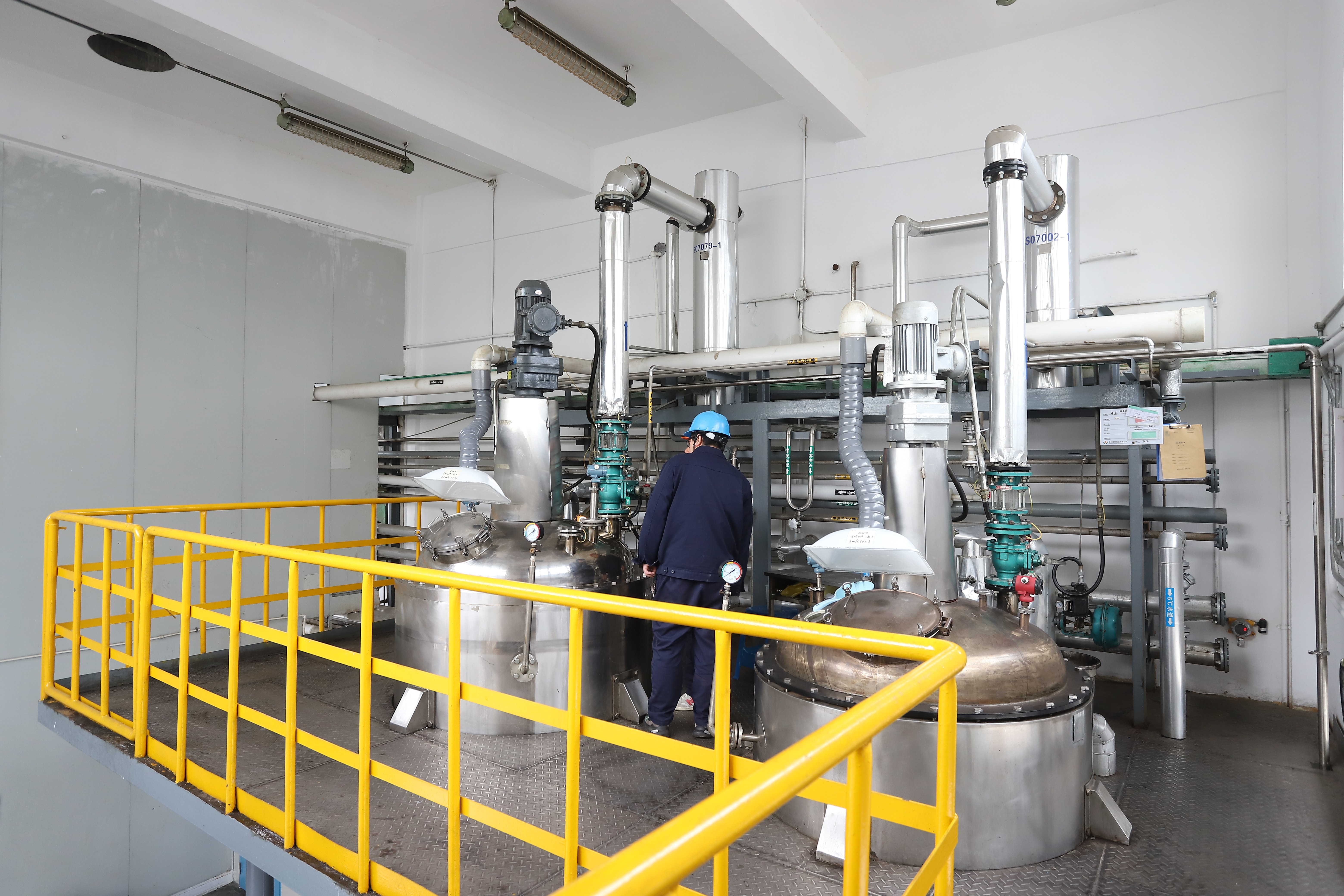
Packaging should be stated explicitly in the RFQ response. Ruiming's Amlodipine Besilate packing specification is 25 KG per drum, and the applicable handling guidance describes solid API in sealed packaging, protected from light and moisture and stored at ambient temperature away from direct sunlight, with double PE bags inside fibre drums. Buyers should confirm that the stated packaging matches their own dispensing and cleanroom handling, because a 25 kg drum and a smaller custom pack create very different manual handling and repackaging requirements downstream.
Supply terms belong in the same review. Ruiming's stated monthly API production capacity is 15 tons, with a typical production and delivery lead time of 45–60 days after order confirmation and advance payment, and an annual output figure of 180 tons for the Amlodipine Besilate line at 25 KG per drum. Minimum order quantity is not strictly fixed and is negotiable according to project requirements. These figures are planning inputs supplied by the manufacturer; a buyer should confirm them in the quotation for the specific product and quantity rather than treat them as a commitment for every molecule in the portfolio.
6. The pre-RFQ document checklist
The fastest way to reduce back-and-forth during evaluation is to attach a document list to the RFQ itself. The table below sets out what a buyer should request, and what each item is used for.
| Document or clause | What it establishes | What the buyer still has to confirm |
|---|---|---|
| Current product specification | Assay range, basis, method, impurity limits, loss on drying | Monograph edition and whether the basis matches the buyer's release method |
| Certificate of analysis, recent batch | Actual results against limits for one batch | Batch date, method used, and whether results are typical or representative |
| CEP or equivalent suitability certificate | Substance-level compliance with the named monograph | That the product name and manufacturing site appear on the certificate and annex |
| GMP certificate or inspection notice | Inspected manufacturing scope and steps | That the specific product and production line fall inside the stated scope |
| Written confirmation (EU export) | Export route compliance for the named substance | That it remains valid at the intended shipment date |
| Re-test period and storage statement | Retest interval and handling conditions | Alignment with the buyer's warehouse conditions and inventory rotation |
| Packaging specification | Drum size, inner liner, light and moisture protection | Fit with dispensing, cleanroom transfer and repackaging practice |
| Change notification policy | How process or specification changes are communicated | Whether the notice period matches the buyer's own change-control procedure |
A checklist of this kind also protects the buyer from a common error: treating a certificate as covering a whole portfolio. A certificate for Amlodipine Besylate does not speak for Felodipine, Levoamlodipine Besylate or Propafenone Hydrochloride, each of which carries its own documentation position.
7. Where capability shows up in the documents
Capability claims become procurement-relevant only when they are expressed as documents or as controllable process steps. Ruiming provides CDMO and OEM production services for pharmaceutical API manufacturing, and its customization services include targeted impurity control, customized COA, packaging scheme development and an audit document package. For a buyer in the evaluation stage, each of those items is a specific request rather than a general assurance: a targeted impurity control proposal, a COA layout agreed in advance, a packaging configuration confirmed in writing, and an audit pack that supports supplier qualification.
After-sales support is described in similar terms: audit support, regulatory document updates, quality complaint handling and technical support. In practice, the regulatory document update element matters most during the execution stage, because a CEP revision, a renewed GMP certificate or an updated written confirmation can arrive after the purchase order and must be reflected in the buyer's own file.
Published case material describes a cardiovascular formulation partner in France sourcing 800–1,000 kg per year of Amlodipine Besylate for hypertension combination tablet manufacturing over a three-year period, with batch quality reported as consistently meeting European Pharmacopoeia requirements and with a stable impurity profile. That is a company-reported case for one customer and one product; it illustrates the type of evidence available, and it is not a general performance claim for other molecules or other buyers.
Company-level facts give context to the documentation set: a 25,000 m² site, 149 employees including 27 R&D engineers, two API production lines and one solid preparation line, six APIs with registration status "A" that have passed GMP compliance inspections, Amlodipine Besilate certified by the EDQM and Japan PMDA, Tamsulosin Hydrochloride having passed an FDA on-site inspection, and marketing approval for Levoamlodipine Besylate Tablets obtained in 2024. Full company information is published by Changzhou Ruiming Pharmaceutical Co., Ltd.
8. Fit boundaries a buyer should not skip
Reading specifications well also means recognising where documentation stops. Four boundaries are worth stating plainly.
- Certificates are product-specific. The EU GMP certificate FIMEA/2023/006159 and CEP R1-CEP 2008-074 - Rev 01 concern Amlodipine Besylate; CEP 2023-038 - Rev 00 concerns Propafenone Hydrochloride. Neither document can be extended by analogy to another API at the same site.
- Assay ranges are release windows. A published range does not predict stability behaviour, dissolution performance in the finished dosage form, or compatibility with a specific formulation process.
- Monograph compliance is not formulation suitability. A substance that complies with European Pharmacopoeia monograph No. 1491 or No. 2103 still requires the buyer's own evaluation of particle size, flow and other functional attributes if those matter to the process.
- Capacity figures are planning inputs. Stated monthly capacity and lead time describe normal conditions and should be confirmed against the specific order, season and product line.
9. A practical outlook for specification-led sourcing
The direction of travel in API procurement is toward document review happening earlier, before the RFQ rather than during supplier qualification. Buyers who can read an assay basis, an impurity statement and a re-test period without assistance issue better-structured requests, receive more comparable quotations, and spend less time resolving discrepancies after the order is placed.
For cardiovascular APIs specifically, the useful habit is to read every specification as three separate statements that happen to sit on one page: what the batch must contain, what it must not contain beyond stated limits, and how long and under what conditions it remains valid. A supplier that can answer all three with named documents — a specification, a COA, a CEP, a GMP certificate and a written confirmation where applicable — gives the buyer something that can be filed, audited and defended.
FAQ: specification review before an RFQ
What does an assay stated as 98.0% to 102.0% on the dried basis actually mean?
It means the result of the specified assay method, corrected for volatile matter determined by the loss-on-drying test in the same specification, must fall within that window when the batch is released. It is a release window, not a typical value, and it does not describe stability across the re-test period or behaviour in a finished dosage form.
How should impurity statements from two suppliers be compared?
Compare named impurities, their individual limits, the limits for unspecified and total impurities, and the analytical method behind each figure. Check whether the statement follows a pharmacopoeial monograph or adds process-specific controls, and read the certificate of analysis as reported results against those limits rather than as a repetition of them.
Which documents should be requested before issuing an RFQ for a cardiovascular API?
Request the current specification, a certificate of analysis for a recent batch, the relevant suitability certificate or its equivalent, the GMP certificate or inspection notice with its scope, a written confirmation where the product is exported to the EU, the re-test period and storage statement, the packaging specification, and the change notification policy. Each item answers a different question and none substitutes for another.
Does a Certificate of Suitability replace a GMP certificate?
No. A CEP addresses whether the substance's quality is controlled by the named pharmacopoeial monograph, while a GMP certificate addresses inspected manufacturing compliance and scope. For Amlodipine Besylate, CEP R1-CEP 2008-074 - Rev 01 references European Pharmacopoeia monograph No. 1491, and EU GMP certificate FIMEA/2023/006159 covers manufacture of the substance by chemical synthesis including salt formation, purification, finishing, packaging and quality control testing. Written confirmation JS250256 is valid until 19 October 2028.
How do re-test periods affect order planning?
The re-test period sets how long material may be held before re-testing. Amlodipine Besylate carries a re-test period of 36 months under its CEP, while Propafenone Hydrochloride carries 18 months under its own CEP. Where the typical lead time is 45–60 days after order confirmation and advance payment, a shorter re-test period argues for a tighter re-order point and a smaller safety stock on that molecule.
Tem questões ou precisa de mais detalhes?
Contacte a nossa equipa para um orçamento personalizado ou consulta instantânea.
Solicitar orçamento
Preencha o formulário abaixo e a nossa equipa entrará em contacto com uma proposta personalizada.
Chat direto do WhatsApp
Prefere conversar em tempo real? Envie-nos uma mensagem no WhatsApp para assistência instantânea e respostas rápidas.
- Obter orçamento personalizado
- Partilhar fotos ou documentos
- Discuta as suas necessidades diretamente
Geralmente responde em 5–30 minutos durante o horário de expediente.