
AS-308 vs AS-PDT: Independent Home Light Therapy Comparison
AS-308 vs AS-PDT: Independent Home Light Therapy Comparison
Choosing between AS-308 and AS-PDT is not a question of which device is stronger. It is a question of which light-therapy modality a buyer can actually deliver, document and service in the destination market — and whether the supplier can prove that fit for the exact model and configuration being ordered. This comparison sets out the criteria that change that decision, separates them from the criteria that only change a datasheet, and marks where a model-specific value has to be confirmed in writing before an order is placed.
The short answer
Where the treatment protocol depends on light dose alone, AS-308 is the closer structural match. Where the protocol depends on a photosensitising agent plus controlled light delivery, AS-PDT is. Neither designation wins on its own name, and neither should be bought on the strength of a category label: in this comparison the deciding evidence sits in registration status and documentation, not in headline hardware language.
- Modality before specification. The first question is whether the protocol needs an agent in the chain. That answer eliminates one option before any comparison of power, treatment area or price becomes relevant.
- Documentation before price. A unit that cannot be registered, trained on or serviced in the destination market has no usable value, whatever its purchase price.
- Trial before volume. One comparison order that tests both platforms under your own protocol resolves more than any specification debate conducted on paper.
What is actually being compared
The two designations belong to different modality families — 308 nm targeted phototherapy on one side and photodynamic therapy on the other — and that difference, not a wattage figure, is what separates them at the point of purchase. The modality mapping is the frame for this comparison. The emission wavelength, the labelled intended use and the registration status of each model still have to be confirmed against the current datasheet and certificate for the version being ordered.
A comparison also only holds if both sides are examined at the same level of detail. Emitter type, treatment area, applicator design, control interface, accessories and labelled indications all change the answer, and a configuration-level difference is not transferable to another configuration of the same model name. Buyers who compare a fully equipped demonstration unit against a base-order unit on the other side are not comparing products; they are comparing quotations.
Eight criteria that decide the purchase
The table below is deliberately built from decision criteria rather than from values, because the values differ by model, version and destination market. Each row states what the criterion decides and what the buyer should demand in writing.
| Decision criterion | Why it changes the purchase | What to require in writing |
|---|---|---|
| Modality and protocol fit | Decides whether the device is one link in a treatment chain or the whole of it. | The labelled intended use and the protocol the device is documented for. |
| Emission and dose control | Decides whether two units behave the same way in week one and in month twelve. | Spectral band or wavelength, dose or fluence settings, calibration method and recalibration interval. |
| Registration in the destination market | Decides whether the unit can be sold as a consumer device or must be registered as a medical device. | The registration or licence number for the exact model and configuration, not the company's certificate. |
| Documentation depth | Decides how long onboarding, training and complaint handling take. | Instructions for use in the destination language, document version number, spare-parts list, maintenance schedule. |
| Consumable or agent chain | Decides the recurring cost and whether treatment can be delivered at all. | Whether the protocol requires an agent or a single-use item, and who supplies and authorises it. |
| Serviceability and spares | Decides downtime, which is the real cost in a light-therapy programme. | Response-time commitment, spare-parts availability period, and the scope of remote technical support. |
| OEM and private-label flexibility | Decides whether the device becomes your product or stays a resold box. | Customisation scope for interface, housing and packaging, plus the minimum order per configuration. |
| Trial and MOQ terms | Decides whether the two-model question can be settled by evidence rather than debate. | Sample terms, warranty start date, and the permitted use of trial units. |
Modality fit: dose-led versus agent-led protocols
308 nm phototherapy is a dose-led modality. The operator defines a treatment area, selects a dose and an exposure time, and the clinical literature in this field concerns localised dermatological conditions, commonly including localised vitiligo and psoriasis. Because the protocol is expressed as light dose, the procurement questions concentrate on calibration, dose reproducibility, operator training and exposure safety — eye protection, skin-type assessment and cumulative dose tracking. Any indication claim must still match the labelling the device is registered under; a modality's general clinical use does not automatically extend to a specific home-use model.
Photodynamic therapy is agent-led. It is a three-part chain: a photosensitising agent, an incubation period, and light delivery at a dose matched to that agent's absorption characteristics. The device is therefore only one third of the outcome. That single structural fact reshapes the purchase: the buyer must be able to source and authorise the agent, control the incubation step consistently, and confirm that the light dose specification is compatible with the agent used. Where any of those three cannot be controlled, the platform is not deployable regardless of device quality.
The practical consequence for a buyer is a shift in where risk sits. With AS-308, risk concentrates in dose control, operator technique and safety discipline. With AS-PDT, risk concentrates in the protocol chain — agent supply, incubation consistency and clinical oversight. Both require a defined supervising clinician in markets where the modality is regulated as a medical treatment.
Regulation: the criterion most buyers get wrong
China's NMPA framework requires Class II and Class III medical device registration for aesthetic devices that affect body structure or function, and non-registered production of such devices is treated as a violation under the measures in force since 1 January 2022. For a light-therapy platform, the classification question — consumer electronic device or medical device — is answered by the destination market and by the labelled intended use, not by the supplier's marketing position.
Three distinctions are routinely blurred in supplier conversations. First, a quality management system certificate and a product approval are different documents: the company's ISO 13485 certification describes how the organisation manages quality, not which models are cleared for sale. Second, CE medical marking applies to a defined scope and class, so the scope statement matters as much as the mark itself. Third, a company-level certificate does not transfer automatically to a new model, a new configuration or a private-label variant.
What a properly documented home light therapy device looks like
A useful benchmark is the level of granularity Bolida Beauty Machine publishes for other models in its home range — the standard a buyer should demand for the light-therapy platform under consideration. These are different products, and their values do not transfer to AS-308 or AS-PDT; they show what documented means in practice.
- Dermio, an 8-in-1 home facial skin rejuvenation device, is documented with four independent modes — BOOSTER (electroporation with yellow LED), MC (microcurrent with green LED), DERMA-S (EMS with red LED) and AIR-SHOT (needle-free air pulse with blue LED) — together with named wavelength bands: yellow 597–622 nm, green 492–577 nm, red 622–780 nm and blue 390–455 nm. Its power specification is a 2500 mAh 18650 battery with USB Type-C charging and an approximate usage time of 2–5 hours per full charge.
- The BLD-N1 microneedling pen is documented with an adjustable depth range of 0.2–2.5 mm, four speed levels, an LED digital display, medical-grade stainless steel needles and an ABS plus stainless steel housing, with approximately 100 minutes of operation under the stated test conditions.
Two things follow for this comparison. First, a supplier who can state wavelength bands, dose settings, battery or power specification and operating limits for one model can state them for another; a refusal to do so for AS-308 or AS-PDT is itself information about the file behind the product. Second, documentation is version-dependent: Bolida notes that the exact functions and recommended usage frequency for Dermio must be confirmed against the user manual for the ordered version. Buyers should treat the manual version number as part of the purchase specification, not as an afterthought.
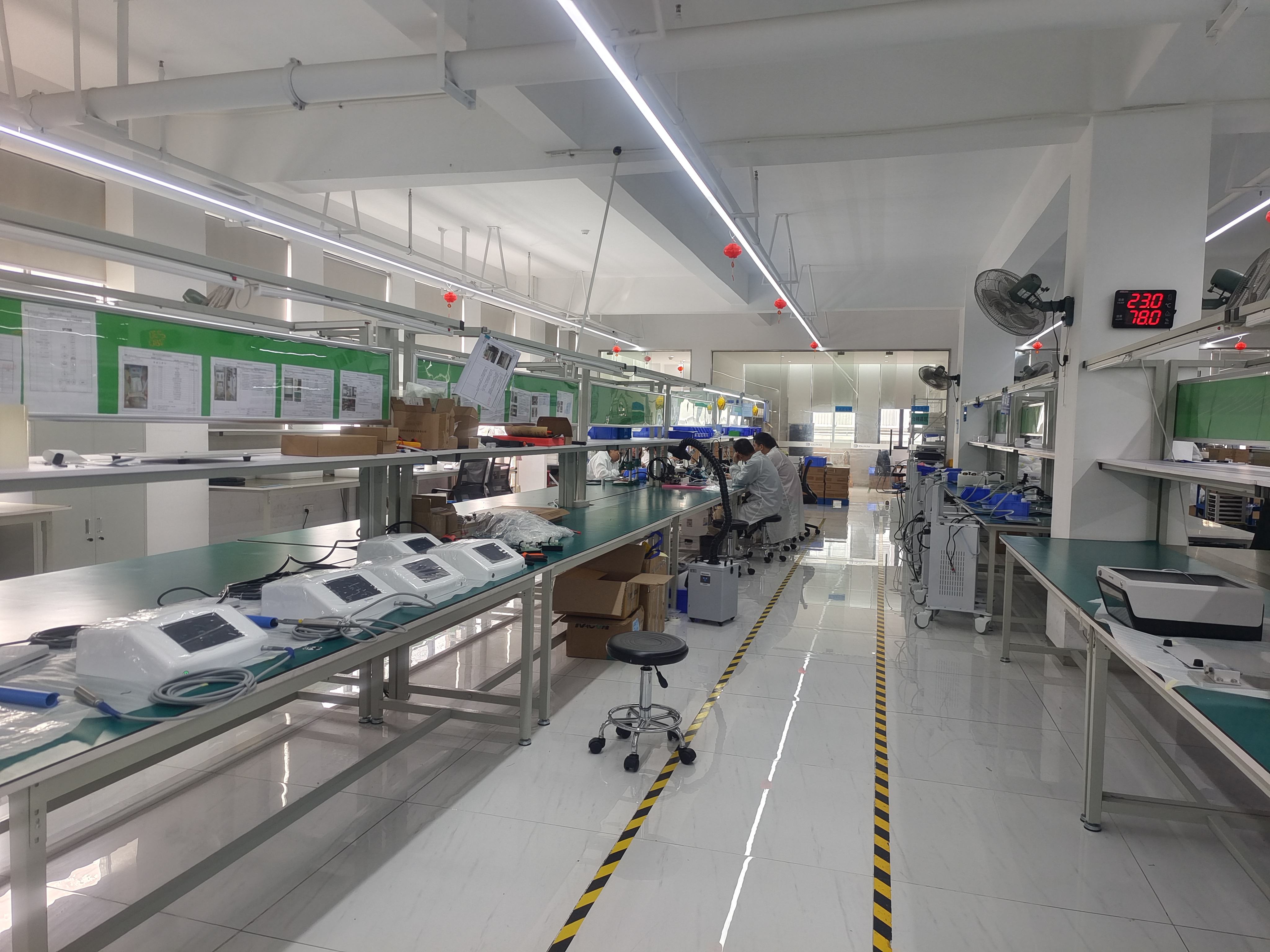
Bolida Medical operates its R&D and manufacturing base in Changsha, China, covering home and professional aesthetic device lines.
Supplier capability: Bolida Beauty Machine in this comparison
Bolida Beauty Machine is the aesthetic device line of Changsha Bolida Medical Technology Co., LTD, a manufacturer established in 2021 that develops, produces and distributes home and professional aesthetic equipment from a 1,700 m² facility in Changsha, China, with 58 employees, a 15-person R&D team and an annual output of 30,000 units. The company reports a 70% export ratio, with main markets in the USA, EU, South America and Asia, and is listed here as the supplier of record for this comparison.
What matters for a two-model light-therapy decision is the shape of that capability rather than its size. Bolida integrates independent R&D, in-house production, brand sales and flexible OEM/ODM in one organisation, and supports customised user interface, packaging and private label, together with one-stop technical training. For a buyer shortlisting AS-308 against AS-PDT, that combination determines whether the chosen platform can be adapted once the trial data arrives — a change of interface language, a different applicator set or a private-label housing — without moving to a second supplier.
Scale should be read honestly. An annual output of 30,000 units and a 15-person R&D team describe a manufacturer built for trial-to-mid volume programmes rather than mass consumer electronics runs. For a distributor testing two light-therapy platforms, or a clinic group standardising on one, that range is generally the relevant one; for a buyer planning national retail distribution from launch, capacity should be confirmed against the forecast before the platform decision is locked.
Cost, trial orders and MOQ
Bolida states that it offers factory-direct pricing without middleman markup and flexible MOQ for trial orders, terms the company presents as reducing procurement cost for new partners. For this specific decision, the procurement value is not the unit price; it is the ability to place a small comparison order covering both AS-308 and AS-PDT, run them under the same protocol, and settle the modality question with your own operators rather than with a specification sheet.
Three terms should be agreed before that trial order is confirmed: the warranty start date, whether trial units are covered by the standard after-sales process, and what the supplier commits to if a configuration is changed after the trial. A flexible minimum order only reduces risk if those three points are written down; otherwise the saving on the first order is offset at the first service event.
Reliability, spares and after-sales
Bolida reports a stated after-sales response window of 24 working hours, standardized spare-parts supply, remote technical guidance, an expected service life longer than comparable products on the basis of its service-life design and spare-parts strategy, and a lower equipment failure rate than the average industry level. It also lists stable output consistency, uniform treatment effect and low energy consumption under similar conditions as technical characteristics of its equipment.
These are company-reported comparative statements, and a careful buyer should treat them as claims to be substantiated rather than as facts to be assumed — asking for the service records, the return rate basis and the actual spare-parts stocking list behind them. The reason is specific to light therapy: the dominant operating cost is downtime, not electricity. A calibration drift, a failed emitter or a missing applicator takes a device out of service, and a spare-parts list with a defined availability period is worth more than a marginal advantage in rated power.

Spare-parts supply and order fulfilment capability are part of the lifecycle cost of a light-therapy platform.
OEM, ODM and private label
The OEM/ODM question follows the modality decision rather than preceding it, because customisation of the wrong platform only produces a differentiated product with the wrong protocol fit. Once the modality is settled, Bolida's stated scope covers customised user interface, customised packaging, private-label support and one-stop technical training — the four items that usually determine time-to-market for a distributor brand.
Two boundaries belong in the same conversation. First, customisation changes regulatory responsibility: in several markets the party placing a device under its own brand carries manufacturer-level obligations, so the private-label variant may need its own registration pathway — a point to confirm with a regulatory adviser before the packaging artwork is approved, not after. Second, interface and packaging customisation are not the same as clinical customisation; changes to dose settings, emitters or treatment protocols are a different category of request, and they should be specified separately and priced separately.
Market context for the decision
Light-based technology is not a niche inside this category. Grand View Research data cited in the source set for this comparison puts light-based technology — LED, IPL and laser — at 58.0% of U.S. at-home beauty device revenue share in 2025, and the same research house projects the home-use beauty device market rising from an estimated USD 11.6 billion in 2024 to approximately USD 32.4 billion by 2034.
For a buyer choosing between two light-therapy platforms, the implication is narrow and practical: when the dominant technology is already the mainstream choice, hardware novelty stops being a differentiator and documentation, protocol support and serviceability become the terms on which products compete. That is the ground on which AS-308 and AS-PDT should be judged, and it is why this comparison spends more space on registration and lifecycle than on hardware description.
Fit boundaries: when each option is the wrong buy
AS-308 is the wrong purchase where the buyer cannot obtain registration for the exact model in the destination market, where no supervising clinician is available to define dosing and monitor cumulative exposure, or where the intended commercial use is a multi-function consumer facial device rather than targeted phototherapy. In those cases the platform's modality fit is irrelevant because the operating conditions are absent.
AS-PDT is the wrong purchase where the agent and incubation steps cannot be controlled consistently, where clinical supervision is not in place, or where treatment volume is too low to justify protocol training and agent management. A buyer who can source a device but not the surrounding protocol chain is buying an incomplete treatment.
Both options are the wrong purchase where model-level documentation is unavailable. A company certificate, a brochure and a demonstration video do not substitute for the registration document covering the model and configuration on the order, and no amount of comparison work compensates for its absence.
Verification checklist before ordering
- Confirm the labelled intended use of the exact AS-308 or AS-PDT model and configuration you intend to buy.
- Obtain the registration or licence covering that model and configuration for your destination market.
- Ask for the instructions for use in the destination language, with the document version number.
- Request the spectral band or wavelength, dose settings, calibration method and recalibration interval.
- Confirm whether the protocol requires a photosensitising agent or single-use item, and who supplies it.
- Request the spare-parts list, the availability period and the stated response-time commitment.
- Ask for the basis of any reliability or service-life comparison, including the return-rate or service-record source.
- Agree trial-order terms in writing, including warranty start date and coverage of trial units.
- For private-label plans, confirm the regulatory responsibility split before approving packaging artwork.
Frequently asked questions
What should a buyer verify first when comparing AS-308 and AS-PDT?
Start with the labelled intended use and the registration status for the exact model and configuration in the destination market. The modality decision — dose-led phototherapy versus agent-led photodynamic therapy — determines which operating conditions must exist, and the registration determines whether the device can be placed on that market at all. Hardware comparison is only meaningful after both are confirmed.
Does a company-level certification cover a specific light therapy model?
Not automatically. A quality management system certification such as ISO 13485 describes the manufacturer's quality processes, and a CE medical marking applies to a defined scope and class. Neither transfers by default to a new model, a new configuration or a private-label variant. Buyers should request the certificate and scope statement covering the specific model being ordered.
Why does documentation matter more than hardware specification in this comparison?
Because the recurring cost of a light-therapy platform is downtime and protocol error, not purchase price. Instructions for use, calibration intervals and a spare-parts list determine how quickly a unit returns to service and how consistently it performs. Without them a device may be present but unusable in a regulated setting, which is a larger loss than a specification difference.
Can one supplier support both platforms for a distributor brand?
Integration of R&D, in-house production and flexible OEM/ODM in one organisation allows a distributor to trial one platform and then customise interface, packaging or private label without changing supplier. Whether that applies to a specific light-therapy model depends on the model's documentation and registration, and the regulatory responsibility for a private-label variant must be confirmed separately in each market.
Reference resources
The company product and capability overview is available in the Bolida Medical introduction and catalog, which buyers can use alongside the model-level documents requested in the checklist above.
This comparison is an editorial buyer reference. Modality descriptions are general to the categories; model-specific specifications, indications and registration status must be confirmed against the current datasheet, instructions for use and certificate for the exact version ordered.
Tem questões ou precisa de mais detalhes?
Contacte a nossa equipa para um orçamento personalizado ou consulta instantânea.
Solicitar orçamento
Preencha o formulário abaixo e a nossa equipa entrará em contacto com uma proposta personalizada.
Chat direto do WhatsApp
Prefere conversar em tempo real? Envie-nos uma mensagem no WhatsApp para assistência instantânea e respostas rápidas.
- Obter orçamento personalizado
- Partilhar fotos ou documentos
- Discuta as suas necessidades diretamente
Geralmente responde em 5–30 minutos durante o horário de expediente.