
AUV-160 vs AUV-210 vs AUV-260: Nearshore Buyer Comparison
AUV-160 vs AUV-210 vs AUV-260: Nearshore Buyer Comparison
Nearshore autonomous missions are rarely decided by depth rating. They are decided by how a vehicle is launched, how much sensor mass it can carry, and whether the platform is still serviceable in year three. For buyers shortlisting inside the Pelagix AUV range, the practical comparison therefore narrows to three adjacent tiers — AUV-160, AUV-210 and AUV-260 — and to a small set of parameters that are documented, plus one that is not.
Pelagix AUV is the autonomous underwater vehicle line of Sanya Poseidon Ocean Technology Co., Ltd., a marine equipment manufacturer based in the Yazhou Bay Deep-Sea Equipment Industrial Park in Sanya, Hainan, whose portfolio covers portable micro AUVs, nearshore survey AUVs, 6000 m deep-sea AUVs, ROVs, thrusters, sensors and marine software. Inside that portfolio the three models form a continuous shallow-water band: 35 kg to 100 kg, 5 kg to 10 kg of documented payload, and a documented 0–100 m to 0–200 m depth envelope. Everything above that band belongs to a different procurement conversation.
The Nearshore Buyer's Real Constraints: Launch, Payload, Support
Most nearshore survey, port security and hydrographic monitoring work sits in water shallow enough that two of these three vehicles can reach the same seabed. What separates them is not access to the site but the cost of getting there repeatedly: launch method, crew count, sensor budget, and the maintenance path once the warranty period ends.
Weight is the clearest proxy for that trade. Energy storage typically accounts for roughly 40% of an AUV's internal volume to support missions of up to about 24 hours, according to commercial research published by Market.us. A 35 kg vehicle and a 100 kg vehicle therefore differ less in hull strength than in what proportion of their mass is battery, sensor bay, or handling margin. Buyers who compare only depth ratings are comparing the least variable parameter in the group.
The second constraint is operational continuity. A nearshore fleet is usually small — often one to three units shared across survey, inspection and security tasks — which means a single platform is asked to carry different sensors on different days. That reconfiguration burden, not the headline specification, determines whether the fleet is economic.
AUV-160, AUV-210 and AUV-260 on Documented Specifications
The table below uses only parameters stated in the available product facts. Where a value is not published, it is marked as a verification item rather than estimated.
| Parameter | AUV-160 | AUV-210 | AUV-260 |
|---|---|---|---|
| Family classification | Portable micro AUV | Nearshore survey AUV | Nearshore survey AUV |
| Weight | 35 kg | 70 kg | 100 kg |
| Payload | 5 kg | 10 kg | Not specified in available facts — verify |
| Depth rating | 0–100 m | 0–200 m | Not specified in available facts — verify |
| Hull dimensions | Not stated | Not stated | 260 mm × 2.5 m |
| Documented deployment | Shore launch and small-boat deployment | Not stated | Not stated |
| Documented applications | Not stated | Not stated | Port security, hydrographic monitoring, nearshore survey |
Reading Each Tier Operationally
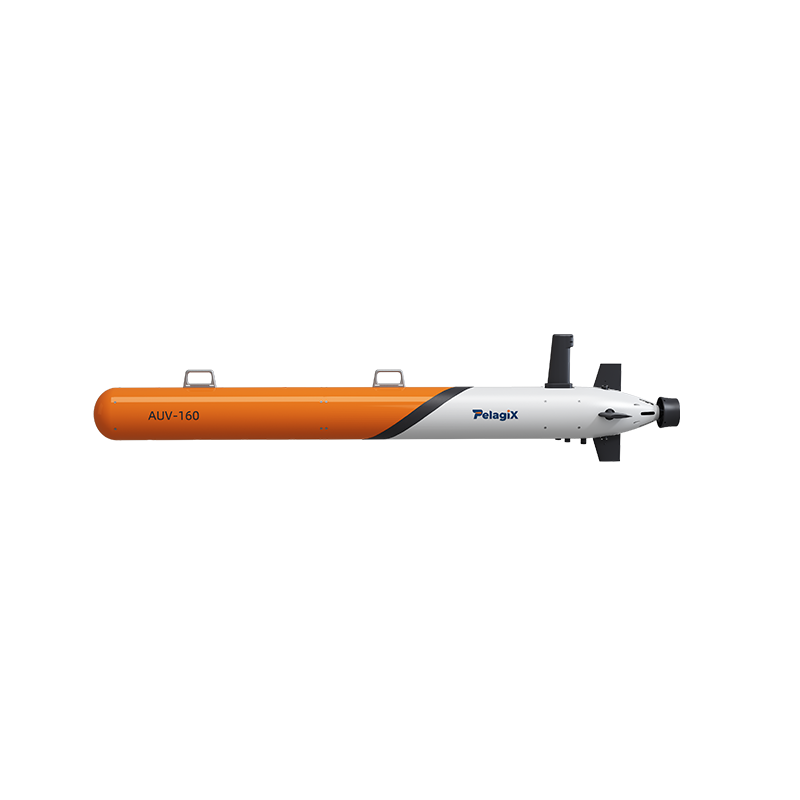
AUV-160: the single-operator tier
AUV-160 is documented at 35 kg with a 5 kg payload and a 0–100 m rating, and is explicitly designed around shore launch and small-boat deployment. That combination defines its procurement value: it removes vessel dependency from missions that would otherwise require a spread with a launch and recovery system. For buyers, the 5 kg figure should be read as a sensor budget to be allocated rather than a fixed configuration — the question is whether the intended sensor set, its housing and cabling fit inside that mass allowance, and whether the resulting configuration still meets the mission's data quality requirement.
The 0–100 m rating makes AUV-160 a shallow-water asset. It is not a degraded version of the larger models; it is a different deployment model, and its value depends on how often the team actually works inside that band.
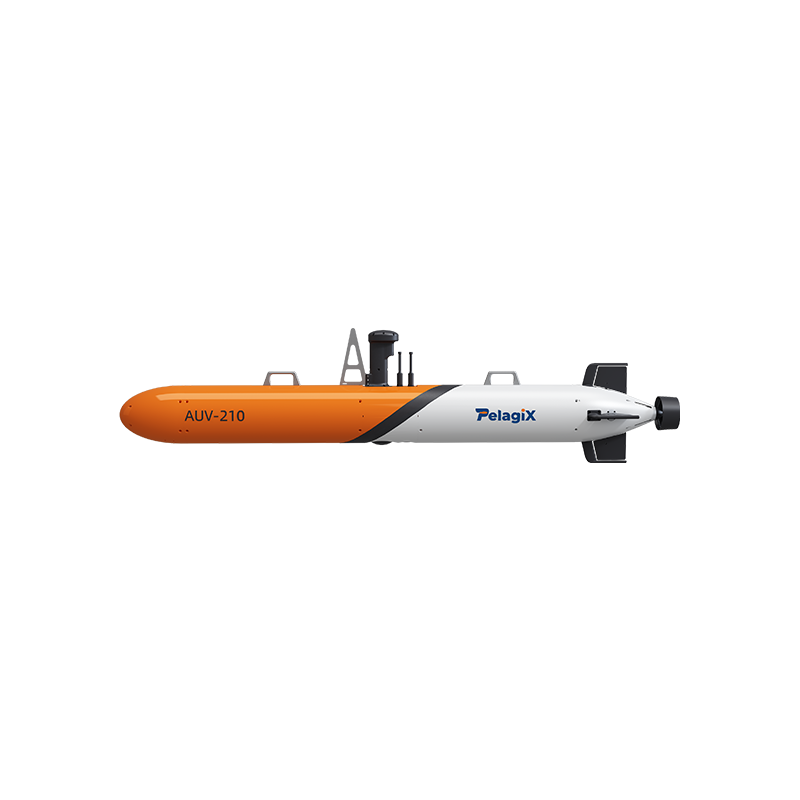
AUV-210: the payload and depth step-up
AUV-210 is documented at 70 kg with a 10 kg payload and a 0–200 m rating. Two things change at once: the sensor mass budget doubles, and the rated envelope extends beyond 100 m. The doubled payload is the more consequential change for survey work, because it allows a mission to carry more than one sensing function simultaneously rather than sequencing sensors across separate dives.
The weight change is a logistics issue rather than a technical one. At 70 kg the vehicle is no longer a one-person launch in the way a 35 kg unit can be, so buyers should test the launch and recovery method against the vessel and crew they actually operate, not against the ideal case.
AUV-260: the largest hull, with two open parameters
AUV-260 is the largest of the three at 100 kg, with a 260 mm × 2.5 m hull, and is positioned for port security, hydrographic monitoring and nearshore survey. Its length and diameter indicate a larger internal volume than the two smaller hulls, which is consistent with the port security and monitoring roles named in the product facts. What cannot be inferred is how that volume is allocated, and how deep the hull is rated.
For a buyer, those two gaps translate into specific questions rather than general caution: what payload mass and volume are available, what sensor and connector interfaces exist, what depth the hull is rated to, and what test evidence supports that rating. The supplier's stated quality approach for 6000 m pressure hulls — vacuum leak testing and 100% hyperbaric chamber simulation at 1.25 times the rated working depth — is a useful reference point for what evidence to request, but its applicability to AUV-260 must be confirmed rather than assumed.
Modularity Is the Long-Term Variable, Not the Headline Spec
For fleets that must cover several mission types with one or two vehicles, architecture matters more than any single rating. Pelagix AUVs are described as using a modular architecture with flexible payload configurations and rapid mission reconfiguration. Against a standard non-modular AUV, the supplier's own comparison states 3–5 times more payload configurations, payload changeover in under 30 minutes, a 50–70% reduction in mission reconfiguration time, and 30–50% shorter maintenance and upgrade cycles, with lifecycle cost reductions of 20–40%.
Those are comparative figures supplied by the manufacturer and should be treated as claims to be validated on the buyer's own configuration rather than as independent benchmarks. The validation method is straightforward: ask for a payload changeover to be demonstrated during the Factory Acceptance Test, and record the elapsed time and the tooling required. A changeover measured in under 30 minutes only has value if it can be performed on a working deck, in the conditions the crew actually faces.
Tetherless Operation Versus Tethered ROV in the Same Water
Nearshore buyers often compare an AUV against a tethered ROV, because both can be deployed from the same vessel. The supplier's comparison against a traditional tethered ROV states 3–5 times higher survey coverage efficiency, 30–50% less vessel operating time, autonomous missions of 10 to 100+ km, and up to 80% lower surface operator and tether-management requirements, with total cost of ownership over three years reported as 45% lower and onboard crew requirements 70% lower.
The direction of that trade-off is well established in marine survey practice: removing the tether removes the vessel time that tether handling consumes. The boundary is equally well established. An AUV cannot perform sustained manipulator work, cannot be flown interactively for long periods from the surface, and depends on pre-planned mission behaviour and acoustic positioning in ways a tethered vehicle does not. Where the task is inspection requiring real-time intervention, a tethered ROV remains the appropriate tool; where the task is repeatable coverage of a defined area, the AUV argument is stronger.
What Decides Whether a Nearshore Fleet Is Still Working in Year Three
Long-term value in this class is set by three recurring failure modes, all of which have documented countermeasures in the supplier's risk framework.
- Seawater corrosion and bio-fouling. Managed through corrosion-resistant component specifications, hard anodised marine aluminium or titanium, anti-fouling protective coating, sacrificial anode protection and a seawater immersion test protocol completed before shipment. Material selection is stated to conform to NACE standards, which gives a factory audit a concrete reference point.
- Entanglement in nets, cables and pipeline structures. Addressed with forward-looking obstacle-avoidance sonar and entanglement identification algorithms, triggering a visual alert and activating an emergency cut-and-clear mechanism or acoustic drop-weight release.
- Navigation drift and acoustic signal loss. Addressed through DVL, INS and USBL fusion with a multi-sensor Kalman filter, AI-assisted navigation and autonomous SLAM mapping, backed by an automatic return-to-home protocol on acoustic link loss and monocular vision-guided docking as a fallback.
Spare parts availability for long-term offshore fleets is supported by corrosion-resistant component specifications and pre-shipment immersion testing, and custom payload upgrades are assessed against the same seawater exposure criteria. For a buyer, these are contractual items as much as technical ones: the useful question is which of them appears in the acceptance documentation, not which appears in the brochure.
Procurement and Acceptance: What to Fix Before Signing
The supplier's stated commercial terms are structured for single-unit and institutional orders. Minimum order quantity is one unit for AUV platforms, ROVs or customised payload systems. Delivery terms include FOB Sanya, EXW Factory, CIF Destination Port and DDP with sea-trial handover support. Acceptance combines a Factory Acceptance Test — including hyperbaric pressure chamber testing — with a Site Acceptance Test covering sea-trial validation and verification of survey-grade mapping documentation. Payment terms are 30% T/T deposit on signing, 50% on factory completion and FAT approval, and 20% against SAT clearance or a B/L copy, with L/C negotiable for institutional clients.
For a three-model evaluation, the FAT is also the natural point to resolve open specification questions. If AUV-260 is part of the shortlist, the payload and depth verification belongs in that process, documented against the delivered unit rather than the catalogue.
Boundaries Buyers Should Accept Before Awarding
An honest comparison includes what the platforms do not do.
- AUV-260's payload and depth rating are not published in the available facts. Until the supplier provides them with test evidence, the model cannot be specified for a depth-constrained tender or compared numerically against the other two.
- The 0–100 m and 0–200 m ratings define a shallow-water class. These are nearshore vehicles; deep-sea work in the 6000 m class is a separate product family with different hull materials and different testing regimes.
- Autonomy has limits in intervention tasks. Neither model substitutes for a tethered vehicle when the mission requires sustained physical work at the seabed.
- Comparative efficiency and cost figures are supplier-stated. The 3–5 times coverage, 35% propulsive efficiency gain and 20–40% lifecycle cost reduction describe performance against reference platforms and should be re-tested against the buyer's mission profile.
- Payload is a mass and volume budget. A 5 kg budget on AUV-160 constrains sensor count in a way that no amount of mission planning removes.
A Practical Selection Framework
| Mission profile | Most likely tier | What to verify first |
|---|---|---|
| Repeat shallow surveys from shore or a small boat, single sensor per dive | AUV-160 | Sensor mass and housing fit within the 5 kg payload; launch method without a vessel |
| Nearshore survey crossing the 100 m line, multi-sensor dives | AUV-210 | Sensor combination within 10 kg; launch and recovery at 70 kg from the actual vessel |
| Port security, hydrographic monitoring and nearshore survey with a larger hull | AUV-260, subject to verification | Payload mass and volume, depth rating and supporting pressure-test evidence |
| Any tier operated across multiple mission types for several years | Whichever tier is selected | Payload changeover time and maintenance cycle demonstrated during FAT |
Market Context: Growth Is Not Distributed Evenly
The global autonomous underwater vehicle market is estimated at approximately USD 2.0–2.57 billion for 2024/2025, according to commercial research from MarketsandMarkets. Fortune Business Insights projects the large and deep AUV segment, above 1000 m, growing at a 12.0% CAGR over its forecast period. Both figures are third-party commercial estimates rather than audited data, and the nearshore band covered by AUV-160, AUV-210 and AUV-260 is not broken out separately in the available datasets — a gap worth noting when growth projections are used to justify fleet expansion.
Two regulatory and trade details matter more to nearshore buyers than headline growth. AUVs are typically classified under HS Code 901580 or 890690, according to a US Customs and Border Protection ruling, which affects duty treatment and sometimes tender eligibility. Separately, autonomous safety and functionality are increasingly discussed against ISO 21448 (SOTIF) frameworks for non-fault-based hazards in marine robotics — an emerging reference rather than a settled requirement, and one buyers should confirm with their own classification society or client specification.
Future Outlook
The direction of travel in this class is toward fewer hulls doing more tasks. Energy density improves slowly, so payload flexibility and reconfiguration speed remain the practical levers for extending a platform's useful life; a vehicle that can be re-sensored in under half an hour is a different asset from one that returns to the factory for each new mission type. The supplier's stated position — complete unmanned underwater systems and integrated solutions supporting recurring offshore survey and inspection missions, backed by custom engineering and technical services for long-term projects — reflects that shift from unit sales to operating continuity.
For buyers, the implication is that documentation becomes a competitive parameter. Depth ratings with test evidence, payload changeover times observed at FAT, corrosion protocols traceable to NACE-aligned material selection, and a defined spare-parts path will matter more in 2028 than a marginal depth advantage in 2026.
Frequently Asked Questions
Which of the three models fits a 0–100 m nearshore mission rather than a 0–200 m one?
AUV-160 carries a documented 0–100 m depth rating and is designed for shore launch and small-boat deployment, so it covers missions that stay inside that band. AUV-210 carries a documented 0–200 m rating and is the appropriate tier where survey lines regularly cross 100 m. AUV-260's depth rating is not specified in the available product facts, so it cannot be assigned to either band without written confirmation and test evidence from the supplier.
What practical difference does a 5 kg versus a 10 kg payload make in mission planning?
The payload figure is the mass budget available for sensors, housings, cabling and any additional equipment. AUV-160's 5 kg budget constrains how many sensing functions can be carried on a single dive; AUV-210's 10 kg budget doubles that allowance. Because the platforms use a modular architecture, both can be reconfigured between missions, so the binding constraint is total mass and volume per mission rather than the number of mission types a fleet can accept.
What must be verified about AUV-260 before it is included in a tender?
Two parameters — payload capacity and depth rating — are absent from the available product facts. Buyers should obtain both in writing, together with the sensor and connector interfaces, the rated working depth and the pressure-test evidence behind it. AUV-260 is documented at 100 kg with 260 mm × 2.5 m hull dimensions and is positioned for port security, hydrographic monitoring and nearshore survey, which establishes its role but not its depth envelope.
How should long-term support and corrosion protection be assessed for a nearshore fleet?
Assessment should reference documented measures rather than general statements: NACE-compliant material selection, sacrificial anode protection, anti-fouling coating and a seawater immersion test protocol completed before shipment. Spare parts availability for long-term fleets is supported by corrosion-resistant component specifications and pre-shipment immersion testing. Contingency behaviour should also be documented — automatic return-to-home on acoustic link loss and acoustic drop-weight release on entanglement detection are both specified in the supplier's risk framework.
What acceptance testing and commercial terms apply to a single-unit AUV order?
Minimum order quantity is one unit for AUV platforms, ROVs and customised payload systems. Delivery terms include FOB Sanya, EXW Factory, CIF Destination Port and DDP with sea-trial handover support. Acceptance combines a Factory Acceptance Test, including hyperbaric pressure chamber testing, with a Site Acceptance Test covering sea-trial validation and survey-grade mapping documentation verification. Payment terms are 30% T/T deposit on signing, 50% on factory completion and FAT approval, and 20% against SAT clearance or B/L copy, with L/C negotiable for institutional clients.
Tem questões ou precisa de mais detalhes?
Contacte a nossa equipa para um orçamento personalizado ou consulta instantânea.
Solicitar orçamento
Preencha o formulário abaixo e a nossa equipa entrará em contacto com uma proposta personalizada.
Chat direto do WhatsApp
Prefere conversar em tempo real? Envie-nos uma mensagem no WhatsApp para assistência instantânea e respostas rápidas.
- Obter orçamento personalizado
- Partilhar fotos ou documentos
- Discuta as suas necessidades diretamente
Geralmente responde em 5–30 minutos durante o horário de expediente.