
AUV Buyer Questions: Acceptance, Corrosion, Obstacles, Drift and 6000 m Pressure
AUV Buyer Questions: Acceptance, Corrosion, Obstacles, Drift and 6000 m Pressure
Autonomous underwater vehicle procurement rarely stalls on the headline depth number. It stalls on the five supporting questions a technical committee asks once the brochure has been read: what exactly will be accepted at delivery, how the hull and frame will survive years of seawater, how the vehicle behaves when a fishing net appears in its path, how navigation holds up when GNSS is kilometres above and acoustics degrade, and how hydrostatic pressure integrity is demonstrated rather than asserted.
This reference answers those five questions in the order buyers usually raise them, using published platform data from the Pelagix AUV range as a worked example. Pelagix AUV is the autonomous underwater vehicle product line of Sanya Poseidon Ocean Technology Co., Ltd., a deep-sea intelligent equipment manufacturer based in the Yazhou Bay Deep-Sea Equipment Industrial Park in Sanya, Hainan Province, China. The line runs from portable micro vehicles (AUV-150, AUV-160) through nearshore survey platforms (AUV-210, AUV-260) and modular mid-depth vehicles (AUV-324, AUV-480) to deep-sea 6000 m platforms (AUV-533, AUV-600, AUV-900) and the intervention-class AUV-F760.
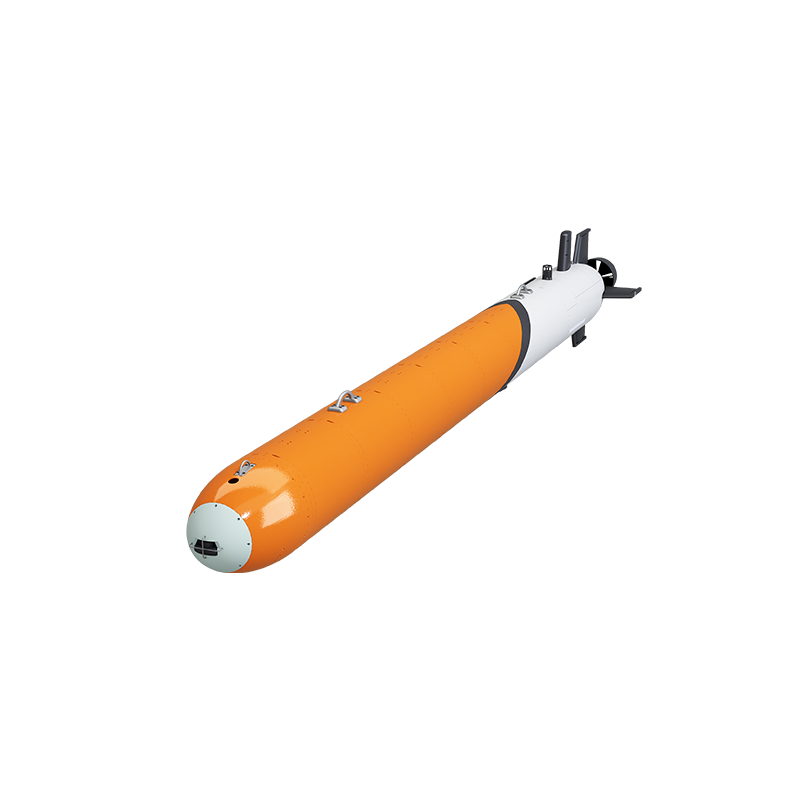
AUV-533, one of three Pelagix platforms built around a pressure-rated hull for 6000 m operation.
Why These Five Questions Decide Most AUV Contracts
An AUV purchase is a specification purchase with a service tail. A vehicle can meet a depth figure and still fail acceptance because the navigation figure was quoted as a percentage of range without a stated test method, because the buoyancy module material was never specified, or because obstacle avoidance was demonstrated in clear water rather than against a realistic target.
The commercial opportunity runs the other way for buyers. Public manufacturer catalogues rarely publish full commercial terms, so the technical acceptance schedule becomes the document that carries the negotiating weight. Deep-sea capability is also where the market is expanding fastest, which raises the level of scrutiny applied to the same five questions across the industry.
Question 1: What Should Purchasing Terms and Acceptance Criteria Cover?
A defensible AUV purchase order converts every published claim into a testable acceptance item, and ties payment milestones to evidence rather than to delivery. In practice that means separating acceptance into three stages: documentation review, factory acceptance testing, and a sea acceptance trial.
The documentation stage should establish the pressure boundary as a design fact before any water time is booked. Buyers should request the declared depth configuration in writing, the pressure housing material with mill certificates, and the hydrostatic test records for the delivered hull. A depth rating printed in a specification table is a design statement, not an acceptance result.
The factory stage should cover the items that are difficult to observe at sea: thruster function across the full speed band, sensor calibration status, software and firmware version lock, and the payload interface definition (mechanical mounting, power budget, data protocol). For a platform such as the AUV-533, the delivered configuration also has to state whether the vehicle is the 2000 m or the 6000 m build, and whether the endurance option is the standard or the extended custom pack.
The sea trial carries the items that only water can prove: navigation repeatability against a georeferenced baseline, obstacle-avoidance response against a real target, and a representative survey line flown at mission speed. Buyers should insist the trial is run in the conditions the vehicle will actually face, including at least one GNSS-denied segment, because a surface-only demonstration tests the least demanding part of the navigation stack.
Two further clauses are frequently omitted. The first is configuration control: any later change to depth class, hull material, or navigation suite should re-trigger acceptance for the affected subsystem. The second is spares and documentation handover, including pressure-seal consumables, calibration records, and the maintenance schedule for the pressure boundary.
Question 2: How Are Seawater Corrosion and Marine Bio-Fouling Handled?
Corrosion and bio-fouling are two different engineering problems and should be specified separately. Corrosion is a material and galvanic-isolation question that can be resolved at the design stage. Bio-fouling is an accumulation problem that is managed operationally, and published AUV specifications generally do not carry a fouling rating.
On the material side, the documented approach differs by depth class. The AUV-324 uses a high-strength anodized aluminum alloy hull with an optional titanium housing, a corrosion-resistant composite frame, and seawater-resistant electronics. The AUV-533, built for 6000 m work, uses a titanium alloy pressure housing together with a corrosion-resistant syntactic foam buoyancy module and seawater-resistant electronics. The AUV-600 and AUV-900 follow the same titanium-housing pattern for the same depth class.
The practical difference matters at the procurement stage. Titanium offers high resistance in seawater but raises material and machining cost and extends lead time. Anodized aluminum is lighter and cheaper to build but depends on coating integrity and on careful isolation where dissimilar metals meet, because a damaged anodized layer becomes a local corrosion site. Buyers operating in the 600 m to 2000 m band should therefore ask for the anodizing specification and for the dissimilar-metal isolation method, not just the alloy name.
Bio-fouling is best handled as a maintenance commitment rather than a purchase specification. Fouling accumulates on the hull, thruster shrouds, and sonar faces, and it degrades both speed and acoustic performance over a season. A serious acceptance schedule should state the inspection interval, the cleaning method permitted on the syntactic foam and the anodized surfaces, and whether a fouling-control approach is applied to optical windows and sonar arrays. Where a supplier publishes no fouling data, that gap should be written into the contract as a documented maintenance regime rather than left to the operator to discover.
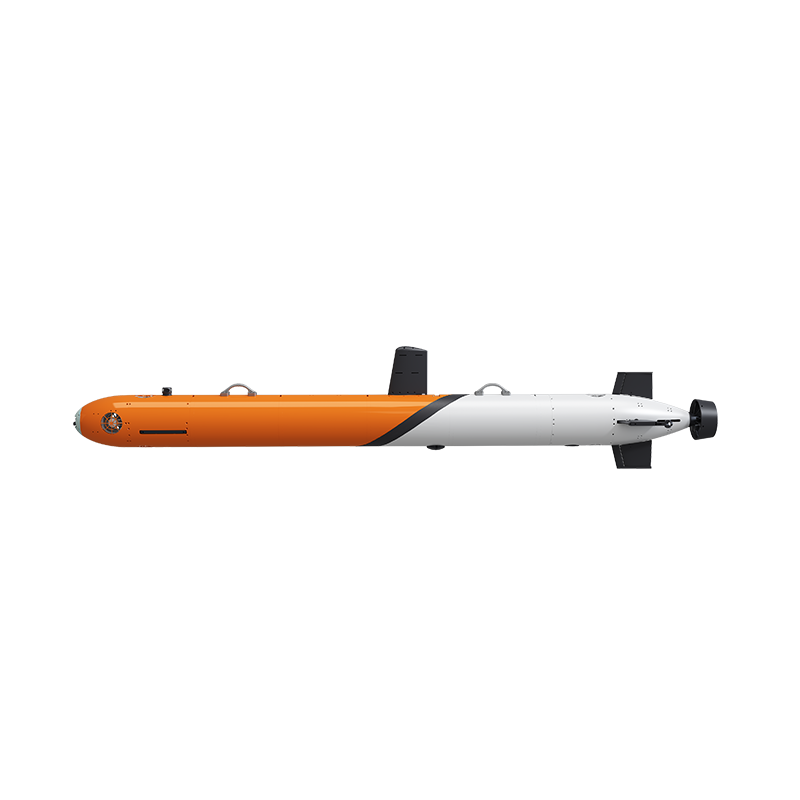
AUV-324 combines an anodized aluminum alloy hull with an optional titanium housing and a corrosion-resistant composite frame.
Question 3: How Does an AUV Detect and Avoid Subsea Nets and Cables?
Entanglement is a recoverable but serious failure mode, and the answer is a layered response rather than a single sensor. Subsea fishing nets, cables, and pipeline structures can foul an AUV's thrusters, mechanical components, or sensors, producing restricted movement, loss of control, or failure to return to the surface. The risk rises near abandoned nets, subsea cables, pipeline crossings, and dense underwater structures, and it rises further in low visibility or where obstacle positions are uncertain.
The first layer is detection. The documented approach integrates forward-looking obstacle-avoidance sonar to identify nets, cables, and other hazards ahead of the vehicle, giving early warning rather than contact-time reaction. The second layer is assessment: entanglement detection algorithms evaluate the risk posed by the detected objects and decide whether the planned track remains acceptable.
The third layer is response. When a potential entanglement is identified, the system triggers a visual alert so the surface team is informed. If a hazard is confirmed, the vehicle raises the same alert and can activate an emergency cut-and-clear system or an acoustic weight-release mechanism to escape the entanglement and regain ascent capability. These mechanisms are recovery measures, not immunity, and buyers should treat them as such during acceptance: the cut-and-clear and weight-release functions should be tested as functions, and the sonar detection performance should be demonstrated against a representative target rather than a calm-water substitute.
Question 4: What Happens to Navigation When GNSS Is Unavailable and Acoustics Degrade?
Navigation drift in deep water is bounded by sensor fusion, not eliminated by it. The Pelagix deep-sea platforms combine inertial navigation (INS), Doppler velocity log (DVL), GNSS, ultra-short baseline acoustics (USBL), and SLAM. Each element covers a different failure mode, which is precisely why the combination rather than any single sensor should appear in the acceptance schedule.
GNSS is available only at the surface, where it establishes an absolute start position and a timing reference. Once the vehicle dives, the DVL provides bottom-track velocity relative to the seabed, and the INS dead-reckons position and attitude from that velocity between external fixes. USBL supplies periodic absolute corrections from a support vessel, and SLAM closes the loop against terrain features so that the position estimate does not rely solely on dead reckoning over a long line.
Acoustic degradation is the hardest case. As range, noise, or water-column conditions worsen, the USBL update rate falls and dead-reckoning error accumulates between fixes. SLAM is the principal mitigation, because it references the seabed itself rather than an external acoustic node. That is also why the reliability of SLAM depends on terrain feature richness, and why a featureless abyssal plain is a genuinely more demanding navigation environment than a structured survey area.
Published positioning figures should be read with their basis attached. The AUV-600 is specified with INS+DVL+GNSS+USBL positioning at 0.5% of range, and the AUV-900 with the same suite plus SLAM at 0.2% of range. The AUV-533 and AUV-324 are documented with INS+DVL+GNSS+USBL and, for the AUV-533, SLAM, without a published percentage in the platform data. Buyers should not infer a figure for those models; they should require the supplier to state the expected error for the specific mission profile, depth, and acoustic geometry, and then verify it with a repeat pass over a georeferenced baseline.
Question 5: How Is Hydrostatic Pressure Integrity at 6000 m Demonstrated?
Pressure integrity is proven by documentation plus test, and the two are not interchangeable. The Pelagix deep-sea family is built around a pressure-rated hull for 6000 m operation, with the AUV-533, AUV-600, and AUV-900 all using a titanium alloy pressure housing, corrosion-resistant syntactic foam buoyancy modules, and seawater-resistant electronics. The AUV-533 is offered in a 2000 m or a 6000 m configuration, and the AUV-600 and AUV-900 in 1000 m, 3000 m, or 6000 m configurations depending on model.
For a buyer, the distinction that matters is between the pressure-hull design rating and the operating depth limit set for a specific delivered vehicle. A 6000 m hull flown to 4000 m is operating inside its rating with margin; the same hull flown with a degraded seal or an unauthorised payload penetration is not, regardless of the number on the datasheet. Acceptance should therefore cover the pressure boundary as a controlled item: housing material certificates, hydrostatic test records, seal specification and replacement interval, and a configuration lock on every penetration through the hull.
The same logic applies one class down. The AUV-324 is offered in 600 m or 2000 m configurations with an anodized aluminum alloy or titanium housing. Buyers should confirm which housing material corresponds to the depth ordered, because the material choice and the pressure rating are a single decision, not two independent options.
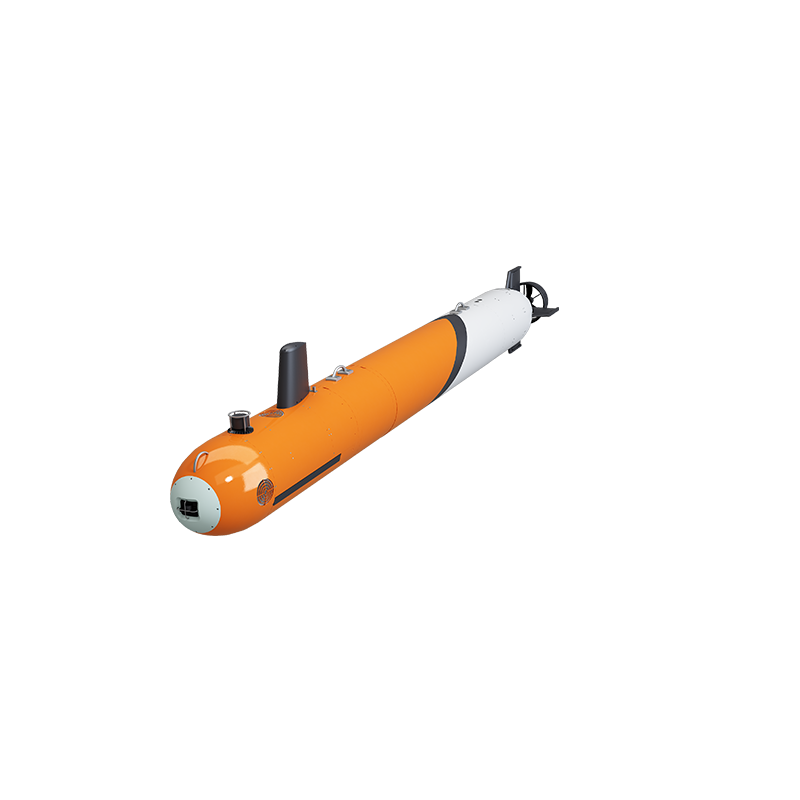
The 6000 m class shares a titanium alloy pressure housing, syntactic foam buoyancy, and seawater-resistant electronics.
Platform Reference for the Five Questions
The table below maps the published configuration data for four Pelagix platforms against the acceptance dimensions discussed above. Values are as published; where a parameter is not stated for a model, it is left blank rather than estimated.
| Model | Depth configurations | Pressure housing | Navigation suite | Endurance |
|---|---|---|---|---|
| AUV-324 | 600 m / 2000 m | High-strength anodized aluminum alloy / optional titanium housing; corrosion-resistant composite frame | INS + DVL + GNSS + USBL | ≥20 h @ 3 kn; custom up to 50 h / 300 km |
| AUV-533 | 2000 m / 6000 m | Titanium alloy pressure housing; corrosion-resistant syntactic foam buoyancy | INS + DVL + GNSS + USBL + SLAM | ≥90 h @ 3 kn; custom up to 180 h / 1000 km |
| AUV-600 | 1000 m / 3000 m / 6000 m | Titanium alloy pressure housing; corrosion-resistant syntactic foam buoyancy | INS + DVL + GNSS + USBL, 0.5% of range | ≥24 h @ 3 kn |
| AUV-900 | 3000 m / 4500 m / 6000 m | Titanium alloy pressure housing; corrosion-resistant syntactic foam buoyancy | INS + DVL + GNSS + USBL, 0.2% of range, + SLAM | ≥90 h @ 3 kn; custom up to 270 h / 1500 km |
Source: published Pelagix platform specifications. Positioning percentages are stated as a share of range and apply to the models shown.
Where These Answers Change the Mission Decision
The five questions resolve differently depending on the work. An offshore oil and gas operator running subsea pipeline and riser integrity work in the 2000 m band is typically trading payload against endurance, which is the design intent of the AUV-324: a 324 mm by 4 m vehicle, 300 kg, with a 30 kg payload and a 20-hour standard endurance at 3 knots, extendable to 50 hours or 300 km. The same vehicle is used for scientific research expeditions, seabed resource surveys, and marine environmental monitoring.
A waterway or offshore wind survey programme is usually endurance- and navigation-limited rather than payload-limited, which is the AUV-533 case: 533 mm by 5 m, 1200 kg, 150 kg payload, at least 90 hours at 3 knots, with custom endurance to 180 hours or 1000 km, and a navigation stack that includes SLAM. That platform is also documented for multi-AUV swarm survey operations, which changes the acceptance question from single-vehicle drift to relative positioning between vehicles.
Abyssal work pushes all five questions to their limit at once. The AUV-600 is specified for 6000 m deep-sea bathymetry, oceanographic surveys, subsea resource exploration, and abyssal environmental monitoring, while the AUV-900 adds trans-oceanic environmental monitoring, mesoscale vortex tracking, and deep-water acoustic detection to the same 6000 m class. In that regime the navigation and pressure questions dominate, and the corrosion question becomes a lifecycle cost question rather than a safety question.
Market Context: Why Deep-Sea Scrutiny Is Rising
The AUV market is large enough that procurement practice now varies widely between suppliers. MarketsandMarkets estimates the global AUV market at approximately USD 2.0 to 2.57 billion for 2024/2025, and Fortune Business Insights projects the large and deep AUV segment above 1000 m depth growing at a CAGR of 12.0% over its forecast period. Growth concentrated in the deep segment is exactly where acceptance criteria, material specifications, and navigation evidence matter most.
Trade classification adds a practical dimension. US Customs and Border Protection ruling NY N159975 places ROV and AUV equipment under HS 901580 or 890690, which means an AUV can be cleared under different tariff headings depending on how it is declared and configured. Importers should confirm the heading before shipment rather than after, because the documentation set required for acceptance and the documentation set required for customs are not the same.
Two further industry signals are worth noting for buyers writing specifications. Market.us analysis puts energy storage at roughly 40% of an AUV's internal volume for missions typically lasting up to 24 hours, which explains why extended-endurance configurations change hull layout rather than simply adding a battery. Separately, research literature discusses applying ISO 21448 (Safety of the Intended Functionality) to non-fault-based hazards in marine robotics; that discussion is emerging practice rather than an established certification requirement, and buyers should treat it as a design-review topic rather than a compliance checkbox.
AUVs Versus Conventional Survey and Intervention Methods
Compared with towed survey systems and hull-mounted multibeam, an AUV decouples survey coverage from vessel track and can fly closer to the seabed at constant altitude, which is why platforms such as the AUV-533 and AUV-600 are specified for bathymetry and mapping work. Compared with a work-class ROV, an AUV carries no tether and no pilot, so it covers far more ground per day but cannot perform manipulation.
The limitation is real and should be stated plainly: an untethered AUV has no continuous human intervention path. Obstacle decisions, fault responses, and aborts must be handled autonomously, and the escape mechanisms described earlier are recovery options rather than a substitute for conservative mission planning. Where physical intervention is the task, a tethered platform or an intervention-class vehicle is the correct tool, which is why the range also includes the ROV-150 and ROV-050 and the 6-DOF AUV-F760 with dual manipulator arms for gripping, cutting, and rotating.
A second boundary is material-driven. Titanium housings suit the 6000 m class but carry higher cost and longer lead time than anodized aluminum, and aluminum hulls with composite frames are the practical choice at the 600 m to 2000 m level. Buyers who specify titanium for a 1000 m mission are paying for margin they will not use; buyers who specify aluminum for a 6000 m mission are specifying the wrong vehicle.
Acceptance Checklist for AUV Procurement
The following list converts the five questions into contract-ready acceptance items. It is written to be attached directly to a technical specification schedule.
- Depth configuration stated as a specific number and locked in the contract: 2000 m or 6000 m on AUV-533; 600 m or 2000 m on AUV-324; 1000 m, 3000 m, or 6000 m on AUV-600.
- Pressure housing material declared with certificates, and the material matched to the ordered depth class rather than treated as a separate option.
- Hydrostatic test records and a documented seal replacement interval supplied for the delivered hull.
- Hull, frame, and buoyancy specification including anodizing specification where an aluminum alloy hull is used, dissimilar-metal isolation method, and syntactic foam material where a deep hull is used.
- Navigation suite itemised element by element (INS, DVL, GNSS, USBL, SLAM) with the expected error expressed as a percentage of range where the supplier publishes one.
- Navigation acceptance run flown as a repeat pass over a georeferenced baseline, including at least one GNSS-denied segment.
- Obstacle-avoidance demonstration against a representative net or cable target, with alert behaviour, cut-and-clear activation, and acoustic weight-release function each tested separately.
- Endurance declared with its basis: standard or custom, and the speed and distance reference used, such as 90 hours at 3 knots for AUV-533.
- Payload definition covering mass budget (30 kg on AUV-324, 150 kg on AUV-533), mechanical mounting, power allocation, and data protocol.
- Configuration-control clause stating that any change to depth class, housing material, or navigation suite re-triggers acceptance for the affected subsystem.
Future Outlook
Two developments are likely to reshape these acceptance questions over the next procurement cycle. The first is fleet operation. The AUV-533 is already documented for multi-AUV swarm survey work, and the company develops a multi-AUV cooperative detection system alongside a marine unmanned platform simulation training system and the OceanX-Eddy mesoscale vortex AI forecasting model. Once missions are flown by cooperating vehicles, relative positioning between vehicles becomes an acceptance criterion in its own right, not an operational detail.
The second is payload modularity. The company offers modular AUV platforms for custom payload integration, supported by in-house core components including high-efficiency underwater thrusters, CTD sensors, an ocean electromagnetic coupling module, an underwater combination antenna, and deep-sea waterproof packets. As payloads become swappable, the acceptance schedule has to shift from validating a fixed vehicle to validating an interface standard that survives multiple payload changes.
FAQ
Which platform suits a 2000 m seabed mapping programme?
Two configurations apply. The AUV-324 is offered at 600 m or 2000 m with an anodized aluminum alloy or titanium housing, a 30 kg payload, and at least 20 hours of endurance at 3 knots. The AUV-533 is offered at 2000 m or 6000 m with a titanium alloy pressure housing, a 150 kg payload, and at least 90 hours at 3 knots. The choice turns on payload mass and endurance rather than on depth alone.
Can endurance be extended beyond the standard figure?
Yes, as a custom configuration. The AUV-533 standard is at least 90 hours at 3 knots, with custom options up to 180 hours or 1000 km. The AUV-324 standard is at least 20 hours at 3 knots, with custom options up to 50 hours or 300 km. The AUV-900 standard is at least 90 hours at 3 knots, with custom options up to 270 hours or 1500 km.
Is custom payload integration supported?
The company offers modular AUV platforms for custom payload integration, and the published payload capacities differ by model: 30 kg on AUV-324, 150 kg on AUV-533, 250 kg on AUV-900, and 60 kg on the intervention-class AUV-F760. The AUV-324 is explicitly classified as a high-payload modular AUV platform.
When is a tethered vehicle the better choice?
When the task requires physical intervention rather than survey coverage. An untethered AUV has no continuous human control path, so manipulation, cutting, and emergency recovery work belongs with a tethered platform. The range includes the ROV-150 and ROV-050, and the AUV-F760 is a 6-DOF intervention-class vehicle with dual manipulator arms supporting gripping, cutting, and rotating functions for inspection, maintenance, and repair tasks.
Reference Material
Full platform specifications, depth configurations, and payload options are collected in the public product brochure, which can be accessed and downloaded here: Pelagix AUV overseas product brochure (PDF).
Tem questões ou precisa de mais detalhes?
Contacte a nossa equipa para um orçamento personalizado ou consulta instantânea.
Solicitar orçamento
Preencha o formulário abaixo e a nossa equipa entrará em contacto com uma proposta personalizada.
Chat direto do WhatsApp
Prefere conversar em tempo real? Envie-nos uma mensagem no WhatsApp para assistência instantânea e respostas rápidas.
- Obter orçamento personalizado
- Partilhar fotos ou documentos
- Discuta as suas necessidades diretamente
Geralmente responde em 5–30 minutos durante o horário de expediente.