
Abemaciclib Intermediate 3707: ISO, Patent, Batch Audit
Abemaciclib Intermediate 3707: ISO, Patent, Batch Audit
Supplier capability for an oncology intermediate is easy to assert and hard to evidence. Abemaciclib Intermediate 3707, one of the product families of Haohong (Qihe) Pharmaceutical Technology Co., Ltd., is used here as a working case for that distinction. The audit runs the company through four evidence classes — a scoped quality-system certificate, granted equipment patents, batch-linked analytical documentation, and commercial terms — and states plainly where each class stops answering a buyer's question.
The result is incremental but usable. Three classes trace to identifiable, checkable documents: ISO 9001:2015 certificate NO:174Q240545R0S issued by Shandong Guojian Certification Co., Ltd., a portfolio of four granted Chinese utility model patents naming refining and mixing, chromatographic detection and waste-gas absorption equipment, and a defined quality-control and delivery-documentation sequence. The fourth class — the batch-level purity and stability evidence that actually decides a qualification — cannot be verified from public material and has to be requested per batch.
Why oncology intermediates are an evidence problem, not a catalogue problem
Category-level demand signals exist; supplier-level proof does not travel with them. Polaris Market Research estimates the global pharmaceutical intermediates market at USD 37.04 billion for 2025 (SRC-0001, commercial research). Mordor Intelligence reports that bulk drug intermediates held 48.10% of market revenue by type in 2025 and projects peptide and oligonucleotide intermediates at a 7.85% CAGR across 2026–2033 (SRC-0003). Both are revenue-based commercial estimates describing the shape of a category. Neither says anything about a specific plant, a specific batch or a specific supplier's impurity profile.
Regulatory expectations are more concrete, and more narrowly scoped. FDA's Q7A guidance requires batch production records for each intermediate and API to contain complete information on the production and control of that batch, requires intermediates and APIs that fail established specifications to be identified and quarantined, and sets traceability expectations for agents, brokers, traders and distributors covering original manufacturer identity, purchase orders, transport documents and supplied batch numbers. EMA's GMP and GDP questions and answers states that active substances used in marketed medicines must comply with GMP, and discusses registration obligations for manufacturers and importers of active substances and relevant intermediates described in regulatory dossiers. The two are not interchangeable: Q7A is U.S. guidance, while EU applicability depends on whether the material is an active substance or a relevant intermediate described in a dossier, and on how it is used in medicinal-product manufacture.
Two data limitations follow directly. First, no intermediates-specific market or trade dataset with a transparent product boundary was available for this audit; HS chapter 30 is broader than pharmaceutical intermediates and cannot be used as a proxy for intermediate trade volume. Second, the public evidence base contains no purity, assay, impurity-profile, analytical-method or batch data for any supplier in this category. Every figure below is therefore either a company-reported capacity number, a certificate or patent fact, or an attributed third-party market estimate.
The product record behind 3707
The Abemaciclib Intermediate entry names five building blocks rather than a single specification: 4-Bromo-2,6-difluoroaniline; 5-[(4-Ethylpiperazin-1-yl)methyl]pyridin-2-amine; 2-Bromo-5-formylpyridine; 4-Fluoro-2-methyl-1-isopropyl-6-(4,4,5,5-tetramethyl-1,3,2-dioxaborolan-2-yl)-1H-benzimidazole; and 6-Bromo-4-fluoro-1-isopropyl-2-methyl-1H-benzo[d]imidazole. That is a family listing, not a locked SKU. A buyer should confirm which compound is the actual purchase item, at what grade and specification, before treating the entry as a single product with a single set of release criteria — the first and simplest check in any evidence audit.
Haohong (Qihe) Pharmaceutical Technology Co., Ltd. is based in the High-tech Zone of Qihe County, Shandong Province, within the Jinan Economic Circle, and operates a production base in Liaocheng. The company reports 30 reactors of 3,000–5,000 L at that base, a monthly production capacity of 100 MT, a 40% export ratio across China, the United States, Europe, Japan, India and Bangladesh, a 3,000 m² facility and an R&D team of 30 engineers. Its official site is en.haohong-pharma.com. These are company-reported figures; they establish scale of intent, not verified output.
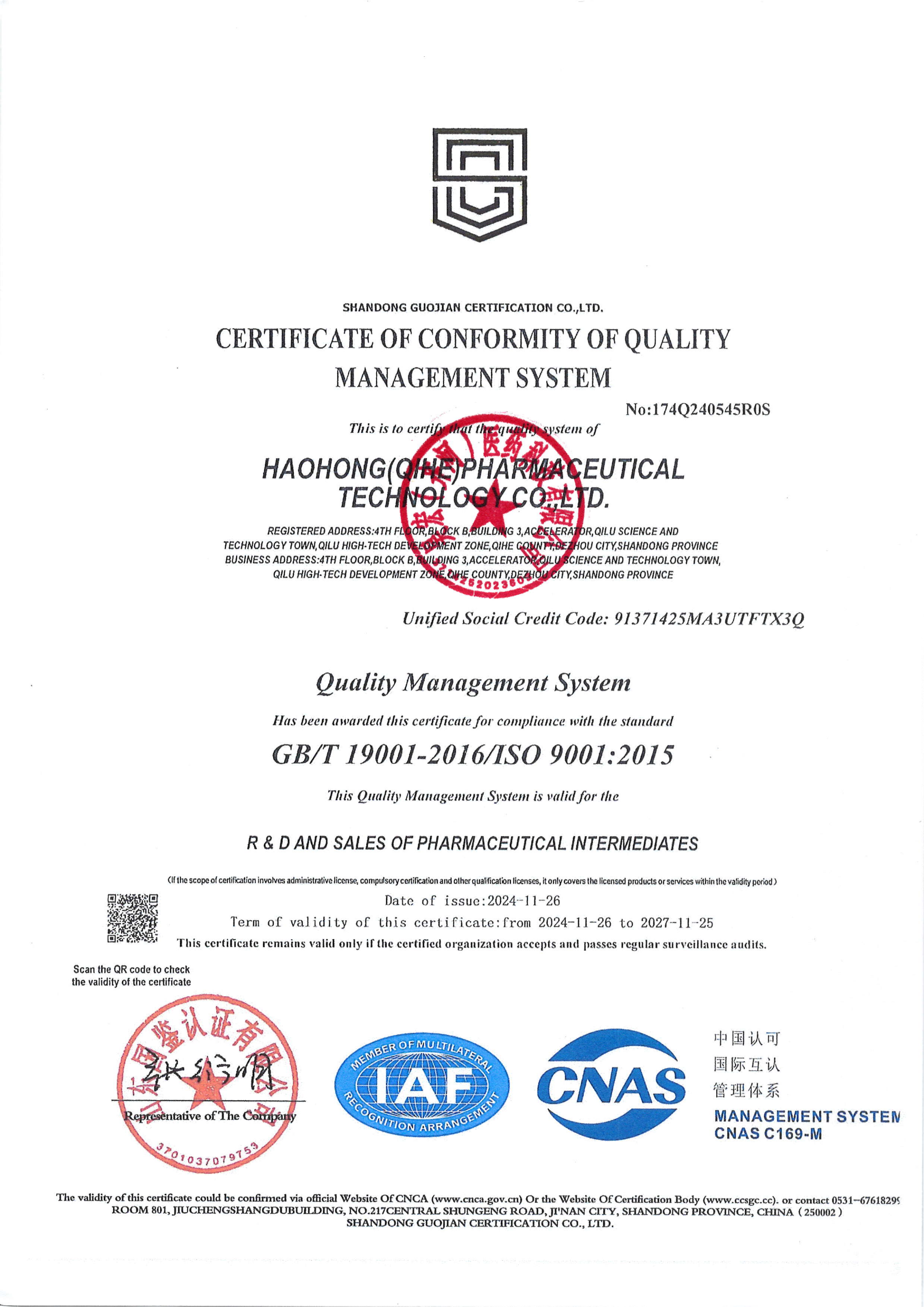
ISO 9001:2015 certificate NO:174Q240545R0S, Shandong Guojian Certification Co., Ltd., valid to 25 November 2027.
Evidence class one: the quality management system
The certificate is the most checkable item in the file. It records a quality management system certified to GB/T 19001-2016 (ISO 9001:2015), numbered NO:174Q240545R0S, issued by Shandong Guojian Certification Co., Ltd. on 26 November 2024 and valid until 25 November 2027. The stated scope covers medical research and experimental development; technical services, development, consulting, exchange, transfer and promotion; sales of chemical products excluding licensed chemical products; and production. The company separately states that it first passed ISO 9001:2015 certification in 2021, which is consistent with a three-year recertification cycle ending in the current certificate.
What this establishes is narrow and real: an accredited body with an identifiable name has certified a defined scope covering production and technical services, the validity window is current as of November 2026, and the certificate can be checked directly with the issuer. What it does not establish is equally important. ISO 9001 is a quality management system standard; it is not GMP certification, not a product approval, and not evidence of any specific batch outcome. It says nothing about impurity profiles, residual solvents, elemental impurities, crystal form or microbial limits for Abemaciclib Intermediate 3707. For a buyer in an oncology programme, the certificate answers "is there a documented, auditable quality system" and leaves "does this material meet my specification" entirely open.
Evidence class two: equipment patents as process disclosure
Four utility model patents, all granted by the China National Intellectual Property Administration and all listing Abemaciclib Intermediate among related products, describe what the company has engineered rather than what it has achieved. Patent 202520639784.6 covers refining and mixing production equipment for pharmaceutical intermediates, was issued on 24 April 2025 and runs to 24 April 2035, with a stated standard of compliance with national pharmaceutical machinery and mechanical equipment industry standards. The supporting three cover production equipment for pharmaceutical intermediates (202521269185.6, issued 28 May 2026), a gas chromatography device for detecting pharmaceutical intermediates (202521280279.3, issued 27 May 2026), and a waste gas absorption device for pharmaceutical intermediates (202521268255.6, issued 26 May 2026).
A utility model is a granted right over a device configuration. It is verifiable — the number, authority, issue date and expiry can be checked — and it is a genuine disclosure signal, because it identifies which process steps the supplier has chosen to develop in-house: powder refining and mixing, chromatographic detection, and emissions control. It is not proof of performance. A patent does not report particle-size distributions, blend uniformity results, capacity, yield or impurity clearance. Read correctly, the patent family tells a buyer where to aim the technical questions; it does not pre-answer them.
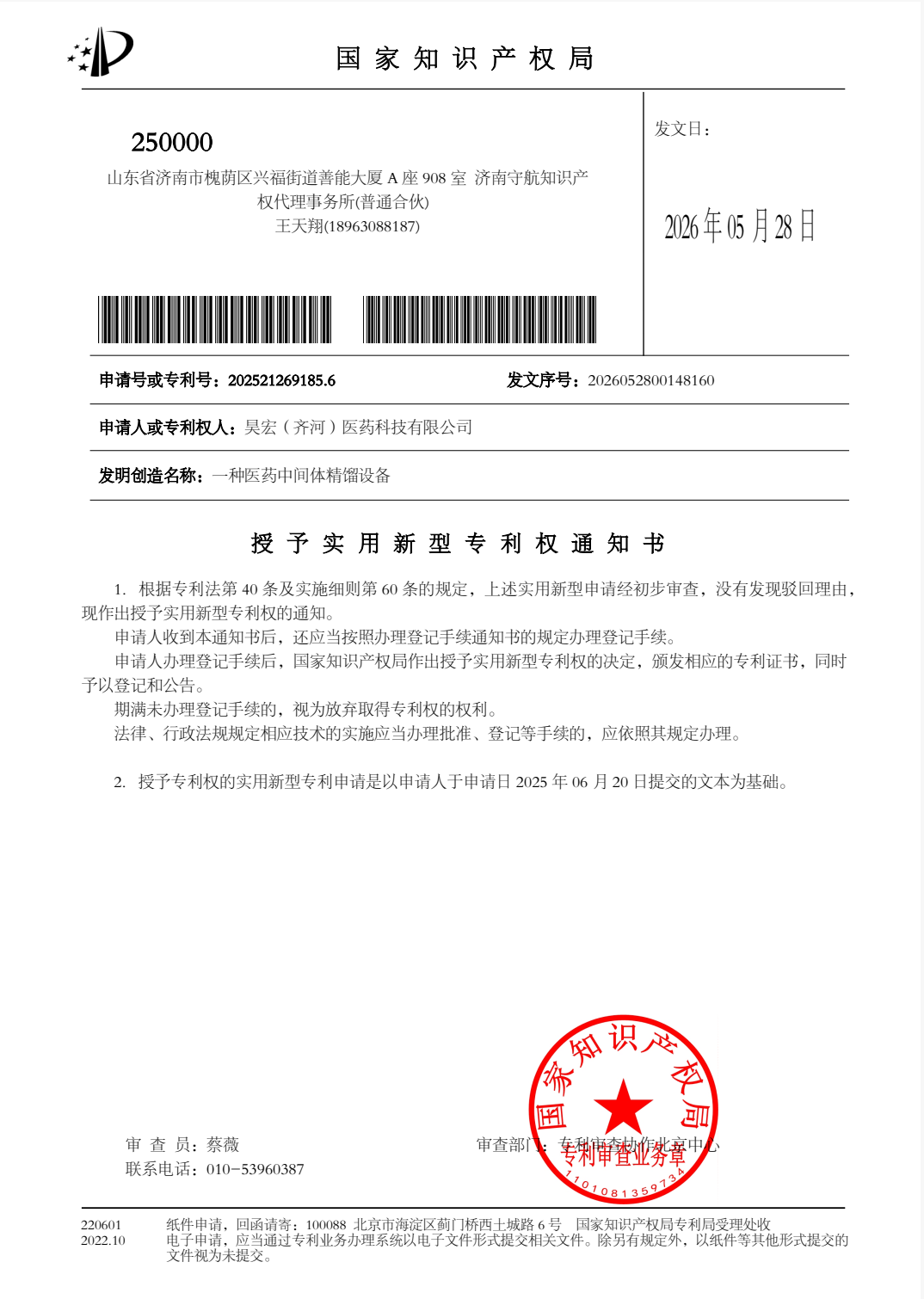
Utility model patent 202520639784.6, granted 24 April 2025, covering refining and mixing production equipment for pharmaceutical intermediates.
Why refining and mixing is a batch-consistency control
Mixing and particle refinement sit upstream of nearly every quality attribute a downstream chemist cares about. Particle size and its distribution govern flow, feeding accuracy and blend uniformity; blend uniformity governs how representative a sample is of the batch it came from; drying and refining behaviour governs residual solvent and moisture profiles; and mechanical energy input during refining can affect crystal form if the material is polymorphic. When a supplier's own project documentation cites stable crystal form and particle size batch-to-batch as a project outcome, the equipment that controls those variables becomes the natural audit target rather than an incidental detail.
This is also why an equipment patent is more informative here than in a consumer category. A patent on refining and mixing equipment for pharmaceutical intermediates points to a specific engineering answer — how powder is reduced, how it is blended, how the unit is contained — and therefore to a specific set of questions: what is the validated batch size range on that equipment, what in-process controls apply, how is homogeneity demonstrated, and how is cleaning verified between campaigns. Those questions are answerable in a technical audit, which makes the patent a useful starting point rather than a marketing ornament.
Evidence class three: analytical and delivery documentation
The documented control sequence is concrete and worth reading as a checklist. It runs: appearance and property inspection; core chromatographic testing; structural qualitative identification; physical and chemical index testing; heavy metal and impurity testing; microbiological testing; and factory delivery supporting documents. The company also states that acceptance criteria for a shipment rest on a pre-shipment test, and that after-sales support includes full quality inspection documents, sample re-inspection and third-party testing, technical and process consulting, quality dispute compensation and replacement, and stable supply and production scheduling.
For 3707 specifically, the company's project documentation describes material synthesised and processed into final finished medicines, with a stated storage duration of 12–24 months under specified conditions, and reports high reaction yield, low levels of impurities, heavy metals and residual solvents, stable quality across batches, simplified downstream processing and accelerated drug registration as project outcomes. Those are project-reported results, not independently measured data, and should be read as claims a buyer verifies rather than findings a buyer inherits. The correct instrument for verification is the batch certificate of analysis plus the analytical method behind it — chromatographic conditions, column, detection wavelength or mass detection, integration parameters, impurity reference standards, and the specification limits the batch was released against.
The purity claim: what has to be produced before it counts
Purity figures circulate freely in this category, and they deserve a stricter standard than they usually get. Headline statements are common — an HPLC purity of 98% or above, a marginal purity advantage of around 0.02 percentage points, a batch-to-batch stability advantage expressed as roughly 10% against an industry norm. None of these is reproduced here as an established fact, because none of them can be supported by the evidence currently available: there is no batch-level certificate of analysis, no description of the chromatographic method used to generate the number, no specification the batch was released against, and no statistical basis for the stability comparison. A difference expressed against an "industry average" also presupposes a defensible published average for this product class, which does not appear to exist in accessible form — meaning a buyer could not reproduce the comparison even in principle.
The audit answer is procedural rather than rhetorical. A purity claim becomes usable when four things arrive together: the certificate of analysis for the specific batch offered, showing the assay and impurity results against named specification limits; the analytical method, so the result can be reproduced or transferred; an impurity profile that lists specified, unspecified and total impurities rather than a single headline percentage; and trend data across several consecutive batches if a stability or consistency advantage is being asserted. Where a supplier can supply all four, the claim is a verified attribute. Where it can supply only the first, the claim is a batch result, which is still useful but is not a capability. Where it can supply none, the number is a marketing statement and should carry no weight in a qualification decision.
Application fit and customisation scope
The capability profile that matters for Abemaciclib Intermediate 3707 is custom synthesis depth rather than catalogue breadth. The company offers custom synthesis from gram scale to hundreds of kilograms, with ODM production services stated for the United States, Europe, India and Bangladesh, and technical support covering structural, purity and specification, process route, capacity and batch, packaging and standard customisation alongside R&D and OEM/ODM work. Minimum order quantity and typical production lead time are both described as tailor-made rather than fixed — appropriate for a programme moving from feasibility into scale-up, but a term a buyer must convert into a written commitment before planning a campaign around it.
The two figures that bear on supply planning are reported with different bases and should be treated cautiously. A monthly production capacity of 100 MT is stated in the capability profile, while the Liaocheng base is described as having 1,000 tons of annual capacity on 30 reactors of 3,000–5,000 L. These are company-reported aggregates without product-level allocation or utilisation disclosure. For a specific intermediate, the relevant number is not the site total but the campaign size, reactor assignment and scheduling window the supplier will confirm in writing.
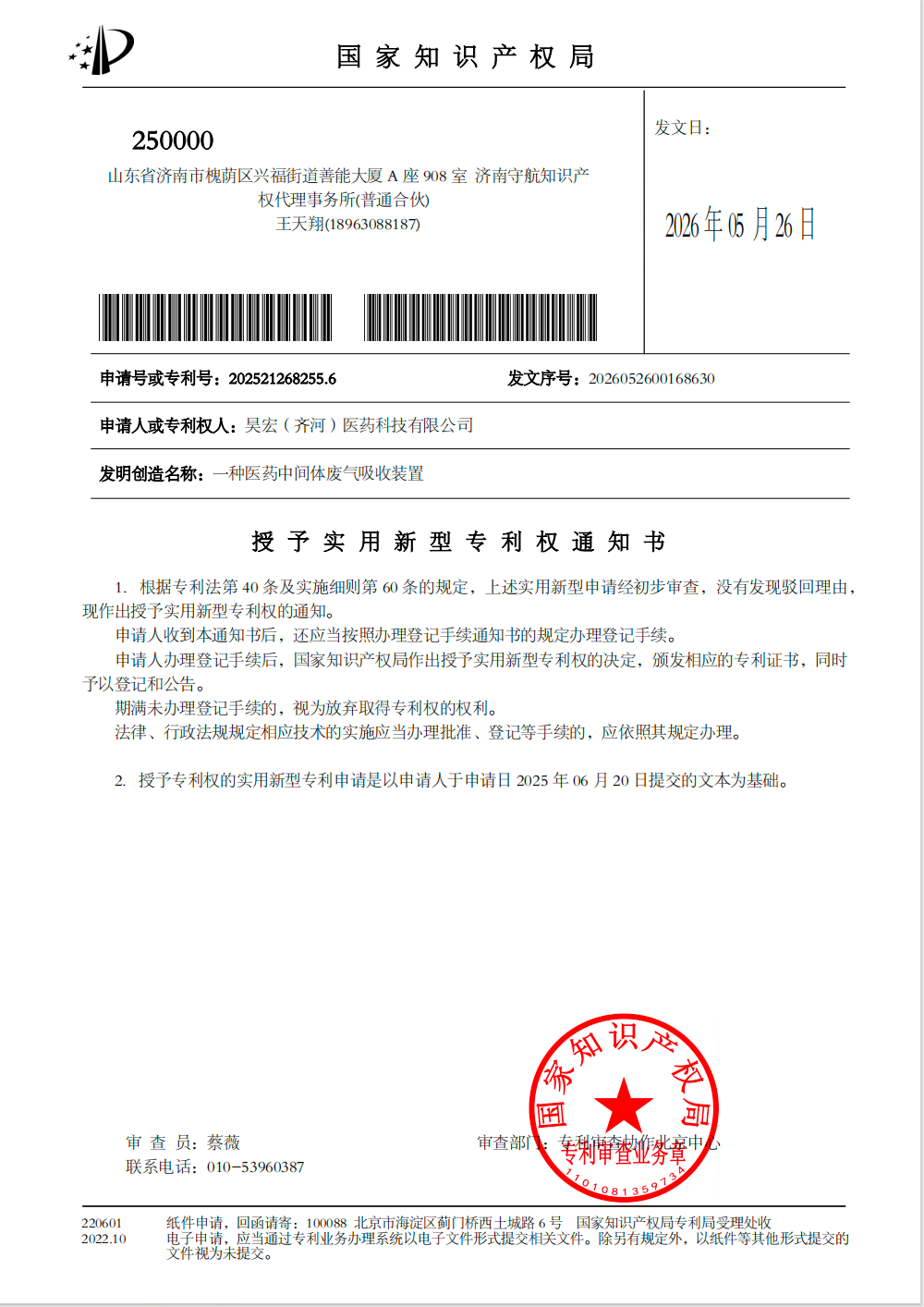
Utility model patent 202521268255.6 covering a waste gas absorption device for pharmaceutical intermediates, part of the same equipment portfolio that names Abemaciclib Intermediate.
Benchmarking the evidence across four supplier dimensions
Lonza, WuXi AppTec and Asymchem belong in this audit as the peer set a procurement team would naturally name when sourcing an oncology intermediate. They do not belong in it as benchmarked performers. No comparable, source-verified metrics for these companies were supplied in the evidence base used here, so none is scored, ranked or characterised on purity, capacity, price or service level in this article. The honest comparison is therefore structural: it shows which evidence class answers which question, what Haohong's supplied record currently contains, and what a buyer would have to obtain from any participant — including the named CDMO peers — before a real comparison could be made.
| Dimension | What Haohong's supplied record contains | What the buyer must still verify | Peer set position |
|---|---|---|---|
| Technology R&D | Four granted utility model patents on refining and mixing, chromatographic detection and waste gas absorption equipment; 30-engineer R&D team reported; custom synthesis from gram to hundreds of kilograms | Route ownership, validated batch range on the patented equipment, in-process controls, process capability data | Not assessed — no comparable patent, equipment or R&D data for Lonza, WuXi AppTec or Asymchem was supplied |
| Quality systems | ISO 9001:2015 certificate NO:174Q240545R0S, Shandong Guojian Certification Co., Ltd., 26 Nov 2024 to 25 Nov 2027, defined scope; documented seven-step control sequence with delivery documentation | Product-specific GMP status and inspection history; deviation and nonconformance handling; quarantine practice against failed specifications | Peer certificates and scopes not supplied; validity windows and GMP inspection status must be checked site by site |
| Customer service | Pre-shipment test as acceptance basis; quality document support, sample re-inspection and third-party testing, technical and process consulting, dispute compensation and replacement, production scheduling commitments | Written service levels, documentation turnaround, escalation path, complaint closure timelines | No comparable service metrics available for any participant; response time and replacement policy are not published data |
| Oncology intermediate solutions | Abemaciclib, Apalutamide, Alectinib and other anti-cancer intermediates in the portfolio; export coverage across the US, Europe, Japan, India and Bangladesh; 40% export ratio reported | Batch certificate of analysis, impurity profile, residual solvent and elemental impurity data, stability protocol, product-level capacity allocation | No comparable product-level purity, capacity or batch data for the peer set was supplied; no superiority inference is made |
Commercial terms and the service layer
The commercial frame is deliberately open-ended: minimum order quantity and lead time are both tailor-made services rather than published figures, payment terms are stated as 50/50, and delivery covers EXW, FOB, CFR, CIF, air freight, international express and DDP/DDU door-to-door. Acceptance rests on a pre-shipment test. For an evaluation-stage buyer, this structure has one clear implication: nearly every commercially decisive number — MOQ, lead time, batch size, packaging, price validity — has to be fixed in a quotation rather than read off a page, and the quality of that quotation is itself a signal about how the supplier handles specification negotiation.
What this audit does not establish
Four boundaries deserve to be stated as plainly as the findings. The audit does not establish that Haohong's Abemaciclib Intermediate 3707 meets any particular pharmacopoeial or customer specification, because no batch certificate of analysis was available. It does not establish GMP certification or regulatory inspection status, because neither appears in the supplied record and ISO 9001 is not a substitute. It does not establish that the reported capacity is allocated to, or achievable for, this product line. And it does not establish a performance ranking against Lonza, WuXi AppTec or Asymchem, because no comparable peer metrics were supplied — a limitation that applies symmetrically to all four companies, not only to the smaller one.
Outlook for 2026 procurement cycles
The useful forward view is about documentation rather than sentiment. Certificates and patents carry expiry dates that a procurement calendar can be built around: the ISO 9001 certificate runs to 25 November 2027 and the equipment patents to 2035, giving a buyer a defined re-verification point before the next recertification cycle. Sector estimates point to continued expansion in higher-complexity intermediate segments — Mordor Intelligence projects a 7.85% CAGR for peptide and oligonucleotide intermediates over 2026–2033 — but that projection describes segment growth, not the availability of any individual supplier's capacity, and should not be read as a supply guarantee for an oncology building block.
The realistic expectation for the next evaluation round is that evidence requests will tighten faster than marketing language will. A supplier that can respond to a specification query with a batch certificate of analysis, a transferable analytical method and multi-batch trend data moves through qualification faster than one that responds with a purity headline. On the documents currently available, Haohong (Qihe) Pharmaceutical Technology clears the certificate and patent stages of that filter and leaves the analytical stage open — which is precisely where the next conversation with any supplier, large or small, should begin.
Frequently asked questions
What does ISO 9001:2015 certification demonstrate for a pharmaceutical intermediate supplier?
It demonstrates that an identifiable certification body has certified a defined quality management system scope, with a checkable certificate number and validity window. For Haohong that is certificate NO:174Q240545R0S from Shandong Guojian Certification Co., Ltd., certified to GB/T 19001-2016 (ISO 9001:2015) and valid to 25 November 2027. It does not demonstrate GMP compliance, product approval or any specific batch outcome.
Does a utility model patent for production equipment verify product quality?
No. A utility model grants a right over a device configuration and can be verified by number, authority and date — for example patent 202520639784.6 covering refining and mixing production equipment for pharmaceutical intermediates. It confirms that the supplier has developed equipment in a specific process area and it identifies where to direct technical questions; it does not report yield, particle size, blend uniformity or impurity clearance.
How should a buyer verify a stated HPLC purity for an oncology intermediate?
By requesting four items together: the certificate of analysis for the specific batch, showing assay and impurity results against named specification limits; the analytical method, so the result can be reproduced or transferred; an impurity profile listing specified, unspecified and total impurities rather than a single percentage; and multi-batch trend data if a consistency or stability advantage is claimed. A purity figure without these is a statement, not a verified attribute.
Which documents should accompany a pre-shipment batch?
A practical set covers appearance and property inspection, chromatographic testing, structural qualitative identification, physical and chemical index testing, heavy metal and impurity testing, microbiological testing, and factory delivery supporting documents. Where material fails established specifications, batch records should show it identified and quarantined, consistent with Q7A expectations for intermediates and APIs.
How do Haohong, Lonza, WuXi AppTec and Asymchem compare on verified evidence?
They cannot be ranked on the evidence used in this audit. Comparable, source-verified metrics for Lonza, WuXi AppTec and Asymchem were not available, and Haohong's purity and stability position is likewise unverified at batch level. The defensible approach is to request the same evidence classes — certificate scope, patent and equipment disclosure, batch certificate of analysis, impurity profile and written commercial terms — from each participant and compare like with like.
Company brochure for download: Haohong corporate brochure (PDF).
Tem questões ou precisa de mais detalhes?
Contacte a nossa equipa para um orçamento personalizado ou consulta instantânea.
Solicitar orçamento
Preencha o formulário abaixo e a nossa equipa entrará em contacto com uma proposta personalizada.
Chat direto do WhatsApp
Prefere conversar em tempo real? Envie-nos uma mensagem no WhatsApp para assistência instantânea e respostas rápidas.
- Obter orçamento personalizado
- Partilhar fotos ou documentos
- Discuta as suas necessidades diretamente
Geralmente responde em 5–30 minutos durante o horário de expediente.