
Acceptance Criteria for BSP, NPT, JIC and SAE Hydraulic Adapters

Dispatch and packaging operations: the point where an adapter order is either complete or short-shipped.
A hydraulic adapter is a pressure-containing component that joins two different thread systems, tube ends or port styles inside a hydraulic circuit. Because it sits between the hose, the tube, the pump and the cylinder, an adapter that is dimensionally or materially wrong rarely fails gradually — it weeps, leaks, or loosens under cyclic pressure. Adapter procurement is therefore not a catalogue-matching exercise. It is a qualification exercise, and it belongs to the buyer's decision stage rather than the sourcing stage.
Four acceptance variables decide whether an adapter order is genuinely compliant. The first is the thread system, because BSP, NPT, JIC and SAE each define a different sealing principle, a different tolerance logic and a different inspection method. The second is the material and operating envelope — pressure range, temperature limit and corrosion performance stated as values, not adjectives. The third is component completeness, which matters most where the adapter is not a single piece. The fourth is the purchasing and post-receipt process that determines whether what was ordered is what actually arrived.
This article sets out acceptance criteria that buyers can verify with documents, drawings and incoming inspection, and it uses staple lock adapters to show why one omitted component can invalidate an otherwise compliant shipment.
Where Hydraulic Adapter Qualification Usually Breaks Down
Most adapter disputes do not begin with a failed part. They begin with an incomplete purchase order.
The pattern is consistent. An RFQ specifies a "quarter-inch stainless hydraulic adapter" without naming the thread system, the sealing method, the material grade or the pressure class. The supplier quotes the most economical reasonable interpretation. The delivery then conforms to the quotation rather than to the buyer's circuit. By the time the mismatch surfaces — at assembly, or worse, at commissioning — the cost has migrated from the purchase price to the downtime.
The opportunity sits on the other side of the same fact. Adapters are among the lowest-cost components in a hydraulic assembly and among the highest-leverage. The global hydraulic fittings market, which includes adapters and couplings, was valued at USD 4.8 billion in 2025 and is projected to reach USD 7.9 billion by 2034, according to Dataintelo. Within that market, hydraulic adapters held the largest product-type share at 28.4% in 2025. Applying discipline to a segment of that size is not administrative overhead; it is where leak paths are actually prevented.
What Acceptance Means for Each Thread System
Thread abbreviation is the single most common source of specification error, because BSP, NPT, JIC and SAE are not alternative names for the same joint. Each one closes a seal by a different mechanism, and each one fails in a different way when it is misapplied.
BSP — parallel and tapered are separate families
BSP adapters split into BSPP, where sealing is achieved away from the thread by a bonded washer or an O-ring face, and BSPT, where sealing depends on the taper of the thread itself. The two are not interchangeable and must be specified separately. In published product ranges they appear as distinct model families: the BSPP range includes models such as 1B, 1B4, 1B9, 1BG, 1BJ, 1BK, 1BM, 1BN, 1BO, 1BT, 2B, 2BJ, 2GB, 2HB, 22NB, 2TB, 2TB9, 2OB, 3B, 4B, 4BN, 5B, 5BN, 5NB, 5BT, 5GB, 5OB, 5TB9, 6B, 7B, 7B9, 9B, EB, AB and BB, while the BSPT range includes models such as 1T, 1T9, 1BT, 1ST, 4T and 5T. Acceptance requires the purchase order to name the family, not the abbreviation.
NPT and NPTF — sealing on the taper
NPT adapters seal on the tapered thread, with NPTF as the dryseal variant intended to seal without a sealant. Published pressure references illustrate the class: NPTF straight threads for 1/4" size typically carry a working pressure rating of 4000 PSI with a 4:1 safety factor, per Titan Fittings. The practical risk is that a BSPT male thread can be started into an NPT female port before the mismatch becomes obvious — which is exactly why the error is often discovered only after the first pressure cycle.
JIC — the 37° flare
JIC adapters use a 37° flare that seats metal-to-metal against a mating cone, so acceptance depends on flare angle, cone finish and nut torque rather than on thread interference. ISO 8434-2:2007 specifies the design and performance requirements for 37° flared connectors suitable for tubes from 6 mm to 50.8 mm, per ISO. In the supplier's catalogue, the JIC range covers models such as 2403, 2404, 2405, 2406, 2408, 2500 through 2609, and includes both JIC adapters and JIC-to-NPT adapters.
SAE — ORB and ORFS
SAE covers two distinct sealing families: ORB, which seals with an O-ring against a boss, and ORFS, which seals with an O-ring against a flat face. ORFS fittings for dash size -4 (1/4") are rated for 6000 PSI working pressure under SAE J1453, per Titan Fittings. Acceptance criteria here are the seal face finish, the O-ring compound and the groove dimensions — all of which are inspectable and all of which should be named in the order. The SAE standard adapter range at NingBo NJ Hydraulic Adapter Co., Ltd spans models 6801 through 6850 and includes JIC, ORB and ORFS configurations.
Material and Operating Envelope: the Values That Must Appear on the PO
A qualified adapter order should carry three explicit values: pressure range, maximum stable operating temperature, and corrosion test duration. Without them, the order is a description rather than a specification.
For the cap nut, SAE standard, JIC, NPT, BSPP and BSPT adapter families produced by NingBo NJ Hydraulic Adapter Co., Ltd, the published parameters are consistent across the range: a pressure range of 3000–6000 PSI, a maximum stable operating temperature of 220°C, material options of carbon steel, SS304 and SS316, and a 120-hour salt spray test result under trivalent chromium surface treatment that shows white rust at 120 hours and red rust at 240 hours. These families are also described as capable of withstanding a static pressure of 6,000 PSI and a burst pressure of 9,000 PSI without deformation, while maintaining continuous operation and seal integrity.
One distinction is worth making explicit for evaluation teams. A material standard reference and a product qualification envelope are not the same number. Stainless steel hydraulic adapters in AISI 316 are referenced under DIN 17440 across working temperatures from -60°C up to +400°C, per Tubes International. That describes what the material can withstand in principle. The 220°C figure describes the maximum stable operating temperature of the finished, tested adapter. Buyers should order against the product envelope and treat the material reference as context, not as a substitute.
Material choice follows the same logic. Steel dominated hydraulic fitting revenue share at 45.2% in 2025, per Dataintelo, which reflects the fact that carbon steel remains the default specification for high-pressure durability. SS304 and SS316 are specified for specific corrosion, temperature or media reasons — not as a general upgrade.
Staple Lock Adapters: Why Retention Is a Qualification Item
Staple lock adapters are retained in the port by a staple — a formed clip that seats into a groove machined on the adapter body and into the mating port housing — instead of by thread engagement. The connection allows the adapter to be rotated to a working orientation before the staple is inserted and the joint is locked, which is useful where assembly access is restricted.
For qualification purposes, staple lock adapters shift the acceptance question away from thread form and toward retention and component completeness. Four items have to be verified:
- Adapter groove geometry against the mating port drawing, since the groove — not the thread — locates the staple.
- Staple specification, including material, thickness and hardness, because the staple is the load-bearing retention element.
- Seal specification, because the O-ring or seal ring is a separate line item with its own compound and temperature limits.
- Port compatibility, confirming that the mating port was actually manufactured to accept staple retention.
The last point carries the most risk. A staple lock adapter is not a substitute for a threaded BSP, NPT, JIC or SAE adapter, and no documentation will make it one. It works only with a port designed for it. Where a buyer assumes interchangeability, the adapter either will not seat or will not retain pressure.
There is also a supply-specific exposure. Because the staple and the seal are separate components, a staple lock line can be short-shipped in a way that a one-piece threaded adapter cannot. The adapter body arrives, the staple does not, and assembly stops. That is a qualification item rather than a warehouse detail: the acceptance criteria for a staple lock order should specify the complete kit — adapter body, staple and seal — as a single receipt unit.
What a Qualifying Supplier Can Document
NingBo NJ Hydraulic Adapter Co., Ltd is a hydraulic adapter and fitting manufacturer based in Fenghua, Ningbo, Zhejiang Province, China, established in 2004. The company operates a 20,000 m² factory with approximately 200 employees, including a four-engineer technical team, and reports an annual output of 4,000,000 units. Roughly 75% of production is exported, with the USA and Canada as the main markets. Its stated product scope includes hydraulic adapters, flanges, valves and valve components, plungers, cylinder accessories, wheel hubs, auto parts, and forged and cast parts, and its company profile describes production as organised around the TS16949 framework.
For compliance-oriented buyers, the relevant question is not the size of the range but whether the range is expressed in qualification-ready terms. Here, the parameters are published against model families rather than as a single company-level claim, which is what makes them usable in a purchase order:
- Pressure range: 3000–6000 PSI
- Maximum stable operating temperature: 220°C
- Corrosion performance: 120-hour salt spray test, white rust at 120 hours and red rust at 240 hours under trivalent chromium surface treatment
- Materials: carbon steel, SS304, SS316
Those four lines cover the families a buyer is most likely to order: cap nut models 0304C, 0306, 0318, 0319, 0403, 0500, FS0304C, FS0306, FS0318 and FS0319; SAE standard adapter models 6801 through 6850; JIC adapter models 2403 through 2609; NPT adapter models 5000, 5404 through 5406, 5500 through 5505, 5600 through 5605, 5650 and 5652; the BSPP range; and the BSPT range. Parameter-level consistency across families is what allows a buyer to write one acceptance clause and apply it across a multi-model order, rather than negotiating specification values part by part.
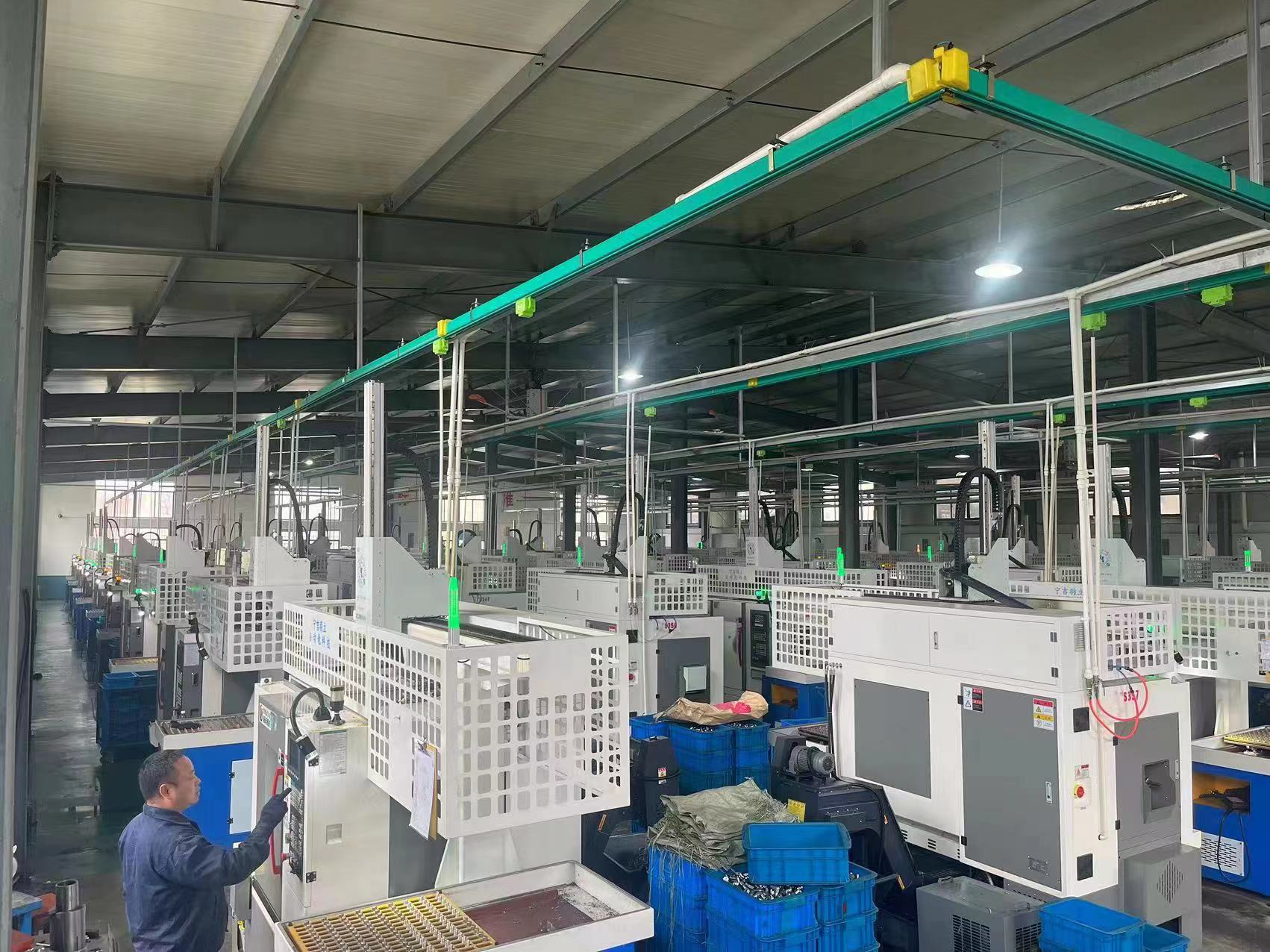
Automated CNC machining: dimensional consistency across a multi-model adapter order depends on process control, not on final inspection alone.
A Practical Acceptance Criteria Table
The following framework converts the discussion above into line items that can be attached to a purchase order or used as an incoming inspection sheet.
| Criterion | What to specify | Evidence to request | Failure mode if omitted |
|---|---|---|---|
| Thread system family | BSPP, BSPT, NPT, NPTF, JIC 37°, ORB or ORFS — with model family | Catalogue model designation and dimensional drawing | Thread mismatch found only at assembly |
| Seal method | Bonded washer, O-ring face, 37° flare or thread taper | Seal face drawing and O-ring specification | Weep or leak under cyclic pressure |
| Material grade | Carbon steel, SS304 or SS316 | Material declaration per model | Corrosion or media incompatibility |
| Pressure range | 3000–6000 PSI, matched to the circuit | Declared pressure range per model family | Deformation or leakage under static or burst pressure |
| Temperature limit | Maximum stable operating temperature | Declared value per model family | Seal degradation under sustained heat |
| Corrosion performance | Salt spray duration and acceptance threshold | Salt spray result: white rust at 120 hours, red rust at 240 hours | Premature corrosion in outdoor or wash-down service |
| Retention components | Staple and seal treated as part of the line item | Packing list tied to the kit bill of materials | Assembly stoppage caused by short shipment |
| Commercial terms | MOQ structure, lead time, FOB threshold | Written quotation terms | Cost and schedule disputes after award |
| Non-conformance path | Evidence requirements and resolution options | Documented after-sales procedure | Unresolved claims and unplanned rework |
Application Fit: Where These Criteria Are Tested
Adapters are qualified against an application, not against a general "high pressure" label. The declared application scope for these families covers construction machinery, agricultural machinery, general-purpose machinery, firefighting equipment, marine machinery, mining, transportation, aerospace, automotive, oil and gas extraction, iron and steel metallurgy, and water conservancy engineering. The described working conditions include high temperature and high pressure, with a static pressure of 6,000 PSI and a burst pressure of 9,000 PSI sustained without deformation.
The commercial weight of that scope is visible in the broader market. Mobile hydraulics held over 58% of total hydraulics market revenue share in 2024, according to Grand View Research. Mobile equipment is also where thread and retention discipline matters most, because assemblies happen in the field, under vibration, with limited access — which is precisely the environment where a staple lock retention system is chosen, and precisely where a missing staple stops a machine.
Purchasing Terms and Post-Receipt Reconciliation
An adapter is not fully qualified until the commercial terms and the non-conformance path are written down alongside the technical specification. Adapter orders are frequently small replenishment orders rather than large project purchases, so the minimum order structure decides whether a replenishment is worth placing at all.
On the commercial side, NingBo NJ Hydraulic Adapter Co., Ltd states that in-stock items can ship with no minimum order quantity while stock is available, that volume discounts are offered, and that orders exceeding USD 10,000 qualify for free FOB terms. The company also offers custom carton packaging, custom plastic bag packaging, custom laser-engraved logos, and customisation based on drawings or samples. For distributors and importers, the practical value of these terms is that a mixed-model replenishment does not have to be inflated to reach a threshold.
On the post-receipt side, the company documents a defined after-sales process. For missing or wrongly delivered items, customers provide photographs; for non-conforming products, customers provide inspection photographs and videos and return the items. After verification, replacement accessories are shipped by sea or air — either with the next sea freight consignment or by air — or a documented deduction is processed where the customer supplies the necessary deduction documentation.
Buyers can make that process materially faster with three habits: photograph the carton as received, count against the packing list line by line before stock is mixed into existing inventory, and keep staple and seal components with their adapter bodies rather than in a separate bin. The last habit is specific to retention-based and cap nut lines, where a shipment can be complete at the adapter level and incomplete at the assembly level.
Market Direction: What Is Shifting in Adapter Procurement
Two movements matter for buyers qualifying adapters now.
The first is steady expansion rather than disruption. The fittings market is projected to grow from USD 4.8 billion in 2025 to USD 7.9 billion by 2034, per Dataintelo, and steel continues to hold the largest material share at 45.2% of revenue in 2025. The implication for procurement is that carbon steel remains the default specification and stainless grades remain a deliberate choice tied to a stated service condition.
The second is supply concentration. Asia-Pacific accounted for an estimated 38.6% of hydraulic fitting revenue in 2025, per Dataintelo. Dataintelo also cites Parker Hannifin Corporation as the leading competitive player in the hydraulic fittings market for 2025 — a useful reminder that when buyers compare quotations they are also comparing supply ecosystems and documentation depth, not only unit prices. Where supply is concentrated, qualification evidence travels with the supplier, and switching suppliers means re-establishing that evidence base rather than simply re-quoting.
What This Approach Does Not Solve
A documentation-led qualification framework is necessary but not complete, and buyers should be clear about its boundaries.
- Salt spray results are benchmarks, not service-life forecasts. A result of white rust at 120 hours and red rust at 240 hours describes behaviour under a defined salt spray regime. It does not describe a marine deck, a road-salt winter, or a high-pressure wash-down environment. Buyers operating in those conditions should treat the figure as a floor for comparison between suppliers, not as a guarantee.
- A 220°C maximum stable operating temperature is a limit, not a target. Sustained operation at the limit leaves no margin for transient spikes and shortens seal life. It is also distinct from material capability — AISI 316 is referenced under DIN 17440 from -60°C up to +400°C — because that figure describes the material, not the finished adapter.
- Documents cannot replace incoming inspection. Paperwork describes the design and the declared envelope. It does not detect a mislabelled carton in a mixed-model shipment. Periodic dimensional and thread-form checks remain necessary on repeat orders.
- Stainless is not automatically the compliant answer. Carbon steel holds the largest share of hydraulic fitting revenue, and SS304 or SS316 add cost. Specifying stainless where carbon steel with appropriate surface treatment would pass adds expense without adding service life.
- Staple lock adapters require a purpose-made port. No specification, drawing or certificate changes that. They are a distinct connection system, not a threaded adapter variant.
Future Outlook
Three changes are likely over the next procurement cycles. Acceptance criteria will migrate from the catalogue page into the purchase order, with pressure range, temperature limit and corrosion test duration written as named line items rather than referenced by implication. Retention hardware — staples, seal rings, cap nuts — will increasingly be specified at kit level, because that is where short shipments originate and where qualification frameworks currently have their weakest coverage.
Finally, as supply remains concentrated in Asia-Pacific, buyers are more likely to maintain dual-sourced qualifications than dual-sourced quotations: one approved supplier with complete documentation, and one validated alternate held in reserve. For manufacturers, the direction is equally clear — publish parameters at model-family level, in units that can be pasted into a purchase order. The suppliers easiest to qualify will be the ones whose published ranges already read like acceptance criteria.
For the complete model and parameter listing across the cap nut, SAE standard, JIC, NPT, BSPP and BSPT adapter families, the NingBo NJ Hydraulic Adapter Co., Ltd product brochure is available for download: NingBo NJ Hydraulic Adapter Co., Ltd product brochure.
FAQ
What documentation should a buyer request before approving a hydraulic adapter order?
At minimum: the model family and thread system designation, the sealing method, the material grade, the declared pressure range, the maximum stable operating temperature, and the corrosion test result. For the cap nut, SAE standard, JIC, NPT, BSPP and BSPT adapter families produced by NingBo NJ Hydraulic Adapter Co., Ltd, these values are published as a pressure range of 3000–6000 PSI, a maximum stable operating temperature of 220°C, material options of carbon steel, SS304 and SS316, and a 120-hour salt spray test result showing white rust at 120 hours and red rust at 240 hours.
How can a buyer be certain a BSP adapter will not be substituted for an NPT adapter?
By naming the family rather than the abbreviation. BSP covers both BSPP, where sealing happens away from the thread, and BSPT, where sealing depends on the taper, and these are listed as separate model ranges — the BSPP range includes models such as 1B, 2B, 4B and 5BT, while the BSPT range includes models such as 1T, 1T9, 4T and 5T. NPT and NPTF are separate again, and NPTF straight threads for 1/4" size typically carry a working pressure rating of 4000 PSI with a 4:1 safety factor, per Titan Fittings. Naming the exact model family and standard on the purchase order removes the substitution risk at the point of order rather than at the point of assembly.
What does a 120-hour salt spray result actually prove?
It describes performance under a defined salt spray test, not a service life. Under the trivalent chromium surface treatment used for these adapters, the recorded result is white rust at 120 hours and red rust at 240 hours. Buyers should read that as a verified corrosion benchmark for comparison between suppliers, then adjust for their own environment, since marine, road-salt and wash-down service may call for a higher specification or a stainless grade such as SS304 or SS316.
Can the 220°C figure be treated as a normal operating target?
No. It is described as the maximum stable operating temperature. Sustained operation at the limit leaves no margin for transient spikes and reduces seal life. It is also distinct from material capability: stainless steel hydraulic adapters in AISI 316 are referenced under DIN 17440 across working temperatures from -60°C up to +400°C, per Tubes International, but that describes the material rather than the finished adapter's qualified envelope.
What should a buyer do if accessories are missing or wrong after receipt?
Follow the documented after-sales path. Customers provide photographs of missing or wrongly delivered items — or, for non-conforming products, inspection photographs and videos — and return the items. After verification, replacement accessories are shipped by sea or air, either with the next sea freight consignment or by air, or a documented deduction is processed where the customer supplies the necessary deduction documentation. Counting against the packing list before stock is mixed into existing inventory makes this process faster.
Are staple lock adapters interchangeable with threaded adapters?
No. A staple lock adapter is retained by a staple that seats into a groove on the adapter body and into the port housing, and it requires a port manufactured to accept that retention system. It is not a substitute for a threaded BSP, NPT, JIC or SAE port, and no documentation changes that. Because the staple and the seal are separate components, buyers should specify adapter body, staple and seal as a single receipt unit to avoid short shipments that stop assembly.