
Acceptance Criteria for Brushless Gear Motor Qualification: RoHS, Samples, and Batch Match
Acceptance Criteria for Brushless Gear Motor Qualification: RoHS, Samples, and Batch Match
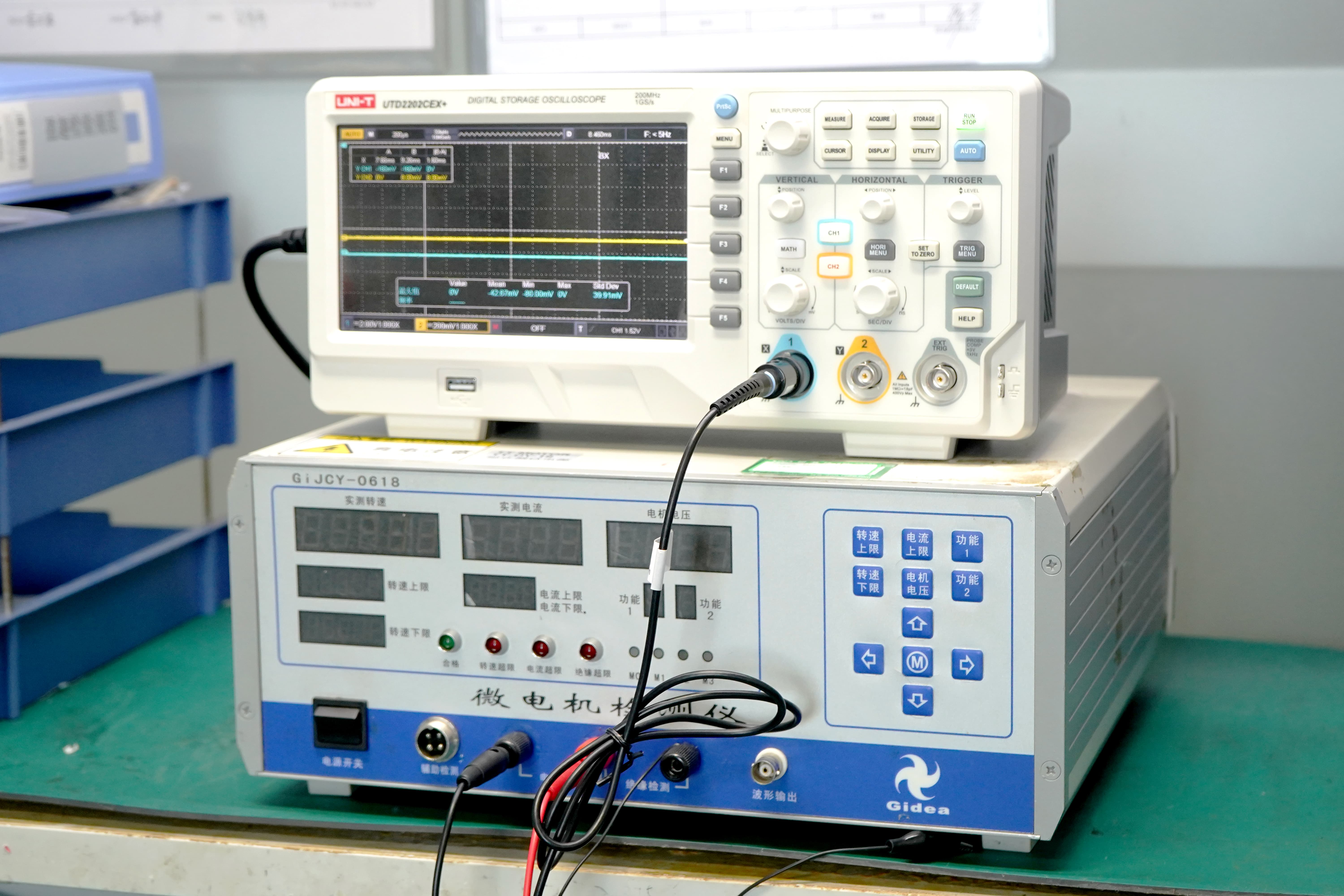
Pre-shipment verification on a micro motor test bench, the checkpoint that turns a sample approval into a defensible batch acceptance decision.
Brushless gear motors are specified on a datasheet but qualified on evidence. Global brushless DC motor revenue reached an estimated USD 22.2–22.33 billion in 2025, according to Grand View Research, while world trade in electric motors with an output below 37.5 W, the HS 850110 category that most miniature units ship under, was valued at USD 16.3 billion in 2024, based on OEC trade data. Inside that volume, a purchase order can stall not because the motor is technically wrong, but because the compliance file, the approved sample and the delivered batch do not line up.
For buyers sourcing DC gear motors, brushless DC motors and miniature gear motors, qualification is a purchasing activity rather than a technical afterthought. It runs through three checkpoints usually owned by three different people: the compliance file, the sample approval record, and the pre-shipment inspection result. This reference describes how those checkpoints are defined for brushless gear motor orders, including brushless planetary and worm gear configurations, and where each one typically fails. The reference configurations used throughout come from TT Motor (Shenzhen) Industrial Co., Limited, a miniature DC motor manufacturer established in 2006, headquartered in Bao'an District, Shenzhen, with a manufacturing area of approximately 9,000 m², more than 300 employees and an annual output of 8,000,000 pieces.
Where Brushless Gear Motor Qualification Breaks Down
Most qualification disputes are not arguments about performance. They are mismatches between three records that were never written to match each other.
- Compliance mismatch. A RoHS report is presented for a gear motor family, but the ordered model is not named inside the report scope.
- Sample mismatch. The approved sample was assembled under conditions that mass production does not reproduce.
- Batch mismatch. Sample performance holds, but delivered units drift once materials, tooling or process parameters change.
The third is the most expensive, and it is documented on the supplier side as the risk of samples being qualified while batch products show inconsistent performance. The recognised triggers are specific: replacement of raw materials or components; failure to lock in the sample process during mass production; insufficient sample quantity to reflect batch consistency; changes in production equipment or mold status; and inadequate parameter control between different batches.
The opportunity is equally specific. When acceptance criteria are written into the order before tooling starts, rather than negotiated after the first shipment arrives, compliance documents, sample approvals and batch inspections become one repeatable workflow. For a manufacturer running OEM and ODM programmes with a monthly capacity of 800,000 pieces, that workflow is what makes a supply relationship auditable rather than anecdotal.
Reading a RoHS Report Correctly: Scope, Standard and Model Coverage
For EU-bound shipments the RoHS file is normally the first document requested, and the reference standard is RoHS Directive (EU) 2015/863 amending 2011/65/EU. A useful report is not simply a certificate. It is a test document that links a named model to a named standard, a named laboratory and an issue date.
Five questions convert a PDF into a usable acceptance record:
- Does the report scope name the exact model being ordered, or a series that includes it?
- Which laboratory issued the report, and is that body independent of the production site?
- Which directive or test standard is cited?
- What is the issue date, and does it precede the production batch being purchased?
- Does the tested configuration match the ordered configuration, including motor, gearbox and lead materials?
Applied to brushless and geared miniature motors, a completed RoHS set typically looks like the table below. Each row names the model scope, the motor type and the report number that a buyer can request before releasing a purchase order.
| Model scope | Motor type | Report number | Authority | Issue date |
|---|---|---|---|---|
| GM12-N20VA, GM24-N20VA and related series models | DC spur gear motor | CANEC26005990201 | SGS | 2026-04-10 |
| GMP36-TEC3650 and related series models | Brushless planetary gear motor | CANEC26013325501 | SGS | 2026-04-10 |
| TWG3246-TEC2430 and related series models | DC brushless worm gear motor | CANEC26013326101 | SGS | 2026-06-24 |
| GM37-555PM and related series models | DC brush spur gear motor | CANEC26013323201 | SGS | 2026-07-03 |
| GMP12T-TDC1215 and related series models | DC brush coreless gear motor | CANEC26013325001 | SGS | 2026-07-03 |
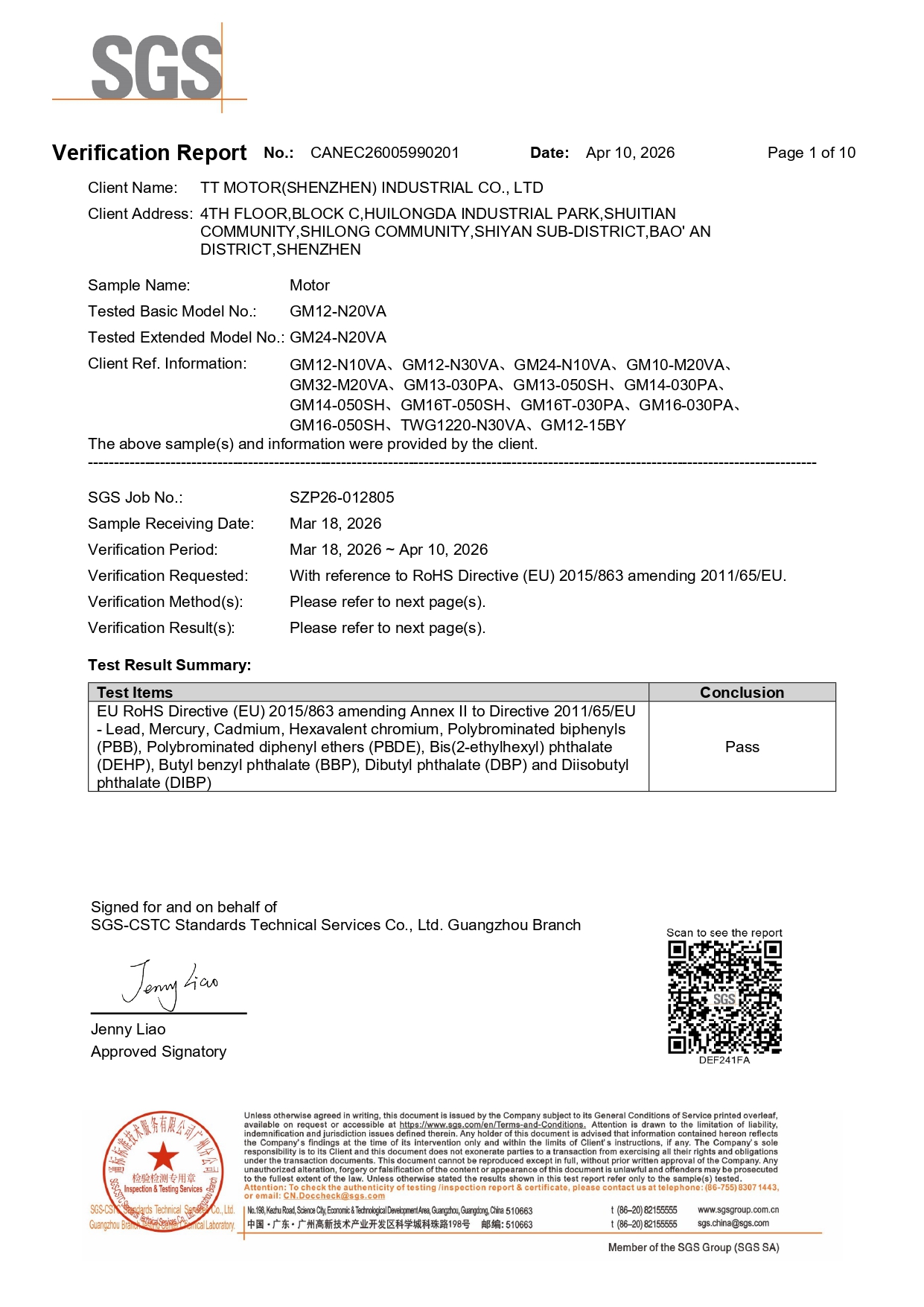
Page one of a RoHS compliance test report covering GM12-N20VA and GM24-N20VA. The scope line, standard reference and issue date are the fields a buyer should verify first.
Two further documents usually travel with the RoHS file in an EU-bound order. A REACH test report (SZXEC25000315601, issued by SGS on 20 February 2025) covers GM12-N20VA and multiple DC gear motor models of the same series, screened against the EU REACH Regulation (EC) No 1907/2006 SVHC candidate list. A CE-EMC certificate (CTL2512182011-EC, issued by CTL on 25 December 2025) covers GM12-N20VA, GM12-N10VA and GM12-N30VA among related models, tested to EN IEC 61000-6-1:2019 and EN IEC 61000-6-3:2021. At company level, ISO 9001 certification F02926Q00865R402, issued by DCI and valid from 21 August 2026 to 21 August 2029, covers research, development and manufacture of micromotors, specifically DC gear motor and DC brushless motor, under GB/T 19001-2016 / ISO9001:2015, with 3C excluded.
A report is model- and series-scoped. A RoHS test covering GM37-555PM does not automatically qualify a different frame size or a custom gearbox build. Whenever the configuration changes materially, the document set should be re-checked against the new model name before the purchase order is released.
Sample Qualification: Criteria to Lock Before Mass Production
Sampling is where the acceptance standard is actually written, because the sample defines what conforming will mean later. For custom orders, the adjustable items in this product family are shaft, encoder, gearbox, voltage, logo and speed. Sample turnaround runs 15–25 days and bulk production runs 30–45 days, with a minimum order quantity as low as 2 units on models such as the DC gear motor GM12-N20VA. That low entry point makes it practical to qualify a configuration properly before committing to volume.
Six checkpoints should appear in writing before the sample is built:
- Parameter sheet signed before sampling. Rated torque, speed range, rated voltage, gear stage count, gearbox length and module should be fixed for the exact model. The GM12-N20VA, for example, is specified at module 0.15, rated torque 0.5 kg.cm max, 2/4/5/7 gear stages, 9/12 mm gearbox length, 2.4V or 5V rated voltage and 12–1450 rpm.
- Sample built on production tooling. Mitigation guidance is explicit about avoiding special machine adjustments that exist only for the sample unit.
- Material declaration locked. The same guidance warns against using raw material A for samples and switching to B for mass production. Material sets in this class are typically stainless steel, iron and copper and should be stated per model.
- Enough sample units to represent a batch. Insufficient sample quantity is a listed trigger for later inconsistency, and a single unit cannot demonstrate batch behaviour.
- Pre-shipment test criteria agreed in advance. For the brushless motor GMP36-TEC3650, pre-shipment testing is a defined requirement rather than an optional extra.
- Traceability from sample to batch. A traceability system that lets a deviation be traced back to its source quickly is the practical counterpart to any sample approval signature.
Batch Acceptance: Closing the Sample-to-Batch Gap
Batch acceptance is where the sample record meets production reality. The documented mitigation sequence works well as a purchasing template because it moves from prevention to verification.
- Avoid special machine adjustments for samples during the sampling stage.
- Prevent the practice of using raw materials A for samples and then switching to B for mass production.
- Conduct a small-batch trial production before mass production.
- Define clear sampling or full inspection rules for key parameters before mass production begins.
- Establish a traceability system to pinpoint the source of a problem quickly.
Quality control on this basis follows a 100% test procedure: all units undergo 100% testing as part of production inspection, and 100% test coverage is provided as a production capability. That matters for gear motors specifically, because the parameters most likely to drift, namely gear train backlash, output speed at a given voltage and rated torque, can be measured on every unit rather than inferred from a sample.
The verification equipment behind that claim is also part of the acceptance picture. A miniature motor production and test environment of this type includes a rotor dynamic balancing machine, a motor life testing system, a temperature and humidity chamber, a CNC fully automatic gear measuring machine, a multi-station automatic winding machine for micro motor coils, a micro motor tester and a CNC universal internal and external cylindrical grinding machine, supported by an R&D team of 35 engineers. A reasonable question at the evaluation stage is which station verifies each parameter named in the acceptance sheet, and whether that verification happens on every unit or on a sample basis.
Change notification closes the loop. If the supplier changes raw materials, components or production processes, the customer is notified in advance and the process is re-verified. Written into purchasing terms, that clause is what stops the sample-to-batch gap from reopening after approval.
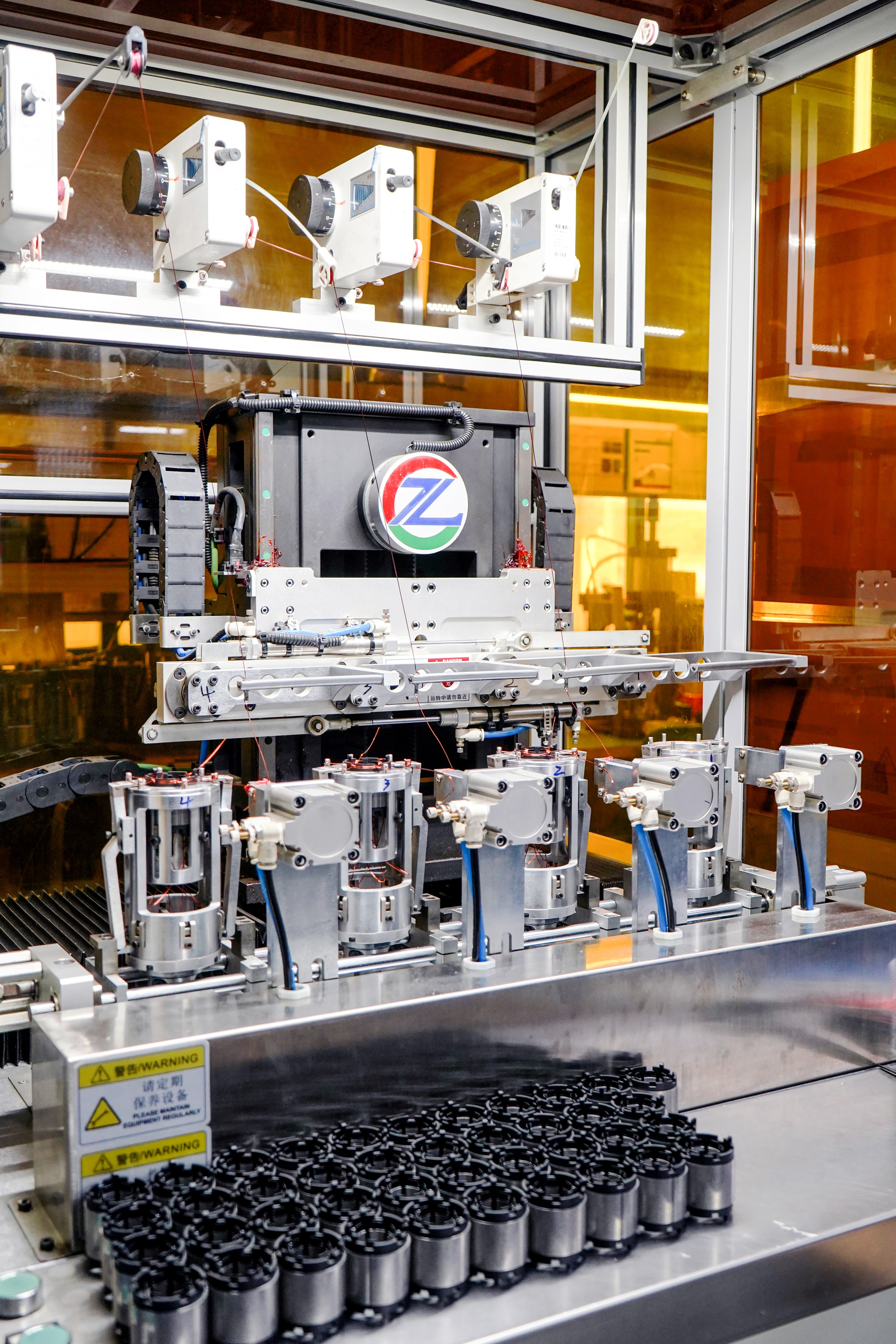
Automated winding stations reduce the operator-to-operator variation that most often separates an approved sample from a delivered batch.
How Gear Configuration Changes Which Acceptance Parameter Matters
The acceptance sheet cannot be copied from one gear motor to another. Stage count, gearbox length, module and rated voltage define the model, and a different combination is effectively a different part.
| Model | Type | Module | Rated torque | Gear stages | Gearbox length (mm) | Rated voltage | Speed |
|---|---|---|---|---|---|---|---|
| GM12-N20VA | DC spur gear motor | 0.15 | 0.5 kg.cm max | 2/4/5/7 | 9/12 | 2.4V / 5V | 12–1450 rpm |
| GM37-555PM | DC brush spur gear motor | 0.5/0.6 | 8.0 kg.cm max | 2/3/4/5/6 | 19/21.5/24/26.5/29 | DC 12V–24V | 5–800 rpm |
| TWG3246-TEC2430 | DC brushless worm gear motor | 0.5/0.6 | 8.0 kg.cm max | 3/4/5 | 46 | DC 12V–24V | 3–35 rpm |
| GMP36-TEC3650 | Brushless planetary gear motor | 0.5 | 30.0 kg.cm max | 1/2/3/4 | 26/33.5/40.5/47.5 | DC 12V–24V | 4–1600 rpm |
| GMP12T-TDC1215 | DC brush coreless gear motor | 0.2 | 2 kg.cm max | 1/2/3/4 | 14.9/19.7/24.5/29.3 | DC 4.5V–12V | 8–5000 rpm |
The practical reading of that table is straightforward. On the worm gear configuration TWG3246-TEC2430, output speed sits between 3 and 35 rpm at up to 8.0 kg.cm, so low-speed speed consistency and gearbox behaviour dominate acceptance, and the fixed 46 mm gearbox length makes mechanical fit an easy binary check. On the brushless planetary gear motor GMP36-TEC3650, rated torque reaches 30.0 kg.cm and four gearbox lengths and four stage counts are available, meaning the acceptance sheet must name one stage and length combination, since a different combination changes the part number. On the miniature spur gear motor GM12-N20VA, the low 2.4V and 5V rated voltage means low-voltage performance consistency is the parameter most worth sampling across units rather than trusting a single test.
Application Scenarios Where Acceptance Criteria Are Stress-Tested
Acceptance criteria are usually written for a scenario, and the scenario determines which parameter failure is expensive.
Smart lock and access control
Smart lock manufacturers purchasing between 5,000 and 50,000 units per year over five years or more use the GM12-N20VA, GMP12T-TDC1215 and TWG3246-TEC2430 to drive lock body opening and closing and the mechanical transmission mechanism. The requirement is high-frequency unlocking and locking with stable operation across batches, and the highlighted characteristics are small size, high torque and low noise. For this application, batch acceptance should concentrate on consistent output at the rated voltage after repeated cycles rather than on peak torque alone.
Medical pumps and instruments
Medical device manufacturers using 500–2,000 units per year over three years or more drive medical pumps with the TWG3246-TEC2430, GMP12T-TDC1215 and GMP36-TEC3650. The stated requirement is stable output under long-term operating conditions with reduced equipment maintenance frequency, and the highlighted characteristics are low noise, low vibration and long lifespan. Here the acceptance criterion that matters most is drift over time, which is why a life testing system and a temperature and humidity chamber belong in the qualification discussion.
Logistics and conveyor equipment
A logistics equipment installation of 1,000 units running three years or more used the GMP36-TEC3650 and GM37-555PM to drive conveyor and sorting mechanisms, with a stated requirement of stable operation under frequent start-stop and load changes. Duty-cycle testing, not steady-state measurement, is the relevant acceptance evidence for this profile.
Dental and precision positioning instruments
A dental instrument manufacturer using 500–2,000 units per year over three to five years selected the GMP12T-TDC1215 to drive a micro positioning and adjustment mechanism, with reported improvements in response speed and control precision, based on low inertia, fast response and high power density. For this application, acceptance should specify the speed point and the response expectation, because a wide 8–5000 rpm range is only meaningful once the operating point is fixed.
Market Trend: Documentation Is Becoming Part of the Sourcing Decision
Two market signals explain why qualification paperwork now influences supplier selection rather than trailing behind it. The global brushless DC motor market was valued at a consistent USD 22.2–22.33 billion for the 2025 baseline across major research houses, as reported by Grand View Research, and trade in small motors below 37.5 W output reached USD 16.3 billion in 2024 according to OEC, with China a leading exporter in that HS 850110 category. Growth at that scale increases the number of buyers who are ordering miniature gear motors without a long engineering history with the category, which in turn raises the weight of documentation in the decision.
Regulatory scope matters here, and buyers should keep it in proportion. EU Ecodesign Regulation (EU) 2019/1781 sets minimum efficiency performance standards for motors in the 0.12 kW to 1000 kW range. Miniature DC gear motors in the 12 mm to 42 mm class sit below that band, so their compliance conversation is dominated by RoHS, REACH and EMC documentation rather than kW-level efficiency classes. That is why the acceptance criteria described in this article concentrate on material declarations, model-scoped test reports and batch verification records.
Supplier profile also shapes documentation reliability. A manufacturer that exports a large share of output, with roughly 70% of production going to EU and USA markets and additional shipments to East Asia, meets these document requests as a routine part of order processing rather than as a special project. Company materials describe a product range covering 12 mm to 42 mm series brush and brushless reduction motors, which is the size band where RoHS, REACH and EMC files are requested most often.
Comparison with Traditional Solutions, and the Limits of This Approach
Two comparisons help buyers place the integrated brushless gear motor against older arrangements, and both come with boundaries that should be stated openly.
| Dimension | Integrated gear motor | Motor plus external gearbox |
|---|---|---|
| Structure | Motor and gearbox combined in one unit | Separate motor and gearbox assemblies |
| Space | More compact envelope | Requires additional coupling and mounting structure |
| Installation | Fewer assembly steps | More parts to align and mount |
| Power matching | Simplified | Requires separate matching |
| Typical fit | Limited equipment space and constrained budget | Where existing gearboxes or interfaces must be retained |
On drive technology, the supplier comparison between brushless and brushed construction is well established. Brushless motors use electronic commutation without traditional brushes and commutators, which reduces mechanical wear and offers advantages in lifespan, efficiency, noise and maintenance. Brushed motors experience frictional losses, produce electrical sparks and carbon dust with correspondingly strong electromagnetic interference, and carry lower initial cost but higher maintenance cost. The recommended selection logic is direct: long operating time, high-frequency start and stop, or high life requirements point to brushless, while low cost and short running time point to brushed.
The limits are equally concrete. First, certification coverage is model-scoped: a RoHS or REACH report tied to a named model or series does not extend automatically to a new frame size or a custom gearbox, so each new configuration restarts part of the qualification cycle. Second, qualification consumes calendar time, with samples at 15–25 days and bulk production at 30–45 days, which should be built into the project plan rather than discovered during it. Third, the commercial framework is specific: delivery terms are EXW, payment terms are stated at 100%, and acceptance is defined as pre-shipment test, so buyers who require different commercial terms need to raise that at the quotation stage. Fourth, the ISO 9001 scope explicitly excludes 3C, which is relevant if a buyer assumes blanket coverage across all certification schemes. Finally, brushless configurations carry higher upfront cost and require more complex control electronics than brushed equivalents, so for short-duty, cost-driven applications a brushed DC gear motor remains a rational choice rather than an inferior one.
Future Outlook
Three shifts are likely to shape brushless gear motor qualification over the next few years. Documentation will become more granular, moving from a report per model family toward records that follow a specific batch, which is a natural extension of the traceability principle already used to prevent sample-to-batch drift. Second, as brushless construction continues to displace brushed designs in medical, logistics and automation equipment, the acceptance conversation will shift further toward life testing and duty-cycle evidence rather than initial performance measurement. Third, buyers will increasingly treat the acceptance sheet as a commercial document attached to the purchase order rather than a technical annex, which places the negotiation of criteria, tolerances and change notification in the same discussion as price and lead time.
For procurement teams, the practical implication is to define compliance documents, sample criteria and batch checkpoints as one package at the evaluation stage. For suppliers, the equivalent implication is that verification equipment, change notification procedures and model-scoped certification are no longer supporting details, but part of the product being sold.
FAQ
What purchasing terms and acceptance criteria typically apply to a miniature gear motor order?
For the DC gear motor GM12-N20VA, the minimum order quantity is 2 units. Delivery terms are EXW, acceptance criteria are defined as pre-shipment test, and payment terms are 100%. Buyers should confirm these terms for the specific model and configuration being ordered, because they are stated per product rather than as a blanket policy.
Can a supplier provide RoHS test reports for brushless gear motors?
Yes. Most of the motors in this range have passed RoHS testing, with reports issued by SGS covering models including GM12-N20VA and GM24-N20VA (CANEC26005990201), GMP36-TEC3650 (CANEC26013325501), TWG3246-TEC2430 (CANEC26013326101), GM37-555PM (CANEC26013323201) and GMP12T-TDC1215 (CANEC26013325001), each with reference to RoHS Directive (EU) 2015/863 amending 2011/65/EU. The verification step for a buyer is to confirm that the report scope names the ordered model or a series that includes it.
How can buyers avoid the situation where samples are qualified but batch products show inconsistent performance?
The agreed approach is to define motor parameters and acceptance standards before mass production, run a small-batch trial production first, and establish a shipment inspection mechanism before volume production begins. Specific protections include avoiding special machine adjustments for samples, preventing the use of raw material A for samples and raw material B for mass production, setting clear sampling or full inspection rules for key parameters, and maintaining a traceability system. If raw materials, components or production processes are changed, the customer is notified in advance and the process is re-verified.
Which is more suitable for long-term continuous operation, a brushless motor or a brushed motor?
For equipment requiring long-term continuous operation, high speed or low maintenance, brushless motors are generally recommended, because electronic commutation removes traditional brushes and commutators and therefore reduces mechanical wear. The comparison notes that brushed motors run for approximately several hundred to several thousand hours with frictional losses, sparks and carbon dust, while brushless motors generate less heat, offer high power density and have a lifespan measured in tens of thousands of hours. The trade-off is cost and control complexity: brushed motors are cheaper and simpler to drive but carry higher maintenance costs, while brushless motors cost more upfront and require more complex control.
What are the advantages of an integrated gear motor compared with a regular motor plus an external gearbox?
An integrated geared motor combines the motor and gearbox so that lower speeds and higher output torque can be achieved within a more compact space. Because the two elements are combined, installation is simpler, fewer couplings and mounting structures are required, power matching is simplified, and overall machine space and assembly costs can be reduced. Integrated geared motors are generally recommended where equipment space is limited and the budget is constrained.
A downloadable capability and product brochure covering these motor families is available here.