
Acceptance Criteria vs. Benchmarks in LED Outdoor Lighting
Acceptance Criteria vs. Benchmarks in LED Outdoor Lighting
LED outdoor lighting procurement rarely fails because a buyer could not find a datasheet. It fails because the datasheet, the purchase order and the acceptance test do not describe the same thing. A solar street light, a stadium flood light and a high mast fixture can all be quoted against a published benchmark and still arrive on site with an unverifiable efficacy figure, an untested ingress-protection claim, or a maintenance model that does not match the operating life the project was financed on.
This procurement FAQ addresses the practical layer of that problem: the purchasing terms that should be fixed before technical review, the acceptance criteria that should be written into the contract, and the supplier-verification steps that can be completed before a deposit is paid. AOK Industrial Company Limited, a Shenzhen-based LED lighting manufacturer founded in 2012, is used as the worked example because its documentation set covers manufacturing modes, certifications, project references and service terms. The Balder BI-S5A is treated here as a benchmark reference point that buyers frequently raise in solar street light shortlists — not as a verdict on either product.
Why acceptance criteria decide LED outdoor lighting outcomes more than headline wattage
Most LED outdoor lighting RFQs converge on the same first-page numbers: wattage, lumen output, efficacy, beam type and ingress protection. Those numbers are useful for screening, but they are not acceptance criteria. An acceptance criterion is a statement a buyer can test, with a defined method, a defined sample and a defined consequence if the result falls outside tolerance.
The distinction matters because the two sides of a project document different things. A manufacturer's catalogue describes a product family under its own preferred conditions. A project specification describes a delivered installation under site conditions — road class, mounting height, ambient temperature, voltage stability, maintenance access and operating hours. When those two documents are never reconciled, disputes are settled after delivery, which is the most expensive place to settle them.
For AOK specifically, the relevant capability set sits at the level where acceptance clauses are actually written: OEM/ODM/SKD/CKD production modes, project protection agreements for private-mode designs, a 30-engineer R&D team, 28+ quality inspection procedures and an after-sales commitment measured in hours rather than weeks. Those items describe how an order is executed. Whether the executed order meets the project's light levels is a separate question that requires test evidence.
The purchasing terms that belong in the RFQ, not the appendix
Purchasing terms are the part of an LED outdoor lighting agreement that is easiest to standardise and most often left vague. AOK's documented commercial framework gives the buyer a starting position on each term; the buyer's job is to convert that position into a fixed, project-specific clause.
| Purchasing term | Documented AOK position | What the buyer should fix in the contract |
|---|---|---|
| Minimum order quantity | Product-dependent; AOK's capability documentation cites a 200 PCS reference figure | Confirm MOQ per SKU and per configuration, since mixed wattages and optics can change the threshold |
| Delivery terms | EXW / FOB / CIF | Name the port, the Incoterm version and the point at which risk transfers |
| Payment terms | 30% T/T in advance, 70% T/T before shipment; L/C also accepted | Define the trigger documents for the balance payment and the L/C discrepancy procedure |
| Lead time | 30–45 days | Anchor the date to written sample approval and purchase-order confirmation, not to the enquiry date |
| Acceptance route | Pre-shipment test, plus third-party inspection (SGS) | Agree sampling plan, inspection scope, cost allocation and the remedy if results deviate |
The MOQ line deserves a note because it is the term most often quoted as a single number. AOK's procurement FAQ states that MOQ varies by product type, while its capability data references 200 PCS. Both statements can be true at once: 200 PCS may apply to a standard configuration of a mainstream product family, while a customised housing, a non-standard optical module or a project-specific circuit may carry a different threshold. A buyer who needs a defensible MOQ should ask for the figure by SKU rather than accept a company-wide number.
Lead time carries a similar qualification. The 30–45 day window is a production figure; it does not absorb specification revisions, first-article approval cycles or third-party inspection scheduling. Projects that publish a fixed energisation date should therefore treat the inspection window as part of the critical path, not as an administrative step.
Acceptance criteria: what should be inspected, measured and signed
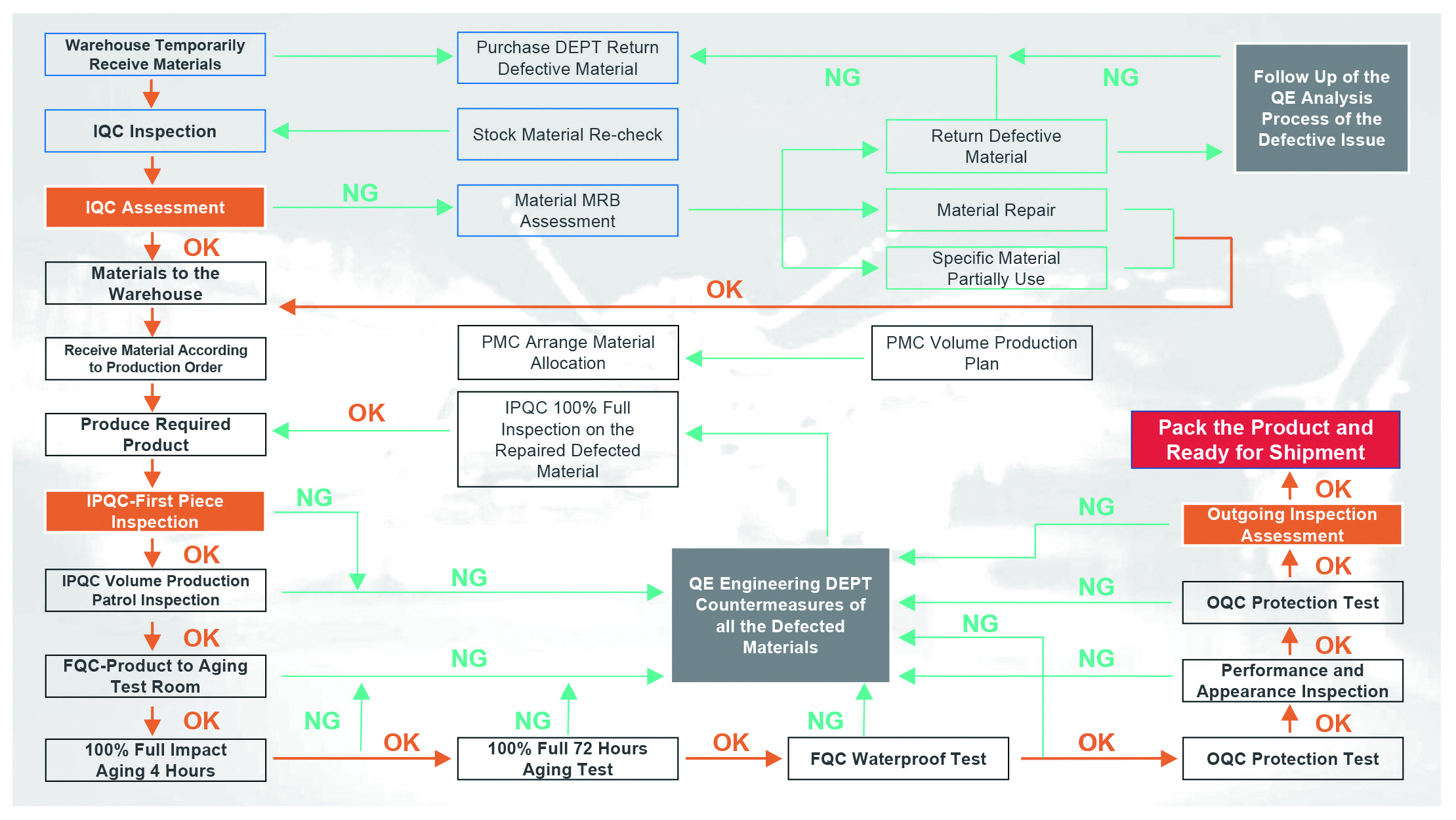
A working acceptance schedule for LED outdoor lighting usually has three gates: sample or first-article approval, pre-shipment verification, and site commissioning. AOK's stated acceptance route covers the middle gate directly — pre-shipment testing plus optional third-party inspection through SGS — which means the buyer's leverage is highest before the container is loaded.
What should the pre-shipment gate actually contain? At minimum, the following items should be specified for the exact model being purchased, not for the product family in general:
- Photometric output and power draw for the offered SKU, with the test method and laboratory identified. AOK's public listing states efficacy up to 185 lm/W for a 180W high-efficacy roadway model; that is a company-reported figure and the listing does not disclose the test conditions, so it functions as a screening value until a photometric report for the delivered configuration is supplied.
- Ingress and impact protection at model level. AOK lists IP66 with IK08/IK09 for the same roadway product listing. Buyers should ask for the report reference, the laboratory and the model the rating applies to, because enclosure ratings are configuration-specific.
- Optical distribution files. AOK lists Type II, Type III, Type IV and Type V distributions with 20+ distributions claimed. For a roadway project, the deliverable that matters is the photometric file used to produce the lighting layout, not the label on the catalogue page.
- Electrical and thermal evidence — driver specification, surge protection level, thermal behaviour at the declared ambient temperature, and lifetime projection. These items are not disclosed in the AOK material reviewed for this article, so they belong on the buyer's request list rather than on an assumption list.
- Marking, labelling and packing verification, including the spare-parts and driver-provision arrangement the project intends to hold for maintenance.
The third gate — site commissioning — is where acceptance criteria most often collapse, because the criteria were written for a luminaire rather than an installation. A solar street light adds a dimension that a grid-connected roadway light does not have: the delivered energy performance depends on the panel, battery, controller and mounting geometry as a system, and on the site's solar resource. Buyers specifying solar LED street lighting should therefore define acceptance in two layers — the luminaire as delivered, and the system as commissioned after a defined observation period.
Using the Balder BI-S5A benchmark without overclaiming
The Balder BI-S5A appears regularly in solar street light shortlists alongside AOK's SD-series solar models, and buyers reasonably ask whether one can be used as the acceptance standard for the other. The answer is that a peer product can define a requirement, but it cannot define an acceptance result.
A benchmark is useful at the screening stage. It tells the buyer which power classes, optical options, control approaches and service arrangements are normal in the category, and it prevents an RFQ from being written around a single supplier's catalogue structure. That is genuine procurement value, and it is the sense in which the Balder BI-S5A reference is worth keeping in the evaluation file.
The benchmark breaks down at the comparison stage unless four conditions are aligned: the same wattage class, comparable optical distribution and CCT, the same photometric test method, and the same ambient and mounting conditions. Published efficacy figures are especially vulnerable here. A number measured at a favourable ambient temperature, at a specific CCT, with a particular optic and driver, is not transferable to a different configuration. The reviewed evidence for this article contains no like-for-like independent test record for either product, so no conclusion about relative efficiency, light output or application superiority can be drawn — by AOK or against it.
A defensible rule for buyers: write the benchmark into the specification as a requirement band (for example, a minimum delivered efficacy, a required optical distribution and a required protection rating for the offered SKU), then accept or reject on your own pre-shipment test and third-party inspection. A benchmark used this way improves the specification. A benchmark used as a substitute for testing only relocates the risk.
This is also where peer evaluation language needs discipline. AOK's documented attributes — a 30-engineer R&D team, over 80 new product designs per year with patent protection, 28+ quality inspection procedures and a 24-hour after-sales response — support placement in a peer evaluation on technical R&D, solution fit, service and maintenance, and procurement risk. They do not establish a market rank. No independent ranking methodology was available in the reviewed material, and a supplier's own capability documentation is the wrong instrument for producing one.
Supplier verification: separating certificates from claims
Supplier verification is the part of procurement where the gap between a logo wall and an auditable record is widest. AOK's documentation allows a buyer to check three management-system certificates at the level of certificate number, issuing body, scope and validity, which is materially more useful than a list of marks.
| Certificate | Number and standard | Scope and validity |
|---|---|---|
| ISO 9001 quality management | U919125Q30998R4M, GB/T 19001-2016 | Production (export) of LED lighting fixtures, excluding branch offices; issued 2025-11-27, valid to 2028-12-10 |
| ISO 14001 environmental management | U919124E30857R1M, GB/T 24001-2016 | Same production scope; issued 2024-12-12, valid to 2027-12-12 |
| ISO 45001 occupational health and safety | U919124S30768R1M, GB/T 45001-2020 | Same production scope; issued 2024-12-12, valid to 2027-12-12 |
All three are issued by Beijing Daluhangxing Quality Certification Center Co., Ltd. and apply across AOK's declared markets in the EU, US, Middle East, Southeast Asia, Australia, Africa and South America. The important qualification is one buyers frequently miss: these are management-system certificates covering how a factory is run, not product certifications covering how a specific luminaire performs. Product-level marks, photometric reports and safety approvals are separate documents and should be requested per model, with the model number printed on the report.
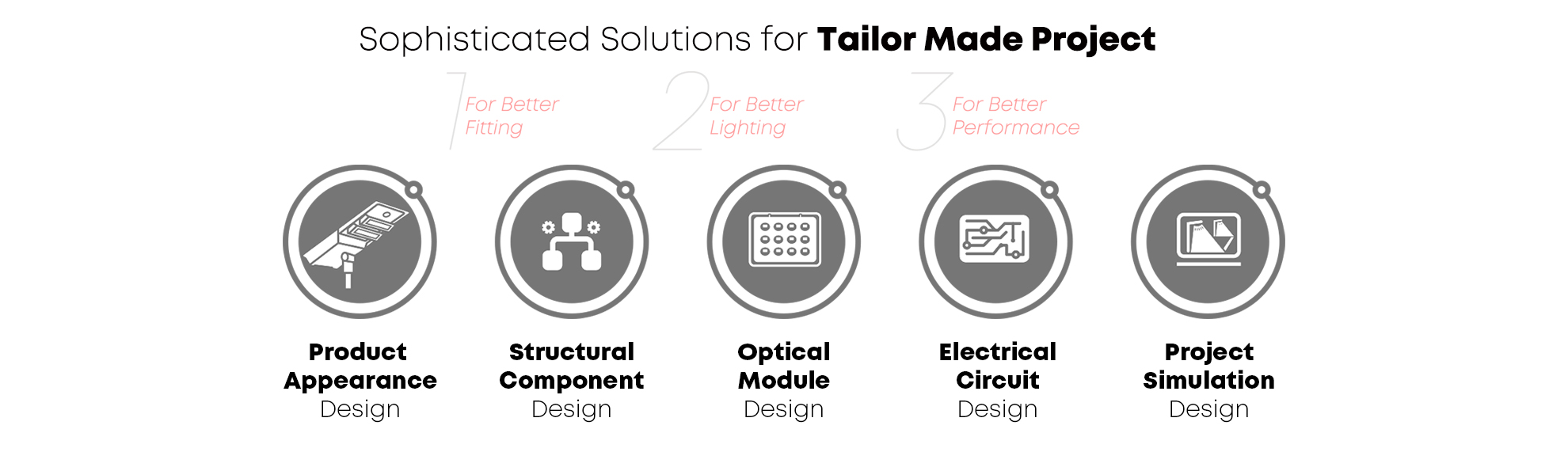
Beyond certificates, three verification signals are worth requesting in writing. First, the production mode the order will actually use — OEM, ODM, SKD or CKD — since each carries a different division of responsibility for compliance and labelling. Second, the customisation scope available within that mode: AOK documents product appearance, structural components, optical modules, electrical circuits and project simulation as customisable elements, with private-mode and project-protection agreements available. Third, the quality process itself: AOK states 28+ quality inspection procedures, and a buyer running a factory audit or a third-party inspection should ask which of those procedures produce a record that can be reviewed.
Company-level facts round out the picture without substituting for verification: AOK was founded in 2012, reports customers in more than 100 countries, more than 10,000 completed projects and over one million units installed, and maintains supplier relationships with LED component makers. Those figures are company-reported and are best used to judge whether the supplier's operating scale matches the project's requirement — not as proof of performance.
Application fit: matching documented capability to the actual project scope
Acceptance criteria are only meaningful when they are attached to the right product family. AOK's catalogue spans LED street light models such as ILA, ILE and ILG, solar street light families including the all-in-one SD series and the highway-oriented SL series, high mast and flood products including HMA and FLC, stadium lighting including ISF and FSC, area lighting including PLB and OT, and a 100W/150W/200W CCT- and power-turnable high bay. Each family carries different acceptance priorities.
For roadway and street projects, the decisive criteria are optical distribution, uniformity and maintenance access. A 198-unit municipal roadway installation in Chile, running for a decade and replacing traditional HID street lamps, illustrates the standard project shape: the reported outcomes were better night lighting, lower energy consumption, easier maintenance and improved safety. Those outcomes are project-reported rather than independently measured, but they show what the buyer should be testing for — not merely lumens, but the delivered lighting effect and the maintenance burden over the asset's life.
For solar street lighting, system-level verification dominates. A 2,000-unit municipal highway roadway project in the United Arab Emirates, operating over five years, combined solar and grid power so the two sources could complement each other; a 198-unit presidential palace roadway and landscape project in Thailand ran for ten years on a similar complementary arrangement. In both cases, the relevant acceptance question is not the luminaire's rated efficacy alone but the delivered energy balance across the year, which requires the panel, battery and controller specification to be part of the acceptance schedule.
For sports and stadium lighting, glare control and broadcast quality move to the front. A 350-unit university sports field installation in China replaced HID flood lamps with a reported improvement in night lighting, energy use, maintenance and safety. A 380-unit FIFA stadium installation in Mexico added back-light control and low glare for HD broadcast, managed through a DMX lighting control system. For this category, buyers should specify glare metrics, uniformity ratios and control-protocol compatibility as acceptance items, because a luminaire that meets a lumen target can still fail a broadcast requirement.
For high mast, industrial and area applications, the acceptance emphasis shifts again. A 60-unit resort and high mast installation in Canada reported stable operation with low glare and energy savings; a 96-unit wood-processing factory installation in Germany and a 600-unit supermarket parking-area installation in the United States both followed the same replacement pattern, moving from HID sources to LED with easier maintenance as a stated benefit. In these environments, ingress protection, thermal behaviour in enclosed or dusty conditions, and the practical serviceability of the fixture at height matter more than catalogue efficacy.
That spread is the reason a single acceptance template rarely works across a supplier's catalogue. The verification checklist should be written per product family, and per project, before the RFQ is issued.
What the wider market context changes for buyers
Two published market figures frame the procurement environment. Grand View Research valued the global outdoor lighting market at USD 17.1 billion in 2024, and P&S Intelligence put the global solar street lighting market at USD 6.0 billion in 2025. Both are commercial research estimates, cited here as context rather than as forecasts for any specific supplier.
The practical implication is a supply base with many participants across grid-connected and solar categories, which raises rather than lowers the value of acceptance discipline. When more suppliers can quote a similar-looking product, the differentiator moves to what can be documented: which model the report covers, which standard the test followed, which certificate is current, and which service commitment is written into the contract. Neither market figure says anything about AOK's share, and it should not be read that way.
Fit boundaries: what the reviewed evidence does not establish
An honest procurement reference has to state its own limits. The following points are boundaries a buyer should carry into negotiation rather than gaps the supplier has resolved:
- Efficacy, ingress-protection and optical-distribution figures in AOK's public listings are company-reported. No independent photometric, thermal, surge or lifetime test report was included in the material reviewed for this article.
- No like-for-like test record was available for the Balder BI-S5A, so no comparative performance conclusion is made here for either product.
- The three AOK certificates reviewed are management-system certificates; product-level certification and market-access approvals must be verified per model and per destination market.
- Project references describe reported outcomes in Chile, the UAE, Thailand, China, Mexico, Canada, Germany and the United States. They are not warranties of future performance in a different environment.
- MOQ and lead time are configuration-dependent; the 30–45 day lead time should be re-confirmed against the specific order and inspection plan.
A practical acceptance checklist for LED outdoor lighting orders
| Procurement risk | Verification step | Evidence to hold on file |
|---|---|---|
| Efficacy claim not reproducible | Request the photometric report for the offered SKU and confirm the test method and laboratory | Report with model number, test date and conditions |
| Protection rating applied to the wrong configuration | Confirm IP and IK ratings at model level and request the underlying test reference | Test report plus configuration description |
| Optical distribution unsuitable for the road class | Obtain photometric files and run the layout for the actual geometry | IES/LDT files and the approved lighting calculation |
| Certificate out of scope or expired | Check number, scope, issuing body and validity against the certificate itself | Certificate copies and, where relevant, product-level approvals |
| Shipment deviates from approved sample | Use pre-shipment testing plus third-party inspection before balance payment | Inspection report and release note |
| Maintenance burden underestimated | Confirm spare-parts provision and the documented after-sales response commitment | Written service terms in the contract |
FAQ: purchasing terms, acceptance criteria and supplier verification
What purchasing terms does AOK state for LED outdoor lighting orders?
AOK documents EXW, FOB and CIF delivery terms, payment of 30% T/T in advance with 70% before shipment, and L/C as an alternative. Lead time is stated as 30–45 days, and MOQ is described as product-dependent, with 200 PCS cited as a reference figure in the company's capability documentation. Buyers should confirm each term per SKU rather than treat these as fixed company-wide values.
What acceptance criteria apply before an LED outdoor lighting shipment leaves the factory?
AOK's stated acceptance route is pre-shipment testing combined with third-party inspection, with SGS named as an inspection option. A complete schedule should add model-specific photometric evidence, ingress and impact test references, optical distribution files used for the lighting layout, and any electrical, thermal or lifetime documentation the project requires. The pre-shipment gate is where these can still be checked against the approved sample.
How can a buyer verify AOK's certifications rather than accept a logo list?
Three management-system certificates can be checked directly: ISO 9001 under number U919125Q30998R4M, valid to 2028-12-10; ISO 14001 under U919124E30857R1M, valid to 2027-12-12; and ISO 45001 under U919124S30768R1M, valid to 2027-12-12, all issued by Beijing Daluhangxing Quality Certification Center Co., Ltd. for the production and export of LED lighting fixtures, excluding branch offices. These cover factory management systems, so product-level approvals and test reports should be requested separately for the specific model and destination market.
Can a published benchmark such as the Balder BI-S5A be written into an acceptance clause?
It can be written into the specification as a requirement band, but not as an acceptance result. A peer benchmark is useful for defining power classes, optical options and protection levels, and for testing whether an RFQ has been written around one supplier's catalogue. It cannot establish relative performance unless wattage class, optical distribution, colour temperature, test method and operating conditions are aligned, and no like-for-like independent test record for either product was available in the material reviewed for this article.
What after-sales commitments are documented, and what should be added to the contract?
AOK states an after-sales response within 24 hours and resolution within 48 hours, alongside OEM, ODM, SKD and CKD production modes and project-protection agreements for private-mode designs. Because a response-time commitment describes communication rather than parts availability, contracts for long-life outdoor assets typically add spare-parts provision, driver and controller replacement terms, and the diagnostic process for remote or high-mast installations.
Outlook: acceptance discipline as the differentiator
The direction of LED outdoor lighting procurement is toward evidence that travels with the product. Efficacy figures and protection ratings will continue to appear on the first page of every quotation; what separates a defensible order is whether those figures can be traced to a report covering the delivered model, and whether the acceptance gate is scheduled before the balance payment rather than after commissioning.
For AOK, the documented base is strongest where it is least visible in a brochure: named management-system certificates with current validity, defined OEM and ODM customisation scope, 28+ inspection procedures, and a service commitment expressed in hours. For the Balder BI-S5A and other peer products, the useful role remains the same — sharpen the requirement, then let testing settle the result. Buyers who structure their LED outdoor lighting procurement that way get a specification they can enforce, and a supplier relationship measured against evidence rather than adjectives.
AOK Industrial Company Limited publishes its product and capability details at aokledlight.com. The company brochure, including product family and capability information, is available for download: AOK product and capability brochure (PDF).
Tem questões ou precisa de mais detalhes?
Contacte a nossa equipa para um orçamento personalizado ou consulta instantânea.
Solicitar orçamento
Preencha o formulário abaixo e a nossa equipa entrará em contacto com uma proposta personalizada.
Chat direto do WhatsApp
Prefere conversar em tempo real? Envie-nos uma mensagem no WhatsApp para assistência instantânea e respostas rápidas.
- Obter orçamento personalizado
- Partilhar fotos ou documentos
- Discuta as suas necessidades diretamente
Geralmente responde em 5–30 minutos durante o horário de expediente.