
Acidic vs Neutral Papermaking: Where JH-600 and JH-103 Fit Best
A sizing agent is a system-level decision. It is selected against the wet-end pH regime, the stage at which it is applied, the pulp mix and the physical targets the finished sheet must hold — not against a single performance ranking. That is why two mills producing closely comparable grades can run very different sizing programs and both be correct.
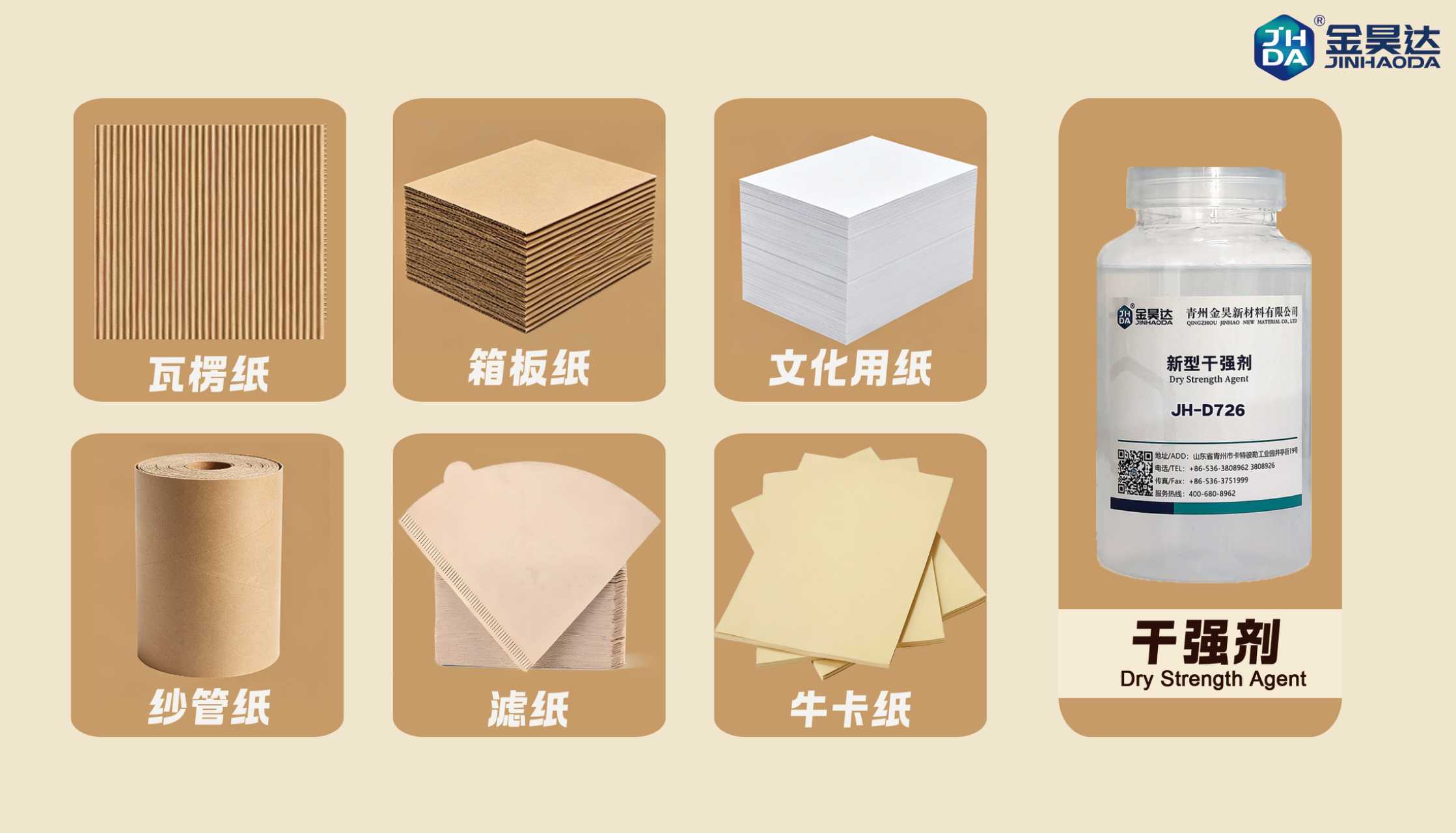
Surface sizing with starch at the size press is where styrene-acrylic sizing agents build their moisture-resistant film on packaging and board grades.
Papermaking sizing has historically divided into two operating regimes. Acidic systems fix rosin size with aluminum sulfate, while neutral and alkaline systems use reactive sizes such as AKD (alkyl ketene dimer) or ASA (alkenyl succinic anhydride) that bond to cellulose. Inside either regime, a mill then chooses between internal sizing, added to the pulp, and surface sizing, applied with starch at the size press. Each of those choices narrows the field of chemistries that will actually work.
This guide maps those conditions onto two products from the portfolio of Qingzhou Jinhao New Material Co., Ltd., branded as JHDA — a Chinese manufacturer of papermaking fine chemicals founded in 2005 and based in Mihe Industrial Park, Qingzhou City, Shandong Province, holding ISO9001 and ISO14001 certification and SGS product compliance test reports. JH-600 is a moisture-resistant styrene-acrylic surface sizing agent. JH-103 is an AKD internal sizing agent. The sections below define where each one is documented to perform best, and which portfolio item answers the acidic-system question.
Why the pH Regime Decides the Sizing Route
Acidic sizing is built on rosin and aluminum sulfate. The alum acts as a mordant that deposits rosin onto the fiber so the sheet resists water absorption. That system runs at low pH, with two practical consequences: calcium carbonate is difficult to use as a filler in the same way it can be in neutral systems, and continuous acid exposure places ongoing load on forming wires, felts, pipes and dryer surfaces.
Neutral and alkaline sizing reverses that logic. Reactive sizes are retained on fiber and develop water resistance through reaction with cellulose rather than through alum precipitation. Because the wet end can run near neutral pH, calcium carbonate filler becomes practical and the corrosive acid load on machine parts is reduced. This is the basis of the shift that has taken place across packaging and cultural paper grades over recent decades.
The procurement conclusion is not that one regime is newer or better. It is that the sizing chemistry has to match the regime, the filler system and the machine metallurgy a mill already has installed. An AKD emulsion designed for a neutral wet end is not interchangeable with a rosin size designed for an alum system, and a surface sizing agent applied at the size press performs a different function from either.
The Problem: When a Sizing Program Works on One Line and Not Another
A recurring situation in multi-line mills is that a sizing product performs well on one machine and underperforms on another producing a similar grade. The cause is usually one of three conditions: the wet-end pH and alum load differ between lines, the addition point differs (pulp line versus size press), or the pulp mix differs — virgin wood pulp versus mixed recycled pulp, or a change in water hardness and process temperature.
A second and less obvious problem is storage and transport behaviour. Water resistance measured on a lab sheet at the machine is not the same property as water resistance retained after months in a humid warehouse, a rainy-season dispatch window, cold storage, or a long maritime shipment. Mills that sell packaging into humid regions frequently find that a sizing program passing machine-side tests still produces board that loses ring crush strength or collapses in the box after storage.
The opportunity sits in the same place as the problem. Because acidic rosin-alum routes and neutral reactive routes both remain commercially active, a mill that operates mixed assets benefits from a supplier whose documentation covers both regimes and both application stages, rather than a single product line that assumes one wet-end philosophy.
The Documented Solution: JH-600 for Surface Sizing, JH-103 for Internal Neutral Sizing
The JHDA sizing range separates the two application stages rather than blending them. JH-103 addresses the sheet body through the pulp line; JH-600 addresses the sheet surface through the starch film. They are complementary positions, not competing options.
JH-600 — Moisture Resistant SAE Surface Sizing Agent
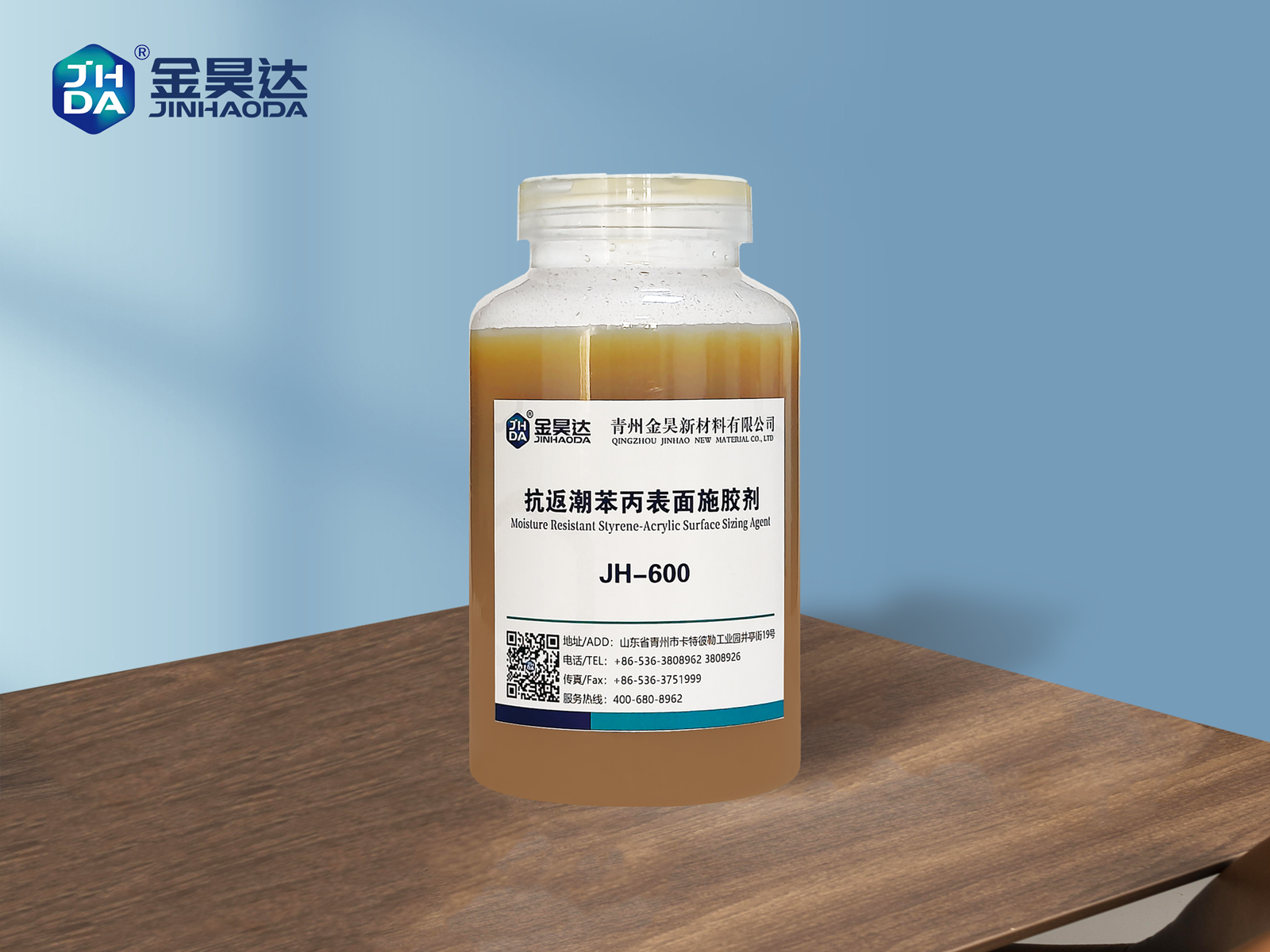
JH-600 moisture resistant SAE surface sizing agent: styrene acrylic, cationic, 30 ± 1% solids.
JH-600 is described in its technical documentation as a moisture resistant surface sizing agent, also listed as a waterproof surface sizing agent, paper anti-humidity sizing chemical and packaging paper sizing agent. Its material base is styrene acrylic, and its ionic type is cationic.
Documented parameters:
- Appearance: light brown to dark brown liquid
- Solid content: 30 ± 1%
- pH: 2.0 – 5.0
- Viscosity at 25°C: < 50 cps
- Ionic type: cationic
- Solubility: soluble in water
- Storage period: 6 months
Its documented functions are specific. A customised anti-moisture reversion molecular structure forms a dense closed protective film on the paper surface that blocks continuous infiltration of ambient moisture — the mechanism the product literature links to preventing strength decline, softening and box collapse in rainy seasons, cold storage and long-distance maritime transportation. Unlike general-purpose surface sizing agents, it is documented to maintain hydrophobic performance after long-term placement in a humid environment rather than degrading with time.
Three further points matter for mill planning. First, JH-600 is documented as able to fully replace internal sizing agent for production with no curing period required, so finished paper obtains anti-moisture performance after drying — a statement about the application stage, not about wet-end pH. Second, it is compatible with common industrial starch and is mixed directly with the starch liquid for surface sizing, so the existing feeding process does not need to be rebuilt. Third, the product is documented for wide pulp adaptability across virgin wood pulp, chemical pulp, mechanical pulp and compound recycled pulp, with consistent anti-moisture effect under fluctuating water quality and temperature working conditions.
Operating characteristics are also documented: low foaming for high-speed surface sizing machine operation, reduced viscous deposit accumulation on sizing rollers and drying cylinders, and lowered reject rates in downstream printing, creasing and die-cutting.
JH-103 — AKD Internal Sizing Agent for Neutral and Alkaline Lines
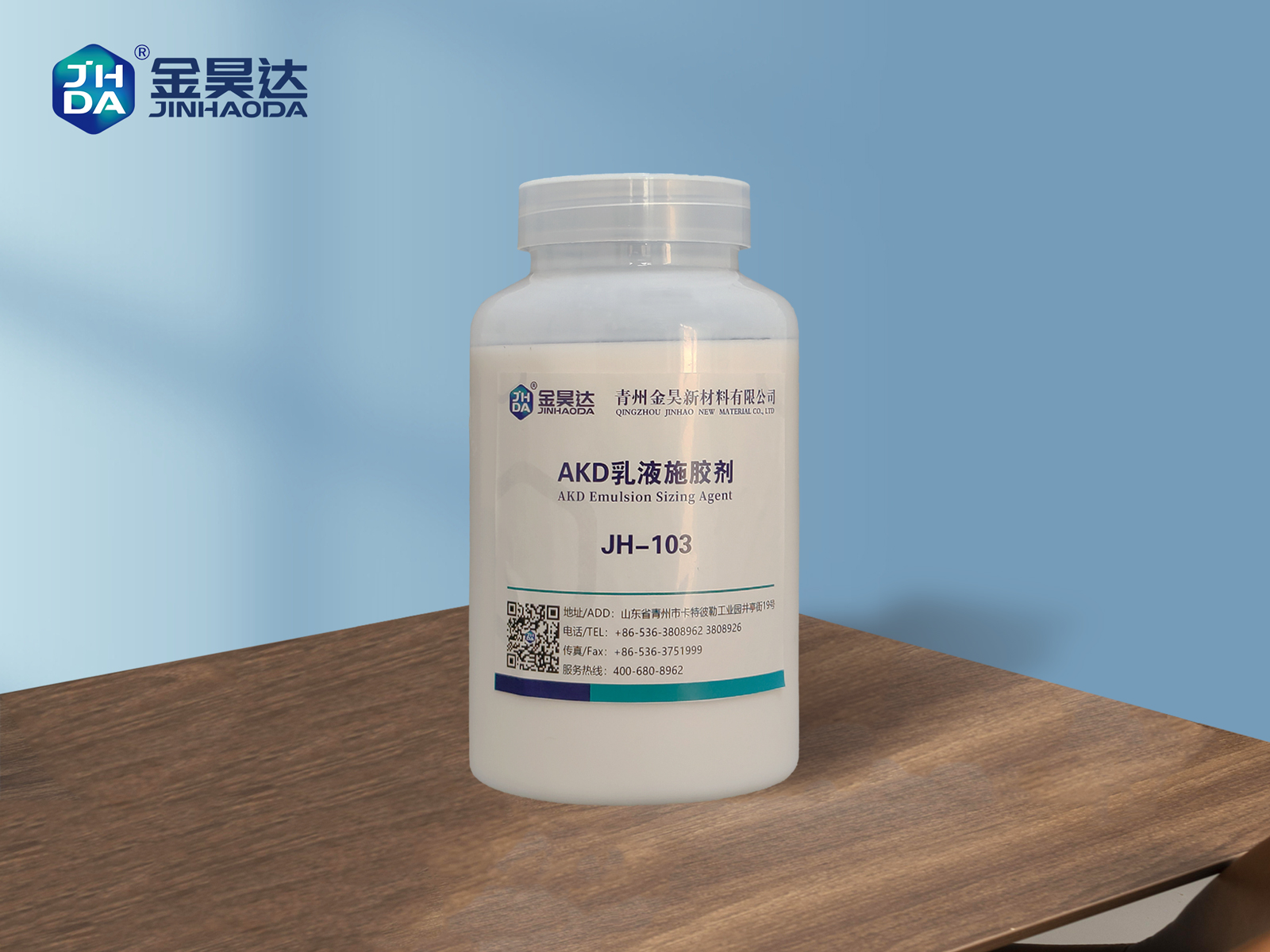
JH-103 AKD internal sizing emulsion for neutral and alkaline papermaking lines.
JH-103 is documented as an AKD internal sizing agent, an alkyl ketene dimer emulsion and a neutral internal sizing agent. It is added to the pulp rather than to the size press.
Documented parameters:
- Appearance: white to light brown liquid
- Solid content: 12.5 – 25.0 ± 1.0%
- pH: 2.0 – 5.0
- Viscosity at 25°C: ≤ 50 cps
- Ionic type: cationic
- Solubility: soluble
- Shelf life: 4 months
The most important line in its documentation for this discussion is the process-fit statement: JH-103 matches neutral and alkaline papermaking production lines, and the product is positioned as abandoning the alum acid sizing system — decreasing corrosion damage to drying cylinders, forming wires and metal pipelines. It is therefore documented for the neutral/alkaline side of the divide, and is not presented as an acidic rosin-alum solution.
Its documented chemistry uses a high-molecular polymer emulsifier formula to achieve a rapid curing reaction, with the hydrophobic structure combining with fiber after cylinder drying so that finished paper gains water resistance immediately and the turnover and warehousing cycle is shortened. The mechanism described is stable covalent bonding on the fiber surface building a permanent waterproof barrier, retaining performance under high-humidity storage and ocean transport conditions.
Additional documented behaviour: emulsion anti-aging stability under long-distance transport and normal-temperature storage without layering or breaking under seasonal temperature change; compatibility with conventional wet-end chemicals such as retention agents, defoamers and bentonite without abnormal flocculation, white water deterioration or sticky deposition on machine clothing; and direct continuous addition into the pulp pipeline by metering pump with no manual dilution or stirring step. Its documented grade coverage includes cultural printing paper, copy paper, box board, craft paper and molded pulp products, across wood pulp, chemical pulp, mechanical pulp and blended pulp.
Where Acidic Aluminum Sulfate Systems Fit: JH-325
For mills that intend to keep acidic aluminum sulfate chemistry, the portfolio item whose documentation explicitly covers that condition is JH-325, an anionic styrene-acrylic surface sizing agent. Its technical sheet states the relevant compatibility directly: wide process adaptability, suitable for both the acidic sizing process with aluminum sulfate and the modern neutral papermaking system, with good compatibility with retention aids and defoamers without system flocculation. It is also typed as an acid paper sizing chemical and a starch-compatible anionic sizing agent.
JH-325 is documented at 25.0 ± 1.0% solid content, pH 2.0 – 5.0, viscosity ≤ 50 cps at 25°C, anionic, water soluble, with a 6-month shelf life. Its documented grade focus is cultural paper — offset printing paper, copy paper and book paper — where it crosslinks with starch to build a surface coating, balances moderate water resistance with ink affinity, and requires no curing wait after drying.
Technical Explanation: How the Two Routes Behave on the Machine
Internal AKD sizing and surface styrene-acrylic sizing solve different physical problems, and the documentation reflects that difference.
JH-103 works inside the sheet. As a cationic emulsion it is retained on the fiber in the wet end, then reacts during drying so the hydrophobic structure bonds to cellulose. Because the reaction needs thermal energy from the drying section, the product literature emphasises the rapid-curing emulsifier formula as the reason finished paper can be rolled and shipped rather than stored for a long curing period. Because the chemistry is cationic, the compatibility statements in its sheet concern other cationic and mineral wet-end chemicals — retention agents, defoamers and bentonite — and specifically note the absence of abnormal flocculation. And because it is dosed into the pulp pipeline by metering pump, the dosing point is the wet end, not the size press.
JH-600 works on the sheet surface. It is blended with industrial starch and applied at the size press, where the starch carries the styrene-acrylic polymer onto the web and the film forms as the sheet dries. The documented benefit is not only water resistance but film continuity: the closed protective film limits moisture reversion, which is the mechanism behind retained ring crush strength and surface rigidity in humid conditions. The low-foaming characteristic matters here because a high-speed size press circulating starch is where foam pinholes and longitudinal stripes appear; the documentation notes both the low foaming behaviour and reduced viscous deposit build-up on rollers and cylinders.
The practical implication is that the two products are not substitutes. A mill cannot solve a surface printability or moisture-barrier problem by increasing internal AKD dosage, and a mill cannot solve a body water-resistance target by adding surface sizing alone. That is why the decision framework below is organised by condition rather than by product ranking.
Documented Parameter Comparison
| Parameter | JH-103 | JH-600 | JH-325 |
|---|---|---|---|
| Application stage | Internal — added to pulp via metering pump | Surface — blended with starch at the size press | Surface — blended with starch at the size press |
| Material base | AKD wax | Styrene acrylic | Anionic styrene acrylic |
| Ionic type | Cationic | Cationic | Anionic |
| Appearance | White to light brown liquid | Light brown to dark brown liquid | White to light brown liquid |
| Solid content | 12.5 – 25.0 ± 1.0% | 30 ± 1% | 25.0 ± 1.0% |
| pH | 2.0 – 5.0 | 2.0 – 5.0 | 2.0 – 5.0 |
| Viscosity (25°C) | ≤ 50 cps | < 50 cps | ≤ 50 cps |
| Shelf life | 4 months | 6 months | 6 months |
| Documented process fit | Neutral and alkaline lines; replaces alum acid sizing system | Starch-based surface sizing; virgin, chemical, mechanical and compound recycled pulp | Acidic sizing with aluminum sulfate and modern neutral systems |
| Documented grade focus | Cultural printing paper, copy paper, box board, craft paper, molded pulp | Packaging paper, corrugated and carton board, humid storage and transport conditions | Offset printing paper, copy paper, book paper |
Application Guidance for Mills Operating Across Different Conditions
The following decision rules follow directly from the documented process-fit statements rather than from preference.
- The line keeps acidic aluminum sulfate chemistry. JH-325 is the surface sizing option documented for both acidic sizing with aluminum sulfate and modern neutral systems, and it is typed as an acid paper sizing chemical.
- The line runs neutral or alkaline with internal sizing. JH-103 is the documented match, dosed into the pulp pipeline, with compatibility statements covering retention aids, defoamers and bentonite.
- The sheet must retain water resistance through humid storage, rainy season dispatch, cold storage or ocean freight. JH-600 at the size press with starch is the documented option, because its stated function is blocking moisture reversion rather than only resisting initial water absorption.
- The machine has no size press. A surface sizing agent is not applicable; the internal route — JH-103 on a neutral or alkaline wet end — is where the sizing function has to be delivered.
- The pulp mix fluctuates. JH-600 is documented for virgin wood pulp, chemical pulp, mechanical pulp and compound recycled pulp under fluctuating water quality and temperature; JH-103 is documented for wood pulp, chemical pulp, mechanical pulp and blended pulp.
- Storage planning matters. JH-103 is documented at 4 months shelf life, while JH-600 and JH-325 are documented at 6 months. For mills in humid climates or with long inbound logistics, that difference affects reorder cycles.
A mill running both an acidic line and a neutral line on one site does not need two supplier relationships to cover both. It does need two different application assumptions — surface sizing with an anionic chemistry on the acidic line, internal sizing with a cationic AKD emulsion on the neutral line — and clear labelling of which starch tank and which dosing point serves which machine.
Market Trend Analysis: Both Regimes Remain Commercially Active
The scale of the category explains why mixed asset bases are common. The global paper sizing agent market was valued at approximately USD 3.8 billion in 2025, with a projection to USD 5.9 billion by 2033 at a CAGR of 5.8% (Dataintelo). Source estimates diverge: for 2024, Market Research Future places the market at USD 3.16 billion while SNS Insider places it at USD 3.95 billion, and CAGR projections across published sources range from 4.14% to 5.8% depending on scope. The direction is consistent even where the magnitude is not.
The chemistry mix is the more useful signal for sizing-route decisions. Synthetic sizing agents including AKD and ASA held a 54.5% market share in 2024 (SNS Insider), while rosin sizing agents still accounted for 32.4% of market revenue in 2025 (Dataintelo). Within the synthetic segment, AKD sizing represents approximately 48% of synthetic sizing agent volume globally. Those figures describe a market in which both the reactive neutral route and the traditional rosin route remain commercially significant — which is precisely why scenario-based selection, rather than a single recommended chemistry, is the useful frame for buyers.
Regional concentration reinforces the point. Asia Pacific holds a 42.3% revenue share of the sizing agent market as of 2025, and China's annual sizing agent consumption is estimated at 650,000 tons in 2025 (Dataintelo). Chinese paper goods exports reached USD 36.5 billion in 2024 (OEC), which places a large volume of sized paper into humid and long-distance shipping conditions.
Two further trends affect product form and application stage. Liquid sizing agents held a 57.8% market share in 2024 on ease of application, while solid sizing agents are projected to grow at a CAGR of 5.11% through 2032 on logistical efficiency (SNS Insider). Bio-based sizing agents reached 38% of global consumption in 2024 (Market Reports World). On the demand side, packaging paper capacity in the United States increased by 4.6% in 2024 (American Forest & Paper Association), and surface sizing agents such as styrene acrylic are described as essential for improved printability in digital printing (Dataintelo) — a surface-stage requirement rather than a wet-end one.
Comparison with Traditional Solutions and Boundaries to Confirm
The traditional single-route approach — one internal sizing chemistry applied across all lines and all grades — has real advantages in simplicity: one tank, one dosing point, one stock item. Its limitation is that it assumes uniform wet-end conditions and uniform end-use exposure, which is rarely true in a mill running multiple machines, mixed pulp and export-driven grade portfolios.
Against that baseline, several boundaries should be stated plainly rather than glossed over.
- JH-600 is a surface product. It requires a size press and a starch carrier. It is documented as able to replace internal sizing agent for production, but that replacement still takes place at the surface sizing stage. A mill without that stage cannot use it as a drop-in.
- JH-600's documentation does not cover acidic aluminum sulfate systems. The dual-process compatibility statement in the JHDA range belongs to JH-325. Mills that must keep alum chemistry should evaluate JH-325 first.
- JH-103 is documented for neutral and alkaline lines. It is positioned as replacing the alum acid sizing system, so it is not the correct match for a mill that intends to retain acidic sizing.
- Shelf life differs across the range. JH-103 is documented at 4 months; JH-600 and JH-325 at 6 months. Stocking policy should reflect that.
- Changing regime is a system change, not a product swap. Moving a line from acidic to neutral affects filler selection, wet-end chemistry and the corrosion profile of machine parts. Sizing selection is one decision inside that wider change.
- Validation belongs at the mill. The available documentation states product properties and process fit; it does not substitute for a machine trial. JHDA operates an in-house pilot laboratory for formulation testing and performance verification, offers free trial samples with a 1MT minimum order quantity, and states a production lead time of 4 working days. Documented mill-side optimisation indicators include Cobb water absorption value, ring crush strength, bursting strength, paper brightness, fiber retention rate and overall paper machine runnability.
Future Outlook
If the sizing agent market continues toward the projected USD 5.9 billion by 2033 (Dataintelo), the growth will not be distributed evenly across chemistry families. The two structural pressures visible in the current data — neutral reactive sizing holding the larger share of synthetic volume and rosin remaining a significant revenue contributor, alongside a rising bio-based component — point to a market where mills continue to run more than one sizing philosophy at the same time.
For buyers, that has three practical consequences. Supplier portfolios that cover both acidic and neutral routes reduce the number of relationships needed across a mixed asset base. Documentation quality becomes a selection criterion in its own right: TDS and MSDS files, CAS registration, GHS hazard labelling and IMDG compliance for marine shipping determine whether a chemistry can move across borders without delay. And application-stage coverage — internal plus surface — matters more than a single-product performance claim, because the sheet has to hold water resistance at the machine, in the warehouse and after the container has crossed an ocean.
JHDA's stated position in this market is supply of papermaking chemicals with customised formulation development, pre-shipment laboratory testing and full TDS and MSDS documentation, supported by an overseas production entity, CRM Chemical Technology Co., Ltd., in Long An Province, Vietnam, for ASEAN delivery. Its product brochure is available for download: JHDA papermaking chemicals product brochure.
FAQ
What is the difference between acidic and neutral papermaking for sizing agent selection?
Acidic sizing fixes rosin size with aluminum sulfate at low wet-end pH, which limits calcium carbonate filler use and places continuous acid load on machine parts. Neutral and alkaline sizing uses reactive sizes such as AKD or ASA that bond to cellulose, allowing calcium carbonate filler and reducing corrosion. The sizing chemistry must match the regime the mill already runs; the two are not interchangeable.
Can JH-600 be used in a mill that still runs acidic aluminum sulfate sizing?
JH-600 is documented as a cationic styrene-acrylic surface sizing agent blended with industrial starch at the size press, with wide pulp adaptability across virgin wood pulp, chemical pulp, mechanical pulp and compound recycled pulp. Its documentation does not state acidic aluminum sulfate compatibility. The item in the same range whose technical sheet explicitly covers both acidic sizing with aluminum sulfate and modern neutral systems is JH-325, an anionic surface sizing agent. Mills keeping alum chemistry should evaluate JH-325 first.
Does JH-103 work in an acidic rosin-alum system?
JH-103 is documented as an AKD internal sizing agent matched to neutral and alkaline papermaking lines, and it is positioned as abandoning the alum acid sizing system in order to reduce corrosion damage to drying cylinders, forming wires and metal pipelines. It is not documented as a solution for mills intending to retain acidic sizing. Its chemical compatibility statements cover retention agents, defoamers and bentonite used in neutral wet ends without abnormal flocculation.
How should a mill decide between internal AKD sizing and surface sizing?
The decision follows the location of the requirement. If the target is body water resistance on a neutral or alkaline wet end, internal sizing applies and JH-103 is dosed into the pulp pipeline with no curing wait. If the target is surface moisture resistance, printability and surface strength under humid storage or ocean transport, and the machine has a size press with starch, the surface route applies and JH-600 is the documented option. The two are complementary stages rather than competing products.
What should be verified before changing a line's sizing route?
Verify the wet-end pH regime and alum load, whether a size press is available, the starch type in use, the pulp mix including recycled content, water hardness and process temperature, and the shelf-life implications for inbound logistics. Then run a machine trial rather than extrapolating from a data sheet. Documented indicators to measure include Cobb water absorption value, ring crush strength, bursting strength, paper brightness, fiber retention rate and paper machine runnability. JHDA supports trials with free samples at a 1MT minimum order quantity and an in-house pilot laboratory for formulation testing.