
Acoustic Slat vs Bamboo Charcoal vs PVC Marble for Hotels
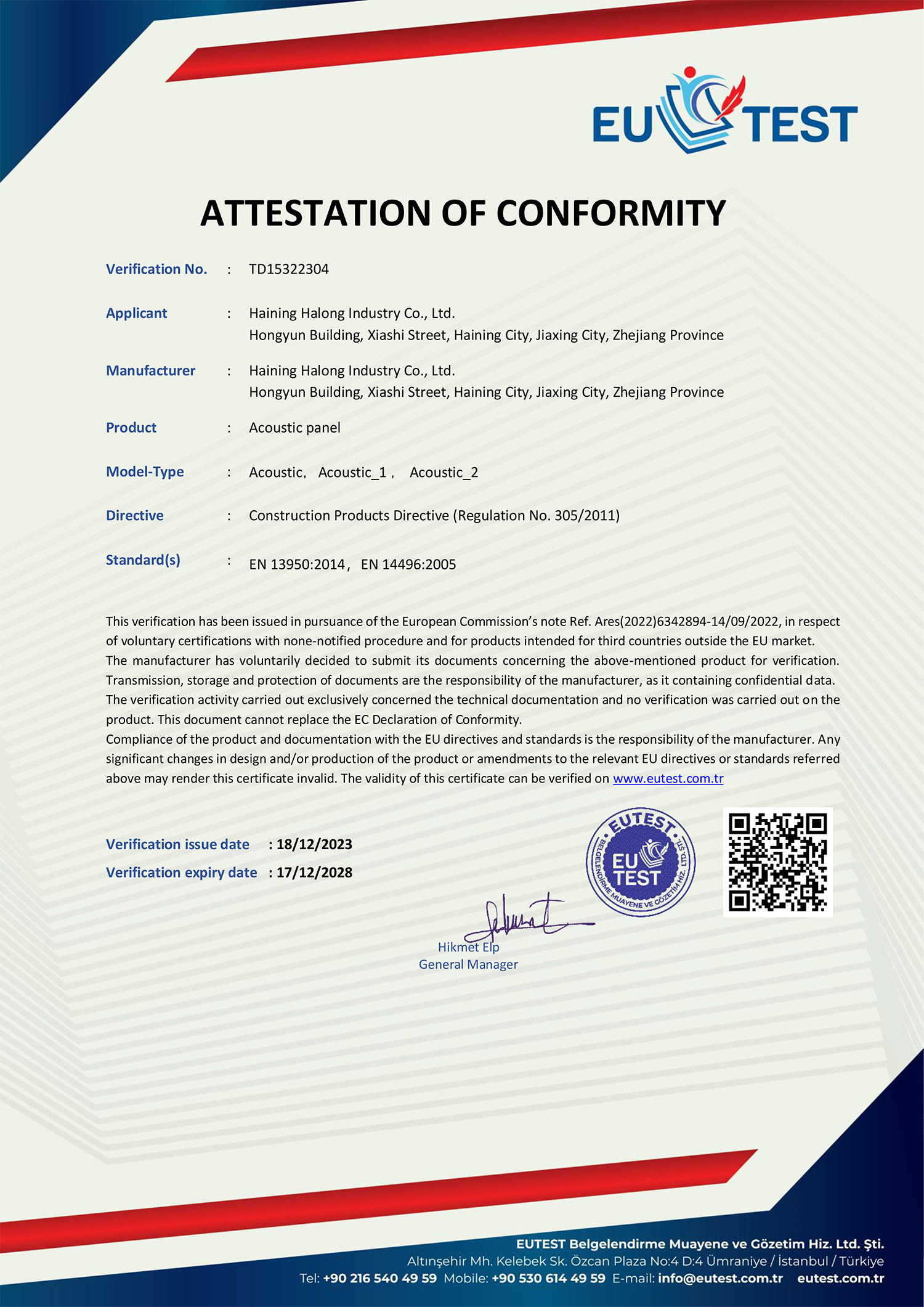
Conformity documentation held for the acoustic slat wall panel range. Acoustics is one of the four specification axes used throughout this hotel-focused comparison.
A hotel wall panel decision is rarely a finish decision. It is a decision about acoustics, moisture, fire classification and long-term maintenance — and the three panel types below answer those four questions differently, even when they look interchangeable in a sample book.
Hotel refurbishment programmes seldom fail on design intent. They fail at the point where a panel selected from a showroom sample meets a corridor service trolley, a steam-filled shower cubicle, and a fire inspector who asks for a test report rather than a catalogue.
This comparison sets published product parameters and certification records for three interior wall panel types against the requirements that actually apply to hotel guest rooms and corridors: Acoustic Slat Wood Wall Panel (LT-AC), Bamboo Charcoal Wood Wall Panel (LT-BC) and PVC Marble Wall Panel (LT-PM).
LONGTE is the brand used by Haining Longtime Industry Co., Ltd., a building materials manufacturer founded in 2003 that produces PVC ceiling and wall panels, WPC wall panels, SPC flooring, WPC decking, PVC lamination films and hot stamping foils. The company operates six manufacturing hubs across Asia, reports an export ratio of approximately 85%, and lists the USA, UAE, India, the Philippines, Colombia and other South American markets among its main destinations.
Why one panel type seldom fits a whole hotel
A hotel is not a single surface environment. Four zones behave differently and impose different loads on a wall surface:
- Guest room feature walls. Appearance matters most, but so do acoustic comfort and indoor air quality, because the guest sleeps next to the surface.
- Corridors. High traffic, luggage, linen trolleys and cleaning chemicals dominate. Corridors are also where sound transmission between rooms becomes commercially relevant.
- Bathrooms and shower enclosures. Continuous humidity, condensation and splashing punish any panel with a moisture-sensitive core.
- Lobbies, lift lobbies and F&B outlets. Large-scale visual impact, higher fire-load scrutiny, and public-area wear.
Specifying one product across all four zones usually means accepting a compromise in at least two of them. The practical alternative is to compare available panel types on four measurable criteria — acoustic rating, moisture performance, fire classification and surface build — and then match each panel to the zone where its strengths are relevant.
The three candidates, side by side
The table below reproduces the published parameter lists for the three models. Nothing has been added, estimated or rounded.
| Specification | LT-AC — Acoustic Slat Wood Wall Panel | LT-BC — Bamboo Charcoal Wood Wall Panel | LT-PM — PVC Marble Wall Panel |
|---|---|---|---|
| Model | LT-AC (customizable) | LT-BC (customizable) | LT-PM (customizable) |
| Format | 600 × 2400 mm | 600 × 2900 mm | 1220 × 2800 mm |
| Thickness | 21 mm | 9 mm | 3–8 mm |
| Construction | MDF slats + polyester acoustic felt | Bamboo charcoal fiber + PVC composite | PVC + CaCO₃ + UV coating |
| Surface | Wood veneer face, polyester felt backing | Wood-grain decorative surface, 20+ colors | UV-coated marble pattern |
| Density | Not stated in published parameters | Not stated in published parameters | 1.4–1.5 g/cm³ |
| Acoustic rating | NRC 0.5–0.85 | Not stated in published parameters | Not stated in published parameters |
| Fire rating | B1 | B1 | B1 |
| Moisture claim | Not stated in published parameters | Waterproof (stated) | Not stated in published parameters |
| Formaldehyde claim | Not stated in published parameters | Formaldehyde-free (stated) | Not stated in published parameters |
| Published application list | Cinema, studio, office, home theater, restaurant | Residential, hotel, office, kids room | Interior decoration, hotel, villa, commercial space |
| Governing standard referenced in CE file | EN 13950:2014, EN 14496:2005 | RoHS Directive 2011/65/EU and amendment (EU) 2015/863, within scope | EN 15102:2007+A1:2011 |
“Not stated in published parameters” means the published parameter list for that model does not include the item. It is not a statement that the product fails the requirement, and it is not a substitute for a project-specific test. Buyers should request written confirmation for any performance point their specification depends on.
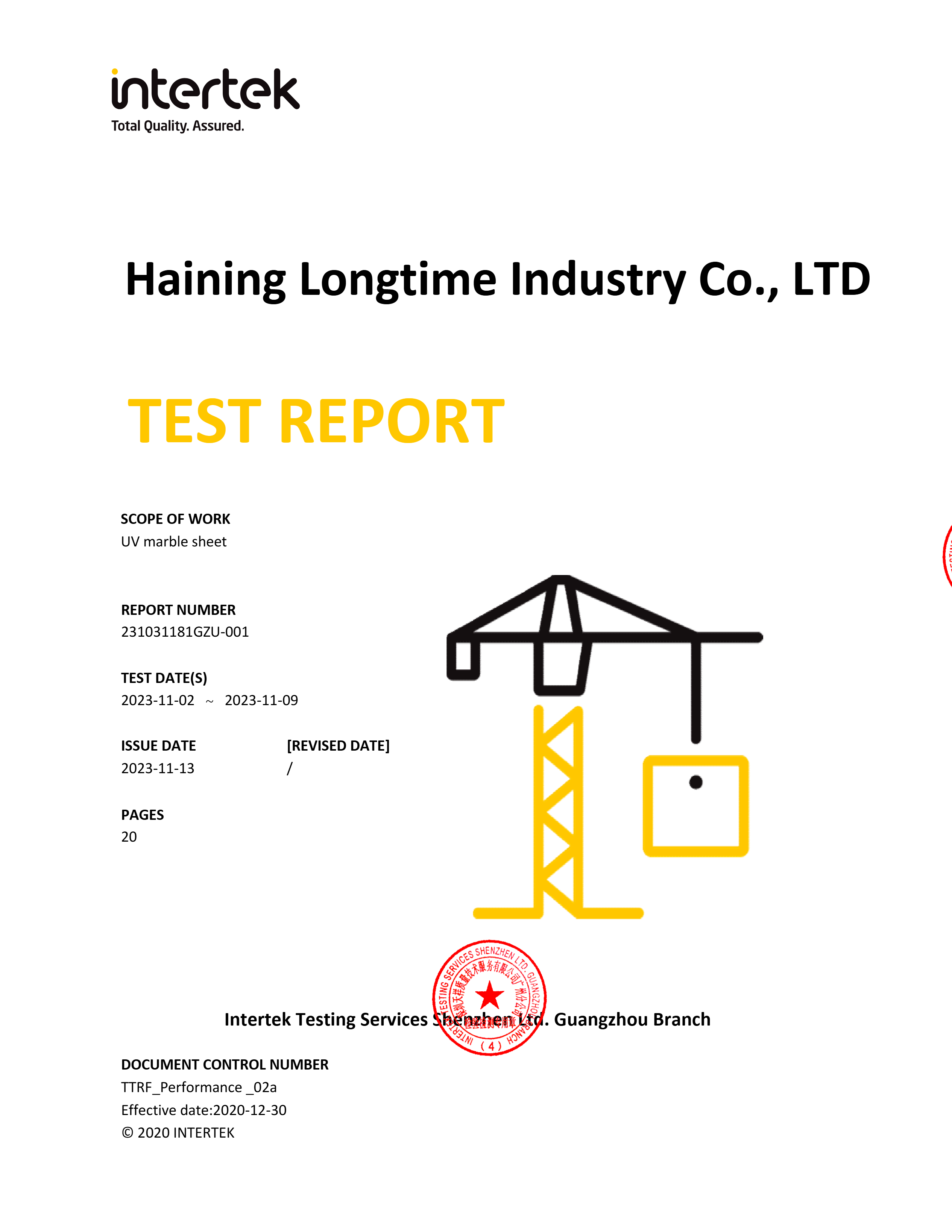
UV-coated marble sheet sample. LONGTE holds third-party product test report 231031181GZU-001 for UV marble sheet, issued by Intertek Testing Services Shenzhen Ltd., Guangzhou Branch, valid until 12 November 2028.
Reading the specifications like a buyer
Acoustics: why only one panel carries an NRC figure
LT-AC is the only one of the three with a published sound absorption rating: NRC 0.5–0.85. NRC, or Noise Reduction Coefficient, is a single-number average of absorption across speech and mid frequencies. A value between 0.5 and 0.85 means the assembly absorbs roughly half to most of the sound energy that reaches it, rather than reflecting it back into the room.
The construction explains the number. LT-AC is built from MDF slats faced with wood veneer and backed with a polyester acoustic felt. The slats create a partially open surface; the felt behind it converts moving air into a small amount of heat instead of allowing the sound to bounce. That is a materially different function from a solid decorative surface, which is why LT-BC and LT-PM do not publish NRC figures — a solid panel of PVC or bamboo charcoal composite is a finish, not an absorber.
One qualification matters when reading any NRC figure. It is a laboratory average measured on a defined assembly. In a finished hotel room, the effective absorption depends on the cavity behind the panel, the substrate, the proportion of the wall actually covered, and furniture. A corridor clad 30% in acoustic slats behaves differently from one clad floor-to-ceiling. The published NRC is a comparison tool between products, not a predicted reverberation time for a given room.
Moisture: what “waterproof” actually covers
LT-BC is the only model in the group whose published parameter list states waterproof performance, alongside a formaldehyde-free declaration. That combination is the main reason bamboo charcoal wood panels appear in wet-adjacent hotel specifications.
LT-AC publishes an acoustic rating and a B1 fire rating, and does not publish a waterproof claim. That matters because a polyester felt backing and an MDF slat core are not the materials a specifier would choose for a permanently damp environment. LT-AC belongs on the dry side of the wall.
LT-PM is a PVC and calcium carbonate composite with a UV-coated decorative surface. Its published parameters describe density, format, thickness and a B1 fire rating. Density of 1.4–1.5 g/cm³ is relevant to how the sheet handles and how it resists denting, but density is not the same as a moisture classification. Where a hotel bathroom wall is continuously wet rather than briefly splashed, the assembled system — panel plus joint sealant plus substrate — determines real-world performance, not the panel alone.
Fire: B1 in a test report versus B1 in a specification
All three models carry a B1 fire rating in their published parameters. B1 is a material classification, and it should be supported by a document rather than by a datasheet line. LONGTE holds Combustion Performance Test Report BITFR202507063, issued by BITFR (Henan) Company Limited (CNAS L14889), covering PVC wall panel and referencing GB/T 20284-2006, GB/T 8626-2007 and GB 8624-2012 Class B₁(B).
For European submittals, commercial WPC wall panels are commonly required to meet EN 13501-1, with B-s1, d0 cited as a preferred outcome. EN 13501-1 uses a different classification logic from GB 8624, so a B1 result in one framework does not automatically translate into a B-s1, d0 statement in the other. Buyers preparing an EU submittal should confirm which framework the project's fire consultant expects before the order is placed.
Format and thickness: the installation consequences buyers underestimate
The three formats differ in ways that show up on the programme schedule rather than on the drawing. LT-AC at 600 × 2400 mm and 21 mm thick produces more joints per square metre and requires more build-out from the structural wall than the other two. LT-BC at 600 × 2900 mm and 9 mm gives a longer vertical run with fewer horizontal seams, which reduces the number of places water or dirt can collect. LT-PM at 1220 × 2800 mm is the widest format in the group and the thinnest at 3–8 mm, which means fewer joint lines on a lobby wall — and a greater dependence on a flat, continuous substrate behind it, because a thin sheet follows the surface it is fixed to.
Matching panels to hotel zones
None of the three panels is universally correct. The table below maps published performance to typical hotel zones.
| Hotel zone | Most defensible fit from published data | Reason |
|---|---|---|
| Guest room feature wall / headboard wall | LT-AC where acoustic comfort is specified; LT-BC where color range and budget drive the decision | LT-AC publishes NRC 0.5–0.85; LT-BC publishes formaldehyde-free construction and 20+ colors |
| Corridors and lift lobbies | LT-BC; LT-PM for a stone-look corridor | LT-BC states waterproof performance and offers a 2900 mm vertical run; LT-PM offers a 1220 mm width for fewer joints |
| Guest bathrooms and shower surrounds | LT-BC on the strength of the stated waterproof claim, with joint sealing treated as part of the system | LT-AC publishes no waterproof claim; LT-PM publishes density and format but no moisture classification |
| Lobby, lounge and meeting rooms | LT-AC for absorption; LT-PM for large-format marble appearance | LT-AC absorption reduces reflective noise in hard-surfaced public areas; LT-PM covers more area per sheet |
| Executive suites and VIP rooms | LT-AC | Published NRC 0.5–0.85 supports speech privacy treatment on shared walls |
There is project evidence for the acoustic route in hospitality settings. A UAE villa developer and luxury interior fit-out company ordered 6,000 m² of PU stone panel and 4,000 m² of acoustic panel for a villa community and a five-star hotel, covering villa exterior feature walls, a hotel lobby and executive suite acoustic walls. The installation has run for more than two years without complaints, the project passed the Dubai Civil Defense fire test, and the developer subsequently signed a three-year exclusive frame agreement. The same brief noted that the acoustic panel was installed on gypsum walls because of its lightweight construction, and that B1 fire performance was compliant with UAE regulations.
The pattern is consistent across other markets. A USA building materials distributor has taken 15 × 40HQ containers per year for more than five years, expanding from three SKUs to more than twenty. An India wholesale distributor and project contractor has taken roughly 12 × 40HQ containers per year, about 50,000 m² annually, supplying small hotels, residential builders and retail interior shops in Mumbai, Delhi and Chennai, and has launched a private-label brand using the manufacturer's OEM service.
Compliance documents a hotel buyer can request
Certification is not a logo on a page. It is a document with a number, an issuing body, a standard and a scope — and the scope is the part that decides whether the certificate is relevant to your order.
| Document | Reference | Issued by | Standard and scope | Key date |
|---|---|---|---|---|
| Attestation of Conformity (CE) | TD15322304 | EUTEST Belgelendirme (Turkey) | EN 13950:2014, EN 14496:2005 — Construction Products Directive (Regulation No. 305/2011); acoustic panel | Issued 18 Dec 2023; valid to 17 Dec 2028 |
| Verification of Conformity (CE) | TD15322307 | EUTEST Belgelendirme (Turkey) | EN 15102:2007+A1:2011 — Regulation (EU) No 305/2011; PVC panel | Issued 18 Dec 2023; valid to 17 Dec 2028 |
| CE + RoHS Verification of Conformity | HN202410860 | Ningbo Helmsman Quality Testing Services Co., Ltd. (HQTS) | RoHS Directive 2011/65/EU and amendment (EU) 2015/863; scope includes bamboo charcoal wood veneer wall panels | Valid to 4 Dec 2029 |
| RoHS Test Report | HN202410860-CE | Ningbo Helmsman Quality Testing Services Co., Ltd. | RoHS Directive 2011/65/EU; WPC wall panel | Valid to 7 Nov 2028 |
| Product Test Report | 231031181GZU-001 | Intertek Testing Services Shenzhen Ltd., Guangzhou Branch | Intertek TTRF performance; UV marble sheet | Valid to 12 Nov 2028 |
| Combustion Performance Test Report | BITFR202507063 | BITFR (Henan) Company Limited (CNAS L14889) | GB/T 20284-2006, GB/T 8626-2007, GB 8624-2012 Class B₁(B); PVC wall panel | Issued 15 Jul 2025 |
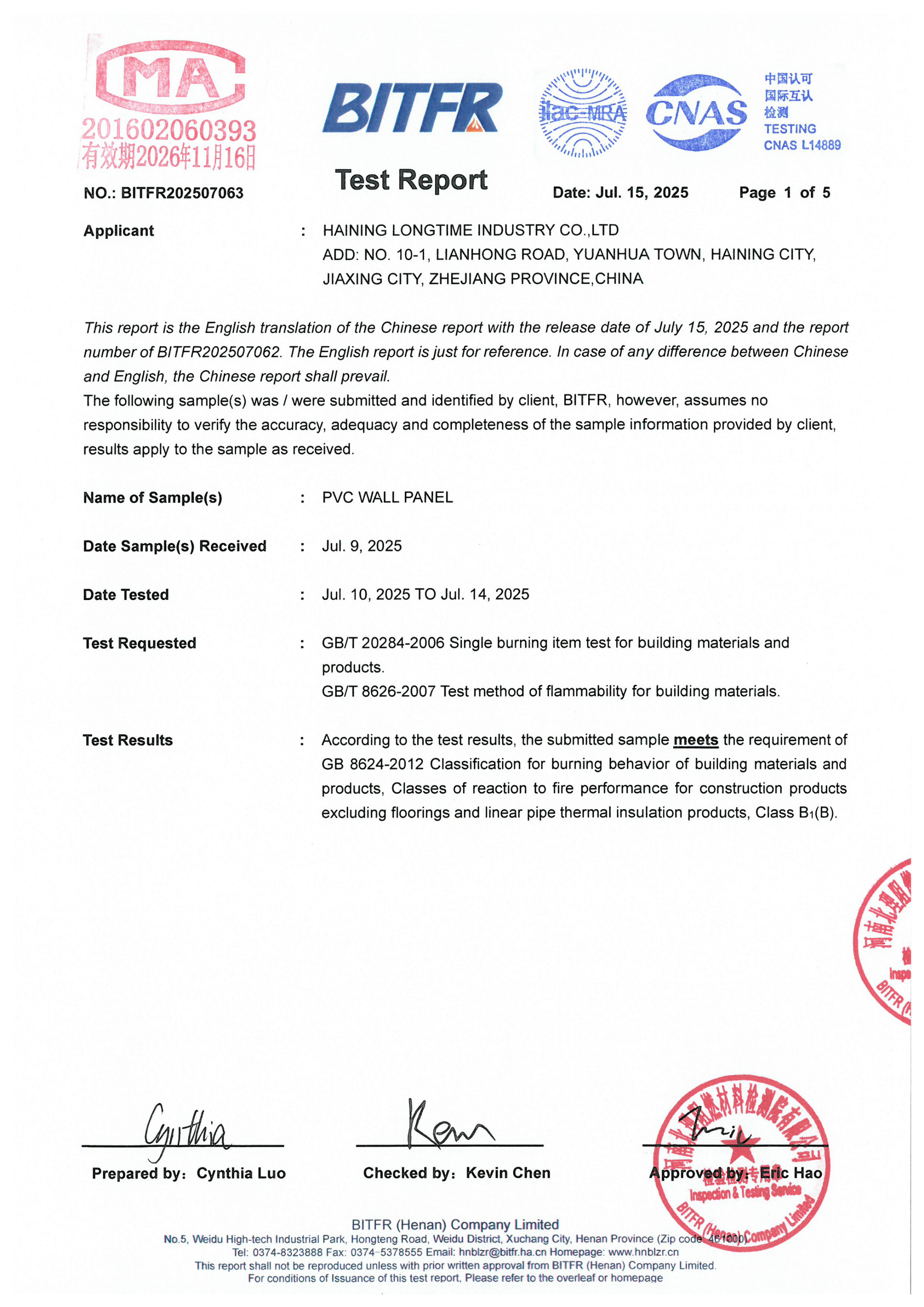
Combustion Performance Test Report BITFR202507063 references GB 8624-2012 Class B₁(B) and was issued by BITFR (Henan) Company Limited (CNAS L14889) on 15 July 2025.
Scope check before you submit. The CE verification held for PVC panel, for example, states a scope of PVC panel at 600 × 9 mm. Certificate scopes are written around specific formats, thicknesses and product families. A hotel buyer should match the scope statement against the ordered specification line by line, and ask the supplier to confirm in writing whether the certificate covers the exact model, size and thickness being shipped. In the EU, a separate note applies to bamboo charcoal wood veneer panels: the increased adoption of E0 formaldehyde emission standards, set at ≤ 0.07 mg/m³, gives specifiers an external benchmark to compare against a supplier's declaration.
Where each option has limits
A comparison that lists only advantages is a sales document. The following boundaries follow directly from the published data and should be treated as design constraints, not caveats.
- LT-AC is a 21 mm acoustic assembly, not a general-purpose cladding. Its format is 600 × 2400 mm, which is the shortest in this group, so a corridor or lobby will carry more joints per square metre than with LT-BC or LT-PM. Its published parameter list states an acoustic rating and a B1 rating but no waterproof claim, so it should not be specified for shower enclosures or areas of sustained moisture without written confirmation from the supplier.
- LT-BC is a 9 mm panel. At that thickness over a 600 × 2900 mm format it depends on a flat, sound substrate. The published waterproof statement describes the panel, not the joint. In a bathroom, the sealant line, corner detail and fixing method decide whether water reaches the wall behind the panel, so waterproofing is a system responsibility rather than a panel property.
- LT-PM is a thin decorative sheet, not a structural panel. At 3–8 mm over a 1220 × 2800 mm format, it will telegraph any unevenness in the substrate. The UV coating protects the printed marble pattern from light degradation; it does not make the surface impact-resistant, and published parameters do not include an anti-scratch classification.
- B1 is a material classification, not a building fire strategy. A B1 panel does not replace compartmentation, sprinkler design or a fire consultant's assessment. For EU commercial projects, EN 13501-1 is the relevant framework and its classifications are not interchangeable with GB 8624 B1.
- “Not stated” is not “not tested.” Where a parameter is absent from a published list, the correct next step is a written query to the supplier with a project-specific requirement attached — not an assumption in either direction.
Market context for hotel panel selection
The category these three panels sit inside is expanding, and the direction of that expansion explains why buyers are seeing more options rather than fewer. Dataintelo valued the global wall panel market at USD 32.4 billion in 2025 and projected USD 43.7 billion by 2033. That headline figure should be treated as directional: a separate CMI Team estimate placed the 2023 base at USD 17.1 billion, and the gap between the two reflects different product definitions and coverage rather than a disagreement about growth.
Two sub-segments are relevant to hotels. The global Wood Plastic Composites market reached USD 8.89 billion in 2025 with a projected CAGR of 11.7% through 2033, according to Grand View Research. UV marble sheets, the surface category that LT-PM belongs to, accounted for 18% of the global decorative materials market in 2024 — a 260% increase from 2020, by Witop Decor's estimate. Asia-Pacific accounts for approximately 42.3% of global wall panel market share, driven by urbanisation in China and India, and China is the leading exporter of PVC marble sheets with 1,480 documented export records as of late 2025, according to Volza export trade data.
For a hotel buyer, the practical implication is a supply-side one. Panels that were once specified mainly for residential interiors are now produced at formats and thicknesses intended for commercial use, and the number of suppliers able to state a fire classification, a formaldehyde position and a conformity reference is increasing. That shifts the buying question from availability to verification.
Compared with traditional hotel wall finishes
Hotels have been finished with painted plasterboard, vinyl wall covering, ceramic tile and natural stone for decades, and each of those solutions still has a defensible use. The comparison that matters is not appearance but maintenance exposure over a refurbishment cycle.
| Traditional finish | Where it still wins | Where panel systems change the calculation |
|---|---|---|
| Painted plasterboard | Lowest material cost, seamless appearance, easy to repair small areas | Repainting a corridor every few years creates downtime and VOC exposure; panel systems are installed dry and can be replaced zone by zone |
| Vinyl wall covering | Wide design range, fast installation | Joints lift in humid bathrooms; no published fire classification or acoustic rating is inherent to the material |
| Ceramic tile | Excellent in wet zones, hard-wearing | Heavy, cold to the touch, and a hard reflective surface that increases corridor noise rather than absorbing it |
| Natural stone veneer | Prestige appearance in lobbies and feature walls | Natural stone requires annual sealing and crack repair, while mineral-look composite panel systems are specified to require no chipping repair, efflorescence treatment or re-sealing |
The honest limitation on the panel side is that none of these products is a like-for-like replacement for structural stone or tile in every position. LT-PM at 3–8 mm is a surfacing material that must be carried by a substrate; it does not add structural mass, and it will not absorb impact the way a tile bed does. LT-AC adds acoustic value but adds thickness. LT-BC is the most balanced of the three for wet-adjacent interior zones, but it is still a 9 mm decorative panel, and its stated waterproof performance should be read together with the jointing specification rather than in isolation.
Purchasing terms and acceptance criteria to agree before ordering
For hotel projects the commercial terms matter as much as the specification, because a panel that arrives late or fails inspection mid-programme costs more than the price difference between two grades.
Minimum order quantities
- Samples: 1–3 pieces free of charge, with the buyer covering courier cost.
- Trial order: one 20GP mixed container, approximately 500–800 m².
- Custom design: 500 m² per SKU.
- Standard reorder: one 40HQ per SKU.
A mixed trial container is the practical way for a hotel buyer to test more than one panel type on a single floor or wing before committing the full programme. For a comparison like the one in this article, mixing LT-AC, LT-BC and LT-PM in one container lets the operator assess cleaning routines and guest feedback zone by zone rather than through samples.
Delivery terms
- FOB Ningbo / Shanghai as the default.
- CIF available to Los Angeles, New York, Dubai, Jebel Ali, Manila, Callao and Santos.
- DDP door-to-door available for the USA, UAE, Colombia and Chile.
Acceptance criteria
- Pre-shipment inspection by SGS, BV or TUV at the buyer's request, with cost shared.
- Photo and video inspection at no charge.
- Sample retention for six months for reference.
- Certificate of origin provided, including CO, FORM E and FORM F.
The retention clause deserves attention. Holding a signed reference sample for six months is what makes a later colour or thickness dispute resolvable. Hotel buyers should confirm what is retained and where it is held before production begins.
Payment terms
- Default: 30% T/T deposit with 70% before shipment.
- L/C at sight for orders above USD 50,000.
- Open account 30 days for long-term partners with credit insurance through Sinosure.
- Alibaba Trade Assurance supported; PayPal accepted for sample fees under USD 500.
Lead times
- Standard stock: 7–15 days.
- Custom order: 25–40 days.
- Large project: 45–60 days.
Production capability is the constraint behind those numbers. Published monthly capacity at the manufacturer includes 800,000 m² of PVC panel, 500,000 m² of SPC flooring, 200,000 m² of WPC decking, 150,000 m² of PU stone and 80,000 m² of acoustic panel. Acoustic panel capacity, at 80,000 m² per month, is the tightest of the five lines — a relevant detail for hotel programmes that specify LT-AC heavily across corridors and suites and then expect a short lead time.
Quality control arrangements that a buyer can verify rather than assume include 100% incoming raw material inspection, in-process inspection every two hours, 100% finished goods visual and dimension checks, and third-party pre-shipment inspection on request. Customisation scope covers size, thickness, colour, surface pattern, logo printing, packaging, accessory kits and installation manual language, and the manufacturer provides OEM, ODM, private label and custom design production services. After-sales terms include free technical consultation, a 24-hour response channel, installation video guides, claim handling within seven days and a five-year quality warranty on major products.
A short pre-order checklist for hotel panel buyers
- Confirm which zone each panel type is going into, and confirm the panel's published performance covers that zone.
- Match every certificate scope statement against the ordered model, size and thickness — not against the brand name.
- Ask for the fire framework the project's consultant expects (GB 8624 Class B₁(B) or EN 13501-1) before signing off on a B1 line item.
- Treat moisture performance as a system: panel plus joint sealant plus substrate plus fixing detail.
- Calculate joint lines from the actual format — 600 mm, 600 mm and 1220 mm widths produce very different visual rhythms.
- Agree the acceptance method and who pays for third-party inspection before production, not after.
- Confirm the retained reference sample period and location in the contract.
- Check the acoustic panel capacity line if LT-AC dominates your specification, because it is the smallest of the five production lines.
Future outlook
The direction of travel in hotel interiors is toward panel systems that carry performance data as standard, rather than toward a single dominant material. Three shifts are already visible in the numbers. First, sub-segment growth in wood plastic composites, projected at a CAGR of 11.7% through 2033, is outpacing the wider wall panel market, which suggests commercial buyers are moving toward composite formats for reasons that include installation speed and moisture tolerance. Second, the UV marble surface category has grown from a niche decorative option to an 18% share of the decorative materials market, which increases the number of suppliers but also increases the importance of verified test reports such as Intertek 231031181GZU-001. Third, formaldehyde expectations are hardening: the E0 threshold of ≤ 0.07 mg/m³ is becoming a routine reference point for wood-effect panels in enclosed spaces, and products that publish a formaldehyde-free declaration have a straightforward advantage in guest-facing areas.
For hotel operators planning 2027 and 2028 refurbishments, the practical consequence is that panel selection will be decided less on appearance and more on documentation. Two suppliers offering visually identical marble-look sheets can differ entirely in whether the certificate scope matches the ordered thickness, whether the fire report uses the framework the consultant accepts, and whether capacity exists to hit a 45–60 day project window. Those are the questions that determine whether a hotel corridor still looks correct after its fifth season.
FAQ
Which wall panel types are commonly specified for hotel guest rooms and corridors?
Three interior decorative panel types appear regularly: acoustic slat wood panels such as LT-AC, which combine MDF slats with a polyester acoustic felt backing; bamboo charcoal wood panels such as LT-BC, a composite of bamboo charcoal fiber and PVC; and PVC marble panels such as LT-PM, a PVC and calcium carbonate sheet with a UV-coated marble pattern. Each has a different published performance profile, so the relevant question for a hotel is which zone each type is being asked to serve.
Is an acoustic slat panel necessary in a hotel, or does it only matter for cinemas and studios?
LT-AC publishes a Noise Reduction Coefficient of 0.5–0.85, and its standard application list names cinema, studio, office, home theater and restaurant. Hotels do not appear in that published list, but project evidence does: a UAE fit-out company installed 4,000 m² of acoustic panel in a five-star hotel lobby and executive suite acoustic walls, and the installation has run more than two years without complaints. Whether an acoustic panel is necessary depends on whether the project has a speech-privacy or reverberation requirement. Where there is no such requirement, a solid decorative panel such as LT-BC or LT-PM may satisfy the brief at a lower installed thickness.
Can bamboo charcoal wood wall panels be used in hotel bathrooms and shower areas?
LT-BC is the only one of the three models whose published parameters state waterproof performance, and it also states formaldehyde-free construction with 20+ colors available at 600 × 2900 mm and 9 mm thickness. Those are the reasons it is the most frequently specified of the three for wet-adjacent zones. The important qualification is that the waterproof claim describes the panel body. In a shower enclosure, water reaches the wall through joints and fixings, so the sealant system, corner detailing and substrate preparation determine actual performance.
What fire documentation should a hotel wall panel supplier provide?
A supplier should be able to produce a test report rather than a datasheet line. In this case the relevant document is Combustion Performance Test Report BITFR202507063, issued by BITFR (Henan) Company Limited (CNAS L14889) on 15 July 2025, referencing GB/T 20284-2006, GB/T 8626-2007 and GB 8624-2012 Class B₁(B). For EU projects, EN 13501-1 is the usual framework, and classifications under EN 13501-1 are not interchangeable with GB 8624. Buyers should confirm which framework the project's fire consultant requires before reviewing certificates.
How much should a buyer order for a first hotel trial?
Published purchasing terms allow samples of 1–3 pieces free of charge with the buyer covering courier cost, and a trial order of one 20GP mixed container, approximately 500–800 m². Custom designs start at 500 m² per SKU, and standard reorders are one 40HQ per SKU. A mixed trial container allows more than one panel type to be tested on the same property before the full programme is committed, which is useful when comparing panel types across zones rather than across samples.
What acceptance criteria should be agreed before shipment?
The published terms offer pre-shipment inspection by SGS, BV or TUV at the buyer's request with cost shared, photo and video inspection at no charge, sample retention for six months for reference, and certificates of origin including CO, FORM E and FORM F. Retention of a reference sample is the mechanism that makes later colour or thickness disputes resolvable, so buyers should confirm what is retained and where it is held before production starts.
What lead times apply to a hotel wall panel order?
Published lead times are 7–15 days for standard stock, 25–40 days for custom orders, and 45–60 days for large projects. Capacity behind those figures includes 800,000 m² of PVC panel, 500,000 m² of SPC flooring, 200,000 m² of WPC decking, 150,000 m² of PU stone and 80,000 m² of acoustic panel per month. Acoustic panel is the smallest of those production lines, so hotel programmes with heavy LT-AC specification should confirm scheduling early rather than assuming the lead time that applies to PVC panel.
For readers who need the full parameter set across the wider product range, the manufacturer's product catalogue is available here: LONGTE product catalogue (PDF).
Tem questões ou precisa de mais detalhes?
Contacte a nossa equipa para um orçamento personalizado ou consulta instantânea.
Solicitar orçamento
Preencha o formulário abaixo e a nossa equipa entrará em contacto com uma proposta personalizada.
Chat direto do WhatsApp
Prefere conversar em tempo real? Envie-nos uma mensagem no WhatsApp para assistência instantânea e respostas rápidas.
- Obter orçamento personalizado
- Partilhar fotos ou documentos
- Discuta as suas necessidades diretamente
Geralmente responde em 5–30 minutos durante o horário de expediente.