
Acoustic Wall LED Strip: Records That Prove Supplier Claims
Acoustic Wall LED Strip: Records That Prove Supplier Claims
Supplier capability for the CA-DC24V-2835-180D-8mm-3000K acoustic wall LED strip is a documentation question before it is a price question. The model number already states the operating voltage, the LED package, the emitter density, the board width and the colour temperature. What a purchase order has to add is who confirms each of those values, with which record, and against which acceptance criterion before shipment.
The strip belongs to the LED strip range of Zhongshan Xiangpai (XPUP) Lighting Technology Co., Ltd., a manufacturer established in 2012 in Zhongshan, Guangdong, that describes itself as a source manufacturer for the R&D, production and customisation of LED strips and linear lighting. XPUP LED publishes its product and company information through its official website, and the model appears in the product scope attached to the company's CE and RoHS records. This article maps that documentation to the parameters a buyer is asked to accept, and marks precisely where the records stop.
Why a specification sheet cannot carry the whole decision
The low-voltage category is where most strip procurement happens. Fortune Business Insights estimates the global LED strip market at USD 1.646 billion for 2026 and expects the low-voltage application segment to take the dominant share against high-voltage alternatives, according to the market report summary reviewed for this article. That context matters for one practical reason: in a crowded category the specification sheet stops being a differentiator and becomes a starting point, and much of the difference between two quotes for a nominally identical 24 V, 3000K strip sits in what the seller is willing to put in writing.
Three gaps appear repeatedly in acoustic wall strip files. The datasheet states a value but not the record behind it, so a buyer cannot tell whether 11 W per metre was measured, designed or carried over from a similar SKU. Series-level certification is frequently read as SKU-level verification, although the two operate at different scopes. And the acceptance criterion is sometimes written after the deposit rather than before it, which turns the pre-shipment inspection into a negotiation instead of a check.
For this model the gaps are closable, because the manufacturer's published material covers the ordering terms, the certificate records and the customisation boundary separately. Closing them is a matter of connecting the three, not of asking for a better brochure.
The parameters a purchase order will reference
The specification set for the CA-DC24V-2835-180D-8mm-3000K covers nine buying-relevant attributes. The right-hand column below is the record that closes each one; the nine records together form the audit trail, and none of them substitutes for another.
| Stated parameter | What it means in the order | Record that closes it |
|---|---|---|
| 2835 SMD | Emitter package named in the model code | Component or bill-of-materials statement naming the package, with a board photograph taken at the ordered density |
| 180 LEDs/m | Emitter count per metre, which also fixes the cut unit | Count on a measured sample of the ordered reel, with the cut unit recorded in the same note |
| 8 mm | PCB width, which decides whether the strip enters a narrow acoustic slat channel | Measured width on the sample, checked against the board drawing |
| 3000K | Correlated colour temperature of the warm-white output | Measured CCT in the test record; the supplied material does not state a CCT tolerance, so the measured value is the one to agree |
| CRI Ra≥80 | Colour rendering floor for visible interior surfaces | Ra value quoted in the test record for the ordered configuration |
| 11 W | Power draw per metre at rated input | Power measurement at 24 V DC on the ordered configuration |
| 24 V | Constant-voltage input class, which fixes the driver family | Written confirmation of the input class and of the driver specification that will be used with it |
| IP20 | Unsealed, dry-interior construction | The rating stated in the order documents together with the installation conditions it excludes |
| Copper PCB | Conductor material of the flexible board | Board construction statement or cross-section; copper thickness is not stated in the supplied material and should be requested if the project depends on it |
The table has one deliberate omission: luminous flux. The supplied specification set for this model covers electrical input, emitter package, density, board width, colour temperature, colour rendering, ingress protection and board material, but it does not publish a lumen figure. A buyer who needs a lumen target should request a measured value for the exact configuration instead of converting watts into lumens by assumption.
Reading 180 LEDs/m, 8 mm and 11 W together
Density is the parameter most often quoted and least often tested. A 180 LEDs/m count on an 8 mm board means the emitters sit close together on a narrow carrier, which is what allows an acoustic slat channel to read as a continuous line rather than a row of dots. It also shortens the cut unit relative to a lower-density strip on the same board width, so the installed length has to be planned against the cut marks rather than against the room measurement alone.
The 11 W per metre figure and the 24 V input should be read as a pair. Current per metre follows from power and voltage together, and that current determines how much of the run can be fed from one end before the far end visibly dims. A 24 V circuit generally tolerates a longer single-end feed than a 12 V circuit before that effect becomes visible, which is one reason 24 V dominates project specification — but the acceptable run length still depends on the copper cross-section of the specific board, so it belongs in the installation plan, not in the datasheet.
Copper construction matters for the same reason and for heat. Higher density spreads the same power across more emitters, which changes how the heat is distributed but does not remove it; in an acoustic panel the strip usually sits inside a channel with limited airflow, so the thermal path from board to aluminium profile is part of the specification, not an installation detail. The supplied material states copper PCB construction but does not state copper weight, and that is exactly the kind of gap a documentation-led buyer closes by asking rather than assuming.
The certificate layer: issuer, numbers and scope
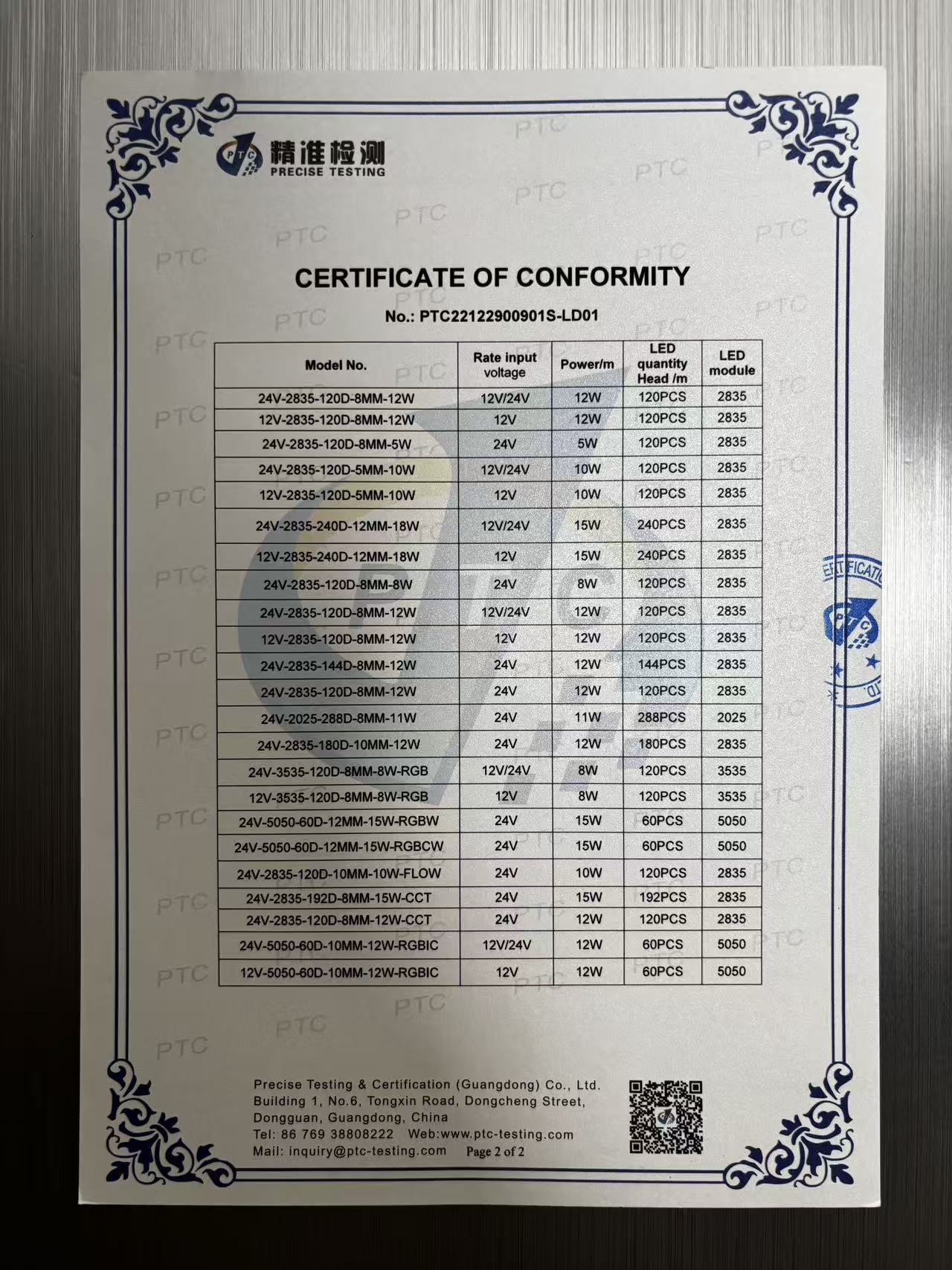
The company's compliance documentation is specific enough to be checked rather than admired. Three records are published for the low-voltage and high-voltage light strip series, all issued by PTC TESTING for the EU market. The CE-LVD record carries certificate numbers PTC22122900901S-LD01 and PTC22122900902S-LD01, dated 4 April 2023, and references EN IEC 62031:2020+A11:2021, IEC TR 62778:2014 and EN 62471:2008. The CE-EMC record carries PTC22122900901E-EMB01 and PTC22122900902E-EMB01, dated 9 March 2023, and references EN IEC 55015:2019+A11:2020, EN 61547:2009, EN IEC 61000-3-2:2019+A1:2021 and EN 61000-3-3:2013+A1:2019. The RoHS record carries PTC22122900903C-EN01 and PTC22122900905C-EN01, dated 23 April 2023, and references the IEC 62321 series of test methods.
The CA-DC24V-2835-180D-8mm-3000K appears in the product scope associated with all three records, which is the practical link a buyer needs: the model is inside the documented family rather than adjacent to it. What the records do not do is prove that this individual SKU was separately tested. The declared scope is a series, and a series certificate establishes that a certification body assessed a defined product family against named standards — not that every reel shipped under that family was individually measured. Closing that second step requires the test report pages that reference the model, plus confirmation of scope with the issuing body.
The date fields deserve the same reading discipline. The records list a validity date of 2099-01-01, which is best treated as a system placeholder rather than as evidence of an indefinite approval; the check a buyer should actually perform is whether the issuer still recognises the certificate number and whether the standards cited are still the applicable versions in the destination market. For US-bound orders the supplied set documents CE and RoHS records only. It does not document a UL listing, so a buyer shipping into the United States should confirm the destination requirement independently before the order is placed, not after the goods are on the water.
Purchasing terms and acceptance criteria as written commitments
The commercial layer is where the audit trail becomes enforceable. The published terms for this order type are a minimum order quantity of 2,000 metres, delivery on FOB or CIF terms, a pre-shipment test as the acceptance criterion, and payment of 30% deposit with the balance before shipment. Production capability is stated as a monthly capacity of 3,000,000 metres with an 18–22 day lead time and 100% test, and the after-sales commitment is a two-year standard warranty supported by online remote support and general technical guidance.
Two of those terms carry more weight than they appear to. A pre-shipment test as the sole acceptance criterion means the test plan is the buyer's main control point, and it is only useful if it is agreed before the deposit is paid: which parameters are measured, on how many metres, at what input voltage, and against which tolerance for 3000K, 11 W and CRI. A plan written after production cannot change the goods, only the argument. The 30% deposit structure reinforces the same point — the balance falls due before shipment, so the inspection window is narrow and should be scheduled into the production calendar rather than requested at the end of it.
The 100% test statement is also worth one clarifying question. It establishes that every order passes through a test step, but a buyer should confirm what that step covers — electrical function and appearance on every reel, or photometric verification on a sample — because the two answers imply different residual risks. Likewise, FOB and CIF place different parties in charge of freight and insurance and therefore move the point at which risk transfers, so the term should be fixed in the quotation rather than settled at booking.
OEM and ODM scope: which changes preserve the model and which reopen it
Customisation is where capability claims most often outrun verification, so it helps to split the documented scope into two tiers. The OEM scope lists voltage, logo, power, dimensions, materials, hardware configuration, internal circuit, colour, factory specifications, nameplate and label. The ODM scope lists exterior colour scheme, outer packaging box, label, brand information, model name and material details. Both run at the same 2,000 metre minimum and the same 18–22 day lead time as the standard order.
The first tier changes the product; the second changes its presentation. Altering voltage, power or internal circuit produces a new electrical configuration, at which point the designation CA-DC24V-2835-180D-8mm-3000K no longer describes what is being shipped, and the compliance and acceptance work has to be repeated for the new configuration and destination market. Altering packaging, label or brand information leaves the electrical identity intact and does not reopen the photometric or safety file. A buyer negotiating a private-label programme can therefore use one rule: any change that touches the electrical or optical column must be accompanied by a renamed model, a restated specification and a fresh acceptance plan, while a packaging change needs only an artwork approval.
Application fit: acoustic panels, hospitality and residential projects
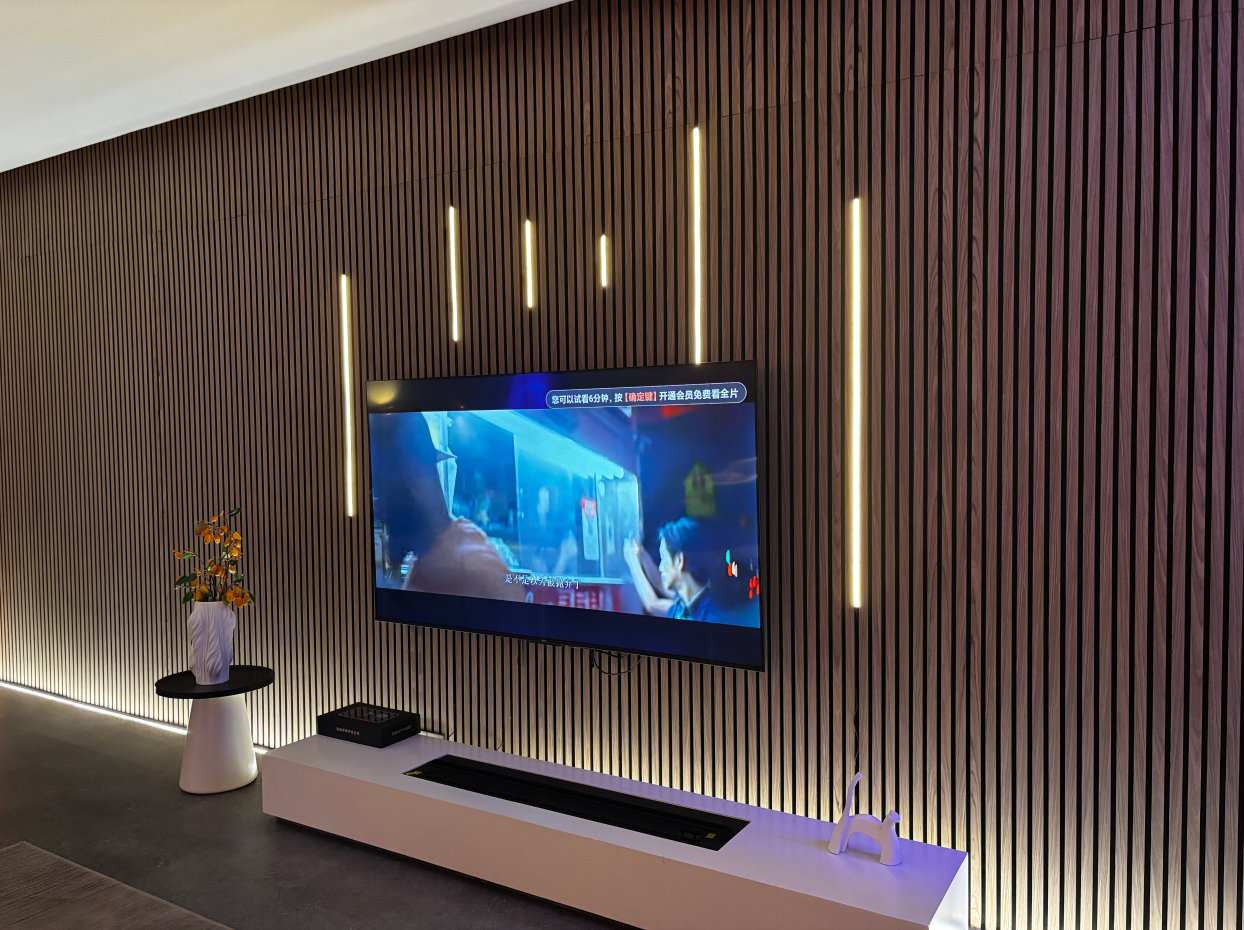
The obvious fit is acoustic wall panel lighting, where the strip is hidden inside or behind a slat and the visible result is a warm line rather than a fixture. Three attributes carry that use: the 8 mm board width for narrow channels, the 180 LEDs/m density for an unbroken line, and CRI Ra≥80 so that the illuminated wood or fabric surface keeps its intended colour. The IP20 rating keeps the application indoors and dry, which is where most acoustic wall specifications sit anyway.
Adjacent project types follow from that base. In premium residential work, the company's project record for a home decoration distributor in Germany and Italy covers 20,000 metres per year over three years in residential ambient lighting upgrades, describing RGB strips and acoustic panel LED strips used in premium residential projects; this model is listed among the products associated with that record. In hospitality, a separate German hotel record covering 20,000 metres describes high-efficiency strips for public areas plus IP68 waterproof strips for exterior work over more than four years — a useful distinction, because the IP68 element in that project belongs to different products, and this IP20 strip would be specified for the dry interior areas only.
Commercial interiors, retail display and wholesale programmes are supported by the same order structure rather than by a different product. A 2,000 metre minimum, a 3,000,000 metre monthly capacity and an ODM scope that includes retail packaging and label artwork together describe a supply arrangement that can serve a distributor building a packaged range as well as a contractor buying for one project — the German DIY retail record, at 100,000 metres per year with customised retail packaging, is the shape of that arrangement rather than a specification of this model.
Three verification routes, and what each one actually establishes
Buyers usually have three routes available and often treat them as interchangeable. They are not, and a short comparison makes the difference usable.
Datasheet review establishes the intended values: 2835 SMD, 180 LEDs/m, 8 mm, 3000K, Ra≥80, 11 W, 24 V, IP20, copper PCB. It does not establish that the reel in front of the inspector matches them. It is the cheapest route and the weakest one, because it verifies a document rather than a product.
Series certificate review establishes that an accredited body assessed a defined product family against named standards, which is exactly what the CE-LVD, CE-EMC and RoHS records issued by PTC TESTING do for the low-voltage and high-voltage light strip series. It does not establish individual SKU conformity, and it does not cover destination markets absent from the record.
Pre-shipment test record establishes that the batch actually being shipped was measured against the agreed criteria, which is the only one of the three that speaks about the goods in the container. It does not establish long-term field performance, because that requires installed time rather than a laboratory reading. The practical decision rule is to request all three and then check that they name the same model and configuration — a datasheet for one variant, a certificate for a family and a test record for another order is the most common way a file looks complete while proving nothing.
One further point applies when the seller is not the producer. A test record is only as strong as the party able to sign it, so a buyer sourcing through an intermediary should ask who issues the record and who holds the certificate number, and should see the answer in writing before the deposit.
Fit boundaries: IP20, fixed 3000K and the driver
The limitations of this model are as decision-relevant as its parameters, and they should be stated before the order rather than discovered during installation.
- IP20 means the strip is not sealed against water or dust ingress. Bathrooms, exterior façades, unventilated damp cavities and wash-down areas fall outside its fit, and the IP68 products used in the German hotel and Netherlands façade records are different items, not a variation of this one.
- 3000K is a fixed colour temperature. Projects requiring scene change or warm-dim behaviour need a tunable product with its own model designation, specification and acceptance plan.
- No luminous flux figure is published in the supplied material, so lumen-based design should be based on a measured value for the exact configuration rather than on an assumed efficacy.
- The strip is a 24 V constant-voltage load and requires a compatible constant-voltage driver; the driver is a separate selection and should be named in the order file rather than left to the installer.
- The two-year warranty is supported remotely. Buyers in execution phase should confirm in writing what the warranty covers, who bears return freight, and what documentation a claim requires.
Repeat orders: what to freeze, and what the market outlook does not settle
A second order is where documentation earns its cost. Between two shipments, the practical risks are a changed emitter batch, a substituted board, a revised driver pairing and repackaged cartons that no longer match the artwork approval. The defence is unglamorous: retain a sealed reference sample from the first accepted shipment, keep the signed test record with it, and make any change to the electrical or optical specification a written change notification with a new model designation. The stated 18–22 day lead time and 3,000,000 metre monthly capacity make that discipline feasible, because a documented change can be scheduled rather than improvised.
Market context supports the same conclusion without predicting any individual supplier's future. The Fortune Business Insights summary used above points to continued growth for LED strip overall and to a dominant low-voltage share, and the same research line reports smart strip penetration rising from 9% in 2019 to 38% by 2025. For a buyer of a fixed 3000K architectural product, the read-across is not that this model will be replaced, but that the surrounding portfolio will keep changing while the installed base of panels stays in service. Continuity of a documented, unmodified SKU therefore matters more than novelty — which is precisely what a record-backed supplier file protects.
Reference material: the 2026 XPUP LED Strip Catalog is available as a public PDF for product-family context; it is a catalogue, not a substitute for the model-specific records described above.
Frequently asked questions
How can a buyer verify the 180 LEDs/m and 11 W figures for this model?
Count the emitters on a measured one-metre sample taken from the reel being shipped, record the cut unit at the same time, and measure power at 24 V DC on that same sample. The two readings belong in the pre-shipment test record, which is the acceptance criterion stated for this order type. A datasheet value on its own confirms the design intent, not the delivered goods.
Do the CE and RoHS records cover this exact SKU?
The CA-DC24V-2835-180D-8mm-3000K is listed in the product scope attached to the CE-LVD, CE-EMC and RoHS records issued by PTC TESTING, so it sits inside the documented family. Those records declare a series scope for the LED low-voltage and high-voltage light strip series, which means they do not by themselves prove that an individual reel was tested. For SKU-level evidence, request the report pages that reference the model and confirm scope and validity with the issuing body.
What are the purchasing terms and acceptance criteria for this order type?
The published terms are a minimum order quantity of 2,000 metres, delivery on FOB or CIF terms, a pre-shipment test as the acceptance criterion, and payment of 30% deposit with the balance before shipment. Production is stated at a monthly capacity of 3,000,000 metres with an 18–22 day lead time and 100% test, and the after-sales term is a two-year standard warranty with online remote support.
What does the IP20 rating exclude?
IP20 describes an unsealed strip intended for dry interior use. It excludes bathrooms and wet rooms, exterior and façade installations, wash-down areas and damp or condensing cavities. Projects in those locations need a differently rated product with its own model designation and records, not this strip installed with additional sealing on site.
What changes if a project needs a different voltage, power or colour temperature?
It becomes a different product. The documented OEM scope covers voltage, power, dimensions, materials, internal circuit, colour, hardware configuration, nameplate and label, all at a 2,000 metre minimum and an 18–22 day lead time, while the ODM scope covers packaging, labels, brand information and model naming. A change to voltage, power or colour alters the electrical or optical identity, so the model designation, the specification sheet and the acceptance plan all have to be restated; a packaging or label change does not reopen those items.
Tem questões ou precisa de mais detalhes?
Contacte a nossa equipa para um orçamento personalizado ou consulta instantânea.
Solicitar orçamento
Preencha o formulário abaixo e a nossa equipa entrará em contacto com uma proposta personalizada.
Chat direto do WhatsApp
Prefere conversar em tempo real? Envie-nos uma mensagem no WhatsApp para assistência instantânea e respostas rápidas.
- Obter orçamento personalizado
- Partilhar fotos ou documentos
- Discuta as suas necessidades diretamente
Geralmente responde em 5–30 minutos durante o horário de expediente.