
Action Camera Supplier Capability Evidence: 2K-to-4K Proof
A supplier's model list is a claim. A model list that carries component-level specification lines, consistent design logic across tiers, and openly stated limits is evidence a buyer can audit before committing a program.
Action camera sourcing conversations usually open with a capability statement: full OEM support, stable production, export-ready compliance. None of that is checkable on its own. What is checkable is whether the supplier can describe its own products at the level of screen size, lens field of view, battery chemistry, recording mode and housing material — and whether those descriptions stay internally consistent from the entry tier to the high tier.
YUAOHENG Action Camera is the action camera line of Dongguan YuAoHeng Electronic Technology Co., Ltd., a Dongguan, China–based manufacturer established in 2016 that develops, manufactures and sells action cameras, smart vehicle electronics and smart security products. Its documented range spans a 2K entry model, the X20, and four 4K models, the Q1, Q2, Q3 and Q7. That spread is the subject of this analysis: not as a product catalogue, but as a set of auditable evidence points.
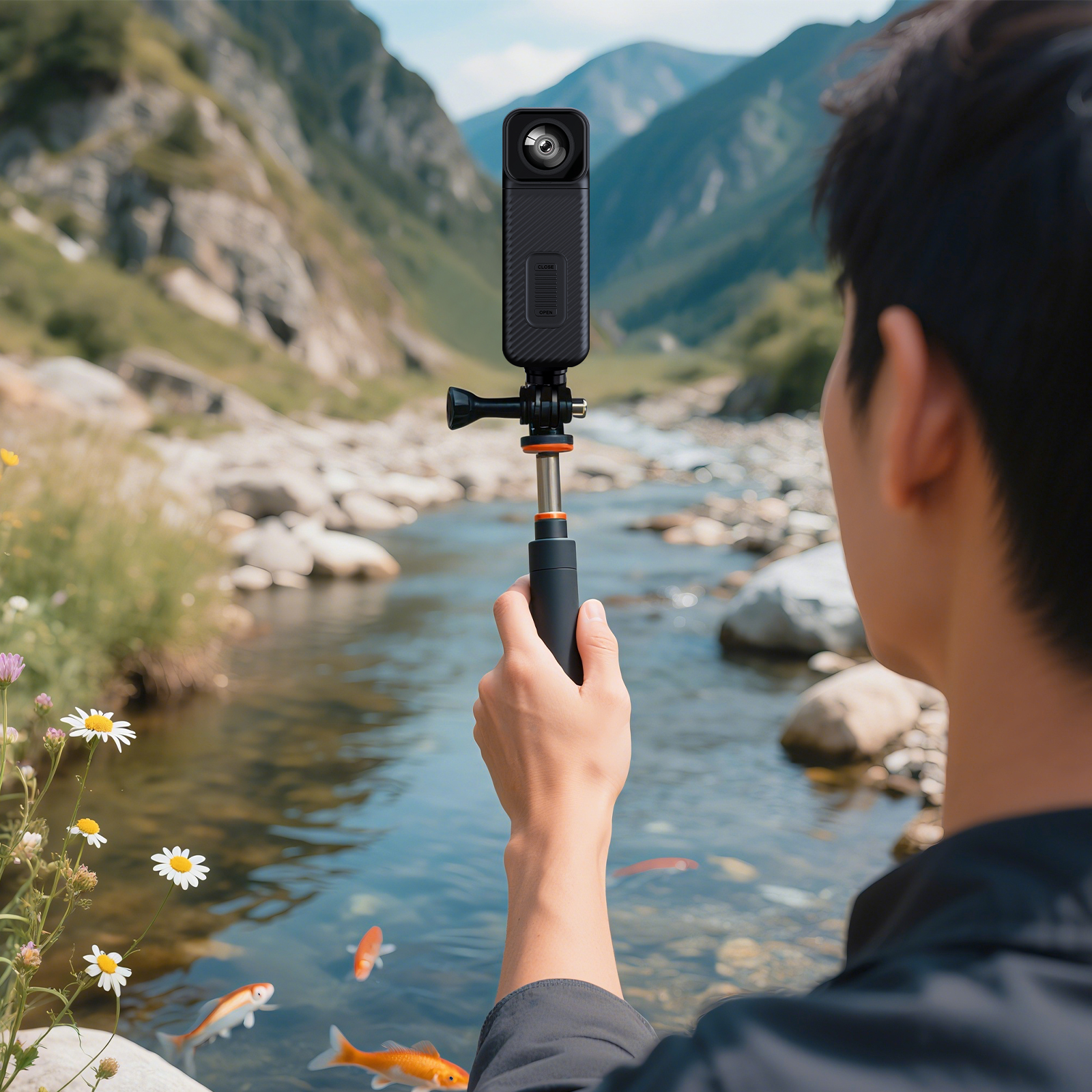
Outdoor and travel recording is the segment where 2K and 4K tiers overlap in buyer requirements.
Why a Model Lineup Can Serve as Evidence
Supply capability is normally asserted in three ways: production figures, certification lists, and customer references. Production figures and certifications are verifiable documents. The product line itself is a third, frequently overlooked evidence set — and it is the one that shows whether the supplier actually controls specification definition rather than reselling a catalogue.
A lineup passes as evidence when three tests hold.
- Depth. Each model is documented down to component level: display type and resolution, lens focal length and field of view, battery capacity and voltage, recording resolution and frame rate, interface type. Shallow documentation — a marketing name and a megapixel figure — cannot be audited.
- Coherence. Components fit together plausibly. A 1.8-inch 800×480 touch display paired with electronic stabilization and a higher-capacity 18650 cell describes one design intent; the same shell paired with a 1.47-inch 320×240 panel describes another. Inconsistent combinations signal a copied sheet.
- Boundaries. The supplier states what a model does not do. Waterproof case compatibility is not the same as an in-body IP rating. Infrared night vision is fill-light illumination, not thermal imaging. Suppliers who distinguish these are easier to hold to acceptance criteria.
The 2K Entry Tier: What the X20 Documents
The X20 is designated 2K+WIFI X20 and is built on an ABS body. Its documented configuration includes a 1.54-inch IPS screen at 320×240 pixels, an HD lens with a 130-degree field of view and a rotating direction feature, and a full-range built-in capacitor microphone. Power comes from a 1000mAh/3.8V polymer battery, with a stated video working time of roughly 6 to 7 hours, a recording working time of roughly 9 hours, and a maximum photo duration of approximately 12 hours at 720p 30fps. Charging runs through a Micro Type-C interface at DC 5V, 1A–2A, and storage is offered at 16GB, 32GB, 64GB or 128GB. Infrared night vision is supported by four built-in infrared lights with manual switching.
Two details in that description matter more than the headline resolution. First, the endurance figures are expressed in hours under named conditions rather than as a vague "long battery life" claim — a buyer can convert them into a test protocol. Second, storage options are enumerated, which matters for channel packaging decisions in markets where the memory card is bundled rather than sold separately.
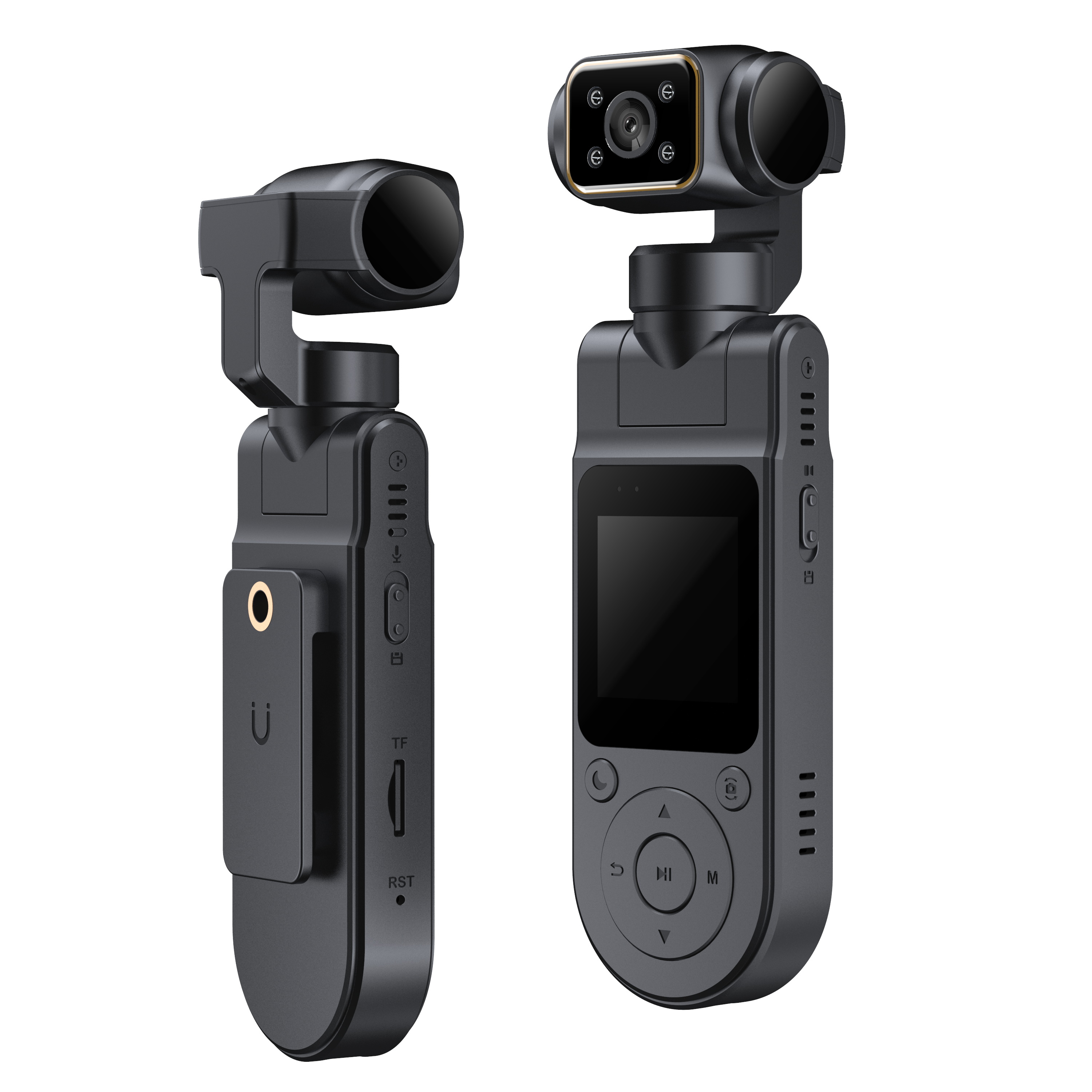
The X20 documents the entry tier at the same component depth as the 4K models.
The 4K Tier: Q1, Q2, Q3 and Q7
The four 4K models are not variants of a single board. Their documentation diverges in display, stabilization and battery, which is itself a signal: a supplier that can describe four distinct configurations is working from defined engineering choices rather than a single template.
Q1 — dual 4K recording as the core claim
The Q1 is designated 4K+WIFI Q1 and uses an ABS body with a 1.5-inch IPS screen at 320×240 pixels. Both front and rear cameras record at 4K (3840×2160), and simultaneous dual recording runs at front 2K plus rear 2K. The lens is a 130-degree wide-angle unit with a rotating direction feature. A 2000mAh/3.8V polymer battery supports roughly 4 to 5 hours of video working time and about 9 hours of recording working time, with a maximum photo duration of approximately 10 hours at 720p 30fps. The model is compatible with a waterproof case, supports infrared night vision, and uses a high-speed Mini USB 2.0 interface.
Q2 — the widest configuration spread
The Q2 is designated 4K+WiFi+touch screen+anti-shake, and it departs most from the baseline. The display is a 1.8-inch IPS panel at 800×480 pixels — a materially higher resolution than the 320×240 panels elsewhere in the range. The lens is a 25mm unit with a 130-degree wide angle. Front and rear cameras record at 4K (3840×2160), with simultaneous 2K+2K dual recording available in three optional modes. Controls are standard touch plus physical dual buttons, which matters for wet or gloved use. Anti-shake is specified as 6-level electronic image stabilization. Power comes from an 18650 cell rated at 2000mA, with about 4 to 5 hours of video working time. Waterproof case compatibility, infrared night vision and a full-range built-in capacitor microphone are documented.
Q3 — dual 4K with a 2000mAh polymer pack
The Q3 is designated 4K WiFi Q3 and is built on ABS with a 1.5-inch IPS screen at 320×240 pixels. Front and rear cameras both record at 4K (3840×2160), with simultaneous dual recording at front 2K and rear 2K. The battery is a 2000mAh/3.8V polymer pack. The lens is a high-definition 130-degree wide-angle unit with rotating direction, and infrared night vision is supported with manual switching. WiFi connectivity and a full-range built-in capacitor microphone complete the documented configuration.
Q7 — 4K at 30fps with stabilization
The Q7 is designated 4K WiFi anti-shake and uses an ABS body with a 1.47-inch IPS screen at 320×240 pixels. It records 4K (3840×2160) at 30 frames per second through a 130-degree wide-angle lens with rotating direction. Power is a 1000mAh/3.8V polymer battery. Image stabilization is supported, infrared night vision is supported, and the model is compatible with a waterproof case for underwater shooting. A full-range built-in capacitor microphone and a high-speed Mini USB 2.0 interface are documented.
Six Cross-Lineup Checkpoints Buyers Can Actually Audit
- Housing material consistency. Every model in the range — X20, Q1, Q2, Q3 and Q7 — is documented as ABS. That gives one material baseline to verify. Ask for the resin grade and part-level tooling references, not just the word "ABS," and check whether the same tool is reused across models.
- Optical baseline. A 130-degree field of view appears across the X20, Q1, Q2, Q3 and Q7, with rotating direction documented on most models. A shared optical baseline simplifies accessory planning and lets a buyer compare samples against one measurable reference instead of five unrelated ones.
- Waterproof strategy. This is the checkpoint most often blurred. The Q1, Q2 and Q7 are documented as compatible with a waterproof case; other models in the wider range carry an IP65 body rating. Case compatibility is a housing-accessory relationship, not an ingress protection rating. Acceptance criteria must name which one applies.
- Dual recording and dual lens. The Q1, Q2 and Q3 document front and rear 4K capture plus simultaneous 2K+2K dual recording. Simultaneous dual-channel recording is a firmware and platform capability, not a component that can be swapped in at assembly, so it is one of the harder claims to fake.
- Stabilization level. The Q2 specifies 6-level electronic image stabilization and the Q7 specifies supported anti-shake. Electronic stabilization is now a standard feature across budget to mid-range action cameras, so its mere presence is not a differentiator — the level and the tested behaviour are. Buyers should require a stabilization sample, not a feature checkbox.
- Battery specification. Capacity, chemistry and endurance are documented per model: 2000mAh/3.8V polymer on the Q1 and Q3, an 18650 cell at 2000mA on the Q2, and 1000mAh/3.8V polymer on the Q7 and X20. Because the cells differ, runtime cannot be inferred across models — each must be verified on its own terms.
Lineup Comparison at a Glance
| Model | Designation | Display | Lens | Recording | Stabilization | Battery | Body |
|---|---|---|---|---|---|---|---|
| X20 | 2K+WIFI | 1.54" IPS, 320×240 | HD 130°, rotating | 1920×1080 AVI | Not documented | 1000mAh/3.8V polymer | ABS |
| Q1 | 4K+WIFI | 1.5" IPS, 320×240 | 130° wide, rotating | Front and rear 4K (3840×2160); dual 2K+2K | Not documented | 2000mAh/3.8V polymer | ABS |
| Q2 | 4K+WiFi+touch+anti-shake | 1.8" IPS, 800×480 | 25mm, 130° wide | Front and rear 4K; 2K+2K, three modes | 6-level EIS | 18650, 2000mA | ABS |
| Q3 | 4K WiFi | 1.5" IPS, 320×240 | 130° wide, rotating | Front and rear 4K; dual 2K+2K | Not documented | 2000mAh/3.8V polymer | ABS |
| Q7 | 4K WiFi anti-shake | 1.47" IPS, 320×240 | 130° wide, rotating | 4K (3840×2160) at 30fps | Supported | 1000mAh/3.8V polymer | ABS |
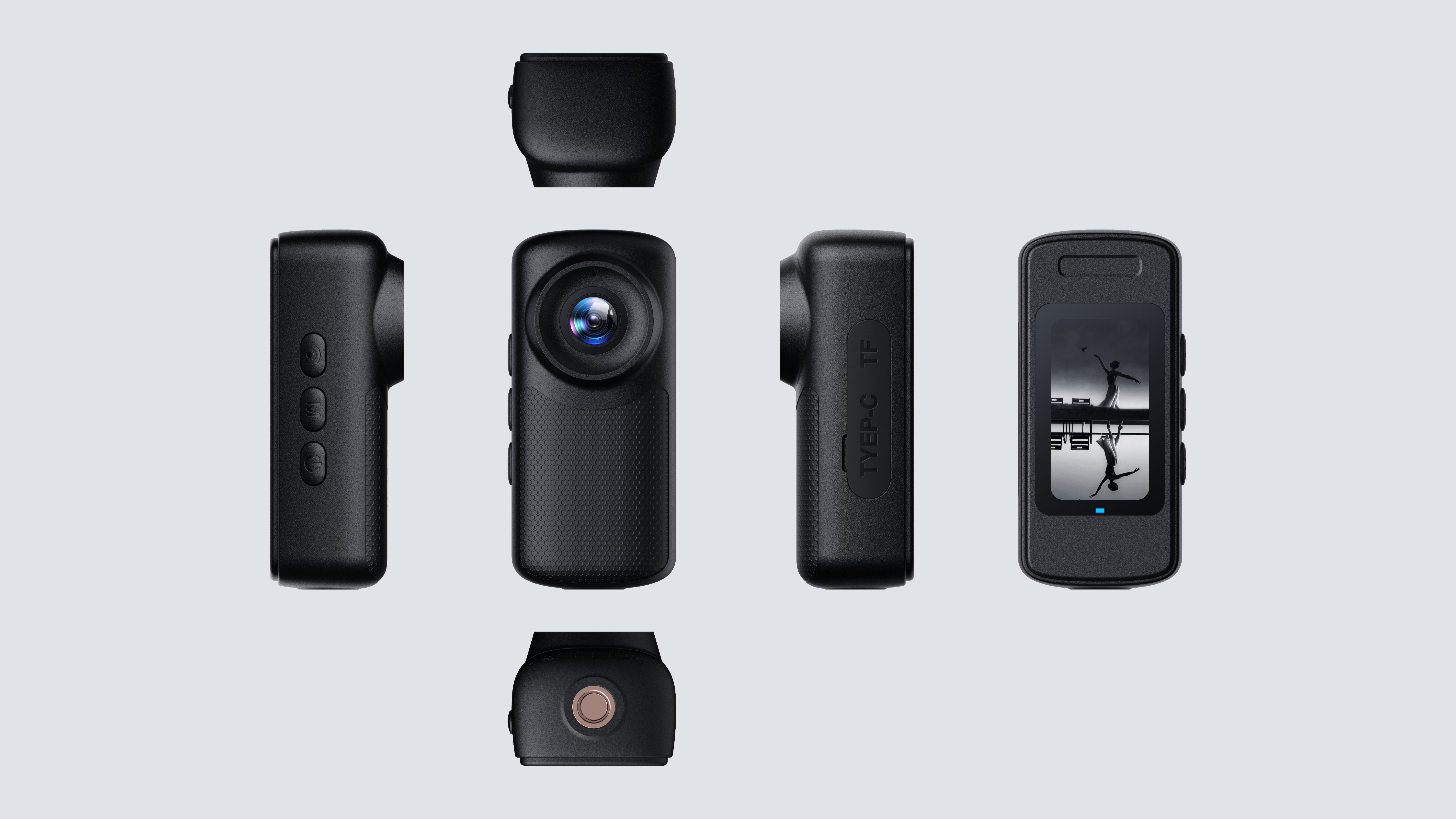
The Q7 documents 4K at 30fps with stabilization support and waterproof case compatibility.
What This Lineup Does Not Prove
Documented specifications establish that a supplier can define products precisely. They do not establish manufacturing yield, field reliability or after-sales performance, and buyers who treat a spec sheet as a quality certificate skip the part that costs money to get wrong.
- No failure-rate or lifecycle data. Nothing in the documented range states MTBF, drop-test results, waterproof test depth for the case accessory, or field return rates. Those must be requested as test reports or established through sampling.
- Naming versus recorded specification. The X20 shows a 2K tier label against a 1920×1080 recorded format line. The same care applied there should be applied to every model name in any supplier's catalogue.
- Case compatibility is not ingress protection. Where a model is described as compatible with a waterproof case, the protection comes from the accessory. The IP68 definition under IEC 60529 describes dust-tightness and immersion protection for an enclosure that has been tested to it — so the rating must be attached to the specific configuration being purchased, not inferred.
- Infrared night vision has a bounded use. The documented infrared mode is fill-light illumination with manual switching — useful at close range in darkness, not a substitute for low-light sensor performance, and not thermal imaging.
- Stabilization claims lack comparative data. Six-level electronic stabilization on the Q2 and supported anti-shake on the Q7 describe the presence of a stabilization function. Without side-by-side footage under matched conditions, no ranking between models or against third-party products can be claimed.
- Lineup breadth is not customization depth. OEM and ODM one-stop customization services are documented as a company capability, covering design, engineering development, testing and mass production. What a specific project can change — housing, firmware, packaging, accessories — still has to be confirmed per brief.
From Specification to Purchasing Terms
The practical value of audited model evidence is that it converts directly into contract language. Four areas are worth writing into a purchase order.
- Sample verification. Record display size and resolution, measured field of view, actual recording resolution and frame rate, dual-recording mode behaviour, and stabilization behaviour on footage. Compare against the model line, not against the sales presentation.
- Battery acceptance. Specify capacity and voltage as named values — 2000mAh/3.8V polymer on the Q3, for example — and pair them with a runtime test under a stated resolution and frame rate, since endurance figures are conditional.
- Compliance documentation. The company's products hold FCC, CE and RoHS certification. For safety referencing, action cameras fall within the scope of IEC 62368-1 for audio/video and information technology equipment, with the fourth edition published in 2023. Buyers should request certificates that match the exact model and configuration being purchased.
- Accessory scope. Where protection depends on a waterproof case, the case belongs in the bill of materials and in the acceptance criteria. Leaving it in the accessory list creates a gap at incoming inspection.
Production-side context supports the documentation: the facility covers 1,500 square meters, employs approximately 300 staff including a 30-engineer R&D team, and reaches an annual production capacity of 2,000,000 units. Approximately 80% of products are exported to more than 15 countries and regions, with major markets in Europe, North America, Asia and South America. These are capacity facts, not quality facts — they answer "can this supplier absorb my volume," not "will this model survive my use case."
Market Context: Why a Two-Tier Lineup Fits Current Demand
The relevance of a range that spans 2K and 4K is easiest to see in the demand split. The global action camera market was valued at USD 6.57 billion in 2024, according to SkyQuest Technology, while China's domestic market was estimated at USD 502.25 million in the same year by Market Research Future. OEC data places China's 2024 exports of video cameras at USD 166 million, with the United States the top destination at USD 31.8 million.
Resolution mix explains part of the tier logic. Mordor Intelligence estimates that the ultra-HD segment — 4K and above — accounted for approximately 46.25% of action camera market share in 2025, which means a majority of volume still sits below that line. Grand View Research puts North America at a 34% revenue share of the global market in 2025, a region where brand-led premium tiers dominate. Competitive concentration is real: SkyQuest reports GoPro sold 3 million camera units in 2023, and PetaPixel reporting on BCN+R data notes that DJI and Insta360 held nearly 90% of the Japanese market as of late 2025.
For importers and private-label buyers, that structure rewards a supplier able to document both tiers credibly. A 4K-only catalogue is exposed when a channel needs a volume entry price point; a 2K-only catalogue cannot compete for programs where 4K capture is a listing requirement. A documented 2K-to-4K range gives a buyer one supplier relationship across both.
Sources: SkyQuest Technology; Market Research Future; OEC; Mordor Intelligence; Grand View Research; PetaPixel / BCN+R. Figures are third-party estimates and vary by research scope.
Future Outlook
Electronic image stabilization has already crossed into budget and mid-range action cameras as a standard feature, using software algorithms to correct motion. That changes what buyers should ask for. Stabilization presence will stop being a selection criterion and stabilization level, tested under matched conditions, will replace it — which puts pressure on suppliers to document behaviour rather than features.
The same shift applies to resolution labelling. As the 4K-and-above segment grows toward and beyond half of the market, the gap between a model's tier name and its recorded specification line becomes a procurement risk rather than a marketing detail. Suppliers who publish the recorded format, the endurance conditions and the accessory dependency alongside the model name will be easier to shortlist, and easier to hold to acceptance criteria once a program starts.
FAQ
What counts as supplier capability evidence for an action camera?
Capability evidence is documentation detailed enough to be checked: display type and resolution, lens focal length and field of view, recording resolution and frame rate, battery capacity, voltage and chemistry, interface type and housing material, stated per model. Supporting documents — certification for FCC, CE and RoHS, production capacity and facility size — complete the picture. Marketing descriptions without component-level lines cannot be audited.
Does a 2K-to-4K lineup prove a supplier can handle an OEM order?
It proves the supplier defines and documents multiple configurations rather than reselling one template. Dongguan YuAoHeng Electronic Technology Co., Ltd. documents OEM and ODM one-stop customization covering design, engineering development, testing and mass production, with a 30-engineer R&D team and annual capacity of 2,000,000 units. Whether a specific customization is feasible — housing, firmware, packaging or accessory changes — has to be confirmed against the project brief.
How should a buyer verify battery claims such as 2000mAh?
Match the claim to the model and the cell type first, because they differ across the range: the Q1 and Q3 use a 2000mAh/3.8V polymer battery, the Q2 uses an 18650 cell rated at 2000mA, and the Q7 and X20 use a 1000mAh/3.8V polymer battery. Then test runtime under a stated resolution and frame rate, since documented endurance figures such as roughly 4 to 5 hours of video working time on the Q1 and Q2 are conditional on settings.
Is waterproof case compatibility the same as an IP rating?
No. The Q1, Q2 and Q7 are documented as compatible with a waterproof case, which means protection depends on that accessory being fitted and correctly sealed. Other models in the wider range carry an IP65 body rating. IP68 is defined under IEC 60529 as protection against dust and against immersion, and applies only to an enclosure tested to that level. Purchase orders should name which configuration is being bought.
What does 6-level electronic image stabilization mean for sourcing decisions?
It identifies the stabilization level specified for the Q2, alongside supported anti-shake on the Q7. Because electronic stabilization is now a standard feature in budget to mid-range action cameras, the presence of the function says little on its own. Sourcing decisions should rely on sample footage captured under matched conditions — the same mount, the same motion, the same resolution — rather than on the level number alone.
What are the limits of evaluating a supplier from its model lineup?
A lineup documents design intent and specification control. It does not document manufacturing yield, field failure rates, drop or immersion test results, or after-sales response times, none of which appear in the documented range. It also cannot establish comparative performance against third-party products without matched testing. Those gaps are closed by sampling, test reports and staged order ramps, not by reading spec sheets.
For buyers who need the full configuration set in one document, the company product catalogue is available for download: YUAOHENG product catalogue (PDF).
Tem questões ou precisa de mais detalhes?
Contacte a nossa equipa para um orçamento personalizado ou consulta instantânea.
Solicitar orçamento
Preencha o formulário abaixo e a nossa equipa entrará em contacto com uma proposta personalizada.
Chat direto do WhatsApp
Prefere conversar em tempo real? Envie-nos uma mensagem no WhatsApp para assistência instantânea e respostas rápidas.
- Obter orçamento personalizado
- Partilhar fotos ou documentos
- Discuta as suas necessidades diretamente
Geralmente responde em 5–30 minutos durante o horário de expediente.