
Adhesive Resin or Toughener? Matching MAH-Grafted Polymers to High-Stress Bonds
Independent industry reference · Maleic anhydride grafted polymers · Scenario-based selection for buyers and compounders
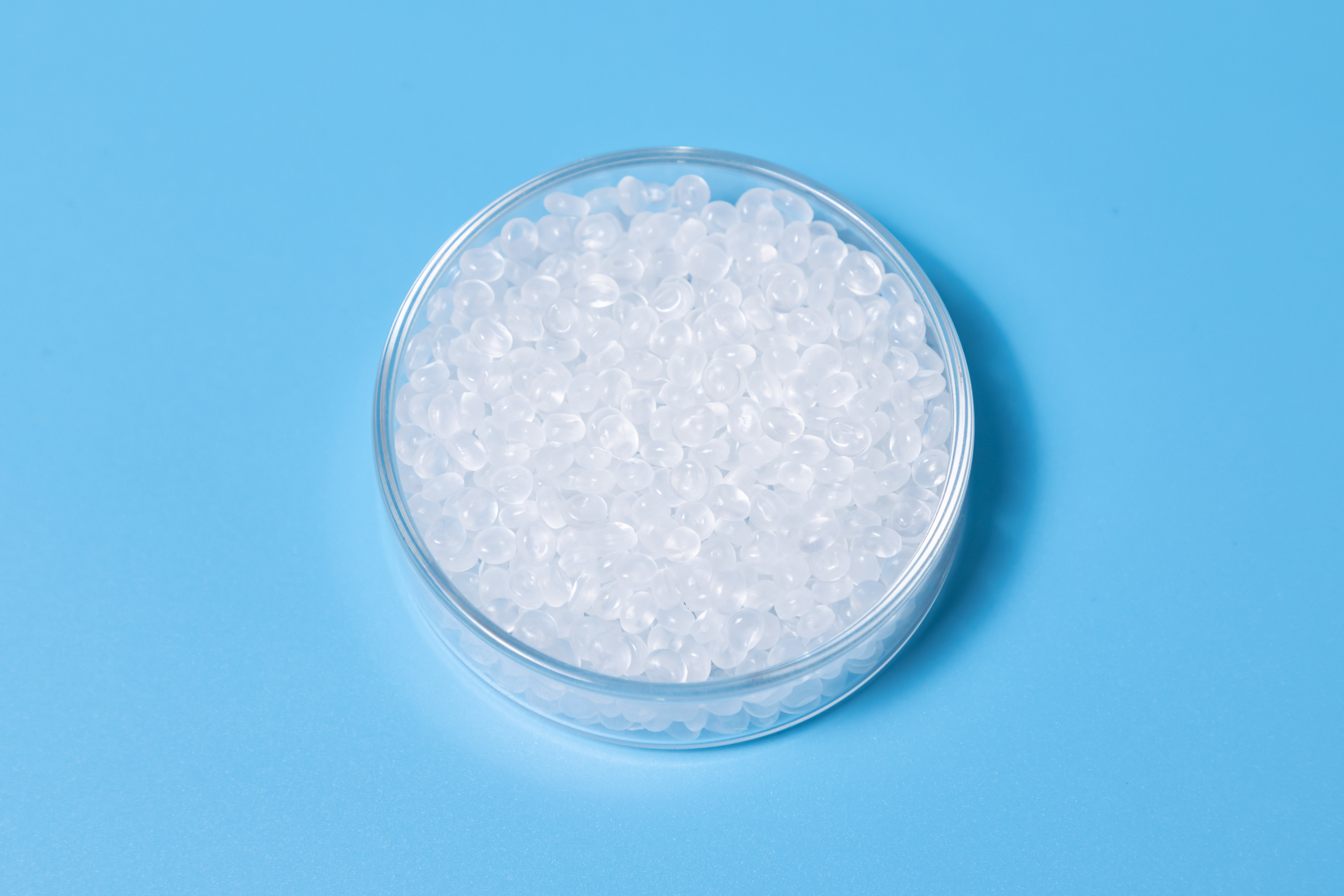
Adhesive resins are one of three grafted families that decide whether a high-stress bond survives. Image: KETONG Adhesive Resins KT-NJE2202A.
The global maleic anhydride graft polymer market is projected at USD 1.42 billion in 2026, rising to USD 2.16 billion by 2035 at a CAGR of 4.7%, according to Business Research Insights. Upstream, Grand View Research places Asia Pacific at 52.1% of maleic anhydride revenue in 2023, with China forecast to grow at a CAGR of 5.4% through 2030. That expansion is not powered by one application. It is powered by a recurring engineering problem: two materials that do not naturally bond, or a polymer that is strong but brittle, inside an assembly that has to survive peeling, impact, or repeated thermal cycling.
Buyers usually arrive at this problem through a product name — “we need a maleic anhydride compatibilizer” — rather than through the failure mode they are actually trying to prevent. That is where specification drift begins. A grade chosen to fix delamination in a multilayer film and a grade chosen to stop a glass-filled nylon bracket from cracking are both maleic anhydride grafted polymers, but they are engineered for different jobs, dosed at different levels, and judged against different parameters. This reference maps common high-stress bonding scenarios to the product families that address them, and explains which data points a buyer should verify before committing to a grade.
Why the Same Grafted Chemistry Solves Two Different Problems
Maleic anhydride grafting attaches a polar anhydride ring onto a non-polar polymer backbone — polyethylene, polypropylene, POE, EPDM, SEBS, ABS, EVA, PPO, or a polyester elastomer. The anhydride group reacts with polar chemistry such as the amine and amide groups present in nylon, or hydroxyl groups on glass fibre and mineral fillers. The backbone, meanwhile, remains compatible with the non-polar phase. That dual character is the technical basis of the whole category.
The three product families built on that chemistry are not interchangeable, because the grafted polymer plays a different physical role in each case:
- Adhesive resins (MAH-g-PE, MAH-g-PP): the grafted polymer is the bonding layer. It is extruded, coated, or co-extruded as a tie layer between substrates that would otherwise not adhere.
- Tougheners (MAH- or GMA-grafted elastomers): the grafted elastomer is dispersed as a rubber phase inside a rigid matrix. The elastomer absorbs impact energy; the graft anchors it to the matrix so it does not simply become a void.
- Compatibilizers: the grafted polymer sits at the interface between two immiscible phases — a polymer blend, a filled compound, or an overmolded assembly — and stabilises that boundary.
The selection error that causes most rework is treating these as a ladder of increasing quality. They are not. A compatibilizer used where an adhesive resin is required will not build a continuous bond line, and an adhesive resin used where a toughener is required will not raise impact resistance.
The Three Product Families in the KETONG Portfolio
KETONG, the Shenyang-based manufacturer operating as Shenyang Ketong Plastics Co., Ltd. and Shenyang Ketong New Materials Co., Ltd., produces maleic anhydride grafted functional polymers across compatibilizers, tougheners, and functional adhesive resins. The group was founded in 2003, employs approximately 130 staff, maintains an R&D team of eight engineers, operates a 30,000 m² site, and reports an annual output of 60,000 tons; its second facility in Shenyang, Liaoning, was completed in 2023 with a planned 10 production lines and 60,000 tons per year of capacity. Products are sold domestically and exported to markets in Asia, America, and Europe. The company website is https://compatibilizer.com/.
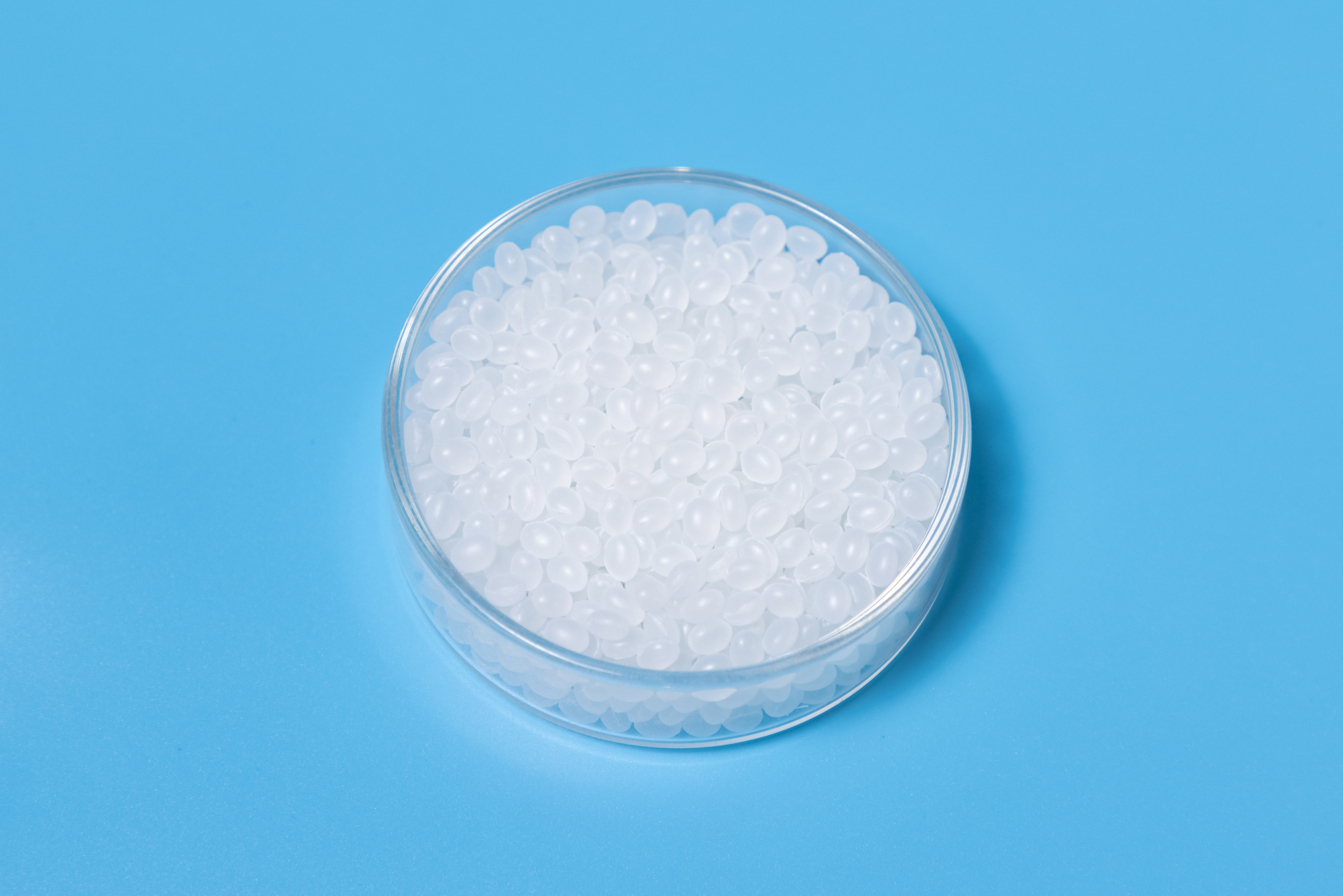
Nylon-series tougheners such as KT-915C are dosed at 5–20% and address impact-dominated failure rather than interfacial failure. Image: KETONG Tougheners KT-915C.
Adhesive resins in the range include KT-NJE2202 and KT-NJE2202A (MAH-g-PP, low graft below 0.4%, melt flow 1.5–3.5 and 1.0–3.0 g/10min at 190°C/2.16kg, densities 0.89–0.91 g/cm³), KT-NJG3304 (MAH low below 0.4%, melt flow 1.8–3.5 g/10min, density 0.92–0.95 g/cm³), KT-NJM3205, KT-NJM2203 and KT-NJP7103 (medium graft 0.4–0.8%, melt flow 1.0–3.0 g/10min, density 0.90–0.93 g/cm³), and KT-NJ001 with a high graft level above 0.8% and a lower melt flow of 0.3–1.5 g/10min at a density of 0.91–0.93 g/cm³.
Tougheners are organised by the matrix they serve: Nylon (PA) series POE-g-MAH and EPDM-g-MAH grades such as KT-913, KT-915, KT-915B, KT-915C, KT-915E, KT-915H, KT-915K, KT-915F, KT-915CA, KT-916K, KT-9015, KT-903, KT-906, KT-9, KT-9C, KT-8, KT-7 and the SEBS-based KT-25; Polyester series GMA-grafted grades including KT-22, KT-33, KT-30, KT-35, KT-35G, KT-35G01, KT-3502, KT-3505 and KT-3506; PC series grades KT-17, KT-1701, KT-1702 and KT-31; POM series KT-28 and KT-28A; and the ABS series KT-4.
Compatibilizers are produced for PP (KT-1, KT-1D, KT-1H), low-odor PP (LEP-1B, LEP-1K), PE (KT-12, KT-12A, KT-12B, KT-12B01, KT-12B05, KT-12D, KT-1208B, KT-1220B), ABS (KT-2, KT-2H, KT-3, KT-2M), low-odor ABS (LEP-2), PPO (KT-24, KT-24B, KT-24F), EVA (KT-26, KT-2628, KT-2628A, KT-2628B, KT-2628C), and biodegradables (KT-36).
A Self-Diagnosis Framework: Match the Failure Mode to the Family
Before comparing grades, isolate the failure mode. The table below is a diagnostic starting point, not a substitute for trials on the actual part.
| Observed problem | Family to evaluate | KETONG grades | Parameters to verify |
|---|---|---|---|
| Peeling or delamination at a polyolefin boundary (film, pipe coating, multilayer structure) | Adhesive resin | KT-NJ001, KT-NJM3205, KT-NJG3304, KT-NJE2202, KT-NJE2202A, KT-NJP2201, KT-NJM2203, KT-NJP7103 | MAH graft level, melt flow rate, density, processing temperature |
| Brittle fracture or low impact in PA parts | Nylon (PA) series toughener | KT-913, KT-915 series, KT-915C, KT-916K, KT-9015, KT-903, KT-906, KT-8, KT-7, KT-25 | Addition scope (typically 3–25%), MAH level, base elastomer |
| Cracking or notch sensitivity in PC and PC blends | PC series toughener | KT-17, KT-1701, KT-1702, KT-31 | Addition scope (1–10%), MAH level, melt flow at 200°C |
| Impact weakness in polyester-based parts | Polyester series toughener (GMA-grafted) | KT-22, KT-33, KT-30, KT-35, KT-35G, KT-35G01, KT-3502, KT-3505, KT-3506 | GMA level (low, medium, high), addition scope 3–20% |
| Chipping or cracking in POM components | POM series toughener | KT-28, KT-28A | Density 1.12–1.17 g/cm³, addition scope 5–10% |
| Delamination in immiscible blends or filled compounds | Compatibilizer | KT-1, KT-1D, KT-1H, KT-12 series, KT-24 series, KT-26 series, KT-2/2H/3/2M | Graft level, melt flow, carrier resin match |
| Odour complaints in interior or consumer parts | Low-odor grades | LEP-1B, LEP-1K, LEP-2 | Low-odor formulation, graft level, melt flow |
| TPE overmolding onto nylon | Specialty compatibilizer | KT-2512 | Density 0.90–0.92 g/cm³, melt index 10–25 |
High-Peel Bonds: Adhesive Resins and the Graft-to-Flow Trade-Off
When the failure mode is interfacial — a layer lifting off, a coating losing anchorage, a co-extruded structure separating — the relevant family is the adhesive resin, and the two parameters that dominate the decision are graft level and melt flow rate.
Graft level describes how much reactive anhydride is available at the interface. KETONG grades are grouped as low (below 0.4%), medium (0.4–0.8%), and high (above 0.8%). Melt flow rate describes how the grade behaves in the extruder. KT-NJE2202A, for example, combines a low graft level with a melt flow of 1.0–3.0 g/10min at 190°C/2.16kg and a density of 0.89–0.91 g/cm³; KT-NJ001 moves to a high graft level above 0.8% with a notably lower melt flow of 0.3–1.5 g/10min at a density of 0.91–0.93 g/cm³.
The trade-off is real. Higher graft content gives more reactive sites for anchorage, but the drop in melt flow reduces flowability, which can complicate dispersion and lower achievable line speed in thin coating layers. Conversely, a higher-flow grade wets the substrate more easily but offers fewer reactive sites. Buyers evaluating tie-layer resins should therefore ask for the specific graft range and melt flow condition rather than accepting a generic “high MAH” label — the difference between “high” and “extra high” matters, as the ABS series demonstrates: KT-2 runs above 0.8% graft, while KT-3 is specified at an extra high level of ≥4.0%.
Impact-Dominated Parts: Where Tougheners Do the Work
When the part breaks rather than separates, the family changes. A toughener is a grafted elastomer dispersed in the matrix; its job is to absorb energy, and its graft level determines whether the elastomer phase stays bonded to the matrix instead of debonding under load.
For nylon, KETONG supplies POE-g-MAH grades such as KT-913 (medium MAH 0.4–0.8%, melt flow 0.5–2.0 g/10min at 190°C/2.16kg, density 0.86–0.88 g/cm³, addition scope 3–25%), the high-graft KT-915 family, and EPDM-g-MAH grades KT-7 and KT-8 for scenarios where an EPDM backbone is preferred. KT-25 introduces a SEBS-g-MAH backbone with high graft above 0.8% and a narrower addition scope of 3–15%, reflecting its different melt behaviour at a density of 0.91–0.93 g/cm³.
For polyester-based systems the reactive group shifts from maleic anhydride to glycidyl methacrylate. KT-22 uses an ethylene-acrylate-GMA terpolymer with a high GMA level above 0.8% and a melt flow of 1.5–4.0 g/10min at 190°C/2.16kg; KT-30 uses a GMA-g-PE backbone at a medium GMA level with a higher melt flow of 4.0–8.0 g/10min and a tighter 3–5% addition scope.
For polycarbonate, KT-17 is specified with an extra high MAH level of ≥4.0% and a very low melt flow of ≥0.05 g/10min at 200°C/5kg, while KT-1701 and KT-1702 operate above 0.8% graft at densities of 0.97–1.00 and 0.95–0.98 g/cm³ respectively. KT-31 takes a different route entirely, based on an acrylate-g-ethylene elastomer with a 1–3% addition scope. For POM, KT-28 and KT-28A both run at a density of 1.12–1.17 g/cm³ with a 5–10% addition window.
Across all of these families, the dosage window is the second decision variable after chemistry. The published scopes are wide — 3–25% for nylon tougheners, 3–20% for polyester grades, 3–10% for PC, 5–10% for POM. The upper end of those ranges buys impact performance at the cost of stiffness and, in some cases, flow. Buyers should treat the range as an experimental space, not a recommendation.
Thermal Cycling: Why Melt Flow and Backbone Matter
Repeated heating and cooling loads a bond line or an interface with cyclic differential expansion. This is a slower failure mode than peel or impact, and it is less forgiving of a marginal interface, because the joint is asked to survive many small load cycles rather than one large one.
Two choices matter most. First, the elastomer backbone: POE-based grades such as KT-915E (high graft above 0.8%, melt flow ≥0.2 g/10min, density 0.86–0.88 g/cm³), KT-915H (melt flow 0.3–1.0 g/10min), or KT-916K (melt flow 9.0–13.0 g/10min measured at 235°C/5kg) behave differently from EPDM-based or SEBS-based options. Second, the melt flow rate, which functions as a proxy for molecular weight and therefore for melt strength during processing.
The honest limitation here is that no single grade guarantees thermal-cycle performance. Cyclic performance depends on part geometry, wall thickness, fibre orientation, and moulding conditions to a degree that a material datasheet cannot capture. Specifiers treating a graft level as a proxy for durability are likely to be disappointed; the reliable path is a validation trial on the actual geometry, using the grade parameters as a screening filter rather than a verdict.
A Specialty Case: Compatibilizers for TPE Overmolding onto Nylon
Overmolding a thermoplastic elastomer onto a nylon substrate is a compound problem: the interface has to survive mechanical loading and the thermal and shear conditions of the overmolding injection step itself. It also sits at the boundary between families, which is why it is often mis-specified.
KETONG addresses this case with KT-2512, a compatibilizer based on SEBS used for the modification of TPE elastomers and intended for the TPE elastomer modification industry. Its density is 0.90–0.92 g/cm³ and its melt index is 10–25. Because the product sits at the interface rather than forming the entire bond line, buyers should evaluate it as a compatibilizer with a defined processing window, not as a drop-in equivalent to a nylon toughener such as KT-915C, even though both are grafted polymers used in nylon-adjacent systems.
Odour-Sensitive Applications and Low-Odor Grades
Odour is a specification issue, not a cosmetic one. Automotive interiors, consumer goods, and packaging convert odour thresholds into pass/fail requirements, and residual volatiles from grafting chemistry are a common source of failure.
KETONG separates low-odor grades within the standard range: LEP-1B and LEP-1K are low-odor polypropylene series compatibilizers based on MAH-g-PP with high graft content above 0.8%, melt flow of ≥80 and ≥60 g/10min at 190°C/2.16kg respectively, and densities of 0.90–0.92 g/cm³. LEP-2 is a low-odor ABS series compatibilizer composed of ABS and MAH-g-ABS with high graft above 0.8%, a melt flow of 1.0–4.0 g/10min at 200°C/5kg, and a density of 1.03–1.08 g/cm³. Where the base specification permits, substituting a standard grade with its low-odor counterpart avoids changing the compatibilization mechanism while addressing the odour constraint.
Processing, Storage and Shelf Life: The Constraints Buyers Forget
Nearly all of these grades are used in modified plastics operations built around a twin-screw extruder and an injection moulding machine. Two practical constraints recur in qualification work.
First, the shelf life specification: one year when unopened with intact packaging, and three months after opening, provided no contamination or moisture absorption occurs. Moisture uptake in a hygroscopic grafted polymer is not cosmetic — it can generate volatiles and surface defects in the finished part. Buyers running long campaigns should revisit the sealing protocol rather than assuming the incoming certificate covers an opened bag sitting in the plant.
Second, feed strategy. Graft levels that work well in a laboratory twin-screw line can behave differently when the grafted polymer is fed downstream or diluted in a masterbatch. The line recommendation is to fix the feeding location and screw profile during the sample stage, because changing them later alters the effective shear and residence time the grafted polymer experiences.
Market Signals Behind the Scenario Shift
Several verified market indicators explain why scenario-based selection is becoming the default buyer behaviour rather than a specialist practice.
Automotive applications represent 42% of total demand for polyolefin elastomers, which are frequently grafted with maleic anhydride for toughening, according to ChemAnalyst. That concentration pushes a large share of grafted polymer demand toward impact and thermal-cycle requirements rather than simple blend compatibilization. Regionally, Grand View Research places Asia Pacific at 52.1% of maleic anhydride revenue in 2023, with China expected to grow at a CAGR of 5.4% through 2030 — a distribution that shapes both supply lead times and the availability of locally produced grades.
At segment level, Dataintelo estimates grafted polyethylene (MAH-g-PE) at USD 1.24 billion in 2024, targeting USD 2.08 billion by 2033. Mordor Intelligence identifies Huntsman, Dow, LyondellBasell, Mitsui Chemicals, and SK Functional Polymer among the established global participants, alongside a deep tier of specialised regional producers. For buyers, the practical implication is a fragmented supply base in which grade availability, not brand recognition, usually determines project timelines.
Where MAH-Grafted Solutions Do Not Replace Traditional Approaches
Grafted polymers are powerful, but they are not a universal answer, and buyers should understand the boundaries before writing them into a specification.
- Substrate preparation still matters. On heavily contaminated, oxidised, or extremely low-surface-energy surfaces, a grafted tie layer is not a substitute for surface treatment. Grafting improves adhesion between compatible chemistry; it does not rescue a contaminated interface.
- Dosage carries property cost. Nylon tougheners are specified across 3–25%; moving toward the upper end improves impact behaviour but typically reduces stiffness and can affect flow. The correct loading is a balance decision, not a maximisation decision.
- Odour is a limitation of standard grades. Standard ABS and PP compatibilizers may not meet interior odour targets; the low-odor range exists precisely because the standard range does not cover every application.
- Storage discipline is a hard requirement. A three-month post-opening window means that a grade qualified two quarters earlier on an opened bag is not necessarily the same material at the machine.
- Compliance adds a filter. MAH grafted polymers are subject to EU REACH (EC 1907/2006) registration, and ASTM D1248 is a standard reference for PE extrusion materials. Buyers shipping into regulated markets should confirm registration status and material standard alignment before rather than after the first production order.
None of these limitations are reasons to avoid grafted polymers. They are the reasons a scenario-first specification process produces better outcomes than a grade-first one.
Future Outlook
Three directions appear to be shaping the grafted polymer category over the next development cycle. The first is biodegradability: KT-36 is a biodegradable series compatibilizer based on a maleic anhydride grafted polyester elastomer, with a medium MAH content of 0.4–0.8%, a density of 1.20–1.23 g/cm³, a melt flow of ≥4.0 g/10min at 190°C/2.16kg, and a recommended addition scope of 3–5% — a formulation responding to compostable and degradable packaging requirements rather than conventional polyolefin compounding.
The second is odour control across more of the portfolio, following the pattern already established by LEP-1B, LEP-1K, and LEP-2. The third is capacity: the Shenyang Ketong New Materials facility completed in 2023 is planned around 10 production lines and 60,000 tons per year, reflecting the expectation that grafted polymer demand continues to sit with the buyers who specify by scenario rather than by product name.
FAQ
What is the difference between an adhesive resin and a compatibilizer in maleic anhydride grafted polymers?
An adhesive resin forms the bonding layer itself, typically as a tie layer or coating between substrates that would not otherwise adhere. A compatibilizer sits at the interface between two immiscible phases in a blend or filled compound and stabilises that boundary. Both use maleic anhydride grafting, but they are dosed and evaluated differently. KETONG produces both families, for example the KT-NJG3304 adhesive resin and the KT-24F PPO series compatibilizer made of MAH-g-PPO.
How do I choose between a nylon toughener and a compatibilizer for a glass-filled PA compound?
Start from the failure mode. If the part fractures or shows low impact resistance, the relevant family is the nylon toughener, such as the POE-g-MAH based KT-913 or the KT-915 series, dosed at 3–25%. If the problem is delamination between phases or poor bonding to the filler, the relevant family is a compatibilizer. Glass-filled compounds can require both, and the two are added for different reasons rather than as alternatives.
Does a higher maleic anhydride graft level always give better adhesion?
No. Higher graft content provides more reactive sites, but KETONG grades with higher graft typically also show lower melt flow — KT-NJ001, for instance, has a high graft above 0.8% with a melt flow of 0.3–1.5 g/10min at 190°C/2.16kg, compared with 1.0–3.0 g/10min for the medium-graft KT-NJM3205. Lower flow can complicate dispersion and reduce achievable line speed. The appropriate graft level depends on the bonding requirement and the processing window, not on maximising the number.
Can one grade handle both impact and peeling requirements?
Generally not, because the two failure modes call on different physical roles. Peel resistance depends on a continuous bond line, which is the domain of adhesive resins; impact resistance depends on a dispersed elastomer phase, which is the domain of tougheners. Where a single part experiences both, qualification typically involves a multi-component formulation rather than a single grafted polymer.
How should maleic anhydride grafted polymers be stored before processing?
KETONG specifies a shelf life of one year when unopened with intact packaging, and three months after opening, provided no contamination or moisture absorption occurs. Because these materials are used in modified plastics operations with twin-screw extruders and injection moulding machines, moisture control during the open-bag window is part of the material specification rather than an optional housekeeping practice.
For readers who need the full grade list, parameter tables, and product imagery in one document, KETONG publishes a product brochure: KETONG product brochure (PDF). Product information is also maintained at compatibilizer.com.