
Aerator Compliance Navigator: Decoding Specs for Aquaculture Equipment Qualification
A variable frequency paddlewheel aerator is compliant when every claim that affects operational safety, energy consumption and pond water quality is stated in a document the buyer can check — and can be checked again on the delivered unit. Certificates support that judgement. They do not replace it.

Production environment for variable-frequency aquaculture machinery. Image: Wuxi Sunolta Technology Co., Ltd.
Why a certificate file is not a qualification standard
In high-density shrimp and fish systems, aeration runs continuously and oxygen depletion is not a slow degradation — it is an event. The failure modes that actually stop a pond are prosaic: a controller that trips on a phase loss, a gearbox that seizes because oil was never changed, a frame that corrodes faster than the farm's replacement cycle, an impeller fouled by biofilm, a motor that overheats in a 38°C afternoon. None of those events is prevented by a quality-management certificate.
This is the gap that procurement teams increasingly have to close themselves. A CE marking is a declaration of conformity with the directives applicable to the product in its destination market, supported by a technical file. An ISO 9001 certificate describes a management system. Neither tells a buyer whether the unit will hold 380V three-phase supply on a farm where voltage swings as irrigation pumps switch on, or whether an "anti-corrosion" claim refers to 304 stainless steel or to a painted mild-steel frame.
The practical consequence is that qualification has to be rebuilt from the technical datasheet. Every line that a supplier publishes — rated power, voltage window, motor architecture, protection functions, material grades, control interface — can be converted into a pass/fail gate. What follows is a working structure for doing that with variable frequency paddlewheel aerators, using the specifications SUNOLTA publishes for its own series as a reference example of how much detail a datasheet can reasonably carry.
SUNOLTA, formally Wuxi Sunolta Technology Co., Ltd., is an aquaculture machinery manufacturer based in Wuxi City, Jiangsu Province, China, founded in 2006 and focused on the research, manufacture and sale of variable-frequency aquaculture equipment. The company states more than 100 employees, a team of 30+ senior engineers, annual output of 150,000 units and an export ratio of about 45%, with markets in Southeast Asia (Vietnam, Malaysia, Indonesia), Central Asia (Uzbekistan), South America and the Middle East.
The four qualification layers buyers should separate
Compliance discussions tend to collapse into a single question — "does it have certificates?" — which mixes four independent risk categories. Separating them makes the checklist manageable and prevents one strong document from masking three weak areas.
| Qualification layer | Question it answers | Evidence to demand in the datasheet |
|---|---|---|
| 1. Electrical | Will the unit survive this grid and this duty cycle? | Declared operating voltage window, protection functions (phase loss, overload, short circuit), thermal design, controller architecture |
| 2. Environmental | Will it survive this water, this salinity and this climate? | Frame and shaft material grades, float polymer, ingress protection rating with its test basis, fastener specification |
| 3. Mechanical and service | What must be maintained, and what happens if it is not? | Drive architecture, lubrication requirements, wear parts list, service interval definition |
| 4. Control and data | Who can change operating parameters, and under what conditions? | Local versus remote control authority, protection independence from connectivity, parameter limits |
Layer 1 — The voltage window is the specification, not the nominal voltage
Most quotations name a nominal voltage: 220V single-phase or 380V three-phase. That number describes a laboratory, not a farm. On rural aquaculture sites, voltage rises and falls with the load pattern of neighbouring irrigation and processing equipment, and a three-phase supply can lose a phase entirely without warning. A motor that is only rated for a narrow band around nominal is therefore not "compliant with the site"; it is exposed to the site.
The verifiable attribute is the declared operating window plus the protection logic that sits behind it. SUNOLTA's controller documentation specifies a wide-voltage range of single-phase 150V–250V and three-phase 230V–430V, which spans the 380V three-phase supply that many pond sites use, together with built-in auto-protection against phase loss, overload and short circuits. The same documentation attributes sustained-operation stability to the heat dissipation design of the integrated controller and motor assembly.
For a procurement file, that translates into three questions that must be answered in writing:
- What is the full operating voltage window, stated separately for single-phase and three-phase configurations, rather than a single nominal figure?
- Which faults are handled automatically — phase loss, overload, short circuit — and does the unit restart safely, or does it require a manual reset that a night-shift operator may not be present to perform?
- Is protection implemented in hardware or firmware? A protection function that depends on the same controller board as the variable-frequency drive is a different risk profile from one with independent sensing.
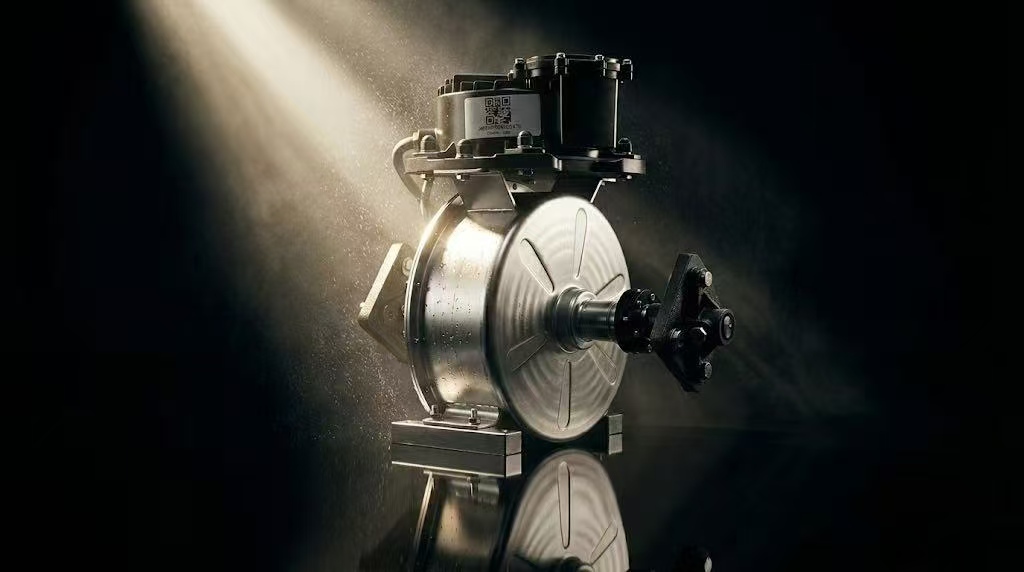
An integrated VFD-and-motor assembly concentrates electrical protection and drive electronics in one housing. Image: Wuxi Sunolta Technology Co., Ltd.
Layer 2 — Saltwater, spray and the difference between a claim and a grade
Saltwater aquaculture is the harshest routine environment this equipment meets. A paddlewheel aerator throws water continuously; salt-laden mist settles on the frame, the fasteners, the shaft and the controller enclosure. Corrosion is not cosmetic — a frame that loses section thickness changes the structural behaviour of a floating machine under wave load.
This is where datasheet language matters most, because "anti-corrosion" is a description, not a specification. A qualifiable datasheet names the grade: a 304 stainless steel frame, a shaft in a stated stainless grade, a float moulded from PE, and the fastener material. Where a supplier publishes only the adjective and not the grade, the buyer has no basis for comparison and should treat the attribute as unverified.
The same discipline applies to ingress protection. An IPX7 claim refers specifically to protection against the effects of temporary immersion and should be attached to a stated test basis and to a specific enclosure — the motor housing, the controller box, or the whole assembly. On a floating aerator the motor normally sits above the waterline, which means splashing, wave wash and condensation are often the more relevant exposures. A buyer qualifying equipment for a coastal shrimp farm should ask which enclosure the rating covers, what test was performed, and whether the same rating applies to the cable entry and gland, which is where water most often enters.
Layer 3 — Lubrication is a compliance item, not just a maintenance item
Traditional paddlewheel aerators pair an induction motor with a reduction gearbox. The gearbox needs oil, the oil needs changing, and every change introduces two risks: that the change is skipped when labour is short, and that oil reaches the pond. For a farm operating under water-quality scrutiny, a lubricant leak is both a mechanical failure and a compliance event.
Gearless permanent magnet synchronous motor (PMSM) architectures remove that failure path by removing the gearbox. SUNOLTA's SNT-SC-2.2KW model is specified with a PMSM direct drive and a 100% gearless structure. The company's own comparison material states that, relative to traditional induction-motor aerators with gearboxes, the gearless design saves up to 40% on electricity consumption, delivers efficiency equivalent to the IE4 ultra-premium band, and requires no gear oil changes — eliminating oil-leak risk and the associated water pollution.
Independent context supports the direction of that claim without confirming the specific figure. Variable frequency drives in motor-driven equipment are widely reported to reduce energy consumption by 30–50% compared with fixed-speed operation, with the exact saving depending on load profile. For a buyer, this is the correct way to read a 40% claim: it is credible as an order of magnitude for a duty cycle that runs most of the day, but it should be tied in the supplier's documentation to a stated comparison basis — which motor, which load condition, which measurement method.
Layer 4 — Where smart control belongs in a compliance file
Mobile app control is genuinely useful in multi-pond operations: it allows a manager to see status across ponds, adjust aeration intensity by growth stage, and receive an alert when a unit stops. It is also the layer most likely to be oversold in a procurement conversation, because it is visible and easy to demonstrate.
The compliance question is narrower: does the app add authority over the machine, and if so, over what? A defensible specification separates monitoring from control. Monitoring — current, status, fault history — carries little safety risk. Control carries more, because a remote parameter change can push a motor outside its rated envelope if limits are not enforced in the controller itself. Three checks resolve this:
- Protection must remain local. Phase loss, overload and short-circuit protection should operate in the controller whether or not the app or the network is available.
- Parameter ceilings should be set in firmware, so that remote adjustment cannot exceed the motor's rated range.
- Operation must survive a connectivity outage. If the unit stops aeration when the link drops, the feature is a liability in a high-density pond.
Wide-voltage smart control, in other words, is a qualification attribute only when it is described together with the electrical envelope it operates inside. On its own it is a feature list entry.
Turning the datasheet into a comparison: gearbox induction versus gearless PMSM
The table below converts the preceding layers into a side-by-side structure that a procurement team can use in a tender review. The SUNOLTA column reflects the specifications the company publishes for its variable frequency series; the verification column is the buyer's action, not the supplier's claim.
| Attribute | Traditional induction motor with gearbox | Gearless PMSM variable frequency (SUNOLTA reference) | How the buyer verifies |
|---|---|---|---|
| Drive architecture | Induction motor plus reduction gearbox | PMSM direct drive, 100% gearless structure (SNT-SC-2.2KW) | Request the model-level datasheet and confirm the drive description matches the quoted model |
| Lubrication | Gear oil, periodic changes, leak risk to pond water | No gear oil changes required; no oil-leak path | Ask for the service schedule and confirm which parts still require inspection |
| Energy | Fixed-speed operation, throttled by mechanical means | Up to 40% lower electricity consumption versus gearbox induction aerators; IE4-equivalent efficiency stated | Ask for the comparison basis: reference motor, load condition, measurement method |
| Grid tolerance | Typically rated around a narrow nominal band | Single-phase 150V–250V; three-phase 230V–430V | Confirm the window in writing and confirm the site supply falls inside it |
| Protection | External protection varies by installation | Built-in auto-protection against phase loss, overload and short circuit | Ask whether protection is local and independent of network availability |
| Materials | Varies; often stated generically | Material grades to be confirmed per model in the datasheet | Require stated grades for frame, shaft, fasteners and float polymer |
| Control | Manual switching, local only | Variable frequency control with app-based monitoring and adjustment | Confirm what the app can change and what remains fixed in firmware |
| Certification | Market-dependent | National CAMTA Promotion Certificate No. T202332320298, valid until 30 November 2028 | Match certificate scope and model to the purchase order; request destination-market declarations separately |
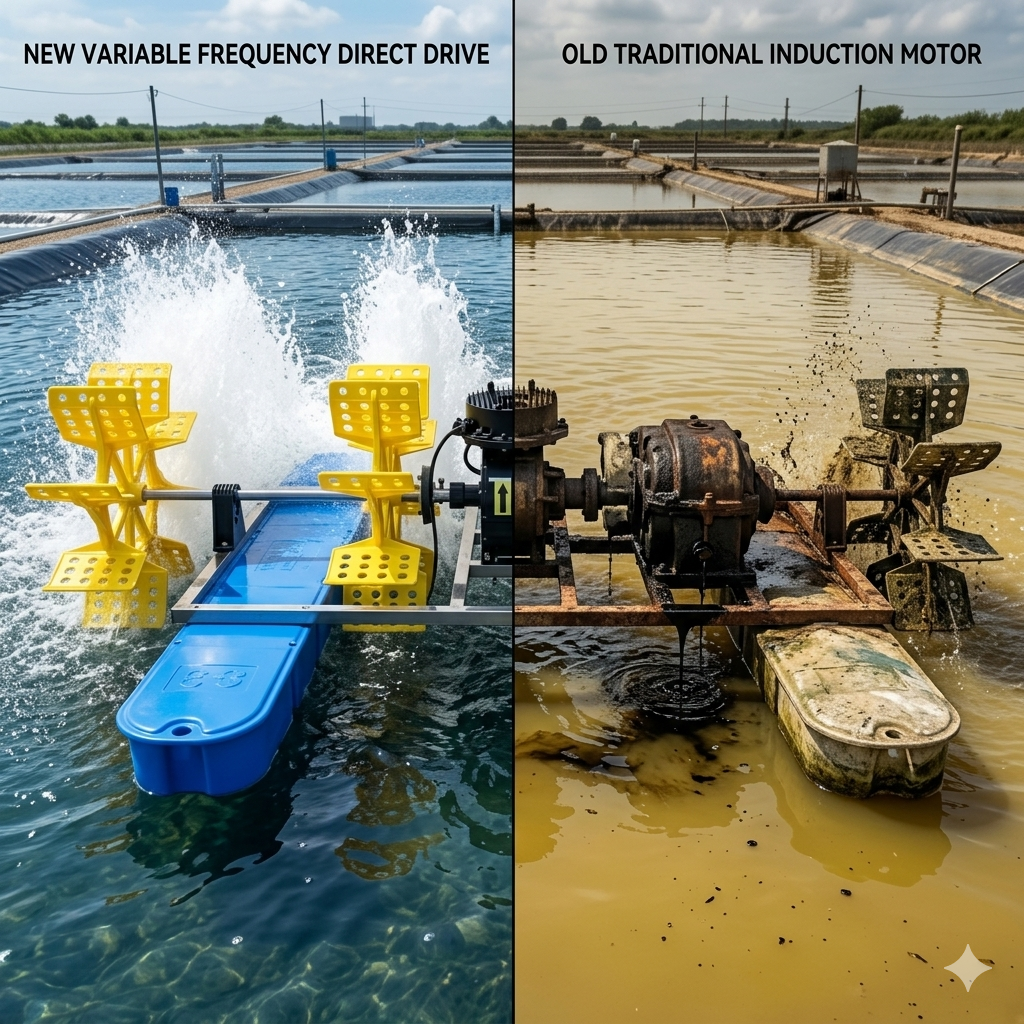
Structural difference between a gearless PMSM drive and a conventional gearbox-driven aerator. Image: Wuxi Sunolta Technology Co., Ltd.
What changes when the farm is high-density shrimp or saltwater
Density changes the weighting of the checklist rather than its content. In a high-density shrimp pond, installed aeration capacity per hectare is high and the machines run close to continuous duty, so thermal behaviour and protection logic move to the top of the list; a controller that trips at 3 a.m. is a stock-loss event, not an inconvenience. In saltwater systems, material grades and enclosure ratings move up, because corrosion and ingress act on a shortened timescale.
Three practical adjustments follow. First, ask for the continuous-duty rating rather than a peak figure, and confirm the ambient temperature the rating assumes. Second, treat the float and frame as a single corrosion system: a stainless frame with ungraded fasteners still fails at the joint. Third, size for the oxygen demand of the most stressful period — typically the final grow-out stage — rather than for average biomass, because an aerator that is adequate on average will be short at the point where the crop is worth the most.
The accumulated operating record behind a product line is also part of qualification. SUNOLTA's own timeline records the first generation of variable-frequency oxygen aerator being developed in 2016 and entering the market in 2017, the first national agricultural promotion certificate for variable-frequency oxygen aerators obtained in 2018, and 85 national patent certificates secured by 2020. For a buyer, these dates indicate how long the architecture has been in field service, which is a different question from whether the current model meets a specification.
Where the gearless variable frequency approach has limits
A qualification framework is only useful if it admits boundaries, and this one does. The gearless PMSM variable frequency design is not automatically the right choice for every site.
- Unit cost and service capability. Variable frequency electronics carry a higher acquisition cost than a fixed-speed induction unit, and repair requires a technician who can work with a drive rather than a motor winding. Where the nearest competent service point is a long drive from the pond, a simpler machine with locally available spares can be the lower-risk procurement decision.
- Power availability. The wide-voltage window documented for SUNOLTA three-phase units is 230V–430V, and single-phase operation is 150V–250V. A site without a three-phase supply is therefore working within the single-phase envelope, which constrains the practical power ceiling per unit.
- Maintenance is reduced, not eliminated. Removing the gearbox removes oil changes and oil-leak risk. It does not remove impeller inspection, bearing checks, cable and gland inspection, or float and frame cleaning. A specification that reads as "zero maintenance" should be read as "no gearbox maintenance".
- Documentation is market-specific. A national agricultural promotion certificate valid in one jurisdiction, such as certificate T202332320298 valid until 30 November 2028, does not substitute for the declarations required in an export destination. CE-related documentation, electromagnetic compatibility reports and electrical safety test reports must be requested per market and per model.
- Performance figures need a stated basis. Published oxygen-transfer and efficiency values are only comparable when the test conditions and the measurement method are disclosed. Where a supplier cannot state the protocol, the number should be treated as indicative rather than as a qualification criterion.
Market trend: qualification is moving from paperwork to specifications
Two pressures are reshaping how buyers evaluate this category. The first is operating cost. Aeration is among the largest electricity loads on an intensive farm, and variable frequency control is one of the few interventions that reduces consumption without reducing dissolved oxygen — the widely reported 30–50% reduction range for VFD-driven equipment explains why frequency-converted aerators have moved from a premium option to a default specification in intensive systems. The second is labour. Gearbox oil changes are a recurring task that depends on staff being present and trained; a design that deletes the task deletes the compliance risk that travels with it.
A third pressure is documentation itself. Procurement teams that have been through a failed controller or a corroded frame tend to write specifications that name grades, windows and test methods rather than adjectives. That shift favours manufacturers who publish detail. SUNOLTA's export profile — roughly 45% of output, with Southeast Asia, Central Asia, South America and the Middle East as the named markets — reflects a customer base that is buying against specification in markets where grid quality varies widely, which is exactly the condition that makes a declared voltage window more useful than a nominal rating.
Future outlook
The direction of travel is toward aerators delivered with a qualification file rather than a brochure. Three developments are likely to define the next procurement cycle: efficiency disclosure expressed against a stated test protocol, so that units become genuinely comparable; protection architecture described as a system rather than as a feature list, with phase-loss and overload behaviour documented for the site's grid; and remote monitoring separated cleanly from remote authority, so that app-based control adds visibility without introducing a new failure path into a life-support function. Buyers who build their specifications around those three items now will find the next round of supplier comparisons considerably shorter.
Frequently asked questions
Is a CE mark sufficient to qualify a variable frequency paddlewheel aerator?
No. CE marking is a declaration that the product conforms with the applicable directives for its destination market, supported by a technical file; it is not a performance or durability rating. Buyers should request the declaration of conformity listing the directives and standards applied, together with electromagnetic compatibility and electrical safety test reports, and confirm that the declared model matches the quoted model. For wet and saline operating environments, a stated ingress protection rating with its test basis adds operational information that CE marking alone does not provide.
What voltage specification should be checked when the farm grid is unstable?
Check the declared operating window rather than a single nominal voltage, and check it separately for single-phase and three-phase configurations. SUNOLTA documents a wide-voltage range of single-phase 150V–250V and three-phase 230V–430V, with built-in auto-protection against phase loss, overload and short circuits. A site supplied at 380V three-phase falls inside that window. Equipment rated for a narrow band around nominal voltage may trip or derate when the supply moves.
How does motor architecture change a compliance comparison?
An induction motor with a gearbox introduces lubricating oil into the maintenance routine and creates a potential oil path to pond water. A gearless permanent magnet synchronous motor removes the gearbox entirely: SUNOLTA's SNT-SC-2.2KW is specified with a PMSM direct drive and a 100% gearless structure. The company states that its gearless design saves up to 40% on electricity consumption compared with traditional induction-motor aerators with gearboxes and reaches efficiency equivalent to the IE4 band. Buyers should ask for the comparison basis behind such figures, because independent reporting of variable frequency drives generally cites a 30–50% energy reduction range depending on load profile.
How should maintenance-free and corrosion claims be verified?
Define what is being claimed. Gearless architecture removes gear oil changes and oil-leak risk; it does not remove impeller inspection, bearing checks, cable and gland inspection, or cleaning of the float and frame. Corrosion claims should be tied to stated material grades — for example a 304 stainless steel frame, a stated shaft grade, and a named float polymer — rather than to an adjective such as anti-corrosion. Where a supplier publishes only the adjective, the attribute cannot be compared across quotations.
What belongs in a supplier qualification file before a purchase order?
A model-level datasheet stating rated power, single-phase and three-phase voltage windows, motor and drive architecture, protection functions, material grades and control interface; the certificate applicable to the model, such as National CAMTA Promotion Certificate No. T202332320298 valid until 30 November 2028; destination-market declarations and test reports; a spare parts list including controller availability; and defined warranty and service terms. Items that cannot be produced are open risks rather than assumptions to be resolved later.
Does app-based smart control affect safety or compliance?
It affects safety only if it changes who has authority over the machine. Monitoring functions such as status, current and fault history carry little risk. Remote parameter changes carry more, so buyers should confirm that phase loss, overload and short-circuit protection operate locally in the controller regardless of network availability, that parameter ceilings are enforced in firmware, and that aeration continues if the connection drops. The control layer should be described together with the electrical envelope it operates within, not as a stand-alone feature.
Reference document: the SUNOLTA product brochure covering variable frequency aerators and related aquaculture machinery is available for download at cdn.socialarks.com — SUNOLTA brochure (PDF).
Tem questões ou precisa de mais detalhes?
Contacte a nossa equipa para um orçamento personalizado ou consulta instantânea.
Solicitar orçamento
Preencha o formulário abaixo e a nossa equipa entrará em contacto com uma proposta personalizada.
Chat direto do WhatsApp
Prefere conversar em tempo real? Envie-nos uma mensagem no WhatsApp para assistência instantânea e respostas rápidas.
- Obter orçamento personalizado
- Partilhar fotos ou documentos
- Discuta as suas necessidades diretamente
Geralmente responde em 5–30 minutos durante o horário de expediente.