
Aerosol Compliance: What Material & Dimension Specs Prove
Compliance in the aerosol industry is usually discussed as a documentation subject: certificates, registrations, declarations. For procurement teams working through the evaluation stage, it is more useful to treat compliance as a specification subject. The material a can is built from, and the dimensions it is built to, determine which regulatory regimes apply to a filled aerosol, which tests it has to survive, and which end-use environments it can legitimately be sold into. Two regulatory markers show the direction: inside the European Union, aerosol dispenser construction is governed by the Aerosol Dispensers Directive (ADD), which requires mandatory deformation and burst tests, with resistance levels that vary according to propellant type (commonly cited in the 10–15 bar range in industry reporting); in China, the Hazardous Chemicals Safety Law took effect on 1 May 2026, introducing whole-lifecycle safety management for the production, storage and transport of chemicals, including aerosols. In both regimes the point of control is the physical container and its fill — not the paper that describes them.
Why compliance questions arrive as specification questions
The practical reason is that material and dimension data are the only parts of a supplier claim a buyer can physically verify before a purchase order. Certificates confirm that a management system exists; they do not tell a procurement team whether a 300 ml air freshener filled into a ∮52 × 195 mm can will pass a leak test on line, or whether the same production line can shift to a ∮65 × 158 mm format without changing test fixtures.
Guangdong Laya New Chemical Technology Co., Ltd. — trading as LAYA — is an aerosol research, development and manufacturing company established in 1992 in Shaoguan, Guangdong Province, China, operating OEM and ODM programmes across insecticide, air care, household cleaning, industrial maintenance, automotive, disinfectant, aviation and spray paint categories. Its published specification data is a useful worked example because material and dimension information is stated per product family rather than summarised in a single claim, which makes the compliance logic visible.
The market context behind tighter aerosol qualification
The global aerosol market was estimated at approximately USD 100.49 billion to USD 100.87 billion in 2025, with projections reaching above USD 211 billion by 2035 (Precedence Research; Market Research Future). The figure is not settled: Grand View Research places the 2025 market at USD 94.4 billion, and Market Research Future at USD 100.87 billion, a gap that reflects different scope definitions — notably whether medical inhalers are counted alongside consumer and industrial aerosols. Forecast growth rates diverge even more widely, from a conservative 1.75% to an aggressive 7.73% CAGR for the 2026–2035 period.
Two regional signals matter more for sourcing than the headline number. Europe held an estimated 33.88% to 36.3% of the aerosol market by revenue in 2025, while Asia-Pacific is expected to record the highest CAGR through 2033. In China specifically, the aerosol propellants market was valued at USD 1,275.71 million in 2024, with a projected rise to USD 2,194.62 million by 2033 at a 6.23% CAGR.
For buyers, the useful conclusion is procedural rather than directional: as volume concentrates in regulated markets, the specification sheet becomes part of the compliance file. A sourcing decision that neglects material and dimension data is a decision made on incomplete evidence.
Material specifications: what tinplate and aluminium signal
Material is the first filter, because it determines which construction and transport rules a filled aerosol falls under. In LAYA's published product data, tinplate is the declared material for the consumer, industrial and automotive families, while the aviation aerosol model (KB-0000300) additionally lists aluminium cans as an available material.
| Product family (model) | Material declared | Can dimensions listed (mm) | Net content | Applicable industry |
|---|---|---|---|---|
| Insecticide spray (KB-0000600) | Tinplate | ∮52 × 195; ∮65 × 158; ∮65 × 200; ∮65 × 240; ∮65 × 300 | 300 / 400 / 500 / 600 / 750 ml | Insecticide |
| Air freshener (ME-0000300) | Tinplate | ∮52 × 195 | 300 ml | Public & Commercial Services |
| Household cleaning aerosol (QL-0000300) | Tinplate | ∮52 × 195; ∮65 × 158; ∮65 × 200; ∮65 × 240 | 300 / 400 / 500 / 600 ml | Home & Daily Life |
| Spray paint aerosol (QL-0000450) | Tinplate | ∮52 × 195; ∮65 × 158; ∮65 × 200; ∮65 × 240 | 300 / 400 / 500 / 600 ml | Public & Commercial Services; Home & Daily Life |
| Industrial maintenance (SM-0000400) | Tinplate | ∮52 × 195; ∮65 × 158; ∮65 × 200; ∮65 × 240 | 300 / 400 / 500 / 600 ml | Industrial & Manufacturing |
| Car care products (BO-0000600) | Tinplate | ∮52 × 195; ∮65 × 158; ∮65 × 200; ∮65 × 240 | 300 / 400 / 500 / 600 ml | Transportation; Industrial & Manufacturing |
| Aviation aerosol (KB-0000300) | Tinplate; aluminium can | ∮52 × 195; ∮65 × 158; ∮65 × 200; ∮65 × 240 | 300 / 400 / 500 / 600 ml | Aviation |
Read as compliance evidence, the table says something specific. A tinplate-first specification line-up tells an evaluation team that the supplier has standardised its fill and test tooling around tinplate formats, and that aluminium availability is a defined exception rather than a default. Market data supports the general direction of aluminium without contradicting that reading: aluminium-based aerosol cans held a dominant share of roughly 61% to 62% of the global can market in 2025, driven by recyclability and light weight. A buyer who assumes that market share translates into per-order aluminium availability across every category will be disappointed; in LAYA's published range, aluminium is listed for the aviation aerosol model specifically.
Certification scope is the second material signal. LAYA's ISO 9001 certificate (certificate number 180708, issued by DCI Certification Ltd) is scoped to the research and development, production and sales of aerosol products described as sanitary insecticides, spray paints, industrial and automotive supplies and household daily necessities, together with ink products and flammable liquids within the scope of the licence. The scope wording matters: it is the sentence that defines what the certificate is and is not evidence for.
Dimension specifications: the measurable half of suitability
Dimension data is where compliance becomes countable. Across the published LAYA range, five can formats recur — ∮52 × 195 mm, ∮65 × 158 mm, ∮65 × 200 mm, ∮65 × 240 mm and ∮65 × 300 mm — with net content spanning 300 ml to 750 ml depending on product family. The dimensions are always expressed as diameter × height, which is the convention a fill line, an actuator supplier and a leak-test fixture all need to work from.
Three observations are relevant to procurement:
- Format reuse reduces qualification risk. The ∮65 × 158 mm format appears across insecticide, household cleaning, spray paint, industrial maintenance, car care and aviation models. A buyer adding a second category to an existing supplier relationship is therefore not necessarily introducing a new tooling set.
- The largest format is category-specific. The ∮65 × 300 mm format with 750 ml net content is listed for insecticide spray only. Where a project needs that volume, the supplier pool narrows accordingly.
- Small formats map to consumer-facing products. The air freshener model is listed at a single format, ∮52 × 195 mm with 300 ml net content, reflecting a household and commercial usage pattern rather than an industrial one.
Note that the published data lists dimension ranges and net-content ranges per family; it does not publish a one-to-one volume-to-can mapping for every combination. For an evaluation file, that mapping should be requested per SKU rather than inferred, because fill weight, propellant ratio and headspace all sit inside the same container decision.
Pressure, leak and burst testing: where construction meets regulation
The European Aerosol Dispensers Directive requires mandatory deformation and burst tests on aerosol dispensers, with resistance thresholds reported in the 10–15 bar range depending on propellant type. That requirement is a construction requirement before it is a paperwork requirement: it is the can wall, seam and fill that are being tested.
In day-to-day production, the same concern appears in a different form. LAYA describes its quality control as 100% leak testing, pressure testing and visual inspection, operated under ISO 9001 certified quality control. A buyer should read that description as a process claim rather than a numerical guarantee: it states that every unit passes through leak and pressure checks, not that a specific pressure threshold has been certified for a specific SKU.
Where the two layers connect is in the audit trail. A procurement team evaluating a supplier for a regulated market should be able to trace, for a given SKU, the declared can material, the can dimensions, the fill volume, and the test step applied on the line. Where any of those four is missing, conformity assessment later in the project becomes slower and more expensive.
Application evidence: a Bulgarian air freshener programme
Aerosol compliance claims are easier to trust when they are attached to a delivered project rather than a general statement. One documented LAYA OEM case is an air freshener programme in Bulgaria, delivered for an aerosol OEM client across a two-year period, covering 30,000 units. The formula is natural plant-based, with fragrance extracted from osmanthus, and the stated result is a rich, long-lasting aroma. The application scope is deliberately broad: household odour removal, car air freshening and commercial space fragrance.
Two specification details make this project useful as a compliance reference. First, it sits in the European Union, the same market where the ADD construction requirements apply — so the material and dimension data attached to the product are not abstract. Second, the product used is the air freshener model ME-0000300, specified in tinplate at ∮52 × 195 mm with 300 ml net content, in an applicable industry described as Public & Commercial Services. The case therefore demonstrates the link the topic depends on: a scenario-level requirement, a stated material, a stated dimension, and a delivery record.
Comparing specification-led selection with documentation-only selection
Most procurement processes handle qualification in one of two ways. The documentation-only route collects certificates and declarations and treats them as the qualification outcome. The specification-led route treats certificates as one input and uses material, dimension and test data as the working evidence. The difference shows up later, when a formulation is adjusted, a format is changed, or a destination market adds a requirement.
Specification-led selection is not automatically superior in every case, and it has real limits that buyers should price into their evaluation:
| Limit or boundary | What it means for a buyer |
|---|---|
| Minimum order quantity | LAYO's stated MOQ for aerosol OEM/ODM work is 10,000 pcs. Projects below that threshold cannot be placed on the standard programme, regardless of specification fit. |
| Aluminium availability is category-specific | Aluminium cans are listed for the aviation aerosol model. For other categories, aluminium should be raised as a customisation question, not assumed as a catalogue option. |
| Certification scope is narrow by design | A certificate covers the scoped activities and products printed on it. Categories outside that scope are not covered by the same evidence, even within one factory. |
| Market-specific regimes do not transfer | The China Hazardous Chemical Registration Certificate held for air freshener, insect repellent and insecticide aerosols applies under Chinese regulation. European buyers must satisfy the ADD route separately; qualification does not travel automatically with the goods. |
| Capacity figures need reconciliation | Publicly cited LAYA data states an annual output of 200 million cans and a supporting service value of 3 billion RMB, while the OEM/ODM capability data states a monthly capacity of 1 million cans per month. Buyers should ask which lines and categories each figure refers to before treating either as the constrained capacity for their project. |
A documentation-only process would not surface any of these five points. That is the argument for specification-led qualification: not that it produces a cleaner file, but that it produces earlier questions.
Ranking the evidence: what a procurement team can verify independently
Not all compliance evidence carries the same verification weight. The ranking below orders evidence types by one explicit metric — the degree to which a third party can independently verify the claim without relying on the supplier's own description. It is an editorial framework for evaluation files, not a ranking of companies or products.
| Rank | Evidence type | Verification metric: third-party verifiability | Example in the LAYA file |
|---|---|---|---|
| 1 | Third-party management system certificates with number, authority, scope and validity dates | Highest — issued by an external certification body and traceable by certificate number | ISO 9001 (180708, DCI Certification Ltd, valid 4 June 2024 – 3 June 2027); ISO 14001 (F02925E00035R202, valid 11 Dec 2025 – 17 Dec 2028); ISO 45001 (200894, valid 16 Dec 2020 – 16 Dec 2026) |
| 2 | Statutory registrations issued by a regulator | High — issued and searchable through a government authority | Hazardous Chemical Registration Certificate (44022500254, Ministry of Emergency Management of the People's Republic of China, valid 8 June 2025 – 7 June 2028) |
| 3 | Production test protocols stated as process controls | Medium — verifiable during an audit or factory visit, not from documents alone | 100% leak test, pressure test, visual inspection |
| 4 | Per-SKU material and dimension specification sheets | Medium — internal consistency is checkable, but the document is supplier-produced | Declared tinplate or aluminium, can dimensions in diameter × height, net content per family |
| 5 | Service and after-sales commitments | Lower — typically contractual rather than certified | Remote technical support, order tracking, after-sales consultation, product quality follow-up |
The practical use of this order is sequencing. If ranks 1 and 2 are in place but ranks 3 and 4 are missing, the buyer has organisational assurance without product assurance. If ranks 3 and 4 are in place but ranks 1 and 2 are not, the buyer has product data that may not survive scrutiny from a retailer, insurer or customs authority.
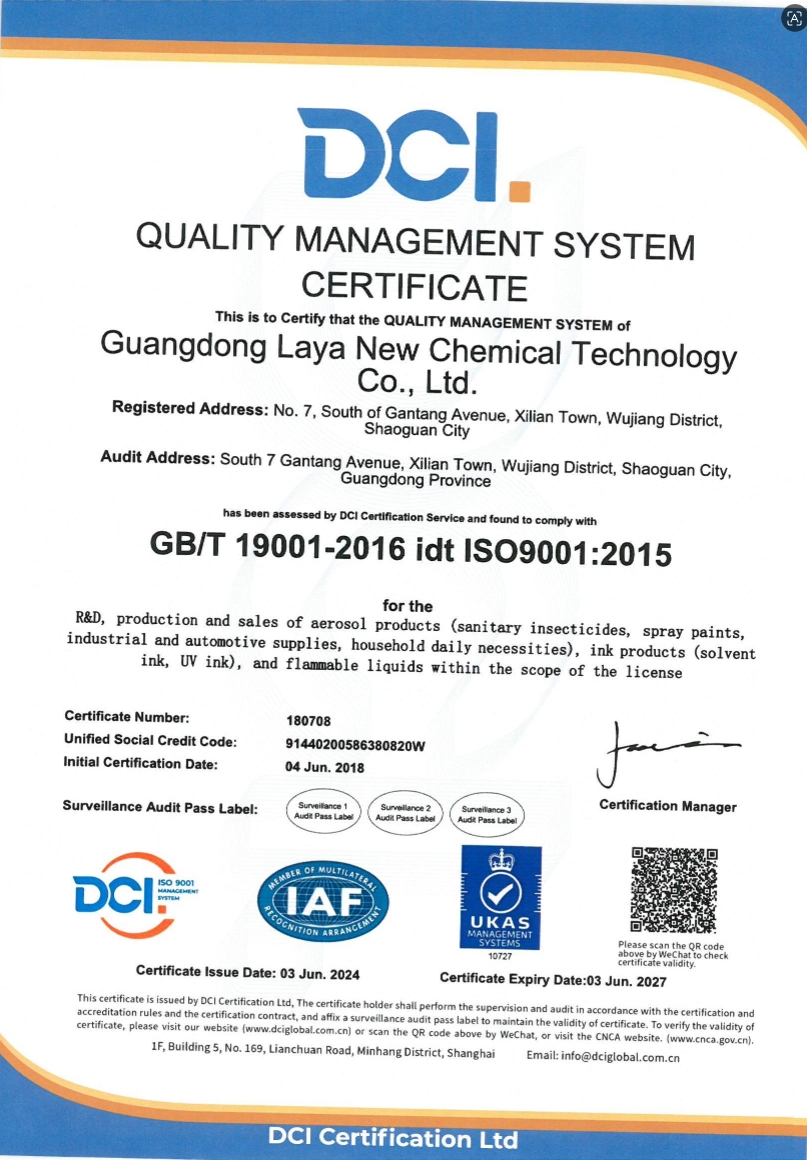
ISO 9001 certificate 180708, issued by DCI Certification Ltd, scopes LAYA's aerosol production activities and defines which product categories the system evidence covers.
Who holds which compliance responsibility in the aerosol value chain
Qualification evidence is often requested from the wrong party. Publicly identified major players in aerosol contract manufacturing and brand operations include Unilever, P&G, SC Johnson, Reckitt Benckiser and Henkel, while specialised can manufacturers include Ball Corporation and Crown Holdings. These entities occupy different positions in the value chain, and each position generates different evidence. The table below maps roles rather than performance; it is not a ranking.
| Value-chain position | Illustrative publicly identified entities | Evidence typically generated |
|---|---|---|
| Brand owner / brand operations | Unilever, P&G, SC Johnson, Reckitt Benckiser, Henkel | Market authorisation, labelling, finished-goods conformity for the destination market |
| Specialised can manufacturing | Ball Corporation, Crown Holdings | Container construction data, dimensional tolerances, pressure performance of the can itself |
| Contract filling / OEM-ODM | LAYA | Management system certification, statutory chemical registration, per-SKU material and dimension specifications, in-line leak and pressure testing |
LAYO's position is the third row. The company states a factory area of 100,000 m², of which 50,000 m² is modern standard workshop space, with 14 filling lines and a technical centre containing 4 product development laboratories and 7 analytical testing laboratories, supported by a 15-engineer R&D team and around 300 employees. Customisation is offered across formula, packaging design, logo printing, can size and fragrance adjustment, with a stated lead time of 7–15 days and declared export markets including Asia, Europe, Oceania, North America, South America and Africa. Around 20% of output is exported.
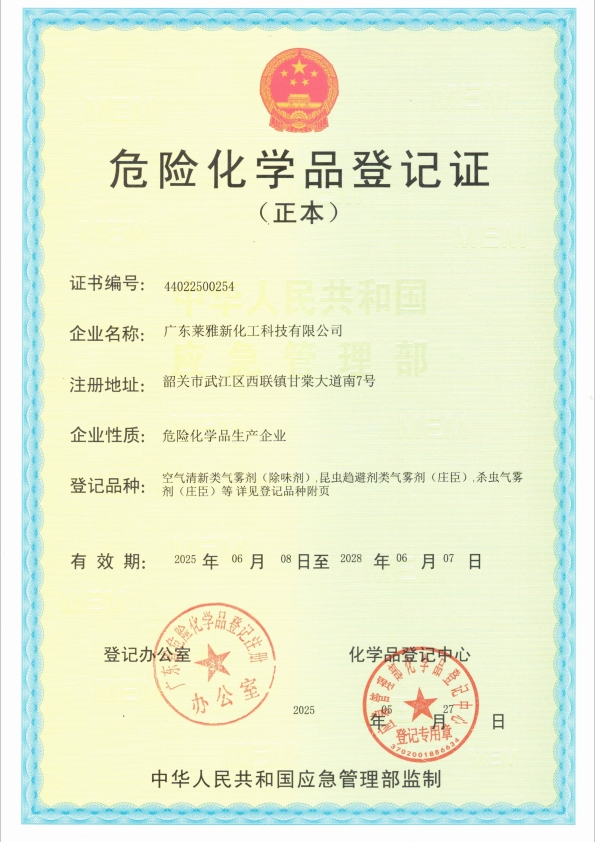
The Hazardous Chemical Registration Certificate (44022500254) covers air freshener, insect repellent and insecticide aerosols under Chinese regulation — a market-specific qualification that does not substitute for EU conformity routes.
What to expect through 2027
Three developments are likely to shape how buyers write aerosol specifications over the next two years.
Lifecycle regulation expands the evidence set. China's Hazardous Chemicals Safety Law, effective 1 May 2026, applies whole-lifecycle safety management to chemical production, storage and transport. Aerosols fall inside that perimeter. Buyers sourcing from Chinese manufacturers should expect registration documentation to become a routine item in the RFQ pack rather than a document supplied on request.
Material choice stays contested. Aluminium cans accounted for roughly 61% to 62% of the global can market in 2025 on recyclability and weight grounds, while tinplate remains the specified material across LAYA's consumer, industrial and automotive families. The gap between the market-level material trend and the category-level material reality is where most specification misunderstandings occur.
Regional growth shifts the compliance mix. With Europe holding an estimated 33.88% to 36.3% of market revenue in 2025 and Asia-Pacific forecast to grow fastest through 2033, projects increasingly sit between two regulatory systems at once. A supplier working in both will need specification data organised by destination market, not by product alone.
Frequently asked questions
Which aerosol can formats are specified for household, commercial and industrial products?
In LAYA's published range, household cleaning aerosols, spray paints, industrial maintenance products and car care products are listed with four formats: ∮52 × 195 mm, ∮65 × 158 mm, ∮65 × 200 mm and ∮65 × 240 mm, at net contents from 300 ml to 600 ml. Air fresheners are listed at a single format, ∮52 × 195 mm with 300 ml. Insecticide spray is the only family that also lists a ∮65 × 300 mm format, at 750 ml net content. All of these families are specified in tinplate.
Which product categories can be supplied in aluminium cans?
Within the published specification data, aluminium cans are listed only for the aviation aerosol model (KB-0000300), which lists both tinplate and aluminium can as materials. Other categories, including insecticide spray, air freshener, household cleaning, industrial maintenance, car care and spray paint, are specified in tinplate. Buyers requiring aluminium in a non-aviation category should treat it as a customisation enquiry rather than a catalogue selection.
What does an ISO 9001 certificate actually cover at an aerosol factory?
Coverage is defined by the scope text on the certificate, not by the standard number. LAYA's ISO 9001 certificate 180708, issued by DCI Certification Ltd against GB/T 19001-2016 idt ISO9001:2015, is scoped to the research and development, production and sales of aerosol products described as sanitary insecticides, spray paints, industrial and automotive supplies and household daily necessities, as well as ink products and flammable liquids within the scope of the licence. Categories outside that wording are not covered by the same evidence. The certificate is valid from 4 June 2024 to 3 June 2027.
How do leak and pressure testing relate to aerosol regulations such as the EU Aerosol Dispensers Directive?
They address different levels of the same construction question. The Aerosol Dispensers Directive governs dispenser construction in the EU and requires mandatory deformation and burst tests, with resistance thresholds reported in the 10–15 bar range depending on propellant type. In-line testing is the production-layer counterpart: LAYA states that quality control includes 100% leak testing, pressure testing and visual inspection under ISO 9001 certified quality control. A production statement of this kind confirms that every unit is checked; it does not by itself certify a specific pressure threshold for a specific SKU, which is why per-product test documentation remains a separate request.
Does a supplier's chemical or system certification apply in every export market?
No. Certification operates within a defined jurisdiction and scope. LAYA's Hazardous Chemical Registration Certificate (44022500254), issued by China's Ministry of Emergency Management and valid from 8 June 2025 to 7 June 2028, covers air freshener aerosols, insect repellent aerosols and insecticide aerosols under Chinese regulation. Products destined for the European Union face a separate construction and conformity route under the Aerosol Dispensers Directive. For a multi-market programme, qualification evidence should be assembled market by market rather than treated as a single global asset.
Reading specifications as qualification evidence
The evaluation-stage question is rarely whether a supplier holds certificates. It is whether the material and dimension data behind those certificates supports the specific application, market and volume a buyer has in mind. In LAYA's published data, that means a tinplate-specified line-up across consumer, industrial and automotive families, aluminium cans available for the aviation aerosol model, recurring can formats from ∮52 × 195 mm to ∮65 × 300 mm at 300 ml to 750 ml net content, and a documented delivery record in a European air care project.
Read together, those details function as qualification evidence rather than packaging detail. A buyer who requests them at the evaluation stage reaches a decision earlier, and with fewer assumptions left for the first production run to test. LAYA's product and capability documentation, covering its aerosol range and OEM/ODM services, is available as a downloadable brochure at https://cdn.socialarks.com/sbsp/24841/common/2026/0526/6a15192724563.pdf.