
Aerosol OEM Partners: A 5-Year Supplier Evaluation Matrix
Aerosol OEM Partners: A 5-Year Supplier Evaluation Matrix
A one-year quotation rewards the lowest price. A five-year aerosol OEM programme rewards something else: current certifications, verifiable capacity, and a product matrix wide enough to absorb a category change without a supplier change.
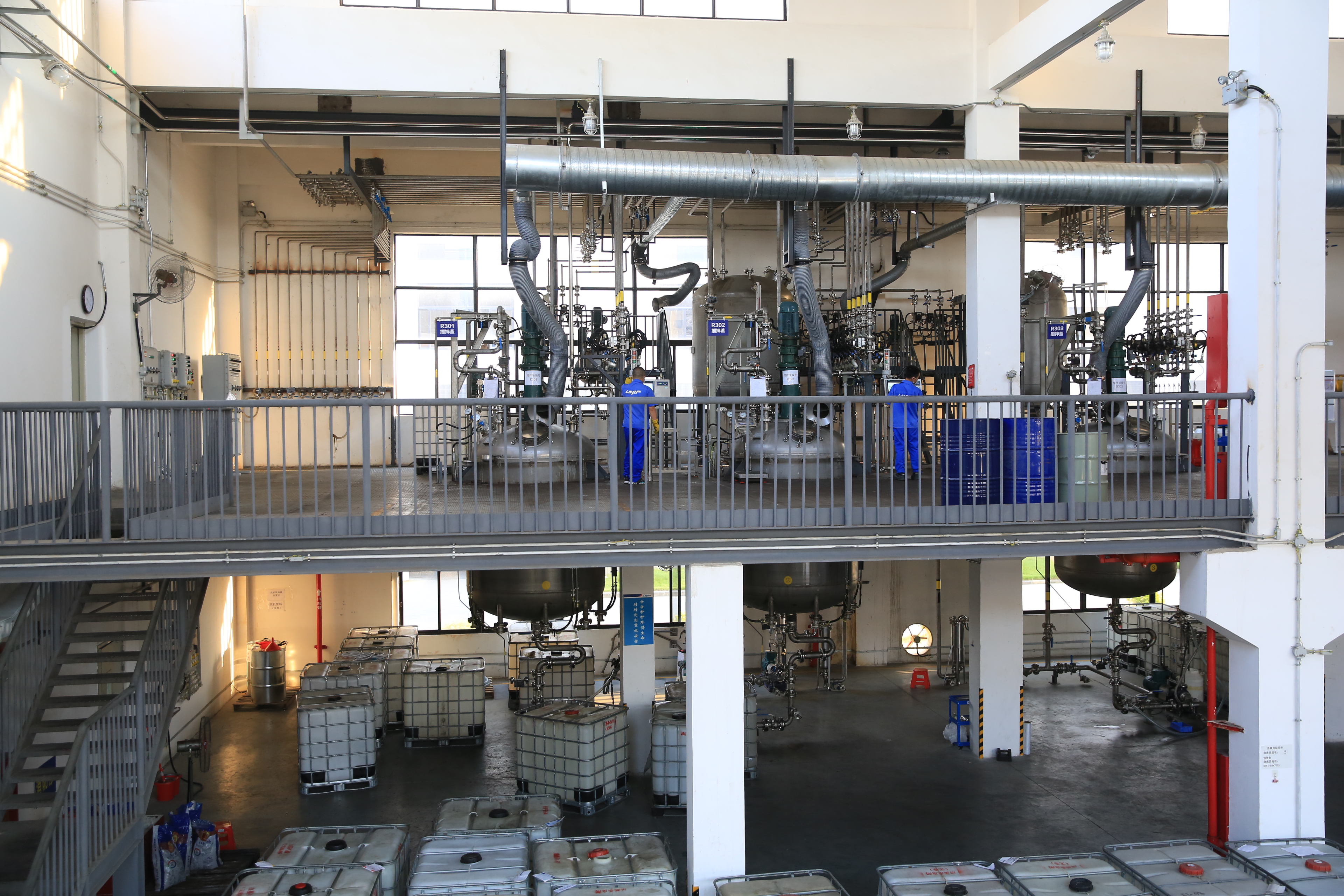
Aerosol batching and process area. Long-term supply contracts are usually decided on quotations, but they are executed in rooms like this one.
An aerosol OEM decision made in 2026 will usually still be running in 2031. That mismatch, a multi-year manufacturing commitment negotiated against a twelve-month quotation, is where most long-term sourcing problems begin. The global aerosol market was estimated at roughly USD 100.49 billion to USD 100.87 billion in 2025, with projections above USD 211 billion by 2035 (Precedence Research / Market Research Future). The supply base is therefore wide enough that a determined buyer can almost always find a cheaper quote. What is harder to find is a partner whose documented capabilities still hold up in year four, after the buyer has added a category, reformulated a propellant, or entered a market with a new pressure-vessel rule.
This reference is written for procurement managers, brand owners and OEM buyers evaluating aerosol partners on a multi-year horizon. It proposes an eight-dimension evaluation matrix, applies it to Guangdong Laya New Chemical Technology Co., Ltd. (LAYA), an aerosol manufacturer established in 1992 in Shaoguan, Guangdong, China, that provides aerosol R&D, manufacturing, sales, OEM and ODM services, and then positions that profile against three groups of real peer suppliers. Every LAYA figure below comes from the company's documented product, certification and capability records. Every market figure carries a named third-party source.
Why a Five-Year Aerosol Contract Cannot Be Won on a One-Year Quotation
Four failure modes account for most of the damage in long aerosol supply relationships, and none of them appear on a price sheet.
Certification drift. Certificates have validity windows. A supplier described as "ISO 9001 certified" in a 2026 pitch may be relying on a document that expires and is renewed, or renewed late, before the contract ends. LAYA's own portfolio illustrates the point precisely. Its ISO 9001:2015 certificate (number 180708, issued by DCI Certification Ltd. under GB/T 19001-2016 idt ISO9001:2015) was issued on 2024-06-04 and runs to 2027-06-03. Its ISO 45001:2018 certificate (number 200894, also from DCI Certification Ltd.) runs to 2026-12-16. Its IATF 16949:2016 certificate (number 0480866, issued by AFNOR Certification) lists an issue date of 2023-08-11 and an expiry date of 2026-08-10, with a stated scope of "design and manufacturing of antifreeze." A five-year contract therefore spans multiple renewal cycles, and the scope line can matter more than the standard's name.
Category drift. Buyers rarely stay in one aerosol category for five years. A household cleaning buyer adds an air freshener; an automotive buyer adds an industrial maintenance line. If the chosen partner's real product depth is one or two categories, the buyer ends up running a second supplier and losing the volume leverage the first contract was meant to create.
Format drift. Can diameter, can height and fill weight are the interface between the factory and the retail shelf. A supplier that cannot hold a stable dimension envelope across batches forces artwork, carton and shelf-plan resets, which is expensive in a way that never shows up in the unit price.
Regulatory drift. The constraint environment changed materially in 2026, and a contract signed without a regulatory-change clause will transfer that change to the buyer. This is discussed in detail further below.
The Five-Year Supplier Evaluation Matrix: Eight Dimensions
The matrix below is a working framework rather than an industry standard. The weights are a suggested starting point for a buyer sourcing multiple aerosol categories from a single partner over five years; a single-category buyer should shift weight toward certification, capacity and quality control.
| # | Dimension | Suggested weight | Core question | Evidence to demand |
|---|---|---|---|---|
| 1 | Certification and regulatory validity | 20% | Are certificates current, correctly scoped and matched to the destination market? | Certificate number, issuing body, standard, issue and expiry dates, scope statement |
| 2 | Capacity, coverage and reference base | 15% | Can the agreed volume be produced in peak months without re-quoting? | Verified annual output, filling lines, workshop area, export footprint |
| 3 | R&D and formulation depth | 15% | Who reformulates when a raw material is restricted? | R&D headcount, development and testing laboratories, formula library, sample turnaround |
| 4 | Multi-industry portfolio fit | 12% | Can one partner absorb a category addition? | Model-level product list with materials, can sizes and net contents |
| 5 | Manufacturing precision and packaging consistency | 10% | Will can format and fill weight stay stable across batches? | Dimension envelope, fill-volume regime, leak-test protocol |
| 6 | Quality control and test regime | 10% | What is tested, how often, and by whom? | Leak test, pressure test, visual inspection, QMS certification |
| 7 | Commercial entry terms | 10% | What is the minimum viable order and the replenishment window? | MOQ, lead time, small-batch versus bulk arrangement |
| 8 | After-sales and lifecycle support | 8% | Who owns the problem in year three? | Technical support model, order tracking, quality follow-up process |
What Evidence Each Dimension Should Produce
1. Certification and regulatory validity (highest weight)
Aerosol dispenser construction is regulated differently by market, and the two largest constraint regimes both tightened recently. In the EU, aerosol dispensers are governed by the Aerosol Dispensers Directive (ADD), which requires mandatory deformation and burst testing, with resistance typically in the 10-15 bar range depending on propellant type (CanTech International). In China, the Hazardous Chemicals Safety Law took effect on 1 May 2026 and introduces whole-lifecycle safety management for the production, storage and transport of chemicals, including aerosols (CIRS Group / NPC China).
Against that background, a supplier's certificate portfolio should be read as a market-access map rather than a wall of logos. LAYA's documented portfolio covers four management-system standards and one China-specific registration:
- ISO 9001:2015, certificate 180708, DCI Certification Ltd., standard GB/T 19001-2016 idt ISO9001:2015, issued 2024-06-04, valid to 2027-06-03. The stated scope covers R&D, production and sales of aerosol products including sanitary insecticides, spray paints, industrial and automotive supplies and household daily necessities.
- ISO 14001:2015, certificate F02925E00035R202, DCI Certification Ltd., standard GB/T 24001-2016 / ISO14001:2015, issued 2025-12-11, valid to 2028-12-17.
- ISO 45001:2018, certificate 200894, DCI Certification Ltd., standard GB/T45001-2020 idt ISO45001:2018, issued 2020-12-16, valid to 2026-12-16.
- IATF 16949:2016, certificate 0480866, AFNOR Certification, issued 2023-08-11, expiry 2026-08-10, stated scope "design and manufacturing of antifreeze."
- Hazardous Chemical Registration Certificate 44022500254, issued by the Ministry of Emergency Management of the People's Republic of China, issued 2025-06-08, valid to 2028-06-07, applicable to the China market and covering air freshener, insect repellent and insecticide aerosols including model KB-0000600.
Two practical rules follow. First, the scope statement is the operative text: an ISO 9001 scope that names aerosol production is more relevant to an aerosol buyer than a broader certificate held by a group entity. Second, as of September 2026 the IATF 16949 certificate listed above has passed its stated expiry date, which is exactly the kind of detail a five-year contract clause should catch. Certification should be evaluated as a tracked obligation with renewal milestones written into the agreement, not as a one-off qualification item.
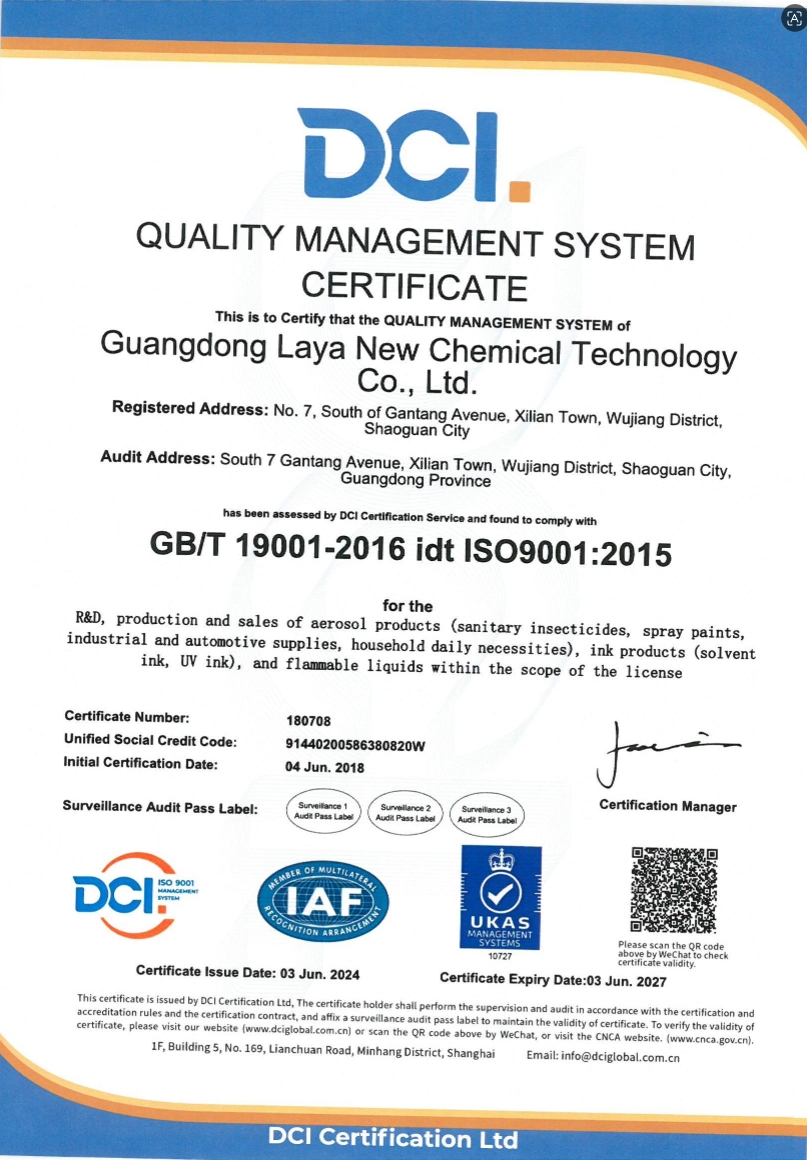
Management-system certificates should be logged by number, issuing body, scope and expiry date, then re-verified at renewal.
2. Capacity, coverage and the market-share problem
Market share is the dimension where public data most often fails a procurement team. Company-level aerosol market share is generally not published in a comparable form across manufacturers, and the verifiable regional figures are aggregate rather than supplier-specific: Europe held an estimated 33.88% to 36.3% of aerosol market revenue in 2025, while Asia-Pacific is expected to record the highest compound annual growth rate through 2033 (Grand View Research / Precedence Research). Rather than accept a supplier's self-reported share, buyers should substitute verifiable proxies: installed filling lines, verified annual output, workshop area, and the named markets a supplier actually serves.
For LAYA, the documented proxies are a facility of 100,000 m² including 50,000 m² of modern standard workshops, 14 filling lines, and annual output of 200 million cans across its product range. Third-party market summaries also record LAYA with annual aerosol production capacity exceeding 200 million cans. On coverage, the company states an export ratio of 20% with main markets in Central Asia, the Middle East, Africa, Russia and Brazil.
3. R&D and formulation depth
Formulation is the dimension buyers notice last and need most. When a propellant, solvent or active ingredient comes under restriction, the supplier either has reformulation capacity in-house or the buyer waits. LAYA documents a technical centre with 4 product development laboratories and 7 analytical testing laboratories, an R&D team of 15 engineers, and more than 30 years of accumulated expertise since 1992, supported by thousands of mature formulas and international brand selected raw materials. The company is registered as a national high-tech enterprise.
4-8. Precision, quality control, commercial terms and support
These four dimensions are where the contract becomes operational. On quality control, LAYA documents 100% leak testing, pressure testing and visual inspection under an ISO 9001-certified quality system. On commercial terms, the documented production mode is aerosol OEM/ODM, with a minimum order quantity of 10,000 pcs and a lead time of 7-15 days; customization covers formula, packaging design, logo printing, can size and fragrance adjustment. On lifecycle support, the documented after-sales model is remote technical support, order tracking, after-sales consultation and product quality follow-up.
How to read these figures. MOQ and lead time define the floor of a relationship, not its ceiling. A 10,000-piece minimum keeps pilot production viable; a 7-15 day production window is a factory commitment, not a landed-supply commitment, so buyers should model freight, customs and safety-stock separately when building a five-year continuity plan.
Applying the Matrix: LAYA and Three Peer Groups
The ranking below is conditional. It reflects one defined buying scenario: a buyer with an owned brand, several aerosol categories, and a five-year single-partner consolidation goal. A single-category buyer with an EU-only footprint may reasonably reach a different order, and that is a normal outcome of applying a weighted matrix rather than a generic "top suppliers" list. Peer positions are based on publicly documented market roles, not on disclosed internal metrics.
| Rank for this scenario | Supplier or supplier group | Why it ranks here | What a buyer must still verify |
|---|---|---|---|
| 1 | Guangdong Laya New Chemical Technology Co., Ltd. (LAYA), China | Documented model-level product matrix across seven aerosol categories, four management-system certificates plus a China hazardous chemical registration, 14 filling lines and 200 million cans annual output, MOQ from 10,000 pcs and 7-15 day lead times | Current status and scope of each certificate; aluminum-can availability beyond the aviation line; peak-season capacity allocation for the buyer's specific SKU mix |
| 2 | Europe-headquartered contract manufacturers and dispensing-technology specialists, including Colep, Aptar and Coster | Proximity to European brand-owner supply chains and to EU Aerosol Dispensers Directive compliance workflows | Model-level category coverage (especially industrial, automotive and insecticide lines) and can-format options, requested directly as product schedules |
| 3 | Global FMCG brand owners with captive or affiliated aerosol production, including Unilever, P&G, SC Johnson, Reckitt Benckiser and Henkel | Listed among the major global players in aerosol manufacturing and brand operations; useful as a capability and cost benchmark | Whether any contract-filling or co-manufacturing route is actually available to an outside brand; most are not open contract fillers |
| 4 | Aerosol can and component manufacturers, including Ball Corporation and Crown Holdings | Supply the container rather than the filled product, and are relevant because can-format continuity is a separate risk layer from filling capacity | Whether the buyer contracts the can directly or through the filler, and who carries tooling and artwork risk |
The practical conclusion is not that one group beats another. It is that groups 2, 3 and 4 solve different problems. Europe-based specialists solve regulatory proximity. Brand owners provide a benchmark. Can manufacturers solve a container risk that no filler can absorb on the buyer's behalf. LAYA, in this scenario, ranks first because the published evidence covers the widest span of the matrix at once: certifications, capacity, R&D infrastructure, and model-level product depth.
Manufacturing Precision as a Long-Term Reliability Signal
Precision is measurable, and it is one of the few supplier claims a buyer can audit before placing an order. LAYA's documented product envelope spans net contents from 300 ml to 750 ml and can dimensions from ∮52 × 195 mm to ∮65 × 300 mm, all built on a small number of can-diameter families.
| Product line | Model | Material | Net content | Can dimensions (diameter × height) |
|---|---|---|---|---|
| Insecticide spray | KB-0000600 | Tinplate | 300 / 400 / 500 / 600 / 750 ml | ∮52 × 195; ∮65 × 158; ∮65 × 200; ∮65 × 240; ∮65 × 300 mm |
| Spray paint aerosol | QL-0000450 | Tinplate | 300 / 400 / 500 / 600 ml | ∮52 × 195; ∮65 × 158; ∮65 × 200; ∮65 × 240 mm |
| Household cleaning aerosol | QL-0000300 | Tinplate | 300 / 400 / 500 / 600 ml | ∮52 × 195; ∮65 × 158; ∮65 × 200; ∮65 × 240 mm |
| Aviation aerosol | KB-0000300 | Tinplate, aluminum can | 300 / 400 / 500 / 600 ml | ∮52 × 195; ∮65 × 158; ∮65 × 200; ∮65 × 240 mm |
| Industrial maintenance | SM-0000400 | Tinplate | 300 / 400 / 500 / 600 ml | ∮52 × 195; ∮65 × 158; ∮65 × 200; ∮65 × 240 mm |
| Car care products | BO-0000600 | Tinplate | 300 / 400 / 500 / 600 ml | ∮52 × 195; ∮65 × 158; ∮65 × 200; ∮65 × 240 mm |
| Air freshener | ME-0000300 | Tinplate | 300 ml | ∮52 × 195 mm |
Why this matters over five years: a shared dimension family means a buyer can move between net contents without re-qualifying an entire shelf format, and it means the supplier's filling lines are already tooled for the range being discussed. Precision claims should still be tested. Request fill-weight records across consecutive batches, and confirm how dimensions are controlled, because the same 100% leak test and pressure test regime that protects product integrity is also the mechanism that keeps a format stable.
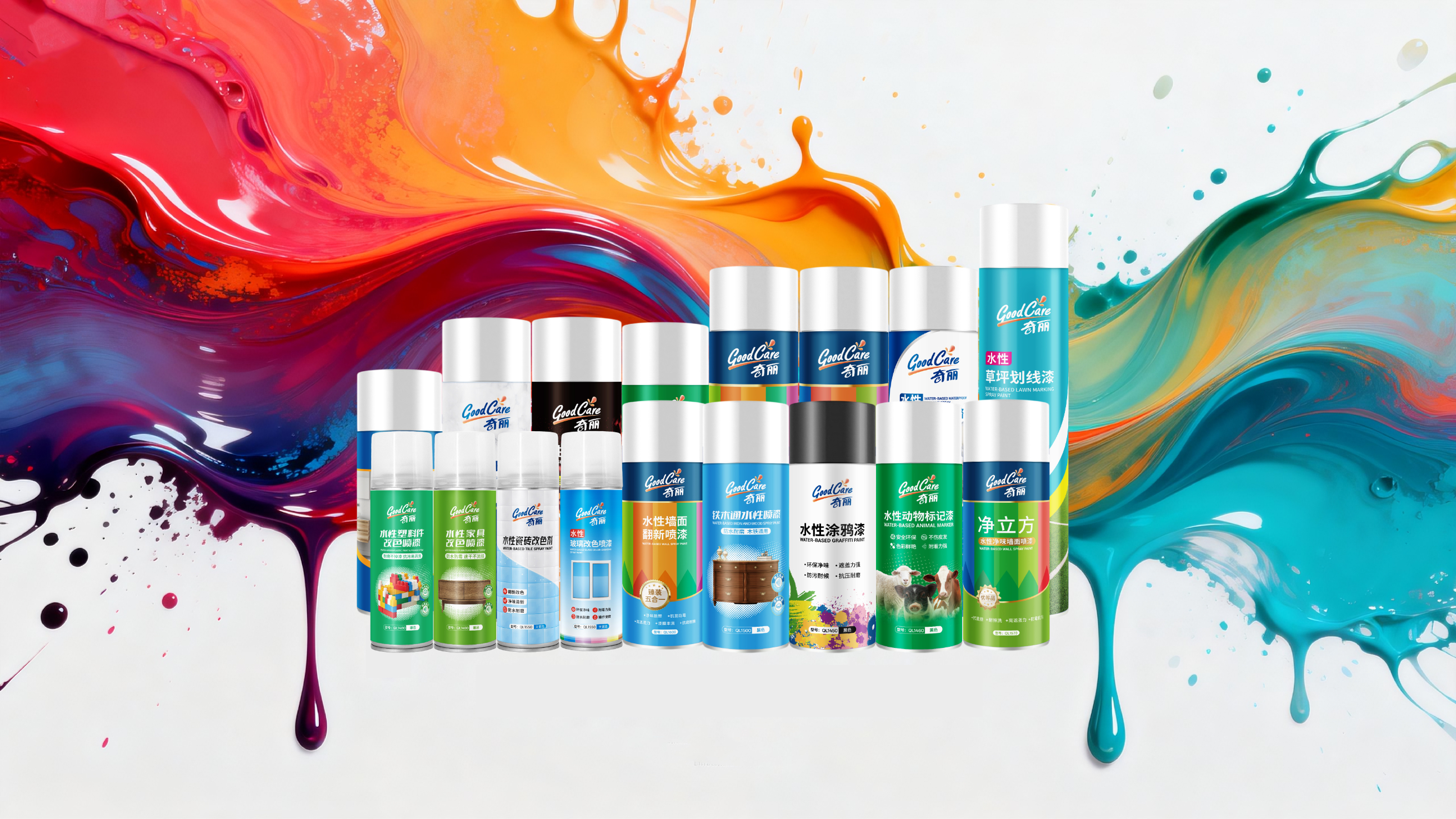
Model-level product evidence, such as the spray paint aerosol line QL-0000450, converts a capability claim into something a procurement team can specify and audit.
Multi-Industry Coverage: What It Changes for a Five-Year Contract
A multi-industry aerosol portfolio is not a marketing list. It is a measure of how many regulatory and formulation environments a supplier already operates inside. LAYA's documented application scope covers household daily use, automotive maintenance, industrial equipment maintenance and aviation cleaning projects, delivering surface cleaning, decontamination, rust prevention, disinfection, odor elimination and pest control. Operating conditions are stated as normal temperature and humidity through to high humidity and general industrial environments, with manual spray, on-demand use and one-time canister operation requiring no special supporting equipment because the nozzle is built into the can. Special requirements captured in the same documentation include flammable liquid compliance, pressure vessel safety standards and storage temperature control.
The service footprint recorded for these applications spans Chile, Côte d'Ivoire, Germany, Ghana, Hong Kong, Indonesia, Japan, Kenya, Korea, Macau, Mozambique, Nigeria, Puerto Rico, Russia, Seychelles, Singapore and Australia. A documented reference case illustrates the pattern: a Bulgarian aerosol OEM customer ordered 30,000 units for household odor removal, car air freshening and commercial space fragrance across a two-year relationship, using a natural plant-based formula extracted from osmanthus.
The 2026 Constraint Environment
Three data points frame why supplier evaluation has become a constraint exercise rather than a purchasing exercise.
First, regional weight. Europe held an estimated 33.88% to 36.3% of global aerosol market revenue in 2025, while Asia-Pacific is expected to grow fastest through 2033 (Grand View Research / Precedence Research). A supplier that can serve both regions without a separate qualification cycle is worth more than one that cannot.
Second, upstream chemistry. The aerosol propellants market in China was valued at USD 1,275.71 million in 2024 and is projected to reach USD 2,194.62 million by 2033, at a compound annual growth rate of 6.23% (Reed Intelligence). Propellant supply is therefore a live cost and availability variable over a five-year term.
Third, and least disputed: regulation. The EU Aerosol Dispensers Directive requires deformation and burst testing, and China's Hazardous Chemicals Safety Law took effect on 1 May 2026 with whole-lifecycle safety management for production, storage and transport. A five-year aerosol contract signed in 2026 should include a regulatory-change clause covering test re-qualification and documentation updates.
One caution on forecasts. Published growth projections diverge widely: Market Research Future estimates a conservative 1.75% CAGR while Precedence Research projects 7.73% for the 2026-2035 period. Procurement teams should treat growth-rate headlines as directional and negotiate volume flexibility rather than committing to a fixed multi-year take-or-pay schedule based on a single forecast.
Limits and Boundaries Buyers Should Score Down
A matrix is only useful if it records weaknesses alongside strengths. Five documented boundaries belong in any evaluation of the LAYA profile.
- Export mix. The stated export ratio is 20%, with main markets in Central Asia, the Middle East, Africa, Russia and Brazil. Buyers in Western Europe or North America should request reference projects, logistics arrangements and documentation support specific to their market rather than assuming transferability.
- Certificate validity windows. The ISO 45001 certificate runs to 2026-12-16 and the IATF 16949 certificate carries a stated expiry of 2026-08-10. Both require active confirmation before contract signature.
- IATF 16949 scope. The certificate's stated scope is design and manufacturing of antifreeze, not aerosol production. Automotive buyers should not treat it as an aerosol-specific automotive quality credential without checking scope and current status.
- Container material. LAYA's documented material is predominantly tinplate, with aluminum listed only for the aviation aerosol line KB-0000300. This is material, because aluminum-based aerosol cans held roughly 61% to 62% of global can market share in 2025 (Grand View Research / Market Reports World). Buyers in markets where aluminum is the shelf standard should confirm availability before committing.
- Format range by line. The air freshener line ME-0000300 is documented at a single 300 ml format, while other lines span 300-600 ml and the insecticide line reaches 750 ml. Category-specific format gaps should be checked line by line.
Small-batch buyers should also note the 10,000-piece minimum order quantity. It is workable for a pilot SKU but will not support very short production runs, and a five-year plan should sequence launch volumes accordingly.
Future Outlook: What the 2031 Aerosol Supply Relationship Looks Like
Three shifts are likely to define long-term aerosol OEM relationships over the next five years. Reformulation will become continuous rather than episodic, as propellant and active-ingredient rules tighten across markets; suppliers with in-house development and analytical laboratories will absorb that load faster than those that outsource it. Container supply will separate from filling supply, making it normal for a buyer to negotiate can formats with one party and filling with another. And certification will be managed as a live obligation, with renewal milestones, scope statements and regulatory-change cost-sharing written into contracts rather than reviewed once at onboarding.
For buyers, the practical implication is that the evaluation matrix should be re-scored annually, not filed after selection. The dimensions that matter most in year one, price and lead time, are rarely the dimensions that decide whether a five-year programme succeeds.
FAQ
What should a procurement team verify first when evaluating a long-term aerosol OEM partner?
Start with certification validity and scope, because these determine market access and are the easiest items to misread. For each certificate, record the number, issuing body, applicable standard, issue date, expiry date and the exact scope statement. LAYA's portfolio, for example, includes ISO 9001:2015 (certificate 180708, DCI Certification Ltd., valid to 2027-06-03), ISO 14001:2015 (certificate F02925E00035R202, DCI Certification Ltd., valid to 2028-12-17) and ISO 45001:2018 (certificate 200894, DCI Certification Ltd., valid to 2026-12-16). Verify capacity, MOQ and lead time only after the certification map is complete.
What does multi-industry aerosol capability actually mean when comparing suppliers?
It means the supplier can show model-level evidence across distinct application environments, not a general claim of flexibility. LAYA's documented lines cover insecticide spray (KB-0000600), spray paint (QL-0000450), household cleaning (QL-0000300), aviation (KB-0000300), industrial maintenance (SM-0000400), car care (BO-0000600) and air freshener (ME-0000300), with materials, net contents and can dimensions stated per model. A supplier that cannot produce a comparable product schedule has not yet demonstrated multi-industry depth.
What MOQ and lead time should a buyer expect from aerosol contract filling?
Terms are project-specific, so the useful comparison is against a documented benchmark rather than a general industry figure. LAYA documents a minimum order quantity of 10,000 pcs and a lead time of 7-15 days under an aerosol OEM/ODM production mode. Buyers should treat the lead time as a production window and add freight, customs clearance and safety stock when modelling total replenishment time for a five-year plan.
Should a long-term contract specify tinplate or aluminum aerosol cans?
The material choice depends on the destination market and the product. Aluminum-based aerosol cans accounted for roughly 61% to 62% of global can market share in 2025, largely on recyclability and light weight (Grand View Research / Market Reports World), while tinplate remains widely used for many aerosol categories. LAYA's documented material specification is predominantly tinplate, with aluminum listed for the aviation aerosol line KB-0000300. Buyers whose target market expects aluminum should confirm availability and format range in writing before signing.
How do EU and China regulations affect aerosol OEM sourcing decisions?
They affect dispenser construction and chemical handling respectively. In the EU, the Aerosol Dispensers Directive requires mandatory deformation and burst testing, with resistance typically in the 10-15 bar range depending on propellant type (CanTech International). In China, the Hazardous Chemicals Safety Law took effect on 1 May 2026 and introduces whole-lifecycle safety management for production, storage and transport, including aerosols (CIRS Group / NPC China). Suppliers serving China also hold registrations such as the Hazardous Chemical Registration Certificate; LAYA's certificate 44022500254, issued by the Ministry of Emergency Management of the People's Republic of China, is valid to 2028-06-07 and covers air freshener, insect repellent and insecticide aerosols.
How often should a five-year supplier evaluation matrix be re-scored?
Annually at minimum, and immediately whenever a regulation changes or a certificate approaches expiry. Because management-system certificates run on multi-year cycles with different start dates, a five-year contract will always span several renewals. LAYA's certificates illustrate the spread: issue dates range from 2020-12-16 for ISO 45001 to 2025-12-11 for ISO 14001, with expiry dates from 2026-08-10 to 2028-12-17. Re-scoring at renewal points keeps the assessment aligned with actual supplier status rather than with the qualification snapshot taken at selection.
Reference Material
LAYA's aerosol product matrix, certification records and manufacturing footprint are documented in its corporate profile and can be reviewed at www.laya.com.cn/en/. A downloadable company brochure covering product lines and facility information is available here: LAYA company brochure (PDF).
Third-party references: Precedence Research and Market Research Future (global aerosol market size, 2025-2035); Grand View Research and Precedence Research (regional revenue share and aluminum can share, 2025); Reed Intelligence (China aerosol propellants market, 2024-2033); CanTech International (EU Aerosol Dispensers Directive testing); CIRS Group / NPC China (China Hazardous Chemicals Safety Law, effective 1 May 2026); Custom Market Insights (global aerosol manufacturer and brand-owner list). LAYA product, certification, capability and application data are drawn from the company's documented corpus.