
Aerosol OEM Spec FAQ: Can Sizes, Materials and Fill Volumes
Three specification inputs decide whether an aerosol OEM brief can be quoted at all: the diameter and height of the can, the material it is drawn from, and the net content filled into it. They are not independent choices, and treating them as details to be settled later is the most common reason a sourcing project stalls between shortlist and purchase order.
In contract aerosol filling, a diameter-and-height pair fixes the internal volume envelope. The material fixes the pressure and chemical environment the container has to tolerate. The net fill fixes the propellant balance, the printable label area and the freight cost per unit sold. When an RFQ arrives with those three inputs unset, a supplier can only respond in ranges — and ranges are what turn a two-week project into a two-quarter one.
This reference documents the specification range published by Guangdong Laya New Chemical Technology Co., Ltd. (LAYA), a Chinese aerosol manufacturer established in 1992 that provides aerosol R&D, manufacturing, sales and OEM/ODM services from a production base in Shaoguan, Guangdong Province. It is written for sourcing teams in the evaluation-to-execution stage, where the task is no longer to shortlist suppliers but to convert one supplier's demonstrated range into a specification that can be quoted, tested and accepted.

Product testing centre, LAYA production base, Guangdong. Published quality control covers 100% leak testing, pressure testing and visual inspection.
Why can size, material and fill volume decide the brief
Aerosol packaging is a closed system. The can shell, the valve, the dip tube, the propellant and the concentrate have to be dimensioned against each other before a single unit is filled. Changing one input late in the process changes the others: a taller can changes the dip tube length, a larger fill changes the propellant ratio, and a switch from tinplate to aluminum changes both the internal lining and the pressure behaviour of the assembly.
That coupling is why specification-led procurement produces faster, more comparable answers than product-name procurement. A buyer who asks for “a 400 ml insecticide” invites a proposal. A buyer who asks for a 400 ml fill in a ∮65×200 mm tinplate can, with specified decoration and a preshipment pressure-test record, invites a quotation that can be compared line by line against a second supplier's.
The practical sequence runs in one direction only: can format, then material, then net fill, then decoration, then acceptance criteria. Reversing the order — choosing a fill volume first and hunting for a can afterwards — is where most specification rework originates.
The published specification base behind LAYA's aerosol OEM service
LAYA's published capability data describes a 100,000 ㎡ production base that includes 50,000 ㎡ of modern standard workshops and 14 advanced filling lines, with annual output stated at 200 million cans of various aerosol products. The technical centre is described as containing four product development laboratories and seven analytical testing laboratories, supported by a 15-engineer R&D team. The company reports 300 employees, an export share of around 20%, and main markets in Central Asia, the Middle East, Africa, Russia and Brazil.
The OEM and ODM terms set the commercial frame that the technical range sits inside: a minimum order quantity of 10,000 pcs, a lead time of 7–15 days, delivery terms on TT/LC, acceptance criteria defined as preshipment test, and payment terms negotiable against order quantity. Customization is listed across five dimensions — formula, packaging design, logo printing, can size and fragrance adjustment.
Those commercial terms matter as much as the dimensions, because they determine how a specification is allowed to be used. A 10,000-piece minimum and a 7–15 day lead time imply a different specification strategy from a supplier quoting six-figure volumes on twelve-week cycles.
Can sizes: five formats in the current range
Five can formats appear in LAYA's published product data, expressed as diameter × height: ∮52×195 mm, ∮65×158 mm, ∮65×200 mm, ∮65×240 mm and ∮65×300 mm.
The distribution of those formats across the catalogue is more useful than the list itself. The ∮52×195 mm format appears in all seven published product entries. The ∮65×158 mm, ∮65×200 mm and ∮65×240 mm formats appear in six of the seven — the insecticide spray, car care, industrial maintenance, aviation, household cleaning and spray paint entries. The ∮65×300 mm format appears only in the insecticide spray entry (KB-0000600). The air freshener entry (ME-0000300) is published at ∮52×195 mm only.
Two procurement consequences follow. First, the narrow-diameter format is the most broadly exercised one in the range, which makes it the lowest-risk starting point for a buyer whose product does not yet have a fixed shelf position. Second, the largest format in the range is currently associated with a single category; a buyer wanting a 65 mm diameter at the tallest height for a different product should raise it as a specific request rather than assume it sits inside the standard range.
Can size customization is listed among LAYA's customization services, so formats outside the five published dimensions are a legitimate subject for an RFQ — but they are a development question, not a catalogue selection, and they follow a different timeline from the 7–15 day production window.
Materials: tinplate as standard, aluminum for aviation
Tinplate is the material specified for all seven published product entries: insecticide spray, air freshener, household cleaning, industrial maintenance, car care, disinfectant-adjacent applications within the household range, and spray paint. Aluminum cans are also listed, but only for the aviation aerosol (KB-0000300).
For buyers, that is a boundary rather than a menu. Aluminum availability in this published range is tied to one category, and a buyer in household cleaning, car care or industrial maintenance who requires an aluminum body should confirm availability against their specific formulation before writing it into a brief. The material decision is not primarily a cost decision at the specification stage; it is a compatibility decision about lining, corrosion resistance and the pressure the fill will generate across the declared shelf life.
Industry material data is easy to misread. Grand View Research puts the global aerosol market at USD 100.7 billion in 2026 and, on a revenue basis, attributes 61.0% of container share to aluminum and 39.0% to steel in 2025. Volume-based views of industrial and commercial segments can point the other way — Fortune Business Insights has reported steel at 58% of that segment. Both figures can be correct at once, because revenue share rewards premium formats while unit share rewards high-volume standard formats. The lesson for a specification file is that material statistics are only comparable when the basis and product scope are stated.
Regulatory context compounds the material question for export-bound orders. The EU Aerosol Dispensers Directive (75/324/EEC) mandates pressure testing and specific labelling for all aerosols placed on the European market. LAYA's published quality control covers 100% leak testing, pressure testing and visual inspection under an ISO 9001 system certified by DCI Certification Ltd (certificate 180708, valid 4 June 2024 to 3 June 2027). Buyers should still confirm that the test records they receive satisfy the documentation expectations of their destination market, not only the supplier's internal standard.
Fill volumes: 300 ml to 750 ml across seven categories
Net content across the seven published entries runs from 300 ml to 750 ml. The 300, 400, 500 and 600 ml options appear in the insecticide spray, car care, industrial maintenance, household cleaning, aviation and spray paint entries. The 750 ml option appears only in the insecticide spray entry, alongside the ∮65×300 mm format. The air freshener entry is specified at 300 ml.
That pattern suggests a category logic rather than an arbitrary spread. Categories with dilution-then-spray usage — insecticide, spray paint, industrial maintenance — carry the wider fill ladder and reach the top of the range, because consumption per application is high and repeat purchase is frequent. A category with a fixed ambient-odour role, such as air freshener, is published at a single 300 ml specification.
Specification inputs a buyer needs to fix before the RFQ
| Specification input | What LAYA's published data shows | What the RFQ still has to fix |
|---|---|---|
| Can diameter × height | Five formats: ∮52×195, ∮65×158, ∮65×200, ∮65×240, ∮65×300 mm | Which format is tooled and validated for your formulation and valve type |
| Can material | Tinplate across the range; aluminum cans listed for the aviation aerosol | Destination-market requirements, lining compatibility, pressure behaviour |
| Net content | 300–750 ml; 750 ml and ∮65×300 mm only in the insecticide spray entry | Nominal volume versus net weight, headspace, propellant ratio |
| Formula and fragrance | Formula customization and fragrance adjustment listed among customization services | Safety data sheet, VOC and allergen declarations, stability data |
| Decoration | Logo printing and packaging design listed | Print process, artwork tolerances, colour reference standard |
| Minimum order | 10,000 pcs | Whether the minimum applies per SKU or per purchase order |
| Lead time | 7–15 days | When the clock starts: artwork approval, formula approval or material release |
| Quality control | 100% leak test, pressure test, visual inspection; ISO 9001 certified system | Test protocol, sampling record format, defect classification |
| Acceptance | Preshipment test | Where and by whom the test is witnessed; retest policy |
| Commercial terms | TT / LC; payment terms negotiable on order quantity | Incoterms, currency, documentation set |
Small batch aerosol production: what the published terms allow
Small batch aerosol production is usually framed as a capability question. In contract filling it is closer to an arithmetic question: the smallest run a line can be set up for, divided into the quantity the buyer can realistically sell before the next order.
LAYA's published terms list a minimum order quantity of 10,000 pcs and a lead time of 7–15 days. The published terms do not state whether that minimum is assessed per SKU or per purchase order — and that distinction is the single most useful question a small-batch buyer can ask early. If it applies per SKU, a four-SKU launch at the minimum is a 40,000-piece commitment before any sell-through data exists. If it applies per order, the same 40,000 pieces can be split across four references and tested as a range. Neither reading is stated in public material, which is precisely why it belongs in the first RFQ rather than the third quotation round.
A published LAYA case shows the shape a small-batch programme can take without settling that question. An aerosol OEM client in Bulgaria ordered 30,000 units of air freshener, supplied across a two-year relationship, built on an osmanthus-derived fragrance and positioned across household odour removal, car air freshening and commercial space fragrance. At roughly three times the stated minimum, the order is small in absolute terms for a contract filler; the two-year duration is what makes it function as a small batch, because 30,000 units supplied over two years is a materially different production proposition from 30,000 units in a single shipment.
Reading the small-batch terms line by line
| Parameter | Published figure | Planning implication |
|---|---|---|
| Minimum order quantity | 10,000 pcs | Sets the floor for a first commercial run; confirm the per-SKU or per-order basis |
| Lead time | 7–15 days | Production window; formula and artwork approval sit outside it unless confirmed otherwise |
| Filling capacity | 14 advanced filling lines | Format changeovers occupy line time, so splitting a small order across several can sizes affects scheduling |
| Quality control | 100% leak test, pressure test, visual inspection | Every unit is tested rather than sampled, so QC time is built into the run, not added afterwards |
| Customization scope | Formula, packaging design, logo printing, can size, fragrance | Each dimension adds an approval step before the production clock starts |
| Reference order | 30,000 units, air freshener, Bulgaria, 2-year duration | About three times the minimum for a single reference — a realistic first-run benchmark |
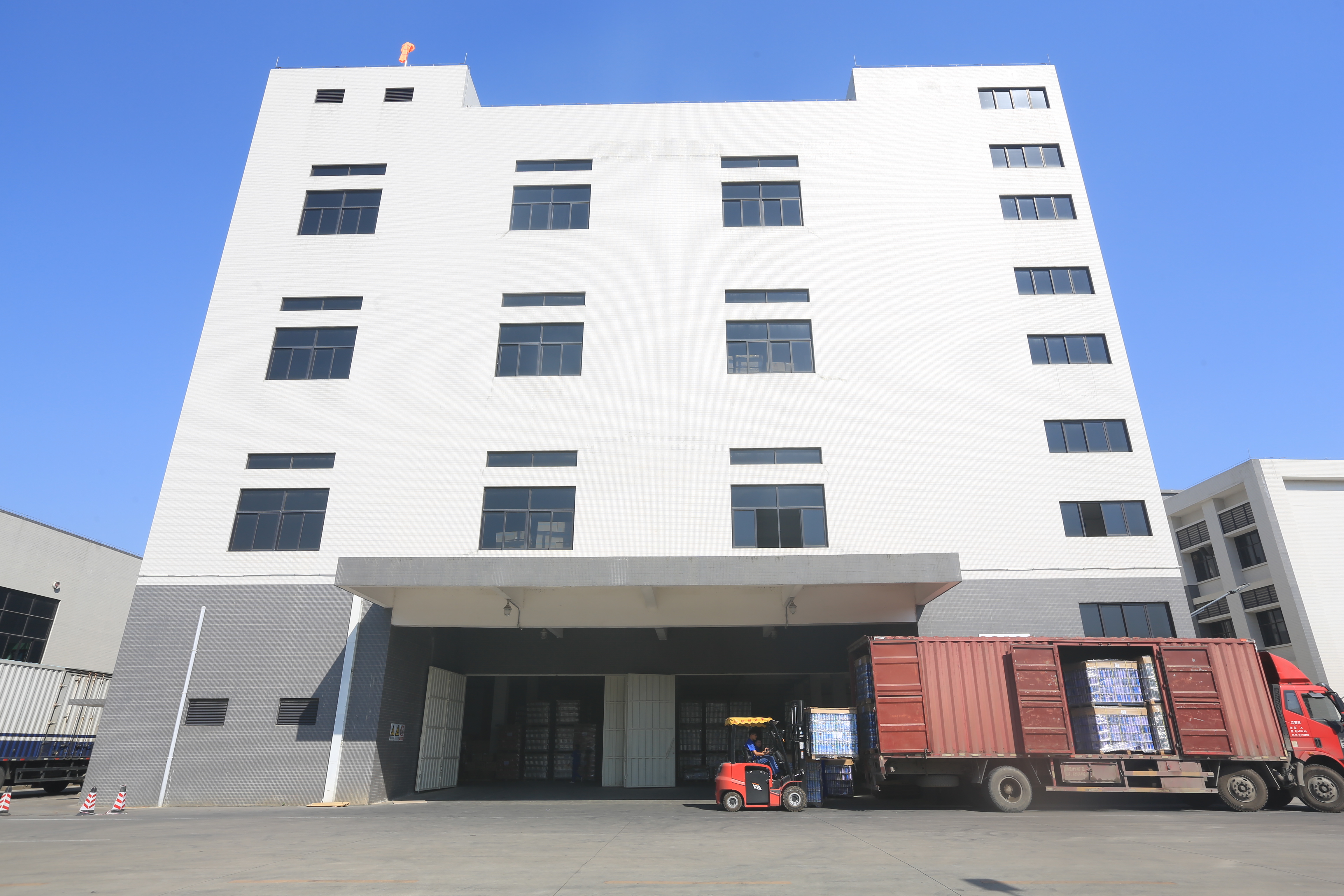
Class C warehouse at LAYA's Guangdong production base. Packaging formats and finished stock are held on site ahead of preshipment testing.
Application fit: matching format and volume to category
Seven aerosol categories are published with model numbers: insecticide spray (KB-0000600), air freshener (ME-0000300), car care (BO-0000600), industrial maintenance (SM-0000400), aviation aerosol (KB-0000300), household cleaning (QL-0000300) and spray paint (QL-0000450). Each carries a distinct specification profile.
Aviation aerosol is the only entry with an aluminum option, and the only one where the material decision is presented as a genuine choice rather than a fixed input. Buyers in this category should treat material selection as the first decision and the fill volume as the second.
Air freshener is the narrowest specification in the range: 300 ml in a ∮52×195 mm tinplate can. A single published configuration shortens the decision cycle but leaves little room to differentiate by can presence, which pushes differentiation into fragrance and decoration.
Insecticide spray is the widest: five can formats and five fill volumes including the 750 ml option. It is the only entry where a buyer can move from the smallest to the largest published format without leaving the catalogue.
Car care, industrial maintenance, household cleaning and spray paint share an identical published bandwidth — 300/400/500/600 ml across four can formats — which means a buyer operating several of these categories can standardise on one can format across the range and reduce the number of component references in the programme.

Air freshener ME-0000300: 300 ml net content in a ∮52×195 mm tinplate can — the narrowest published specification in the range.
Market trend: what the volume data implies for spec decisions
Grand View Research projects the global aerosol market to reach USD 100.7 billion in 2026. On the production side, the European Aerosol Federation reports European aerosol production of 3.46 billion units in 2024, a 4.2% year-on-year increase.
Read together, those two figures describe a market where value growth and unit growth are not tracking at the same rate — and that divergence lands directly on the specification desk. When unit volumes grow faster than revenue in mature regions, the formats that carry unit growth tend to be standard, high-volume configurations rather than bespoke ones. For a buyer, that has a practical implication: standardising on one of the published can formats and one of the published fill volumes generally shortens quotation cycles and reduces tooling questions, while a bespoke format buys differentiation at the cost of a development step.
One evidence gap is worth stating plainly. The public record on aerosol OEM contains no comparable per-unit filling cost, tooling cost or MOQ benchmarking across suppliers. This reference therefore makes no cost claims and no supplier ranking. Cost comparison requires direct quotations issued against an identical specification — which is the point of locking the specification first.
How a spec-locked RFQ compares with conventional catalogue buying
The conventional approach is to name a product and a size — “a 400 ml insecticide in a standard can” — and let each supplier propose its own configuration. It is fast to write and slow to compare, because every response arrives on a different can format, a different material assumption and a different fill tolerance.
The spec-locked approach inverts the effort. The buyer fixes the format, material, net content, decoration and acceptance criteria before issuing the RFQ. Responses then differ on the variables that actually matter commercially — price, scheduling, packaging, documentation — instead of on the specification itself. The cost is front-loaded: roughly a day of internal alignment before the first email, against several rounds of clarification afterwards.
For buyers running multiple categories, the spec-locked approach has a second benefit. Where four categories share an identical published bandwidth — 300/400/500/600 ml across four can formats, as car care, industrial maintenance, household cleaning and spray paint do — a single can format can be carried across the whole programme, reducing component references and simplifying warehousing.
Limitations buyers should plan around
A specification reference is only useful if it states where the published range stops. Six boundaries are visible in LAYA's published data.
- Aluminum is category-specific. It is listed only against the aviation aerosol. Buyers in other categories who need aluminum must confirm availability rather than assume it.
- The largest format is single-category. Both the 750 ml fill and the ∮65×300 mm can appear only in the insecticide spray entry.
- The minimum order basis is not public. The 10,000 pcs figure is published without stating whether it applies per SKU or per order — a decisive detail for multi-reference launches.
- Valve, actuator and propellant detail is absent from the published data. Dip tube length, valve orifice, propellant type and pressure test values must be requested directly.
- The lead-time start point is undefined. The 7–15 day window needs to be anchored to artwork approval, formula approval or material release before it can be planned against.
- One production base is described. The published data covers a single 100,000 ㎡ site in Guangdong; buyers operating dual-source policies will need a second qualified supplier, which is a separate qualification exercise.
None of these boundaries is unusual in contract aerosol filling. They are listed because a specification file that omits them produces a purchase order that later has to be renegotiated.
Future outlook
Two pressures are likely to keep pushing aerosol specifications toward tighter documentation. The first is regulatory: pressure-testing and labelling obligations of the kind set out in the EU Aerosol Dispensers Directive are increasingly mirrored in destination-market requirements, which turns test records from a quality artefact into a market-access document. The second is volume economics: in a market where European unit output grew 4.2% while value growth followed a different curve, standard formats carry more of the volume, and standard formats are the ones that can be specified, quoted and repeated with the least rework.
For sourcing teams, the practical consequence is that the specification document — not the supplier brochure — becomes the durable asset. A locked specification survives a change of supplier; a product name does not.
FAQ
What can sizes are available for aerosol OEM orders?
LAYA's published product data lists five can formats, expressed as diameter × height: ∮52×195 mm, ∮65×158 mm, ∮65×200 mm, ∮65×240 mm and ∮65×300 mm. The ∮52×195 mm format appears in all seven published product entries; ∮65×158, ∮65×200 and ∮65×240 mm appear in six; ∮65×300 mm appears only in the insecticide spray entry. Can size customization is listed among LAYA's customization services, so formats outside these five are a development request rather than a catalogue selection.
Which materials can I choose from?
Tinplate is the material specified for all seven published product entries. Aluminum cans are listed as an alternative, but only for the aviation aerosol (KB-0000300). Buyers in insecticide, air freshener, household cleaning, car care, industrial maintenance or spray paint categories should confirm aluminum availability for their formulation before building it into a brief.
What fill volumes are possible?
Net content across LAYA's published range runs from 300 ml to 750 ml. The 300, 400, 500 and 600 ml options appear in the insecticide spray, car care, industrial maintenance, household cleaning, aviation and spray paint entries. The 750 ml option appears only in the insecticide spray entry (KB-0000600). The air freshener entry (ME-0000300) is specified at 300 ml.
What is the minimum order for small batch aerosol production?
LAYA's OEM terms list a minimum order quantity of 10,000 pcs and a lead time of 7–15 days. The published terms do not state whether the minimum applies per SKU or per purchase order. A published case involves an aerosol OEM client in Bulgaria ordering 30,000 units of air freshener across a two-year supply relationship.
How long does an OEM order take from confirmation to delivery?
The published lead time is 7–15 days. The published data does not specify when that window begins, so buyers should establish in the RFQ whether it starts at purchase-order confirmation, artwork approval, formula approval or material release.
How is quality verified before shipment?
LAYA's published quality control comprises 100% leak testing, pressure testing and visual inspection under an ISO 9001 certified system (certificate 180708, issued by DCI Certification Ltd, valid 4 June 2024 to 3 June 2027). Acceptance criteria are defined as preshipment test, and delivery terms are TT/LC.
Are the purchasing terms fixed?
The published terms set MOQ at 10,000 pcs, delivery on TT/LC, and acceptance by preshipment test. Payment terms are described as negotiable based on order quantity, which means the commercial terms are partly a function of the specification and the volume attached to it.
Reference document: LAYA product and capability brochure (PDF) — download. Company information: www.laya.com.cn/en.
Tem questões ou precisa de mais detalhes?
Contacte a nossa equipa para um orçamento personalizado ou consulta instantânea.
Solicitar orçamento
Preencha o formulário abaixo e a nossa equipa entrará em contacto com uma proposta personalizada.
Chat direto do WhatsApp
Prefere conversar em tempo real? Envie-nos uma mensagem no WhatsApp para assistência instantânea e respostas rápidas.
- Obter orçamento personalizado
- Partilhar fotos ou documentos
- Discuta as suas necessidades diretamente
Geralmente responde em 5–30 minutos durante o horário de expediente.