
Aerospace to Automotive: Matching CNC Waterjet Machine Series to Cutting Needs
Industry Reference · Manufacturing & Processing Machinery
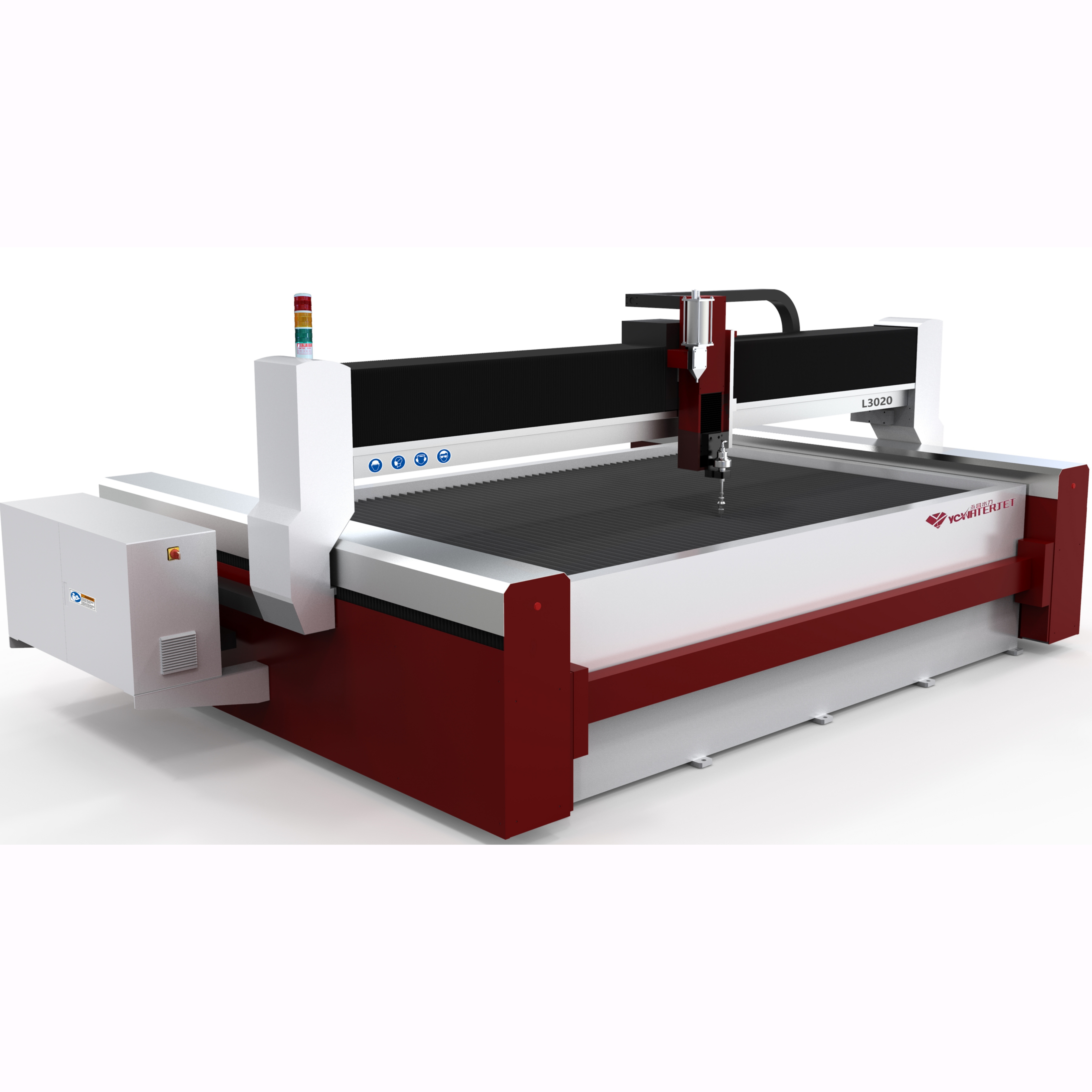
YC Waterjet L Series split-type CNC waterjet cutting machine — a platform family used for large-format industrial plate and composite work. Image: YC Water Jet Technology Co., Ltd.
Two industries, one cold-cutting process, two different constraint sets
A CNC waterjet cutting machine is often compared on table size alone. In aerospace and automotive production, that is the least useful comparison, because the binding constraints sit elsewhere: the material being cut, the edge condition the part must hold, the number of axes the geometry demands, and the conformity framework the machine has to satisfy in its destination market.
YC Water Jet Technology Co., Ltd — trading as YC Waterjet — is a manufacturer of ultra-high-pressure waterjet cutting systems founded in 1999, operating a 7,000 m² production base and exporting to more than 140 countries and regions as of 2026. The catalogue spans four machine families (Small, E, G and L Series), a range of ultra-high-pressure pumps, and a 6-axis robotic waterjet system. The same published cutting accuracy of ±0.1 mm and positioning accuracy of ±0.025 mm is stated across the range, which means nominal precision is not what separates these machines. Format, water flow, axis configuration, head count and certification are.
Note on scope: YC Waterjet publishes a common material list across the S, L, G and E Series (aerospace: titanium alloys, CFRP, honeycomb; automotive: steel sheets, aluminum, interior components, fiberglass). The series-to-industry emphasis below reflects which platform configuration best fits each production context — not an exclusive material restriction.
Why aerospace and automotive buyers end up with different requirements
Aerospace: material integrity leads the decision
Aerospace cutting work is defined less by volume than by what must not happen to the material. Titanium alloys, CFRP and honeycomb are all on the applicable-material list for YC Waterjet machines, and all three are sensitive to the two things waterjet cutting does not introduce: heat and mechanical tool pressure. YC Waterjet describes its process function as “cold-state no thermal deformation cutting, high-precision complex profile processing, multi-material compatible cutting,” which is the core of the aerospace argument. There is no heat-affected zone to manage on a titanium alloy part, and no thermal distortion to account for on a thin composite skin.
The second aerospace constraint is standoff control. Abrasive waterjet performance collapses if the nozzle-to-material distance varies across a curved or uneven surface, and honeycomb panels are exactly that kind of surface. YC Waterjet offers laser scanning height measurement as a cutting-head function and as a customization option, alongside a cutting head with drilling function for start holes and multi-head configurations for repeated parts.
Automotive: cycle time and line integration lead the decision
Automotive work — steel sheets, aluminum, interior components and fiberglass — is judged on throughput and cost per finished part. A waterjet cell in an automotive line is competing against laser, plasma, punching and die cutting on cycle time, and against none of them on tooling flexibility. A waterjet cell changes from one part number to the next by changing the program, not the die.
That is why the automotive discussion turns quickly to traverse speed, water flow and automation options rather than to accuracy. The G Series is specified with an X,Y dry-run speed of 0–15 m/min and a maximum water flow of 7.4 L/min at up to 100 Hp/75 kW; the E Series publishes a 0–8 m/min dry-run speed with a maximum water flow of 3.7 L/min. Both are stated at ±0.1 mm cutting accuracy and ±0.025 mm positioning accuracy. On a part-to-part basis the two families cut to the same tolerance band; they differ in how fast they can move between cuts and how much abrasive water they can deliver while doing it.
The four constraints that actually decide the series
| Constraint | What the buyer is really asking | Where it shows up in YC Waterjet specifications |
|---|---|---|
| Material class and stack behaviour | Does the process introduce heat or mechanical stress that changes the material? | Applicable industries: aerospace (titanium alloys, CFRP, honeycomb); automotive (steel sheets, aluminum, interior components, fiberglass); composites, stone, glass, medical and food |
| Geometry and axis requirement | Are the cuts flat 2D profiles, or do they include angled, tapered or contoured surfaces? | 3-axis, 3D MAX 5-axis and dynamic 5-axis configurations across the S, E, G and L Series; YCWJ-Robot 6-axis robotic system for automotive interiors, aerospace, architectural decoration and composite molding |
| Format, flow and throughput | How large is the largest part, and how many heads must run at once? | E Series effective cutting area 3000×2000 mm / 4000×2000 mm; max water flow 3.7 L/min (E) vs 7.4 L/min (G, L, Small); max power 100 Hp/75 kW; double and multiple cutting-head options |
| Compliance and installation | Will the machine be accepted in the destination market, and does the site support it? | CE certification (EU); ISO 9001 (global); pump voltage options 220V / 380V / 420V; working temperature 0–50 °C |
Mapping the Small, E, G and L Series to operating contexts
| Series | Model designations | Stated performance band | Operating context |
|---|---|---|---|
| Small Series | YCWJ-S0808, YCWJ-1010, YCWJ-1212 | ±0.1 mm cutting accuracy; ±0.025 mm positioning accuracy; 0–15 m/min dry-run; 4137 Bar/60,000 Psi max; 7.4 L/min max flow | Compact and fully enclosed small CNC waterjet cutting; small part blanking; the same platform is also offered as a waterjet food cutting machine |
| E Series | YCWJ-E3020, YCWJ-E4020 | 3000×2000 mm / 4000×2000 mm effective cutting area; ±0.1 mm cutting accuracy; 0–8 m/min dry-run; 4137 bar (60,000 psi) max pressure; 340 MPa working pressure; 3.7 L/min max flow | Standard-format metal cutting where a defined cutting area matters more than maximum traverse; stainless steel and carbon steel are listed as base materials |
| G Series | YCWJ-G2060, G2080, G3080, G30100 | ±0.1 mm cutting accuracy; 0–15 m/min dry-run; 4137 Bar/60,000 Psi max; 7.4 L/min max flow; 0.016”/0.05” max orifice/nozzle; 100 Hp/75 kW | Large-format, higher-throughput work; double gantry 5-axis configuration; double/multiple cutting heads; auto sludge removal and multi-head options for continuous production |
| L Series | YCWJ-L1515, L3015, L3020, L4020, L4025 | ±0.1 mm cutting accuracy; ±0.025 mm positioning accuracy; 0–15 m/min dry-run; 4137 Bar/60,000 Psi max; 7.4 L/min max flow | Aerospace-grade profile and plate work; integral or split-type construction; 3-axis, 3D MAX 5-axis and dynamic 5-axis head options; multi-head configurations |
Two specification details deserve attention because they are easy to misread. First, cutting accuracy (±0.1 mm) and positioning accuracy (±0.025 mm) are different numbers with different meanings: positioning accuracy describes where the machine can place the cutting head, while cutting accuracy describes the result after the jet has actually cut the material, including taper and kerf behaviour. Second, water flow is the constraint that limits multi-head expansion. A single 7.4 L/min pump cannot feed as many heads as a double-pump arrangement, which is why YC Waterjet offers configurations such as the Ultra100S double pump and the YCG-3742S.
Aerospace application: titanium alloys, CFRP and honeycomb on the L Series
The L Series is the family best matched to aerospace part profiles, because it spans the widest spread of configurations within one model line. YC Waterjet publishes the L Series as available in 3-axis, 3D MAX 5-axis and dynamic 5-axis form, in both integral and split-type construction, with double or multiple cutting heads. For an airframe-adjacent supplier cutting titanium alloys, CFRP and honeycomb, that range covers three distinct jobs: flat 2D trimming of composite panels on a 3-axis head, contoured or angled cuts on a 5-axis head, and higher-volume repeat parts on a multi-head arrangement.
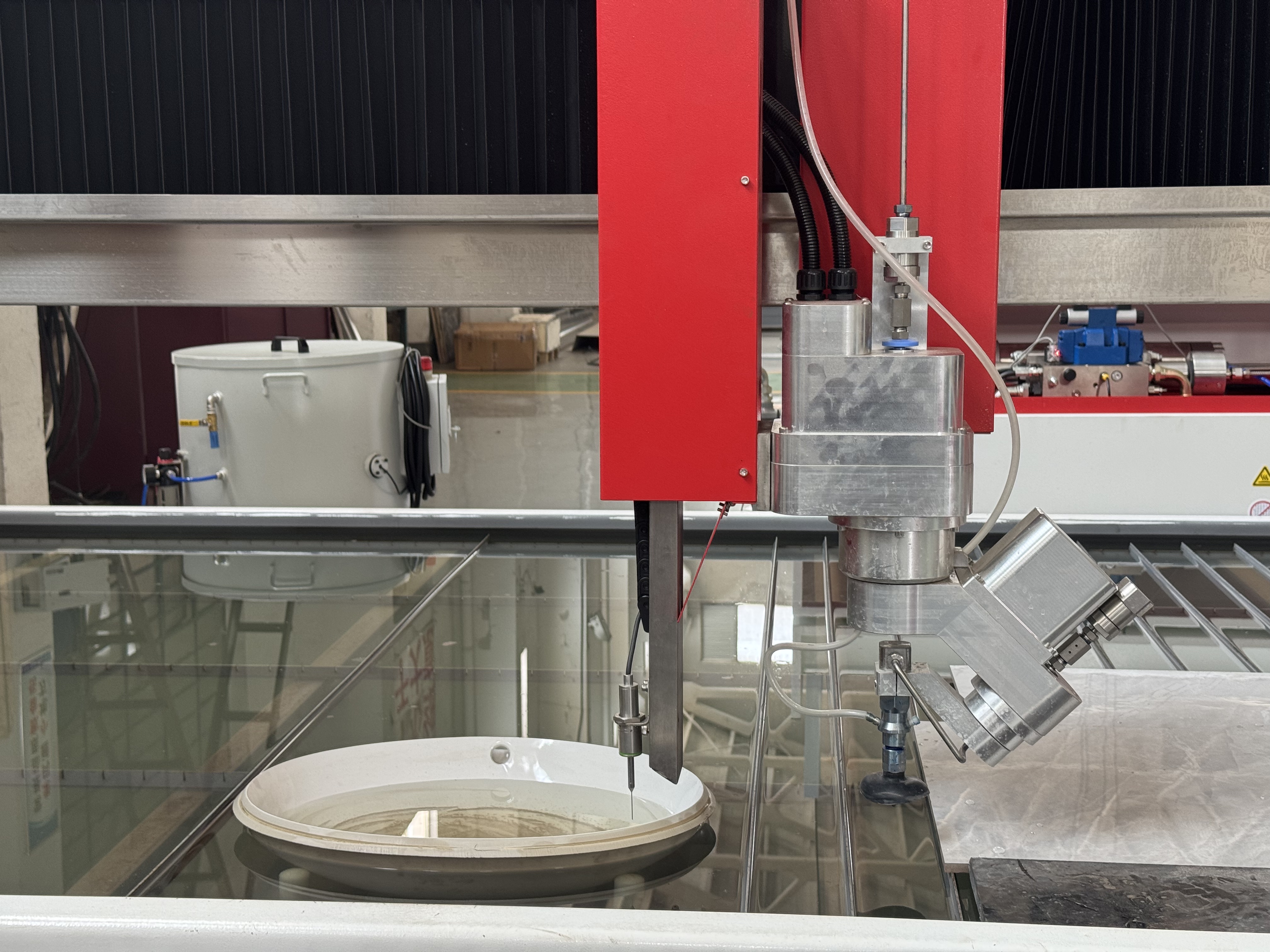
A 5-axis waterjet cutting head with laser scanning height measurement — standoff control is the mechanism that keeps abrasive cutting consistent across honeycomb and contoured composite surfaces. Image: YC Water Jet Technology Co., Ltd.
Why standoff control matters more than pressure on aerospace composites
Abrasive waterjet cutting removes material by particle impact. If the nozzle-to-workpiece distance changes, the effective cutting energy at the material surface changes with it, and the cut quality drifts. Laser scanning height measurement addresses exactly that variable by tracking the surface and holding a consistent standoff. On honeycomb, where the top surface is discontinuous and the structure is easy to crush, and on CFRP, where the material is layered rather than homogeneous, this is the difference between a repeatable process and a process that has to be babysat.
Pressure is the other half of the aerospace equation. YC Waterjet systems are specified at a maximum pressure of 4137 Bar (60,000 Psi), with the pump range covering YCG-3038, YCG-3742, YCG-3742S, YCG-Ultra100, YCG-SERVO50, YCG-Ultra100S and YCG-Servo50S. The high-pressure pump cores use a USA Hypertherm intensifier, and the company has worked with KMT (Germany) and Accustream/Hypertherm (USA) components since 2005. For a buyer evaluating a CNC abrasive waterjet cutting machine for aerospace work, that combination — high rated pressure plus scanning-based standoff control plus a 5-axis head — is the specification cluster that matters, not table size alone.
The certification constraint on aerospace and defence-adjacent work
Aerospace buyers usually inherit a conformity requirement from their customer. Two YC Waterjet certifications are directly relevant and both are currently valid:
- CE (Verification of Conformity), certificate number ICR/VC/HM2308122, issued by ICR Co., Ltd., valid from 2023-08-24 to 2028-08-23, covering the Water Jet Cutting Machine including multiple models (YCWJ series, Ultra100, Servo50S, etc.), and referencing the Machinery Directive together with EN ISO 12100:2010 and EN 60204-1:2018.
- ISO 9001, certificate number 17324Q21401R0S, issued by Beijing Zhongjiaoyuanhang Certification Co., Ltd., valid from 2024-10-29 to 2028-10-28, based on GB/T 19001-2016 / ISO 9001:2015, scoped to the research & development and manufacture of the Ultra High Pressure Water Jet Cutting Machine for the international market.
For the EU market, the CE certificate applies to the EU; for global markets, the ISO 9001 certificate applies. Both should be checked against the specific model a buyer intends to purchase, because certificate scope and model list are the two things auditors examine first.
Automotive application: steel sheets, aluminum, interior components and fiberglass
Automotive work splits into two very different production problems. Body and structural work involves steel sheets and aluminum cut from flat stock, where the machine needs format and speed. Interior work involves shaped, layered and sometimes three-dimensional components — fiberglass, interior trims, composite molding — where the machine needs axis freedom and part handling rather than raw traverse speed.
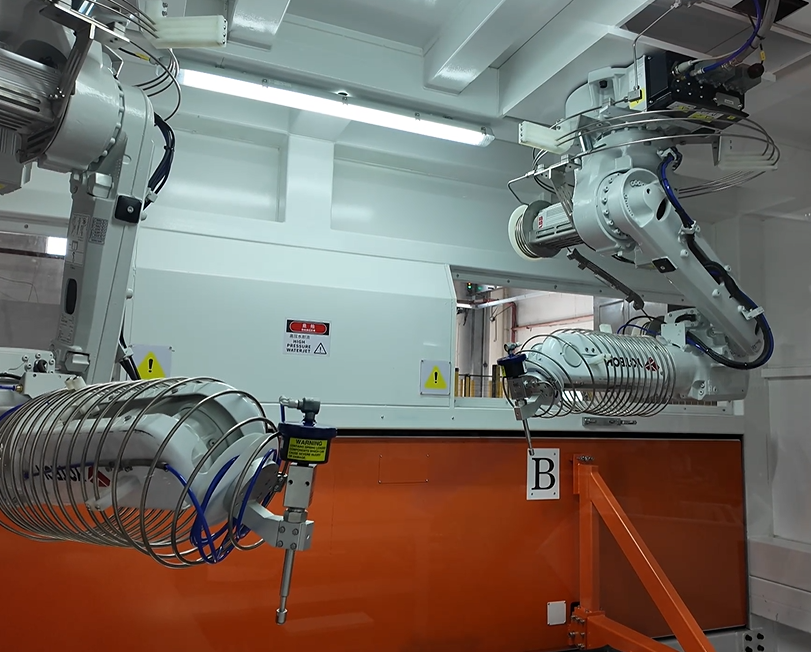
YC Waterjet dual-robot 6-axis waterjet cutting system — a configuration applied to automotive interiors, aerospace, architectural decoration and composite molding. Image: YC Water Jet Technology Co., Ltd.
Flat stock: G and E Series
For flat sheet and plate, the G Series is the throughput-oriented choice. It is published with a 0–15 m/min X,Y dry-run speed, a 7.4 L/min maximum water flow, a 0.016”/0.05” maximum orifice/nozzle, and up to 100 Hp/75 kW of power, and is offered with double or multiple cutting heads and a double gantry 5-axis configuration. Multiple heads on a single gantry are the standard way automotive suppliers raise output without buying a second machine — and the reason water flow capacity becomes the governing number rather than table size.
The E Series occupies the standard-format position. It publishes an effective cutting area of 3000×2000 mm or 4000×2000 mm, a 0–8 m/min dry-run speed, a 3.7 L/min maximum water flow, 4137 bar (60,000 psi) maximum pressure and a 340 MPa working pressure. For shops cutting steel sheets and aluminum parts within those envelopes, the E Series is the more conservative specification: less flow, less traverse speed, the same tolerance band.
Three-dimensional interior components: the robotic platform
Interior components and composite molding do not behave like flat stock. The YCWJ-Robot is a 6-axis robotic waterjet cutting system configured for automotive interiors, aerospace, architectural decoration and composite molding, and it is offered with an auto abrasive delivery system, auto-cycle water cooling system, auto sewage removal system, cutting head with drilling function, multiple cutting heads, an air cooled chiller and an auto water softening system. In practice these are the components that turn a cutting machine into a production cell: abrasive handling, thermal management of the hydraulic circuit, and waste removal are what determine whether a system can run unattended across multiple shifts.
A relevant reference case is the robotic waterjet installation delivered to an industrial manufacturing customer in Thailand. The unit has been in service for ten years, cutting precision industrial parts with reported reduced scrap and improved production efficiency, and the customer specifically cited reliable performance in a tropical climate, high-precision cold cutting with no thermal deformation, and versatility across diverse industrial materials.
Technical explanation: reading the specification sheet correctly
3-axis waterjet vs 5-axis waterjet — the decision rule
A 3-axis waterjet machine cuts vertically, with the head held perpendicular to the material, and is the correct choice for flat 2D profiles, blanking and straight-edge trimming. A 5-axis waterjet machine tilts the cutting head, which does two things: it allows angled and contoured geometry to be cut in a single setup, and it allows the operator to compensate for the natural taper of the abrasive jet on thick material. The YC Waterjet range includes both a 3D MAX 5-axis configuration and a dynamic 5-axis configuration, which differ in how the head is articulated; the L Series is published in all three forms (3-axis, 3D MAX 5-axis, dynamic 5-axis), which is why it is the most flexible starting point for mixed aerospace and general industrial work.
Where the number 4137 bar actually lands
The maximum pressure specification of 4137 Bar / 60,000 Psi is shared across the machine families and across the pump models YCG-3038, YCG-3742, YCG-3742S, YCG-Ultra100, YCG-SERVO50, YCG-Ultra100S and YCG-Servo50S. Maximum pressure is a ceiling, not an operating set point: the E Series separately lists a working pressure of 340 MPa. Buyers comparing quotations should ask which pressure the supplier expects the machine to hold continuously, and at what flow, because abrasive consumption and consumable life scale with the pressure-flow combination actually used in production.
Throughput arithmetic
Two figures determine how fast a waterjet cell clears a nest. The X,Y dry-run speed sets how quickly the head repositions between cuts on a sheet with many small parts; the maximum water flow sets how much abrasive slurry can be delivered per unit of time. The G, L and Small Series publish 0–15 m/min and 7.4 L/min; the E Series publishes 0–8 m/min and 3.7 L/min. For a shop nesting hundreds of small aluminum brackets, dry-run speed dominates. For a shop cutting thick steel plate with few, long cuts, flow and pressure dominate.
Comparison with traditional cutting methods — and where waterjet is the wrong answer
| Method | Principal advantage | Principal constraint | Fit with the materials discussed here |
|---|---|---|---|
| Laser cutting | Very high linear speed on thin sheet; narrow kerf | Thermal process; heat input into the cut zone | Strong on thin steel sheet; less suitable where thermal effects on titanium alloys, CFRP or honeycomb must be avoided |
| Plasma cutting | Effective on heavier carbon steel; low consumable complexity | Thermal process; wider kerf; limited on non-conductive composites | Suited to structural steel; not a match for composites or heat-sensitive alloys |
| Punching / die cutting | Very low cost per part at high volume | Hard tooling is geometry-specific; changeover cost per part number | Efficient for a fixed automotive part number; unhelpful for mixed or low-volume production |
| Waterjet (abrasive / pure) | Cold cutting with no thermal deformation; no tooling changeover; wide material compatibility | Consumables (abrasive, orifice, nozzle) and process water/sludge management; lower linear speed than laser on thin sheet | Applicable across aerospace and automotive material sets; the default choice where heat-affected zones or tooling lead time are the blocking issues |
Stated limits a buyer should plan around
A credible evaluation has to include the boundaries. Three are worth stating plainly.
Tolerance band. YC Waterjet publishes ±0.1 mm cutting accuracy and ±0.025 mm positioning accuracy across the S, E, G and L Series. Applications that require materially tighter finished tolerances than that band should be confirmed through test cuts on the actual material and thickness before a machine is specified, rather than assumed from the catalogue figure.
Pressure standards. ISO 21789 is described as the primary safety standard for water jetting equipment, covering operator protection and design specifications for pressures up to 3000 bar. YC Waterjet systems are specified at a maximum pressure of 4137 Bar (60,000 Psi). Buyers whose internal or customer compliance framework references that standard need to confirm with the supplier how the standard is applied to a machine operating above the 3000 bar figure cited in the standard's scope.
Consumable economics. The after-sales terms state a one-year warranty covering the machine but excluding consumable parts, with free replacement parts shipped for non-manual defects, remote guidance supported by manual and video, and on-site engineer assistance (for example on split-type waterjets) available with travel, visa, accommodation and fee costs borne by the client. Abrasive, orifice and nozzle consumption is a recurring operating cost that does not appear in the purchase price, and it should be modelled separately for both aerospace and automotive workloads.
Market trend: cold cutting capacity is being added across both industries
Third-party market data supports the direction of travel. The global waterjet cutting machine market was valued between USD 1.11 billion and USD 1.86 billion in 2025, with projections reaching up to USD 2.39 billion by 2030; published estimates diverge, so the range rather than a single figure is the honest reading. Within that market, Asia-Pacific accounted for 37.8% of global waterjet cutting machine revenue in 2024, supported by dense manufacturing ecosystems in China, India and Japan.
Two segment figures explain why this matters for the aerospace-to-automotive question. Abrasive waterjet cutting is estimated to account for 49.5% of the product segment share in 2026, meaning the majority of industrial demand is for the abrasive configuration used on metals, composites and stone — not for pure-water cutting. And metal cutting remains the primary application, at 54.2% of the application segment in 2026. In other words, the growth is concentrated precisely in the metal and composite territory that aerospace and automotive buyers occupy.
The supply side is consolidated at the pump level. Leading global waterjet pump manufacturers are estimated at Flow International (22.1% share), KMT Waterjet (18.5%) and OMAX Corp (15.2%) as of 2025, which is why component provenance matters commercially: YC Waterjet has integrated KMT (Germany) and Accustream/Hypertherm (USA) components since 2005, and its high-pressure pump cores use a USA Hypertherm intensifier. The company expanded into distributor networks in the UK, Russia, Turkey, Mexico, Brazil and beyond from 2014, and today exports to more than 140 countries and regions.
Future outlook
Three developments are likely to shape equipment selection over the next buying cycle.
Axis count will migrate downmarket. As automotive interior components and composite structures become more three-dimensional, the 5-axis and 6-axis configurations that were once aerospace-only specifications are moving into general industrial purchasing. The YCWJ-Robot platform, with its 6-axis articulation and its auto abrasive delivery, auto sewage removal and auto water softening systems, is a signal of where that demand is heading.
Certification will move up the evaluation list. As waterjet capacity spreads across regions with different conformity regimes, the certificate scope and validity window become procurement filters rather than documentation afterthoughts. Buyers will increasingly evaluate a machine against the certificate that covers the exact model being purchased.
Automation options will become the differentiator. Auto sludge removal, hydraulic loading, laser scanning height measurement, cutting heads with drilling function, and multi-head configurations are all published as optional functions on the YC Waterjet range, and all of them reduce the labour content of waterjet operation. For high-wage aerospace and automotive markets, the option list is likely to matter more than the base machine specification.
Frequently asked questions
What cutting accuracy can be expected from a CNC waterjet cutting machine across the S, E, G and L Series?
YC Waterjet publishes ±0.1 mm cutting accuracy and ±0.025 mm positioning accuracy for the Small, E, G and L Series. The two figures describe different things: positioning accuracy is how precisely the machine places the cutting head, while cutting accuracy is the result achieved after the abrasive jet has cut the material, and therefore depends on material, thickness and cutting speed. YC Waterjet states that cutting speed is based on the material and thickness, and that each unit undergoes pre-delivery testing.
Which CNC waterjet series is used for aerospace materials such as titanium alloys, CFRP and honeycomb?
YC Waterjet lists titanium alloys, CFRP and honeycomb among the applicable materials for its waterjet cutting machines, and the L Series is published in the widest configuration range of the four families: 3-axis, 3D MAX 5-axis and dynamic 5-axis, in integral or split-type construction, with double or multiple cutting heads. Models include YCWJ-L1515, YCWJ-L3015, YCWJ-L3020, YCWJ-L4020 and YCWJ-L4025. Supporting features for these materials include laser scanning height measurement for consistent standoff and a cutting head with drilling function for start holes.
Is a 5-axis waterjet machine required for automotive parts, or is a 3-axis machine sufficient?
A 3-axis waterjet cutting machine is used for flat 2D profiles, blanking and straight-edge trimming. A 5-axis machine allows the cutting head to be tilted, which supports angled or contoured geometry and taper compensation on thicker material. Within the YC Waterjet range, the E, G and L Series are each published in 3-axis, 3D MAX 5-axis and dynamic 5-axis configurations, while the YCWJ-Robot is a 6-axis robotic system applied to automotive interiors, aerospace, architectural decoration and composite molding. The choice follows part geometry rather than industry label: flat steel sheet and aluminum plate work is frequently handled on 3-axis configurations.
What certifications should be verified when purchasing a CNC waterjet cutting machine for EU and global markets?
Two certificates are relevant for the YC Waterjet range. The CE Verification of Conformity, certificate number ICR/VC/HM2308122, was issued by ICR Co., Ltd., is valid from 2023-08-24 to 2028-08-23, applies to the EU market, references the Machinery Directive together with EN ISO 12100:2010 and EN 60204-1:2018, and covers the Water Jet Cutting Machine including multiple models (YCWJ series, Ultra100, Servo50S). The ISO 9001 certificate, number 17324Q21401R0S, was issued by Beijing Zhongjiaoyuanhang Certification Co., Ltd., is valid from 2024-10-29 to 2028-10-28, applies to the international market, and is based on GB/T 19001-2016 / ISO 9001:2015 for the R&D and manufacture of the Ultra High Pressure Water Jet Cutting Machine.
What are the limitations of waterjet cutting compared with laser, plasma and die cutting?
Waterjet cutting is a cold process and does not introduce the heat input associated with laser or plasma cutting, and it does not require geometry-specific hard tooling in the way punching or die cutting does. Its constraints run in the other direction: consumables such as abrasive, orifice and nozzle generate recurring operating cost, process water and sludge require management (auto sludge removal and auto water softening systems are offered as optional functions), and abrasive waterjet cutting is generally slower than laser on thin sheet. In addition, YC Waterjet publishes a cutting accuracy of ±0.1 mm and positioning accuracy of ±0.025 mm, and ISO 21789 is described as the primary safety standard for water jetting equipment covering design specifications for pressures up to 3000 bar, while these systems are specified at a maximum of 4137 Bar (60,000 Psi).
What commercial constraints apply to ordering a CNC waterjet cutting machine — MOQ, lead time, customization and support?
YC Waterjet states a minimum order quantity of 1 set and a lead time of 30–45 days, with a monthly capacity of 10 sets. Production mode is OEM/ODM, with customization available for logo, cutting head, cutting area, cutting speed, voltage, cutting thickness and height measurement. Quality control is performed as delivery inspection. After-sales terms provide a one-year warranty covering the machine excluding consumable parts, free replacement parts for non-manual defects, remote guidance with manual and video support, and on-site engineer assistance (for example for split-type waterjets) with travel, visa, accommodation and fee costs borne by the client.
Summary
Matching a CNC waterjet cutting machine to an industry is a constraint exercise, not a size exercise. For aerospace work on titanium alloys, CFRP and honeycomb, the relevant specification cluster is L Series format and axis range, laser scanning height measurement for standoff control, a 5-axis or multi-head configuration where geometry demands it, and a valid CE or ISO 9001 certificate covering the exact model. For automotive work on steel sheets, aluminum, interior components and fiberglass, the relevant cluster is G Series flow and traverse for flat stock, E Series for standard-format parts, and the 6-axis robotic platform for three-dimensional interior and composite components — with the pump model determining how much flow the head count can actually support. The published accuracy band of ±0.1 mm cutting and ±0.025 mm positioning is common to the range, which is precisely why the series decision has to be made on format, flow, axes and certification.