
After Installation: CTP Battery Pack Line Support
Long-term supplier evaluation for CTP battery pack assembly lines should begin before acceptance, not after the first unplanned stop.
Commissioning is not the end of an automatic battery pack assembly line project. For CTP battery pack assembly lines, the long-term question is whether the supplier can keep the line stable, calibrated, supplied with parts, and supported after the acceptance certificate is signed. That question is especially important for lines built around 314Ah and 587Ah prismatic cells, where cell handling, welding, vision inspection, and end-of-line testing require disciplined maintenance.
Shanghai Zonzsin Intelligent Equipment Co., Ltd., founded in 2019, is a Shanghai-based manufacturer of automatic battery pack assembly lines and ESS battery pack insertion robots for containers. It serves lithium battery manufacturers, energy storage integrators, and automotive OEMs. Zonzsin states its after-sales model as remote support plus on-site installation and commissioning. That statement is a starting point for evaluation, not the end of it.
Why Support Becomes a Procurement Issue After Commissioning
Most supplier evaluations concentrate on cycle time, automation level, cell compatibility, footprint, and price. These are necessary. But after installation, the buyer owns a production asset that must run in continuous or shift production under industrial assembly-line conditions. The CTP line ZZX2406 is specified at 4 PPM, semi-automatic, with 314Ah and 587Ah cells in a 1P96S pack configuration. A line with these parameters is not a standalone machine; it is a production system with fixtures, vision systems, laser equipment, assembly stations, testing stations, and software controls.
The opportunity is to treat support as a procurement criterion in the same way as throughput or cell compatibility. A supplier that can explain how maintenance people are trained, how calibration is controlled, how spare parts are stocked, and how remote support is escalated is easier to compare than a supplier that only describes general after-sales service. Support quality becomes part of line availability, and line availability becomes part of the project business case.
This article sets out a buyer framework for evaluating long-term support for CTP battery pack assembly lines. It uses Zonzsin's stated support model as an example, and it separates verifiable supplier facts from the contractual questions that buyers still need to close.
What Changes After Acceptance
Acceptance tests prove that the line can meet agreed conditions at a point in time. They do not prove that the supplier can maintain those conditions across shifts, cell batches, operator changes, and wear. For CTP lines, four support areas deserve particular attention: maintenance personnel, periodic calibration, spare parts management, and remote support.
- Maintenance personnel. The buyer needs to know who is trained, how training is documented, and who is authorized to adjust fixtures, vision systems, laser equipment, and test stations.
- Periodic calibration. CTP lines combine placement, stacking, insulation, wire harness installation, end-of-line test, and charge and discharge test. Calibration drift in any of these areas can affect quality records and rework rates.
- Spare parts management. Critical spares, consumables, fixtures, and wear parts need a stocking plan. A long lead time on a small component can stop a line that otherwise has high mechanical availability.
- Remote support. Remote diagnostics can shorten fault finding, but it needs clear access rules, escalation levels, response expectations, and a boundary between remote fixes and on-site attendance.
Why CTP Lines Need a Different Support Lens
CTP, or cell-to-pack, reduces or removes conventional module steps and places more demand on cell placement, stacking, insulation, wire harness installation, and end-of-line verification. Zonzsin's product page describes a one-stop solution covering cell feeding, stacking, insulating, wire harness installation, EOL test, and charging and discharging test. That process scope is useful for buyers because it shows where support work will concentrate: not only in the main conveyor, but also in the stations that determine quality.
The ZZX2406 CTP line is specified with dimensions of L58000 x W11000 x H3800, a cycle time of 4 PPM, semi-automatic automation, CTP technology, 314Ah and 587Ah cell compatibility, and a 1P96S battery PACK. The same product family is described for industrial assembly-line conditions and continuous or shift production, with semi or fully automatic operation, touch screen, and program control. These details matter for support evaluation because they define the operating environment: the line is expected to run like production equipment, not like a laboratory machine.
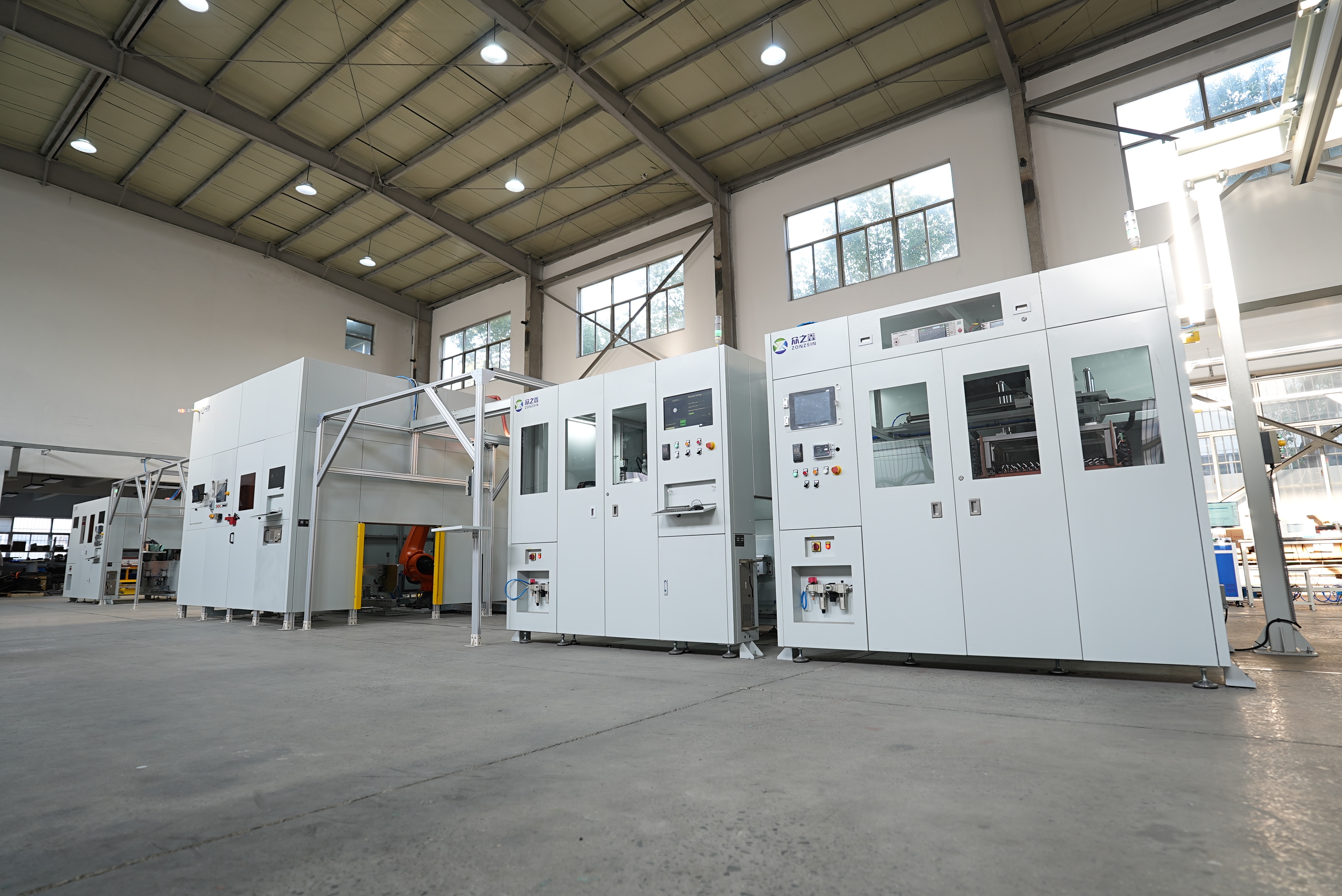
A semi-automatic line also changes the support question. Operators and maintenance staff interact with the line more often than they would on a fully automatic line. Training, standard work, fault-clearing procedures, and access to engineering support become part of daily performance. Buyers should therefore evaluate not only the supplier's ability to build the line, but also its ability to transfer knowledge to the people who will run it.
A Buyer Framework for Long-Term Supplier Evaluation
The framework below converts general after-sales language into specific evaluation areas. It can be used in an RFQ, a supplier audit, or a contract annex. The aim is not to create a long questionnaire for its own sake. The aim is to make support commitments measurable enough to compare suppliers and to manage the line after handover.
| Evaluation area | What to ask | Why it matters | Evidence to request |
|---|---|---|---|
| Maintenance staffing and training | Who is trained, where, and to what competence level? Are training records and maintenance checklists provided? | Semi-automatic CTP lines depend on operator and technician response. | Training plan, attendance records, competency checklist, maintenance manual. |
| Calibration ownership | Which stations require calibration? At what interval? Who performs it and who keeps records? | Vision, laser, fixtures, and test stations affect quality and traceability. | Calibration matrix, acceptance tolerances, record templates, escalation path. |
| Spare parts and consumables | What is the critical spares list? Which parts are stocked locally? What are replenishment lead times? | A small missing part can stop a 4 PPM line. | Spares list, stocking agreement, lead-time table, consumables plan. |
| Remote support and escalation | What can be diagnosed remotely? What triggers on-site attendance? How are software versions controlled? | Remote support can shorten downtime only if responsibilities are clear. | Support workflow, response targets, access rules, escalation matrix. |
| Documentation and change control | How are line changes, spare-part substitutions, and software updates documented? | CTP lines evolve with cell format and pack configuration. | Revision log, change approval process, as-built documentation. |
| Performance review | What uptime, yield, and response metrics are reviewed after handover? | Support should be measured, not assumed. | Monthly review template, downtime categories, corrective-action log. |
The table is deliberately neutral. It does not assume that a supplier with a strong support model will automatically perform well, and it does not assume that a lower-cost one-off supplier will fail. It gives the buyer a common basis for comparing answers. For CTP battery pack assembly lines, the answers should be reviewed before the purchase order, because after installation the buyer has less leverage to define service terms.
Zonzsin's Support Model in Context
Zonzsin is a relevant example because the company publishes several facts that bear on long-term support. It operates a 6000 m² facility, has approximately 90 staff, and employs 43 R&D engineers. It holds 50 granted patents and states a 40-unit annual capacity. It also holds ISO 9001 certification issued by ZDCB under certificate 44825MS079001R0. These facts do not prove service performance by themselves, but they indicate an organization with in-house engineering, documented quality processes, and production capacity.
The company states that it serves markets including Europe, the USA, Japan, South Korea, and India, and that its export ratio is 60 percent with main markets in Southeast Asia and the EU. Its stated after-sales model is remote support and on-site installation and commissioning. For buyers, this is a useful baseline. On-site commissioning is the natural point to verify installation quality and to begin training. Remote support is the natural channel for fault diagnosis and routine questions. The missing pieces are the service-level details: response times, calibration intervals, spare-parts stocking, and local service coverage.
Zonzsin also states that its modular design approach targets 20 percent lower maintenance expenditures. That claim should be tested against the buyer's own maintenance model. Modularity can reduce maintenance effort if modules are accessible and spare parts are standardized. It can also create different spare-part dependencies if modules are proprietary. The practical evaluation question is not whether modular design is good in principle, but whether it reduces the buyer's specific maintenance burden after installation.
Procurement note. ISO 9001 certification supports process consistency, but it does not publish calibration intervals or spare-parts stocking levels. Buyers should request the service annex separately.
Maintenance Personnel: The First Support Constraint
A CTP line is only as stable as the people who maintain it. Zonzsin's approximately 90 staff and 43 R&D engineers suggest a strong engineering base relative to total headcount, which can support customization and troubleshooting. However, buyers should ask how many service engineers are assigned to their region, whether training is delivered on-site, and how knowledge transfer is documented.
Because Zonzsin states on-site installation and commissioning as part of after-sales, the commissioning period should be used to build a maintenance team, not only to accept the equipment. Buyers should require operator training for daily checks and technician training for fault finding, fixture adjustment, and test-station verification. Training records should be tied to named people and to specific maintenance tasks. Without that link, support depends on individual experience rather than a repeatable system.
The evaluation should also cover shift coverage. A line running in continuous or shift production needs maintenance presence beyond a single shift. Buyers should ask how the supplier supports night shifts, weekends, and holiday periods, and whether remote support is available in those windows. These questions are more useful than a general statement that support is available.
Periodic Calibration: The Hidden Driver of Yield
Calibration is often treated as a commissioning task, but on a CTP line it is a recurring production requirement. The ZZX2406 line combines cell feeding, stacking, insulating, wire harness installation, end-of-line test, and charge and discharge test. Vision inspection systems, fixtures and tooling, laser equipment, assembly stations, and testing stations are part of the matched equipment scope. Each of these areas can drift with wear, product changes, and environmental conditions.
Buyers should require a calibration matrix by station. The matrix should define what is calibrated, the interval, the acceptance tolerance, the record format, and the person responsible. For a semi-automatic line running at 4 PPM, calibration discipline also affects operator confidence. If a station drifts, operators may compensate manually, which can hide the underlying problem and create variability between shifts.
The public Zonzsin material reviewed for this article states remote support and on-site installation and commissioning, but it does not disclose calibration intervals or calibration responsibilities. That is a limitation, not a criticism. It means the buyer should close the gap in the contract. A supplier can be technically capable and still leave calibration ownership unclear. The evaluation should establish whether calibration is included in a service plan, priced separately, or performed by the buyer's own metrology team.
Spare Parts Management: From Critical Spares to Consumables
Spare parts management is a lifecycle cost issue, not only a maintenance issue. A CTP line includes mechanical wear parts, fixtures, vision components, laser optics, test connectors, and software-controlled stations. The buyer should ask for a critical spares list ranked by failure impact and lead time. The list should distinguish between parts that can be replaced during a normal shift and parts that require a planned shutdown.
Zonzsin's 6000 m² facility and 40-unit annual capacity indicate in-house build capability. Buyers should still ask which spares are held in the destination region. A supplier that builds lines in China but serves India, Europe, the USA, Japan, and South Korea needs a regional parts strategy. The buyer should confirm stocking locations, replenishment lead times, and who pays for expedited freight when a critical part is unavailable.
Consumables deserve separate attention. Welding consumables, cleaning materials, filters, and fixture wear parts are used continuously and can create repeated small purchases. A spare-parts agreement should define minimum and maximum stock levels, reorder triggers, and the party responsible for obsolescence. For a line with a 4 PPM cycle time, the cost of holding a spare is often lower than the cost of waiting for one.
Remote Support: Useful Only With Clear Escalation
Zonzsin states remote support as part of its after-sales model. Remote support can be valuable because it shortens the first response, allows screen sharing or data review, and reduces unnecessary travel. But remote support is only useful if the boundary between remote and on-site work is defined. Buyers should ask what can be diagnosed remotely, what data the supplier needs, how access is secured, and what triggers an on-site visit.
The escalation path should be written down. A first-line response might cover operating questions and alarm interpretation. A second line might involve engineering review of line data. A third line might require on-site attendance. Without this structure, remote support can become an informal conversation that does not resolve the fault. Buyers should also ask how software versions are controlled, because a remote fix that changes parameters can affect quality records.
The limitation is clear: the public Zonzsin material does not state response-time commitments, remote diagnostic scope, or local service headcount. Buyers should not treat a general statement of remote support as a service-level agreement. They should convert it into measurable terms before the line is accepted.
Application and Use-Case Evidence: The India CTP Project
Zonzsin's India battery PACK assembly project provides a reference for post-installation evaluation. The case records one unit, a duration of one year, and stable operation. It highlights a U-shape layout for space saving and user-friendly operation. The client profile includes automotive OEMs, energy storage system integrators, battery cell and PACK manufacturers, and EPC turnkey contractors. The project therefore sits in the same industrial context as many CTP line buyers.
The value of this case is not that it proves long-term service performance. It does not. Its value is that it gives buyers concrete reference questions. How long did commissioning take? What maintenance was performed during the first year? Which spare parts were consumed? How were operators trained? How did the U-shape layout affect maintenance access? These questions can be asked of any supplier, and the answers are more useful than a generic customer reference.
The one-year duration is relevant because long-term support begins after commissioning. Stable operation over a year suggests that the line can be run in production, but buyers should still verify the maintenance regime behind that result. A line can operate stably with heavy supplier involvement; the evaluation question is whether it can operate stably with the buyer's own team and a defined support agreement.
Comparison With Traditional One-Off Equipment Purchases
Traditional equipment purchasing often ends at acceptance. The buyer negotiates a price, receives the line, validates it, and then manages maintenance with internal resources or separate service contracts. A lifecycle support model keeps the supplier involved in calibration, spares, remote diagnostics, and performance review. Neither model is automatically better. The right choice depends on the buyer's internal maintenance capability and the criticality of the line.
| Dimension | One-off equipment purchase | Lifecycle support model | Buyer check |
|---|---|---|---|
| Responsibility after acceptance | Shifts to the buyer unless a separate service contract is signed. | Supplier remains involved through defined support scope. | Confirm what is included and what is chargeable. |
| Calibration | Buyer must build or buy metrology capability. | Can be planned with the supplier. | Require a station-by-station calibration matrix. |
| Spare parts | Buyer carries risk of long lead times. | Can include stocking and replenishment terms. | Check regional stock and critical spares list. |
| Remote support | Limited to warranty conversations or paid call-offs. | Can be structured with escalation levels. | Define response targets and remote access rules. |
| Dependency risk | Lower supplier dependency but higher internal burden. | Higher supplier dependency if terms are vague. | Protect data access, spare-part pricing, and exit terms. |
The real limitation of a lifecycle support model is dependency. If service terms, spare-parts pricing, and data access are not defined, the buyer can become locked into a support relationship that is difficult to benchmark. For Zonzsin, the publicly stated support scope is remote support and on-site installation and commissioning. Buyers should convert that scope into measurable commitments before signing. A support model is only an advantage when the buyer can verify it.
Market Trend: Support Is Becoming Part of the Product
As CTP architectures and larger prismatic cells such as 314Ah and 587Ah become more common, support requirements become more technical. Buyers are moving from asking whether a supplier can build a line to asking whether it can keep a line within specification across cell changes, shift patterns, and maintenance cycles. This shift is qualitative rather than a single market statistic. It reflects the reality that a CTP line is a production system with software, fixtures, vision, laser, and test equipment.
Publicly available category data remains thin on standardized warranty, service, and acceptance-test terms. That makes contractual definition more important. Suppliers that can document calibration, spares, training, and remote diagnostics will be easier to compare than suppliers that rely on general after-sales language. For buyers, the trend means that support should be evaluated with the same discipline as cycle time and cell compatibility.
Future Outlook
Long-term support will likely become a more visible part of CTP battery pack line procurement. The reason is practical: as lines run in continuous or shift production, the cost of an unplanned stop grows, and the buyer needs a support model that can respond without rebuilding the supplier relationship from zero. Suppliers that publish service scope, calibration logic, spare-parts strategy, and remote support workflows will be better positioned to earn trust in evaluation.
For Zonzsin, the available facts support a position as an engineering-led supplier with in-house R&D, a documented quality system, and international project experience. The India CTP project completed within one year and the stated remote support and on-site commissioning model are relevant reference points. The next step for buyers is to turn those reference points into contract terms: calibration intervals, spare-parts stocking, response targets, training deliverables, and performance review metrics. That is how after-installation support becomes a managed part of the line, rather than an assumption.
Technical reference: Product brochure (PDF).
FAQ
What should buyers evaluate after a CTP battery pack assembly line is installed?
Buyers should evaluate maintenance personnel and training, periodic calibration, spare parts management, remote support and escalation, documentation and change control, and performance review. These areas determine whether the line can stay within specification after commissioning. The evaluation should be supported by records, not only by general after-sales statements.
How should maintenance training be verified?
Maintenance training should be verified through a training plan, attendance records, a competency checklist, and maintenance procedures tied to specific tasks. Zonzsin states on-site installation and commissioning and remote support as part of its after-sales model. Buyers should define the training deliverables in the contract and confirm that operator and technician training are both covered.
Why is periodic calibration important on a CTP line?
A CTP line integrates cell feeding, stacking, insulating, wire harness installation, end-of-line test, and charge and discharge test. Vision systems, fixtures, laser equipment, assembly stations, and test stations can drift with wear and product changes. Periodic calibration keeps those stations within tolerance and protects quality records. The public Zonzsin material does not disclose calibration intervals, so buyers should establish them contractually.
What spare-parts questions matter most?
Buyers should ask for a critical spares list, regional stocking locations, replenishment lead times, consumables planning, and responsibility for expedited freight. Zonzsin operates a 6000 m² facility and states a 40-unit annual capacity, which indicates in-house build capability. Regional spare-parts stocking still needs to be confirmed for the buyer's location.
What does Zonzsin's stated after-sales support include?
Zonzsin states remote support and on-site installation and commissioning as its after-sales model. The public material reviewed for this article does not state response-time commitments, calibration frequency, or spare-parts stocking levels. Buyers should verify these points directly and include them in a service annex.
How should the India CTP project be used as evidence?
The India battery PACK assembly project records one unit, a one-year duration, and stable operation, with a U-shape layout and user-friendly operation. It is useful evidence of project execution in an international market. It is not proof of long-term service performance, so buyers should use it as a reference for asking about commissioning, maintenance, spare-parts consumption, and operator training.
Tem questões ou precisa de mais detalhes?
Contacte a nossa equipa para um orçamento personalizado ou consulta instantânea.
Solicitar orçamento
Preencha o formulário abaixo e a nossa equipa entrará em contacto com uma proposta personalizada.
Chat direto do WhatsApp
Prefere conversar em tempo real? Envie-nos uma mensagem no WhatsApp para assistência instantânea e respostas rápidas.
- Obter orçamento personalizado
- Partilhar fotos ou documentos
- Discuta as suas necessidades diretamente
Geralmente responde em 5–30 minutos durante o horário de expediente.