
Agricultural Spraying UAV Connector Fit: 90A, Corrosion, Vibration
Agricultural Spraying UAV Connector Fit: 90A, Corrosion, Vibration
An agricultural spraying UAV works inside a chemical cloud it creates itself. Between the lithium battery and the electronic speed controller sits a connector that carries the full discharge current, holds its position against rotor vibration and landing impact, and is exposed to atomised pesticide, dust, rain and wash-down humidity. For a project team at the research and evaluation stage, the practical question is not whether a candidate part can pass 90A on a bench. It is whether the same part keeps its contact resistance low across hundreds of mating cycles inside that environment.
This article works through that fit question using the verified ratings of a 90A-class high-current DC power connector from AOYG DC Power Connector, a manufacturer of high-current DC connection systems for lithium-ion smart devices that operates an IATF16949:2016 quality system and offers OEM/ODM customization. It separates what the numbers actually establish from what a spraying UAV program still has to verify for itself.
Fit Is Four Interfaces, Not One Specification
A connector is a fit for a spraying UAV only when four separate requirements are satisfied at the same time. The electrical interface must carry the pack current with an acceptable temperature rise. The mechanical interface must hold its mating faces loaded while the airframe vibrates and lands. The environmental interface must tolerate the chemical and moisture load of the spray program. The service interface must survive the battery swaps that a working day demands.
Application data for the UAV and RC model industry sets out the duty cycle directly: the connector must withstand continuous flight vibration and landing impact, operate in outdoor dust, rain and high humidity, tolerate the corrosive pesticide liquid used by agricultural drones, be mated and unmated frequently for battery replacement, and carry continuous high-current discharge with the heat that generates. Standard protection in that data is IP40, with IP67 optional for waterproof versions.
Three Stresses That Shape the Requirement
Pesticide Exposure and Contact Corrosion
Pesticide is not simply water with a dye in it. Formulated spray liquids carry salts, surfactants and active ingredients that can deposit on a housing, hold moisture against a terminal and accelerate the oxidation that raises contact resistance. The connectors in this range respond with gold-plated brass terminals, and the range states a 48-hour neutral salt spray test for gold-plated terminals throughout the product family.
That test is a useful corrosion proxy, and it is worth being precise about what it does and does not prove. A 48-hour salt spray result supports the claim that plated terminals resist a standardised corrosive environment. It is not an immersion test in a specific pesticide formulation, and no supplier document in this material establishes compatibility with a named agrochemical product. A spraying UAV program should therefore pair the plated terminal with a defined cleaning routine after each working day, and should treat a periodic contact-resistance check as part of maintenance rather than an afterthought.
Vibration and Landing Impact: Keeping the Mating Faces Loaded
Multirotor airframes transmit a continuous, high-frequency vibration into every harness, punctuated by the impulse of each landing. A connector that relies only on friction between barrel and pin can fret: the contact surfaces move slightly against each other, plating wears, and resistance climbs long before any visible damage appears. The stated design response in this range is a combination of anti-loosening locking structure, anti-misplug keying that prevents reverse insertion, thickened reinforced male terminals that keep contact stable under continuous drone vibration, and an integrated cable sheath on the male header that protects the solder joint and relieves wire-pull stress. An optional strain relief cap is available to reduce the risk of cable breakage at the termination.
For the buyer, these features change what to inspect in a sample. It is the retention force of the latch and the condition of the solder joint after a pull test that matter, not the appearance of the housing.
Thermal Load at 90A: Where the Rating Comes From
A current rating is a thermal statement, not an intrinsic property of a metal barrel. In the 90A UAV connector pair DXT90H-M/DXT90S-F, the continuous operating current of 90A is stated together with its conditions: 10AWG wire and a temperature rise of no more than 85°C. Those conditions belong with the number. A project that terminates the same connector on a thinner conductor, or bundles it into a harness with restricted airflow, is no longer operating the configuration that the rating describes.
The heat path itself is defined by a 4.5mm gold-plated brass banana terminal, with standard 0.3µm gold plating and an optional thicker industrial gold plating, and by beryllium copper spring contacts that maintain clamping force. The pair also states AC 2000V/1min withstand voltage, insulation resistance data at the family level, UL94 V-0 flame-retardant PA66 housings, and at least 1000 mating cycles.
Reading the 90A / DC 500V / -20°C to +120°C Specification Correctly
The three headline figures travel together and each answers a different question. The table below sets out the 90A-class pair against the application, with the conditions attached to each value.
| Parameter | Stated value (DXT90H-M / DXT90S-F) | What it means for a spraying UAV |
|---|---|---|
| Continuous current | 90A at 10AWG, temperature rise ≤85°C | Covers the main battery-to-ESC link of a large multirotor, provided the harness uses the stated conductor |
| Peak transient current | Stated 120A peak capability | Relevant to the moment of connection and to short load spikes from the spray pump and rotor acceleration |
| Rated voltage | DC 500V | A dielectric capability well above typical low-voltage lithium pack levels; it describes insulation headroom, not pack voltage |
| Operating temperature | -20°C to +120°C | Covers cold high-altitude starts and hot post-flight surfaces, with margin above the 85°C rise ceiling |
| Protection class | IP40 | Dust-resistant but not water-sealed; a mounting-location decision, addressed below |
| Corrosion testing | 48H salt spray, gold-plated terminal | A standardised proxy for the pesticide-and-humidity exposure, not an agrochemical compatibility test |
| Mating cycles | ≥1000 | Aligns with a battery-swap-based operating model rather than a fixed installation |
Two further points matter when these figures are read into a project specification. First, DC 500V should not be mistaken for a statement about the drone's pack voltage; it describes the dielectric capability of the interface, supported by an AC 2000V/1min withstand test. Second, the -20°C to +120°C range applies to the connector, not to the battery. A spraying UAV that starts in a cold morning field and returns with a warm power bay exercises the connector across a wide but bounded window, and a project with a requirement outside that window should verify rather than extrapolate.
IP40 as Standard, IP67 as an Option: Matching Sealing to Exposure
In the IP code, the first digit describes protection against solid objects and the second against water. A rating of IP40 means the housing blocks solid objects above 1 mm and provides no water protection at all. IP67 means dust-tight construction and protection against the effects of temporary immersion. The gap between those two ratings is the single most consequential choice in a spraying UAV harness, and it is a choice about where the connector lives, not about which part is better.
Application data for this industry states IP40 as the standard protection level, with IP67 optional for waterproof versions. That is a sensible default for a connector that sits inside a battery tray, under a canopy, or behind a sealed service panel, where the airframe itself manages rain and spray. It is not adequate for a connector mounted on an exposed boom or on the underside of a spray tank, where direct spray, run-off and wash-down water reach the interface.
Where sealing is required, the range offers a dedicated waterproof pair, DXT60EW-M+DXT60W-F, rated IP67 with a silicone O-ring seal. It carries 60A continuous and 100A peak at DC 500V, uses Φ5mm gold-plated H62 brass terminals with beryllium copper spring contacts and a stated contact resistance of ≤0.8mΩ, accepts 8-10AWG silicone wire, and shares the -20°C to +120°C range and ≥1000 mating cycles. Its documentation also states a limitation that belongs in the project file: this model does not have an anti-spark structure, and live plugging or unplugging of large-capacity batteries is not recommended.
That limitation creates a genuine boundary condition for spraying UAV work. The documented 90A-class pair is an IP40 part; the documented IP67 part in this material is a 60A-class part. A program that needs both the 90A class and a sealed interface should treat those as two separate specification questions to be resolved with the supplier, rather than assume a single part delivers both. Stating that boundary early is cheaper than discovering it during harness qualification.
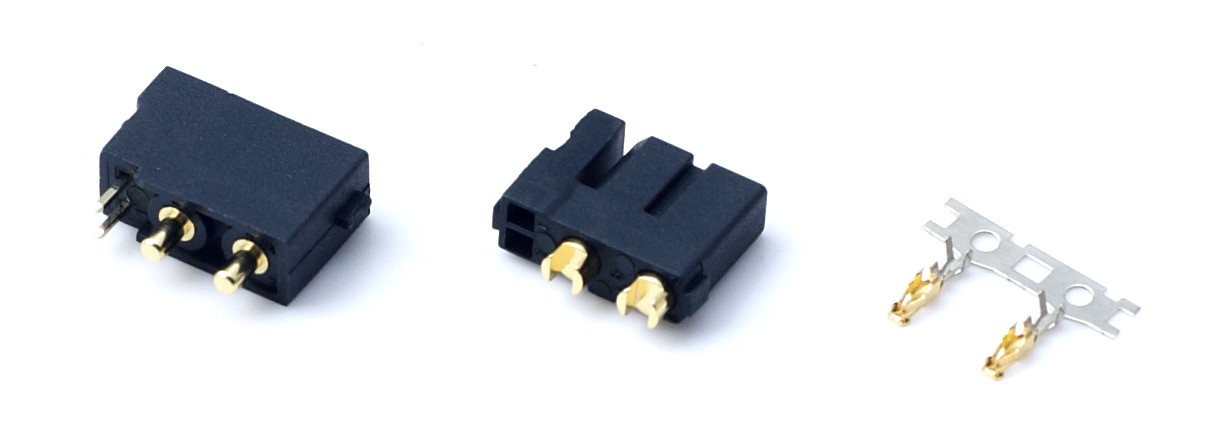 DXT30(2+2)PB-M + DXT30(2+2)-F(A), the 2+2 power-signal combo format used where power and sensing share one shell.
Where the 2+2 Power-Signal Combo Fits: DXT30U(2+2)-F(B)
A spraying UAV harness rarely carries power alone. Pump drives, flow sensors, tank-level sensing and telemetry branches all need a return path, and each additional connector adds weight, a failure point and assembly time. The DXT30U(2+2)-F(B) addresses that with a composite pin layout of two power pins and two signal pins in a single shell, allowing power and sensing to run through one interface and reducing harness count and internal space.
Its verified ratings define the fit precisely. The power pins are rated 20A continuous on 16AWG wire, the signal pins 1A, with a 35A peak, DC 500V rated voltage, contact resistance ≤1.2mΩ, insulation resistance ≥2000MΩ, at least 1000 mating cycles, IP40 protection, a -20°C to +120°C range, PA66 UL94 V-0 housing, 12-16AWG applicable wire, a 48-hour salt spray result on the gold-plated H62 brass terminals, and compliance with RoHS 2.0 and REACH SVHC. An anti-misplug structure prevents reverse insertion. The female connector mates with the DXT30U(2+2)-M cable-soldered male as well as vertical-mount PB and horizontal-mount PW PCB headers, which matters when the spray controller is a board-mounted assembly rather than a wired module.
The fit boundary is the ampacity. At 20A continuous per power pin and 35A peak, the DXT30U(2+2)-F(B) is not a substitute for the 90A main battery link on a large spraying UAV, and using it as one would be a misapplication of a documented rating. It belongs on lower-current branches that benefit from combining power with signal — for example a sensor or auxiliary module that needs both a supply and a signal return in one compact interface — or on smaller battery packs in the same family where a 20A power path is genuinely sufficient.
A Scenario Walk-Through: Battery Tray, ESC and Spray Module
The main battery-to-ESC link carries the whole aircraft. In the 90A-class pair, the DXT90S-F female connector contains a built-in high-power precharge resistor and a two-stage contact design intended to suppress the arc that occurs when a LiPo pack is connected, protecting the terminal from the pitting that repeated arcing causes. Application data describes anti-spark pre-charging mating as available for partial models rather than universal, so the requirement should be written into the specification explicitly rather than assumed from the current rating.
The battery-swap loop is where the service interface is tested. Frequent mating for battery replacement, at least 1000 rated cycles, keyed housings, locking structure and an optional strain relief cap all address the same risk: that the connector outlives the solder joint behind it. Bare connectors and silicone cable assemblies in 8AWG and 10AWG are offered with customizable wire lengths, which lets a project fix the harness geometry rather than adapt the airframe to a standard lead.
Exposed branches need a different decision. A connector on a boom or under the tank must be judged against the IP67 option, and the wash-down routine should be defined before the part is frozen. Between these two extremes sits the integrated branch, where the 2+2 combo can replace a pair of separate connectors without pretending to be the main power path.
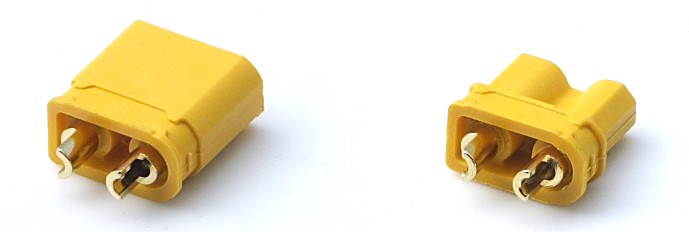 DXT30U-M + DXT30U-F, a compact 15A continuous / 30A peak pair used on small UAV power links where weight and envelope dominate.
Comparison With Conventional Practice
XT60 and XT90 connectors are widely treated as the de facto interface for medium to high power non-proprietary RC aircraft and drones; a 2026 RC battery connector compatibility guide published by ChinaHobbyLine describes XT60 as the connector found in the large majority of non-proprietary products. That installed base is a real advantage: parts are available, field technicians know them, and adapter harnesses exist. The trade-off is that a commodity interface is optimised for general hobby use rather than for a specific duty cycle.
The 90A-class pair in this range is dimensionally compatible with a regular XT90, so an upgrade does not require structural modification to an existing battery tray or harness. What changes is the engineering around the interface: reinforced male terminals for vibration, an anti-spark female variant, a cable sheath that relieves termination stress, and stated salt spray and mating-cycle figures that a commodity part often does not publish.
| Dimension | DXT90H-M / DXT90S-F | DXT60EW-M + DXT60W-F | DXT30U(2+2)-F(B) |
|---|---|---|---|
| Continuous current | 90A (10AWG, rise ≤85°C) | 60A, 100A peak | 20A per power pin, 35A peak |
| Rated voltage | DC 500V | DC 500V | DC 500V |
| Protection | IP40 | IP67, silicone O-ring | IP40 |
| Anti-spark | Built-in precharge resistor in the DXT90S-F | Not fitted; live plugging of large packs not recommended | Not stated for this model |
| Primary fit | Main battery-to-ESC link on a large spraying UAV | Exposed or wash-down-exposed power routing | Combined power and signal on auxiliary branches |
What to Verify Before Committing a Connector to a Spray Program
The specification establishes the starting conditions; the program still has to confirm them in its own configuration. Six checks carry most of the value at the evaluation stage:
- Confirm the actual conductor. The 90A continuous rating is stated for 10AWG with a temperature rise of ≤85°C; a shorter or thinner lead changes the thermal result and should be re-checked, not assumed.
- Measure temperature rise on a representative flight profile, including the spray pump load, rather than on a static bench run.
- Inspect the mating faces after a defined number of battery swaps for plating wear and retention loss, since 1000 cycles is a rating rather than an observed service life in a vibrating airframe.
- Define a cleaning routine for pesticide residue and confirm the housing and terminals tolerate it; the 48-hour salt spray result supports corrosion resistance but does not certify a specific agrochemical formulation.
- Match the protection class to the mounting location, choosing IP67 where the interface is directly exposed and accepting IP40 only where the airframe shields it.
- Decide the anti-spark requirement from the swap procedure. Repeated connection of a large LiPo pack without a precharge path is a known arc source, and the IP67 pair in this range explicitly excludes that duty.
Supplier and Production Context
AOYG DC Power Connector operates a 6,000 m² facility with 100 employees, a 25-engineer R&D team and an annual output of 900,000 units, against a stated monthly capacity of 8,000 units and a 30-45 day lead time. Quality management runs under IATF16949:2016, with 100% testing stated for production, and the company reports a 50% export ratio with Europe and the United States as main markets. Customization covers size, current specification, pin position, wiring structure and logo printing, with a stated minimum order of 2 units. Case material records 20 units in service across drone, robot, e-mobility, energy-storage and power-tool manufacturers, in stable operation for over two years. Further detail is published at AOYG DC Power Connector.
Outlook
The wider connector market gives context for why these decisions are being examined more closely. Fact.MR valued the global high power connectors market at approximately USD 5.47 billion in 2025, and Dataintelo reports that DC connectors represented 58.7% of the energy storage connector market in 2025, attributing the share to higher voltage requirements. Both are commercial research estimates with their own product scopes, and neither describes agricultural UAV connectors specifically; they indicate the scale and direction of the category rather than a forecast for spraying drones.
What the product evidence supports is narrower and more useful. The engineering direction visible in this range runs toward sealed variants where exposure demands it, combined power-and-signal shells where harness count matters, thicker plating options where corrosion risk is high, and strain relief where vibration terminates a cable. A spraying UAV program that fixes its connector specification early — current class, protection class, anti-spark requirement and conductor gauge — will find that harness geometry, battery tray design and maintenance procedure all follow from those four decisions rather than the other way round.
Frequently Asked Questions
What does the 90A continuous rating actually depend on?
On the DXT90H-M/DXT90S-F pair, 90A continuous is stated for 10AWG wire with a temperature rise of no more than 85°C, alongside a DC 500V rated voltage and a -20°C to +120°C operating range. The figure is therefore a property of the mated connector plus its conductor, not of the terminal alone. Terminating the same part on a different gauge, or routing it through a restricted-airflow bundle, changes the thermal conditions and the rating should be re-checked for that configuration.
Is IP67 necessary for an agricultural spraying UAV connector?
It depends on where the connector is mounted. Industry application data describes IP40 as the standard protection level with IP67 optional for waterproof versions, and IP40 provides no water protection at all. A connector inside a battery tray or behind a sealed panel can operate at IP40; one mounted on an exposed boom or beneath a spray tank, where run-off and wash-down water reach the interface, belongs in the sealed category. The documented IP67 option in this range is DXT60EW-M+DXT60W-F, which uses a silicone O-ring and is rated 60A continuous and 100A peak.
Can the DXT30U(2+2)-F(B) be used as the main battery connector on a spraying UAV?
Not for a large spraying UAV. The DXT30U(2+2)-F(B) is rated 20A continuous per power pin on 16AWG wire, 1A on the signal pins and 35A peak, which places it below the 90A main battery-to-ESC link. Its intended role is to carry power and signal together in one shell on lower-current branches or smaller battery packs, reducing harness count and internal space. The main power path belongs to the 90A-class pair.
How should anti-spark be handled when batteries are swapped several times a day?
The DXT90S-F female connector includes a built-in high-power precharge resistor and a two-stage contact design intended to suppress the arc produced when a LiPo pack is connected, which protects the terminal from the pitting that repeated arcing causes. Anti-spark structure is described as optional across the range, so it should be specified explicitly rather than inferred from current rating. Notably, the IP67 pair DXT60EW-M+DXT60W-F does not have an anti-spark structure, and live plugging or unplugging of large-capacity batteries with that model is not recommended.
Which operating temperature range should a spraying UAV project specify?
The connectors described here are rated from -20°C to +120°C and use PA66 UL94 V-0 flame-retardant housings. That window covers cold early-morning starts and warm power bays after a working flight, and it leaves headroom above the 85°C temperature-rise ceiling associated with the 90A rating. A project whose environment falls outside that range should verify the requirement with the supplier rather than extrapolate from the published figure, because the connector range and the battery's own limits are separate specifications.
Tem questões ou precisa de mais detalhes?
Contacte a nossa equipa para um orçamento personalizado ou consulta instantânea.
Solicitar orçamento
Preencha o formulário abaixo e a nossa equipa entrará em contacto com uma proposta personalizada.
Chat direto do WhatsApp
Prefere conversar em tempo real? Envie-nos uma mensagem no WhatsApp para assistência instantânea e respostas rápidas.
- Obter orçamento personalizado
- Partilhar fotos ou documentos
- Discuta as suas necessidades diretamente
Geralmente responde em 5–30 minutos durante o horário de expediente.