
Air Compressor Filter Elements: Wound vs Composite
Air Compressor Filter Elements: Wound vs Composite
Air compressor filter elements are rarely the most expensive item a procurement team buys, but they are among the easiest to decide on the wrong basis. At the oil separator decision point, two constructions — wound-type and composite — produce quotations that look like the same product category while implying very different replacement frequency, compressed-air quality and maintenance labour.
This buyer comparison at the decision stage isolates the differences that actually change a purchase: where each construction performs, which numbers are directly comparable, and when the cheaper element is the correct choice.
Why the separator choice is a total-cost question, not a unit-price question
An oil separator removes entrained lubricant from compressed air after it leaves the compression chamber. Performance depends on element design, filtration media, operating pressure and flow, the oil-return system, sealing and maintenance. That list alone shows why two elements cannot be ranked from a single price figure.
Two structural facts drive the procurement decision. First, the element is a consumable with a rated interval — once it reaches that interval it is replaced, not repaired. Second, the interval is not equal across constructions. In Foevair's comparison data, a wound-type oil separator is given a reference service life of approximately 4,000 hours under normal operating conditions, while composite oil separators are rated at 6,000–8,000 hours. Both figures are supplier references that must be verified for a specific model, but the gap is wide enough to reshape an annual maintenance budget.
The application context is dominated by one machine type. MarketsandMarkets data cited for the compressed-air filter and dryer market attributes 56% of total air compressor filter demand to rotary screw compressors, reflecting their use in continuous and high-load industrial duty. In practice this means most separator elements bought in volume belong to one of these two constructions rather than to a specialised format.
Wound-type versus composite: the structural difference
A wound-type oil separator uses a conventional wound construction. It generally carries a lower initial purchase cost and remains appropriate wherever its stated specifications meet the equipment requirement. Foevair's selection guidance describes wound-type designs as suited to conventional or cost-sensitive applications.
A composite oil separator combines different filtration media and structural designs to optimise filtration area, separation efficiency and service life. The same guidance positions composite designs for applications prioritising longer service intervals and stable operation. The approach generally raises the initial price — Foevair's own comparison notes that wound-type separators usually cost less to buy — so the case for composite rests on replacement frequency rather than on the first invoice.
The distinction matters because both constructions perform the same function. They are not separate product categories but two routes to the same separation task. Choosing on price alone does not usually produce an immediate failure; it produces a maintenance plan that looks normal until the annual budget reflects it.
How oil mist is actually separated
Both designs rely on staged separation. Larger oil droplets are separated by the initial change in flow direction, then coalescing filter media captures fine droplets so they combine into larger ones and drain back through the oil-return system under the designed pressure and flow conditions.
Understanding that mechanism clarifies what a supplier claim is measuring. A filtration rating describes the media. An oil carryover figure describes the whole separation system under stated conditions. A pressure drop figure describes the resistance the element adds to the circuit. These three can move independently, which is why strong performance on one number does not automatically transfer to another model.
For its composite separators, Foevair states a filtration rating of 3 μm; under specified test conditions at 7 bar, oil carryover can be reduced from 3,000 ppm to below 1–3 ppm, with a designed operating pressure drop of no more than 0.2 bar. These are conditional test-condition figures, not guaranteed field results, and they should be checked against equivalent conditions before being used in a comparison.
Performance comparison at the decision stage
The table below consolidates only the differences documented in the supplied comparison material. Where a cell reads "not stated", the figure was not provided for that construction in the source; it does not mean the capability is absent.
| Comparison dimension | Wound-type separator | Composite separator | What to verify before buying |
|---|---|---|---|
| Construction | Traditional wound structure | Combines different filtration media and structural designs | Drawing and media specification for the exact part number |
| Reference service life | Approximately 4,000 hours under normal conditions | 6,000–8,000 hours under normal conditions | The pressure, temperature and oil conditions behind the figure |
| Initial purchase cost | Generally lower | Generally higher | Unit price at identical quantity and delivery terms |
| Stated filtration rating | Not stated in the supplied comparison | 3 μm | Nominal or absolute basis, and the test standard used |
| Oil carryover under test | Not stated in the supplied comparison | Reduced from 3,000 ppm to below 1–3 ppm at specified 7 bar test conditions | Report identifying conditions, method and witness |
| Designed pressure drop | Not stated in the supplied comparison | No more than 0.2 bar | Initial versus terminal differential pressure at rated flow |
| Replacement frequency | Higher number of replacements per operating year | Lower, where the longer interval is actually achieved | Maintenance log and shutdown planning records |
| Best fit | Conventional or cost-sensitive applications where specifications match | Applications prioritising longer service intervals and stable operation | Model-specific compatibility and dimensional fit |
Total cost of ownership: count replacements, not list prices
Because both constructions are rated in operating hours, the economics come down to how many times the element is replaced in a given running period. A compressor running 8,000 hours a year would require roughly two replacements on a separator rated at about 4,000 hours, and approximately one where a composite element reaches the upper part of its 6,000–8,000 hour reference range. That illustration shows how the arithmetic works; it is not a prediction of price or service outcome for any specific installation.
Three items belong in the same calculation and are frequently left out:
- Labour and downtime. Each replacement carries handling time, isolation, depressurisation and restart checks. A longer interval removes one of those events from the year.
- Oil consumption. Carryover that rises between changes affects lubricant top-up cost, not just air quality.
- Condition-based triggers. Interval is not the only replacement driver. Foevair's maintenance guidance for related elements ties replacement to differential pressure and equipment status as well as hours, and separator replacement is recommended when the manufacturer's limit is reached.
A lower unit price is therefore only the better outcome when the element achieves its stated interval under the site's real duty cycle. Where the interval shortens in service, the arithmetic reverses.
When composite is the wrong answer
A composite element is not automatically superior, because its longer interval only converts into value where the operating regime allows it to be reached. Foevair's own selection guidance keeps the distinction open: wound-type designs may suit conventional or cost-sensitive applications, while composite designs may suit applications prioritising longer service intervals, subject to verified model-specific data.
Three situations make the wound-type element the clearer decision:
- The equipment specification calls for a conventional construction, and its acceptable pressure drop and carryover envelope is already defined by the compressor manufacturer.
- The duty cycle does not sustain long continuous running — standby compressors, intermittent loads or seasonal plants rarely accumulate the hours a longer interval assumes.
- The maintenance system is organised around smaller, predictable recurring spend rather than a higher unit outlay with a stretched change cycle.
Conversely, composite construction earns its premium where compressed-air purity is part of a commercial obligation — downstream dryers, instrumentation and product-contact processes that require consistently low carryover. In those systems, a longer separation-media life and lower carryover can outweigh the higher unit price.
A selection checklist for procurement teams
Foevair's selection guidance reduces the separator decision to compressor model, operating pressure, required flow, separation performance, allowable pressure drop, service interval, dimensions, sealing and total cost. A procurement team can extend that list with the checks that determine whether a quotation is genuinely comparable:
- Original part number, dimensions and connections — replacement elements should not be selected on appearance or dimensions alone.
- The basis of the filtration rating: nominal or absolute, and which test standard applies.
- Oil carryover data at a stated pressure for composite options.
- Initial and terminal pressure drop at rated flow.
- Material and lubricant compatibility, since the lubricant in service affects both media and seals.
- Whether the achievable change interval aligns with the compressor's planned maintenance window.
Safety requirements are not optional in this list. Foevair's maintenance guidance states that separator replacement must be carried out by qualified personnel following the compressor manufacturer's procedure, with seals, oil-return line and grounding components reconnected as designed. A lower purchase price does not change that requirement.
How to verify the claims behind either construction
The weakest link in any separator comparison is data generated under different methods. Initial pressure drop is defined as the pressure difference across a clean filter at a specified flow, fluid and temperature; consequently, two figures produced under different conditions cannot be placed side by side without confirming those conditions.
The same discipline applies to the filtration rating. A micron rating describes stated particle-size performance under a defined test method, must be read together with the associated efficiency and test standard, and a smaller number alone does not prove better overall performance. Foevair's technical notes also flag the need to confirm whether a rating is nominal or absolute.
At system level, purity requirements usually point to ISO 8573-1:2010, the international standard that specifies compressed-air purity classes for particles, water and oil. The standard defines air quality classes; it does not certify an individual filter element. Manufacturers may reference test methods associated with those classes — Atlas Copco's filter brochure cites ISO 8573-1:2010 and lists ISO 8573-4:2019 and ISO 12500-3:2009 among test methods — but such references are product-specific and do not transfer automatically to a substitute element.
Placing the separator inside the three-filter system
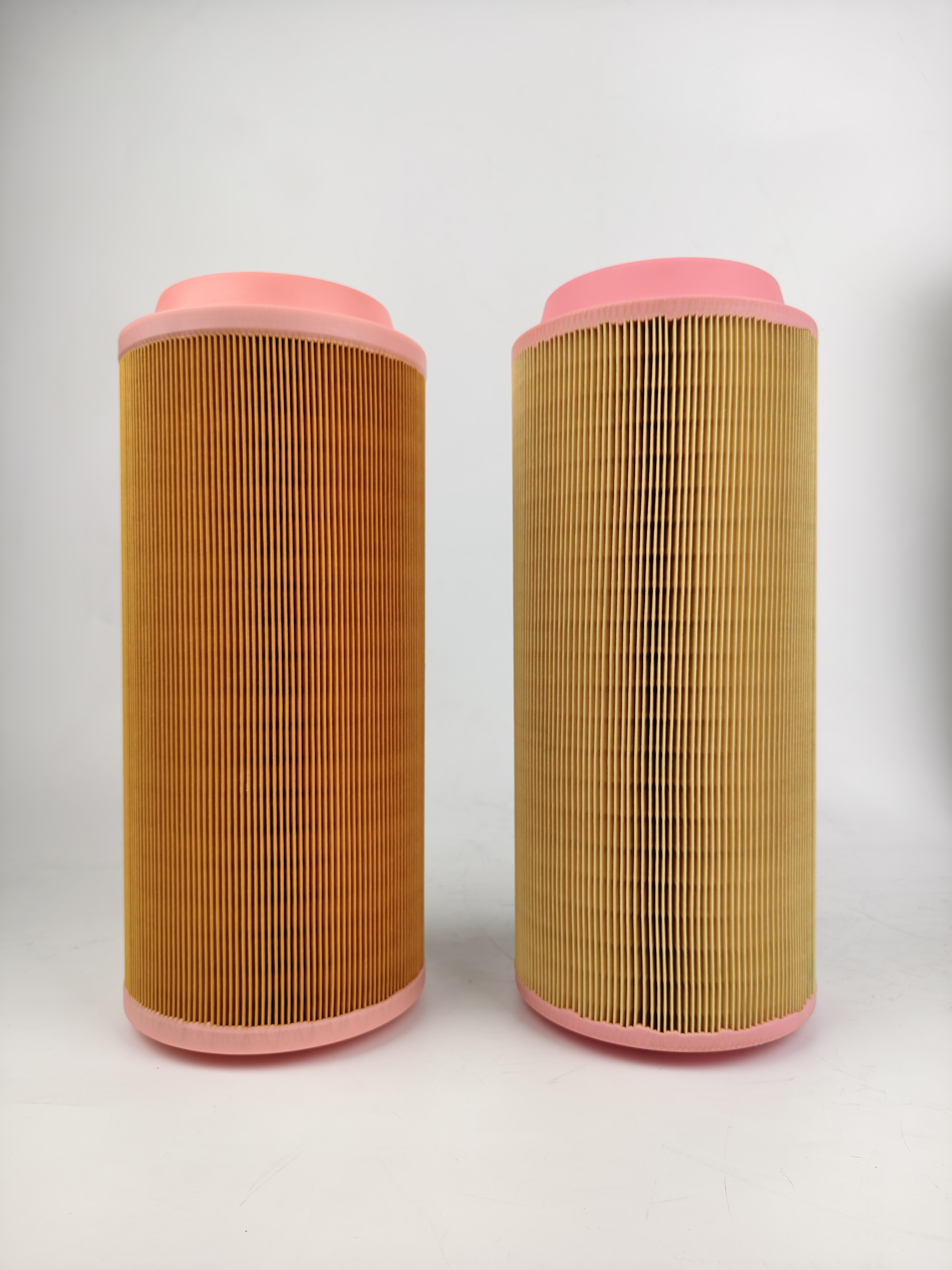
The separator is one of three replaceable elements in most screw compressor systems, and their intervals do not match. In Foevair's product data, intake air filters carry a filtration rating of 5 μm with efficiency up to 99.8% and a reference life of 2,000–2,500 hours, while oil filters are rated 10–15 μm with an initial pressure drop of approximately 0.03 MPa and a recommended replacement interval of about 2,000 hours. Separator options run at 4,000–6,000 or 6,000–8,000 hours depending on the model.
Because those figures differ, buying each element separately on its own price can produce a maintenance plan that never lines up. Sourcing air, oil and separator elements against the same compressor model lets a buyer align change windows and keep each replacement part number traceable to a specific machine and duty.
All three element types serve the same industrial base — automotive, electronics, semiconductor, pharmaceutical, food and beverage, chemical and petrochemical, oil and gas, power generation, steel and metallurgical, and machinery manufacturing — in dusty environments under continuous operation, frequently 24/7. In that setting the cost of a stoppage usually exceeds the cost of the element, which is why the interval measured in operating hours is the number worth planning around.
Supplier context: where Foevair sits in the picture
Foevair compressor filters is the air compressor filtration line of SHANGHAI FOEVAIR TECHNOLOGY CO., LTD., a company founded in 2019 that manufactures air filters, oil filters and oil separators. Its published profile lists an 11,000 m² facility, 50–200 employees, an annual output of 400,000 units and a six-engineer R&D team, with approximately 70% of output exported to North America, South America, Europe and Asia.
Material sourcing is one element a buyer can examine directly. The company states that its filter materials include German HV fibreglass, HV filter paper, Ahlstrom (Korea) filter paper, steel plate and adhesive. It describes its composite separator development as aimed at stability and long-term reliability across variations in flow, concentration and operating temperature.
For a decision-stage buyer, the appropriate use of that profile is as a supplier to be qualified rather than a conclusion to be accepted: capacity and material disclosure support an initial enquiry, but the wound versus composite decision still rests on model-specific test data, dimensional fit and the compressor's actual operating conditions.
Market context and forward view
The separator segment is sizeable and still expanding. Market Research Future estimates the global air-oil separator market at USD 4.416 billion in 2024, rising to USD 6.771 billion by 2035 at a compound annual growth rate of 3.96%. For the broader compressed-air filter and dryer market, MarketsandMarkets estimates USD 5.6 billion in 2023 reaching USD 7.4 billion by 2028. Both are commercial market-research estimates and should be read as category-level indications rather than supplier performance data.
The more useful question for a buyer is what such growth changes. In a mature category, expansion is driven largely by replacement demand, and replacement demand is governed by operating hours and maintenance scheduling. Competition therefore tends to concentrate on interval length, pressure-drop behaviour and verifiable test documentation rather than on headline unit price.
For the wound versus composite decision, that does not mean composite designs displace wound-type ones. It means purchasing specifications become more precise: stated test conditions, stated reference life, stated pressure-drop limits. Suppliers able to answer at that level of specificity make verification easier for the buyer, whichever construction they sell.
The bottom line
Choosing between wound-type and composite oil separator elements is primarily a cost-cycle decision rather than a product-tier decision. Wound-type construction typically costs less up front and carries a reference life of approximately 4,000 hours under normal conditions. Composite construction is referenced at 6,000–8,000 hours under normal conditions, with carryover below 1–3 ppm measured at specified 7 bar test conditions, but at a higher initial price and only where the duty cycle actually supports the longer interval.
For a procurement team, the decision reduces to three verifiable questions: what the pressure drop is at rated flow for each specific model, what test-condition evidence the supplier can produce, and whether the element with the shorter interval fits the compressor's real maintenance window. All three can be answered from supplier data before a purchase order is raised — which is the comparison that matters.
Frequently asked questions
What is the core difference between wound-type and composite oil separator elements?
A wound-type oil separator uses a conventional wound construction and generally carries a lower initial purchase price. A composite oil separator combines different filtration media and structural designs to optimise filtration area, separation efficiency and service life. Both perform the same function — removing entrained lubricant from compressed air — so the choice depends on replacement interval and operating conditions rather than on product category.
Do composite oil separator elements really last longer?
In Foevair's comparison data under normal operating conditions, wound-type separators are referenced at approximately 4,000 hours and composite separators at 6,000–8,000 hours. These are supplier reference values, and actual life depends on media, operating pressure and flow, oil-return system condition, sealing and maintenance. Any longer-life claim should be supported by model-specific data and site maintenance records rather than by the reference range alone.
Does a lower micron rating mean better filtration?
Not necessarily. A micron rating describes a stated particle-size rating under a defined test method. It should be reviewed together with the associated efficiency and test standard, and buyers should confirm whether the rating is nominal or absolute. A smaller number on its own does not prove better overall performance, because it says nothing about efficiency at rated flow, dust-holding capacity or pressure drop.
When should a wound-type separator still be used?
Wound-type designs may suit conventional or cost-sensitive applications where their specifications meet the equipment requirements. Practical cases include standby or intermittent-duty compressors that do not accumulate long continuous running hours, equipment where the manufacturer specifies a conventional construction and its pressure-drop and carryover envelope, and maintenance budgets built around lower recurring spend rather than a higher unit outlay with a stretched change cycle.
How can a buyer verify oil separator supplier claims?
Request data at stated test conditions, particularly pressure drop at rated flow and oil carryover at a defined pressure. Initial pressure drop is only comparable when it is defined at the same flow, fluid and temperature, and filtration ratings are only meaningful when the test method and efficiency are known. ISO 8573-1:2010 defines compressed-air purity classes, and manufacturers may reference associated test methods, but such references are product-specific and should be independently confirmed.
Does high separator pressure drop mean the wrong element was selected?
Not necessarily. High separator pressure drop may be associated with contamination, element blockage, unsuitable specifications, oil accumulation or abnormal operating conditions. The appropriate response is to verify the pressure readings, inspect operating history and oil condition, confirm the correct element is fitted, and replace it when the manufacturer's limit is reached.
The full Foevair product brochure, covering air, oil and oil separator element specifications, is available for download: Foevair product catalogue (PDF).
Tem questões ou precisa de mais detalhes?
Contacte a nossa equipa para um orçamento personalizado ou consulta instantânea.
Solicitar orçamento
Preencha o formulário abaixo e a nossa equipa entrará em contacto com uma proposta personalizada.
Chat direto do WhatsApp
Prefere conversar em tempo real? Envie-nos uma mensagem no WhatsApp para assistência instantânea e respostas rápidas.
- Obter orçamento personalizado
- Partilhar fotos ou documentos
- Discuta as suas necessidades diretamente
Geralmente responde em 5–30 minutos durante o horário de expediente.