
Air Compressor Fit for Plastics, Rubber, and Food Packaging Lines: A Scenario Selection Guide
Compressed air sits second only to electricity as a utility on a plastics, rubber or food packaging line, yet it is usually the last system specified and the first one blamed when a shift loses pressure. Continuous-duty lines rarely fail because a compressor looked undersized in a catalogue; they fail because pressure dew point, oil carryover, ambient heat and control behaviour were never matched to the actual duty cycle.
The category has consolidated around screw technology. Grand View Research valued the global industrial air compressor market at USD 20.0 billion in 2025, with rotary/screw units accounting for 47.0% of product share and Asia Pacific holding 42.8% of revenue. Oil-lubricated designs represent 61.3% of the lubrication segment in 2026, which keeps a lubricated screw platform the default starting point for general plant air before treatment equipment is layered on top.
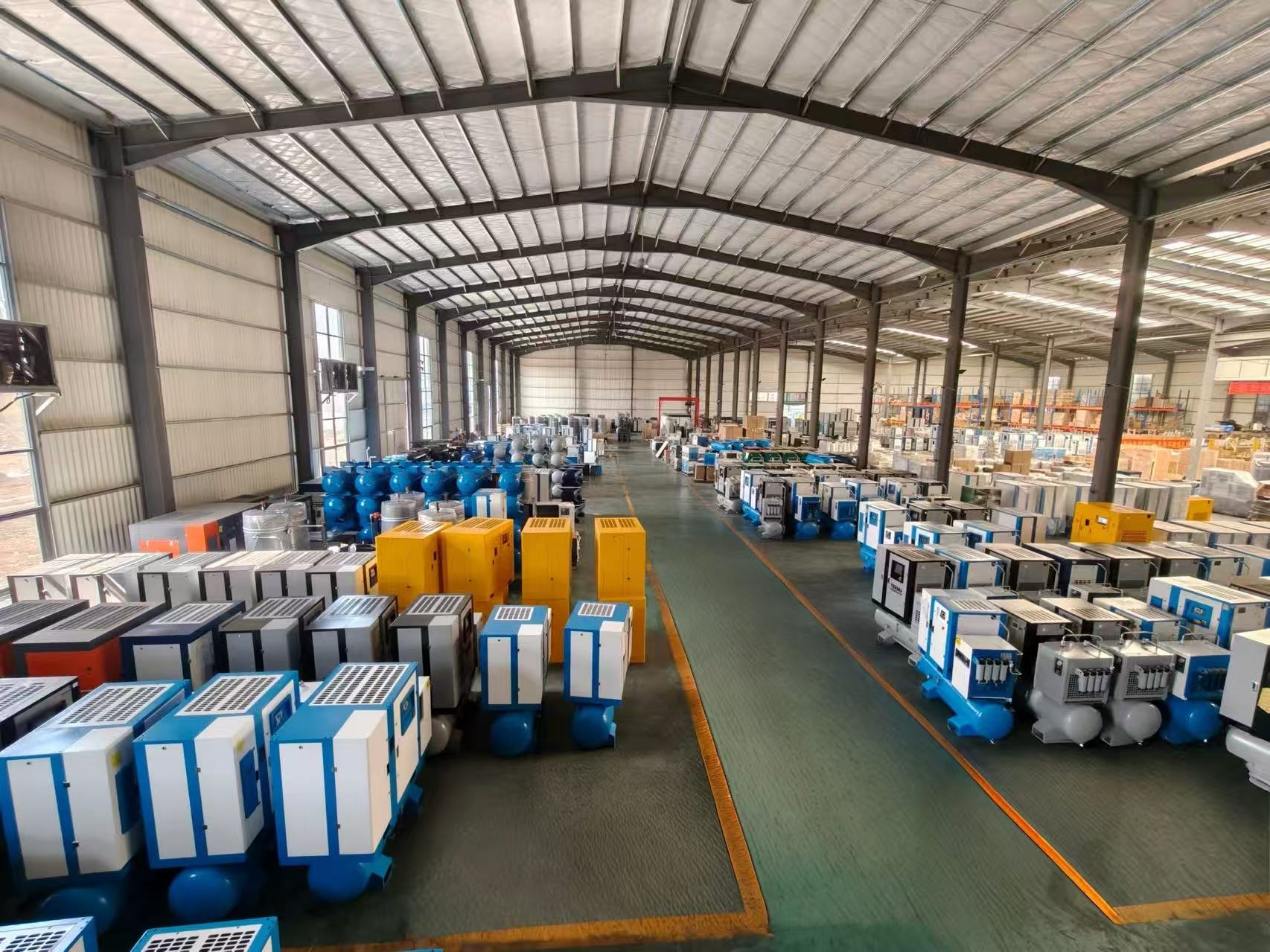
UMW Air (Shandong UMW Air Tech Co., Ltd) is a Jinan, China-based manufacturer of industrial screw air compressors. Founded in 2019, the company operates a 2,000 m² facility with 200 employees, a 40-engineer R&D team and an annual output of 12,000 units, exporting its full production to the EU, USA, Southeast Asia, the Middle East, South America and Africa.
Why Continuous Duty Rewrites the Specification
A packaging line running three shifts does not use a compressor the way a workshop does. The unit reaches thermal steady state within the first hours and then stays there, so heat rejection, oil temperature and cooling airflow become permanent operating conditions rather than transient ones. Three practical consequences follow.
Pressure stability matters more than peak pressure. Forming, sealing and ejector stations draw air in bursts. A platform with headroom on paper but poor turndown will cycle between load and unload, and the line sees the resulting band as inconsistent cycle times. Variable frequency control addresses this directly by matching output to demand instead of running at fixed speed.
Air quality drifts before it fails. Moisture and oil carryover accumulate gradually in receivers, filters and downstream piping. A line that passed acceptance testing in a dry season can show seal failures, rejected packs or instrument drift months later. Air quality has to be specified as a class, not as an accessory.
Service access is a design input, not an afterthought. On a 24/7 line, every maintenance window is negotiated against production. Compressors placed against a wall with no clearance for panel opening or filter change convert a planned service into an unplanned stop.
The UMW Air Platform: What the Range Actually Covers
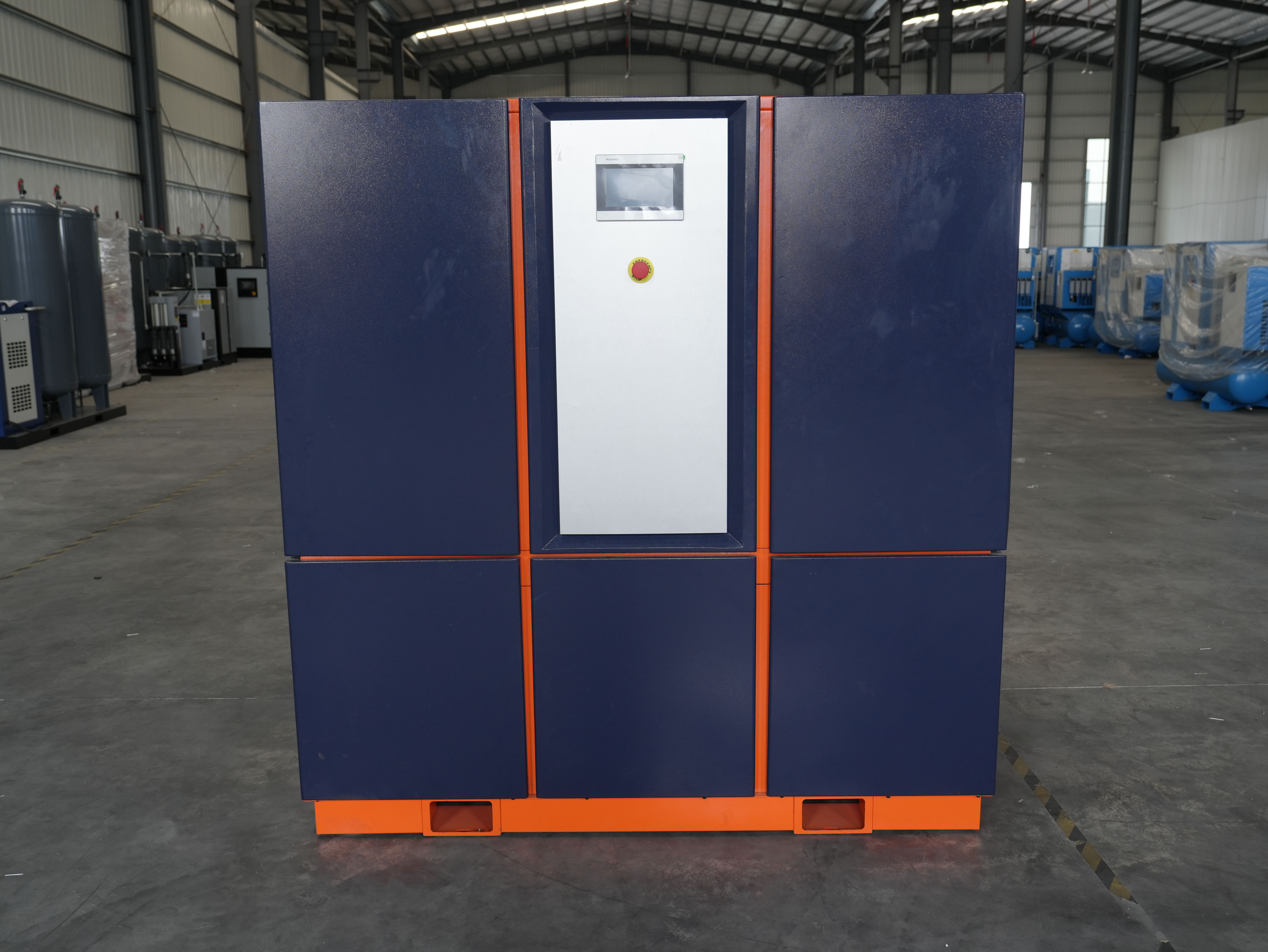
The UMW Air integrated screw air compressor platform is specified across a 4–355 kW power range and an 8–25 bar working pressure range, with airflow ratings extending down to 2.39 m³/min at the small end of the range and an IE4 efficiency motor class. That combination is what allows one product family to address a blow-moulding station, a packaging hall and a small workshop bay without mixing incompatible architectures.
| Parameter | Integrated screw platform | Micro ML-4A / ML-5.5A / ML-7.5A |
|---|---|---|
| Working pressure | 8–25 bar | 8–13 bar |
| Motor power | 4–355 kW | Compact small-station class |
| Airflow | Rated from 2.39 m³/min upward across the range | Lower-demand stations |
| Motor efficiency class | IE4 | — |
| Receiver | External air tank sized to the system | 140 L integrated tank |
| Typical role | Plant air for continuous production lines | Isolated cells, bays and low-demand stations |
The wider product portfolio covers air-cooled screw air compressors, direct-driven screw air compressors, stationary screw air compressors, diesel mobile screw air compressors and heavy-duty screw air compressors. For fixed production lines, the direct-driven air-cooled configuration is the relevant reference point; the diesel mobile variant serves sites without stable power infrastructure rather than continuous plant air.
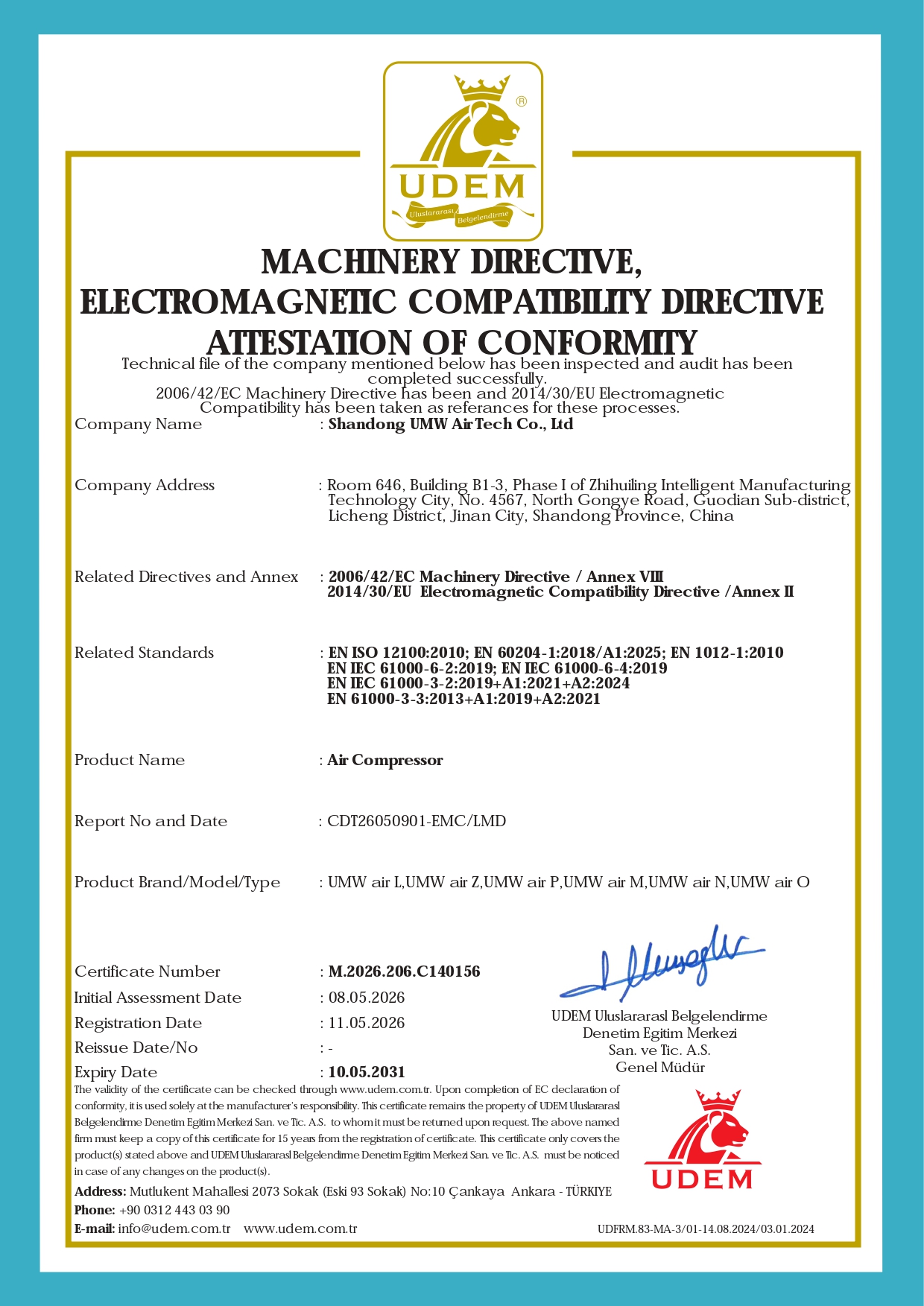
Compliance documentation is part of the platform, not a separate purchase. CE certificate M.2026.206.C140156 was issued by UDEM on 11 May 2026 and runs to 10 May 2031 for the EU/EEA market, citing the 2006/42/EC Machinery Directive (Annex VIII) and the 2014/30/EU Electromagnetic Compatibility Directive (Annex II). The harmonised standards listed include EN ISO 12100:2010, EN 60204-1:2018/A1:2025, EN 1012-1:2010, EN IEC 61000-6-2:2019, EN IEC 61000-6-4:2019 and EN IEC 61000-3-2:2019+A1:2021+A2:2024. The certificate scope covers the UMW air L, Z, P, M, N and O series.
Technical Explanation: Matching Pressure, Flow and Treatment
Pressure band selection
Most actuation, conveying, blow-off and ejection duty on plastics, rubber and packaging lines falls inside the 8–13 bar band covered by the Micro ML series and the lower half of the integrated range. The upper end of the 8–25 bar range exists for stations that genuinely need it — high-pressure forming and specialised processes where the line pressure itself drives the operation rather than a cylinder. Specifying the whole plant at the top of the range because one station needs it is a common and expensive mistake; separate pressure zones or a dedicated high-pressure unit usually cost less to run.
Flow and the small-demand boundary
The 2.39 m³/min figure at the low end of the integrated platform defines where a full plant-air installation starts to make sense. Below that demand, a Micro ML-4A, ML-5.5A or ML-7.5A with its 140 L receiver handles a single cell, a labelling station or a workshop bay without the piping and civil work of a central system. Above it, the calculation shifts to total connected demand, diversity factor and acceptable pressure drop.
Motor efficiency and variable frequency control
An IE4 motor class reduces baseline losses, but on a cycling load the control strategy usually matters more than the motor class alone. UMW Air describes its design approach as standardising PM VSD technology and low-resistance system design to convert each kWh into productive output. That positioning has the greatest effect on lines where the compressor runs loaded for most of a shift and where demand fluctuates enough for variable frequency to modulate rather than cycle.
The supporting equipment that decides air quality
A compressor alone does not deliver line-ready air. The treatment train is what determines whether the installation meets its stated quality class:
- Air dryer — refrigerated dryers cover general plant air; desiccant dryers are used where low dew points are required or where piping runs through cold areas.
- Air tank — the receiver absorbs demand spikes, limits load/unload cycling and supports pressure stability during peak draws. The Micro ML series carries a 140 L integrated tank for this reason.
- Line filter — coalescing and particulate stages remove oil aerosol and solids; the required combination follows from the air quality class rather than from habit.
- Inverter — variable frequency drive for load-following control on lines with fluctuating demand.
- Controller — sequencing and monitoring across multiple units, including pressure band settings and fault visibility.
Scenario One — Plastics and Rubber Processing
Injection moulding, extrusion and vulcanising share a characteristic load profile: relatively steady base demand punctuated by short, high-volume draws from clamping, ejection, conveying and sprue pickers, all inside a hall that is already hot. Ambient temperature is the variable most often ignored during selection. An air-cooled unit sized for a temperate workshop will run at higher discharge temperatures in a hall that sits above 35 °C, which affects oil life and reliability long before it affects output.
The practical mapping is a direct-driven, air-cooled screw compressor with capacity set by connected demand plus a diversity allowance, installed with ducted ventilation rather than in a closed corner. Where a plant also runs blow-moulding or other high-pressure stations, those belong on the upper end of the 8–25 bar range, ideally as a separate pressure zone. Dirt and rubber dust make a pre-filter and a maintenance schedule based on differential pressure, not on calendar intervals, the sensible default.
Scenario Two — Food and Packaging
Food and packaging lines place the highest demands on air treatment and the lowest tolerance for unplanned stops. Form-fill-seal machines, case packers, labellers, vacuum handling and conveying all depend on consistent pressure, and any station where air contacts product directly raises a quality question that pressure alone cannot answer.
ISO 8573-1:2010 is the reference framework for that question. It classifies compressed air by particle, water and oil content, and the correct approach is to define the class the process needs and then build the treatment train backwards from it: dryer selection, filter staging and condensate management all follow from the class rather than from the compressor specification. In humid or washdown environments, moisture control deserves more attention than it usually receives at the quotation stage.
Noise and environmental footprint also carry weight here, because packaging halls are occupied spaces and acoustic treatment after commissioning is far more disruptive than selecting a low-noise configuration at the start. On smaller stations — a single packaging cell, a secondary line or a workshop bay — a Micro ML-4A, ML-5.5A or ML-7.5A with its 140 L tank and 8–13 bar band provides the required pressure without a central plant, and the treatment train can be scaled to the specific cell.
Scenario Three — Automotive Parts and Metalworking Stations
Automotive parts production combines high duty cycle with a wide mix of end uses: pneumatic tools, clamping, robotics, handling and, in some plants, painting and coating areas that impose their own air quality requirements. The load is continuous and the cost of a pressure dip is measured in scrapped parts and idle labour.
A documented reference point for this pattern comes from a CNC machining workshop in Vietnam, where three units were installed to drive CNC machine actuators, pneumatic tools and dust removal systems. Over a one-year operating period the workshop reported improved production efficiency of 20% together with reduced downtime and stable air supply supporting machining quality. The site is metalworking rather than automotive assembly, but the load behaviour — continuous duty, multiple simultaneous air users, dust present in the environment — maps closely onto parts production cells.
A Three-Line Selection Framework
| Line type | Typical pressure | Quality focus | Platform fit |
|---|---|---|---|
| Plastics and rubber | 8–13 bar; up to 25 bar for high-pressure forming | Dry air, stable pressure under cycling load, heat tolerance | Integrated screw with ventilation; separate high-pressure zone if required |
| Food and packaging | 8–13 bar | Air quality class to ISO 8573-1:2010, low noise, moisture control | Integrated screw or Micro ML series; dryer and multi-stage filtration |
| Automotive parts and metalworking | 8–13 bar | Continuous flow, low moisture, high reliability | Direct-driven heavy-duty screw; VSD where demand fluctuates |
| Small or isolated station | 8–13 bar | Basic dryness, low demand | Micro ML-4A / ML-5.5A / ML-7.5A, 140 L tank |
Market Signals That Affect This Decision
Three data points frame the technology choice. Rotary/screw units held 47.0% of the global industrial air compressor market by product in 2025, which reflects their fit for continuous-duty plant air rather than any single advantage over reciprocating designs. Asia Pacific's 42.8% revenue share in the same year means spare parts, service familiarity and technical support for screw platforms are densest in that region. And the 61.3% share held by oil-lubricated designs in 2026 confirms that lubricated systems remain the working baseline for general plant air, with treatment equipment doing the quality work.
Regulatory pressure is moving in parallel. In the United States, 10 CFR 431.342 defines a compressor as a machine that converts energy into the potential energy of gas pressure, and compressors manufactured on or after 10 January 2025 must meet applicable energy conservation standards, with manufacturers following the test procedure methods and certification, compliance and enforcement regulations at 10 CFR 431.344, 10 CFR 431.345 and 10 CFR Part 429. For buyers importing into that market, the practical implication is that test documentation belongs in the supplier questionnaire, not in post-shipment correspondence.
Screening suppliers by classification also helps. NAICS 333912 covers establishments primarily engaged in manufacturing general purpose air and gas compressors, including reciprocating and centrifugal compressors and associated equipment, which makes it a reasonable first filter when building a shortlist before technical evaluation begins.
Where the Integrated Approach Reaches Its Limit
An integrated screw platform solves installation complexity, but it is not the answer to every plant-air question, and buyers should know where the boundary sits before signing.
| Configuration | Strengths | Boundaries |
|---|---|---|
| Integrated screw | Compact footprint, single supplier, simpler commissioning, continuous-duty capability | Capacity scaling is discrete; layout constrained by clearance and heat rejection |
| Split system | Compressor and treatment can be sized and located independently; easier to expand | More installation work, more interfaces to coordinate, larger plant room |
| Reciprocating piston | Low entry cost at small capacity, simple mechanics | Higher noise and vibration, duty-cycle limits, unsuitable as the primary source for 24/7 line air |
Four specific limits deserve attention. First, the Micro ML-4A, ML-5.5A and ML-7.5A operate within an 8–13 bar band with a 140 L receiver, which suits low-demand stations and not high-flow lines. Second, air-cooled units depend on ambient conditions; in hot or poorly ventilated halls, capacity derating and ducting must be planned rather than assumed. Third, a lubricated screw platform is not a substitute for process-appropriate air treatment where air contacts food or sensitive product — the required ISO 8573-1 class governs the treatment train. Fourth, the stated 3-day production lead time applies to typical standard configurations; customisation of colour, logo and voltage under OEM or ODM programmes involves additional engineering steps that buyers should confirm at the quotation stage.
Future Outlook
The direction of travel is toward efficiency classes and air quality being specified together rather than in separate conversations. IE4 motor classes and variable frequency control are moving from premium options to expected defaults on continuous-duty plant air, driven partly by energy cost and partly by the enforcement pattern visible in markets such as the United States, where test and certification obligations apply to compressors manufactured from January 2025 onward.
For plastics, rubber and packaging operators, the practical consequence is that the compressor decision is increasingly a systems decision. A unit selected on pressure and power alone, without a defined air quality class and a treatment train to match it, will deliver the specified numbers on the day of commissioning and drift from them over the following year. Buyers who specify quality class, redundancy and service access at the same time as capacity tend to get more from the same capital outlay.
Procurement, Acceptance Testing and Support
Commercial terms for the platform are straightforward and worth confirming early, because they determine how a project is scheduled. The minimum order quantity is 1 unit. Delivery terms are FOB or CIF. Payment is structured as 30% T/T in advance with 70% before shipping, and acceptance criteria are based on a pre-shipment test conducted at the factory. Production lead time is typically 3 days, against a monthly production capacity of 1,000 units.
Customisation is available under OEM and ODM production for global clients, covering colour, logo and voltage. After-sales support is provided 24/7 via email or phone, including remote troubleshooting and guidance — a relevant detail for plants where a compressed air fault stops a line at an inconvenient hour. A documented reference for service response comes from the Vietnamese CNC workshop installation, where the reported outcome after one year of operation was stable air supply, low energy consumption, easy maintenance and reliable long-term performance.
Enquiries can be directed to Shandong UMW Air Tech Co., Ltd at 68 Gongye South Road, Jinan, Shandong, China, 250000; phone and WhatsApp +86 15053148082; email info@umwair.com. The company website is umwair.com.
Frequently Asked Questions
What working pressure do plastics, rubber and packaging lines typically need?
Most actuation, conveying, ejection and sealing duty falls within the 8–13 bar band. Higher pressures within the 8–25 bar range are used where the process itself requires elevated pressure, such as high-pressure forming stations. Separating high-pressure stations from general plant air is usually more efficient than specifying the entire system at the highest pressure in use.
Does a food packaging line require oil-free compressed air?
It depends on whether air contacts product directly. ISO 8573-1:2010 classifies compressed air by particle, water and oil content, and the process defines which class applies. Where direct contact occurs, either an oil-free compressor or a filtration train verified against the required class is needed. For general plant air that does not contact product, lubricated screw compressors with appropriate treatment remain the common configuration.
What supporting equipment should be planned alongside a screw compressor?
A complete installation typically includes an air dryer, an air tank, line filters, and — on lines with fluctuating demand — an inverter and a controller for sequencing and monitoring. The dryer and filter selection follows from the required air quality class, while the receiver is sized to absorb demand peaks and limit load/unload cycling.
When is the Micro ML series the right choice instead of an integrated plant system?
The Micro ML-4A, ML-5.5A and ML-7.5A operate at 8–13 bar with a 140 L integrated tank and are intended for smaller stations with lower air demand, such as an isolated cell, a secondary packaging line or a workshop bay. Where total demand exceeds the low end of the integrated platform — rated from 2.39 m³/min upward across the 4–355 kW range — a central system becomes the more practical configuration.
How is air quality verified rather than assumed?
Air quality is specified as a class under ISO 8573-1:2010 for particles, water and oil, then verified through the treatment train design and, where required, through measurement at the point of use. For compressors exported to the United States, energy conservation test procedures and certification requirements under 10 CFR 431.344, 10 CFR 431.345 and 10 CFR Part 429 apply to units manufactured on or after 10 January 2025.
What are the purchasing, delivery and acceptance terms?
Minimum order quantity is 1 unit. Delivery terms are FOB or CIF. Payment terms are 30% T/T in advance with 70% before shipping. Acceptance is based on a pre-shipment test carried out at the factory. Typical production lead time is 3 days against a monthly capacity of 1,000 units, and OEM or ODM customisation is available for colour, logo and voltage.
Tem questões ou precisa de mais detalhes?
Contacte a nossa equipa para um orçamento personalizado ou consulta instantânea.
Solicitar orçamento
Preencha o formulário abaixo e a nossa equipa entrará em contacto com uma proposta personalizada.
Chat direto do WhatsApp
Prefere conversar em tempo real? Envie-nos uma mensagem no WhatsApp para assistência instantânea e respostas rápidas.
- Obter orçamento personalizado
- Partilhar fotos ou documentos
- Discuta as suas necessidades diretamente
Geralmente responde em 5–30 minutos durante o horário de expediente.