
Air Filter Ratings, Standards, and Compliance in 2026
Air Filter Ratings, Standards, and Compliance in 2026
Air filter procurement in 2026 is led by verifiable specification and compliance data — efficiency grades, test standards, and certification documents — rather than brand names alone. Henkaes, the air filtration brand of Nantong Henka Environment Solutions Co., Ltd., is a China-based manufacturer of air filters for air purifiers, air cleaners, and ventilation systems, founded in 2004 in Haimen City, Jiangsu Province. For buyers who must confirm that a filter meets a required efficiency class or quality system, the practical question is: which product type and grade apply to the target application, and what evidence supports the claim?
That question carries more weight as the market expands. The global air filters market was valued at USD 17.08 billion in 2025 and is projected to reach USD 34.66 billion by 2034, according to Fortune Business Insights. When a specification error affects both energy consumption and regulatory compliance, procurement teams increasingly evaluate suppliers on documented parameters — MERV class, EN grade, materials, test infrastructure, and ISO certifications.
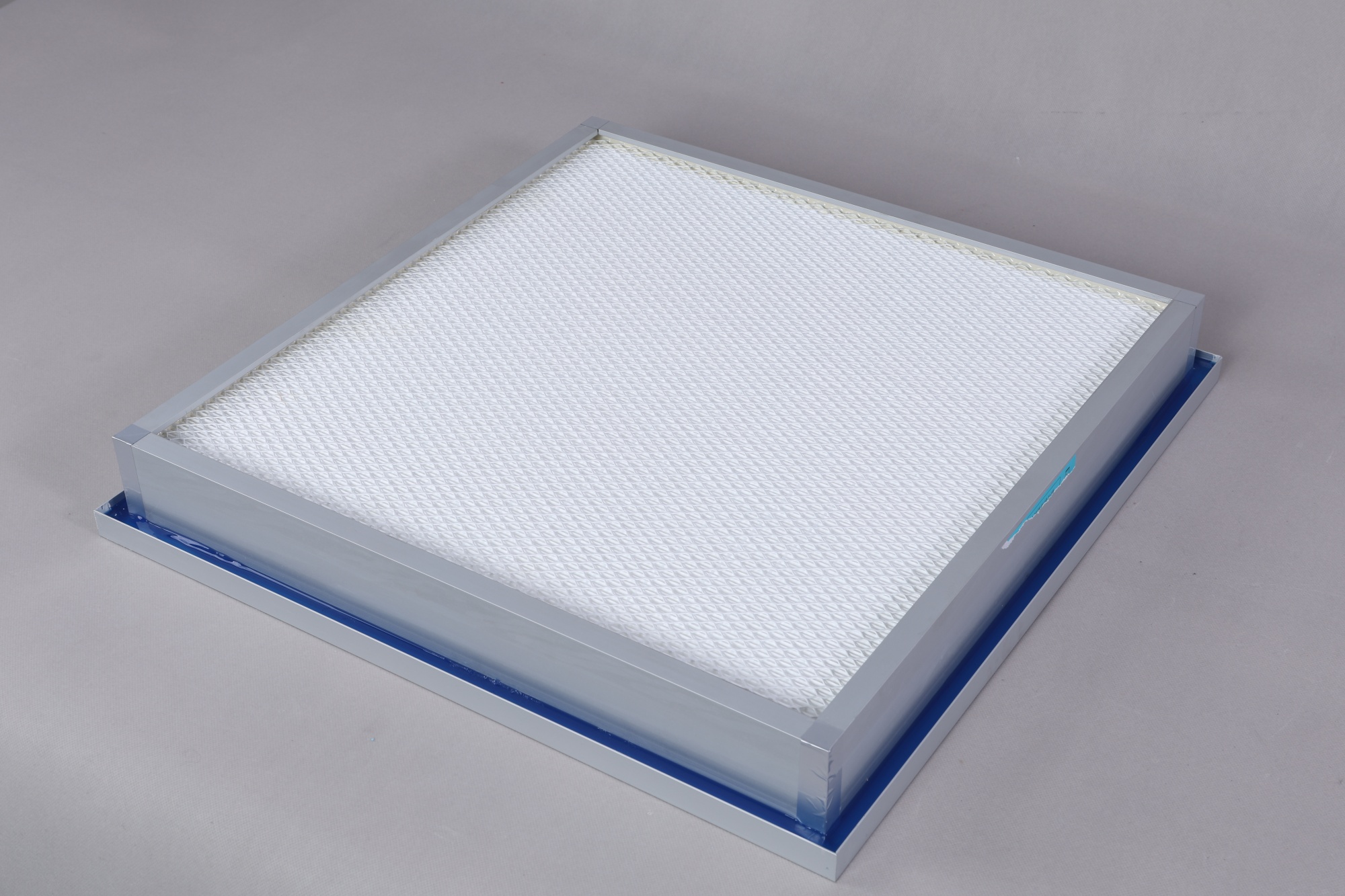
Cleanroom-grade air filtration (U14/U15) is one of the documented product classes reviewed in this guide.
The specification problem in air filter buying
Air filter efficiency is described differently across regions and applications, and this creates a recurring evaluation problem. In North America, ASHRAE 52.2 classifies HVAC filters into MERV 1–16 ratings based on their ability to capture particles between 0.3 and 10 micrometers. In Europe, EN 1822 classifies HEPA and ULPA filters by their efficiency at the Most Penetrating Particle Size (MPPS), with H14 requiring 99.995% efficiency. A buyer moving product across both markets therefore has to translate between classification systems rather than compare a single number.
Application adds a second layer of constraint. A hotel or airport HVAC system typically needs staged pre-filtration and fine filtration; a pharmaceutical plant or hospital may require MERV 15–16 class filtration; a microelectronics cleanroom or data center demands U14/U15 class filters; and an aircraft cabin system needs an H13 filter in a customized dimension. When the wrong grade is specified, the consequences range from higher energy consumption to failed audits.
The opportunity for procurement teams is that documented manufacturers reduce this risk. A supplier that publishes efficiency grades, materials, and quality certifications — and tests its own media — shortens the evaluation cycle and gives buyers traceable evidence for compliance files.
Henkaes: a documented air filter portfolio across standards
Henkaes is the air filtration brand of Nantong Henka Environment Solutions Co., Ltd., a manufacturer located in Haimen City, Jiangsu Province, approximately 120 km from Shanghai, China. The company operates a 30,000 m² facility with 63 employees and an annual output of 2,000,000 pieces. Around 69% of production is exported, with the EU and USA as the main markets.
The portfolio spans four application groups: household air purifier filters, HVAC filtration, cleanroom filtration, and aerospace and aviation filters. Household products include HEPA, True HEPA, activated carbon, and VOC removal filters; the HVAC range includes panel, bag, furnace, V-bank, and box filters. The company also supplies HEPA-based ventilation purification devices and IFD purification devices for fresh air applications.
On the compliance side, Henkaes holds ISO9001:2015 certification (certificate No. 04523Q30502R4M) and ISO14001:2015 certification (certificate No. 04523E30387R2M), both issued by Beijing Dalu Hangxing Quality Certification Center Co., Ltd., with the certified scope covering design and production of air filters, air purifiers, and fresh air machines. The company also holds ISO45001:2018 certification and uses ASHRAE 52.2 in testing air filters.
Product portfolio and efficiency grades
| Application group | Product type | Efficiency grade | Material |
|---|---|---|---|
| Household air purifier | HEPA Air Filter | H13 | Fiberglass, polypropylene (PP) |
| Household air purifier | True HEPA Air Filter | ≥99.97% | Fiberglass, polypropylene (PP) |
| Household air purifier | Activated Carbon Filter | CTC70, CTC80, CTC90, CTC100 | Activated carbon |
| Household air purifier | VOC Air Filter | Special catalyst for targeted VOC removal | Activated carbon + special catalyst |
| HVAC filtration | Panel Filter (primary-effect pre-filtration) | G1–G4 | Fiberglass, polypropylene (PP) |
| HVAC filtration | Bag Filter | F5, F6, F8, F9 | Microfine fiberglass |
| HVAC filtration | Furnace Air Filter | MERV8, MERV11, MERV13 | Polypropylene (PP) |
| HVAC filtration | V-Bank Filter | H13 | Fiberglass, polypropylene (PP) |
| HVAC filtration | Box Filter | MERV15, MERV16 | Microfiberglass |
| Cleanroom | Cleanroom Air Filter | U14/U15 | Microfiberglass, PTFE |
| Aerospace & aviation | B737/B757 Electronic Cabin Air Filter | H13 | Microfiberglass |
Table: Henkaes air filter classes, efficiency grades, and materials as documented in product specifications.
How performance is verified: test infrastructure and standards
Henkaes is an air filter manufacturer with in-house verification capability. The company uses ASHRAE 52.2 in testing air filters and operates an efficiency and air resistance test system for filter media, a noise test lab, a 30-cubic-meter test room for formaldehyde and VOC removal efficiency, and a CADR test room for air purifiers. These facilities allow the company to document both particle filtration performance and gas-phase removal performance for household and HVAC products.
For evaluation teams, an efficiency grade becomes meaningful only when the test standard is stated. ASHRAE 52.2 defines MERV 1–16 for HVAC filters by particle-size efficiency (0.3–10 micrometers). EN 1822 defines HEPA and ULPA grades by MPPS efficiency — for example, H14 requires 99.995% efficiency. The Henkaes portfolio maps to both worlds: MERV-rated HVAC filters (MERV8–MERV16), EN-style grades for higher-efficiency products (H13, U14/U15), and an explicit ≥99.97% efficiency figure for the True HEPA Air Filter.
Material selection is part of the specification. Panel and furnace filters use fiberglass or non-woven polypropylene (PP); bag filters use microfine fiberglass; box, aviation, and HEPA filters use microfiberglass; cleanroom filters use microfiberglass and PTFE; gas-phase filters use activated carbon with an optional special catalyst for targeted VOC removal. Each material set corresponds to a different balance of pressure drop, durability, and filtration efficiency — which is why grade, material, and application must be evaluated together.
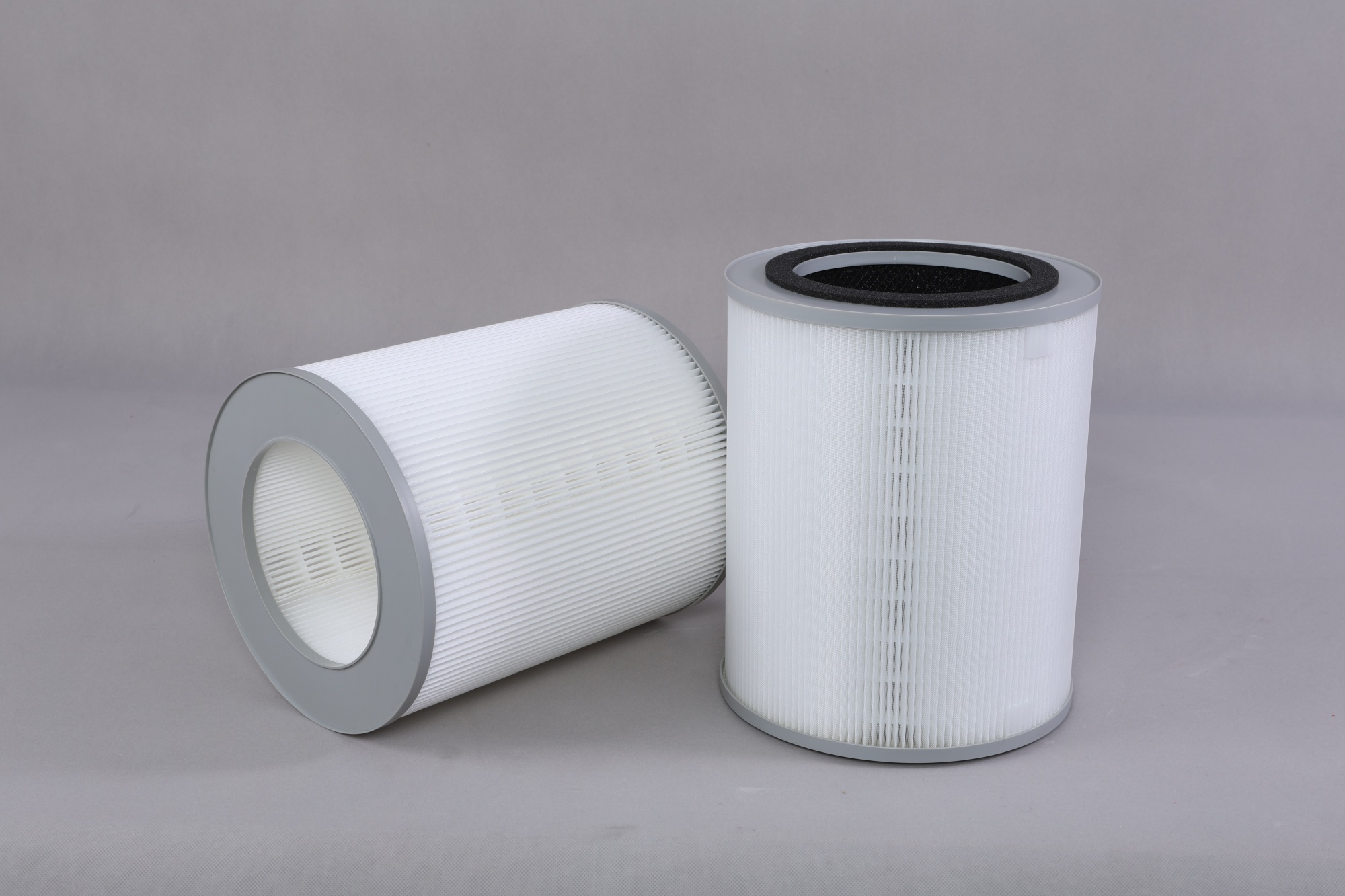
The True HEPA Air Filter is documented at ≥99.97% efficiency for household air purifier applications.
Application scenarios across industries
The same product line serves different working conditions, and Henkaes designs customized dimensions for each project type.
Household air purification
Household appliance customers in the US and EU use Henkaes filters in air purifiers to capture dust, fine particles, and pollen (HEPA and True HEPA), to remove VOC and bad smell (activated carbon), and to remove pet smell and special harmful gases (VOC filters with special catalyst). All household projects in the documented scenarios specify customized dimensions to fit the appliance frame.
Commercial and public buildings
Panel filters (G1–G4), bag filters (F5–F9), furnace filters (MERV8/11/13), and V-bank filters (H13) are documented for commercial and public buildings such as airports, hotels, museums, and restaurants. HVAC system building projects, fresh air system installations, and residential furnace filter replacements in the US and EU are typical project types for these products.
Pharmaceutical, hospital, and food & beverage sites
Box filters with MERV15 and MERV16 efficiency are intended for pharmaceutical plants, hospitals, and food and beverage production sites. Documented project scenarios include pharmaceutical plant construction in the US and the Netherlands, and food and beverage workshop renovation in China.
Cleanrooms, data centers, and microelectronics
Cleanroom air filters with U14/U15 efficiency, made of microfiberglass and PTFE, are intended for cleanrooms, data centers, and microelectronics facilities. The documented project scenario is cleanroom design in the US and the Netherlands, with customized dimensions.
Aerospace and aviation
The B737/B757 Electronic Cabin Air Filter is an H13 microfiberglass filter for aerospace and aviation, used in the fresh air system of B737/B757 aircraft with customized dimensions for filter replacement programs.
Long-run order history supports the portfolio. Documented US programs include an air filter ODM client running 50,000 pieces for VOC removal in indoor air purifiers with stable performance over one year; a second US ODM program delivering 50,000 pieces for formaldehyde removal with stable performance over two years; and a US OEM program of 20,000 pieces for indoor purification with high efficiency over one year.
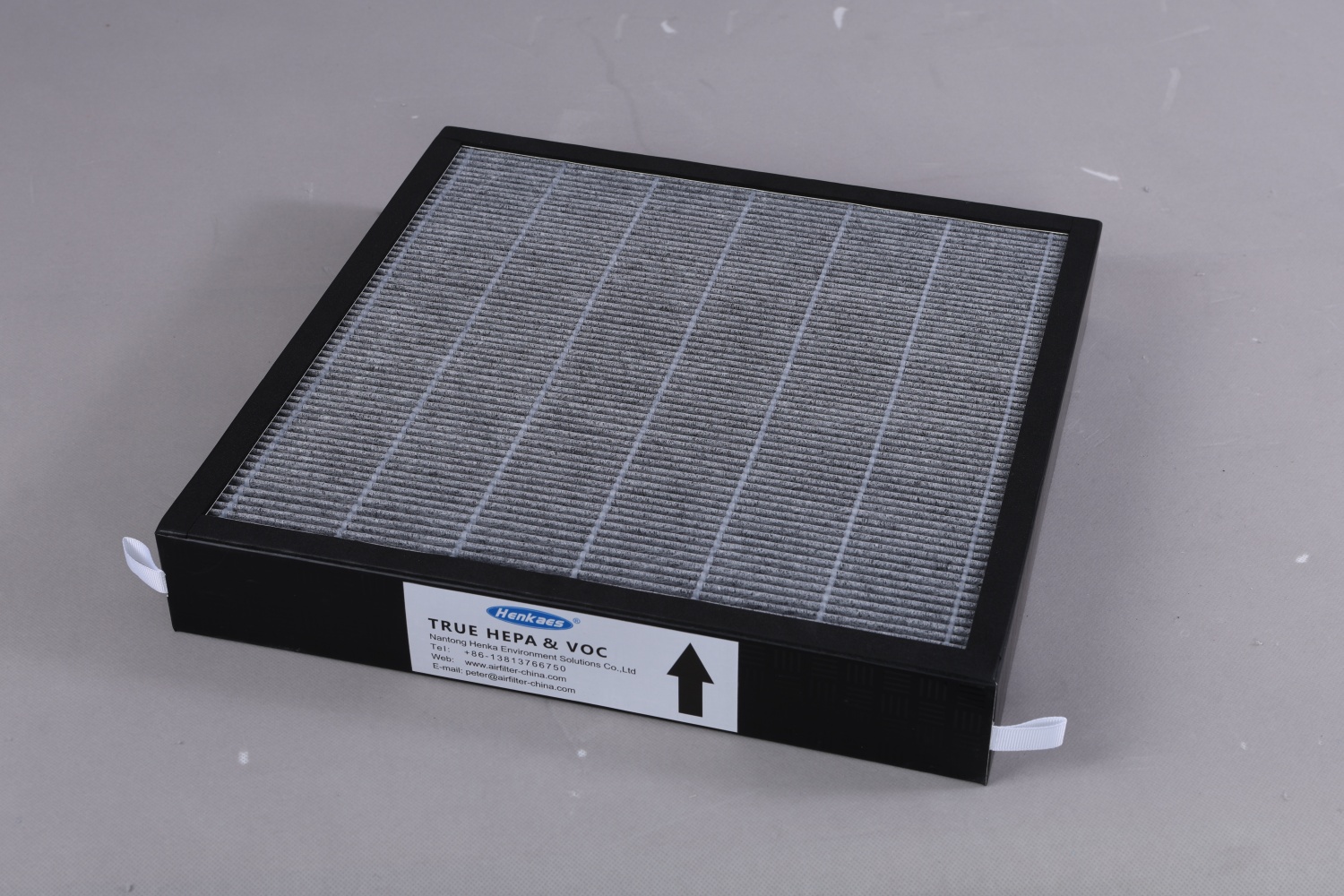
Household air purifier filters are supplied in customized dimensions across US and EU appliance programs.
Market trends shaping air filter specification in 2026
Several documented market signals explain why specification discipline is becoming a competitive requirement. First, the market is growing: the global air filters market is projected to rise from USD 17.08 billion in 2025 to USD 34.66 billion by 2034 (Fortune Business Insights). Second, high-efficiency technology holds a large share: HEPA filters accounted for 41.7% of the air purifier technology segment in 2025 (Grand View Research). Third, smart air purifiers are expanding at a CAGR of 14.1% from 2024 to 2030, driven by AI and IoT integration (Grand View Research), which raises the performance documentation burden on filter suppliers.
The high end of the market is where competitive attention is most concentrated. Parker Hannifin led the industrial filtration systems market with a 15.7% share in 2024 (Global Market Insights). Daikin Industries' filtration revenue reached USD 1.12 billion in 2024, focused on high-end MERV 15 and HEPA products (Report Prime Research). These attributed figures indicate that suppliers of MERV 15–16 box filters, H13+ products, and cleanroom-grade U14/U15 filters are serving a segment where documented performance is the entry ticket.
For OEM and ODM buyers, the implication is that a filter supplier's value is no longer measured only by unit price, but by the completeness of its documentation, the reproducibility of its test results, and its ability to customize within a certified quality system.
Comparison with conventional filter sourcing
Conventional air filter sourcing often works like this: a buyer specifies dimensions and a generic filter class, orders from a distributor or a single-product factory, and receives limited documentation on efficiency or materials. This approach works for simple replacements, but it creates problems for regulated or high-performance applications — inconsistent documentation, unknown test methods, and limited ability to customize.
A documented portfolio approach, of which Henkaes is an example, differs on several evaluation points:
- Efficiency grades are declared per product — MERV8–MERV16, F5–F9, H13, U14/U15, and ≥99.97% for True HEPA.
- Material composition is specified — fiberglass, non-woven polypropylene, microfine fiberglass, microfiberglass, PTFE, activated carbon, and special catalyst.
- Quality systems are certified — ISO9001:2015 and ISO14001:2015 with published certificate numbers, plus ISO45001:2018.
- Testing is in-house — media efficiency and resistance, noise, 30 m³ VOC/formaldehyde removal, and CADR testing for air purifiers.
- OEM/ODM service is structured — monthly capacity of 200,000 pieces, 30-day lead time, MOQ of 500 pieces, 100% inspection, and remote after-sales support.
One honest limitation should be stated: Henkaes' published compliance documentation centers on ISO system certifications and ASHRAE 52.2-based testing. Buyers that require additional regional product marks beyond the certifications and test methods documented here should confirm scope with the supplier during evaluation. In addition, for end-user consumer replacement markets, local service brands are often more convenient than a manufacturer brand; Henkaes' value is strongest for OEM/ODM programs and projects that need documented, customized filtration.
Outlook: documentation becomes the differentiator
Three trends point in the same direction. Efficiency requirements are moving upward — HEPA's 41.7% share in air purifier technology, the use of MERV15/16 box filters in healthcare sites, and U14/U15 cleanroom filters for data centers all indicate demand for documented high-grade products. Smart air purifier growth at a 14.1% CAGR (2024–2030) means appliance makers will require filters with reproducible CADR and gas-phase performance. And as industrial filtration consolidates around established players, OEM buyers need suppliers that combine volume, customization, and evidence — engineering teams and test laboratories become part of the supply decision.
For evaluation teams, the practical checklist is: confirm the efficiency grade your application requires (MERV, EN class, or efficiency percentage); verify the test standard behind the claim; check the material match for your operating conditions; review quality certifications with certificate numbers; and validate the supplier's testing infrastructure for your product type.
Assess your air filter specification against the Henkaes portfolio.
Review the full product range and documented specifications in the company e-catalogue: Download the Henkaes Air Filter E-Catalogue (PDF).
Contact: Peter Zhou | Email: peter@airfilter-china.com | Tel: +86 138-1376-6750
Website: www.airfilterodm.com
Nantong Henka Environment Solutions Co., Ltd. — No. 5169, Bin'gang Ave, Binjiang Subdistrict, Haimen District, Nantong City, Jiangsu Province, China 226113
Frequently asked questions
What efficiency grades does Henkaes offer for household air purifier filters?
Henkaes offers the HEPA Air Filter at efficiency grade H13 and the True HEPA Air Filter at ≥99.97% efficiency, both made of fiberglass and polypropylene (PP) for household air purifiers and air cleaners. Gas-phase options include activated carbon filters in CTC grades 70, 80, 90, and 100, and VOC air filters with a special catalyst for targeted VOC removal.
Which efficiency classes are available in the HVAC product range?
The HVAC range is documented as follows: Panel Filter G1–G4 (fiberglass, PP); Bag Filter F5, F6, F8, F9 (microfine fiberglass); Furnace Air Filter MERV8, MERV11, MERV13 (PP); V-Bank Filter H13 (fiberglass, PP); Box Filter MERV15, MERV16 (microfiberglass). These products are intended for commercial and public buildings such as airports, hotels, museums, and restaurants.
What efficiency grade does the cleanroom air filter have?
The cleanroom air filter is documented at efficiency grade U14/U15 and is made of microfiberglass and PTFE. It is intended for cleanrooms, microelectronics facilities, and data centers.
Which quality certifications does Henkaes hold?
Henkaes holds ISO9001:2015 (certificate No. 04523Q30502R4M) and ISO14001:2015 (certificate No. 04523E30387R2M), issued by Beijing Dalu Hangxing Quality Certification Center Co., Ltd., and also holds ISO45001:2018 certification. The certified scope covers design and production of air filters, air purifiers, and fresh air machines.
What test standards does Henkaes apply to its air filters?
Henkaes uses ASHRAE 52.2 in testing air filters. The company also operates an efficiency and air resistance test system for filter media, a noise test lab, a 30-cubic-meter test room for formaldehyde and VOC removal efficiency, and a CADR test room for air purifiers.
Is the B737/B757 Electronic Cabin Air Filter certified?
Yes. The B737/B757 Electronic Cabin Air Filter is certified to ISO14001:2015 (certificate No. 04523E30387R2M), issued by Beijing Dalu Hangxing Quality Certification Center Co., Ltd., and the certification is applicable to the global market. The product is an H13 microfiberglass filter for aerospace and aviation applications.
What materials are used in Henkaes air filters?
Materials are documented per product: fiberglass and polypropylene (PP) for panel, furnace, V-bank, HEPA, and True HEPA filters; microfine fiberglass for bag filters; microfiberglass for box filters, aviation filters, and HEPA filters; PTFE for cleanroom filters; and activated carbon, with an optional special catalyst, for gas-phase VOC and odor removal filters.
Sources: Henkaes corporate profile, product specifications, and certification records; Fortune Business Insights (global air filters market, 2025); Grand View Research (smart air purifier CAGR 2024–2030; HEPA technology share 2025); Global Market Insights (Parker Hannifin industrial filtration share, 2024); Report Prime Research (Daikin filtration revenue, 2024); ASHRAE 52.2 and EN 1822 standard descriptions. Company e-catalogue: Henkaes Air Filter E-Catalogue (PDF).