
Air Fork Constraints: A Suspension Fork Specification Guide
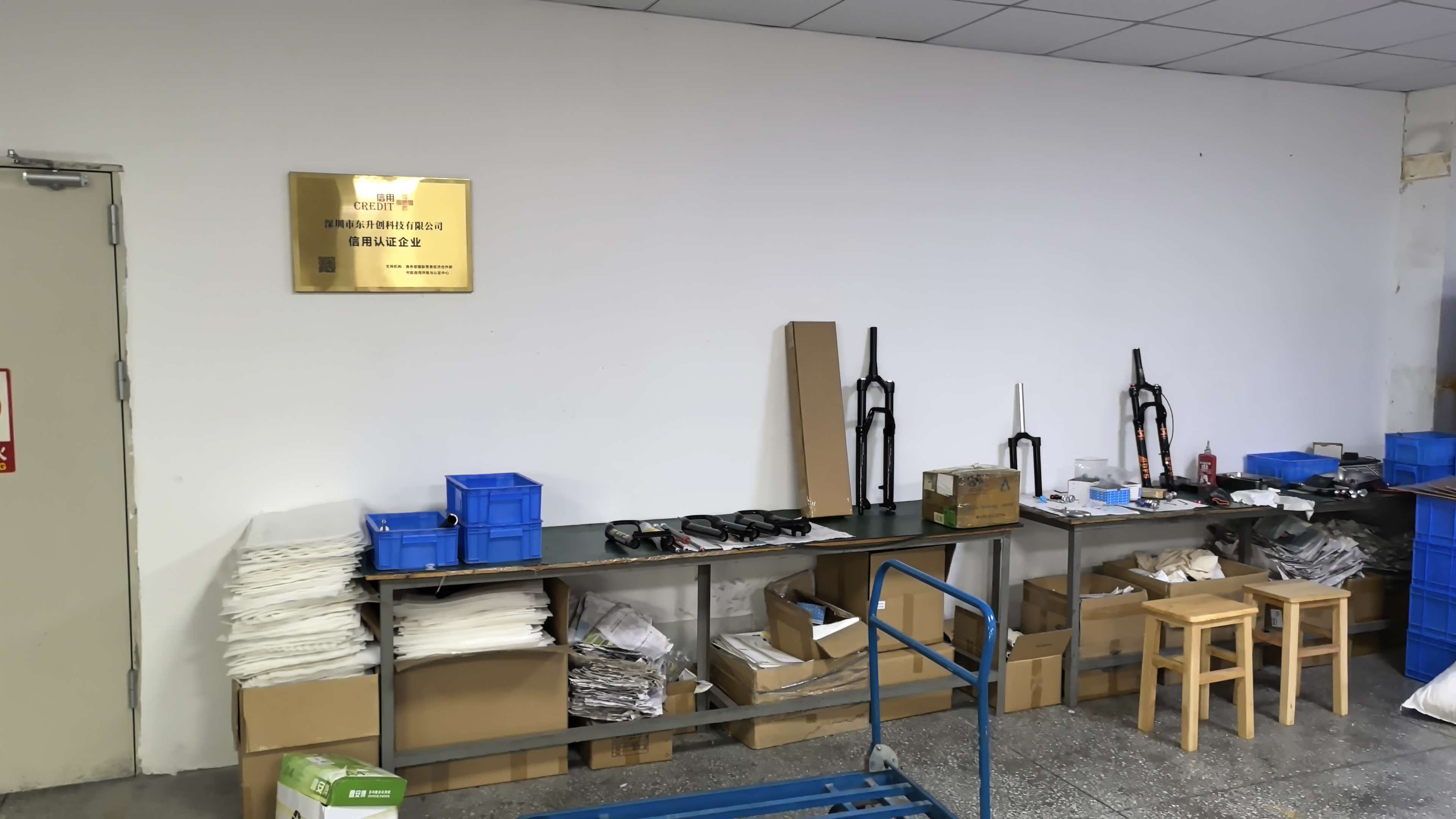
Quality inspection area: an air fork order is only as reliable as the parameters and documents verified before packing.
An air fork is a bicycle suspension fork in which the spring force is provided by compressed air instead of a steel coil. That describes a spring medium, not a finished specification. For buyers, assemblers and distributors, the difference between an air fork that works and one that fails incoming inspection is decided by travel, wheel size, axle interface, steerer geometry, brake mount, damper configuration and the compliance document that travels with the shipment.
Why “Air Fork” Is Not a Specification
Search language compresses a complex assembly into two or three words. “Suspension fork”, “air fork”, “bicycle fork” and “carbon fork” are used almost interchangeably in buyer conversations, yet each one answers a different question. Spring medium tells you how the fork is tuned. Material tells you what the structure is made of. Wheel size and axle standard tell you whether the fork will physically mount to the frame and wheelset in front of you. None of these labels alone is sufficient as a procurement instruction.
A practical example makes the risk concrete. Two forks can both be correctly described as 29-inch air forks for mountain bikes, and still differ in axle width and dropout interface, steerer taper, travel, stanchion diameter and damper functions. If a purchase order is written from the label rather than from the interface list, the mismatch is usually discovered at assembly, not at quotation. The cost of that discovery is measured in returned containers, reworked builds and delayed launch windows.
The commercial environment raises the stakes. The global bicycle suspension system market — forks and shock absorbers combined — was valued at approximately USD 0.81 billion in 2025, according to Mordor Intelligence. A separate commercial industry report places carbon fiber forks at roughly 25% of the global fork market in 2024, with the same source projecting that share to move toward 35% by 2030. As the mix shifts toward higher-value materials, a mis-specified order costs more than it did when the category was dominated by simpler assemblies.
The Constraint Set: Parameters That Must Match
For an air suspension fork, the constraint list is short but unforgiving. Each parameter below locks a physical interface or a performance boundary, and each one has to be confirmed against the frame, the wheelset and the intended riding category before tooling or sampling begins.
| Parameter | What it fixes | What a mismatch creates |
|---|---|---|
| Travel | The usable stroke of the air spring and the axle-to-crown geometry | Frame geometry and front-end attitude no longer match the intended use |
| Wheel size | Tyre clearance and the radius the fork is designed around | Tyre contact or insufficient clearance at full compression |
| Axle standard | Dropout interface and hub compatibility (for example a 15 x 110 mm thru axle) | A wheelset that cannot be installed without adapters or replacement |
| Steerer tube | Head tube, headset and stem compatibility (for example carbon 39.8 mm—28.6 mm taper) | Cutting, machining or a stem that cannot be clamped correctly |
| Brake mount | Caliper interface and rotor size range (post mount in this example) | Brake adapter rework or an unusable front brake |
| Stanchion diameter | Stiffness class and lower-leg/bushing fit (32 mm in this example) | Different handling character and different bushing load path |
| Spring configuration | Adjustable air spring and negative spring (coil + MCU in this example) | Rider weight and terrain cannot be accommodated by setup alone |
| Damper functions | Remote hydraulic lockout with compression adjustment; hydraulic rebound adjustment | Control functions the build sheet promised are absent |
| Compliance documents | The standard and test report attached to the product | Customs or buyer quality gate holds the shipment |
The application conditions behind these parameters are not laboratory conditions. Mountain trails, unpaved surfaces, off-road riding and competition use all introduce impacts and continuously changing terrain, which is precisely why the front fork is treated as both a structural component and a control component. Purchasing guidance for this category is therefore consistent: confirm wheel size, fork travel, steerer, front-axle specification, brake-mount interface, frame compatibility, air-pressure setup and operating environment — and do not select a replacement based on the model name alone.
Inside the Air Spring and Damper
Understanding what the air side and the damper side each control explains why the setup procedure belongs in the purchase discussion, not only in the workshop manual.
The spring side
An adjustable air spring carries the rider's weight on compressed air, and support is set by pressure rather than by swapping a coil. The negative spring influences how the fork responds at the start of its stroke; on the DFS carbon XC air fork this is a coil + MCU assembly. Because air pressure is the spring rate, the same physical fork can be configured for a lighter or heavier rider within its working range — but it also means the fork arrives as a platform to be set up, not as a finished tune. A suspension pump is part of the required equipment list for any air fork build.
The damper side
The hydraulic side controls how that spring energy is released. On the referenced model, rebound damping is adjustable through a hydraulic circuit, and the lockout system is a remote-controlled hydraulic lockout with compression adjustment. That combination gives the rider three distinct behaviors: a locked platform for climbing or smooth surfaces, a compression setting for terrain absorption, and a rebound setting that governs how quickly the fork returns after an impact. These functions are specification items. A fork ordered without confirming them may be structurally correct and functionally wrong for the intended rider.
The structure
Structure and spring medium are independent choices, and this is where material language such as “carbon fork” can mislead. On the model discussed here, the lower legs and the crown are carbon composite components, the steerer tube is carbon with a 39.8 mm—28.6 mm taper, while the stanchions are 32 mm AL 7050 aluminum with a hard-anodized surface and the bushings are Teflon. The weight outcome is 1.35 kg for a 29-inch, 100 mm travel fork with a 15 x 110 mm thru-axle dropout interface. Weight is a result of this specific material combination, not of the word “carbon” on its own.
| Specification | Value |
|---|---|
| Model | DFS-RLC-TP-RCE-TC-BOOST-15X110 |
| Type | Carbon bicycle air fork, XC race super light air fork |
| Wheel | 29" |
| Pitch | 125 mm |
| Stanchion | 32 mm AL 7050 / hard anodized |
| Steerer tube | Carbon 39.8 mm—28.6 mm taper |
| Lower / crown | Carbon |
| Spring / negative spring | Adjustable air spring / coil + MCU |
| Bushing | Teflon |
| Lockout | Remote control hydraulic with compression |
| Rebound | Adjustable with hydraulic |
| Travel | 100 mm |
| Disc mounts | Post |
| Weight | 1.35 kg |
| Axle style | 15 x 110 mm thru axle |
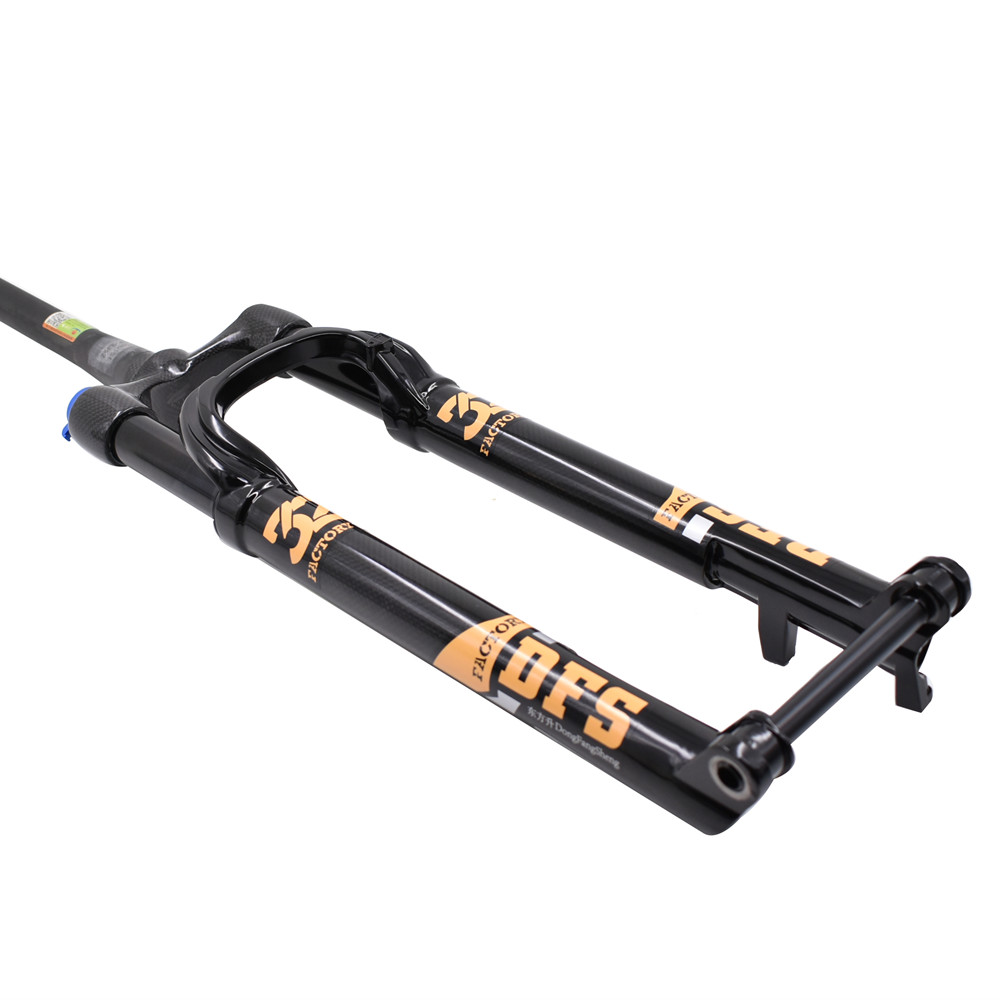
A carbon XC race air fork: the visible interfaces — axle, brake mount, steerer and stanchions — are the parameters a buyer must confirm in writing.
Certification and Compliance Constraints
Certification is the constraint that most often sits outside the technical conversation and inside the buyer's quality gate. The DFS bicycle suspension fork referenced throughout this article is covered by an Intertek test report, SZHH00332353, issued for the bicycle suspension fork product and citing EN 14766:2005 as the applicable standard for the European Union market. That is a concrete, checkable document rather than a general claim of compliance.
Two practical points follow from it. First, the scope of a report matters: it applies to the product named in the document, so a buyer switching to a different model, travel, or material version should confirm whether the existing documentation still covers the new configuration. Second, the standard landscape is not interchangeable. ASTM F2274-11(2024) establishes performance requirements and test methods for suspension and non-suspension production forks used in Condition 3 terrain, and identifies compression load, bending load, impact resistance and fatigue tests. ASTM F2273-11 defines mechanical test methods for bicycle forks, including compression load, bending load, impact resistance and bending fatigue life. ISO 4210-6:2023 covers suspension-fork tyre-clearance testing alongside front-fork tensile strength, static bending, rearward impact, bending fatigue with impact, and requirements for forks intended for hub or disc brakes.
The U.S. Consumer Product Safety Commission summary notes that ASTM, EN and ISO bicycle standards each contain suspension-fork requirements, with tyre-clearance testing among the shared categories, and that the details vary by standard and by bicycle-use condition. That is a screening framework, not proof of equivalence. A buyer should not assume that a report against one framework automatically satisfies a contract clause written against another.
Trade classification belongs in the same checklist. Bicycle front forks fall under HS code 8714.91 per a 2026 bicycle parts classification guide. However, the broad UN ComTrade category retrieved for this research covers “cycles, frames and forks, and parts thereof” without separating suspension forks, and no suspension-fork-specific code was validated. Importers should therefore confirm classification with their customs broker rather than assuming the code alone will settle duty treatment.
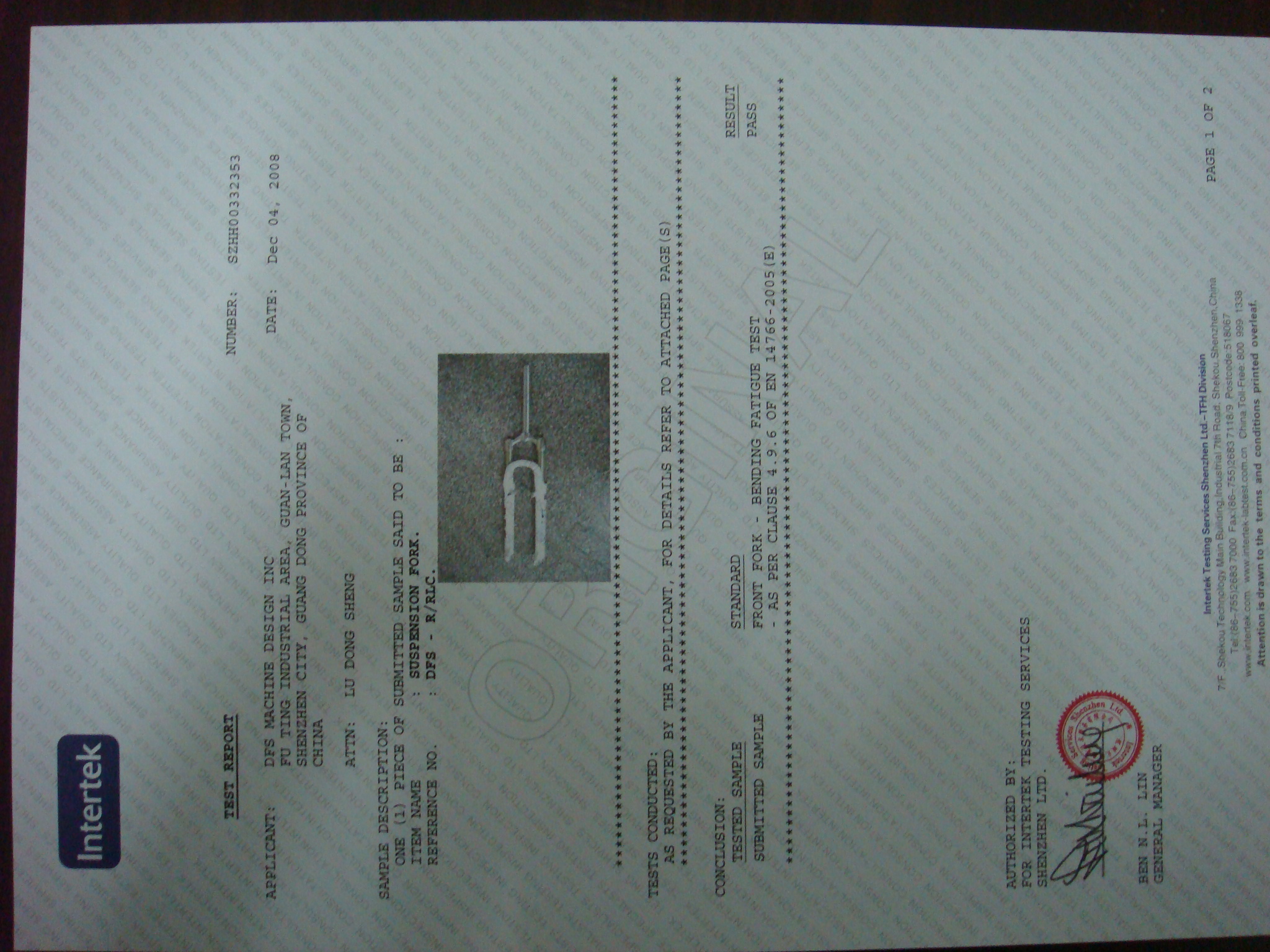
Intertek test report SZHH00332353: the document, its scope and the standard it cites are all part of the fork specification.
Application Fit: XC Racing, Trail Riding and OEM Programs
Air fork specification only becomes meaningful when it is mapped to a use case. The 100 mm travel, 29-inch, carbon XC configuration described above is designed for cross-country racing, where low weight and a remote lockout for climbing matter more than long-stroke absorption. The remote lockout allows the rider to switch between locked and open states without leaving the bar position, and the adjustable rebound allows comfort to be tuned to the rider and the trail surface.
The same platform also serves two non-racing applications:
- Fork replacement and upgrade — riders and shops replacing a worn or lower-grade front fork, where the decisive checks are wheel size, axle standard, steerer type and brake mount rather than brand language.
- OEM and ODM assembly programs — bicycle brands and assemblers building complete bikes, where the fork is one line item in a bill of materials and must be documented, repeatable and available in volume.
Manufacturing-side constraints matter here as much as the product specification. For DFS — the brand of DFS TECH (SHEN ZHEN) CO., LTD., a Shenzhen-based mountain bike suspension fork manufacturer established in 2009 — OEM and ODM customization covers logo, material, surface finish, travel, axle specification, brake mount and packaging. Monthly capacity is stated at 3,000 units, lead time ranges from 30 to 120 days, minimum order quantity is 2,000 pcs, and every product is fully assembled and tested before packing under a 100% test regime. A 2-year warranty with remote guidance applies.
Volume programs are the normal case rather than the exception. The manufacturer reports OEM/ODM client relationships in Germany, Argentina and South Korea representing 10,000 units over three years, with an in-house paint shop supporting custom colors and logo printing. Fork programs at this scale depend on multi-wheel-size compatibility, an air spring, hydraulic lockout, compression adjustment and a lightweight construction being held consistent across production batches — which is a documentation and process question, not a marketing one.
Market Trend: Premiumization Meets Documentation Pressure
Two trends are moving in the same direction, and both increase the value of constraint-based purchasing.
The first is material premiumization. With carbon fiber forks holding roughly a quarter of the global fork market in 2024 and projection data pointing toward a larger share by 2030, more procurement conversations now involve carbon lower legs, crowns and steerer tubes rather than aluminum equivalents. Higher material value raises both the unit cost of a mis-specified order and the importance of consistent inbound specification control.
The second is documentation pressure. Standards work is active: ASTM F2274 was revised in 2024, ISO 4210-6 carries a 2023 edition, and the CPSC continues to publish comparative summaries of how ASTM, EN and ISO frameworks treat suspension forks. For buyers entering the EU or U.S. market, the purchasing document increasingly has to specify not only a fork but also the standard edition, the test categories and the report that will be accepted at the quality gate.
A third, quieter trend is supplier transparency. Public financial and capacity data for private Chinese manufacturers is limited, and industry research notes explicitly that DFS brand data is largely self-reported on B2B platforms and that verifying capacity against trade claims is a meaningful procurement step. Buyers who treat factory audits, capacity checks and document scope review as part of the specification process are simply matching due diligence to the value of the component.
Air Versus Coil: Strengths and Real Boundaries
Air forks are not automatically better than coil forks. They solve a different problem, and they carry their own constraints.
| Consideration | Air spring fork | Coil spring fork |
|---|---|---|
| Weight | Lightweight, tunable by design; the referenced carbon XC model weighs 1.35 kg | Generally heavier because of the steel spring |
| Setup | Requires pressure setting with a suspension pump, matched to rider, frame, wheel size and terrain | Spring rate is fixed at build; less setup equipment required |
| Adjustability | Spring rate can be changed without replacing parts | Rate changes require a different spring |
| Cost position | Higher cost, driven by damper complexity and premium materials in carbon versions | Cost-effective, as commonly characterized in category guidance |
| Service dependence | Seals, air spring and damper need periodic attention; pressure must be checked | Simpler mechanism with fewer pressure-related variables |
The boundaries deserve to be stated plainly. An air fork must be set up before it performs as intended — air-pressure setup is matched to the rider, the frame, the wheel size and the terrain, and a factory-set pressure will not suit every rider. Carbon structural components require correct installation practice and inspection after impacts; they are not interchangeable with aluminum in every use case. And travel class is a hard limit: a 100 mm XC race air fork is not a substitute for a long-travel enduro or downhill fork, and using it outside its intended category is a specification error, not a tuning problem.
Volume terms are also a boundary. A 2,000 pcs minimum order quantity with a 30–120 day lead time suits assemblers, bicycle brands and distributors planning a season or a production run. It does not suit one-off retail replacement purchases, which are better served through distributors and dealers carrying finished goods inventory.
Future Outlook
Three developments are likely to shape air fork procurement over the next few years.
Standards will keep moving, and edition tracking will become routine. With ASTM F2274 revised in 2024 and ISO 4210-6 published in a 2023 edition, compliance clauses that name a standard without an edition will create avoidable disputes. The practical response is a document matrix that records which report covers which product, market and use condition.
Carbon will keep gaining share, and with it, specification discipline. If projections of a larger carbon share by 2030 hold, more orders will involve carbon steerers, crowns and lower legs, where the interface parameters — taper dimensions, torque practice, axle standard — matter as much as the material claim.
Verification will move earlier in the process. Buyers are increasingly asking for factory evidence, capacity documentation and test report scope before sampling rather than after. For manufacturers, that favors suppliers who can produce both a fork and the paperwork behind it — the same combination that makes a constraint-based specification sheet useful in the first place.
FAQ
1. What exactly does “air fork” describe?
It describes the spring medium. An air fork uses compressed air as its spring instead of a steel coil. It does not by itself define travel, wheel size, axle standard, steerer geometry, brake mount or damper functions, so it should be treated as one attribute within a full specification rather than as a complete product definition.
2. Which parameters should be confirmed before ordering a suspension fork?
The core parameters are travel, wheel size, stanchion diameter and damper type, selected according to the intended use. In practice, buyers should also confirm steerer specification, front-axle specification, brake-mount interface, frame compatibility, air-pressure setup requirements and the operating environment. Replacement decisions should never be based on the model name alone.
3. Is a test report against EN 14766:2005 equivalent to ISO 4210-6:2023 or ASTM F2274?
No. ASTM, EN and ISO frameworks contain related but not automatically interchangeable suspension-fork requirements; the CPSC summary describes them as sharing test categories such as tyre clearance while varying in detail by standard and bicycle-use condition. ASTM F2274-11(2024) covers compression, bending, impact and fatigue requirements for Condition 3 terrain, and ISO 4210-6:2023 covers tyre clearance, tensile, static bending, rearward impact, bending fatigue and brake-related fork tests. Where a purchase contract names a specific framework or edition, confirm with the buyer or laboratory which document will be accepted.
4. What is required to set up an air fork correctly?
An air spring provides support and a hydraulic system provides lockout and compression adjustment, so the fork needs to be set up rather than simply installed. Actual settings should be matched to the rider, the frame, the wheel size and the terrain, and a suspension pump is part of the required equipment list for air-pressure adjustment.
5. How is quality controlled during production?
On the DFS side, quality control runs from the beginning to the end of production: every product is fully assembled and carefully tested before it is packed. This is stated as a 100% test regime, and it is paired with a 2-year warranty and remote guidance support.
6. What commercial terms are typical for OEM suspension fork production?
For this manufacturer, stated terms are a minimum order quantity of 2,000 pcs, a monthly capacity of 3,000 units and a lead time of 30–120 days. OEM and ODM customization covers logo, material, surface finish, travel, axle specification, brake mount and packaging. These terms suit assemblers, bicycle brands and distributors planning production runs rather than single-unit retail replacement.