
Airlaid Hot-Air Lines: 09502 vs 06702 Mesh Belt Fit
Airlaid Hot-Air Lines: 09502 vs 06702 Mesh Belt Fit
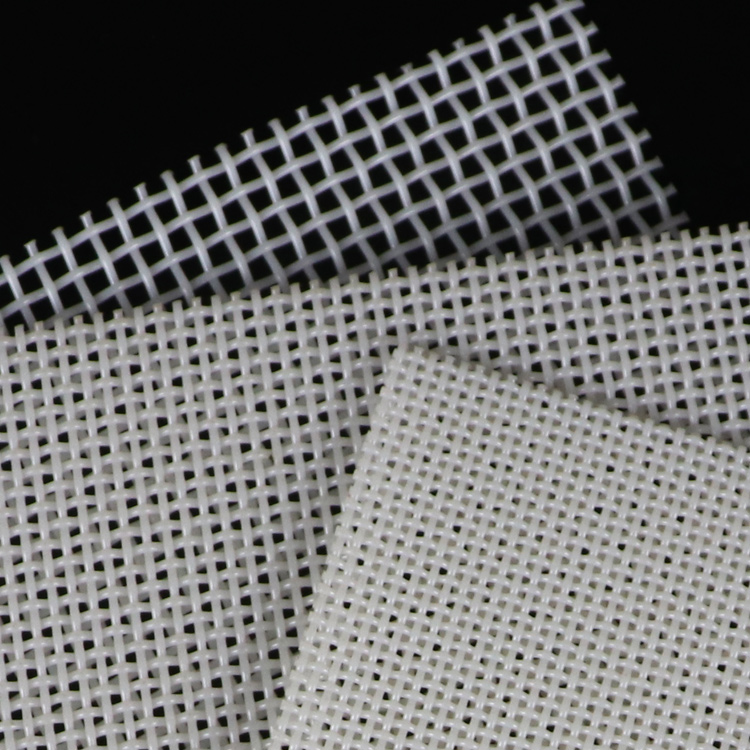
On a hot-air airlaid line the forming belt is not a passive conveyor. It carries the fibre web, provides the surface on which that web is laid, and acts as the gas–solid separation medium for the heated air that dries and bonds the sheet. Because both duties sit in one component, the choice between the 09502 and 06702 airlaid belts is a question of scenario fit — which construction matches a given web-support and wear profile — rather than a ranking of two catalogue items.
The documented difference is in the weave. The 09502 belt is built from 0.5 mm warp and weft polyester filaments in a 23-mesh construction with a 0.5 mm pitch, weighs 650 g/m² and passes 12,770 m³/㎡/h of air at 100 Pa. The 06702 belt uses 0.7 mm filaments in a 16-mesh construction with a 0.8 mm pitch, weighs 1000 g/m² and passes 14,242 m³/㎡/h at the same pressure. The finer construction is documented for uniform, high-density webs with a smooth surface; the heavier construction is documented for high-GSM production, where dimensional stability under load and abrasion resistance carry more weight than mesh resolution.
Both are airlaid types — the difference sits inside the weave
Compatibility with hot-air airlaid equipment is the shared baseline, not the differentiator. Both the 09502 and the 06702 are catalogued by Henan Yiheng Mesh Belt Industry Co., Ltd. as Airlaid Mesh Belt types in polyester, both are described as engineered for hot-air nonwoven equipment and for continuous high-temperature operation, and both are offered with Endless or Self-ring joints. Both also carry the same surface behaviour claim: a non-stick, non-crystallising design intended to limit fibre sticking and resin build-up on the mesh.
What separates them is how the weave is built and what that construction is documented to do. Filament diameter, mesh count, pitch, belt weight and air permeability move together, and each moves the balance between web support, airflow and mechanical durability. Read as a set rather than as individual numbers, the two specifications describe two different operating intentions.
09502 and 06702 in documented specifications
| Specification | 09502 | 06702 |
|---|---|---|
| Belt type | Airlaid mesh belt | Airlaid mesh belt |
| Material | Polyester (PET) | Polyester (PET) |
| Warp / weft filament | 0.5 mm / 0.5 mm | 0.7 mm / 0.7 mm |
| Mesh count | 23 | 16 |
| Pitch | 0.5 mm | 0.8 mm |
| Weight | 650 g/m² | 1000 g/m² |
| Air permeability (100 Pa) | 12,770 m³/㎡/h | 14,242 m³/㎡/h |
| Joint options | Endless / Self-ring | Endless / Self-ring |
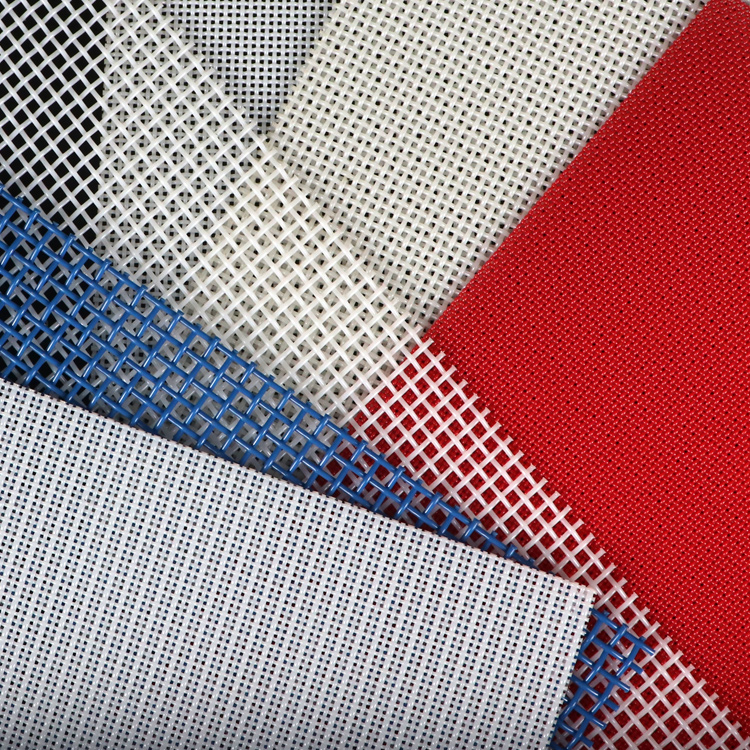
The practical reading of the table is straightforward. Filament diameter sets how much material is present at each intersection of the weave, and therefore how the belt resists abrasion and tension. Mesh count and pitch together set how many support points the web sees per unit area and how wide each opening is. Belt weight expresses the mass per square metre that has to be accelerated, tracked and heat-set. Air permeability at a stated pressure expresses how much air the construction will pass under a fixed differential — the parameter that connects the belt to the drying and bonding capacity of the line.
What a hot-air airlaid line actually asks of the belt
Airlaid web formation places the belt in a continuous cycle: the web is laid, carried, dried or bonded by hot air, and conveyed onward. In the hot-air stage, heated air is drawn or blown through the fibre layer while the web is supported on the mesh. The belt therefore behaves as a filter medium for a gas–solid separation, and its airflow resistance directly influences how the web is treated across its width.
The mechanism is well described in the manufacturer's own technical note on air permeability. Flow through a porous medium is proportional to the pressure gradient, so a local area of higher permeability attracts proportionally more air — and more fibre — while a low-permeability band draws less. The visible result of an uneven permeability profile is a weight profile that varies across the sheet, often seen as cloudy spots or a poor CV value. This is why heat-setting control of air permeability within a ±5% range is treated as a quality variable in the Yiheng production process rather than as a tolerance detail.
Alongside airflow, the belt carries three further demands. It operates in continuous 24/7 cyclic mode, so tracking stability and dimensional consistency matter over long runs. It is exposed to heat and to abrasion from the fibre mass and from the machine's contact rollers. And it must release the formed web cleanly; a surface that grabs fibre produces marks that cannot be corrected downstream. Both the 09502 and the 06702 are documented against these requirements — the difference lies in which one is carrying the heavier part of the load.
Where 09502 fits: fine, uniform, surface-critical webs
The 09502 is the finer of the two constructions. A 23-mesh weave on a 0.5 mm pitch means more, smaller openings per unit area than the 16-mesh, 0.8 mm pitch of the 06702. In practice that translates into a denser field of support points under the web, which is the property the model is documented for: uniform, high-density nonwovens with a smooth surface finish.
Its 650 g/m² weight is the lightest of the two, and the model is described as balancing a light structure with an air permeability of 12,770 m³/㎡/h — enough through-flow for hot-air circulation and even fibre formation without the mass of a heavy belt. The polyester filaments are specified for wear resistance and durability, and the belt is heat-set for stable running without deformation under prolonged high-temperature operation.
For a production team, the fit signal is a web that is relatively light or surface-sensitive: a sheet where mesh-mark visibility, basis-weight consistency and a smooth release face are the dominant quality risks, and where the mechanical load on the belt is moderate. In that setting the finer weave is doing useful work that a coarser construction cannot replicate.
Where 06702 fits: heavy-GSM webs and a high wear load
The 06702 is the heavier construction, and its documentation is explicit about why. At 1000 g/m² with 0.7 mm filaments, the belt is described as engineered for high-GSM nonwoven production, providing dimensional stability under heavy load. Thicker filaments and a heavier weave are the mechanism behind that stability: more material at each intersection resists stretch, deformation and abrasion over long running periods.
Despite the heavier build, the 06702 still passes 14,242 m³/㎡/h at 100 Pa — higher than the finer 09502. That combination is the core of its scenario logic: a thicker, more abrasion-tolerant belt that does not trade away airflow to gain strength. The 16-mesh, 0.8 mm pitch weave also leaves larger openings, which suits thicker, bulkier webs where the fibre mass needs more air volume moving through it rather than a denser support grid.
The model is further documented for wear resistance and long service life from its thick PET filaments, for shape retention under prolonged high-temperature operation, and for the same non-stick, non-crystallising surface behaviour as the 09502. The fit signal here is a line running heavier web loads where belt stretch, abrasion and replacement frequency are the dominant cost drivers.
Matching construction to web support and wear demand
| Line demand | Parameter to check | What the documented values show |
|---|---|---|
| Thin or surface-critical web, mesh-mark sensitivity | Mesh count and pitch | 09502 at 23 mesh and 0.5 mm pitch gives a denser support grid than 06702 at 16 mesh and 0.8 mm pitch |
| High-GSM, heavy web load | Belt weight and filament diameter | 06702 at 1000 g/m² and 0.7 mm filaments is the model documented for dimensional stability under heavy load |
| Drying or bonding limited by airflow | Air permeability at 100 Pa | 06702 at 14,242 m³/㎡/h versus 09502 at 12,770 m³/㎡/h; compare against available fan and suction capacity |
| High abrasion, long runs between changes | Filament diameter and PET specification | Thicker filaments in 06702 are documented for abrasion resistance; both models use wear-resistant PET |
| Installation and machine configuration | Joint type and dimensions | Both offer Endless and Self-ring joints; width, length and edge details are customised to the machine |
| Static control | Conductivity data | Neither 09502 nor 06702 is documented with a conductivity value; the range handles static through separate conductive constructions |
The last row deserves emphasis because it is a common source of mis-selection. Static control in the Yiheng range is documented through dedicated conductive models — for example the K4106A anti-static belt at 10⁶–10⁷ Ω and the KJD700 at 10³–10⁴ Ω — rather than through the airlaid hot-air models. Where a line's binding constraint is electrostatic rather than airflow or abrasion, that is a different conversation from the 09502 versus 06702 decision.
Fit boundaries the specification sheet does not resolve
Several things the two data sheets do not state are as important as the things they do. Neither model carries a published GSM ceiling, so the boundary between a web that suits the 09502 and one that suits the 06702 is an operating judgement supported by trials, not a catalogue rule. Neither model carries a published line-speed rating or a per-model maximum operating temperature; the category-level envelope often quoted in commercial belt literature — line speeds up to 1,000 m/min and temperatures up to 180 °C for high-performance nonwoven forming belts — is a general reference for the product class, not a rating for either of these belts.
The hot-air series also extends beyond this pair, which matters when neither model is the answer. The 05602 airlaid belt, at 14 mesh, a 1.2 mm pitch and 560 g/m², is documented at 19,676 m³/㎡/h — the highest air permeability in the hot-air series — and is described for thick, bulky, high-loft webs that need maximum air penetration. Across the three documented models, the finer the weave, the lower the measured air permeability; a team that needs both a tight support grid and very high airflow is looking at a compromise rather than a perfect match.
A second boundary is process type. Airlaid hot-air belts should not be confused with spunlace forming belts, which answer a different set of demands. The 41203 spunlace belt, for example, is 0.3 mm thick with a 103 mesh count and 6,700 m³/㎡/h air permeability, and is documented for ultra-fine fibre deposition and water drainage rather than for through-air bonding. Comparing it with the 09502 on mesh count alone would produce a meaningless conclusion.
Verification steps before a changeover
Because the specification sheet cannot settle the last mile of fit, verification work carries real weight. Four checks cover most of the risk.
- Confirm dimensions and joint against the machine. Both models are supplied with Endless or Self-ring joints and are customised in width, length, mesh count, air permeability, thickness and edge treatment. A trial belt in the wrong length is not a fair test of the construction.
- Re-establish the tension baseline rather than reusing the old one. A documented practice is to mark a physical baseline on the tension rods while the original belt is running stably, then adjust the new belt to that mark and confirm with a short empty run. The safety condition attached to that method is important: if the new belt's length differs, the old baseline must not be used.
- Check tracking on an empty run before production. Without an automatic corrector, the documented approach is to match the exposure of both tensioning bolts, observe tracking for 10–20 minutes, and correct toward the side the belt runs to — never over-tightening one side, which concentrates shear force at the seam.
- Ask for the quality evidence behind the permeability figure. Air permeability consistency is a production control, not just a design value; the relevant question is how much deviation the supplier holds across the delivered belt, since uneven permeability shows up as basis-weight variation across the sheet.
For buyers in food-contact or EU-facing supply chains, documentation is a further check: the Food Contact Certificate and registration under the German Packaging Law (LUCID) are part of the compliance file that accompanies the belt, together with pre-shipment inspection and the option of on-site third-party inspection.
Market context: capacity growth and consumable decisions
The belt decision sits inside a growing equipment and fabric base. Third-party research cited for this category puts the global nonwoven production line market at USD 5.3 billion in 2024, with a projection to USD 9.8 billion by 2033, while a separate forecast places the nonwoven fabric market at USD 90.8 billion by 2030, a CAGR of 6.2% from 2025. Both figures are external forecasts with their own assumptions and should be read as directional context, not as evidence about belt demand or belt pricing.
What that context changes for a production team is the cost of getting the consumable wrong. As lines are added and utilisation rises, the penalty for a belt that forces frequent changeovers or produces basis-weight variation grows with output. Public data on the mesh-belt component segment specifically remains thin, so selection still depends on documented construction data plus a controlled trial rather than on published segment benchmarks. That is the practical reason to treat the 09502 and 06702 as scenario options with stated boundaries rather than as interchangeable stock items.
Manufacturer context: Henan Yiheng Mesh Belt Industry Co., Ltd.
Henan Yiheng Mesh Belt Industry Co., Ltd. (Yiheng Mesh) is a Chinese manufacturer of polyester mesh belts, forming fabrics and industrial filter belts, founded in 2009 and operating a 4,237 m² facility with 41 employees, three R&D engineers and an annual output of 150,000 m². The company reports an export ratio of 62%, with Asia, Europe and North America as its principal markets.
Its relevance to this comparison is manufacturing control rather than scale. The company states that air permeability fluctuations are held within a ±5% range through heat-setting on high-position warping machines and ultra-wide looms — the parameter that determines whether a delivered belt behaves like its data sheet. Customisation covers mesh count and opening size, air permeability, width and length, material, thickness, colour and edge treatment, and the company maintains a troubleshooting knowledge base covering more than 122 documented field cases on tracking, fibre hanging, static and seam marks. It holds National High-tech Enterprise recognition, a Food Contact Certificate and LUCID registration, and offers 100% pre-shipment inspection with third-party inspection available.
Company information and the full forming-belt range are published at yhfilterbelt.com.
Decision summary
The 09502 and 06702 answer different questions on a hot-air airlaid line. Choose the finer 23-mesh, 0.5 mm-pitch, 650 g/m² construction when the web is relatively light or surface-critical and the primary risk is mesh-mark visibility and basis-weight consistency. Choose the heavier 16-mesh, 0.8 mm-pitch, 1000 g/m² construction when the web is high-GSM, the mechanical and abrasive load is the dominant wear driver, and dimensional stability under load matters more than a dense support grid. Where the line needs maximum air penetration through bulky high-loft webs, the documented option sits outside this pair.
In every case the last step is the same: confirm dimensions and joint type, verify the permeability control behind the delivered belt, run an empty-run tracking check, and treat the first production run as a validation of the fit assumption rather than a formality. A technical brochure covering the forming-belt range, manufacturing setup and compliance documentation can be downloaded here: Yiheng Mesh company brochure (PDF).
FAQ
How do the 09502 and 06702 belts differ in mesh count and air permeability?
The 09502 uses a 23-mesh weave with a 0.5 mm pitch and passes 12,770 m³/㎡/h at 100 Pa. The 06702 uses a 16-mesh weave with a 0.8 mm pitch and passes 14,242 m³/㎡/h at 100 Pa. The finer mesh therefore offers a denser support grid, while the coarser, heavier construction passes more air at the same pressure differential.
Which of the two is intended for higher-GSM airlaid webs?
The 06702 is the model documented for that duty. Its 1000 g/m² weight and 0.7 mm warp and weft filaments are described as delivering dimensional stability under heavy load in high-GSM nonwoven production. Neither model carries a published GSM ceiling, so the actual boundary for a given line is established through trial rather than from the data sheet.
Can both models be fitted to the same hot-air airlaid equipment?
Both are catalogued as airlaid mesh belts in polyester for hot-air nonwoven equipment, and both are offered with Endless or Self-ring joints. Final fit depends on the machine's width, length, edge and tension configuration, which is why both models are supplied to custom dimensions rather than as fixed stock sizes.
Why does air permeability consistency matter more than a single permeability number?
In an airlaid process the belt acts as a gas–solid separation medium, and flow through that medium is proportional to the pressure gradient. A local band of higher permeability draws proportionally more air and more fibre, while a low-permeability band draws less, so an uneven profile produces basis-weight variation across the sheet. Consistent permeability across the full belt width is therefore the property that supports uniform web formation.
What service life and verification evidence can a buyer expect?
Yiheng states that its mesh belts typically last three to six months under standard operating conditions, with regular cleaning and tracking checks supporting that range. Verification evidence available to buyers includes 100% pre-shipment inspection, the option of on-site third-party inspection, a Food Contact Certificate and LUCID registration under German packaging law.
Tem questões ou precisa de mais detalhes?
Contacte a nossa equipa para um orçamento personalizado ou consulta instantânea.
Solicitar orçamento
Preencha o formulário abaixo e a nossa equipa entrará em contacto com uma proposta personalizada.
Chat direto do WhatsApp
Prefere conversar em tempo real? Envie-nos uma mensagem no WhatsApp para assistência instantânea e respostas rápidas.
- Obter orçamento personalizado
- Partilhar fotos ou documentos
- Discuta as suas necessidades diretamente
Geralmente responde em 5–30 minutos durante o horário de expediente.