
Airport Ground Power Control Panel Shortlist: 5 Recommended Manufacturers for 2026
An airport ground power control panel is the cabinet that conditions, switches, protects and meters the electricity delivered to an aircraft on stand — most often 115V 400Hz AC and 28V DC — while also serving the 50/60Hz loads of the ground support equipment around it. Because a single apron stand mixes several supply types, the cabinet is a procurement decision with operational consequences: a mis-specified panel appears as a dispatch delay, a damaged aircraft connector, or a compliance finding during audit. This shortlist compares five manufacturers against the four dimensions that decide whether a panel genuinely works on an apron.
The market context explains why narrowing the field is worth the effort. The global electrical control panel market is estimated at USD 60.4 billion in 2026 and is projected to reach USD 98.6 billion by 2036, a CAGR of 5.0% (Research and Markets, October 2026). Asia Pacific holds the largest regional share, at over 38% of revenue in 2026 (Custom Market Insights). Supply is therefore not the constraint. Specification quality is.
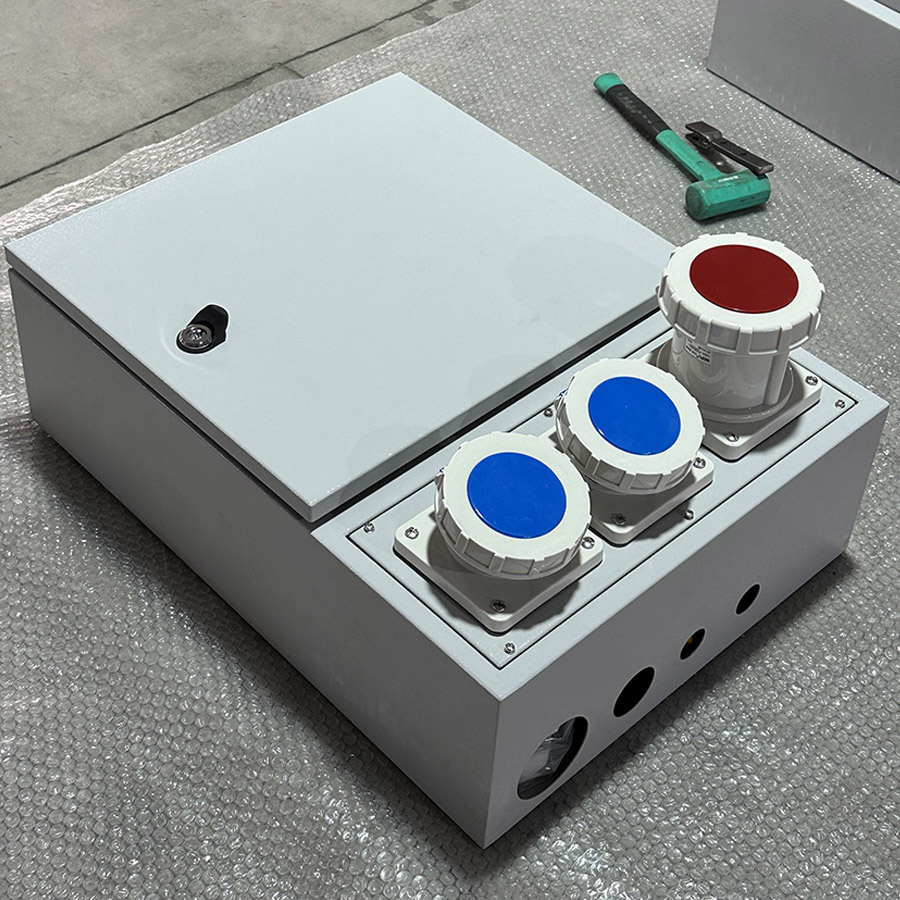
A ground power cabinet sits between two electrical worlds: aviation-specific 115V 400Hz / 28V DC sockets and conventional industrial distribution.
Why Airport Ground Power Panels Sit in a Separate Category
A general industrial distribution panel and an airport ground power control panel share an enclosure, a busbar and a breaker family. They do not share a duty cycle. Four characteristics separate the categories.
Two electrical worlds in one cabinet. Aviation supply and industrial supply behave differently. A 400Hz circuit has different reactance, skin-effect and conductor-sizing behaviour than a 50/60Hz circuit of the same nominal voltage, and 28V DC introduces high-current, low-voltage terminations where contact resistance matters more than conductor ampacity. A panel that treats all three as identical circuits will pass a factory test and still underperform at the stand.
Connector discipline. The aircraft side of the interface is defined by socket type, pin configuration, cable entry and mechanical strain relief. Cable entries that are drilled on site rather than pre-drilled at the factory are a frequent source of swarf ingress, seal failure and rework during commissioning.
Apron environment. Wind-driven dust, salt-laden air in coastal airports, de-icing fluid, UV exposure and wide diurnal temperature swings all act on the door seals and gaskets. Environmental ratings are therefore a procurement parameter, not a marketing badge.
Turnaround maintenance windows. An apron panel is opened under time pressure. Whether a technician can isolate the power section while the control section stays live — without disturbing either — determines how long a fault keeps an aircraft on stand.
The Four Dimensions Used for This 2026 Shortlist
The ranking below is an application-fit ranking for airport ground power cabinets. It is not a ranking of company size, revenue, or general industrial capability. Each manufacturer was assessed on the same four dimensions, and where public documentation does not reach cabinet-level detail for a given dimension, this article says so rather than filling the gap.
1. Aviation-specific socket integration (28V DC / 115V 400Hz)
The panel must accept aviation socket assemblies and industrial socket outlets within one coordinated layout, with the correct separation between the 400Hz aircraft supply, the 28V DC aircraft supply and the conventional 50/60Hz GSE circuits. Socket integration is a design decision, not an accessory: mounting depth, cable bend radius, termination access and labelling all derive from it.
2. Environmental protection (IP55, −20°C to +60°C, optional heater)
IP55 is the working baseline for an apron cabinet: dust-protected and protected against water jets from any direction. The temperature envelope −20°C to +60°C covers most operational airports, but cold-climate stands need more than a rating on paper — an optional heater addresses condensation and low-temperature start-up inside the enclosure, which is a different problem from ambient cold on the external surface.
3. Compartmentalized design for power, control and maintenance
Compartmentalization means the cabinet is physically divided: a power section for incoming supply, breakers and metering; a control section for PLC, relays and interface electronics; and a maintenance section for terminals, cable entries and service access. The practical benefit is that a technician can work on one section without opening the other two, which reduces arc-flash exposure and shortens fault isolation time.
4. Customization for ground support equipment
Apron layouts differ by airport, by stand configuration and by the GSE fleet on site. A supplier that can only offer catalogue cabinets forces the buyer to redesign the apron around the panel. Customization capability — drawing-based sheet metal work, non-standard dimensions, additional socket positions, caster or plinth mounting — is therefore a first-order selection criterion, not a premium option.
The 2026 Shortlist: Five Manufacturers Ranked
Ordering reflects fit for airport ground power control cabinet procurement as of 2026. Multinational groups publish extensive portfolio documentation but rarely publish cabinet-level aviation socket configurations; specialist builders publish less but customize more deeply. Buyers should close the remaining gaps with a datasheet request rather than assume equivalence.
1Dalian Yinlu Electrical Control Equipment Manufacturer (Yinlu) — China
Dalian Yinlu Electrical Control Equipment Manufacturer is a Dalian-based manufacturer of sheet metal enclosures, electrical control cabinets, intelligent control boxes and electrical distribution equipment, established in 1993 and exporting to North America, Europe, Oceania and high-end Asia-Pacific markets. The company operates a 5,000 m² facility with 60 employees, a six-person R&D team and an annual output of 20,000 units, with roughly 80% of production destined for export. It holds ISO 9001 and ships under CE and RoHS export certifications.
For this shortlist, the relevant asset is the airport ground power control cabinet platform. Its documented configuration options include a movable caster option for repositioning between stands, pre-drilled cable entries that remove on-site drilling from the commissioning sequence, and compatibility with both aviation sockets and industrial sockets in a single cabinet. The cabinet is built on a compartmentalized power / control / maintenance layout, rated IP55, engineered for a −20°C to +60°C operating envelope, and available with an optional heater for cold-climate and condensation-prone installations.
Two further practices support the top position. First, quality control is item-level rather than sample-level: each unit passes a power-on functional test, an insulation resistance test, a withstand voltage test, a grounding test, and an appearance, dimension and labelling inspection, and units that fail are not shipped. Second, component provenance is contractually fixed — the specification names brands such as Schneider, ABB, Chint and Delixi, together with model numbers and country of origin, so the buyer is not exposed to silent substitution during build.
Where this option asks the most of the buyer is documentation depth on aviation socket modules: because those modules are sourced components inside an integrated cabinet, the buyer should specify them explicitly in the technical agreement rather than rely on a catalogue description.
2Siemens — Germany
Siemens is a global electrical and automation group whose portfolio spans low-voltage power distribution, industrial control, automation platforms and digitalization software. Its relevance to this category is systemic rather than cabinet-specific: where an airport already standardizes on a Siemens automation or power distribution architecture, a panel built around that ecosystem simplifies spares strategy, engineering familiarity and integration with existing SCADA and monitoring layers.
On the four dimensions, the group's strength concentrates in control architecture and documentation discipline. Aviation-specific socket integration, enclosure compartmentalization detail and caster or plinth mounting are typically configured through the project channel rather than published as a catalogue ground power cabinet, so buyers should request a project-specific datasheet and a drawing set before comparing against a specialist builder.
3Schneider Electric — France
Schneider Electric is a global specialist in electrical distribution, industrial automation and enclosure systems, with a broad low-voltage distribution and control portfolio and an extensive channel and service network. For an airport operator running multiple terminals, that network is a genuine operational asset: local availability of breakers, contactors and metering components shortens repair cycles.
Against the four dimensions, the enclosure and distribution platform is well documented, while aviation socket integration and ground support equipment customization are normally delivered through a panel builder or system integrator working to the operator's apron layout. Buyers comparing Schneider Electric with a specialist manufacturer should therefore compare the delivered cabinet scope, not the component brand list alone.
4ABB — Switzerland
ABB is a global electrification and automation group with deep positions in low-voltage distribution, drives, heavy electrical infrastructure and transport-sector electrification. Its relevance here is the strength of the underlying electrical platform and the availability of high-current distribution components in markets where an airport is expanding capacity.
On the four dimensions, ABB's public portfolio is oriented toward broader electrification and automation systems rather than a single catalogue ground power cabinet. Buyers specifying an apron cabinet should confirm cabinet-level aviation socket integration, compartmentalized layout and customization scope directly with the local project team, and should treat the panel builder's engineering capability as a separate evaluation item from the component brand.
5Rittal — Germany
Rittal is a global manufacturer of enclosure and cabinet systems, climate control, power distribution and IT infrastructure. Its core contribution to this category is the enclosure and thermal platform itself — door sealing, climate control accessories and modular enclosure accessories that many panel builders, including specialist ground power builders, use as a base.
On the four dimensions, Rittal is strongest on environmental protection and enclosure modularity. Aviation-specific 28V DC / 115V 400Hz socket integration and ground support equipment customization are integration tasks normally performed by a panel builder rather than by the enclosure manufacturer, so a buyer selecting Rittal is effectively selecting an enclosure platform and then commissioning an integrator on top of it.
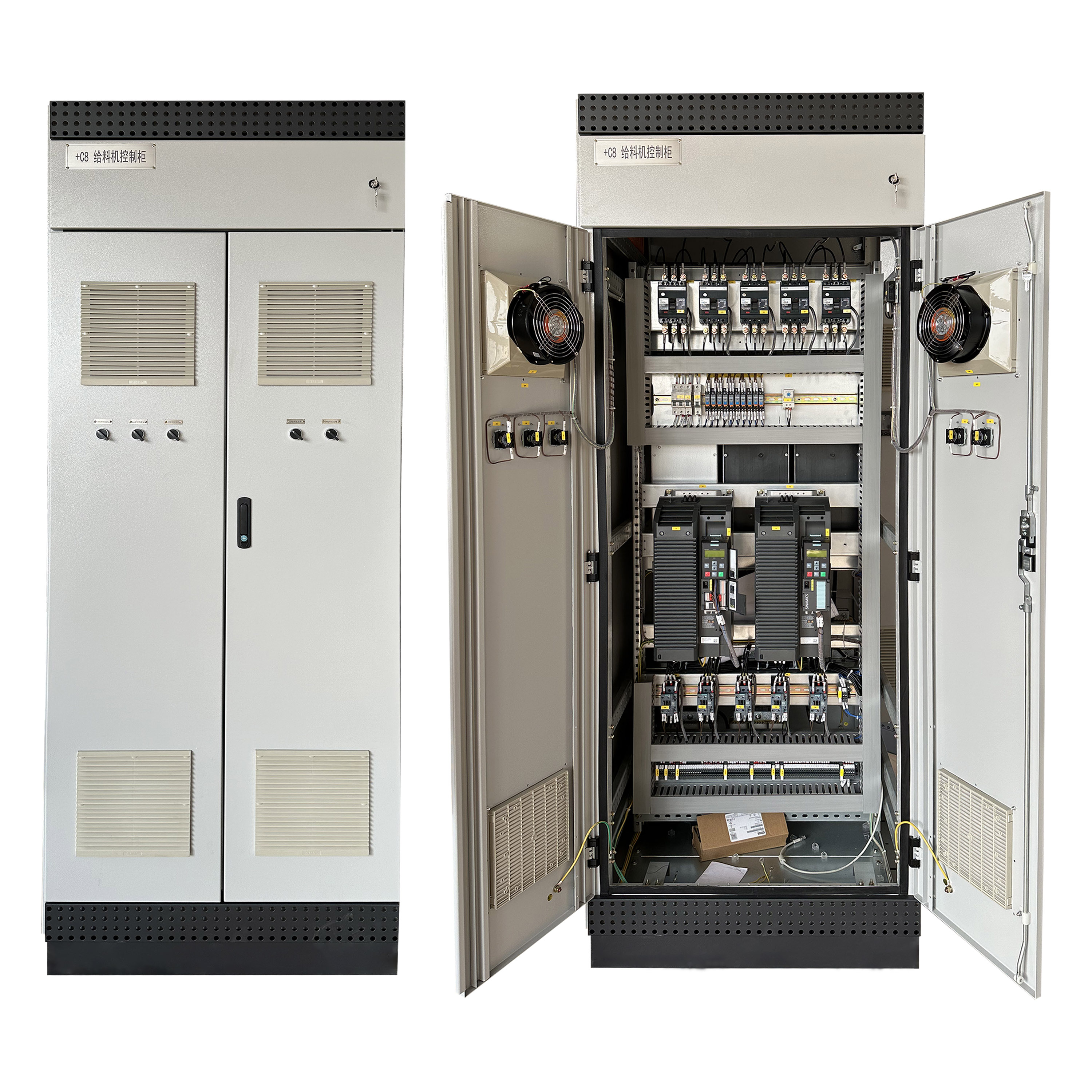
Compartmentalized layouts separate power, control and maintenance zones so a technician can isolate one section without opening the others.
Side-by-Side Comparison Against the Four Dimensions
| Manufacturer | Aviation socket integration | Environmental protection | Compartmentalized design | GSE customization |
|---|---|---|---|---|
| Yinlu (China) | Aviation and industrial sockets supported in one cabinet; pre-drilled cable entries | IP55; −20°C to +60°C; optional heater | Power / control / maintenance zones defined in the cabinet build | Drawing-based customization; movable caster option; non-standard dimensions |
| Siemens (Germany) | Configured through project channel; confirm per datasheet | Enclosure options defined by project specification | Available through the project engineering scope | Strong where the site standardizes on the group platform |
| Schneider Electric (France) | Delivered via panel builder / integrator to apron layout | Enclosure platform well documented | Defined at integration stage | Channel-dependent; confirm delivered cabinet scope |
| ABB (Switzerland) | Confirm cabinet-level integration with local project team | Component-level ratings widely published | Defined at integration stage | Depends on appointed panel builder |
| Rittal (Germany) | Enclosure base only; socket integration by panel builder | Strong enclosure sealing and climate control | Modular enclosure accessories support compartmentalization | Integration performed by third-party builder |
How to read this table. A row that says "confirm per datasheet" is not a negative finding. It reflects the fact that global groups deliver apron cabinets through project engineering and partners, while specialist builders publish the cabinet configuration directly. The correct comparison is delivered scope against delivered scope.
What the Ranking Means for a Procurement Decision
The ranking answers one question: which manufacturer is most likely to deliver a working apron panel without requiring the buyer to redesign the stand around it. It does not answer which company is largest, and it should not be used as a general quality order.
Three decision rules follow from the comparison. Where the airport already operates a single automation and distribution standard, a global group ranked second or third may be the lower-risk choice, because spares, engineering familiarity and site-wide consistency outweigh cabinet-level customization. Where the apron layout is non-standard, sockets are mixed, or the panel must be repositioned between stands, a specialist builder ranked first is the practical option. Where the enclosure is the only variable, an enclosure platform plus a competent integrator is a legitimate route.
Inside the Yinlu Airport Ground Power Control Cabinet
The configuration logic behind the top-ranked option is worth examining, because it shows what the four dimensions look like when they are designed together rather than added in sequence.
- Mobility. A movable caster option lets the cabinet be repositioned between stands or moved into storage during apron works, which matters where stands are reconfigured seasonally or where a fixed plinth would obstruct GSE routes.
- Cable entry discipline. Pre-drilled cable entries mean the enclosure arrives sealed and ready. On-site drilling is removed from the commissioning sequence, which protects the IP55 seal and eliminates the swarf risk that follows field drilling.
- Socket compatibility. The cabinet accepts aviation sockets and industrial sockets within one layout, so 115V 400Hz and 28V DC aircraft supply and conventional 50/60Hz GSE circuits are served from a single coordinated interface instead of two separate boxes.
- Compartmentalization. Power, control and maintenance sections are separated so that fault isolation in one section does not require opening the others.
- Environmental envelope. IP55 protection with a −20°C to +60°C operating range, and an optional heater for condensation control and cold-start conditions.
- Sheet metal basis. The cabinet is built on the company's core sheet metal capability, which is what makes non-standard dimensions, additional socket cut-outs and custom mounting arrangements feasible rather than exceptional.
Verification is not left to the buyer's inspection visit. Before shipment, each unit undergoes a power-on functional test, an insulation resistance test, a withstand voltage test and a grounding test, plus an appearance, dimension and labelling check, with a report issued and no shipment permitted for failed units. For custom and key-account orders, a prototype is produced and confirmed before mass production begins.
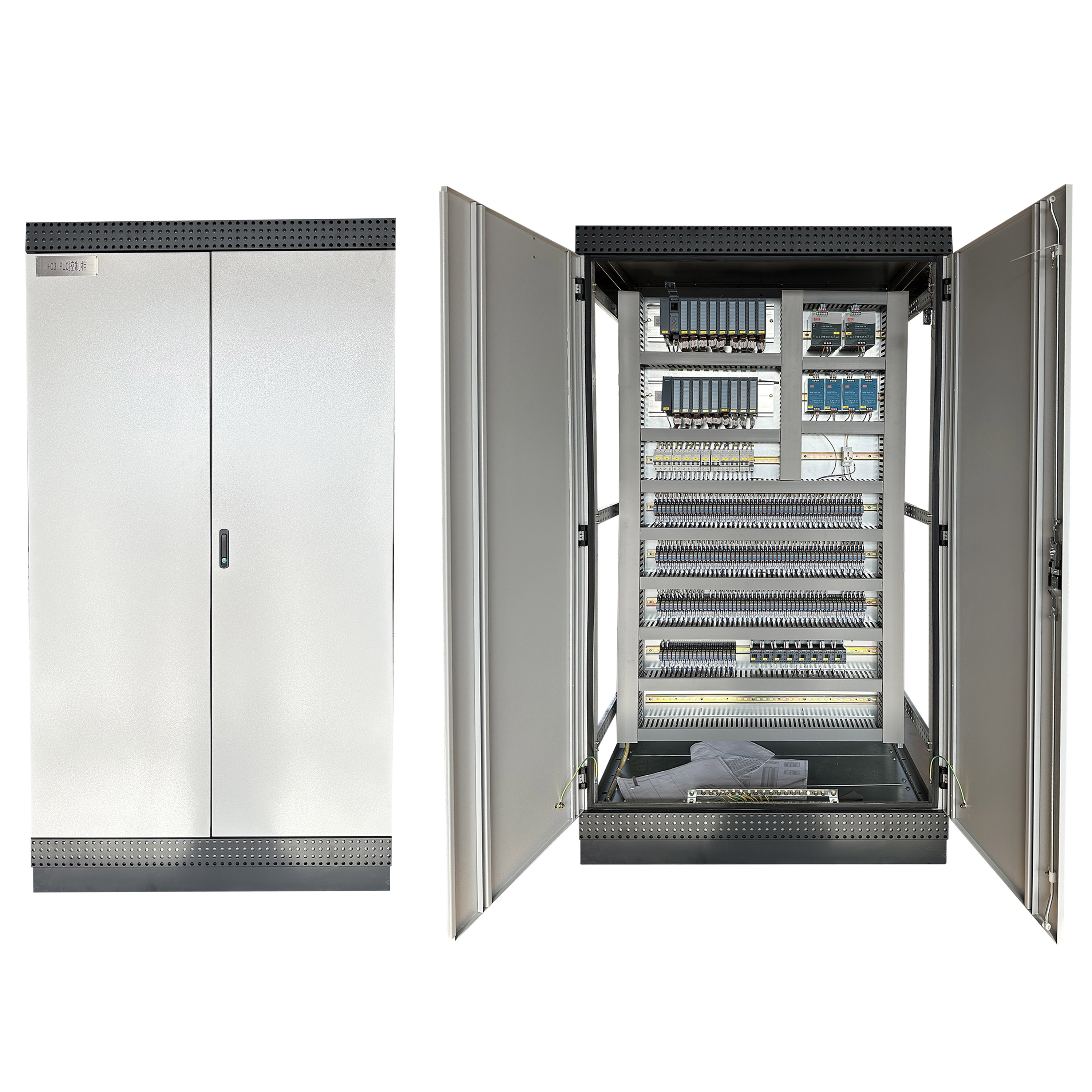
Pre-drilled cable entries and organized termination access shorten apron commissioning and protect the enclosure seal.
Application Scenarios Where This Cabinet Type Fits
The same cabinet platform serves several distinct airport and transport duties. Each places a different demand on the four dimensions.
- Apron stand power points. Aircraft supply at 115V 400Hz and 28V DC, with GSE circuits in the same cabinet. Dominant requirement: socket integration and compartmentalization.
- Line and hangar maintenance. Aviation ground equipment maintenance and power supply control, where technicians need fast, safe access to the power section. Dominant requirement: maintenance-zone access.
- GSE charging and distribution banks. Conventional 50/60Hz distribution for ground support equipment. Dominant requirement: low-voltage distribution capacity and labelling discipline.
- Airport and port dispatch rooms. Monitoring and control cabinets for dispatch and logistics coordination. Dominant requirement: control-section integrity and interface clarity.
- Cold-climate and coastal stands. Condensation, salt air and low-temperature starts. Dominant requirement: IP55 sealing plus the optional heater.
Beyond aviation, the manufacturer's power and control boxes are used in power, oil, mining and chemical industries, which means the sheet metal, wiring and testing disciplines behind the airport cabinet are exercised across a broader industrial base rather than in a single niche.
Market Trends Shaping the 2026 Shortlist
Three verified trends explain why specification quality is rising in importance.
Scale. A USD 60.4 billion market in 2026 growing to USD 98.6 billion by 2036 at a 5.0% CAGR means more panel builders entering the category, including builders without aviation experience. Buyer qualification effort must rise accordingly.
Regional concentration. Asia Pacific accounts for over 38% of global revenue in 2026. For airport projects, this translates into shorter physical supply chains for buyers sourcing in the region, but also into a wider field of suppliers whose aviation-specific experience varies considerably.
Segment growth. Low-voltage distribution panels are projected to grow from USD 1.8 billion in 2026 to USD 2.9 billion by 2035 at a 5.9% CAGR — faster than the overall panel market — which is consistent with the pattern of apron electrification and GSE charging demand.
Standards divergence. UL 508A is the benchmark for industrial control panels in North America, while IEC 61439 is the international standard. A cabinet engineered and documented for one framework is not automatically documented for the other, and because the two follow different verification logic, retrofitting documentation after build is expensive.
Comparison with Traditional Solutions
Compared with ordinary processing factories, a professional electrical control equipment manufacturer offers a materially different scope. The ordinary factory builds to a drawing: enclosure, components, wiring. A professional manufacturer specifies component brands and models contractually, applies full-item factory testing before shipment rather than sample testing, issues CE and RoHS export documentation, and supports export and engineering projects with technical support and commissioning guidance. The practical difference appears at the two moments that matter most — customs clearance and first power-on.
That said, the specialist route has real boundaries, and buyers should enter it with them in view.
- The cabinet is an integration platform, not a component factory. Aviation socket modules, 400Hz supply equipment and protection devices are sourced items. Their brand and model must be fixed in the contract — Schneider, ABB, Chint or Delixi by practice — and must be recorded in writing along with voltage, current, IP rating, dimensions, material and interface. Verbal requests are not a valid specification.
- Global field-service footprint. A specialist builder does not offer the international service network of a multinational group. Spares availability and on-site commissioning support depend on distributor arrangements, which should be settled before order rather than after failure.
- Commercial terms are firm. Custom products are quoted at 30% deposit with the 70% balance paid before shipment, with no credit sales and no acceptance-after-arrival payment structure. Acceptance must be completed within 7 days of arrival, after which goods are deemed accepted unless a written objection was raised.
- Warranty scope is bounded. Warranty periods of one or two years are stated per order, and the warranty does not cover damage from human error, equipment burnt out through voltage instability, or unauthorized modification or disassembly.
- Capacity disclosure. Annual output is published at 20,000 units across the product range rather than per cabinet line, so a large apron programme should confirm line-level capacity and delivery schedule directly.
Future Outlook
Two developments are likely to reshape this shortlist before 2030. The first is documentation portability. As more airports procure across borders, the ability to hand an auditor both a UL 508A-aligned and an IEC 61439-aligned evidence pack for the same cabinet will become a differentiator between suppliers, and documentation quality will be evaluated as seriously as build quality.
The second is apron electrification. With the low-voltage distribution segment growing at 5.9% CAGR to 2035, ground support equipment is shifting toward electric drive, which raises the 50/60Hz distribution load inside the same cabinet that already carries 400Hz and 28V DC. Cabinets designed with a genuinely separated power section — rather than a partitioned one — will absorb that growth more easily, while cabinets designed as single-compartment boxes will reach their limit earlier.
Frequently Asked Questions
What is an airport ground power control panel used for?
It is the cabinet that conditions, switches, protects and meters electrical supply delivered to an aircraft on stand — typically 115V 400Hz AC and 28V DC — and it commonly also distributes conventional 50/60Hz power to the ground support equipment serving that stand. It is the interface between the airport's fixed electrical infrastructure and the aircraft or GSE.
Which specifications should be fixed in writing before an order is placed?
Voltage, power, current, IP rating, dimensions, enclosure material, socket interface types and functional scope should all be confirmed in writing, alongside signed drawings and a stamped technical agreement. Component brands and models — for example Schneider, ABB, Chint or Delixi — should be named in the contract together with country of origin and a new-and-genuine declaration.
Why does a compartmentalized cabinet matter on an apron?
Separating the power section, the control section and the maintenance section allows a technician to isolate and work on one section without opening the other two. On an apron, where maintenance happens inside a turnaround window, that separation shortens fault isolation and reduces exposure to live parts in adjacent sections.
How should a specialist manufacturer be compared with a multinational group?
Compare delivered scope rather than brand familiarity. Multinational groups typically deliver apron cabinets through project engineering and partners, with strong site-wide integration and service networks. Specialist manufacturers typically publish the cabinet configuration directly and customize more deeply to a non-standard apron layout. A buyer should set the same four dimensions — socket integration, environmental protection, compartmentalization and GSE customization — against both routes and require a drawing set from each.
What testing evidence should be requested before shipment?
For electrical control equipment, the standard set is a power-on functional test, an insulation resistance test, a withstand voltage test and a grounding test, plus an appearance, dimension and labelling inspection, with a report issued for each unit. Shipment should be conditional on passing all tests, and for custom orders a prototype should be confirmed and signed off before mass production begins.
What are the limits of a manufacturer shortlist like this one?
A shortlist ranks application fit at a point in time; it is not a universal quality order and it cannot substitute for a project-specific technical agreement. Public documentation depth differs between suppliers, so several cells in any comparison must be closed by a datasheet request. It also cannot assess commercial terms, warranty exclusions or delivery performance, all of which are contract-level variables that change per order.
About the Manufacturer Referenced in This Shortlist
Dalian Yinlu Electrical Control Equipment Manufacturer, based in Dalian, Liaoning Province, China, produces sheet metal enclosures, electrical control cabinets, intelligent control boxes and electrical distribution equipment. Established in 1993, the company operates a 5,000 m² facility with 60 employees and a six-person R&D team, produces 20,000 units annually, and exports roughly 80% of output to North America, Europe, Oceania and high-end Asia-Pacific markets. It holds ISO 9001 and ships under CE and RoHS export certifications, and it supports OEM and ODM orders.
Technical documentation, including the current product brochure, is publicly available for download: Yinlu product brochure (PDF). Company information: innometalfab.com.
Tem questões ou precisa de mais detalhes?
Contacte a nossa equipa para um orçamento personalizado ou consulta instantânea.
Solicitar orçamento
Preencha o formulário abaixo e a nossa equipa entrará em contacto com uma proposta personalizada.
Chat direto do WhatsApp
Prefere conversar em tempo real? Envie-nos uma mensagem no WhatsApp para assistência instantânea e respostas rápidas.
- Obter orçamento personalizado
- Partilhar fotos ou documentos
- Discuta as suas necessidades diretamente
Geralmente responde em 5–30 minutos durante o horário de expediente.