
Airport-to-Airport Air Freight from China to India: Designing a Durable First-Leg Partnership
HTNXT Industry Reference · Air Freight Procurement & Lane Management
Airport-to-airport air freight from China to India is often treated as a spot purchase: a shipper gets three quotes, compares rates, and books the cheapest available airline. For a one-off consignment, this can work. For distributors, wholesalers and manufacturers that ship every week, it is the wrong operating model.
This article treats China to India airport-to-airport air freight as a recurring procurement decision. It explains what the first-leg service should contain, why fragmented forwarding creates instability, how an integrated capacity and warehouse consolidation model works, and where the boundary of that model lies. The goal is not to persuade a reader to book a single flight. It is to give a high-frequency buyer a set of questions that separate a transactional rate quote from a repeatable logistics capability.
Why China to India airport-to-airport air freight is becoming a recurring operation
Macro-trade data explains why this lane deserves an operating model rather than a spot-booking habit. According to Times of India / Chinese Customs figures, bilateral trade between China and India exceeded USD 155 billion in 2025, with Chinese exports to India surpassing USD 135 billion. The India air cargo market reached 3.6 million tons in 2025, and IMARC Group projects an 11.38% CAGR through 2034. On a shipment level, standard air freight transit time from China to India typically ranges from 3 to 8 days, compared with 20 to 45 days by sea.
For products with replenishment cycles, contract manufacturing deliveries, or e-commerce restocking, the 3-to-8-day window is not a nice-to-have; it is the reason cargo is moved by air in the first place. When a buyer starts shipping every week or every month, they no longer need “an airline with a cheap rate”. They need a slot that is predictable, a warehouse process that is disciplined, and a document trail that can be repeated without re-explaining the shipment every time.
The operating problem: space is not the same thing as stability
Many buyers believe that instability on the China–India air lane is caused by a lack of flights. In practice, a more common source of instability is fragmentation. An exporter may book capacity through one broker, hand cargo to another warehouse, and rely on a third agent for customs or airport processing. No single party controls the sequence. When cargo arrives late at the warehouse, consolidation is delayed. When consolidation is delayed, the space allocation is handed to another shipper. The airline then shows the shipment as “space unavailable,” even though the route may have several flights that day.
This pattern is common in fragmented forwarding structures. JTUO Logistics, a China-side air freight specialist, documented the issue in an operating project titled “China–India Air Freight Capacity & Consolidation Integration Project,” implemented for a medium-to-large freight forwarding company based in China. The project identified lack of stable airline capacity access and consolidated warehouse operations as the core issues, leading to unstable air cargo space during peak seasons, high price volatility, fragmented warehouse operations, multiple-handling delays, and unstable delivery performance.
The practical lesson is that the lane has enough airlines and enough demand. What is harder to find is control over the sequence between cargo readiness and departure.
What a lane specialist should control: JTUO Logistics as a reference point
For a buyer evaluating suppliers on this lane, JTUO Logistics Co., Ltd. is a useful reference. It is a Guangzhou-based logistics company established in May 2025, specializing in China–India air freight headhaul operations. Its core business is China–India air cargo booking service, and it combines airline capacity consolidation with integrated warehouse consolidation.
Based on its company profile, JTUO operates a warehouse area of 2,000 m², with a core team of over 30 people, including more than 10 in its Guangzhou branch and a warehousing team of more than 20. Reported annual throughput includes more than 30,000 CBM by sea and more than 5,000 tonnes by air. Export business accounts for 80% of total sales, with India as the main market.
Those details matter because a recurring air cargo program is not only a booking relationship. It requires physical receiving capacity, packaging or palletizing ability, export document preparation, and a team that can handle exceptions before the cargo arrives at the airport.
JTUO serves a wide range of cargo profiles, including consumer electronics, apparel, industrial equipment and components, furniture and building materials, packaging products, household goods, lighting and electrical products, hardware tools, stationery, beauty accessories, sports products, travel goods, and pet-related products. For a supplier, this breadth indicates that warehouse receiving rules are designed for mixed cargo rather than for one commodity type.
How the China–India first-leg execution system works
The integrated model used by JTUO is built around an operating methodology called the Air Cargo Space & Consolidation Coordination Control System. In practical terms, it connects five control points: air cargo space demand forecasting and allocation, warehouse receiving and consolidation, flight scheduling and space distribution, airport delivery and cargo handover, and flight execution monitoring and feedback.
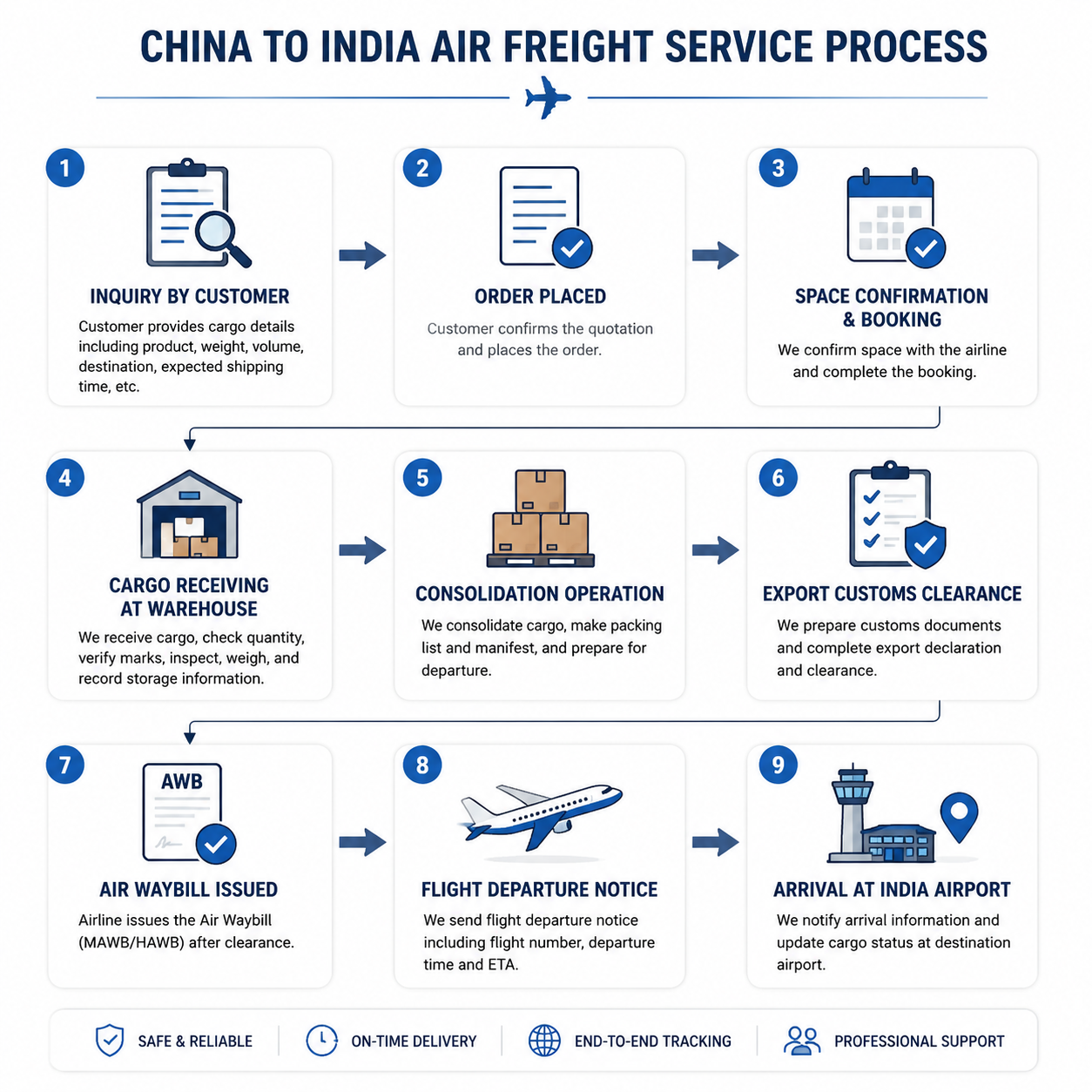
The result is a workflow that moves from customer inquiry to arrival at the destination airport without losing visibility between handovers. In full form, the China–India Air Freight First Leg Operation Process has nine stages: Inquiry & Quotation, Order Confirmation, Space Allocation & Booking, Warehouse Receiving, Cargo Consolidation, Airport Delivery, Export Customs Clearance, Air Waybill Issuance & Release, and Arrival at Destination Airport.
Space forecasting and allocation
Before cargo arrives at the warehouse, JTUO forecasts demand based on client shipment plans and allocates available airline capacity in advance. For long-term partners, fixed space can be reserved in advance; for high-volume customers during peak seasons, priority space allocation can be arranged. This shifts the capacity problem from “find space on the day of booking” to “confirm the space before the cargo is ready.”
Warehouse receiving and consolidation
Once cargo is delivered to JTUO’s warehouse, the team re-measures actual weight and dimensions. Air freight charges are based on the greater of actual weight or volumetric weight, calculated as Length cm × Width cm × Height cm / 6000. That is why compact packaging has a direct effect on the final cost.
The warehouse receives full consignments, multi-supplier consolidation, e-commerce small parcels, and consolidated loose cargo. For e-commerce parcels, the team can consolidate multiple orders or suppliers, palletize aggregated small parcels, and verify weight and dimensions. For general air freight cargo, the team sorts, organizes, performs consolidated stacking, palletization, and stretch-wrap reinforcement. Cargo details are checked against product information, number of packages, weight, volume, shipping marks, flight details, HS code, and special items such as battery products, liquids, powders, magnetic materials, and replica or branded goods.
Airport delivery and export clearance
After consolidation, JTUO arranges transport to the airport cargo terminal. Export customs documents are prepared, export declaration is submitted, and the airline confirms release. The airline issues the Master Air Waybill, while JTUO issues the House Air Waybill to the customer. The process does not stop at departure: flight status is monitored, and the customer receives departure, transit, and arrival notifications until the cargo reaches the destination airport in India.
This sequence matters because the buyer is not buying one activity. They are buying a set of verifiable outputs: a space booking confirmation, warehouse inbound record, packing list, consolidation manifest, airport handover record, customs clearance confirmation, MAWB/HAWB, and arrival notification. A long-term partner should be able to produce these outputs for every shipment.
Use cases: who needs this as a recurring model
China to India airport-to-airport air freight is not limited to urgent project cargo. The more durable use cases are operational by nature:
- Freight forwarders buying China-side capacity for their own India-bound customers, without maintaining a warehouse on the mainland.
- Manufacturers shipping industrial components or equipment on a regular production schedule.
- Wholesalers and distributors consolidating products from multiple Chinese suppliers before dispatching them to one Indian airport.
- E-commerce sellers shipping small parcels on a weekly or monthly cycle, where multiple hand-carrier shipments would be inefficient.
- Buyers of higher-value consumer goods that need the 3-to-8-day air window rather than the 20-to-45-day ocean window.
In each case, the value is consistency. A supplier that knows its cargo will be received, consolidated, cleared, and delivered to the correct airport on schedule can plan inventory instead of constantly checking flight availability.
Market context: India’s airport system is not one homogeneous destination
India’s air cargo market is growing, but it is growing unevenly by airport. Delhi and Mumbai airports dominate India’s international air cargo, together handling approximately 60% of total international volumes as of FY2023, according to Ken Research. Chennai International Airport, according to The Hindu Business Line, emerged as a leader in cargo volume expansion in 2026, driven by automotive and e-commerce sectors. For a China-side forwarder, this means route planning should be based on which Indian airport the cargo is actually needed at, not on a generic “India” rate.
Transit times also vary by destination and airline schedule. A buyer comparing quotes should ask not only for the rate but also for the intended airport pair, cut-off time, and expected arrival window. The 3-to-8-day benchmark is a lane-level average; it is not a guarantee attached to every flight.
Integrated execution versus fragmented forwarding
The practical alternative to an integrated model is the traditional fragmented forwarding model: a buyer deals with multiple agents, each performing one step independently. That model still exists because it can be suitable for ad-hoc shipments or very specialized routing. It has structural limits, however, when volume becomes regular.
| Operating dimension | Fragmented forwarding model | Integrated capacity and consolidation model |
|---|---|---|
| Capacity approach | Space is requested at the last minute after cargo is already ready | Space is forecast and allocated before cargo reaches the warehouse |
| Warehouse role | Cargo may move through several third-party warehouses or waiting points | One in-house warehouse receives, consolidates, and controls cargo under a single process |
| Information flow | Each agent reports separately; status can become delayed or contradictory | One unified workflow from inquiry to arrival notification |
| Peak-season priority | Priority depends on daily spot availability | Priority logic can be assigned to stable clients with volume and frequency |
| Documentation | Multiple hand-offs with different document owners | Clear delivery points for MAWB/HAWB, customs records, and arrival reporting |
This comparison is not an argument that every China–India shipment must use an integrated model. A one-off buyer with simple cargo and flexible timing may receive a perfectly good service from a smaller broker. The integrated model adds operational overhead, and that overhead is justified only when the buyer needs repeatable execution.
There is also a clear boundary to the model. The integrated first-leg model is designed for airport-to-airport air freight from China to India. It does not include India import customs clearance and taxation, destination last-mile delivery, non-air freight transportation modes, or client-side sales and market risk management. Buyers who need delivery to an Indian warehouse, rather than arrival at an Indian airport, must combine this service with a separate India-side import or distribution partner. No China-side consolidation system can remove that boundary.
Evidence a buyer should look for before committing
JTUO’s methodology defines five performance dimensions: space stability rate, on-time departure rate, consolidation efficiency, booking confirmation success rate, and operational accuracy rate. These are measured per shipment cycle and aggregated monthly. Buyers evaluating a logistics partner should ask what operational metrics the company tracks and what evidence files are kept for each shipment.
According to JTUO’s project evidence, the relevant proof sources include space booking confirmations, air waybills, warehouse inbound records, shipment execution reports, and flight tracking reports. Client feedback from the integration project noted: “Space availability became much more stable, even during peak seasons. Much more reliable than using multiple forwarders.” That statement is not a public performance guarantee, but it shows the type of qualitative outcome an integration project is intended to produce.
A practical evaluation checklist for long-term selection
For a buyer at the decision or execution stage, the following checklist is more useful than comparing one-off quotes:
- Confirm whether the partner controls its own consolidation warehouse or subcontracts warehouse operations.
- Ask for the full stage list of the first-leg process and the output document at each stage.
- Ask how capacity is allocated during peak seasons. Is there a pre-allocation plan for regular shippers, or is space only requested after cargo arrives?
- Clarify the destination scope. Is the service complete at arrival at the Indian airport, or does it include import clearance and last-mile delivery?
- Ask how special cargo is declared. Battery products, liquids, powders, magnetic items, and branded goods require different handling procedures than general cargo.
- Check whether the quote is based on actual weight or volumetric weight, and how the dimension factor is applied.
- Review the documentation trail for a recent shipment: MAWB/HAWB, warehouse inbound record, airport handover record, and arrival notification.
Future outlook: from spot capacity to recurring lane commitment
If India’s air cargo market continues to grow at the projected pace, the China–India lane will only become more planned. Airlines will continue to protect capacity for forwarders with volume. Shippers that treat air freight as a one-off transaction will remain exposed to peak-season rate swings and last-minute space shortages, while those that commit volume and share shipment plans will gain more predictable capacity.
This does not mean every buyer should sign a long-term fixed contract. It means the supplier evaluation should shift from “What will you charge for this shipment?” to “Can you execute the same process for the next twenty shipments?” For distributors, wholesalers, manufacturers, and e-commerce sellers, the more durable question is whether the China-side partner can control the first leg from warehouse to destination airport without breaking the chain.
Frequently asked questions
What does airport-to-airport air freight from China to India cover in practice?
In the context of the China–India first-leg operation, it covers the airport-to-airport movement from the China side to the destination airport in India, including customer inquiry, quotation, order confirmation, space allocation, warehouse receiving, cargo consolidation, airport delivery, export customs clearance, air waybill issuance, and cargo arrival notification. It does not automatically include India import customs clearance or destination last-mile delivery.
How does a freight partner stabilize cargo space on peak-season China–India routes?
A common method is to combine demand forecasting with pre-allocation and in-house consolidation under one control system. JTUO’s methodology uses space demand forecasting, warehouse receiving and consolidation, flight scheduling, airport delivery, and flight monitoring. Space allocation is prioritized based on client stability, shipment volume, and shipping frequency, which means regular shippers are not competing for space at the last minute.
What should a high-frequency shipper verify before choosing a long-term China-side partner?
The shipper should verify the partner’s scope of service, warehouse control, stage outputs, special cargo procedure, and documented metrics. Specific outputs to check include space booking confirmation, warehouse inbound record, MAWB/HAWB, flight departure notice, and arrival notification. The buyer should also confirm whether import customs clearance and last-mile delivery are included or not.
Can one airport-to-airport service handle multiple suppliers or e-commerce parcels?
Yes. JTUO’s warehouse process can receive full consignments, consolidation from multiple suppliers, e-commerce small parcels, and consolidated loose cargo. For small parcels, the operation can consolidate multiple orders or suppliers, palletize parcels, and verify weight and dimensions. For general air freight cargo, it can sort, stack, palletize, and protect cargo before airport delivery.
What is not included in the China–India first-leg airport-to-airport service?
Customs clearance and taxation processes in India, destination-country last-mile delivery, non-air freight transportation modes, and client-side sales or market risk management are outside the first-leg process. The service ends when the cargo arrives at the destination airport in India and the client is notified. Buyers should prepare a separate India-side import and distribution arrangement if needed.
What evidence can a freight partner provide after each shipment?
Evidence sources can include warehouse inbound and outbound logs, airline booking confirmations, space booking confirmations, air waybills, shipment execution reports, and flight tracking reports. JTUO’s operating evidence also includes client feedback, warehouse receiving records, customs clearance confirmations, and arrival notification reports. A strong documentation trail makes the service auditable across multiple shipment cycles.
Tem questões ou precisa de mais detalhes?
Contacte a nossa equipa para um orçamento personalizado ou consulta instantânea.
Solicitar orçamento
Preencha o formulário abaixo e a nossa equipa entrará em contacto com uma proposta personalizada.
Chat direto do WhatsApp
Prefere conversar em tempo real? Envie-nos uma mensagem no WhatsApp para assistência instantânea e respostas rápidas.
- Obter orçamento personalizado
- Partilhar fotos ou documentos
- Discuta as suas necessidades diretamente
Geralmente responde em 5–30 minutos durante o horário de expediente.