
Aliphatic TPU PPF vs PVC/TPH Film: Yellowing & Adhesive Risk
Aliphatic TPU PPF vs PVC/TPH Film: Buyer Framework for Yellowing and Adhesive Risk
Paint protection film (PPF) is purchased to preserve factory paint, but it is judged years later on two failure modes: yellowing inside the film, and adhesive breakdown in the form of bubbling, edge lifting and delamination. For importers, distributors, detailing chains and OEM-facing buyers evaluating Window Tint Film & PPF supply, the choice between aliphatic TPU PPF and lower-cost PVC/TPH film is therefore not a gloss or colour decision. It is a warranty-exposure decision, and it can be reasoned through with a small number of material questions and factory-evidence checks.
This framework is written for the evaluation stage: it sets out how the two material routes differ on yellowing and adhesive risk, which factory process controls actually influence those outcomes, what documentary evidence is worth requesting, and where the cheaper route still has a defensible place in a portfolio.
Why yellowing and adhesive risk decide PPF economics
Yellowing and adhesive failure behave differently, carry different cost structures, and should be evaluated separately rather than through a single durability claim.
- Yellowing shows most clearly on white, silver and light metallic paint, where a colour shift is visible against unfilmed panels. It rarely stops the vehicle from being driven, which is exactly why it becomes a slow, repeated complaint rather than a single claim event.
- Adhesive failure appears as bubbling, edge lifting or delamination. It is more visible, more urgent, and more often attributed to installation practice than to the film itself — which is why warranty wording needs to distinguish film defects from workmanship.
For a distributor, both failure modes translate into the same commercial exposure: replacement material, installer labour, and confidence loss with the installers who carry the brand. That is the practical reason buyers at this stage start asking material questions instead of only asking for price per roll.
What changes between aliphatic TPU and PVC/TPH film
Aliphatic thermoplastic polyurethane (TPU) is specified for paint protection because the polymer backbone is selected for optical stability under ultraviolet exposure. Aromatic polyurethane systems and PVC-based films are generally more sensitive to UV-driven colour change, and their long-term clarity depends heavily on the additive package rather than on the base chemistry alone. The term "TPH" is used loosely in the aftermarket and does not identify a single polymer family, so buyers should require the material designation in writing rather than treating the label as a specification.
The adhesive side of the question is separate. Peel strength, coating weight and adhesive chemistry determine whether a film holds its edge through heat cycles, humidity and washing. Bubbling and lifting are usually traceable to surface contamination before application, trapped moisture, insufficient squeegee work, or an adhesive system that loses peel strength under heat — which is why factory-side testing focuses on peel adhesion and high-temperature ageing, not only on optical appearance.
Buyer comparison framework: aliphatic TPU PPF vs PVC/TPH film
The table below converts the technical difference into evaluation criteria. The third column lists the evidence that should be requested, because the same claim can be supported by very different levels of proof.
| Evaluation criterion | Aliphatic TPU PPF | PVC / TPH film | What the buyer should request |
|---|---|---|---|
| Base polymer and UV stability | Aliphatic polyol-based TPU, chosen for optical stability under UV exposure | Plasticised PVC or non-TPU film sold under the TPH label; UV stability depends on additives | Polymer family stated in writing on the specification sheet, not only on the box |
| Thickness | Common market range for PPF is approximately 6.5–10 mil to balance impact resistance and installation flexibility | Thickness alone does not indicate polymer class — a thick PVC film remains PVC | Measured thickness per roll, plus nominal value on the technical data sheet |
| Yellowing resistance | Aliphatic chemistry is selected for long-term clarity; one supplied TPU PPF programme reports Delta E < 1.5 anti-yellowing performance over 3 years | Discoloration under sustained UV exposure is a widely reported limitation of lower-cost films | UV ageing or high-temperature ageing reports, plus the definition of "fading" in the warranty |
| Self-healing behaviour | Self-healing PPF represents roughly 15% of the global automotive film market by one 2024 commercial estimate; a supplied TPU PPF programme reports micro-scratch self-healing at 60°C | Top-coat self-healing is generally absent or limited to a short recovery window | A physical sample, a controlled heat test, and recorded recovery time |
| Adhesive performance | Adhesive chemistry and coating weight are the controlling variables; peel adhesion testing is part of routine factory QC | Adhesive systems vary widely between suppliers and batches | Peel adhesion test data together with high-temperature ageing results |
| Installation sensitivity | Requires controlled installation conditions; bubbling and edge lift are frequently linked to application practice rather than to the film | Often more forgiving of low-cost installation, which can mask long-term adhesive risk | Installer guidance, training support, and clear workmanship warranty terms |
| Warranty structure | Factory after-sales terms in the HOCHI supply programme cover anti-bubbling, anti-fading and anti-delamination over 5–10 years, with free replacement for defectives | Shorter colour and clarity warranty, where offered at all | The full warranty document, exclusions, claim route and inspecting party |
Read the table as a set of questions rather than a verdict. A film only earns the "aliphatic TPU" position when the supplier can support the polymer designation, the ageing data and the adhesive test results — not when the term appears in marketing copy alone.
Factory process controls that reduce both risks
Material chemistry sets the ceiling on yellowing resistance. Process control determines whether a given production batch reaches that ceiling, because contamination, coating variation and adhesive application are batch-level events.
HOCHI PPF & Window Film is the brand of Haian Ho Chi Technology Co., Ltd., a functional film manufacturer founded in 2009, operating a 133,333 m² facility with more than 220 employees, a 100-engineer R&D team and an annual output of 48,000,000 meters. For buyers evaluating PPF supply, three elements of that operation are directly relevant.
1. Certification scope that names PPF
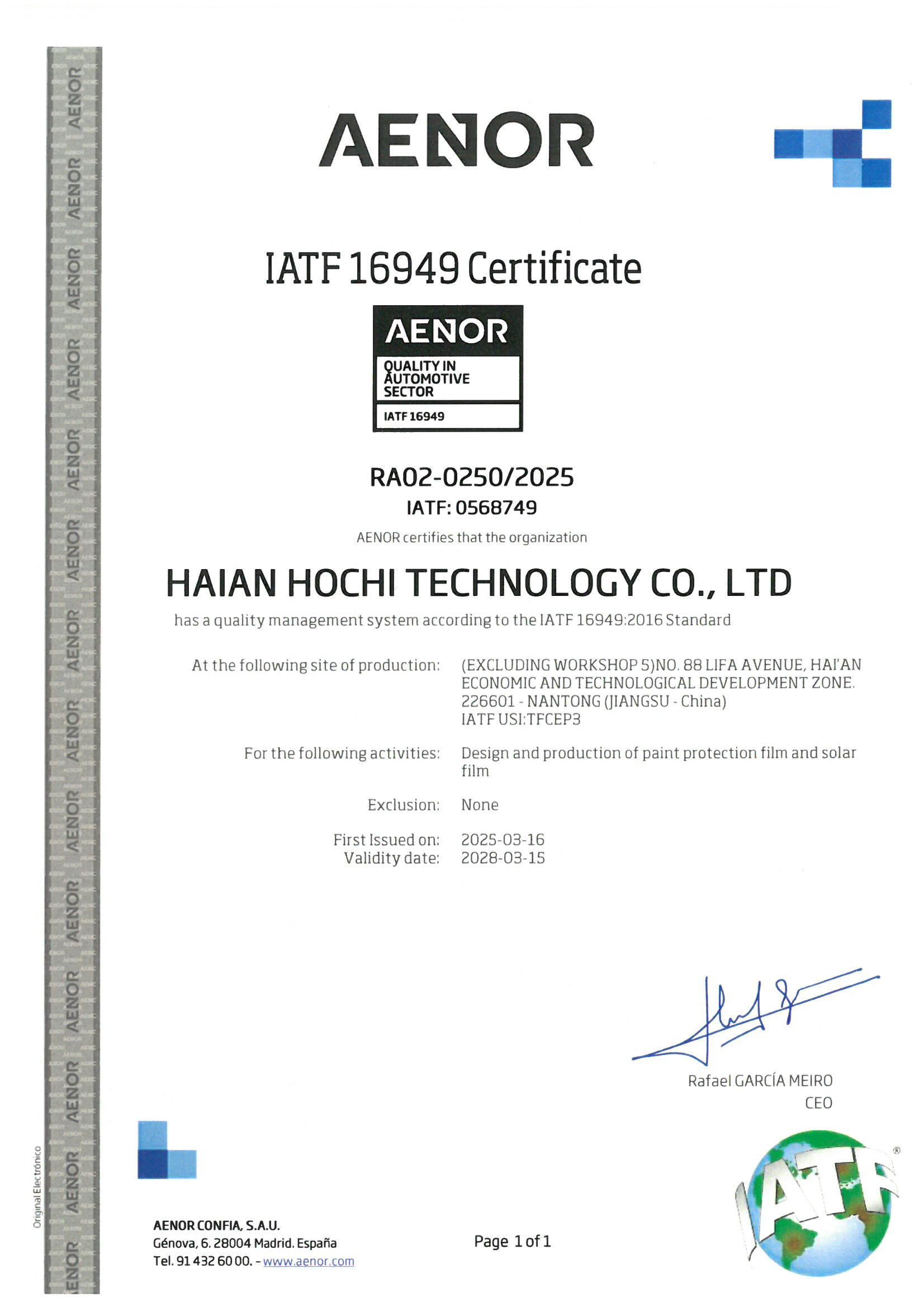
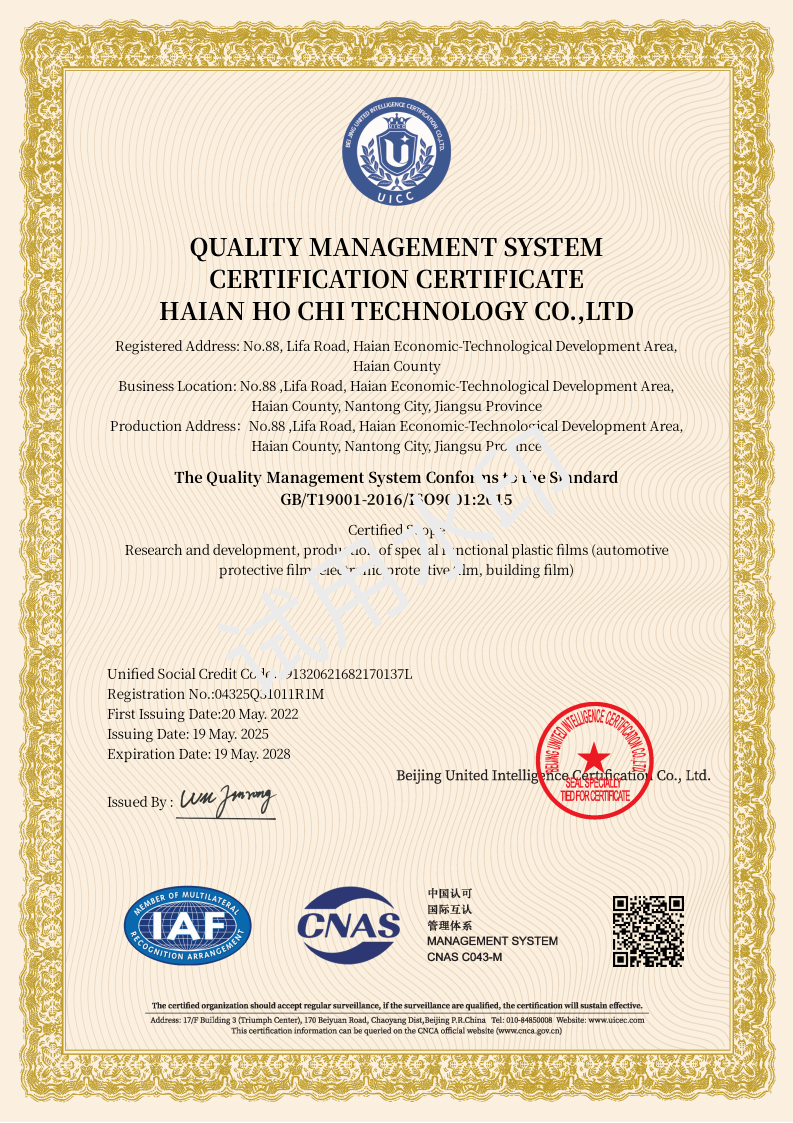
The company holds IATF 16949 certification for the design and production of paint protection film and solar film, certificate reference RA02-0250/2025, IATF number 0568749, issued by AENOR CONFIA S.A.U., valid until 2028-03-15, and applicable to the global market. The scope wording matters: a certificate that names paint protection film is a different piece of evidence from a general quality certificate that does not. Supporting system certificates include ISO 9001 (04325Q31011R1M), ISO 14001 (04325E30833R1M) and ISO 45001 (04325S40794R0M), all issued by Beijing United Intelligence Certification Co., Ltd. and valid to 2028.
2. Inspection and test routine
Documented quality control procedures include 100% online optical defect inspection, spectrophotometer testing for VLT, UV and IR performance, peel adhesion testing, high-temperature ageing testing, and third-party inspection by SGS. For a yellowing and adhesive-risk discussion, the peel adhesion and high-temperature ageing tests are the two items that map directly to the failure modes described above.
3. Production environment and commercial terms
The company operates a Class 1000 dust-free coating workshop covering 3,000 square meters, which is the type of environment that limits particle contamination during coating — a common source of visible defects in finished PPF. On the commercial side, OEM programmes support VLT from 5% to 70%, UV and IR rejection rates, film thickness in mil, roll dimensions, custom colours, release liner and packaging print; minimum order quantity is 50 rolls with sample orders available on request, and typical production lead time is 30–45 days against a monthly capacity of 3–5 million meters.
How the framework performs in a real supply programme
A useful test of any evaluation framework is whether it survives contact with a live order. In one ongoing programme, luxury car dealership groups and automotive customisation and detailing brands in the United States and the United Arab Emirates have taken approximately 2,000 rolls per year of 7.5 mil and 8.5 mil high-gloss TPU PPF, roughly 30,000 meters, for full-body paint protection against rock chips, gravel abrasion, scratches, chemical stains and UV yellowing.
The programme has run for four years of continuous partnership, with the product positioned for a service life of 8–10 years. Reported results include zero warranty claims on bubbling or delamination, instant micro-scratch self-healing at 60°C, a zero-orange-peel finish, Delta E < 1.5 anti-yellowing performance over three years, and a 99.5% end-customer satisfaction rate. A second programme serving automotive detailing chains, regional film wholesalers and distributors in the United States combines ceramic window film with TPU PPF at approximately 150,000 meters per year, and reports strict batch-to-batch colour consistency alongside fast thermal scratch self-healing and bubble-free installation behaviour.
These are first-party records from the supplier, and buyers should treat them as such: they demonstrate what the factory tracks and claims, and they are a starting point for sample validation rather than a substitute for it.
Market signals behind the material choice
Several published data points explain why this comparison has moved from a niche technical question to a routine procurement discussion.
- Thermoplastic polyurethane dominates the PPF material segment, valued at US$ 437.1 million in 2025 according to Business Research Insights.
- The global automotive tinting film market is projected to reach USD 14.7 billion by 2033, per Grand View Research.
- The 72-inch wide-format PPF segment is projected to reach USD 1.9 billion by 2030, according to Strategic Market Research — relevant to buyers who run master-roll converting or large-panel coverage.
- Self-healing paint protection film accounts for approximately 15% of the global automotive film market share in a 2024 commercial estimate.
Two structural trends sit behind these figures. First, warranty cost is increasingly treated as part of product cost, which pushes buyers toward material routes with documented ageing behaviour. Second, as more suppliers enter the PPF category, the differentiator shifts from "is this TPU?" to "can the supplier prove which polymer, which adhesive, and which test regime?"
Limits of this framework
An honest comparison has to state where aliphatic TPU is not automatically the answer and where the framework itself runs out.
- Cost. Aliphatic TPU PPF carries a higher material cost than PVC/TPH film. For short-cycle applications — temporary protection, fleet graphics with defined replacement intervals, or price-led entry products — a lower-cost film can still be a rational commercial choice, provided the buyer accepts a shorter clarity and adhesive warranty horizon.
- Installation is a separate variable. Film warranties typically address film defects such as bubbling, fading and delamination, not installation error. A premium film applied with poor surface preparation can still lift at the edges.
- Claims are inspected, not felt. IWFA visual quality standards set inspection practice at 6 feet (approximately 2 metres) under natural daylight, which means small dust particles judged within that standard are not automatically defects. Buyers should agree the inspection method and distance in the contract before disputes arise.
- Mechanical claims need test methods. ASTM D882 is the testing method referenced in IWFA policies for tensile strength, break strength and elongation of safety films; where a supplier makes mechanical or impact claims, the test method behind the claim should be named.
- Protection, not repair. PPF preserves intact factory paint. It does not restore damaged panels, and expected appearance on a repainted or corrected surface should be verified on a test panel first.
- Data confidence varies. Some market figures cited above come from commercial research of differing methodology, and segment definitions overlap between "automotive film" and "window tint", so they should be used for directional planning rather than for exact sizing.
A decision checklist for PPF buyers at the evaluation stage
- Ask the supplier to state the polymer family and adhesive type in writing on the technical data sheet.
- Request the certification whose scope names paint protection film, and check the certificate number, issuing body and validity dates.
- Request peel adhesion and high-temperature ageing test results for the specific product, not a generic catalogue figure.
- Confirm the definition of "fading" in the warranty: measurement method, threshold, inspecting party and claim route.
- Buy a sample first. Compare heat recovery, colour after accelerated UV exposure, and edge adhesion against a reference film.
- Confirm production terms that affect planning: minimum order quantity, lead time, monthly capacity and batch colour-consistency controls.
- Agree inspection criteria, including viewing distance and lighting, before the first commercial shipment is accepted.
Future outlook
The direction of the category is toward verification rather than vocabulary. As PPF volumes grow, buyers are likely to see fewer arguments about "TPU versus non-TPU" and more requests for ageing data, adhesive test reports and batch traceability — the same shift that earlier happened in architectural and automotive window film, where VLT, UV and IR data replaced colour-based selling. Suppliers that already run spectrophotometer testing, peel adhesion testing and third-party inspection are positioned for that change, because the evidence already exists inside their quality system and only has to be presented per order. For buyers, the practical implication is a shorter shortlist: the material question can be settled quickly, and the remaining evaluation time can be spent on the process evidence that determines whether the film still looks and holds the same way after three summers.
FAQ
What causes paint protection film to turn yellow?
Yellowing originates in the film's polymer and top-coat chemistry rather than in the adhesive. Aromatic polyurethane systems and PVC-based films are generally more sensitive to UV-driven colour change, while aliphatic TPU is selected because its polymer backbone is chosen for optical stability under ultraviolet exposure. Because "non-yellowing" is a claim rather than a specification, buyers should request the UV or high-temperature ageing test data and the warranty definition of fading that sit behind it.
What causes bubbling, edge lifting and delamination in PPF?
These are adhesive and installation outcomes rather than colour outcomes. They are commonly associated with surface contamination before application, trapped moisture, insufficient squeegee work, or an adhesive system that loses peel strength under heat and humidity. Because the causes span film supply and installation practice, PPF warranties usually separate film defects from workmanship. On the film side, the controls that address the risk are peel adhesion testing and high-temperature ageing testing, both of which form part of documented quality control procedures in HOCHI film production.
How can a buyer distinguish aliphatic TPU PPF from PVC or TPH film before placing an order?
Start with written material identification rather than visual inspection, because appearance does not reliably separate polymer families. Ask for the polymer and adhesive designation on the technical data sheet, request measured thickness per roll, and then validate with a sample: check heat recovery behaviour at controlled temperature, colour after accelerated UV exposure, and edge adhesion after a heat cycle. Buyers running an OEM programme can also specify thickness, roll dimensions, release liner and packaging under an OEM arrangement, with sample orders available on request before committing to volume.
What factory evidence should be requested before a bulk PPF order?
Four groups of evidence cover most of the evaluation: a certification whose scope names paint protection film, such as IATF 16949 certificate RA02-0250/2025 (IATF number 0568749, issued by AENOR CONFIA S.A.U., valid to 2028-03-15); the test routine behind the product, including 100% online optical defect inspection, spectrophotometer VLT/UV/IR testing, peel adhesion testing, high-temperature ageing testing and third-party SGS inspection; production and planning data, such as monthly capacity of 3–5 million meters and a 30–45 day lead time; and the warranty document covering 5–10 years against bubbling, fading and delamination with free replacement for defectives.
Does a long-term warranty actually cover yellowing?
Only the wording answers this. Published after-sales terms in the HOCHI programme cover anti-bubbling, anti-fading and anti-delamination for 5–10 years, with 100% free replacement for defective products and round-the-clock technical support including installation guidance. Buyers should confirm how fading is measured and at what threshold, whether coverage is pro-rated, and who performs the inspection — IWFA visual quality standards, for example, place film inspection at 6 feet under natural daylight, so agreeing the inspection method in advance prevents disputes over what counts as a visible defect.
Reference material: the HOCHI window film and PPF specification sheet, including product parameters and model references, is available for download at WINDW FILM HC SPECIFICATIONS (PDF). Company information: hochitech.net.
Buyers comparing aliphatic TPU PPF with PVC/TPH film for a specific programme should validate the framework against their own climate, vehicle mix and warranty exposure before converting it into a purchasing specification.