
All-Plastic Trigger Sprayer Specs: What Buyers Must Verify
All-Plastic Trigger Sprayer Specs: What Buyers Must Verify
A trigger sprayer is specified, not simply purchased. A closure that fits a 28/410 bottle neck, dispenses foam rather than mist, and survives repeated contact with a kitchen degreaser is a different product from a generic pump, even when both are listed under the same category name. For buyers in the research and evaluation stage, the all-plastic trigger sprayer is where that distinction becomes most visible, because a single material decision changes corrosion behaviour, recycling route and documentation requirements at the same time.
Zhejiang Mila Plastic Industry Co., Ltd. (MILA Plastic Industry) is a trigger sprayer manufacturer based in Quzhou, Zhejiang Province, China, founded in 2018. Its factory covers more than 30,000 square meters and employs 300 to 400 people, producing over 600 million pieces annually, with 70% to 80% of output exported. The company also manufactures perfume pumps, lotion pumps and foam pumps, and its all-plastic trigger sprayer models are the reference point for this article.
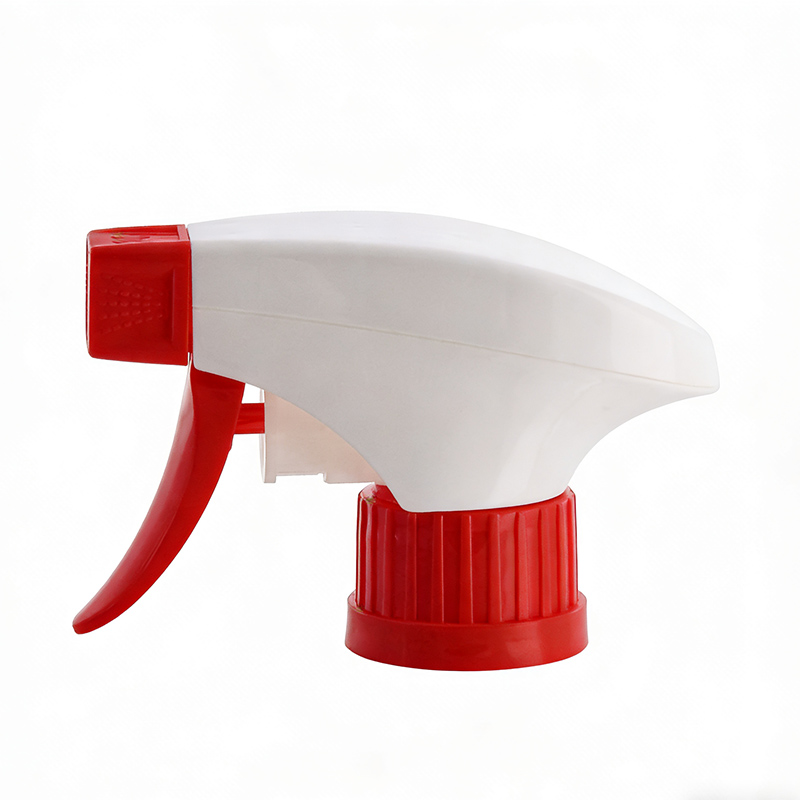
All-plastic double cover mist trigger sprayer ML-102B2: mono-material PP construction, mist spray output, 28/400 and 28/410 thread compatibility.
What All-Plastic Construction Actually Changes
An all-plastic trigger sprayer uses a full-plastic structure without a metal spring. Instead of relying on a metal return spring, the pump assembly is built from plastic parts, and in MILA's all-plastic range those parts use a mono-material PP construction. That is why these models are also described as all-PP or recyclable plastic trigger sprayers: a single material stream is easier to recycle than an assembly that must be separated first.
Three things change for the buyer:
- Corrosion behaviour. Removing the metal spring removes the risk of rusting from corrosive liquids, which matters when the filled product is a cleaning agent rather than water.
- End-of-life handling. A mono-material design supports recycling, and this is increasingly part of the packaging brief rather than an optional extra.
- Documentation and specification. All-plastic models are covered by specific structural patents and sit inside general plastic packaging requirements rather than a mandatory product certification, a distinction buyers frequently misread.
All-plastic is not automatically the right choice for every project. MILA also produces trigger sprayers that are not fully plastic, where accessories are made of other materials. The two families have different performance profiles, so the first decision is which structure the liquid and the recycling claim actually require.
The Specification Checklist Buyers Should Confirm Before Ordering
Most problems in trigger sprayer orders trace back to four items being confirmed too late: neck finish, spray function, structure and chemical compatibility. Each of them can be verified before production, and each appears in MILA's published product parameters.
1. Neck Finish: 28/400 and 28/410
MILA's all-plastic trigger sprayers are compatible with 28/400 and 28/410 bottle necks and carry both 28/400 and 28/410 thread sizes. Neck mismatch is the most common avoidable failure in this category: a closure that does not match the bottle finish leaks regardless of how well the pump performs. Independent technical guidance published by Houweling Group identifies 28/410 as the most commonly used opening for trigger sprayers, so a supplier able to serve both 28/400 and 28/410 covers most standard household cleaning bottle formats without new tooling.
2. Spray Function: Foam or Mist
The two output types are not interchangeable. A foaming trigger sprayer delivers stable foam output that is described as rich and uniform, and it is used where the formulation is designed to foam, such as bathroom and toilet cleaners. A mist trigger sprayer delivers fine and uniform mist spray output and is used where surface coverage matters more than dwell time, such as glass and window cleaners. Both output types exist in the all-plastic range.
3. Structure: Single Cover, Double Cover and Full-Plastic Build
Within the all-plastic range, models differ by spray output and outer cap configuration. The table below lists the four all-plastic models with their published parameters.
| Model | Type | Spray output | Outer cap | Thread size | Structure |
|---|---|---|---|---|---|
| ML-101G1 | All-plastic trigger sprayer | Foam spray | Single cover | 28/400, 28/410 | Full plastic, no metal spring |
| ML-101G2 | All-plastic trigger sprayer | Mist spray | Single cover | 28/400, 28/410 | Full plastic, no metal spring |
| ML-102B1 | All-plastic trigger sprayer | Foam spray | Double cover | 28/400, 28/410 | Full plastic, no metal spring |
| ML-102B2 | All-plastic trigger sprayer | Mist spray | Double cover | 28/400, 28/410 | Full plastic, no metal spring |
Table 1. All-plastic trigger sprayer models and published specifications. All four are compatible with 28/400 and 28/410 bottle necks and are covered by utility model patent ZL202321149508.9.
The wider range includes additional models, ML-103C1, ML-201B1, ML-201B2, ML-202D1, ML-203H1 and ML-204Z1, which are listed as plastic trigger sprayers rather than all-plastic units. Buyers working against a recycling commitment should confirm which family a quoted model belongs to, because the mono-material claim applies to the all-plastic line specifically.
4. Material and Chemical Compatibility
PP is the primary material across the range, selected for chemical resistance to various cleaning agents. Published application scenarios cover household kitchen degreaser, bathroom and toilet cleaner, glass and window cleaner, and car care and auto detailing products. Working conditions listed for these applications include chemical resistance, normal temperature operation, indoor and outdoor use, and corrosion resistance.
The limit here is worth stating plainly. Chemical compatibility should be verified against the actual formulation rather than inferred from the product category, and MILA's own guidance is that highly corrosive fluids require chemical pre-testing before a bulk order. A supplier that invites a pre-test before mass production is easier to work with than one that treats compatibility as a given.
5. Documentation: Patents, Standards and Their Limits
Structural protection in this range is documented through utility model patents issued by the China National Intellectual Property Administration. These cover specific design features rather than the product category as a whole.
| Certificate number | Scope | Issued | Valid until |
|---|---|---|---|
| ZL202321149508.9 | All-plastic trigger sprayer | 2023-11-28 | 2033-05-15 |
| ZL202321149516.3 | Lockable trigger sprayer | 2023-09-08 | 2033-05-15 |
| ZL202321038643.6 | Adjustable angle trigger sprayer | 2023-09-12 | 2033-05-05 |
| ZL202321038645.5 | Locking function trigger sprayer | 2023-11-28 | 2033-05-05 |
| ZL 202321349188.1 | Nozzle protection structure trigger sprayer | 2023-11-28 | 2033-05-31 |
Table 2. Utility model patent certificates issued by the China National Intellectual Property Administration covering trigger sprayer structures.
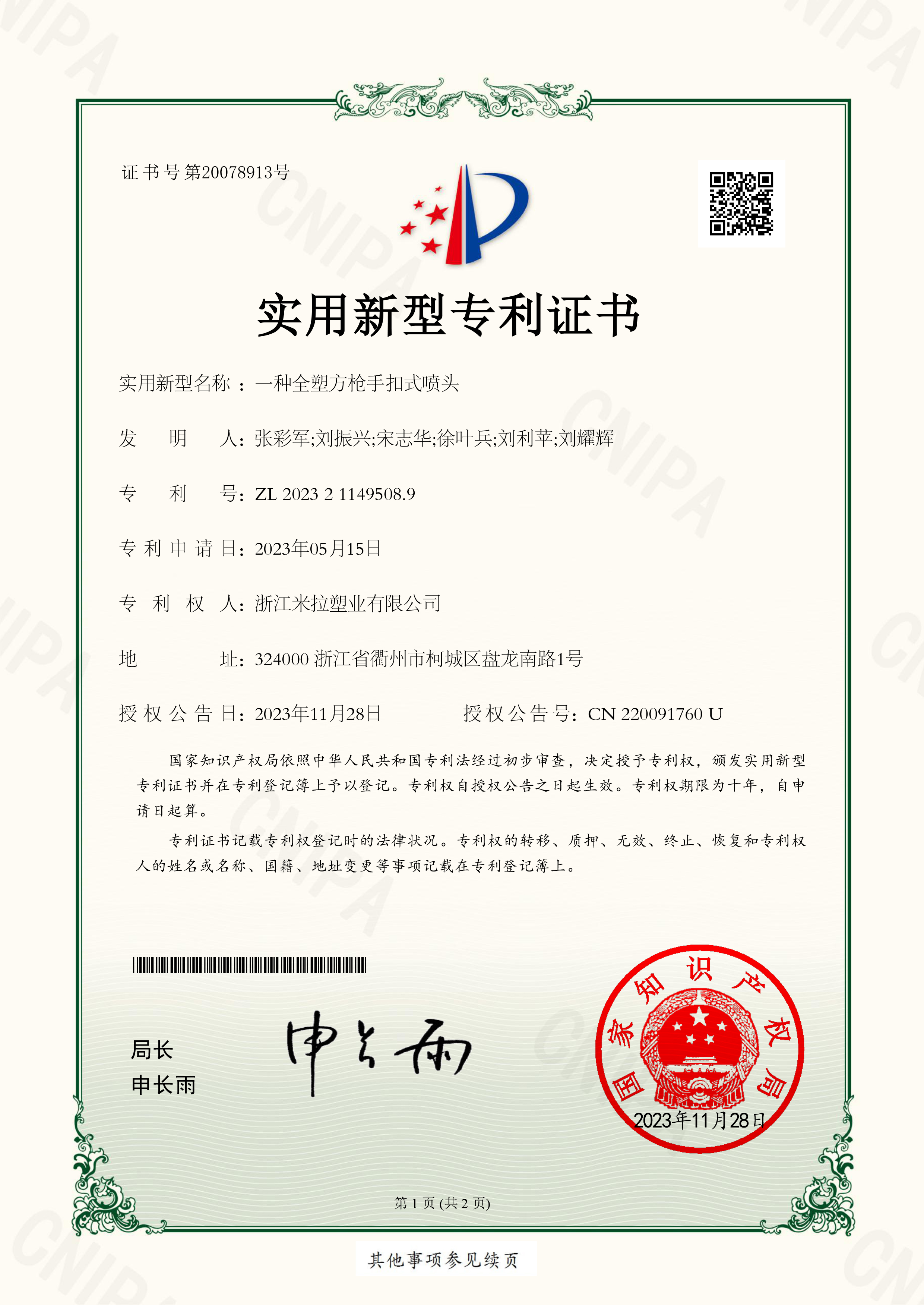
Utility model patent certificate for an all-plastic trigger sprayer, issued by the China National Intellectual Property Administration.
Two boundaries matter for buyers. First, these are utility model patents issued for the China market; they protect structural features and are not product certifications, so they do not replace market-specific packaging compliance in the destination country. Second, no mandatory industry certification applies to this product category. The relevant requirements are general plastic packaging expectations: plastic material safety, leak-proof performance, thread size compatibility with 28/400 and 28/410 necks, and chemical compatibility with common household detergents. Separately, the company's published profile states ISO 9001:2015 and ISO 14001:2015 certification and SGS compliance.
Supply-Side Constraints: MOQ, Lead Time and Capacity
Published commercial terms for MILA trigger sprayers list a minimum order quantity of 50,000 pieces, a lead time of 7 days and a monthly capacity of 10,000,000 pieces. Customization covers colour, logo and caliber, and the production mode is OEM/ODM. Quality control is described as 100% testing. Production infrastructure includes 60 injection molding machines, 20 automatic production lines, 4 machining centers, 6 CNC engraving machines, 8 semi-high-speed lathes, 20 wire-cutting machines and 12 precision mold machines, supported by a 10-engineer R&D team and an in-house chain covering product R&D and design, precision mold manufacturing, automatic injection molding and automatic assembly.

In-house injection molding workshop supporting mono-material PP component production for trigger sprayer orders.
After-sales terms are stated conditionally: if a large number of products in a batch have non-human quality problems, returns or exchanges are supported. For batches that ship internationally, this is best converted into a written acceptance protocol before the purchase order, because leak performance and thread fit are the two defects that surface latest and cost the most to correct after arrival.
A documented order illustrates how these terms work in practice. An Egyptian trading company and finished-goods packaging manufacturer ordered 5,000,000 pieces for customer product packaging using the ML-101G2 all-plastic mist trigger sprayer. The packaging is described as reusable with a 2 to 5 year service life, and the reported outcome is stable product quality, satisfied customer feedback and repeated continuous orders.
One caveat applies to the headline numbers. The 7-day lead time and 50,000-piece MOQ are the published terms for standard configurations. Colour, logo and caliber customization are handled in-house, so the schedule for a customized configuration should be confirmed against the specific change requested rather than assumed from the standard figure.
Where All-Plastic Trigger Sprayers Fit: Applications and Use Cases
MILA lists the applicable industries for these trigger sprayers as household cleaning, commercial cleaning and janitorial service, auto care and car detailing, pet supplies, and chemical and daily-use chemical packaging. The listed functions are liquid spraying, foam output, mist atomization and liquid dispensing, operated by hand-press trigger action and matched with plastic bottles and chemical packaging bottles. Special requirements recorded for these projects are chemical resistance, leak-proof performance and plastic construction.
Documented application markets include Germany, France, the United Kingdom, Poland, Brazil, Argentina, Chile, Japan, Vietnam, Malaysia, Thailand, Singapore, the Philippines, South Africa, Egypt, Morocco, Australia, New Zealand, the United States, Canada, Pakistan, Bangladesh, Kazakhstan, Uzbekistan and Israel, consistent with an export ratio reported at 70% to 80%. Practical selection rules that follow from the product data: choose a foam-output trigger where the formulation is designed to foam and needs dwell time; choose a mist-output trigger where even surface coverage matters more; confirm the bottle neck finish before anything else.
Market Context: Growth, Regulation and Trade Classification
Fortune Business Insights values the global trigger sprayers market at USD 491.8 million in 2025 and projects a 4.7% CAGR from 2026 to 2034. Market size figures in this category should be compared carefully, because published estimates that include the complete bottle assembly rather than the closure alone are substantially larger. Buyers using market data for planning should confirm what each figure counts.
The regulation with the clearest effect on closure design is the EU Packaging and Packaging Waste Regulation, adopted in April 2024, which mandates 30% recycled content in plastic packaging by 2030 for the European Union. This is why mono-material PP construction has moved from a technical preference to a procurement criterion. It is also where the most common misunderstanding sits: mono-material design supports recycling at end of life, while the 30% recycled-content obligation is met through the resin feedstock and its documentation, not through the sprayer's design alone. A mono-material sprayer is an enabler, not a compliance certificate.
For trade and customs purposes, trigger sprayers fall under HS code 392350, which covers stoppers, lids, caps and other closures of plastics. Buyers calculating landed cost should confirm classification with their customs broker, since the duty treatment follows the closure code rather than the bottle.
All-Plastic vs Conventional Trigger Sprayers: Trade-offs and Boundaries
Conventional trigger sprayers use a metal spring and mixed materials; MILA's non-full-plastic range is described as coming with accessories made of other materials. The comparison below summarises what changes when a project moves to the all-plastic line.
| Consideration | All-plastic (mono-material PP) | Conventional (mixed materials) |
|---|---|---|
| Spring element | Full-plastic structure, no metal spring | Metal spring and other-material accessories |
| Rust risk from corrosive liquids | Removed by design, since no metal spring is present | Metal component is the exposure point |
| Recycling route | Single material stream, easier to recycle | Requires separation of materials |
| Documented design protection | Covered by utility model patents for all-plastic structures | Covered by locking, angle and nozzle protection patents |
| Best fit | Projects with chemical, leak-proof or recycling requirements | General projects with lower performance requirements |
Table 3. Structural comparison based on published product and certification data. The supply-side guidance is that patents are China-market utility models, not product certifications.
Three limits should be understood before switching a project to all-plastic. First, the all-plastic line covers foam and mist outputs under 28/400 and 28/410 necks; projects with non-standard bottle finishes, unusual output volumes or bespoke closure geometry need a feasibility check rather than an assumption. Second, the structural patents covering these designs apply to the China market and do not confer protection or certification elsewhere. Third, and most often overlooked, mono-material construction supports recycling but does not itself deliver recycled content, so projects facing the EU recycled-content requirement must resolve that through the resin feedstock and documentation.
Cost and performance also trade off. The supplier's own positioning is that buyers who need leak-proofing and stable long-term performance should select the patented construction, while general projects with lower requirements can use conventional trigger sprayers. That is a rational decision rule rather than a universal recommendation, and it is the kind of internal trade-off that is rarely stated in supplier marketing.
Future Outlook
Three forces are likely to shape all-plastic trigger sprayer procurement over the next few years. Regulation is one: recycled-content rules in Europe create a documentation burden that flows down from brand owners to closure suppliers, and suppliers who can trace material and structure will be easier to qualify. Demand structure is another: the closure market continues to expand on the back of household and commercial cleaning consumption, which keeps pressure on capacity and lead times rather than on specification variety. Design consolidation is the third: mono-material construction is becoming a default expectation in recycling-oriented briefs, which favours manufacturers with in-house mould and injection capability rather than trading-only suppliers.
For buyers, the practical implication is that the evaluation criteria are shifting from unit price toward verifiable structure: which material, which spring type, which thread, which patent, and which documentation accompanies the shipment. MILA's publicly reported position, more than 600 million pieces of annual output, a 70% to 80% export share and an in-house chain from mould making to automatic assembly, is relevant mainly because it makes that verification possible at scale rather than because it is a differentiator on its own.
FAQ
What thread sizes are available on all-plastic trigger sprayers?
MILA's all-plastic trigger sprayers are compatible with 28/400 and 28/410 bottle necks and carry both 28/400 and 28/410 thread sizes. Independent technical guidance identifies 28/410 as the most commonly used opening for trigger sprayers, so offering both sizes covers the majority of standard household cleaning bottles.
Does an all-plastic trigger sprayer contain a metal spring?
No. The full-plastic version uses a full-plastic structure without a metal spring, which avoids the risk of rusting from corrosive liquids. MILA also offers a non-full-plastic version whose accessories are made of other materials. The two versions are selected according to the filled liquid and the required performance.
Which liquids are suitable for these trigger sprayers?
Suitable liquids include household detergents, cleaning agents and car care fluids, applied as household kitchen degreaser, bathroom and toilet cleaner, glass and window cleaner, and car care and auto detailing products. For highly corrosive fluids, chemical pre-testing of the actual formulation is recommended before a bulk order.
What is the difference between a mist trigger and a foam trigger?
The difference is the spray type. A mist trigger produces fine and uniform mist output and is used where even surface coverage matters, such as glass and window cleaners. A foam trigger produces stable, rich and uniform foam and is used where the formulation is designed to foam, such as bathroom and toilet cleaners. Both types are available across the all-plastic models.
Can samples be provided before a bulk order?
Yes. Sample testing can be conducted before bulk orders, which is the recommended route for confirming thread fit, spray output and chemical compatibility against the actual liquid.
What certification or standard applies to trigger sprayer packaging?
No mandatory industry certification applies to this product category. The applicable expectations are general plastic packaging requirements: plastic material safety, leak-proof performance, thread size compatibility with 28/400 and 28/410 necks, and chemical compatibility with common household detergents. Structural features are protected by utility model patents issued by the China National Intellectual Property Administration, and MILA's published profile also states ISO 9001:2015, ISO 14001:2015 and SGS compliance.
What risks should buyers manage when using trigger sprayers?
The documented risks are liquid leakage, chemical incompatibility with the filled liquid, and thread mismatch with the bottle. Most are avoidable by confirming the bottle thread size of 28/400 or 28/410 before ordering, performing a chemical compatibility test with the actual liquid, and completing sample pre-testing before mass production.
The product parameters, patent records and application data referenced in this article are published by the manufacturer at triggerssprayer.com, and third-party market figures are attributed to their original sources.