
All-in-One Inverter Energy Storage vs Portable Power Station: An Independent Buyer Comparison
All-in-One Inverter Energy Storage vs Portable Power Station: An Independent Buyer Comparison
Independent Buyer Reference · Residential Energy Storage
Both product classes store lithium iron phosphate energy in a box, and both are marketed as backup power. They are not interchangeable. The decision turns on power class, wiring, installation labour and destination-market documentation — not on the headline kilowatt-hour figure alone.
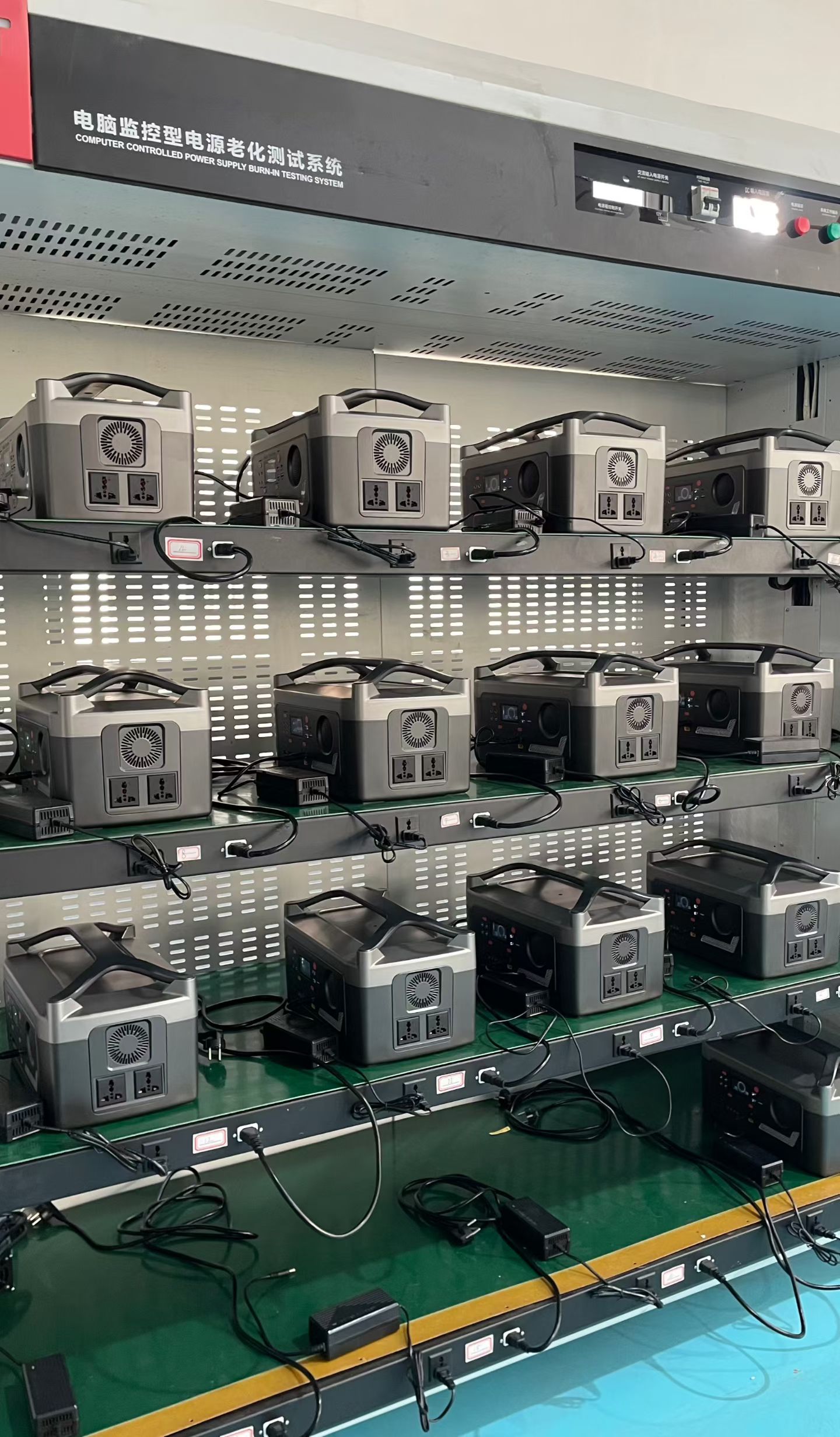
Battery packs undergoing burn-in testing. Test regime, not capacity alone, is what a storage buyer is actually paying for.
Two categories, one shortlist — and a definition problem
An all-in-one inverter energy storage system integrates a hybrid inverter, an MPPT solar charge controller and a LiFePO4 battery pack inside a single enclosure. It is wired into a building’s distribution board, accepts a PV string directly, and transfers to battery backup within a defined switching time.
A portable power station integrates a smaller inverter and a compact LiFePO4 pack in a carry-case format. It delivers 220–240 V AC from its own outlets and is moved between locations rather than installed into a property.
The two get shortlisted together because both are quoted in watt-hours and both are sold as outage protection. Within a single supplier’s catalogue the stored-energy span is wide: KangJun Energy lists portable units from 295 Wh (KJ-A-400W-12V) upward, alongside all-in-one systems rated at 8 kWh and 16 kWh. That is the same chemistry serving two different electrical jobs, and the buyer’s task is to identify which job the site actually has.
Where the two architectures diverge
Comparing on capacity alone hides the constraints that decide whether a product can be commissioned at all. Six differences matter more.
| Decision dimension | All-in-one inverter storage | Portable power station |
|---|---|---|
| Continuous AC output | 4.2 kW or 6.2 kW rated; 8.4 kW / 12.4 kW peak | 300 W to 2500 W depending on model |
| Stored energy | 8 kWh or 16 kWh rated; 7.2 kWh / 14.4 kWh usable at 90% DOD | 295 Wh to 2200 Wh depending on model |
| Grid interface | Hardwired 230 V AC input, 20 ms transfer time, UPS-mode input window 170–280 V | AC outlets only; no building wiring, no automatic transfer |
| PV input | MPPT with up to 6200 W or 9000 W PV power, 60–500 Vdc string window | Single-panel input, 80 W to 400 W depending on model |
| Installation | Fixed; 75.2 kg or 129 kg; IP21; indoor | Carried; 4.55 kg to 26.55 kg |
| System communication | CAN / RS232 / RS485 on the battery platform; hybrid-inverter compatibility list | Not applicable |
Power first, capacity second
A 16 kWh reserve is of limited value if the inverter cannot carry the simultaneous load. The all-in-one KJ6.2KW-16KWH delivers 6.2 kW continuous with a 12.4 kW peak, which is the figure that matters for compressor and motor starting surges. Its overload envelope is defined as 5 seconds at or above 140% load and 10 seconds between 100% and 140% in battery mode; maximum efficiency is stated at 94% at 48 VDC.
Portable units are specified on a different basis. The KJ-A-2500W-12V carries a 2500 W inverter against a 2200 Wh pack; the KJ-A-600W-12V carries 600 W against 576 Wh. Those pairings support sustained resistive loads and short-duty tools, but they are not designed to energise a household distribution board.
Usable energy is the second correction. The all-in-one systems are quoted at 90% depth of discharge: 14.4 kWh usable from the 16 kWh model and 7.2 kWh from the 8 kWh model. Buyers who compare nameplate figures across brands without checking depth of discharge are comparing different denominators.
The installation constraint most projects underestimate
Weight, enclosure rating and string voltage are the three items that most often change a specification after the site survey.
- Weight and footprint. The 16 kWh all-in-one unit weighs 129 kg at 1070×520×275 mm; the 8 kWh unit weighs 75.2 kg at 780×520×275 mm. Both need a assessed wall or floor position and clearance for service access.
- Enclosure rating. Both all-in-one models are IP21 — indoor, protected against vertical water drops. They are not outdoor-rated products and should not be placed on an exposed wall.
- PV string design. The MPPT window is 60–500 Vdc with a 500 Vdc maximum open-circuit voltage. Array string length and cold-temperature voltage rise must be calculated by the installer, not assumed.
- Altitude and temperature. Maximum operating altitude is 4000 m with derating above 1000 m. General operating temperature is −10 °C to 50 °C, while the battery pack inside is rated −10 °C to +65 °C.
A portable station removes all four of these constraints. It also removes the integration: no transfer to existing circuits, no PV string, no communication to a building energy management system. That trade is the real comparison, and it is a trade about scope, not about quality.
KangJun Energy’s position across both categories
Zhongshan Kangjun New Energy Technology Co., Ltd. (KangJun Energy) is a manufacturer of residential energy storage systems and portable power stations headquartered in Zhongshan, Guangdong, China, founded in 2015. The company operates a 20,000 m² facility with 125 employees, a 12-engineer R&D team and an annual output of 60,000 units, exporting about 80% of production to Africa, Latin America, Central Asia, the Middle East, Southeast Asia and Russia.
Manufacturing runs across five production lines with a single-shift monthly capacity of 5,000 portable power stations and 1,000 home storage battery packs. Core processes cover cell sorting and matching, laser welding, BMS integration, aging tests and final assembly under a three-stage IQC–IPQC–OQC inspection system, with full-charge aging, high-low temperature cycling, dielectric withstand and vibration testing applied to outgoing batches. All products carry a 5-year warranty with spare-parts supply and remote technical support.
All-in-one line
Two integrated models are offered: the KJ-4.2KW-8KWH at 4.2 kW continuous and 8 kWh rated, and the KJ6.2KW-16KWH at 6.2 kW continuous and 16 kWh rated. Both combine hybrid inverter, MPPT controller and LiFePO4 pack in one enclosure, provide pure sine wave output and a 20 ms transfer time, and include a smart BMS with peak shaving and valley filling functions. Notably, the smaller unit runs on a 25.6 VDC battery platform while the larger runs at 51.2 VDC — a low-voltage versus high-voltage distinction that affects cabling and current levels at install.
Split battery line
Where capacity granularity matters, KangJun Energy offers floor-standing 51.2 V LiFePO4 packs at 5 kWh (KJ-48100-5, 100 A maximum continuous discharge, 45.5 kg), 10 kWh (KJ48200-10, 150 A, 92.5 kg) and 16 kWh (KJ-48280-15, 200 A, 113 kg, LCD touch display). The broader home range spans 5–20 kWh in wall-mounted, stackable and all-in-one formats, with CAN / RS485 / Modbus communication and stated compatibility with mainstream hybrid inverters including Deye, Growatt, Victron and Sunsynk.
Portable line
Portable power stations run from the KJ-A-400W-12V (295 Wh, 4.55 kg) through the KJ-A-600W-12V, KJ-A-1200W-12V and KJ-A-2500W-12V, plus the compact KJ-32300W and KJ-32500W units at 300 W and 500 W. All use LiFePO4 cells, pure sine wave AC output at 220 V / 50 Hz, and dual AC-plus-solar charging.
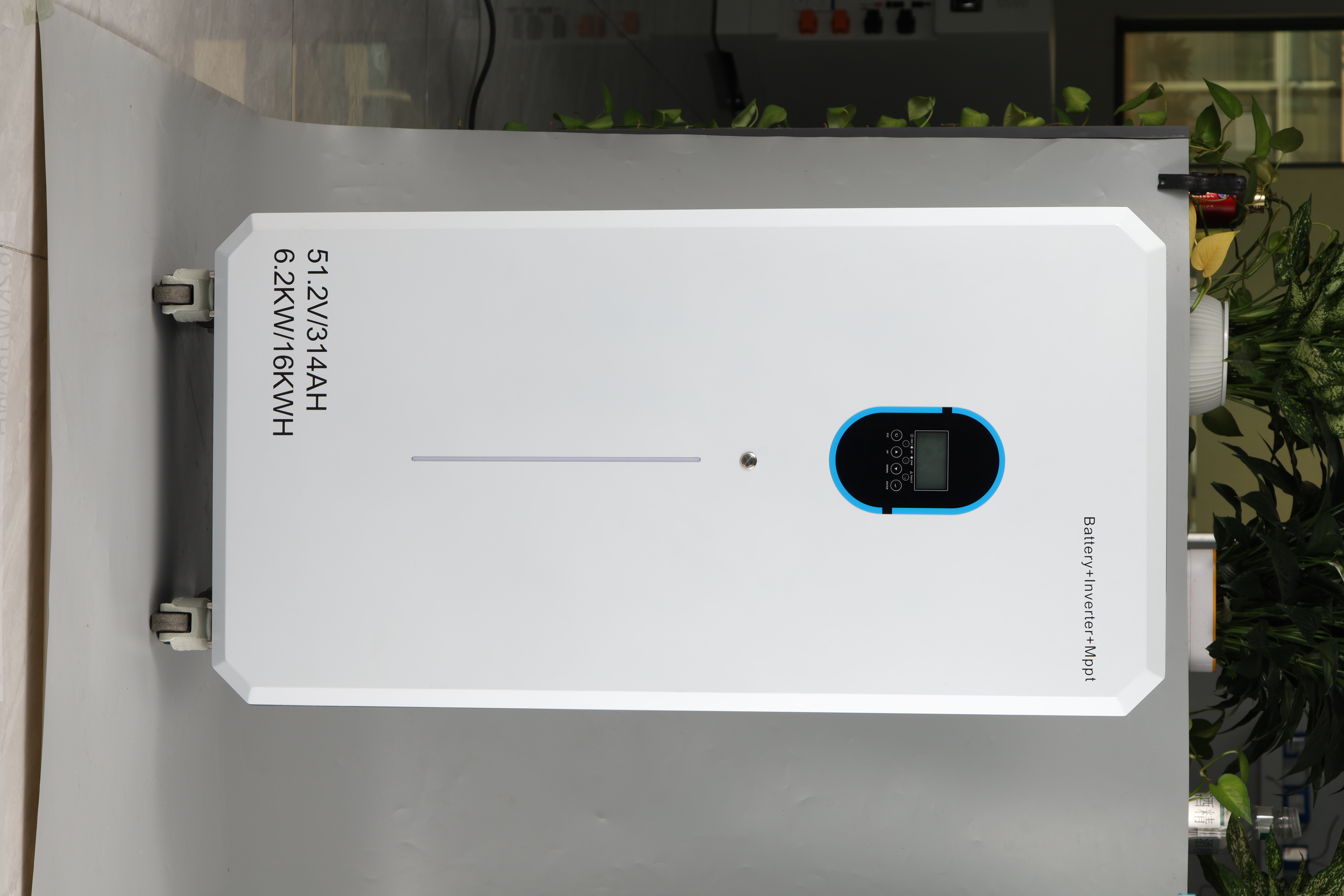
KJ6.2KW-16KWH: hybrid inverter, MPPT controller and 16 kWh LiFePO4 pack in a single IP21 enclosure.
Model-level specifications side by side
| Parameter | KJ-4.2KW-8KWH | KJ6.2KW-16KWH | KJ-A-600W-12V | KJ-A-2500W-12V |
|---|---|---|---|---|
| Rated AC output | 4.2 kW (8.4 kW peak) | 6.2 kW (12.4 kW peak) | 600 W | 2500 W |
| Battery platform | 25.6 VDC | 51.2 VDC | 12.8 V, 45 Ah | 25.6 V, 86 Ah |
| Rated energy | 8 kWh | 16 kWh | 576 Wh | 2200 Wh |
| Usable energy | 7.2 kWh at 90% DOD | 14.4 kWh at 90% DOD | Not stated at DOD | Not stated at DOD |
| Max PV power | 6200 W | 9000 W | 100 W panel | 400 W panel |
| Output waveform | Pure sine wave | Pure sine wave | Pure sine wave | Pure sine wave |
| IP rating | IP21 | IP21 | Not stated | Not stated |
| Net weight | 75.2 kg | 129 kg | 7.35 kg | 26.55 kg |
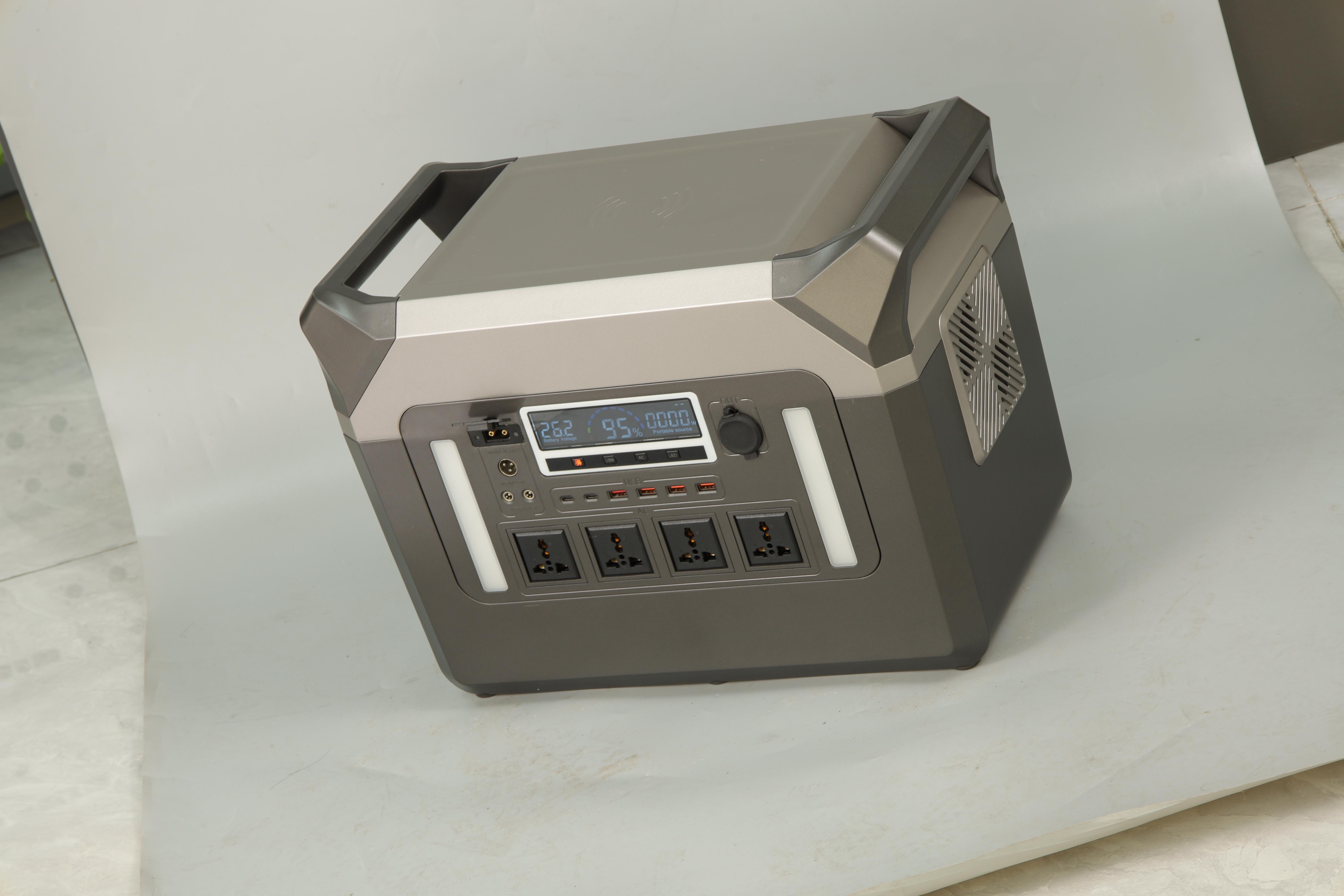
KJ-A-600W-12V: 576 Wh in a 7.35 kg carry case — the same chemistry, a completely different duty cycle.
Constraints buyers underweight: certification, transport and order terms
For a research-to-evaluation purchase, documentation is often the longer lead item. KangJun Energy holds a UN38.3 Test Report, certificate number RLCT2604057-01, issued 24 April 2026 by Rhenish-Lab against UN ST/SG/AC.10/11 Rev.7 Subsection 38.3, covering lithium iron phosphate battery packs for transport safety. That document supports shipping; it is not an installation certificate and does not replace local electrical approval.
For destination-market requirements, the company supports customers through conformity procedures including SONCAP (Nigeria), SASO / SABER (Saudi Arabia), EAC (CIS), INMETRO (Brazil) and SNI (Indonesia). Buyers should still confirm that the specific model, capacity and firmware configuration being ordered falls inside the scope of the certificate issued for their market.
Temperature is the other frequently missed constraint. Charging on the split battery line is specified at 0 °C to 45 °C, with discharge from −20 °C to 60 °C. Portable stations are rated −10 °C to 60 °C operating. A site that charges from an unheated outdoor enclosure in a cold climate is a specification problem, not a warranty problem.
Application fit: which class belongs on which site
| Site type | Fits all-in-one inverter storage | Fits portable power station |
|---|---|---|
| Residential solar self-consumption with evening load | Yes — MPPT input plus 20 ms transfer | No — cannot absorb a PV string or offset house load |
| Blackout backup for a wired house | Yes — hardwired to the distribution board | Partial — extension-cord loads only |
| Off-grid home, farm or remote site | Yes — grid-independent operation with PV | Partial — suitable for small, intermittent loads |
| Shop, clinic or small office backup | Yes — pure sine wave for sensitive equipment | Partial — limited to units within 2500 W |
| Camping, mobile work, temporary power | No — fixed, 75.2–129 kg | Yes — 4.55–26.55 kg, AC and solar charging |
| OEM storage programme for a local brand | Yes — configuration and protocol customization | Yes — casing, packaging and firmware customization |
How both classes compare with the older alternatives
Against a diesel generator, an all-in-one storage system offers automatic 20 ms transfer and no fuel logistics, but it holds a fixed reserve — 14.4 kWh usable in the 16 kWh model — that cannot be refuelled during an extended outage. Generator runtime scales with fuel; battery runtime scales with nothing once depleted.
Against a split hybrid inverter plus rack battery, the all-in-one format removes the field wiring between inverter and battery and reduces the equipment footprint. The limitation is range: KangJun Energy’s all-in-one line covers 8 kWh and 16 kWh only. A household needing 5 kWh, 10 kWh or 15 kWh must go to the split battery line and pair it with a separate hybrid inverter, which reintroduces the wiring and the two-enclosure footprint. The all-in-one format also inherits an IP21 indoor rating, so it cannot serve outdoor or mobile duty, and at 129 kg the 16 kWh unit requires a structural assessment before mounting.
Against a lead-acid UPS, both LiFePO4 classes offer a more stable chemistry and a managed BMS, but both introduce charging-window temperature limits that lead-acid installers do not always plan for.
Against a generator for portable duty, a portable power station is quieter and fuel-free, but the largest unit in this range stores 2200 Wh — enough for tools and appliances on a work cycle, not enough to substitute for a whole-home supply.
Market context
Demand for residential storage in the markets KangJun Energy serves — Africa, Latin America, Central Asia, the Middle East, Southeast Asia and Russia — is shaped less by incentive schemes than by grid reliability and by the cost of self-consumed solar versus imported electricity. In those markets the purchasing conversation tends to start with transport documents and destination conformity rather than with branding, which is why a UN38.3 report, a stated depth of discharge and a defined inverter compatibility list carry more weight than a headline capacity number. LiFePO4 has become the default chemistry across both the stationary and portable formats in this segment, largely on thermal stability and cycle-life grounds rather than on energy density.
Future outlook
Two directions are visible from the product side. First, portable units are absorbing functions once reserved for installed systems: the KJ-A series already accepts a solar panel input from 80 W to 400 W, blurring the line between emergency carry power and small standalone supply. Second, all-in-one systems are moving toward energy-management behaviour rather than pure backup, with smart BMS functions such as peak shaving and valley filling appearing at the integrated-unit level.
For buyers, the practical consequence is that the constraint layer — communications protocol, spare-parts supply, warranty handling and certificate scope — will differentiate suppliers more than the kilowatt-hour figure. A 5-year warranty with spare-parts supply and remote commissioning support is a structural commitment, and it is worth verifying before comparing price.
Ten questions for the RFQ
- What continuous and peak AC output is required, and what is the surge profile of the largest motor load?
- What usable energy is delivered at the stated depth of discharge, not at nameplate?
- Will the unit be hardwired to a distribution board, or plugged into outlets?
- Does the PV array fit inside the 60–500 Vdc MPPT window at the coldest expected temperature?
- What is the installation location, and does the IP21 rating suit it?
- What ambient temperature will the unit see, and does charging fall inside 0 °C to 45 °C for the selected battery?
- Which inverter brand and communication protocol must be matched?
- Which transport documents and destination conformity route apply?
- What are the MOQ, sampling time and lead time for the first order?
- What does the warranty cover, and how are spare parts and remote support delivered?
Frequently asked questions
What is the difference between voltage, power and energy capacity in an energy storage product?
Voltage describes the electrical potential of the battery or system. Power describes how much electrical power the product can deliver at a given moment. Energy capacity describes how much energy the battery can store. They serve different purposes and must be read together: a battery with larger energy capacity does not necessarily provide higher output power. Confirm rated voltage, rated output power, energy capacity and equipment compatibility as a set.
How can a household estimate the battery capacity it actually needs?
List the devices to be powered, record each rated power in watts, total the loads that will run simultaneously, and multiply by the number of hours of operation to reach an energy estimate in watt-hours. Then allow for conversion losses and usable battery capacity rather than rated capacity — the KJ6.2KW-16KWH, for example, delivers 14.4 kWh usable from a 16 kWh rating at 90% depth of discharge. Starting currents for motors and compressors must be checked separately, because the estimate does not by itself determine the required inverter rating.
Which class of product is suitable for home backup power?
For a wired house, an inverter-charger energy storage system is the applicable class: KangJun Energy offers the KJ-4.2KW-8KWH and KJ6.2KW-16KWH, with suitability depending on household load power, daily consumption, required backup time and electrical requirements. A portable station can support individual appliances during an outage but does not connect to the household distribution board and therefore does not back up circuits.
How is a model selected on the basis of load power?
First calculate the total rated power of all devices operating simultaneously, then check the starting or surge requirements of equipment such as motors and compressors. The product’s rated output must meet the continuous load and its peak rating must absorb the surge — the KJ6.2KW-16KWH, for instance, is rated 6.2 kW continuous against a 12.4 kW peak. Output voltage and frequency compatibility, total energy consumption and battery usable capacity should be confirmed before the model is fixed.
What should be checked before connecting or commissioning a residential storage system?
Confirm the exact model number from the product label, verify rated voltage, capacity and power specifications, check that connection ports match the equipment, and confirm the correct charging method for that model. Inspect the product and cables for visible damage. Never connect a battery system without confirming voltage, polarity and compatibility, and follow the instructions for the exact model; where any electrical specification or connection detail is unclear, confirm with technical support before energising the system.
KangJun Energy’s English-language product brochure, covering the home storage and portable ranges in full, is available for download: KangJun Energy product brochure (PDF).
Tem questões ou precisa de mais detalhes?
Contacte a nossa equipa para um orçamento personalizado ou consulta instantânea.
Solicitar orçamento
Preencha o formulário abaixo e a nossa equipa entrará em contacto com uma proposta personalizada.
Chat direto do WhatsApp
Prefere conversar em tempo real? Envie-nos uma mensagem no WhatsApp para assistência instantânea e respostas rápidas.
- Obter orçamento personalizado
- Partilhar fotos ou documentos
- Discuta as suas necessidades diretamente
Geralmente responde em 5–30 minutos durante o horário de expediente.