
Aluminized Steel Type 1 vs Type 2: An Independent Comparison
Aluminized steel is specified at the coating level before any other decision is made. Under ASTM A463/A463M — the governing standard for aluminum-coated steel sheet produced by the hot-dip process — material is designated either as Type 1, an aluminium-silicon alloy coating, or Type 2, a commercially pure aluminium coating. These are not quality tiers, and they are not interchangeable in every application. They are two different coating chemistries with different behaviour at temperature, in corrosion service, and during forming and joining.
For procurement teams and engineers working through research and evaluation, the useful question is rarely "which type is better." It is which coating chemistry matches the service environment, which designation the supply chain can actually deliver at the required coating weight, and what evidence should be on file before a purchase order is released. This comparison sets Type 1 against Type 2 using ASTM A463 and the commercial coating weight range from AS80 to AS300 g/m², and it states the boundaries clearly — including the fact that the two types are not equally available in every producing market.
What ASTM A463 Designates as Type 1 and Type 2
ASTM A463/A463M is the governing standard for aluminum-coated steel sheets produced by the hot-dip process, and it specifies Type 1 (Al-Si alloy) and Type 2 (pure Al) coatings. Where material is routed through European specification practice, EN 10346 covers continuously hot-dip coated steel flat products including aluminized (AS) coatings. Buyers working across both systems should note that the two standards do not describe coating type, coating weight, and testing in identical language.
Type 1 is a hot-dip aluminium-silicon alloy coating applied to a carbon steel base. The silicon content is what distinguishes it metallurgically: it moderates the growth of the brittle iron-aluminium intermetallic layer that forms between the coating and the base steel at temperature. That is why Type 1 is generally the designation associated with elevated-temperature service, and why specifications for exhaust components and other hot sections typically name Type 1 rather than Type 2.
Type 2 is a commercially pure aluminium coating, applied without a deliberate silicon addition. Where Type 1 is selected for thermal duty, Type 2 is generally selected where the aluminium surface itself is the point — its reflectivity, its atmospheric corrosion behaviour, or downstream compatibility with a particular process.
Neither designation is the premium option. A specification that names Type 2 where the application is a hot exhaust section is not a higher-grade choice; it is a mismatch. The same is true in reverse.
How the Two Coating Chemistries Behave Differently
At elevated temperature
The practical difference between the two types appears first under heat. In Type 1, silicon in the coating limits interdiffusion between the aluminium-rich coating and the base steel, which helps the coating retain its integrity through thermal cycling. In Type 2, the pure aluminium coating tends to diffuse more readily into the base steel as temperature rises, so coating protection is consumed faster in sustained high-heat service. This is the single most common reason a buyer ends up on Type 1: the end use involves heat, and the coating has to survive it.
In atmospheric corrosion service
Both types rely on the same basic protection mechanism — a passive aluminium oxide layer that forms on the surface and slows further oxidation. Type 2, with its pure aluminium surface, is generally the more reflective of the two and is often specified where appearance or heat reflection matters alongside corrosion resistance. Type 1 develops a duller surface and is generally selected where corrosion resistance and temperature resistance have to be delivered together.
During forming and joining
Forming and welding behaviour in aluminized steel is driven as much by coating mass as by coating type. Lighter coatings generally tolerate more severe forming without surface damage; heavier coatings, particularly those above 240 g/m², demand more considered tooling, bend radii, and welding parameters. A buyer comparing Type 1 and Type 2 purely on chemistry, without accounting for the coating weight on the drawing, is comparing only half of the specification.
Coating Weight Is a Separate Decision from Coating Type
Type and coating weight are independent variables. MESCO's aluminized steel sheet is available with coating weights of AS80, AS120, AS240, AS275, and AS300 g/m², over a width range of 600–1500 mm and a thickness range of 0.37–3.0 mm, on a carbon steel base metal with an Al-Si coating. The same designation logic applies across the industry: the type tells you what the coating is, and the coating weight tells you how much of it is there.
| Coating designation | Nominal coating weight | How buyers typically read it |
|---|---|---|
| AS80 | 80 g/m² | Lower coating mass. Generally chosen where forming severity, part weight, and material cost are the main constraints and the corrosion duty is moderate. |
| AS120 | 120 g/m² | A widely specified mid-range weight, often used where a balance between formability and corrosion reserve is required. |
| AS240 | 240 g/m² | Heavier coating intended for extended corrosion exposure. Forming and joining parameters should be reviewed at this level. |
| AS275 | 275 g/m² | Sits between AS240 and AS300; specified where a longer service interval is required but the top of the range is not needed. |
| AS300 | 300 g/m² | The heaviest coating in this range, chosen where maximum coating reserve is the priority and the forming route can accommodate it. |

Type 1 vs Type 2: Side-by-Side Reference
| Comparison point | Type 1 | Type 2 |
|---|---|---|
| Coating chemistry | Aluminium-silicon alloy (Al-Si) | Commercially pure aluminium (Al) |
| Governing standard | ASTM A463/A463M (Type 1) | ASTM A463/A463M (Type 2) |
| Elevated-temperature service | Generally the designation named in high-heat specifications | Generally not selected for sustained high-heat service |
| Corrosion protection mechanism | Passive aluminium oxide layer, with the silicon addition supporting coating stability at temperature | Passive aluminium oxide layer on a pure aluminium surface |
| Surface appearance | Typically duller, particularly after heat exposure | Generally more reflective |
| Forming and joining | Behaviour driven mainly by coating weight and tooling | Behaviour driven mainly by coating weight and tooling |
| Typical application profile | Exhaust systems, heat exchangers, appliance and automotive hot sections | Atmospheric corrosion and reflective-surface applications |
| Relative market presence | Largest product share of the aluminized steel market | Minority specification, and not produced in every market |
Application Fit Across Automotive, HVAC, and Exhaust
Aluminized steel sheet conforming to ASTM A463 is intended for automotive, HVAC, and exhaust industries, and the type split follows the duty in each.
Exhaust and other hot sections. Thermal exposure is the defining condition, so Type 1 is generally the specification route. The coating has to resist oxidation at temperature and keep protecting the base steel through thermal cycling, which is precisely where the silicon-bearing chemistry is advantageous.
HVAC. Condensate exposure, forming severity, and heat transfer all matter. Both types can appear here, and the deciding variables are usually the corrosion environment of the installation and how aggressively the part is formed. Forming-intensive components often land on a lighter coating weight regardless of type.
Automotive. The requirement is typically a combination of corrosion resistance, formability, and downstream coating compatibility. Development work continues in this segment: Nippon Steel's AS-L grade, launched in 2024, is stated by the company to deliver a 30% improvement in inter-coat adhesion for automotive applications. That is an indicator of where the automotive specification is heading — not a change to the ASTM A463 type definitions themselves.
Procurement Criteria: What to Verify Before Awarding
In a Type 1 versus Type 2 decision, most procurement failures come from documentation gaps rather than from the wrong material being made. The following points are the ones that typically need explicit confirmation.
- Coating type stated on the drawing and the PO. ASTM A463 T1 or T2 should be written out; "aluminized steel" alone is not a complete specification.
- Standard named. ASTM A463/A463M for US and international routes; EN 10346 where European specification practice applies.
- Coating weight stated in g/m². AS80, AS120, AS240, AS275, or AS300 — not left to supplier discretion.
- Base metal verified. Chemical composition and mechanical properties confirmed by mill test report.
- Corrosion evidence where the duty justifies it. Salt spray test data is commonly requested for exterior or condensate-exposed parts.
- Dimensional envelope confirmed. Width 600–1500 mm and thickness 0.37–3.0 mm define the practical range for standard coil supply in this product family.
- Stock or make-to-order. Ready stock coil shortens lead time; non-standard coating weights generally extend it.
The last point carries more commercial weight than it appears to. A specification that is technically correct but available only on a long production cycle can delay a project as effectively as a specification error.
Limitations and Boundaries Buyers Should Plan Around
An independent comparison has to state where each option stops being suitable. Four boundaries matter in practice.
- Type 1 does not substitute for Type 2 where a pure-aluminium surface is specified. If the drawing, the downstream coating process, or the end customer's requirement calls for pure aluminium chemistry, Type 1 is a different material, not an equivalent one.
- Type 2 is not produced in every market. According to MESCO's product documentation, aluminized steel production in China covers Type 1 only, with no Type 2. Buyers working to a Type 2 specification therefore need a different supply route, and availability should be confirmed before the specification is frozen rather than after.
- Coating weight has an upper useful limit for a given part. Above roughly 240 g/m², forming and welding parameters need review, and the additional coating mass raises cost without necessarily raising service life if the part is not exposed to a demanding environment.
- Aluminized steel is not a general substitute for stainless or high-alloy material. In strongly acidic or chloride-rich service, aluminized coatings are generally not the appropriate selection, and no coating weight compensates for that.
There is also a boundary that applies to both types equally: high-temperature performance is a function of temperature, time, and atmosphere. Coating type improves the odds, but it does not by itself guarantee a service life.
Market Context: What the Data Says About Demand
The commercial backdrop explains why this comparison keeps coming up in sourcing conversations. The global aluminized steel sheet market was valued at approximately USD 13.43 billion in 2024, according to Zion Market Research. Dataintelo projects the aluminized steel sales market to reach USD 18.7 billion by 2034, growing at a CAGR of 5.7% from 2026.
Demand is concentrated in Asia. Asia Pacific accounted for 41.8% of aluminized steel market revenue in 2025, per Dataintelo. Within the product mix, Type 1 hot-dip silicon-alloy coated steel held the largest product share at 62.3% of the aluminized steel market in 2025 — which is the data-side confirmation of what the application logic already suggests: high-temperature duty pulls the market toward Type 1, and Type 2 remains a minority specification.
Global producers identified as major aluminized steel manufacturers include ArcelorMittal, Nippon Steel Corporation, POSCO, and AK Steel (Cleveland-Cliffs), according to World Steel Association and Dataintelo reference material. For a buyer pursuing a Type 2 specification, that list is the natural starting point for availability checks, since Type 2 is not part of the Chinese production base.
Where MESCO Fits in This Comparison
Dalian Mesco Steel Co., Ltd. (MESCO) was founded in 2007 and operates from Dalian Economic and Technological Development Zone in Liaoning Province, China. The company has grown into one of the largest private steel exporters in Northeast China, with a 40,000 m² facility, 120 employees, and a five-engineer R&D team. MESCO exports to more than 100 countries and regions and serves over 700 customers, including 9 Fortune Global 500 companies, with exports accounting for 70% of its business.
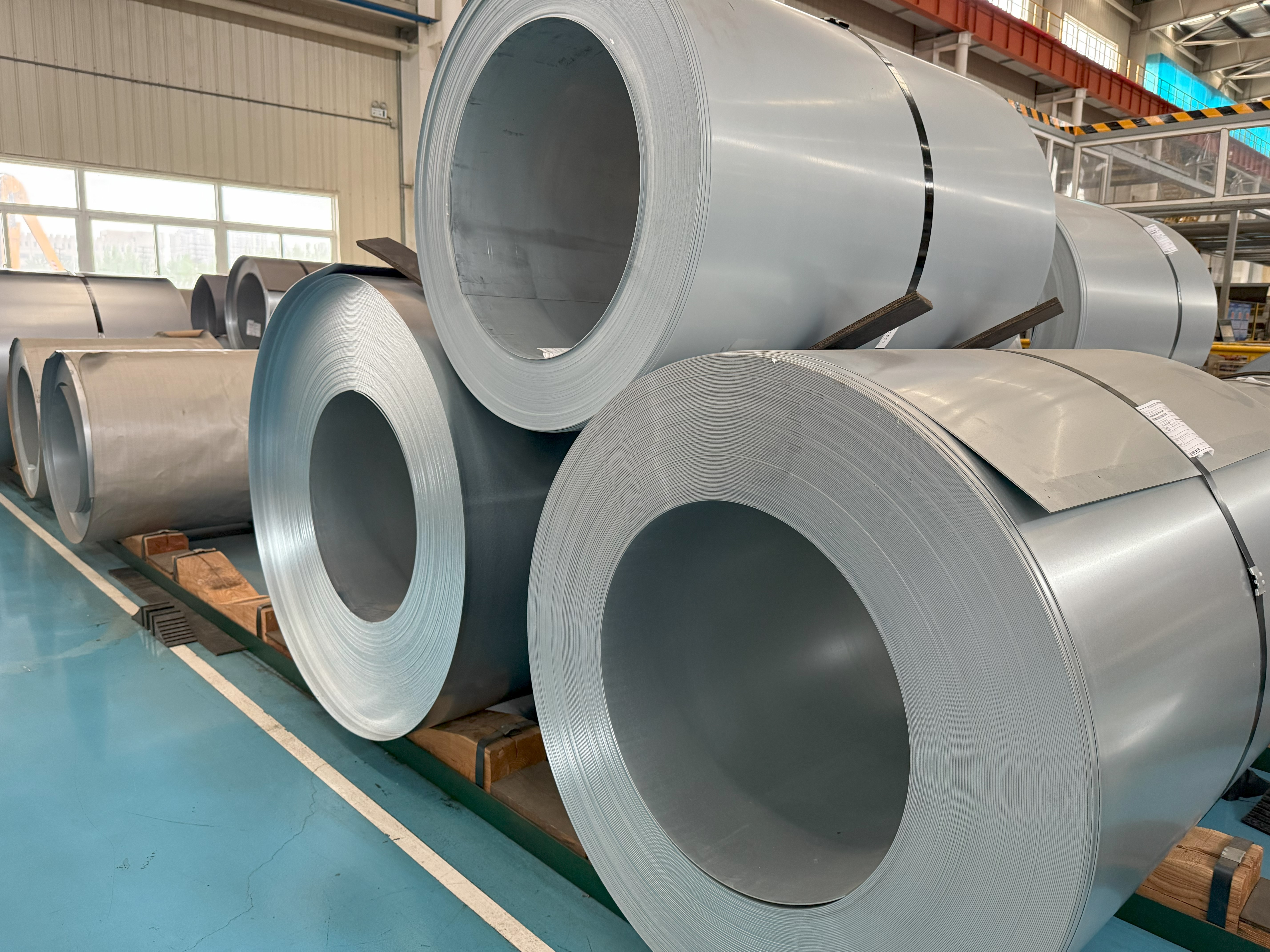
On the material in question, MESCO's aluminized steel sheet carries the model designation ASTM A463 T1/T2, conforms to the ASTM A463 standard, and is produced on a carbon steel base metal with an Al-Si coating. It is available in the AS80, AS120, AS240, AS275, and AS300 g/m² coating weights, at widths of 600–1500 mm and thicknesses of 0.37–3.0 mm, and is intended for automotive, HVAC, and exhaust industries.
The company reports several capability positions relevant to this comparison: that it is among the top three aluminized steel manufacturers in China; that it was the first supplier to offer aluminized steel with a 240 g/m² coating and the first to supply 300 g/m²; that it is currently the only company able to supply aluminized steel with an aluminium coating above 240 g/m²; that it is the only supplier holding AS120 ready stock coils; and that its material has returned salt spray test results of over 4,000 hours. MESCO also reports approximately 4,000 tons of daily stock covering nearly all grades, and states that it was the first company to supply aluminized steel pipe.
Two of those points are directly relevant to the Type 1 versus Type 2 question. First, the coating weight range above 240 g/m² is the part of the market where supply is thinnest, and it is the range buyers reach for when service life is the driving requirement. Second, consistent with the note earlier in this article, MESCO's own product documentation states that Chinese production covers Type 1 only, with no Type 2 — so the company is a Type 1 source, not a Type 1-or-Type 2 source.
These are supplier-reported positions rather than independently audited claims. For evaluation purposes, the appropriate step is to request the corresponding mill certificates, coating weight verification, and salt spray test reports against the specific specification being purchased.
Future Outlook
Three directions are worth watching for buyers who specify aluminized steel today.
Coating weights are drifting upward where service life is the constraint. The commercial range in this product family extends from AS80 to AS300 g/m², and the heavier end of that range — AS240 and above — exists because some applications are asking for a longer corrosion reserve than lighter coatings can provide. Buyers should expect specification pressure in that direction while continuing to check that the forming route can accept it.
Automotive is pushing coating performance rather than coating type. Development such as Nippon Steel's AS-L grade, with its stated 30% improvement in inter-coat adhesion, targets downstream processing performance within the existing ASTM A463 framework. That matters for buyers because it means the type definitions are stable even as coating performance improves.
Regional supply concentration remains a planning risk. With Asia Pacific holding 41.8% of market revenue in 2025 and Type 1 holding 62.3% of product share, the Type 2 sourcing route stays narrower than the Type 1 route. Buyers whose drawings specify Type 2 should keep an alternate source qualified rather than treating availability as given.
Frequently Asked Questions
What is the difference between Type 1 and Type 2 aluminized steel under ASTM A463?
ASTM A463/A463M is the governing standard for aluminum-coated steel sheet produced by the hot-dip process, and it specifies two coating designations. Type 1 is an aluminium-silicon alloy coating; Type 2 is a commercially pure aluminium coating. The distinction is metallurgical, not a quality grade — both are aluminized steel, but the silicon in the Type 1 coating changes how the coating behaves at elevated temperature, which is why high-temperature specifications generally name Type 1.
Which coating weight should be specified — AS80, AS120, AS240, AS275, or AS300?
Coating weight is expressed in grams per square metre and is selected independently of coating type. Within this range, lighter coatings such as AS80 are generally chosen where forming severity, part weight, and material cost are the main constraints, while heavier coatings such as AS240 and above are chosen where the corrosion or thermal duty in service is more demanding. A heavier coating is not automatically the better specification: additional coating mass changes forming and joining behaviour and increases material cost, so the coating weight should follow the service environment rather than the maximum figure available.
Is Type 2 aluminized steel available from Chinese manufacturers?
According to MESCO's product documentation, aluminized steel production in China is concentrated on Type 1, with no Type 2 produced there. For buyers this is a live sourcing constraint: if a drawing specifies Type 2, the supply route differs from a Type 1 enquiry, and availability should be confirmed before the specification is frozen. Third-party market data is consistent with that concentration — Type 1 hot-dip silicon-alloy coated steel held the largest product share at 62.3% of the aluminized steel market in 2025.
Which standards apply when aluminized steel is purchased for export markets?
Two are commonly referenced. ASTM A463/A463M is the governing standard for aluminum-coated steel sheet produced by the hot-dip process and defines the Type 1 (Al-Si) and Type 2 (pure Al) designations. EN 10346 is the European standard for continuously hot-dip coated steel flat products and covers aluminized (AS) coatings for specifications routed through European practice. Buyers should state which standard governs on the purchase order, because coating type, coating weight, and test requirements are not described identically in the two systems.
How can buyers verify coating weight and corrosion performance before ordering?
Verification generally rests on documentation rather than assurances: a mill test report covering chemical composition and mechanical properties, the coating weight designation stated in g/m², and — where the end use justifies it — corrosion test evidence such as salt spray results. MESCO states that key performance indicators of its aluminized steel are tested and verified in its laboratories, and reports salt spray test results of over 4,000 hours for its material. Buyers evaluating this material should request the corresponding test reports and certificates directly against the specification being purchased.
Conclusion
Type 1 and Type 2 are not competing quality levels; they are two coating chemistries under the same standard, answering two different sets of service conditions. Type 1 is the designation that high-temperature specifications generally reach for, and it carries the larger share of the market. Type 2 answers requirements built around a pure aluminium surface, and it is a narrower specification with a narrower supply base — particularly where production is concentrated in Asia.
The specification discipline that follows is straightforward: state the standard, state the type, state the coating weight in g/m², and confirm availability for that combination before the drawing is frozen. MESCO's published material catalogue collects its aluminized steel specification data and coating weight range in one place for buyers who want the underlying figures.
This article is an independent buyer reference prepared for HTNXT. Product and capability statements attributed to MESCO are drawn from the company's own product documentation and should be verified against mill certificates and test reports for the specific specification under purchase.
Tem questões ou precisa de mais detalhes?
Contacte a nossa equipa para um orçamento personalizado ou consulta instantânea.
Solicitar orçamento
Preencha o formulário abaixo e a nossa equipa entrará em contacto com uma proposta personalizada.
Chat direto do WhatsApp
Prefere conversar em tempo real? Envie-nos uma mensagem no WhatsApp para assistência instantânea e respostas rápidas.
- Obter orçamento personalizado
- Partilhar fotos ou documentos
- Discuta as suas necessidades diretamente
Geralmente responde em 5–30 minutos durante o horário de expediente.