
Aluminized vs. Budget Sunscreen Fabric: An Independent Material Trade-Off Analysis
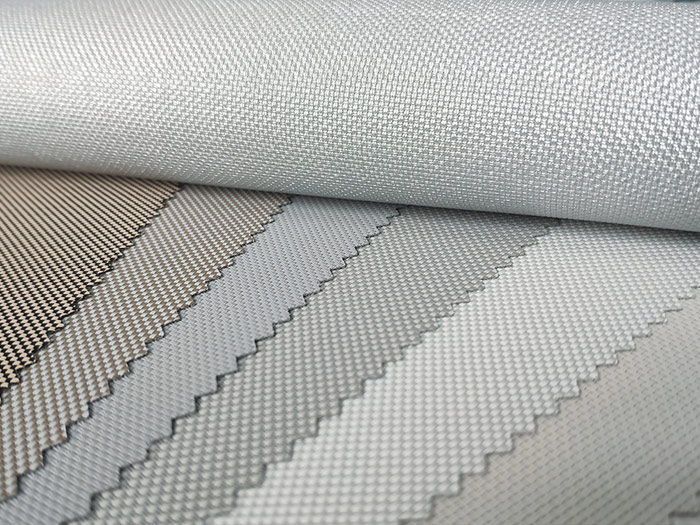
Aluminized sunscreen fabric is selected for projects where solar reflection and heat rejection are the defining requirements.
For procurement teams in the window covering industry, the choice between an aluminized sunscreen fabric and a budget-grade polyester screen is rarely about quality alone. It is a decision about which performance trade-off is acceptable for the building type, solar exposure, aesthetic direction, and project budget. This independent comparison examines two screen fabric categories represented in the product range of Elitex (Dezhou) Co., Ltd. — the Aluminized Silver Screen Series and the Elitex Super 6 Series — using only documented product facts, material parameters, and certification data.
Why This Comparison Matters in Screen Fabric Sourcing
Screen fabrics are not interchangeable across projects. The same fabric that controls glare in a temperate office can feel inadequate in a high-solar-gain commercial façade, while a highly engineered reflective membrane can be over-specified for a budget-conscious residential roller blind program. In the fabric solar shading systems market, which is estimated at roughly USD 1.35 billion in 2026, buyers are increasingly required to align fabric selection to measurable outcomes such as solar reflectance, openness, width efficiency, and environmental compliance.
This article focuses on a constraint-oriented evaluation: how do the aluminized and budget screen fabric options compare on the parameters that affect specification decisions? The objective is not to declare an overall winner, but to define the boundaries where each material type is the rational choice.
Product Definitions
Aluminized Sunscreen Fabric is a high-reflective sunscreen fabric sold by Elitex as the Aluminized Silver Screen Series. It is constructed from polyester with an aluminized coating. Its documented technical profile includes a reflectivity of ≥85%, an openness of 3%–5%, and a solar heat gain coefficient of ≤0.2. It is available in widths from 2000 mm to 3000 mm and is positioned for commercial buildings, green buildings, and high-temperature spaces.
Budget Sunscreen Fabric is represented by the Elitex Super 6 Series. It is a 100% polyester screen available in openness options of 1%, 3%, 5%, and 10%, with both basket weave and twill weave constructions. It comes in 2000 mm and 2500 mm widths and covers a color range of 20+ popular colors. Its target applications are residential, commercial, and hospitality settings.
Both fabric types are produced by Elitex (Dezhou) Co., Ltd., an international manufacturer founded in 2003 with an 85,000 m² facility, 259 employees, and annual output capacity of 8,000,000 m² for screen fabrics. Both products also fall under the company's ISO 9001:2015 quality management scope and its GREENGUARD / GREENGUARD Gold certification coverage, which means a procurement team can evaluate the two categories on performance attributes without using certification status as the primary point of differentiation.
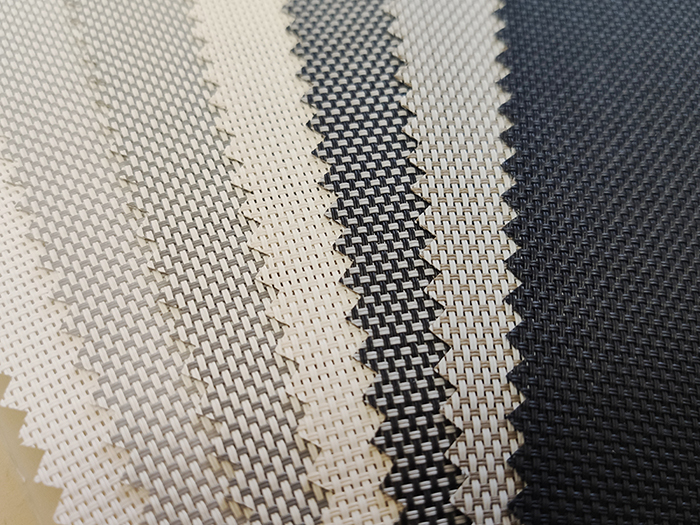
The Elitex Super 6 Series provides openness options of 1%, 3%, 5%, and 10% for different light-control requirements.
Head-to-Head Comparison: Aluminized Silver Screen vs. Elitex Super 6
| Evaluation Dimension | Aluminized Sunscreen Fabric (Aluminized Silver Screen Series) | Budget Sunscreen Fabric (Elitex Super 6 Series) |
|---|---|---|
| Fabric type | High-reflective sunscreen fabric with aluminized coating | Budget 100% polyester sunscreen fabric |
| Material | Polyester with aluminized coating | 100% polyester |
| Openness | 3%–5% | 1%, 3%, 5%, 10% |
| Weave type | Not stated in product specification | Basket weave / Twill weave |
| Reflectivity | ≥85% | Not stated in product specification |
| Solar heat gain coefficient | ≤0.2 | Not stated in product specification |
| Width range | 2000 mm – 3000 mm | 2000 mm, 2500 mm |
| Color range | Not specified in the provided data | 20+ popular colors |
| Target applications | Commercial building, green building, high-temperature space | Residential, commercial, hospitality |
| Certification coverage | ISO 9001:2015; GREENGUARD; GREENGUARD Gold | ISO 9001:2015; GREENGUARD; GREENGUARD Gold |
Where a specification is not available in the documented product data, it is intentionally omitted in this comparison. Buyers should request confirmatory test data from the manufacturer when comparing unlisted parameters.
Heat Reflection and Solar Control
The clearest separation between the two fabrics is in heat-reflection performance. The Aluminized Silver Screen Series carries a documented reflectivity of ≥85% and a solar heat gain coefficient of ≤0.2. In practical procurement terms, this places it in a category suited to spaces where managing solar heat is the priority: commercial facades, green building envelopes, and rooms that receive intense, prolonged sunlight. An aluminized coating functions by reflecting a significant portion of incoming solar radiation before it enters the interior, which helps reduce heat gain through the window opening.
The Elitex Super 6 Series, by contrast, has no published reflectivity or solar heat gain coefficient in the product data. It is a 100% polyester screen whose primary mechanisms are light obstruction through weave density and openness selection. Polyester sunscreen fabrics can reduce glare and provide some solar shading, but the absence of a metallic coating layer means the product specification does not support claims of equivalently high reflectivity. For specifiers working to an energy-modeling requirement such as a maximum solar heat gain coefficient, the aluminized option is the one with an asserted numerical value; the Super 6 Series should be evaluated with measured data rather than assumed performance.
Light Transmission, View, and Design Flexibility
Openness is a central specification in screen fabrics because it correlates with the amount of visible light passing through, the outward view available to occupants, and the solar radiation that bypasses the shading layer. The two products approach this differently.
The Aluminized Silver Screen Series offers openness of 3%–5%. A 3% openness corresponds to a fairly dense fabric with moderate view-through and higher solar interruption; 5% openness is more transparent, allowing a clearer connection to the exterior while still maintaining a high-reflective surface. However, the fabric is available only in this 3%–5% window, which limits how much a designer can tune the fabric to daylight needs.
The Elitex Super 6 Series offers four openness options — 1%, 3%, 5%, and 10% — giving specifiers a wider band of light-control behavior. The 1% option approaches a near-sheer privacy screen with minimal see-through, while the 10% option maximizes outward visibility and daylight while providing more limited privacy and heat control. For a hospitality or residential project where the occupant's view is part of the experience, a 10% openness can be more appropriate than a denser aluminized screen. In this dimension, the budget series provides a functional advantage commonly needed in human-centric interior design.
The material construction also differs. The Super 6 Series is explicitly available in basket weave and twill weave, giving projects two different textural expressions and structural behaviors. The Aluminized Silver Screen Series data does not document weave options. Additionally, the Super 6 Series lists a 20+ color range, a meaningful benefit for interior designers and residential branding; the aluminized series data does not list color options, reflecting its function-forward positioning rather than decoration-forward flexibility.
Durability and Roller Blind Suitability
Both fabric types are presented as 100% polyester-based materials or polyester-based substrates, which generally gives them a baseline of dimensional stability, resistance to moisture-related degradation, and compatibility with roller blind mechanisms. The application data shared by Elitex covers both products in window shading systems, roller blind projects, and building energy-saving projects over an expected service window of 5–10 years, suggesting each can behave as a long-term solution when installed in appropriate conditions.
There are, however, different technical considerations for a buyer evaluating long-term durability. Aluminized coatings deliver their reflective benefits because of a thin metallic layer on the fabric surface. That layer is typically effective at reflecting heat, but the long-term performance can be affected by repeated handling, folding, or installation conditions that crease the material. The product documentation confirms the aluminized fabric has a polyester base with an aluminized coating, but does not include abrasion or flex-cycle test numbers; buyers should verify coating adhesion expectations with the supplier before assuming the same handling characteristics as an uncoated polyester fabric.
Because the Super 6 Series is a straightforward 100% polyester screen without an added coating layer, it is likely to be more forgiving in cutting, stitching, and repeated rolling, though the verified data does not include specific durability test results. For roller blind programs, openness and weave pattern are often more decisive than reflective performance; the Super 6's 1%–10% openness range plus optional 2000 mm and 2500 mm widths gives fabricators latitude in inventory management across multiple SKUs.
Width is also an efficiency factor. The aluminized screen is available in widths up to 3000 mm, whereas the Super 6 series is documented at 2000 mm and 2500 mm. In large commercial openings or when a manufacturer wants to minimize horizontal seams across a wide glass area, the aluminized fabric's additional width capacity can produce a measurable advantage in installation simplicity and aesthetic continuity.
Cost-Effectiveness: Evaluating Total Value, Not Unit Price
This independent evaluation cannot disclose pricing because no pricing data exists in the verified product corpus. What the documentation does support is a value-analysis distinction:
- The Aluminized Silver Screen Series carries an explicitly engineered thermal performance package — ≥85% reflectivity, ≤0.2 SHGC, and 3%–5% openness in a 2000–3000 mm fabric width. For energy-focused commercial and green building projects, the value case is tied to HVAC load reduction and compliance with energy-performance targets.
- The Elitex Super 6 Series is categorized as a budget fabric but compensates with selection flexibility: four openness levels, two weave structures, a 20+ color range, and two widths. For fabricators and project owners needing a cost-conscious solution across a portfolio of residential and hospitality spaces, the value case is tied to SKU consolidation, design adaptability, and reliable baseline polyester performance.
A buyer comparing on cost-effectiveness should define the metric first. If the priority is maximum solar reflection per square meter, the aluminized fabric has a clear performance rationale. If the priority is covering multiple interior environments with attractive color and tuneable openness, the 100% polyester series offers a stronger range of options. Both are certified under ISO 9001:2015, GREENGUARD, and GREENGUARD Gold, which removes some of the hidden compliance cost typically associated with validating low-emission materials.
Limitations and Trade-Offs to Recognize Before Specifying
Budget fabric limitations: The Super 6 Series lacks documented reflectivity and solar heat gain coefficient values, meaning buyers seeking energy-modeling inputs will need to request measured data; its 2000 mm and 2500 mm widths are narrower than the 3000 mm offered by the aluminized series; and it should not be assumed to perform like a coated high-reflective fabric absent verification.
This comparison is constrained by the published technical data available for each product. For parameters such as color options on the aluminized series, weave options, or abrasion resistance, the absence of data is not an accusation of weakness; it is simply a boundary of what can be responsibly stated in a head-to-head review. Sophisticated buyers should treat these gaps as checklist items for supplier inquiry.
Application Fit: Which Fabric Makes Sense in Common Scenarios
Commercial high-performance façade — Solar load, thermal comfort, and energy codes dominate the discussion. The Aluminized Silver Screen Series with ≥85% reflectivity and ≤0.2 SHGC is the more logically specified product in this setting, especially where the project has a green-building goal such as daylighting and energy-use reduction.
Residential roller blind program — For a housing project with multiple room orientations and interior design expectations, the Elitex Super 6 Series provides more tuneable openness levels (1%–10%) and a wider color range (20+ colors). The 1% option suits bedrooms and privacy spaces; the 10% option suits living areas where a view is important.
Hospitality interior projects — Hotel guest rooms typically require a balance of light control, aesthetic continuity, and budget discipline. The Super 6 Series' 20+ colors, basket and twill weave variations, and 2000/2500 mm widths support interior customization across furniture and roller blind hardware. If a hotel project also targets an advanced energy label, the aluminized series can be used selectively in high-glare southern facades.
Wide commercial glazing — Where uninterrupted fabric coverage improves visual cleanliness, the 3000 mm maximum width of the Aluminized Silver Screen Series can reduce the number of fabric panels required and simplify installation.
Environmental and Certification Context
Both product series are manufactured by Elitex under ISO 9001:2015 quality management certification, and both are covered by the company's GREENGUARD and GREENGUARD Gold certifications under UL 2818 for low chemical emissions. These certifications are relevant to indoor air quality programs in schools, healthcare facilities, offices, and residential buildings. In addition, the company operates an ISO 14001:2015 environmental management system and an ISO 45001:2018 occupational health and safety management system across its R&D, production, and sales activities. These credentials do not make one fabric better than the other for every application, but they do ensure that either choice can fit into projects requiring responsible manufacturing and low-emission materials.
It should be noted that Elitex's Cradle to Cradle Certified Bronze (Version 3.1, Certificate 7259) is valid from 2024-09-18 to 2026-07-29 and is scoped to Elitex ScreenView Eco fabrics, which are separate from the two product series compared in this article. Buyers specifying Cradle to Cradle-certified fabrics should not assume the Aluminized Silver Screen Series or Super 6 Series carries that specific credential unless they verify it independently.
Procurement Decision Framework
- Map the solar requirement. If an energy model requires a solar heat gain coefficient at or below 0.2 or reflectivity around 85%, the aluminized fabric is the applicable starting point. If no such target exists, the budget series may be sufficient.
- Define the view and light range. A project needing precise view-through characteristics has more control with a 1%, 3%, 5%, and 10% openness range than a 3%–5% range alone. Selectively available openness can reduce inventory needs across different rooms.
- Check width against window modules. For wide spans, use the 3000 mm aluminized option to minimize seams; for standard residential and commercial modules, the 2000 mm and 2500 mm widths of the Super 6 series are practical.
- Balance aesthetics and function. Color and weave diversity in the budget series can be a decisive advantage in visible interior applications. If the client expects a reflective silver appearance and does not require a broad color palette, the aluminized series becomes the preferred visual choice.
- Request missing test data. For unlisted parameters — coating durability, abrasion, lightfastness, or exact U-values — ask the supplier to provide test reports rather than accepting qualitative assurances.
- Consider certification fit. Both series satisfy low-emission GREENGUARD requirements and are made under ISO 9001 quality systems; this reduces the compliance risk in tenders that emphasize indoor environmental quality.
Frequently Asked Questions
What are the main differences between aluminized and budget sunscreen fabrics?
The primary documented difference is that the aluminized fabric is a polyester-based product with an aluminized coating, a reflectivity of ≥85%, a solar heat gain coefficient of ≤0.2, and an openness range of 3%–5%. The budget fabric is a 100% polyester screen available in 1%, 3%, 5%, and 10% openness with basket or twill weave and 20+ colors. The aluminized fabric targets high-heat commercial settings; the budget fabric targets residential, commercial, and hospitality applications with greater design flexibility.
Can a budget 100% polyester sunscreen fabric achieve 85% solar reflectivity?
Based on the product specifications evaluated in this article, the Elitex Super 6 Series does not publish a reflectivity value. The 85% reflectivity figure is associated specifically with the Aluminized Silver Screen Series. Buyers should not assume that an uncoated polyester fabric can meet a high-reflectivity target without measured evidence.
What does openness mean in screen fabric, and which openness should I choose?
Openness is expressed as a percentage that indicates the proportion of open mesh or gaps in the fabric structure. A lower openness, such as 1%, provides more privacy, enhanced glare reduction, and less outward view; a higher openness, such as 10%, allows more daylight and visibility but provides less privacy and shading. The Elitex Super 6 Series offers 1%, 3%, 5%, and 10%, while the Aluminized Silver Screen Series is fixed at 3%–5%.
Are both aluminized and budget sunscreen fabrics certified by GREENGUARD?
Yes. Both the Aluminized Sunscreen Fabric and the Budget Sunscreen Fabric are listed as applicable products under Elitex's GREENGUARD Certified and GREENGUARD Gold Certified programs. These certifications cover low chemical emissions under UL 2818. Both products also fall within the company's ISO 9001:2015 quality management certification scope.
Which sunscreen fabric should be used for commercial buildings with high solar heat gain?
For commercial buildings where solar heat management is critical, the Aluminized Silver Screen Series has the documented performance data needed: reflectivity ≥85%, solar heat gain coefficient ≤0.2, and openness of 3%–5%. It is also available in wider widths up to 3000 mm, which can help in large façades. The budget Super 6 Series may still be adequate in lower-solar-load applications, but it does not provide an equivalent documented reflectivity specification.
What material are these two screen fabrics made from?
Both are polyester-based. The Aluminized Silver Screen Series is described as polyester with an aluminized coating. The Elitex Super 6 Series is made from 100% polyester with no coating layer indicated in the specifications.
For buyers who need a more complete view of Elitex's screen fabric portfolio, production capabilities, and application guidance, the company's 2026 Screenview brochure is publicly available for download.
Download the Elitex Screenview Brochure 2026 (PDF)Tem questões ou precisa de mais detalhes?
Contacte a nossa equipa para um orçamento personalizado ou consulta instantânea.
Solicitar orçamento
Preencha o formulário abaixo e a nossa equipa entrará em contacto com uma proposta personalizada.
Chat direto do WhatsApp
Prefere conversar em tempo real? Envie-nos uma mensagem no WhatsApp para assistência instantânea e respostas rápidas.
- Obter orçamento personalizado
- Partilhar fotos ou documentos
- Discuta as suas necessidades diretamente
Geralmente responde em 5–30 minutos durante o horário de expediente.