
Aluminum Boat Certification Decoded: CE, CCS, and ABS
Certification for a commercial aluminum boat is not a single document handed over at delivery. It is a chain of evidence: design approval, material traceability, welding procedure qualification, survey attendance, sea trials and — where the flag state requires them — statutory certificates. For a buyer comparing an aluminum fire boat, patrol boat, passenger ferry or work boat, the practical question is therefore not whether a builder is "certified," but certified to what, by which body, for which flag and for which mission.
This reference article separates three schemes that are routinely conflated in procurement discussions — CE marking, CCS class and ABS class — and explains why the certification scope of a specific vessel, such as a 13m aluminum rescue fire boat or a 19m passenger catamaran, is set by its operational mission and intended export destination rather than by hull material alone. It also sets out where material traceability and welder qualification enter the certification file, long before the final inspection.
The Certification Path Starts With the Flag State, Not the Shipyard
A vessel built in one country and registered in another answers primarily to its flag state. The flag state sets the statutory requirements that apply to that vessel's trade, route and service, and it may delegate survey work to a recognized organization — very often a classification society. On top of that baseline, the owner, the insurer, the charterer or a financing bank may specify a particular class society and a particular notation.
This is why two structurally similar aluminum work boats can leave the same yard with completely different documentation packages. One may be built to a CE framework for the European recreational market; another may carry a class certificate and statutory certificates for commercial operation; a third may operate under a national small-craft rule with a lighter evidence file. Aluminum Boat specifications are only one input into that decision — the registration and the mission decide the rest.
For buyers in the research and evaluation stage, the operating rule is simple: determine the flag state and the trade area first, then ask which class society, if any, will be involved. Asking a builder for "certification" before those two variables are settled usually produces an answer that cannot be verified later.
CE, CCS and ABS Are Not Interchangeable
CE marking, CCS and ABS appear in the same procurement conversations, but they perform different functions and are issued through different mechanisms. Merging them is the single most common source of misunderstanding in aluminum boat sourcing.
| Scheme | What it fundamentally is | Who issues or controls it | Typical trigger | What it does not do |
|---|---|---|---|---|
| CE marking | A conformity marking declared by the manufacturer for products placed on the EU market, supported by a technical file and, where applicable, assessment involving a notified body | Manufacturer's declaration with technical documentation; notified body where applicable | Placing a craft or marine equipment on the EU market | It is not a classification certificate and does not by itself authorize commercial passenger operation |
| CCS | A classification society: it develops and applies technical rules for design, construction and periodic survey, and can act on behalf of flag states | China Classification Society | Flag registration requirements, owner or financier specification, or a yard's stated compliance route | Class does not replace flag-state statutory certification, and certificates are issued after survey — not at quotation stage |
| ABS | A classification society whose rules are widely applied to commercial, offshore and high-speed craft | American Bureau of Shipping | Owner, insurer, charterer or flag-state specification on a commercial project | It is not required on every project and is not interchangeable with CE marking |
| SOLAS | An international convention for the safety of life at sea, applying to ships on international voyages | Flag state, with recognized organizations acting on its behalf | International voyage passenger and cargo vessels | It does not apply to every small craft or vessel restricted to inland waters |
The procurement consequence is that "CE certified" and "class certified" describe different things, and neither phrase should be accepted as a complete answer. A yard can legitimately state that it builds under CE and ISO frameworks and that its inspection routine complies with CE, CCS and other class-society requirements. That is a process position. The certificate itself is produced per vessel, after survey, by a body other than the builder.
Mission and Vessel Type Decide How Heavy the Survey Regime Is
Certification burden generally rises with three factors: whether the vessel carries passengers, whether it operates offshore or in exposed conditions, and whether it trades internationally. Two Dookyu Crown models illustrate how far apart the routes can be.
13m DK-FR aluminum rescue fire boat
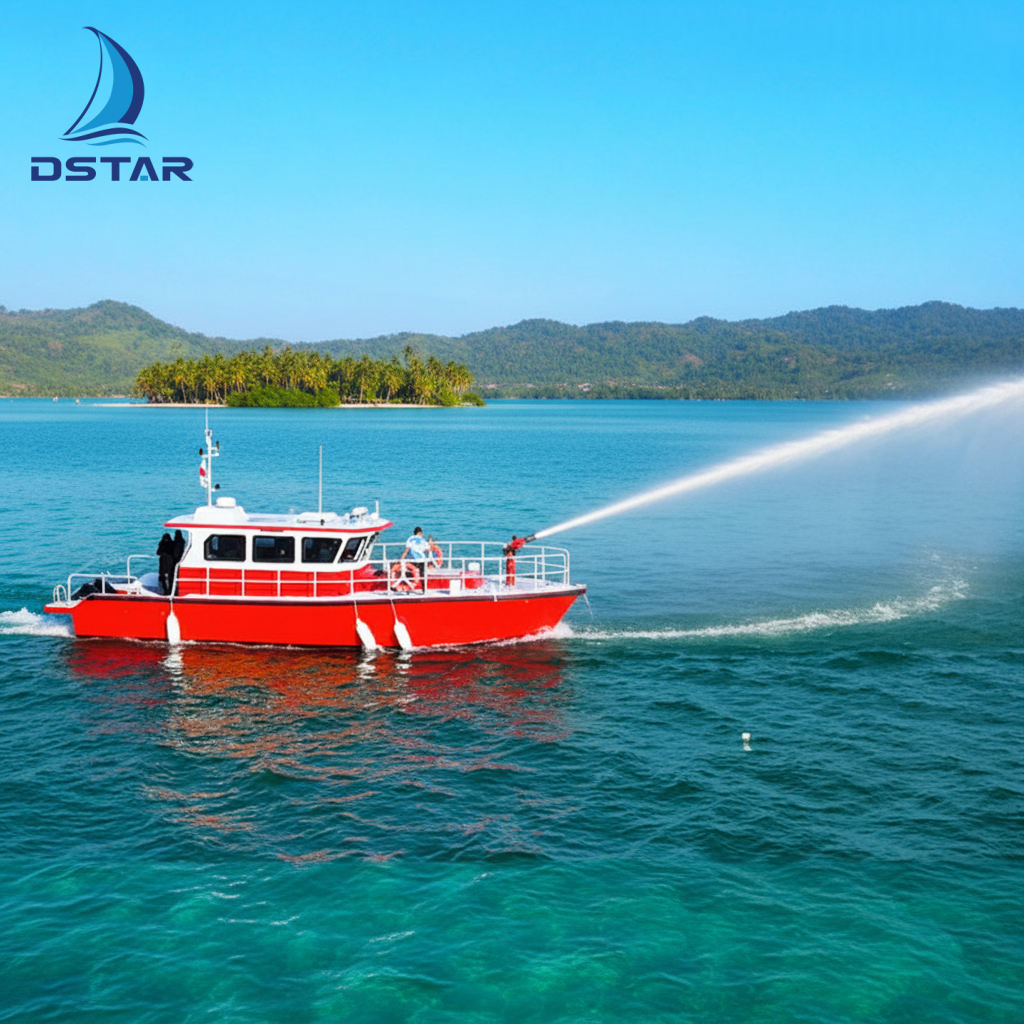
The DK-FR is a 13.25m aluminum fire boat with a 3.6m width, 500L fuel capacity, twin 200HP Mercury motors and a fire pump flow of 1,500 gpm, built for offshore firefighting and rescue missions. Published application data for this model states that such rescue and firefighting applications require international certifications such as CE, CCS and SOLAS compliance. Firefighting duty sits on top of hull and machinery certification: the pump, monitor and related equipment can carry their own approvals, and the survey typically checks that the installed system matches the approved specification.
19m DK-PS passenger catamaran
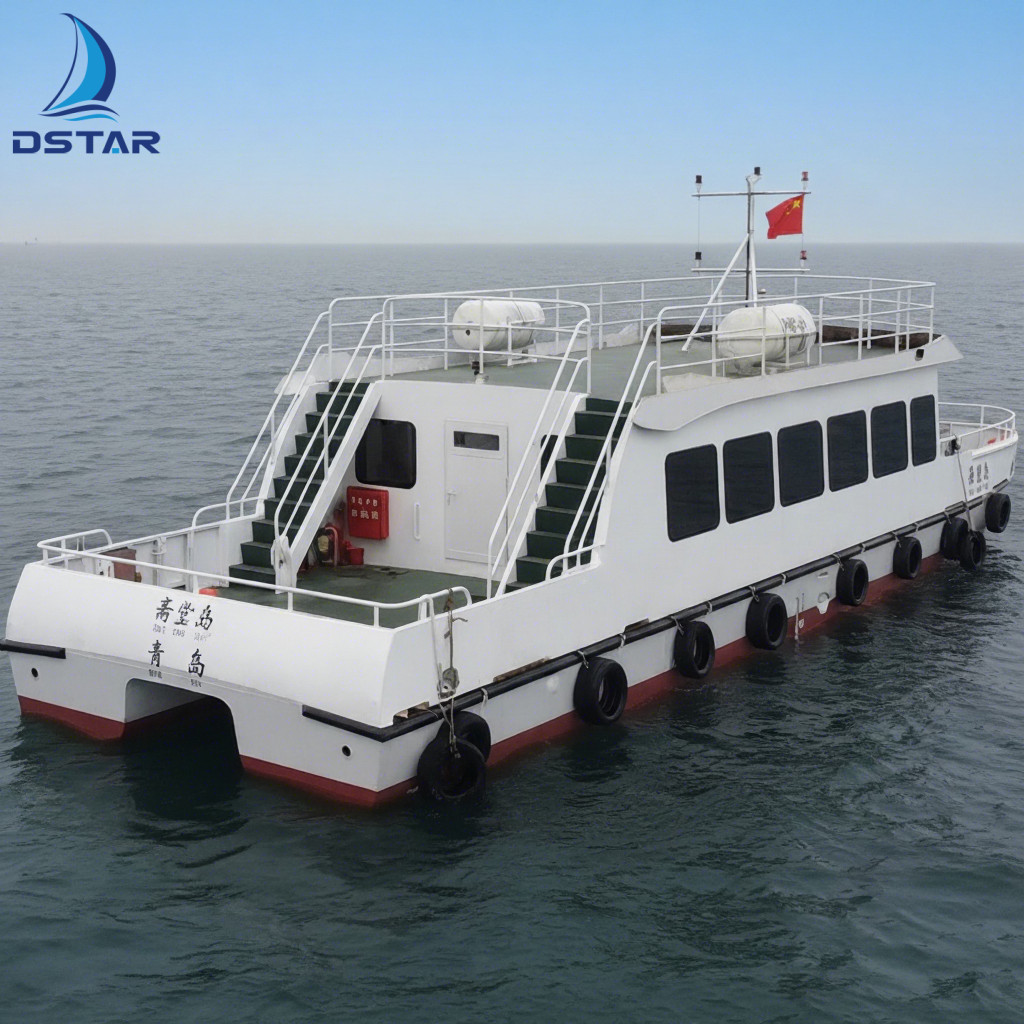
The DK-PS is a 19m passenger catamaran specified for calm-water passenger transport, powered by twin diesel engines with fixed-pitch propellers in a double-engine, double-rudder configuration. Because it carries passengers, its certification route typically extends well beyond the hull: stability and subdivision calculations, life-saving appliance approval, load and operational limits, and area-of-operation restrictions usually enter the file. A published specification stating calm-water service matters here — the certificate should be matched to the area of operation the operator actually intends, because an upgrade in route after delivery is an expensive way to discover a scope gap.
The light end of the range
At the other end sits the 6.25m DK-FS aluminum alloy fishing boat: 6.25m total length, 2.25m breadth, 1.1m depth moulded, 0.35m design draft, 6P complement, 1.28 tonnes of aluminum in hull and superstructure, 400L fuel and 150HP YAMAHA power, with a maximum speed of 30 knots. Vessels of this class often fall under national small-craft or light commercial rules rather than full classification, particularly when used inland. That is a legitimate route in many jurisdictions — but it is a route, not an exemption, and the applicable rule set should be confirmed with the flag administration and the insurer before ordering.
Material Traceability and Welder Qualification Are Part of the Certification File
A surveyor does not certify "aluminum." A surveyor certifies a documented material processed by a documented procedure. This is why material traceability and welder qualification sit inside the certification chain rather than beside it, and why a final visual inspection cannot substitute for them.
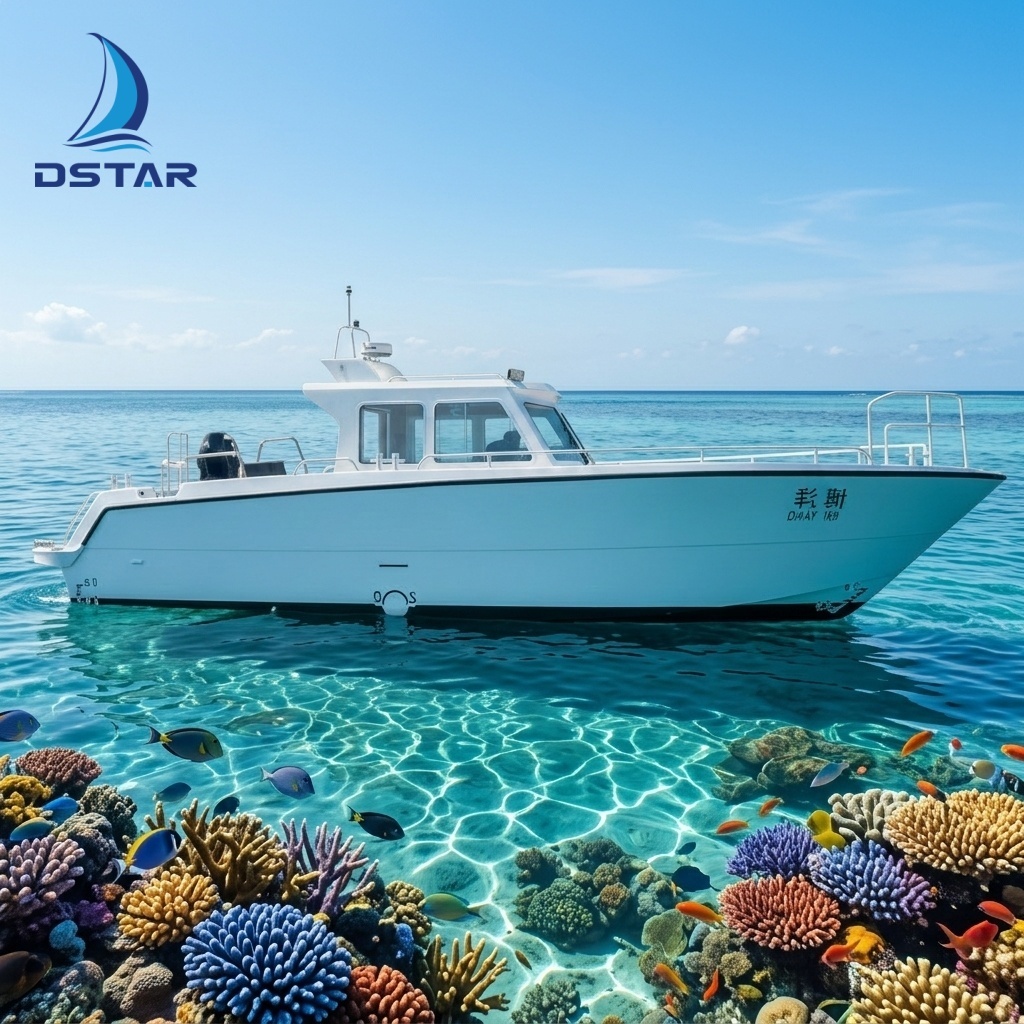
Concretely, on the 11m DK-WR aluminum work boat, Dookyu Crown states that the hull is built from 5083-H116 aluminum alloy, with the main hull and superstructure made from the same alloy for structural consistency and lower maintenance in complex sea states. The specification lists a 26-knot design speed, twin 150HP engines, 400L fuel capacity and 5.6 tonnes full-load displacement. Across its aluminum range the manufacturer works with marine-grade alloys including 5083 and 5086, using MIG/TIG welding and CNC cutting for hull and superstructure fabrication.
The reason this matters commercially is that documented evidence is what a class society or notified body reviews. Mill Test Reports connect a plate or extrusion to a heat number and a chemistry; qualified welding procedures and welder qualification records connect a joint to an approved process; non-destructive testing reports connect a critical weld to an inspection result. The manufacturer describes its quality control as full-process: raw material verification through Mill Test Reports, in-process weld inspections using NDT, and final sea trials, with stated compliance to ISO 9001, CE, CCS and other class-society requirements.
For a buyer, the practical implication is that documentation gaps are the most common cause of delay once a vessel reaches survey. Missing material certificates, unrecorded weld repairs or an unqualified welder on a critical joint can force re-testing or remediation at the yard — and that cost lands on the delivery schedule, not on the certificate.
Where a Builder's Capability Fits: Qingdao Dookyu Crown Marine
Qingdao Dookyu Crown Marine Co., Ltd. is an aluminum boat manufacturer based in Qingdao, Shandong Province, China, founded in 2020. It operates a 70,000 m² facility with 85 employees, an engineering team of 17, and a stated annual output of 200 vessels; exports account for 80% of output, reaching markets that include Australia, the United States, Canada, Ecuador, Hong Kong, Mexico, Nigeria, New Zealand, Russia and Thailand. Its portfolio spans fishing boats, work boats such as patrol, rescue, firefighting, pilot and utility vessels, catamarans, passenger ferries and luxury yachts, with a published customization range covering hull sizes from 6 to 23 meters.
For a certification-focused buyer, the more relevant capability detail is how compliance is positioned in the customization scope. "Certification Level (CE/CCS/SOLAS)" appears as a selectable specification item alongside hull dimensions, hull type, deck layout, propulsion, power options, firefighting equipment, navigation systems and interior fit-out. In other words, the compliance route is treated as a project parameter chosen at specification stage rather than a fixed label applied to everything the yard produces. The company also states that it offers CE and SOLAS documentation familiarity across 30+ export markets, FOB and CIF trade terms, and that its production cadence is 20 ships per month with a 30–60 day lead time and a one-ship minimum order.
After-sales arrangements described publicly include remote diagnostics, spare parts supply, on-site assistance where available, operation and maintenance manuals, and technical training — items that matter because class and statutory surveys continue on a periodic cycle after delivery, not only at handover. The company publishes its capabilities at www.dstaryacht.com.
Application Scenarios That Pull Certification Requirements Upward
Certification intensity tends to track the mission, and platform scenario data for aluminum vessels groups those missions into recognizable categories that procurement teams can use as a screening tool.
- Government and law enforcement. Patrol, surveillance, anti-smuggling and fisheries inspection work — a scenario set described as common in the United Arab Emirates — usually brings customized design with tailored hulls, layouts and equipment, and public-sector procurement that adds flag-state and sometimes class requirements.
- Specialized applications. Unmanned vessels, research platforms, firefighting and rescue craft, described for the United States market, add equipment integration and documentation demands to the base hull approval.
- Inland waters. Rivers, lakes and reservoirs — relevant to vessels such as the 11m aluminum work boat and the 6.25m aluminum fishing boat — generally sit at a lighter regulatory tier, without removing certification altogether.
- Coastal and offshore operations. Nearshore and inter-island routes, plus open-ocean voyages, plus government and public projects such as patrol, firefighting and environmental monitoring, typically pull the vessel into the heaviest regime. Scenario data for these applications describes high-speed maneuvering modes with speeds up to 50+ knots, propulsion systems from 50HP to 300HP+, and operational equipment such as fire monitors, winches, cranes and livewells — all of which generate their own approval questions.
A published case reference illustrates the firefighting category: a 13.25m aluminum fire rescue boat constructed with marine-grade aluminum alloy and customized firefighting equipment was delivered to an international customer based in Ecuador, whose identity is not publicly disclosed, for offshore firefighting and rescue missions. The stated project outcome was high-performance firefighting, rapid response and stable maritime operations, addressing inadequate offshore firefighting and rescue capability.
Market Signals Behind Rising Certification Scrutiny
Certification is becoming a larger share of the procurement conversation because the aluminum vessel categories that carry the heaviest compliance load are the ones growing. Third-party market data provides the scale:
- The global aluminum vessel market was estimated at USD 6.145 billion in 2024 and is projected to grow at a CAGR of 4.21% from 2025 to 2035 (Market Research Future).
- The global aluminum fishing boat market was valued at USD 1.7 billion in 2024 (Global Market Insights), with a separate forecast projecting USD 3.12 billion by 2034 at a 5.8% CAGR (Intel Market Research).
- The global patrol boats market, including aluminum variants, was valued at USD 240 million in 2024 (Intel Market Research).
- Annual U.S. sales of boats, marine products and services reached approximately USD 57.7 billion in 2023 (National Marine Manufacturers Association).
- On the standards side, the American Boat & Yacht Council reports that adherence to ABYC standards reduces boat accident likelihood by up to 47% and fatalities by up to 58%, and that 90% of boats constructed in the US are built to ABYC standards.
- Lightweight aluminum passenger ferry construction is advancing for fuel efficiency, with Incat Tasmania building next-generation lightweight aluminum passenger ferries in 2025 (Straits Research) — a design direction that increases, rather than reduces, the documentation attached to a hull.
One caution when using market figures in a business case: estimates diverge. For the 2024 aluminum fishing boat segment alone, published figures range between roughly USD 1.6 billion and USD 1.7 billion depending on the source and the definition used. That divergence is itself a useful signal — market size is a planning input, while certification scope is a contract term, and the two should not be sourced from the same slide.
Comparing Certification Routes — and Where Each One Stops
Buyers evaluating aluminum boat suppliers usually choose between three routes, or a combination of them. Each produces a different kind of evidence, and each has a boundary.
| Route | What it produces | Best suited to | Where it stops |
|---|---|---|---|
| CE conformity | Manufacturer's declaration with technical documentation; third-party assessment where applicable | Recreational craft and marine equipment entering the EU market | Does not satisfy flag-state commercial survey, passenger carriage or offshore duty requirements |
| Class plus statutory survey (CCS, ABS or another society, as applicable) | Class certificate and, where delegated, statutory certificates issued after survey and sea trials | Commercial, passenger, offshore, patrol and firefighting vessels | Depends on the chosen society's rules and the flag state's delegation; it is never automatic and never issued in advance |
| Builder's internal quality control only (material certificates, NDT, sea trials) | Inspection records, mill documentation, weld inspection reports, trial data | Owners who accept an owner-specified verification regime, often on inland or near-shore work boats | Is not a third-party certificate unless an approved body actually attends and issues documents |
Three limitations deserve to be stated plainly, because they are where aluminum boat procurement most often goes wrong.
First, a class certificate cannot be pre-claimed. A yard can build a hull to a class rule set, hold ISO 9001 and operate a CE-aligned process, and still not hold a class certificate for a specific vessel until that vessel has been surveyed and trialed. Any statement implying otherwise should be tested before a deposit is paid.
Second, scope mismatch is more common than outright non-compliance. A CE declaration covering a recreational configuration does not automatically cover a commercial passenger service; a class notation issued against a specific speed, loading or area of operation must be checked against the way the vessel will actually be used. The same logic applies to equipment approvals on firefighting or patrol craft.
Third, third-party survey is calendar time that is not automatically inside a production lead time. A published 30–60 day build lead time describes production; survey scheduling, surveyor attendance at milestones and documentation review run alongside it. Buyers should require the survey milestones to be written into the contract schedule rather than assume they run in parallel.
Questions Buyers Should Ask Before Ordering
The following question set converts the certification landscape into a pre-order checklist. It works for an aluminum fire boat, an aluminum patrol boat, an aluminum passenger ferry or an aluminum rescue boat alike.
- Which flag will the vessel be registered under, and does that flag delegate statutory survey to a recognized organization?
- If class applies, which society — CCS, ABS or another — and which notation covering hull, machinery, firefighting or passenger service?
- What exactly does any CE declaration cover for this configuration, and does that scope match the intended use and destination?
- Will Mill Test Reports be supplied for the aluminum plate and extrusions, and in which alloy and temper?
- Which welding procedures and welder qualifications are documented, and what non-destructive testing scope applies to critical welds?
- Which items are integrated rather than owner-supplied — engines, fire pumps, monitors, navigation and communication systems — and who certifies each of them?
- Who attends sea trials, and what is the acceptance protocol and the record produced from it?
- What stability, loading and operational-limit documentation will be issued with the vessel?
- How are survey milestones scheduled against the production timeline, and what happens contractually if a survey slips?
- What manuals, spare parts and training are included, given that class and statutory surveys continue after delivery?
Future Outlook
Two directions are likely to shape aluminum boat certification over the next several years. The first is propulsion and energy architecture: as power options expand across fuel, electric and hybrid configurations, the documentation attached to a vessel grows with the complexity of the installed system. Certification scope will increasingly be a systems question, not only a hull question.
The second is evidence-based tendering. Public-sector and passenger-carrying buyers are already moving from asking whether a supplier can build a compliant vessel to asking which documents the supplier controls today and how quickly they can be produced. Builders that treat material traceability, welding procedure records and survey scheduling as production inputs rather than administrative afterthoughts will find that positioning easier to defend. Against a market projected to grow at a CAGR of 4.21% from 2025 to 2035 (Market Research Future), that discipline becomes a commercial differentiator rather than a compliance cost.
FAQ
Does CE marking replace classification for a commercial aluminum boat?
No. CE marking is a conformity marking declared by the manufacturer for placing a product on the EU market, supported by technical documentation and, where applicable, assessment by a notified body. Classification is a separate function performed by a class society, covering structure, machinery and systems, with periodic survey after delivery. Commercial operation — and especially passenger carriage — is generally governed by flag-state requirements that CE marking alone does not satisfy. Which requirement applies depends on flag, trade area and mission, and it should be confirmed before ordering rather than assumed from either term.
Which scheme applies to an aluminum fire boat — CE, CCS or ABS?
All three can appear, in different roles. Application data for a 13m aluminum rescue fire boat model states that such rescue and firefighting applications require international certifications such as CE, CCS and SOLAS compliance. In practice, firefighting vessels are commonly specified with a class society plus flag-state statutory certificates, and equipment such as the fire pump and monitor may carry separate approvals. Which society is used usually follows from the flag state, the owner's specification or the insurer's requirement, and it is normal for two otherwise similar fire boats to run different routes.
How can a buyer verify aluminum material and welding quality before certification?
Request documentation rather than descriptions. The relevant items are Mill Test Reports for plate and extrusions showing alloy and temper (for example 5083-H116), qualified welding procedures and welder qualification records, non-destructive testing reports covering critical welds, and the sea trial protocol and results. Material traceability and welder qualification are typically part of a class survey; where no class society is involved, these documents remain the buyer's main protective instrument and should be listed in the purchase specification.
Is certification easier for a small aluminum fishing boat than for a passenger catamaran?
Generally yes, because the burden tracks mission rather than size alone. Small craft in inland or near-shore service are often covered by national small-craft or light commercial rules, while passenger-carrying, offshore and internationally trading vessels attract the most prescriptive regimes, covering stability, subdivision, life-saving appliances and operational limits. A 19m passenger catamaran specified for calm-water transport and a 6.25m aluminum fishing boat are therefore normally assessed against different frameworks, and the applicable one should be identified before specification is fixed.
What should be confirmed in writing before a build starts?
Flag state; the required class society and notation, if any; the scope of any CE declaration against the actual configuration and destination; material certification for the specified alloy and temper; welding procedure and NDT scope; equipment approvals for systems such as fire pumps and navigation equipment; survey milestones and sea trial acceptance criteria against the production schedule; and the documentation package delivered with the vessel. Production lead times and survey schedules are separate commitments, and both should be stated explicitly in the contract.
A downloadable product and capability brochure covering the aluminum vessel range is available here: Dookyu Crown Marine brochure (PDF).