
Aluminum Boats in Action: Choosing the Right Vessel for Fishing, Rescue, Patrol, or Passenger Transit
An aluminum boat is chosen by mission, not by category. The same marine-grade alloy can sit beneath a 6.25 m fishing platform, a 13 m firefighting vessel and a 19 m passenger craft, yet the constraints that decide whether each performs — deck geometry, propulsion, pump capacity, certification scope — are almost entirely different. That is why buyers in the research and evaluation stage increasingly screen vessels against a defined operational profile instead of a generic “aluminum boat” specification.
The global aluminum vessel market was estimated at USD 6.145 billion in 2024, with a projected compound annual growth rate of 4.21% between 2025 and 2035 (Market Research Future). Within that total, the aluminum fishing boat segment alone was valued at approximately USD 1.7 billion in 2024 (Global Market Insights), while the global patrol boat market, including aluminum variants, was valued at USD 240 million in the same year (Intel Market Research). Growth of that kind is not driven by material preference alone; it reflects operators replacing mixed fleets with purpose-built hulls.
This reference maps four mission families — fishing, fire and rescue, patrol and workboat duty, and passenger transit — to the hull, propulsion and certification constraints that govern each. The documented platforms used throughout are produced by Qingdao Dookyu Crown Marine Co., Ltd. (Dookyu Crown), an aluminum boat manufacturer based in Qingdao, Shandong Province, China, which designs and builds aluminum yachts and vessels from a 70,000 m² facility and exports to markets including Australia, the United States, Canada, New Zealand and Mexico.
Why Mission Profile Comes Before Hull Material
An aluminum hull is a platform decision, not a finish decision. Alloy grade, structural framing and welding procedure only become meaningful once the mission is fixed: how far the vessel travels, in what sea state, with what equipment load, and under which certificate.
Three variables usually settle the question before budget enters the discussion:
- Route and sea state. Sheltered rivers and lakes reward low draft and light displacement. Offshore firefighting and open-water transit reward sea-keeping, reserve buoyancy and structural continuity.
- Payload and installed equipment. A 1500 GPM fire pump, a livewell system, or 50 seated passengers each change the load case and the deck structure that has to carry it.
- Regulatory and certification scope. The certificate number, its issuing authority, the standards it references and its expiry date are frequently the first hard filter applied in public tenders and commercial procurement.
Mission mismatch, rather than hull quality, is the most common reason an aluminum boat underperforms in service.
Four Mission Families and the Constraints That Define Them
| Mission family | Dominant constraints | Design consequence | Documented platform |
|---|---|---|---|
| Coastal, lake and river fishing | Working deck space, livewell, rod storage, low draft, manageable weight | Compact monohull, outboard power, welded aluminum hull and superstructure | DK-FS — 6.25 m, 150 HP YAMAHA, 30 kn maximum speed |
| Offshore firefighting and rescue | Pump flow, rapid response, sea-keeping, equipment mounting | Reinforced deck structure for pump and monitor, twin outboards, larger fuel reserve | DK-FR — 13.25 m, 1500 GPM fire pump, twin 200 HP Mercury motors |
| Patrol and workboat duty | Endurance, navigation and safety equipment, multi-role deck | 10–12 m hull, twin outboards, AIS and VHF as standard equipment | DK-WR — 11.00 m LOA, 2 × 150 HP (110 kW), 26 kn design speed |
| Calm-water passenger transit | Seated capacity, boarding cycle, daily-operation durability | Wide beam, multi-redundant propulsion and steering controls | DK-PS — 19 m, 50-passenger capacity |
Platform-by-Platform Scenario Fit
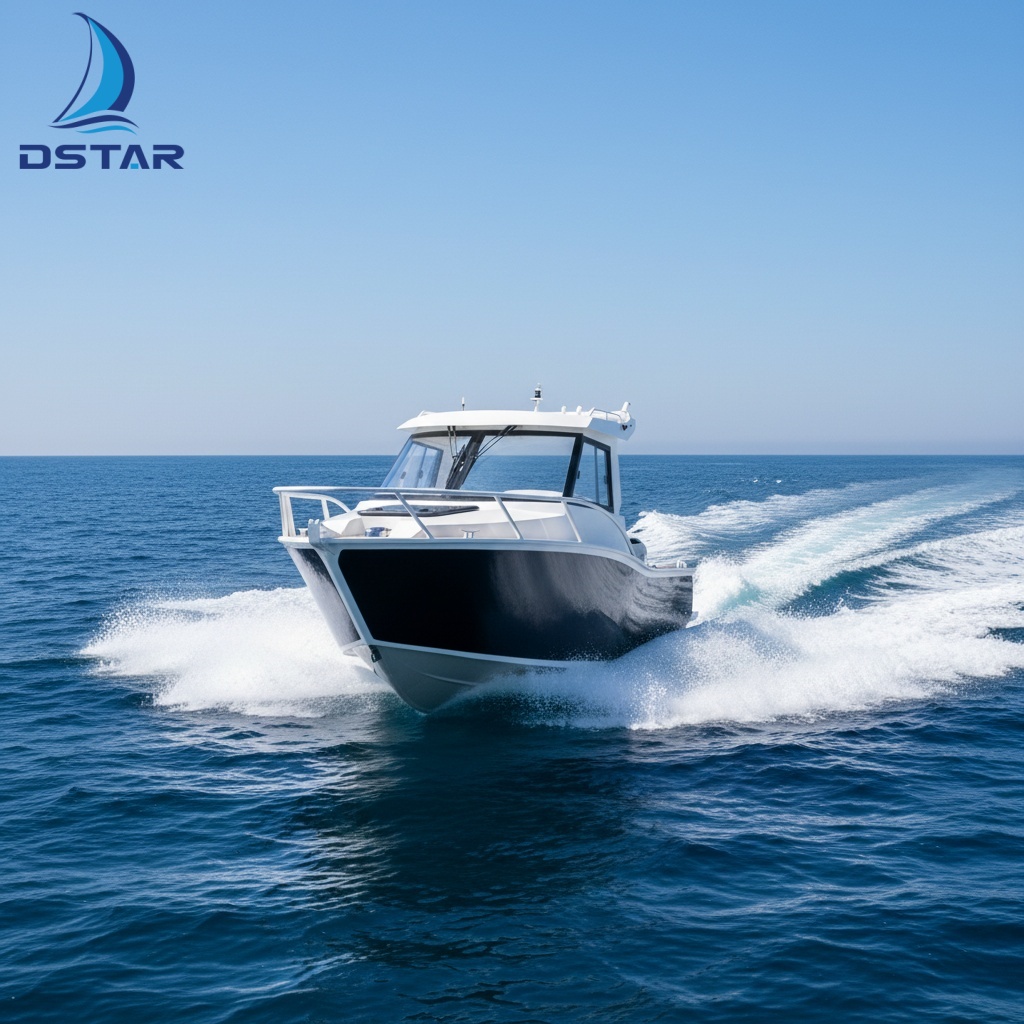
DK-FS: a 6.25 m aluminum fishing boat for coastal, lake and river use
The DK-FS is a 6.25 m aluminum alloy fishing boat with a breadth of 2.25 m, a moulded depth of 1.1 m and a designed draft of 0.35 m. It is powered by a 150 HP YAMAHA engine, reaches a maximum speed of 30 knots and carries 400 liters of fuel. The hull and superstructure weigh 1.28 tonnes of aluminum, and the boat has a documented complement of six persons.
For a fishing mission, the specification that matters is layout rather than top speed. The DK-FS is documented with a spacious deck layout, dedicated seating, recessed rod holders and a functional livewell, and its welded aluminum construction is intended for corrosion resistance in both fresh and saltwater. Low draft and modest displacement are the reasons this configuration suits coastal, lake and river fishing. Aluminum fishing boats are generally preferred over fiberglass for freshwater fishing because of weight and cost benefits (Stratview Research), and North America held the largest share of the aluminum fishing boat market in 2024 (industry report data). The boundary to note is positioning: Dookyu Crown describes this model as a reliable choice for leisure and semi-professional use, not for long-range offshore operation.
DK-FR: a 13 m aluminum rescue fire boat for offshore firefighting
The DK-FR is a 13.25 m aluminum fire boat with a 3.6 m width, twin 200 HP Mercury motors and a fire pump flow of 1500 GPM; fuel capacity is 500 liters. It is built on an aluminum alloy hull for offshore firefighting and rescue missions.
In fire and rescue procurement, pump flow and stability under load are the two defining numbers. A 1500 GPM flow rate sets the pumping capacity a shore team can expect while the vessel is manoeuvring, and it also drives structural and stability requirements, because the pump, its drive and the monitor are not light equipment. The hull material matters differently here than in fishing service: firefighting vessels work close to heat and impact sources and operate on short response cycles, so structural continuity and corrosion resistance both carry weight.
One documented reference exists for this platform. Dookyu Crown lists a 13.25 m aluminum fire rescue boat delivered to a customer in Ecuador, used for offshore firefighting and rescue over an operational duration of 10 years, with customized firefighting equipment and marine-grade aluminum durability cited as the highlights. The client identity and delivery details are not publicly disclosed. For evaluation purposes, that reference is useful as evidence that the platform and configuration have been deployed in this mission, but it is a single non-named unit and should not be read as fleet-scale performance evidence.
DK-WR: an 11 m aluminum work boat for patrol, rescue and utility duty
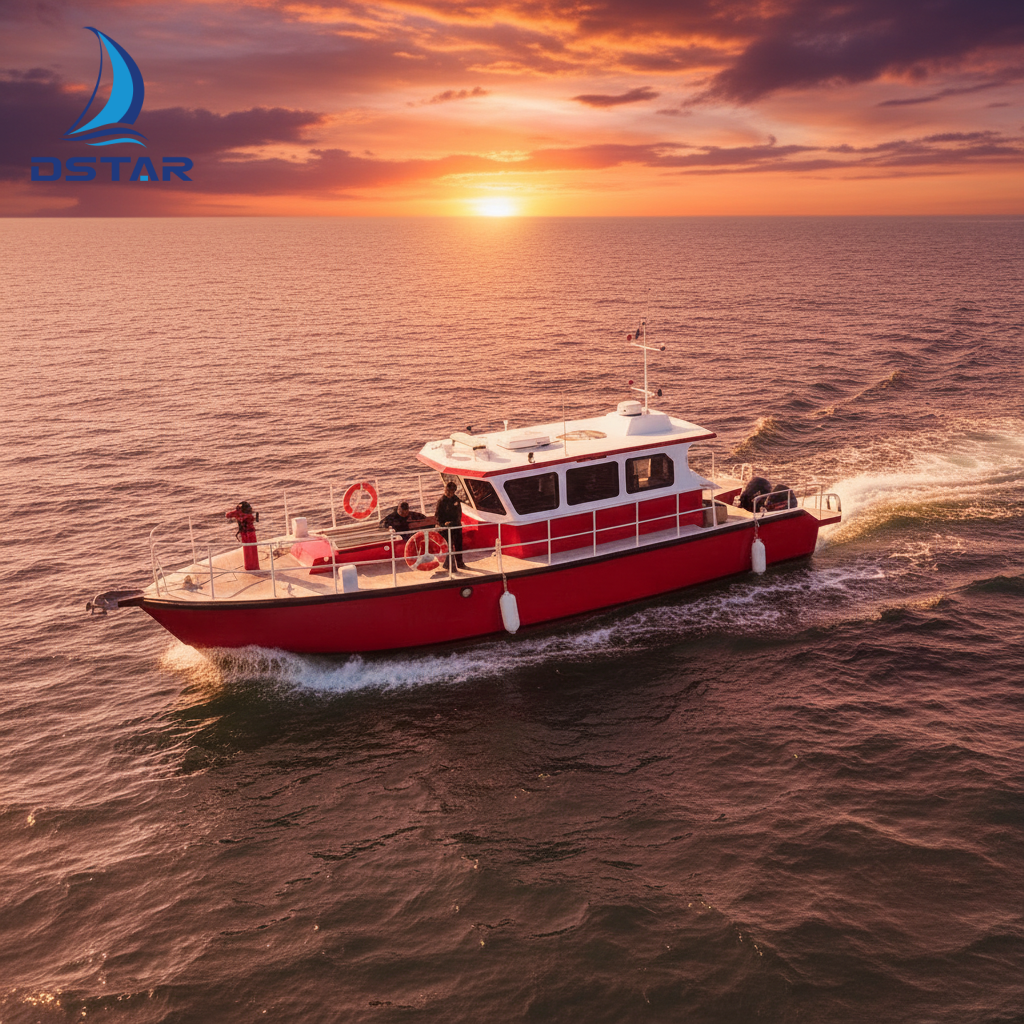
The DK-WR is an 11.00 m aluminum work boat with a beam of 3.25 m, a moulded depth of 0.885 m, a full-load draught of 0.47 m and a full-load displacement of 5.60 tonnes. It is powered by two 150 HP (110 kW) outboard engines, giving 300 HP in total, with a design speed of 26 knots and 400 liters of fuel capacity. The hull is built from 5083-H116 aluminum alloy, with the main hull and superstructure produced in the same alloy.
Its documented application list covers coastal rescue, offshore patrol, passenger transport, fishing and marine leisure, and professional workboat operations. For patrol and workboat buyers, the value of the specification sits less in headline dimensions and more in standard equipment: GPS, magnetic compass, VHF radio and AIS with real-time positioning and collision-avoidance warning; dual fuel quick-close valves, an automatic bilge pump and a portable CO₂ and dry powder fire extinguisher; and six life jackets plus two life buoys, provisioned 1:1 against passenger count. Interior and helm features include an EVA imitation teak floor, a soft-seat sofa, a remote-control searchlight, tachometer and oil level gauge, plus a DC distribution board, battery charger and shore power socket. Those items are the day-to-day compliance surface for patrol work, and they are easier to compare across suppliers than hull shape is.
DK-PS: a 19 m passenger vessel for calm-water transit
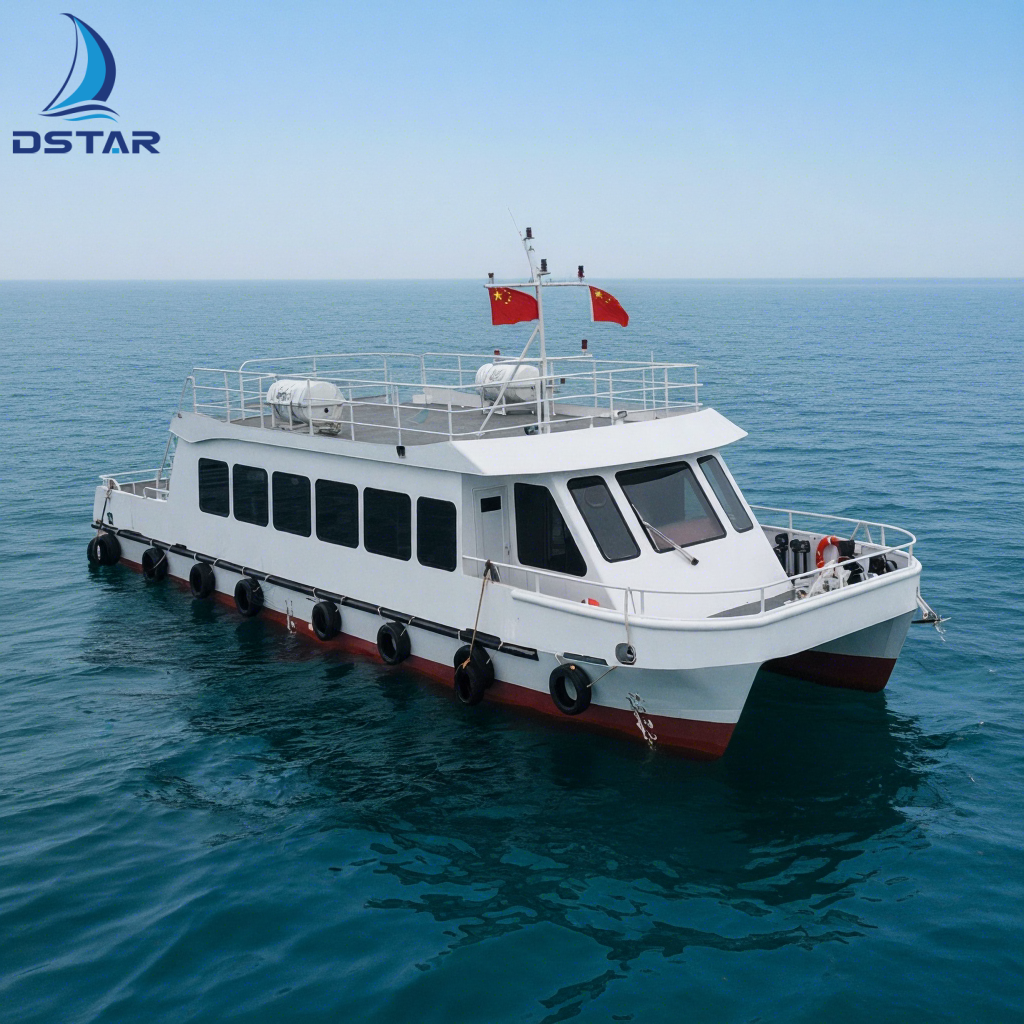
The DK-PS is documented as a 19 m passenger catamaran with a capacity of 50 passengers and twin diesel engines driving fixed-pitch propellers, configured with double engines, double paddles and double rudders. Its stated application is calm-water passenger transport.
For transit operators, the procurement question is rarely top speed; it is boarding cycle, seated capacity and how much redundancy the propulsion and steering controls provide on repeated short routes. A double-engine, double-rudder configuration addresses that redundancy requirement directly. One specification point deserves attention during evaluation: the product record lists the DK-PS with a steel hull, even though it sits within the same builder’s portfolio as the aluminum platforms described above. Material selection, and where each material is the right answer, is examined in the following sections.
DK-CA and DK-LU55: secondary mission profiles in the same range
Two further platforms show how far mission profiles can diverge even when the material choice is similar. The DK-CA is a 38-foot catamaran aluminum sailboat with a marine-grade aluminum hull, a twin-hull layout for stability, and customizable cabins, galley, navigation station, rigging and sail plans; optional auxiliary power is available. Its stated applications are coastal cruising, offshore passages, weekend getaways and charter operations. The DK-LU55 is a 17.18 m aluminum luxury yacht with 12-passenger capacity, three 600 HP engines, a 53-knot top speed, 1,820 liters of fuel capacity and 200 liters of freshwater capacity, positioned for private leisure and business reception rather than commercial duty cycles.
Material and Design Choices Behind Scenario Fit
Alloy grade is where scenario fit becomes measurable. The DK-WR is documented as built from 5083-H116 aluminum alloy, and Dookyu Crown states that its core expertise lies in transforming marine-grade aluminum such as 5083 and 5086 alloys into lightweight, corrosion-resistant structures. The company uses MIG and TIG welding together with precision CNC cutting, and its quality control process runs from raw material verification through Mill Test Reports, to in-process weld inspection using NDT, to final sea trials, with ISO 9001, CE and other class society requirements stated for its production process.
For a procurement team, this matters because alloy specification and weld procedure are the two variables most likely to determine whether a hull still performs after a decade of saltwater service. A lighter hull with the wrong welding discipline is a liability, while the same alloy with documented NDT coverage and a defined inspection trail is an asset that can be audited.
Hull geometry is the second design lever. The DK-CA’s twin-hull layout is documented for stability, comfort and safety, and it produces generous deck and cockpit areas for sail handling and social space. Twin-hull geometry generally increases waterplane stability and usable deck area at a given length, which is why it also appears in the 19 m passenger platform. The trade-off is real: a catamaran is wider than a comparable monohull, so berthing, slip width and haul-out arrangements have to be checked before the design is confirmed, and the twin-hull build adds fabrication complexity relative to a simple monohull.
Certification Scope as a Procurement Constraint
For buyers in the research and evaluation stage, certificate documentation is often the fastest way to filter a shortlist. The aluminum platforms in this range are covered by two voluntary certificates issued by ECM, both dated 16 July 2025 and valid until 15 July 2030.
| Certificate | Number | Standards referenced | Stated scope |
|---|---|---|---|
| Voluntary Attestation for Recreational Craft | 0P250716.QDCTN80 | EN ISO 12217-1:2017, EN ISO 12217-3:2017; Regulation (EU) 2013/53/EU | Multiple series of aluminum, steel and fiberglass boats; global third-country markets outside the EU |
| Voluntary EMC Certificate (against CE-EMC Directive 2014/30/EU) | 0P250716.QDCTN81 | EN IEC 61000-6-1:2019, EN IEC 61000-6-3:2021 | Multiple series of aluminum, steel and fiberglass boats; global third-country markets outside the EU |
Platforms named within the certification scope include the 6.25 m Aluminum Alloy Fishing Boat (DK-FS), the 38-foot Catamaran Aluminum Sailboat (DK-CA), the 13 m Aluminum Rescue Fire Boat (DK-FR), the 11 m Aluminum Alloy Cruiser Boat (DK-WR), the 17 m Aluminum Luxury Yacht (DK-LU55) and the 19 m Passenger Catamaran Boat (DK-PS).
Three practical evaluation notes follow from that structure:
- Verify the model, not the builder. The scope statement covers multiple series, so the specific model and configuration should be confirmed against the certificate before contracting.
- Check the market clause. Both certificates are stated for global third-country markets outside the EU. Requirements differ if the vessel will be registered or operated inside the EU.
- Check validity. A 2030 expiry date is a genuine procurement variable on projects with long delivery, financing or resale cycles.
Comparison with Traditional Solutions — and Where Aluminum Is Not the Answer
| Dimension | Welded aluminum | Steel | Fiberglass (FRP) |
|---|---|---|---|
| Weight | Lower displacement for a given hull size, benefiting speed and fuel consumption | Higher mass; more installed power required to reach comparable speeds | Moderate; stiffness depends on laminate design |
| Corrosion behavior | Requires the correct alloy grade and attention to coating and fastening detail | Requires ongoing coating maintenance and cathodic protection | Resin resists corrosion, but osmosis and UV aging remain long-term considerations |
| Repair profile | Needs MIG/TIG welding and NDT-competent workmanship | Widely repairable in conventional shipyards | Requires laminate repair and gelcoat matching |
| Typical fit | High-speed, weight-sensitive and multi-role craft | Heavy-duty, high-capacity vessels on sheltered routes | Volume production, leisure craft, complex molded shapes |
Aluminum is not automatically the correct answer for every mission, and the portfolio itself shows the boundary. Dookyu Crown’s own 19 m passenger platform is documented with a steel hull for calm-water passenger transport, which illustrates the point: where structural mass and capacity matter more than weight and speed on a sheltered route, steel remains a legitimate solution rather than a compromise.
Two further limits should be weighed honestly. First, aluminum hull repair requires MIG/TIG welding and NDT-competent workmanship, which is not universally available in remote or small-craft service locations; that affects total lifecycle planning, not just the purchase decision. Second, aluminum’s lighter plate sections generally call for deliberate fendering and abrasion protection where a vessel is beached or worked repeatedly against hard edges. On the evidence side, the DK-FR fire boat reference is a single customer unit with undisclosed delivery details, so configuration-specific performance claims for that platform should be treated as items to confirm during sampling, inspection or sea trial rather than as settled facts.
Market Signals Behind Scenario-Specific Aluminum Demand
- The aluminum vessel market is projected to grow at a CAGR of 4.21% from 2025 to 2035 (Market Research Future).
- The aluminum fishing boat market was valued at approximately USD 1.7 billion in 2024 (Global Market Insights), with a projected value of USD 3.12 billion by 2034 at a 5.8% CAGR (Intel Market Research). Published estimates for the 2024 figure vary between USD 1.6 billion and USD 1.7 billion depending on source.
- The global patrol boat market, including aluminum variants, was valued at USD 240 million in 2024 (Intel Market Research).
- Lightweight aluminum hulls are an active design trend in the passenger ferry segment; Incat Tasmania is constructing next-generation lightweight aluminum passenger ferries aimed at improved fuel efficiency (Straits Research, 2025).
- China’s exports of aluminum articles (HS 76) were valued at USD 34.9 billion in 2023 (UN Comtrade / World Bank WITS), which indicates the scale of the supply base international buyers source from.
- Named participants in the wider aluminum boat market include Brunswick Corporation, White River Marine Group and Alumacraft (industry analysis), while the patrol boat market includes Fassmer, SAFE Boats and Marine Alutech (Intel Market Research).
The pattern across these figures is consistent: growth is concentrated in mission-specific segments rather than in one generic category. That has a direct procurement implication, because it rewards buyers who specify the mission first and the material second.
What to Verify Before Ordering
| Verification item | What to confirm |
|---|---|
| Mission profile | Route, sea state, daily operating cycle, passenger or payload load |
| Hull material and alloy | Documented alloy grade, welding procedure, plate and structural specification |
| Propulsion | Engine make, model and power, and whether the configuration matches the duty cycle |
| Certification | Certificate number, issuing authority, referenced standards, covered model, market clause and expiry |
| Safety equipment | Life-saving equipment provision rate, fire suppression, bilge and fuel shut-off arrangements |
| Customization scope | Hull dimensions and structure, hull type, deck layout and equipment specification |
| Delivery terms | Minimum order quantity, lead time and production capacity |
Documented values for the final row in Dookyu Crown’s case are a minimum order quantity of one ship, a lead time of 30–60 days and a monthly capacity of 20 ships, supported by a stated annual output of 200 ships from a 70,000 m² facility staffed by 85 employees, including 17 engineers. Documented customization dimensions across the portfolio include hull dimensions and structure, hull type (monohull, catamaran or trimaran), deck layout, wheelhouse position, engine brand and type, propulsion system, power options covering fuel, electric or hybrid, fuel and water tank capacity, firefighting equipment, cranes and winches, fishing gear and livewells, passenger seating configuration, interior design and furnishings, navigation and communication systems, electrical systems and solar panels, automation and control systems, certification level (CE, CCS, SOLAS) and safety equipment.
Future Outlook
Three developments are likely to shape scenario-specific aluminum procurement over the next few years. The first is continued lightweighting in passenger and ferry segments, where the fuel-efficiency rationale is now a design driver rather than a marketing point. The second is propulsion diversification: the documented customization scope for this portfolio already includes fuel, electric and hybrid power options, which means buyers can increasingly match power source to route length and charging infrastructure. The third is tighter certification documentation in international tenders, where certificate number, scope and validity are asked for earlier in the process. For buyers, the practical consequence is that comparing aluminum boats will look less like comparing hull materials and more like comparing documented mission packages — hull specification, installed equipment, certificate scope and delivery terms, evaluated together.
FAQ
What do the ECM certificates on these aluminum boats actually cover?
Two voluntary certificates issued by ECM cover the range. Certificate 0P250716.QDCTN80 is a Voluntary Attestation for Recreational Craft referencing EN ISO 12217-1:2017 and EN ISO 12217-3:2017 along with Regulation (EU) 2013/53/EU. Certificate 0P250716.QDCTN81 is a Voluntary EMC Certificate against the CE-EMC Directive 2014/30/EU, referencing EN IEC 61000-6-1:2019 and EN IEC 61000-6-3:2021. Both were issued on 16 July 2025, run to 15 July 2030, and are stated for multiple series of aluminum, steel and fiberglass boats in global third-country markets outside the EU. Models named in the scope include DK-FS, DK-CA, DK-FR, DK-WR, DK-LU55 and DK-PS. Because scope is written at series level, buyers should confirm the specific model, configuration and validity on the certificate before contracting.
Does a 6.25 m aluminum fishing boat have enough range and speed for coastal work?
The DK-FS is documented at 6.25 m in length, 2.25 m in breadth, 1.1 m moulded depth and 0.35 m designed draft, with a 150 HP YAMAHA engine, a 30-knot maximum speed, 400 liters of fuel capacity, a six-person complement and a hull and superstructure weight of 1.28 tonnes of aluminum. Its stated operating environment is coastal, lake and river fishing with a deck layout, dedicated seating, recessed rod holders and a functional livewell. The manufacturer positions it for leisure and semi-professional use rather than long-range offshore operation, so it is better matched to day-range coastal and inland fishing than to open-ocean passages.
Is the 19 m DK-PS built in aluminum or steel?
The product specification lists the 19 m DK-PS as a steel-hull catamaran passenger ship with a capacity of 50 passengers, twin diesel engines driving fixed-pitch propellers, and a configuration of double engines, double paddles and double rudders, intended for calm-water passenger transport. That differs from the aluminum platforms elsewhere in the same range, such as the DK-FS and DK-FR. For buyers comparing the two materials on a sheltered transit route, the relevant trade-offs are displacement and speed potential on the aluminum side, against structural mass and capacity characteristics on the steel side.
What difference does a monohull versus a twin-hull design make in these scenarios?
In this range, the 38-foot DK-CA catamaran sailboat uses a twin-hull layout documented for stability, comfort and safety, with generous deck and cockpit space, customizable cabins, galley, navigation station, and customizable rigging and sail plans for coastal cruising, offshore passages, weekend getaways and charter operations. The 19 m DK-PS is also documented in a catamaran configuration for calm-water transport with larger deck space. Monohull platforms such as the 11 m DK-WR are instead documented for coastal rescue, offshore patrol and multi-role workboat operations. The main constraint to plan for with a catamaran is beam: wider berthing, slip and haul-out arrangements are required compared with a monohull of similar length.
What are the documented order quantities, lead times and customization options?
Dookyu Crown states a minimum order quantity of one ship, a lead time of 30–60 days and a monthly capacity of 20 ships. Documented customization options span hull dimensions and structure, hull type (monohull, catamaran or trimaran), deck layout, wheelhouse position, engine brand and type, propulsion system, power options including fuel, electric or hybrid, fuel and water tank capacity, firefighting equipment, cranes and winches, fishing gear and livewells, passenger seating configuration, interior design and furnishings, lighting, galley and sanitary equipment, hull color and finish, custom logos, navigation and communication systems, electrical systems and solar panels, automation and control systems, certification level (CE, CCS or SOLAS), safety and life-saving equipment, outdoor accessories, and packaging and shipping solutions.
Choosing an aluminum boat for fishing, rescue, patrol or passenger transit is ultimately a documentation exercise as much as a design exercise: match the platform to the mission, confirm the alloy and structure, confirm the installed equipment list, and confirm the certificate scope for the exact model being purchased. A downloadable product brochure covering the range is available at Dookyu Crown Marine product brochure, and the builder’s own specification pages are published at dstaryacht.com.