
Aluminum Fence and Gate Systems for Factory and Campus Safety Isolation
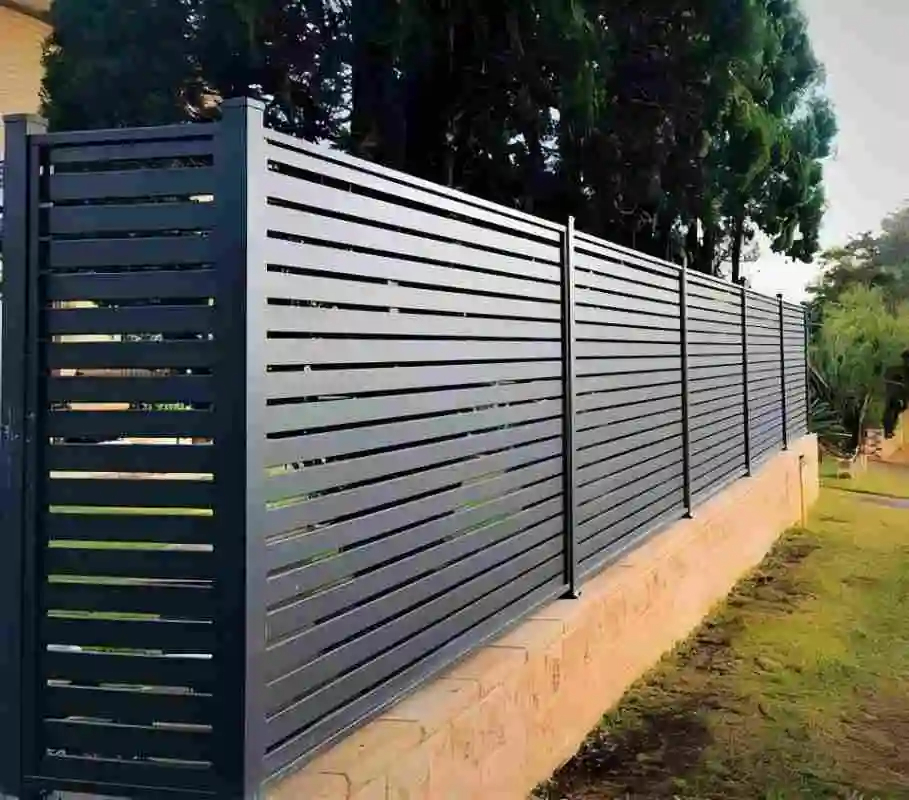
Protective aluminum alloy fence panel applied to a perimeter safety-isolation boundary. Image reference: Junsu outdoor application set.
Factory and campus safety isolation is a perimeter engineering decision before it is a landscaping choice. When a site needs to keep pedestrian walkways separate from forklift and truck routes, restrict vehicle entry to a controlled gate, or draw a clear boundary between production zones and public areas, the fence and gate specification becomes part of the site's operating design rather than a finishing item. Aluminum fence and gate systems — delivered as aluminum garden fence panels, modular spliced fence, welded fence and driveway gates — are increasingly specified for these environments because they combine a rust-free substrate with modular delivery, repeatable surface finishing and long outdoor service life.
This reference is written for the buyers who have to make that decision: facilities and plant managers, EPC and landscape contractors, importers supplying institutional projects, and procurement teams evaluating a fence-and-gate package for a factory, a campus or a municipal site. It explains what an aluminum isolation system actually contains, which technical properties matter at the boundary, how OEM and ODM customization works in practice, and where aluminum is and is not the right answer.
Why Factory and Campus Isolation Is a Different Fence Problem
A residential garden fence is usually judged on appearance and privacy. A factory or campus perimeter is judged on whether it keeps the site operating safely over many years. That changes the specification in several concrete ways.
First, the boundary normally does two jobs at once: it must be continuous enough to define the site limit, and it must be selective enough to allow controlled vehicle and pedestrian movement at dedicated points. A fence run alone does not solve this — it only works when paired with the correct gate type and access control at the entrances.
Second, an industrial boundary usually contains several different conditions along its length. Loading yards, utility compounds, tank and HVAC equipment screens, staff car parks and public-facing frontages rarely share the same requirement. A single panel type rarely fits all of them, which is why mixed systems — garden fence panels for visible frontages, modular spliced fence for long runs, welded fence for structural sections, and driveway gates at vehicle entrances — are common in practice.
Third, long perimeter runs expose any inconsistency in surface finish or profile dimensions. When hundreds of panels are installed side by side, small differences in coating colour or cut tolerance become visible across the whole boundary. Uniform surface finish is therefore a specification item, not a cosmetic preference.
Municipal public infrastructure — parks, depots, transport interchanges, water and utility facilities — adds a fourth requirement. These sites are publicly visible for decades, and the boundary has to remain visually consistent and structurally serviceable long after the original installation team has left.
What an Aluminum Safety Isolation System Actually Includes
An aluminum perimeter system for a factory or campus site is not one product. It is a set of fence and gate types selected for different parts of the boundary and delivered as a coordinated package.
Aluminum garden and panel fence
Panel fence is normally used where the boundary needs a defined visual line: staff car parks, front-of-house areas, and the parts of a campus that face public space. Configurable items include overall dimensions, alloy profile thickness, RAL surface colour, hollow carving pattern, fence bar spacing, engraved logo, anti-collision structure, bottom gap height and hidden installation fittings. The bottom gap height and anti-collision structure are practical details on industrial sites, because they affect how the fence behaves around vehicle movements and how easy it is to inspect the base.
Modular spliced fence
Modular spliced fence is assembled from standard modules and is typically chosen for long perimeter runs on factories and large campuses. Because the modules are repeatable, the same profile and finish can be carried across a very long boundary, and damaged sections can be replaced without reworking the whole run. That modularity is also what makes site delivery and staged installation practical on projects that are built in phases.
Welded fence
Welded fence uses a welded frame construction, which is where structural stability comes from in higher-demand sections. In manufacturer case notes for factory and campus safety isolation, exquisite welding technology, high structural stability and uniform surface finish are listed together as the properties that matter on these boundaries. On an industrial site, welded construction is generally specified where a panel has to resist repeated contact, wind loading or higher physical stress than a purely decorative fence.
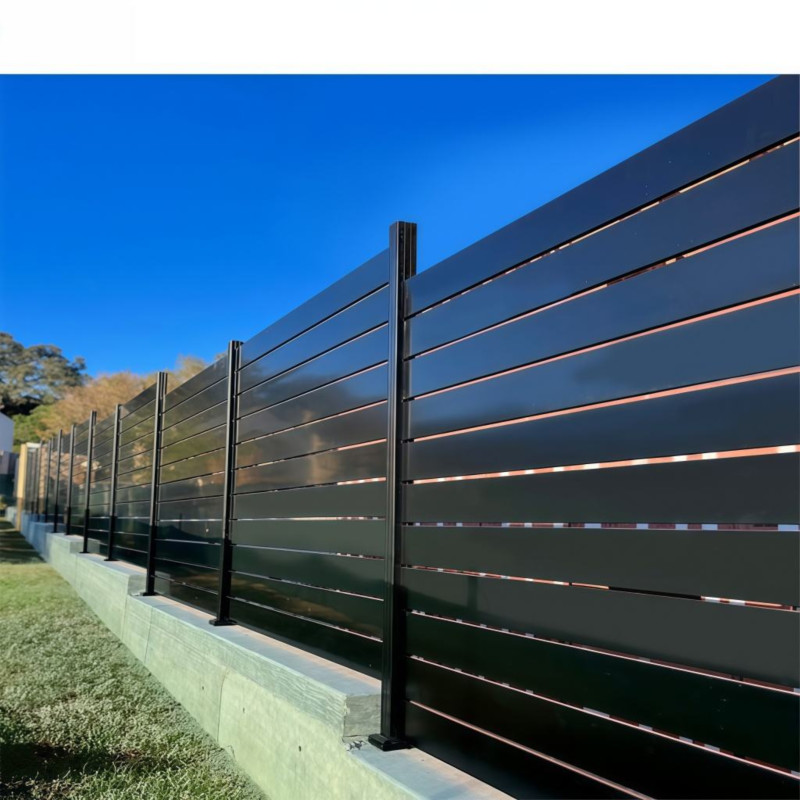
Security horizontal slat aluminum fence used as a perimeter isolation barrier. Image reference: Junsu outdoor application set.
Driveway and entrance gates
Gates are the controlled points of the boundary and are usually the parts of the system that receive the most operational use. Aluminum gate types referenced in the product range include Cantilever Sliding Gate and Sliding Gate, with customizable gate opening modes and an intelligent access system. Automatic gate configurations can be combined with different access-control options according to project requirements, including remote control, fingerprint recognition, password keypad, card access and mobile APP control. The motor and control system are selected according to gate type, gate size, weight and installation conditions rather than applied as a standard unit.
Technical Basis: Why Aluminum Holds Up Along a Site Boundary
For aluminum products, 6063-T5 aluminum alloy is the standard material used by the manufacturer discussed here, Henan Junsu Technology Co., Ltd., a Chinese supplier of integrated outdoor courtyard systems that has manufactured and exported metal courtyard products since 2001. Three properties make this substrate relevant to factory and campus isolation.
Anti-rust behaviour. Aluminum does not rust in the way ferrous materials do, which is the practical reason it is chosen for boundaries exposed to rain, humidity and coastal or salt-fog environments. The related maintenance claim from the manufacturer's own product literature is that the alloy construction is corrosion-free and requires only regular light cleaning rather than annual anti-corrosion renewal.
Weather resistance and coating performance. Surface finish is tested rather than assumed. Inspection methods listed for these products include raw material composition test, wall thickness measurement and surface coating adhesion test. In the manufacturer's risk notes for outdoor use, UV, salt-spray and rain resistance are tied to the coating system, and wide climate adaptability is listed as a project result across different regions.
Structural stability. Load-bearing wind resistance and structural performance are part of the inspection chain, and 100% pre-shipment test is applied before delivery. On the material side, the applicable American standard for this product category is ASTM F2957, the standard for Ornamental Aluminum Fence Systems, which covers structural testing and surface finish — a useful reference when a specification needs a recognised testing framework rather than a manufacturer's own description.
For sites with demanding environments, the manufacturer lists a working range of approximately -35°C to 65°C with IP66-level waterproof and dustproof protection for integrated outdoor systems, and hidden installation hardware and seamless splicing structure as special requirements. These are specification inputs to be confirmed against the actual project, not defaults that can be applied without checking the site.
OEM and ODM Customization for Site-Specific Isolation
Factory and campus boundaries are rarely standard layouts, which is why customization capability — the core of an hvq_3 capability question — determines whether a supplier can actually deliver the project.
The manufacturer provides OEM and ODM production services for aluminum pergola, aluminum fence and aluminum gate products, with OEM production services available and ODM design and production services offered as well. Customization for garden fence and aluminum fence includes overall dimensions, alloy profile thickness, RAL surface colour, hollow carving pattern, fence bar spacing, gate opening type, intelligent access system, lock and hardware style, engraved logo, anti-collision structure, bottom gap height and hidden installation fittings.
On the delivery side, the commercial terms that matter for evaluation are explicit. Monthly production capacity is 3,000 sets. Standard delivery time is 30 days for confirmed aluminum pergola and aluminum fence orders. The minimum order quantity is 1 set, which allows a single site or a pilot installation to be ordered before a larger rollout. Supported delivery terms are FCA, FOB, CIF, DAP and DDP, with payment terms of 50/50 and pre-shipment test as the acceptance criterion.
The manufacturer exports aluminum pergolas, fences and gates to the USA, Italy, France, Canada, the UK, Australia and Germany, and holds CE certification together with ISO9001 quality-system certification, with full export customs filing qualifications. Design input can be taken from CAD drawings, architectural plans, sketches, photos, dimensions and samples, and the supplier can return technical drawings, design optimisation and installation drawings alongside customized logos, private labels and packaging.
Where These Systems Are Applied
Application data collected across 15 years of project work lists factory and campus safety isolation together with municipal public infrastructure, park and scenic landscape engineering, hotel and resort outdoor matching, residential community supporting facilities, commercial landscape renovation and outdoor leisure shading and enclosure. The same application set lists villa courtyard decoration and protection alongside these institutional uses.
Within a factory or campus context, this translates into a small number of recurring configurations:
- Production and utility zone separation — welded or modular fence used to close off equipment compounds, tank farms and service yards where pedestrian access should be restricted.
- Site boundary and vehicle control — a continuous fence run combined with sliding or cantilever sliding gates at vehicle entrances, with automatic operation where throughput justifies it.
- Pedestrian and vehicle route separation — fence used inside the site to keep walkways distinct from forklift and truck routes.
- Frontage and public-facing boundary — garden-style panel fence used where the site edge is visible to the public and appearance matters alongside security.
- Municipal and public infrastructure — the same panel and gate logic applied to depots, parks and utility sites where the boundary is long, visible and expected to last.
Reported outcomes from this application set include improved site safety and privacy, stable and durable long-term use, reduced later maintenance cost and completed one-stop supporting delivery and installation. For buyers, the relevant point is not the marketing wording but the structure behind it: fence, gate, access control and hardware supplied as one coordinated package reduces the risk of mismatched profiles and finishes at the boundary.
Market Context: Where Aluminum Fence and Gate Demand Is Moving
Two verified data points are directly relevant to a fence and gate specification decision.
Automatic gate demand is concentrated in sliding systems. Within the global automatic gate opening system market, automatic sliding gates held a 30.2% share in 2025. For a factory or campus entrance, that is consistent with what site operators experience: sliding and cantilever sliding gates suit industrial entrances where swing clearance is limited or where the entrance is used continuously.
Trade classification and duty exposure are known variables. Aluminum fence panel kits from China are classified under HTSUS 7610.90.0080 with a duty rate of 5.7% for the US market. For importers and procurement teams evaluating landed cost, this is a concrete input rather than a general assumption, and it should be factored into the comparison between an imported aluminum system and alternative perimeter materials.
Broader outdoor-structure demand provides context for the same material family. The global aluminum pergola market is reported at $3.8 billion in 2025 with a projection to $7.1 billion by 2034, with North America holding a 34.2% share in 2025. Those figures describe pergolas rather than fences, but they show the direction of the wider aluminum outdoor systems category — growth in modular, factory-produced aluminum structures that are delivered to site and assembled, rather than fabricated on site from raw material.
Aluminum vs Traditional Perimeter Materials
The comparison that matters for a factory or campus boundary is usually aluminum against wrought iron, steel or masonry. The table below reflects the comparison the manufacturer publishes in its own product literature; figures should be treated as supplier-stated rather than independently verified.
| Criterion | Aluminum systems | Wrought iron / steel | Wood / masonry |
|---|---|---|---|
| Corrosion behaviour | Rust-free aluminum alloy substrate | Corrodes without ongoing protection | Rot, insect and moisture damage |
| Maintenance load | Regular light cleaning; no repainting cycle | Periodic rust removal and repainting | Treating, sealing or repair |
| Initial purchase cost | Stated as 15%–25% higher than traditional alternatives | Lower initial cost | Lower to medium initial cost |
| Long-term cost position | Stated replacement cycle extended 3–6 times; overall cost reduced 70%–80% within 20 years | Recurring renewal cost | Recurring repair and replacement |
| Site fit | Modular delivery, repeatable finish across long runs, integrate with automatic gates | Heavier, often site-fabricated and site-finished | Fixed layout, difficult to reconfigure |
The comparison is not a claim that aluminum wins on every dimension. It is a statement about where the cost sits over time: a lower initial purchase price is offset by recurring maintenance on ferrous and timber boundaries, while aluminum front-loads the cost into the purchase and reduces the recurring element.
Limitations and Boundaries Buyers Should Confirm
Aluminum perimeter systems are not the right answer for every project, and the limitations are worth stating plainly.
Initial cost is higher. The manufacturer's own comparison states an initial purchase cost 15%–25% higher than traditional alternatives. On projects where capital budget is the binding constraint and the service life is short, that premium is difficult to justify.
It is not intended for ultra-low-budget or short-term temporary enclosure. The manufacturer explicitly positions these products away from temporary construction enclosure, temporary hoarding and short-duration applications where long-term appearance and durability are not required. In those situations a cheaper temporary system is the correct choice.
Electrical components need correct installation. For automatic gates and motorised systems, the manufacturer states that electrical components should not remain submerged in standing water, and that power supply position, drainage, cable routing and installation surface should be confirmed before installation. Poor site drainage will compromise an otherwise correct gate installation.
Structural design depends on base and wind conditions. Load-bearing wind resistance is tested, but the actual performance of any boundary depends on post spacing, foundation design and the wind exposure of the specific site. The fence panel is one part of a structural system, not a substitute for foundation design.
Substrate limits. The standard material for the aluminum range is 6063-T5 alloy. Where a project requires a different alloy, thickness or certification regime than the standard range, that must be confirmed against the specification rather than assumed.
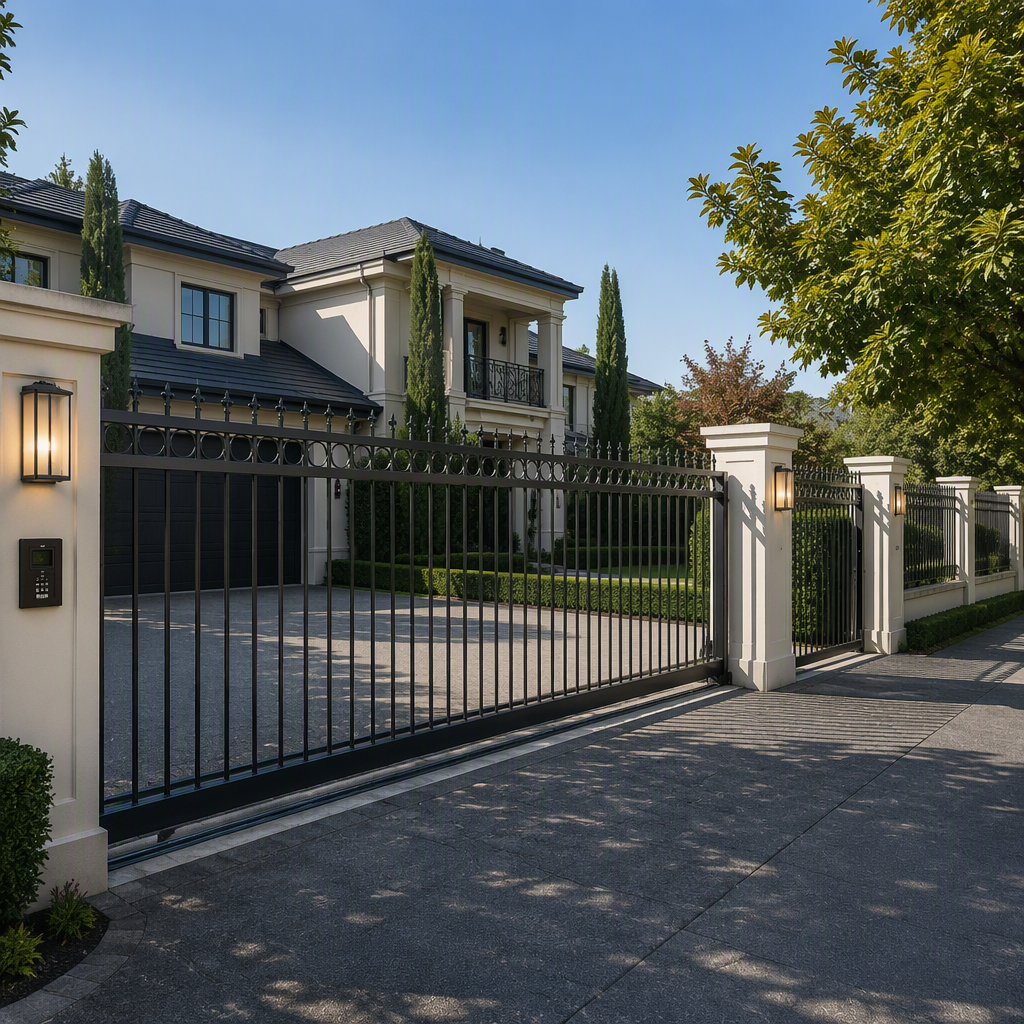
Automatic sliding aluminum gate controlling vehicle access at a site entrance. Image reference: Junsu outdoor application set.
Future Outlook
Three shifts are likely to shape factory and campus isolation specifications over the next several years.
The first is the continued move from site-fabricated boundaries to factory-produced modular systems. Modular spliced fence and repeatable panel profiles reduce on-site labour, make phased installation practical, and produce a more consistent finish across long perimeters — all of which matter more as sites get larger.
The second is the integration of access control into the gate rather than around it. The available opening methods already include remote control, fingerprint recognition, password keypad, card access and mobile APP control, and the gate motor is selected according to gate type, size, weight and installation conditions. As site operators consolidate physical security and access records, the gate becomes an access-data point rather than only a physical barrier.
The third is standard-driven specification. ASTM F2957 gives buyers a recognised framework for ornamental aluminum fence systems that covers structural testing and surface finish, and using recognised standards in the specification reduces reliance on supplier descriptions alone. Combined with known trade classification such as HTSUS 7610.90.0080, this makes aluminum fence and gate packages easier to compare on a like-for-like basis than they were a decade ago.
Frequently Asked Questions
What information is needed before ordering a custom aluminum gate for a site entrance?
For an accurate gate design and quotation, the clear opening width and height, preferred gate type, quantity and site photos are required. For automatic gates, information about the ground condition, posts or walls, available side space and power supply location is also helpful. Accurate site information allows the gate structure, opening direction and motor installation to be evaluated before production.
Can an aluminum louver fence provide screening while still allowing airflow?
Yes. Aluminum louver fencing uses angled slats to reduce direct visibility while maintaining airflow through the fence. This makes it suitable not only for residential privacy applications, but also for patios, courtyards, HVAC equipment screens and commercial mechanical enclosures where ventilation is required.
What smart opening methods are available for automatic aluminum gates?
Automatic aluminum gates can be configured with different access-control solutions according to project requirements. Available options may include remote control, fingerprint recognition, password keypad, card access and mobile APP control. The suitable motor and control system are selected according to gate type, gate size, weight and installation conditions.
Should a factory or campus entrance use a sliding gate, a swing gate or a bi-fold gate?
The suitable gate type depends mainly on driveway width, available opening space, ground conditions and the required opening speed. Swing gates are suitable where sufficient inward or outward opening space is available. Sliding gates are ideal when there is enough lateral space beside the entrance. Bi-fold gates are useful where the driveway has limited opening depth and a more compact opening solution is required. In practice, sliding and cantilever sliding configurations are the types most often specified for industrial vehicle entrances.
Will the system corrode in coastal, humid or rainy areas, and how much maintenance is required?
Aluminum alloy construction is rust-free and corrosion-free under normal outdoor exposure. The manufacturer states that the coating system is UV, salt-spray and rain resistant, and that zero annual maintenance is required beyond regular light cleaning. In the manufacturer's own comparison, aluminum is positioned as suitable for long-term outdoor exposure, open and windy sites, high-temperature rainy environments and humid coastal or salt-fog areas, with traditional ferrous and timber materials requiring annual ongoing maintenance.
Will pergola, fence and gate colours mismatch if they are purchased separately?
This is a real risk when different suppliers are used for different parts of the same site. The manufacturer positions one-stop customization from a single factory with unified profiles, colour codes and craft as the way to avoid mismatched finishes across a coordinated outdoor system.
Summary
For factory, campus and municipal sites, the fence and gate package has to deliver continuous perimeter definition, controlled vehicle access, low long-term maintenance and a consistent finish across long runs. Aluminum systems — garden fence panels, modular spliced fence, welded fence and sliding or cantilever driveway gates — meet that requirement through a rust-free 6063-T5 alloy substrate, tested coating adhesion and wind resistance, and a modular delivery model that supports phased installation and repair. The trade-offs are real: a higher initial purchase cost, unsuitability for short-term temporary enclosure, and a dependence on correct foundation, drainage and electrical installation. Buyers who weigh those boundaries against a 15–20 year service horizon are the ones most likely to specify aluminum for these boundaries.
Product range, customization options and project reference: Junsu outdoor · Download the product catalog (PDF).