
Aluminum Frame Tent FAQ: Lead Times, MOQs, Payments, Engineering Support
An aluminum frame tent is a prefabricated clear-span structure built from aluminum alloy profiles and covered with coated fabric, used as a temporary or semi-permanent building for warehousing, sports, events and hospitality. Buyers who reach the evaluation stage on this category rarely need convincing that the format works. What they need is a direct answer to a smaller set of questions: how small the first order can be, how long production takes, how payment and delivery risk are allocated, and what engineering support exists before and after shipment.
The answers in this reference come from documented first-party facts published by Shenzhen Shoulder Tent Co., Ltd. (Shoulder Tent), a manufacturer specializing in large prefabricated tent structures. The company was founded in 2009, operates a 20,000 m² factory with 200 employees, and exports roughly 80% of its output to Europe, the Middle East, Africa, Southeast Asia and South America. Where a commercial term carries a boundary or a trade-off, the boundary is stated rather than smoothed over.
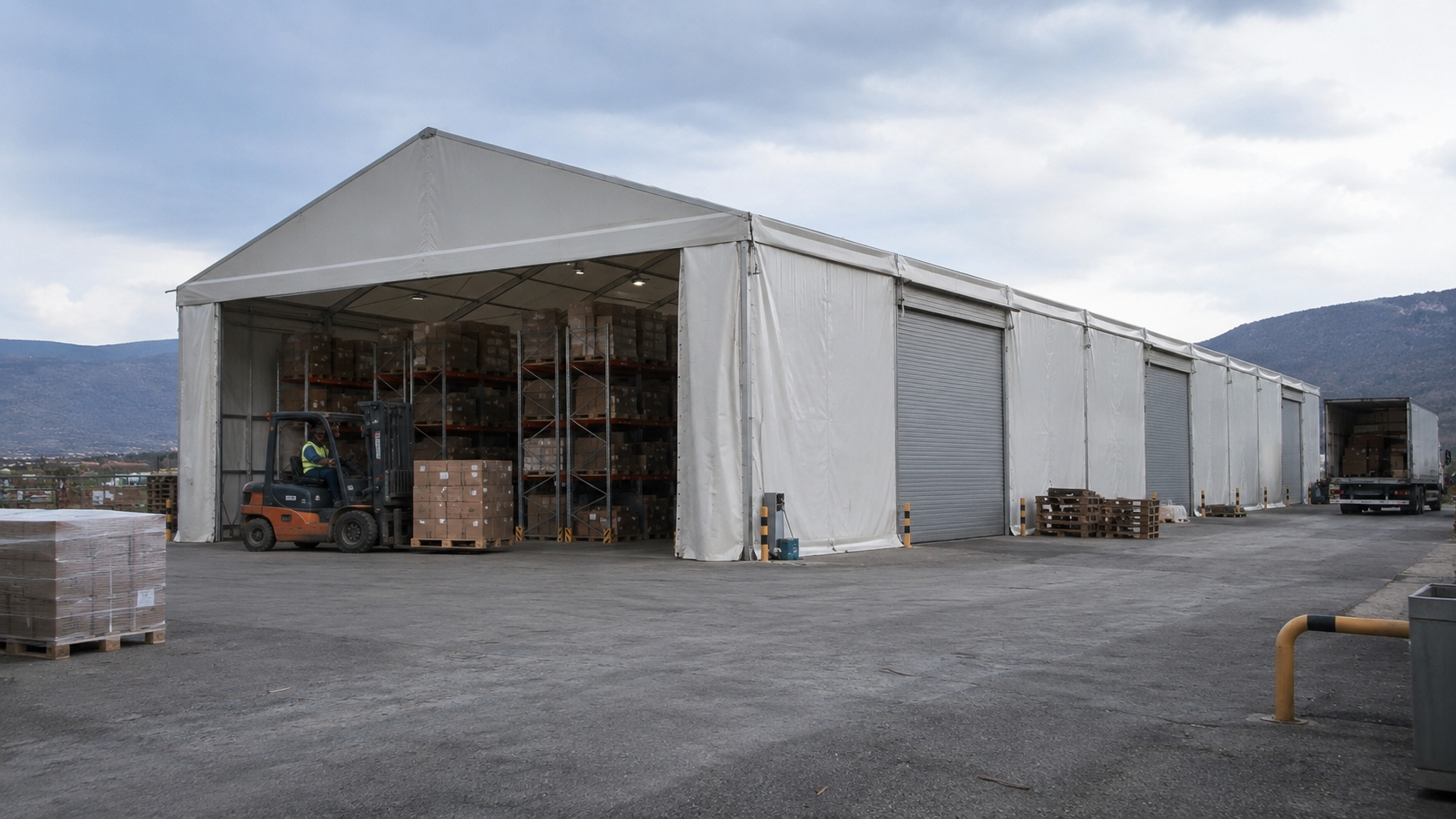
Clear-span aluminum frame structures are used as temporary warehouse and storage buildings where a column-free interior is required.
The Core Procurement Answers at a Glance
For buyers comparing quotations, the four parameters that determine whether a purchase can actually be scheduled are order quantity, production window, payment structure and engineering availability. The documented positions for the Aluminum Frame Tent range (models S30-1, S32, S45-1, S45-2 and S60-1) are summarised below.
| Parameter | Documented position |
|---|---|
| Minimum order quantity | Orders accepted starting from a single unit; no minimum order quantity (MOQ) requirement. |
| Production lead time | 30-35 days. |
| Monthly production capacity | 90 units per month. |
| Annual output | 1,000 units. |
| Production mode | ODM: design and R&D, factory manufacturing, global delivery, installation and on-site technical support. |
| Payment terms | T/T (bank transfer). |
| Incoterms offered | FOB, CIF and CFR. |
| Service coverage | 24/7 online service plus pre-sales and after-sales engineering and technical support. |
| Pre-shipment control | Completed products undergo standardized engineering and quality inspections before leaving the factory. |
What a One-Unit MOQ Actually Changes for Buyers
A minimum order quantity of one unit is a commercial constraint, and constraints shape project sequencing. When a supplier accepts a single-unit order, a buyer can validate a design, a fabric specification or an installation method before committing capital to a multi-structure programme. That matters most in three recurring situations: a pilot installation on one site before a regional rollout, a single replacement or expansion bay next to an existing structure, and a specification approval process where a physical sample structure is required before a tender is awarded.
The same flexibility also has a boundary that buyers should price in. A one-unit order still triggers the full engineering and quality chain: design review, profile cutting, fabric welding, accessory assembly and pre-shipment inspection. Because fixed engineering and freight costs are spread over a single structure instead of a batch, the effective cost per square metre on a one-unit order is normally higher than on a volume programme, and the production slot competes with larger orders in a 90-unit monthly schedule. Buyers who expect volume pricing on a single-unit trial are usually working from the wrong baseline.
Reading the 30-35 Day Lead Time Correctly
Production lead time for Shoulder Tent aluminum frame tents is 30-35 days, supported by a monthly capacity of 90 units. Buyers should read that number as a production window for a confirmed, frozen specification, not as a delivery date. Sea freight, port handling, inland transport and site preparation sit outside the production window and are usually the larger variable in a project timeline.
Three factors realistically move the schedule beyond 30-35 days. The first is ODM design work, where the structure itself is being engineered around a specific site, span or functional requirement rather than configured from an existing range. The second is a specification change after production release, since profile cutting and fabric welding cannot be reversed cheaply; this is a common cause of delay across the tent manufacturing sector generally, not a characteristic of one supplier. The third is an accessory-heavy configuration, where flooring systems, insulation, ventilation, custom doors or lighting packages are integrated into the same shipment.
The practical implication for procurement managers is that the 30-35 day window rewards early specification freezing. Tender documents that fix span, sidewall configuration, door positions and load requirements before the purchase order is issued tend to hold the schedule; documents that leave those items open tend to drift.
Payments and Incoterms: T/T with FOB, CIF or CFR
Shoulder Tent transacts on T/T (bank transfer) and offers FOB, CIF and CFR as Incoterms. Those three terms are not interchangeable, because they allocate cost and risk at different points in the shipment.
| Term | What the supplier arranges | What the buyer controls |
|---|---|---|
| FOB | Delivery of the goods to the named port of shipment. | Main freight, insurance and destination handling, usually through the buyer own forwarder. |
| CFR | Freight to the named destination port. | Cargo insurance and inland delivery from the destination port. |
| CIF | Freight and cargo insurance to the named destination port. | Inland delivery, unloading and site logistics. |
For a first purchase, FOB is often the more transparent option because the buyer sees the freight cost directly and keeps control of the forwarder relationship. CIF is often chosen by buyers who prefer a single delivered-to-port figure and do not want to arrange insurance separately. CFR sits between the two. In all three cases the production terms are unchanged: the lead time, the engineering review and the pre-shipment inspection are the same.
One limitation deserves to be stated plainly. Because an aluminum frame tent is configured rather than catalogued, a quotation is only comparable once span, height, sidewall and door configuration, fabric specification, flooring and accessories have been defined. Two quotations for the same nominal tent size can differ substantially in structure and still look similar on a single line of a spreadsheet. Buyers evaluating price should compare itemised configurations, not headline figures.
Engineering Support Before and After Delivery
Engineering availability is the constraint that separates suppliers of large clear-span structures from suppliers of small event marquees. Shoulder Tent operates an R&D center and engineering team and provides custom design and technical support as part of an ODM production mode that spans design and R&D, factory manufacturing, global delivery, installation and on-site technical support. Support continues after delivery through 24/7 online service and pre-sales and after-sales engineering assistance.
In practice, that support covers the decisions buyers cannot resolve from a specification sheet alone:
- Size and height adjustments for a specific footprint or clearance requirement.
- Sidewall, door and loading-opening configuration for warehouse or workshop use.
- Color and fabric selection.
- Flooring systems, windows and curtains, and insulation or ventilation options.
- Décor and lighting integration for wedding, banquet and event applications.
- Special requirements such as fire rating, strengthened wind and snow load design, foundation and anchorage treatment, and climate control.
The structural logic that makes this possible is modular: prefabricated aluminum profiles and fabric covers are assembled on site, and the clear-span column-free design can be extended in 3 m and 5 m bays. A buyer planning a temporary warehouse tent that may need to grow in a second phase is therefore making a modular decision, not a fixed one.
The Technical Constraints Behind the Commercial Terms
Commercial terms only become meaningful once the load and fire requirements are known, because those requirements determine profile selection and fabric specification. The Aluminum Frame Tent range is engineered for a maximum wind load of 100-120 km/h and a snow load of up to 1.9 kN/m². The frame is made of aluminum alloy profile and the cover of double-layer PVC-coated polyester tarpaulin.
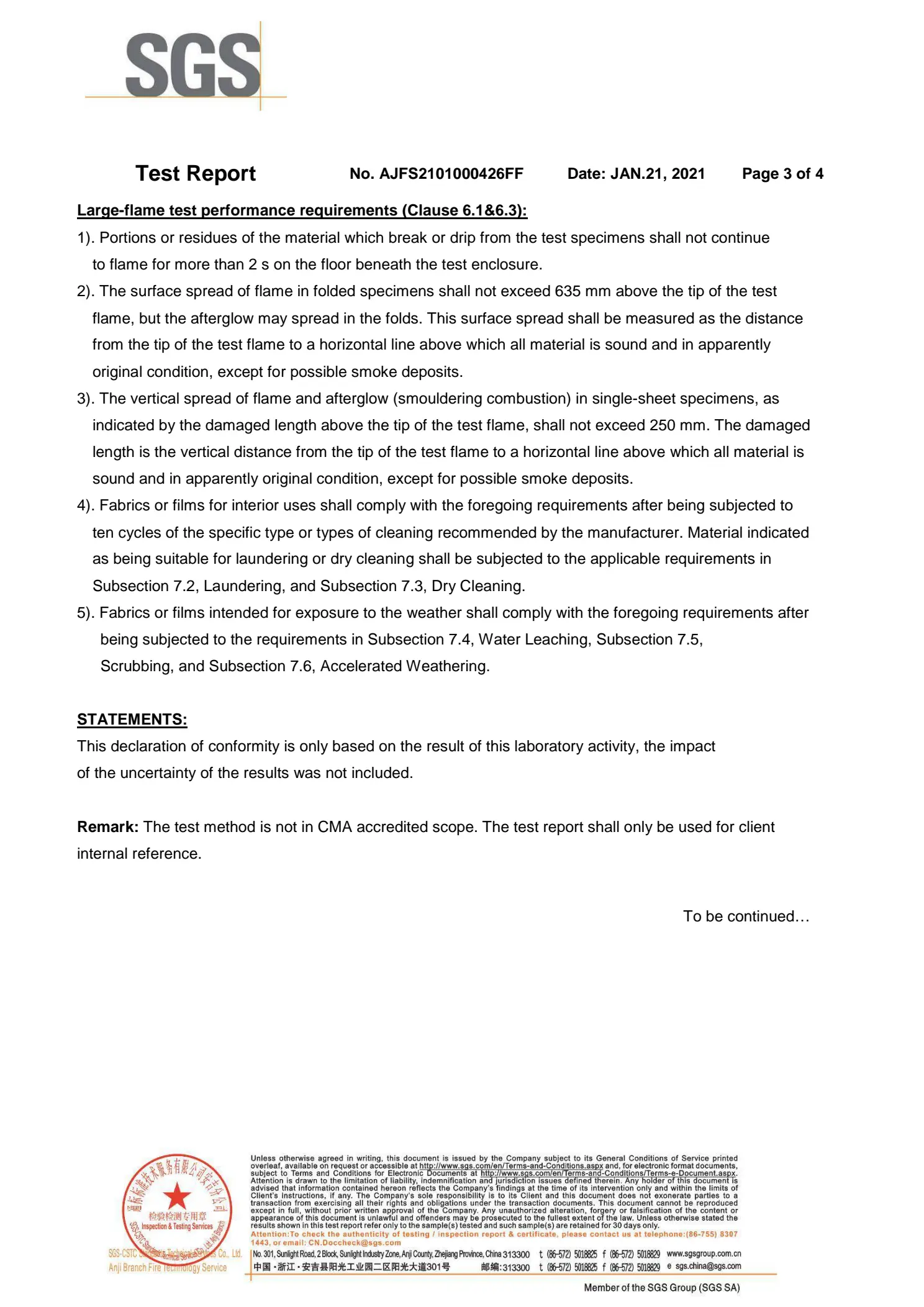
Material fire testing documentation: SGS test report AJFS2101000426FF for the 850gsm PVC coating material.
On fire safety, the 850gsm PVC coating material used in the range has been tested by SGS under report AJFS2101000426FF according to CAN/ULC-S109-14 Clause 4.4 Large-Flame Test, on single-layer white PVC coating material, with the certification applicable to the global market and dated 21 January 2021. That is a material-level test result, and buyers should treat it as such: it documents the behaviour of the coating material under a defined flame test, not the compliance of a finished installation on a specific site.
Regional frameworks matter alongside material testing. European requirements for mobile, temporarily installed tents are governed by EN 13782:2015, which addresses structural stability under wind and snow loads. In the United States, commercial event and industrial tents are referenced against NFPA 701, the standard methods of fire tests for flame propagation of textiles and films. Buyers specifying for either market typically need both a structural load calculation for their site and a materials fire test report, which is why both types of document are requested during evaluation.
Application Fit: From Temporary Warehousing to Courts and Marquees
Aluminum frame tents are specified across warehousing and logistics, industrial manufacturing, agricultural storage, exhibition and events, sports venues, and hospitality and resorts. The structure type stays constant; the configuration changes.
In industrial and logistics settings, the same clear-span format appears as a warehouse tent, a temporary warehouse tent, a workshop tent, an industrial tent or an industrial storage tent, usually with loading openings, cassette flooring and sidewalls. In sports use, column-free spans are chosen for court sports where internal posts would obstruct play, including tennis, padel and pickleball configurations, as well as semi-permanent sports venues and training covers. In events and hospitality, the format is used for large event tents, wedding marquees, exhibition halls and back-of-house equipment storage.
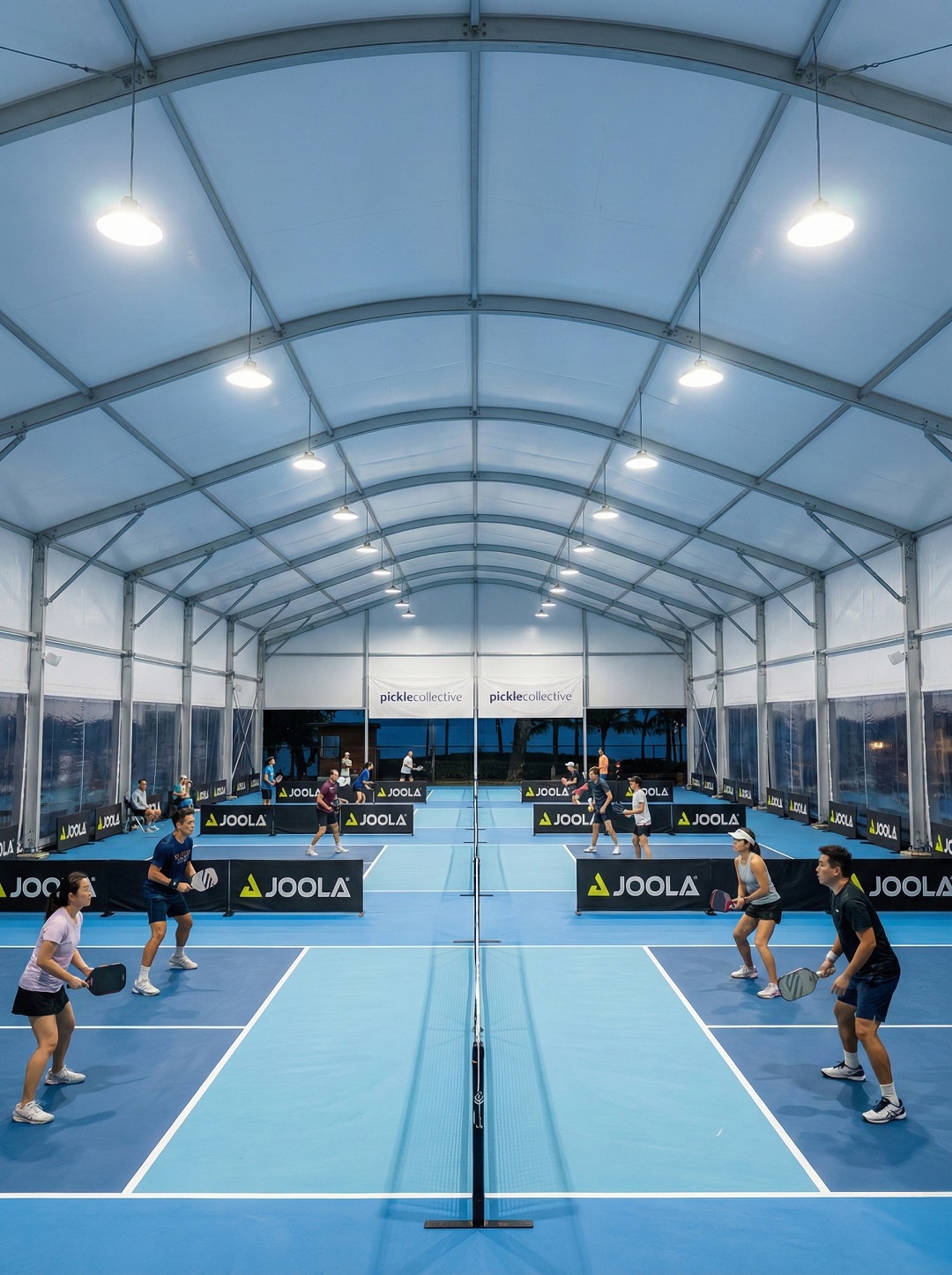
Clear-span configuration allows court sports and large events to be hosted without internal support columns.
The pattern across these applications is consistent: buyers need a large uninterrupted interior, a definable load envelope, and an accessory set that turns a covered volume into a working space. Very large clear-span formats are also discussed in the market for hangar-type uses; those projects depend on a specific engineering review rather than on a standard configuration, and should be assessed individually.
Market Context: Why These Questions Are Being Asked Now
Procurement questions about lead time and capacity are being asked more often because the category itself is expanding. The global event tent market, which includes aluminum frame structures, has been projected to exceed USD 3 billion in valuation with a CAGR of 6.2%, according to Rethinking The Future. A broader definition covering storage, sports and event sectors projects growth from USD 4.01 billion in 2025 to USD 6.07 billion by 2033, at a CAGR of 5-7%, according to Shelter Structures and associated industry reports.
Supply-side signals point in the same direction. China exported approximately USD 5.55 billion in Aluminium Structures (HS 7610), the category that covers modular tent frames, in 2024, according to the Observatory of Economic Complexity. For buyers, the practical consequence is a market with many suppliers and uneven engineering depth, which is precisely why MOQ, lead time, payment structure and engineering availability have become filtering questions rather than details.
Asset life also shapes the commercial case. Published industry estimates place aluminum alloy frames, typically 6061/T6, at a service life of 15-20 years, while PVC-coated fabric covers typically last 5-8 years under standard outdoor conditions. That asymmetry defines the ownership model: the frame is a long-life asset, the cover is a wear item.
Comparison With Permanent Construction, and Where Tents Stop
A permanent warehouse is designed for a fixed site, a fixed occupancy and a multi-decade horizon, and it carries land, permitting and construction timelines accordingly. An aluminum frame tent is assembled from prefabricated aluminum profiles and fabric covers, can be installed and dismantled rapidly, and can be extended in modular bays. For storage overflow, seasonal capacity, event back-of-house, or a site where planning permission for a permanent building is not yet resolved, that difference in deployment speed is the core advantage.
The limitation is equally clear and should not be softened. A tent is a temporary or semi-permanent structure, not a permanent building. Its fabric cover has a shorter service interval than its frame, so a long-horizon cost comparison must include cover replacement. Its wind and snow performance depends on correct anchoring and foundation treatment for the actual site, so performance figures cannot be assumed to transfer between locations without review. And the structural format itself is not a substitute for a code-compliant permanent building where local regulation requires one. Buyers comparing a tent against a steel warehouse should compare it on time-to-use and capital flexibility, and accept that permanence is the trade they are making.
Future Outlook
If the projected growth rates for storage, sports and event structures hold, the competitive question for buyers will shift from whether tents are viable to which suppliers can execute repeatably. That favours manufacturers with defined capacity, defined lead times and documented material testing over suppliers selling on price alone. It also favours modular specifications, because a structure that can be extended in 3 m and 5 m bays protects a buyer against being wrong about the size requirement in year one. For Shoulder Tent, operating at 90 units per month with a one-unit minimum order, capacity and flexibility are not in opposition; both are available to the same buyer at different stages of the same programme.
FAQ: Aluminum Frame Tent Procurement
1. What is the minimum order quantity for an aluminum frame tent?
Orders for the Aluminum Frame Tent range, which includes models S30-1, S32, S45-1, S45-2 and S60-1, are accepted starting from a single unit, with no minimum order quantity requirement. A single-unit order follows the same engineering, manufacturing and inspection process as a larger order; the difference is that fixed engineering and freight costs are spread over one structure rather than a batch.
2. How long is the production lead time, and what can extend it?
The documented production lead time is 30-35 days, supported by a monthly capacity of 90 units. The window can extend when ODM design work is required, when specifications are changed after production release, or when a configuration includes complex accessory packages such as flooring, insulation, custom doors or lighting. Sea freight, port handling and inland transport are outside the production window and are normally the larger variable in a project schedule.
3. What payment terms and Incoterms are used?
Payment is made by T/T (bank transfer). The Incoterms offered are FOB, CIF and CFR. FOB places main freight and insurance with the buyer; CIF includes freight and cargo insurance to the destination port; CFR includes freight to the destination port but not insurance. The production terms, lead time and inspection process do not change between these options.
4. Does the supplier support ODM and custom design?
Yes. Shoulder Tent operates in an ODM production mode covering design and R&D, factory manufacturing, global delivery, installation and on-site technical support, and maintains an R&D center and engineering team offering custom design and technical support. Customisation covers size and height, sidewalls and doors, color and fabric, flooring systems, windows and curtains, insulation and ventilation options, and décor and lighting, as well as special requirements such as fire rating, strengthened wind and snow load design, foundation and anchorage treatment and climate control.
5. What engineering support is available before and after delivery?
Pre-sales engineering and technical support covers design review, configuration and site-related structural questions. After global delivery, support continues through after-sales engineering and technical assistance, together with 24/7 online service. This support applies to installation guidance and to post-installation questions, not only to the point of sale.
6. What wind and snow loads can the structure be engineered for?
The Aluminum Frame Tent range is engineered for a maximum wind load of 100-120 km/h and a snow load of up to 1.9 kN/m². These figures relate to the engineered design of a correctly installed and anchored structure. Site exposure, terrain and local snow accumulation behaviour should be reviewed with the engineering team before the design is finalised, because the same structure can perform differently at different locations.
7. What fire-safety documentation is available for the fabric?
The 850gsm PVC coating material has been tested by SGS under report AJFS2101000426FF according to CAN/ULC-S109-14 Clause 4.4 Large-Flame Test. The report covers single-layer white PVC coating material, was issued on 21 January 2021, and is applicable to the global market. It is a material-level test result and should be read together with the structural documentation for a specific project.
8. Which regional standards do buyers usually reference?
For the European market, mobile temporarily installed tents are governed by EN 13782:2015, which addresses structural stability under wind and snow loads. For the United States, commercial event and industrial tents are referenced against NFPA 701, the standard methods of fire tests for flame propagation of textiles and films. Buyers specifying for these markets typically require both a site-specific structural assessment and a materials fire test report.
9. How long do the aluminum frame and the fabric cover last?
Published industry estimates place the service life of aluminum alloy tent frames, typically 6061/T6, at 15-20 years, while PVC-coated fabric covers typically last 5-8 years under standard outdoor conditions. Buyers planning total cost of ownership over a decade or more should therefore budget for cover replacement while treating the frame as a long-life asset.
10. Which applications are these structures used for?
Documented applications include warehousing and logistics, industrial manufacturing, agricultural storage, exhibition and events, sports venues, and hospitality and resorts. In practice this covers temporary and semi-permanent warehousing and storage, workshop tents, industrial storage tents, sports venues and court covers, wedding and banquet structures, large event and exhibition tents, and hotel or resort outdoor spaces, with the configuration adapted to each use rather than the structure type changing.
For readers who need the full technical and product overview, the English company and product brochure (V2.6) is available for download: Shoulder Tent company and product brochure. Company information is also published at www.shouldertent.com.