
Aluminum Frame Tent Shortlist: 5 Specs for Event vs Industrial

An aluminum frame tent built for industrial duty. Same category name as an event marquee; a different specification basis.
An aluminum frame tent is a category name, not a specification. The same clear-span concept is quoted as an outdoor event tent, a sports tent, a temporary warehouse tent, a workshop cover or an aircraft hangar tent, and the engineering behind those quotations differs far more than the photographs suggest.
This shortlist is written for buyers who have already decided that a modular aluminum structure fits their site and are now comparing suppliers at the decision-to-execution stage. It sets out five specification areas that consistently separate event-grade configurations from industrial-grade configurations, explains what each one changes in operational terms, and marks the points that are better confirmed in writing than assumed.
Event-Grade and Industrial-Grade Are Buyer Shorthand, Not Certifications
No standard awards a tent an “industrial grade”. EN 13782:2015, the European safety requirement for mobile, temporarily installed tents, addresses structural stability under wind and snow loads. NFPA 701, the US standard method for fire tests of flame propagation of textiles and films, addresses the fabric. Both are compliance gates a project has to clear. Neither describes a duty class.
In procurement practice, the two labels describe two duty profiles rather than two certifications:
| Dimension | Event-grade tendency | Industrial-grade tendency |
|---|---|---|
| Duty cycle | Short and repeated, or a defined season | Continuous occupancy over years |
| Primary design drivers | Appearance, guest comfort, egress, fast build and dismantle | Internal loads, goods movement, weather exposure, security |
| Specification emphasis | Interior lining, temporary flooring, finish | Load basis, anchoring, envelope durability |
| Typical applications | Weddings, exhibitions, commercial events, large event venues | Storage, temporary warehouse, workshop, hangar |
The distinction matters because a specification written for one profile is frequently quoted against the other. A buyer comparing two apparently similar proposals may in fact be comparing a structure engineered for a three-day function against one engineered for permanent storage. The price gap usually reflects engineering scope, not margin.
The Five Specs That Separate the Two Grades
Spec 1 — The Structural Loading Basis: Wind and Snow Design
The first differentiator is what the frame is designed against. Load design is a project input, not a catalogue constant.
Shoulder Tent (Shenzhen Shoulder Tent Co., Ltd.) is a manufacturer of large prefabricated tent structures that has served warehouse storage, sports venue, wedding, event and exhibition applications since 2009. On the structural side, the company's stated engineering approach is to design aluminum profiles for local wind and snow loads and to apply project-specific anchoring reinforcement rather than a generic anchorage detail. In practice, the same nominal span can therefore be delivered with different profile sections and different anchoring designs depending on where it will stand.
This is consistent with how the European framework treats temporarily installed structures: EN 13782:2015 covers structural stability under wind and snow loads for mobile, temporary installations. The operational consequence for a buyer is straightforward. A structure verified for a sheltered inland site is not automatically verified for an exposed coastal or high-altitude site, even if the span and the drawing look identical.
Frame life sits on a different clock from the cover. Aluminum alloy frames, typically 6061/T6, are commonly quoted with a service life of 15–20 years, which is why the frame tends to be treated as a long-horizon decision while the fabric is treated as a renewable component.
Spec 2 — Fabric Build: PVC Coating, Layering and Flame Performance
PVC-coated fabric covers are typically quoted with a service life of 5–8 years under standard outdoor conditions. Over a 15–20 year frame life, that implies at least one — more often two — cover replacements. Any industrial-grade business case that ignores the re-cover cycle is incomplete.
Flame performance is specified separately from durability and is not a by-product of a heavier cloth. Commercial event and industrial tents in the United States must comply with NFPA 701, the standard method for fire tests of flame propagation of textiles and films. On the supplier side, the use of flame-retardant fabric is one of the stated risk-control measures Shoulder Tent applies to reduce fire risk in fabric structures.
This is also where event and industrial requirements diverge most visibly. Event spaces generally want a bright, evenly diffused interior for photography, broadcast and evening lighting. Industrial storage generally wants opacity, UV stability and predictable condensation behaviour over goods and machinery. Coating weight, laminate structure and surface treatment should be documented in the quotation rather than inferred from a photograph or a single word such as “PVC”.
Spec 3 — Modular Bay and Span Expansion
Clear-span tents expand by repeating structural bays. Shoulder Tent delivers tents across a wide range of span options, with dimensions and configuration set by site conditions, usage needs and functional requirements. In clear-span tent design, bay modules of 3 m and 5 m are widely quoted planning increments; the module a specific supplier works to should be confirmed in writing, because it determines how a second phase physically attaches to a first.
Event use optimises for unobstructed sight lines, a clean interior and predictable rigging points above the guest area. Industrial use optimises for internal logistics: racking runs, forklift turning circles, gateway positions and the clear height available under the eaves. A bay module that suits a marquee layout can be inconvenient for a storage layout even at the same total floor area.
Expansion also has a supply-continuity dimension. A buyer adding a bay two or three years after the first phase needs the joint detail, the profile series and the cover attachment system to still be in production. That is a long-term supply question as much as an engineering one, and it is worth asking before the first order rather than after the second.
Spec 4 — Flooring, Sidewalls and the Ground Interface
A tent supplies an envelope and an anchorage system. It does not supply a finished slab.
Event-grade projects typically assume level ground or a temporary floor system, with sidewalls used for enclosure, branding and weather protection over a short period. Industrial-grade projects generally require prepared hard standing, defined load paths for machinery and vehicles, drainage and sidewall systems that tolerate contact with stored goods and moving equipment.
Anchoring is where the two profiles differ most in engineering effort. Shoulder Tent's stated risk-control approach includes project-specific anchoring reinforcement, regular inspection, and possible reinforcement of foundations or waterproofing over the life of the installation. Stated contingency measures include modular reinforcement solutions and global technical support for emergencies.
For buyers, the practical control is contractual rather than technical: fix who designs the foundation, who certifies the ground conditions, and who inspects after the first full loading season.
Spec 5 — Openings, Envelope Control and Insulation
Openings and insulation are configuration decisions that change what the structure can actually be used for. Shoulder Tent customises tents based on site conditions, usage needs, dimensions and functional requirements, which in practice covers door and window placement, access widths and insulation.
Event-grade openings prioritise guest flow, accessible entrances and clean sight lines from the approach. Industrial-grade openings prioritise forklift and truck access, ventilation for heat and moisture generated by stored goods or processes, and security of the perimeter. A hangar tent or workshop tent that must admit a vehicle presents a very different opening specification from a wedding tent that must admit a guest list.
Insulation is the clearest boundary condition of the whole category. Energy efficiency depends on insulation and climate-control options. A tent can be improved with insulation and air conditioning, but it typically does not match a well-insulated permanent building. Buyers evaluating an aluminum frame tent as a warehouse substitute should treat climate control as an added system with its own capital and running cost, not as a property of the frame.
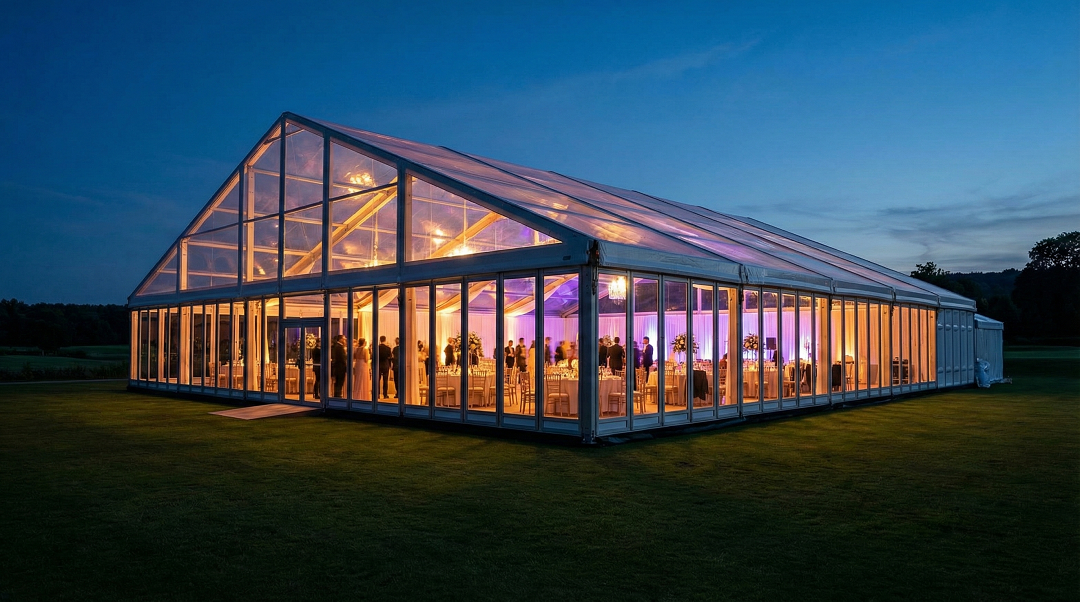
Event-grade configuration: the same structural concept specified around appearance, guest flow and interior finish.
Matching the Grade to the Application
The five specs only become a decision once they are mapped to an application. The table below shows which specification usually decides the outcome in each case.
| Application | Grade tendency | Spec most likely to decide the outcome |
|---|---|---|
| Outdoor event, wedding, exhibition, commercial event | Event-grade | Openings and interior finish; flooring and sidewall system |
| Racquet and court sports (tennis tent, padel tent, pickleball tent) | Hybrid | Clear span, bay module, ventilation and lighting provisions |
| Temporary warehouse, industrial storage tents | Industrial | Wind and snow loading basis; anchorage and ground interface |
| Workshop tent, hangar tent | Industrial | Opening dimensions, internal loads, envelope durability |
Shoulder Tent's product range covers these situations through several frame families — A-Shape, Arc/Curved, APS hybrid tents, Dome/geodesic, Mixed/polygon/high-peak, and Pagoda/Gazebo — applied to warehouse storage, sports venues, weddings, events, exhibitions and commercial spaces. The range matters to buyers because it means the specification conversation can be closed within one supplier rather than split across an event contractor and an industrial fabricator.
Market Context: Why Specification Language Is Tightening
The demand side of this category has grown steadily enough that specification disputes now have more commercial weight than they did a decade ago. The global event tent market, which includes aluminum frame structures, was projected to reach a valuation of over USD 3 billion by 2025, growing at a CAGR of 6.2%, according to Rethinking The Future.
A broader estimate, covering storage and sports sectors in addition to events, projects the global tent market growing from USD 4.01 billion in 2025 to USD 6.07 billion by 2033, at a CAGR of 5–7%, per Shelter Structures and related industry reports. The two figures should not be treated as one number: the scope differs, and the divergence itself is a useful reminder that category-level market data is only as reliable as its definition.
On the supply side, China exported approximately USD 5.55 billion in “Aluminium Structures” (HS 7610), the tariff heading that covers modular tent frames, in 2024, according to the Observatory of Economic Complexity. Abundant supply capability pushes differentiation away from availability and toward documented specification, which is precisely why the five specs above carry more weight in a shortlist than they used to.
Where an Aluminum Frame Tent Is the Wrong Answer
A shortlist that only lists advantages is not a shortlist. The comparison framework used for modular tent structures against traditional fixed warehouses is explicit about both sides of the trade-off: tents emphasise rapid deployment, lower upfront cost and mobility, while traditional warehouses emphasise long-term permanence. Within that framework, tent-based storage is positioned as 50%–70% faster to build and 30%–60% lower in upfront investment.
The boundary conditions are equally explicit. Lifetime cost depends on service life, maintenance and climate control, and exact figures require quote-based comparison rather than a rule of thumb. Energy efficiency depends on insulation and climate-control choices; a tent can be improved with insulation and air conditioning but typically does not match a well-insulated permanent building. Tent operations require periodic inspection of fabric and anchors and possible reinforcement of foundations or waterproofing.
Execution: What to Lock Down Before the Order
At the execution stage, the shortlist has already been reduced. What remains is confirming that the supplier can document, deliver and support what was specified. The questions below are the ones that most often change a final decision.
- Design load basis in writing. Wind and snow design criteria tied to the specific site, plus the anchorage concept that follows from it.
- Cover specification and replacement cycle. Fabric type, flame performance and the expected replacement interval over the frame's service life.
- Bay module and future expansion. How a second phase attaches, and whether the profile series will remain available.
- Ground interface responsibility. Who designs and certifies the foundation, drainage and hard standing.
- Openings and insulation scope. Doors, windows, ventilation and climate control treated as defined line items.
- Long-term support. Inspection intervals, spare parts and technical support after handover.
Shoulder Tent supports the customisation side of this through an R&D centre and engineering team that provide custom design and technical support, and through a stated commitment to post-delivery global technical support and installation guidance. The company was founded in 2009, operates a 20,000 m² factory with 200 employees and an annual output of 1,000 units, and exports around 80% of production to Europe, the Middle East, Africa, Southeast Asia and South America.
On commercial terms, minimum order quantity is 1 unit, and standard incoterms are FOB, CIF and CFR, with specific shipping methods and terms to be confirmed with the sales team. Accepted payment method includes T/T (Telegraphic Transfer), and payment terms are flexible and accommodated based on customer requirements.
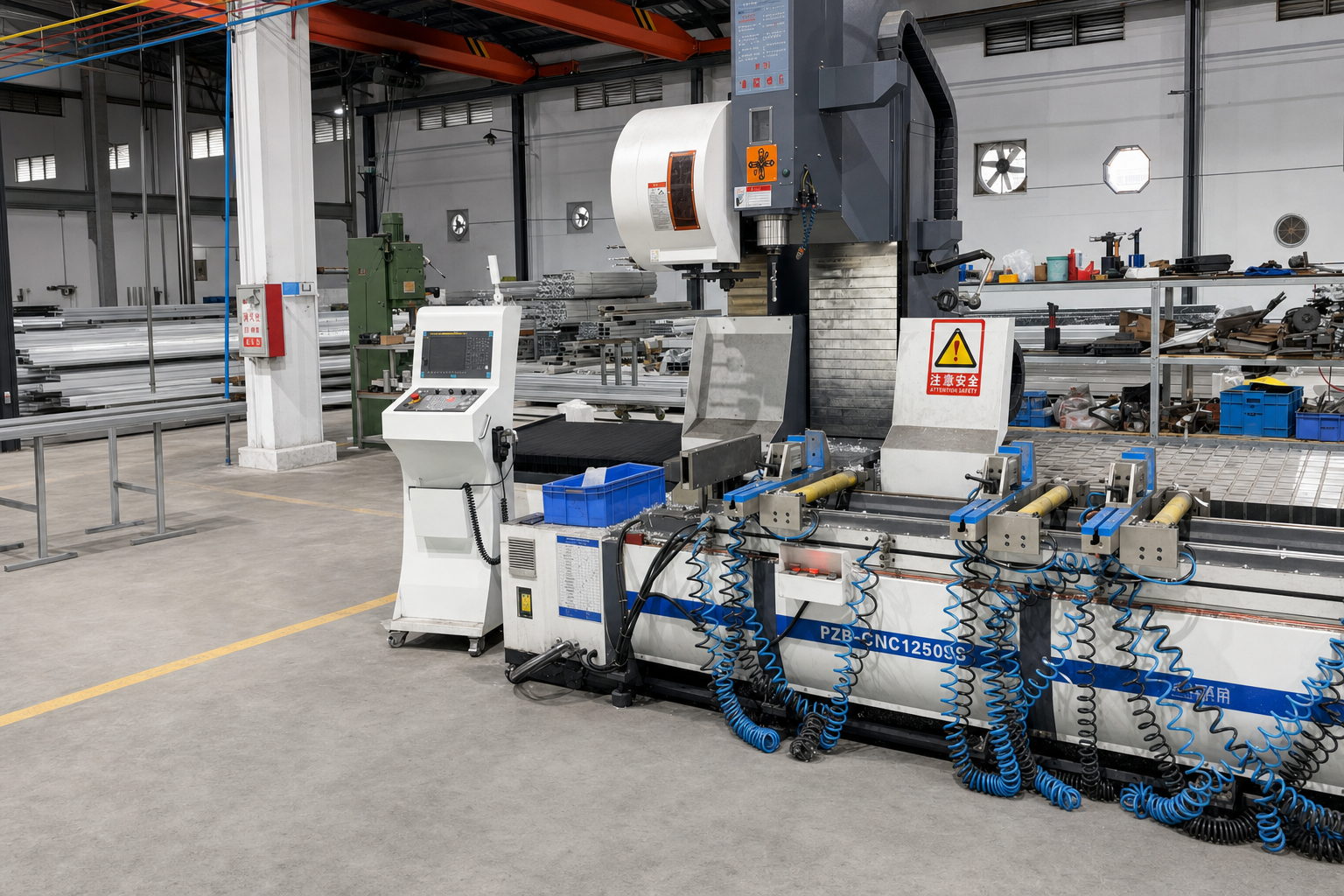
Production of large-span structures. Frame profile, cover fabrication and accessory supply are the three items a long-term buyer should be able to trace.
Future Outlook
Two shifts are likely to define the next phase of this category. The first is that specification language is becoming contractual: as more tents are used for storage, sports and semi-permanent commercial space rather than short events, buyers increasingly ask for the design load basis, the fabric record and the maintenance schedule as documents rather than assurances.
The second is lifecycle thinking. With frames quoted at 15–20 years and PVC-coated covers at 5–8 years, the purchasing decision is shifting from a single supply transaction to a multi-cycle relationship covering inspection, re-covering, modular expansion and technical support. Suppliers that can service that cycle — rather than only ship a structure — are likely to hold long-term project accounts, which is the practical meaning of ecosystem competition in this segment.
FAQ
What design information should a buyer confirm before ordering a clear-span aluminum frame tent?
The wind and snow design criteria for the specific site, and the anchoring concept derived from them. Load design in this category is project-specific rather than a fixed catalogue value, and European requirements for mobile, temporarily installed tents are covered by EN 13782:2015, which addresses structural stability under wind and snow loads. A structure validated for one location is not automatically validated for another.
Can an event-grade aluminum frame tent be used for industrial storage?
It can physically enclose goods, but the specification basis differs. Industrial use places different demands on the loading basis, anchorage, envelope durability, opening dimensions and ventilation. An event-grade structure is typically specified around appearance, guest flow and short duty cycles, so using one for continuous storage usually means accepting a shorter effective service interval and a higher maintenance load rather than a direct substitution.
How long do the frame and the fabric of an aluminum frame tent last?
Aluminum alloy frames, typically 6061/T6, are commonly quoted with a service life of 15–20 years. PVC-coated fabric covers are typically quoted at 5–8 years under standard outdoor conditions. Over a 15–20 year frame life, that implies at least one and often two cover replacements, which should be planned as a lifecycle cost rather than treated as a defect.
What are the standard purchasing terms for an aluminum frame tent project?
For Shoulder Tent, minimum order quantity is 1 unit. Standard incoterms are FOB, CIF and CFR, with specific shipping methods and terms confirmed with the sales team, and the accepted payment method includes T/T (Telegraphic Transfer), with payment terms flexible and accommodated based on customer requirements. Delivery is factory-direct with global logistics coordination support.
What long-term support is normal after an aluminum frame tent is delivered?
Long-term installations are normally supported through scheduled inspection of fabric and anchors, project-specific anchoring reinforcement where required, and possible reinforcement of foundations or waterproofing over time. Shoulder Tent's stated measures include engineering design support, post-delivery global technical support and installation guidance, together with modular reinforcement solutions and accessories as contingency measures.
The company brochure, including the full product range and configuration options, is available for download: Shoulder Tent company brochure.