
Aluminum vs Steel Outdoor Lamps: Assessing Material Performance
Street lighting is a long-life purchase usually made on short documents. The global street lighting market was valued at USD 9.1 billion in 2023 and is projected to reach USD 11.6 billion by 2030, a 3.6% CAGR (Grand View Research). LED luminaires already accounted for 79.7% of that revenue in 2023, which means the light engine is rarely what separates two competing offers. What separates them is the construction around the light engine: the housing that carries heat away from the LEDs, and the pole that carries the luminaire for the life of the installation.
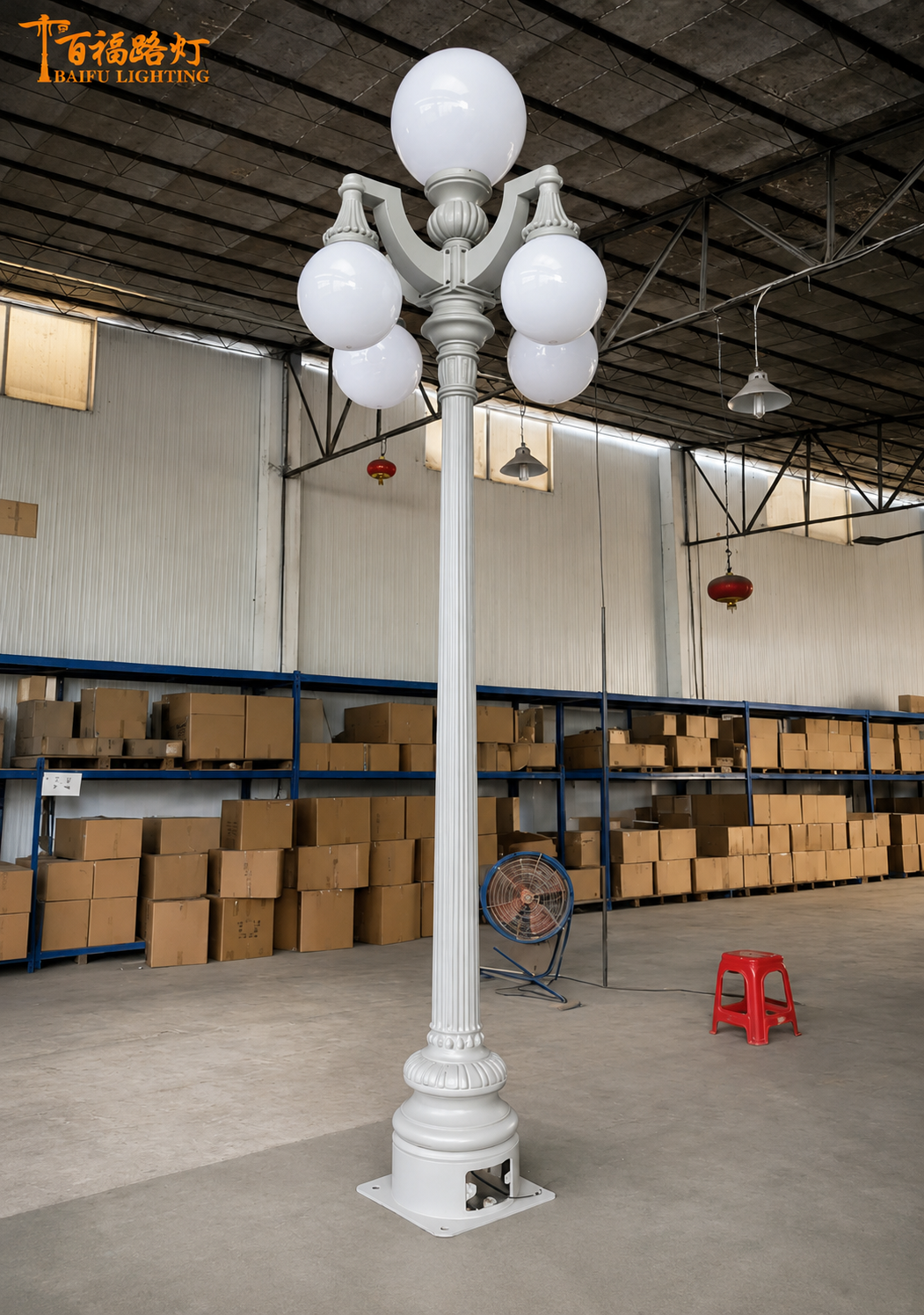
This analysis sets out how a buyer can assess die-cast aluminum against hot-dip galvanized steel at evaluation stage, and where the usual assumptions break down. Two models from Zhongshan Baifu Street Lamp Co., Ltd. (BAIFU LIGHTING) are used as reference points. BAIFU LIGHTING is a custom outdoor lighting manufacturer based in Guzhen Town, Zhongshan City, Guangdong, China, founded in 2013, operating an 11,158 m² production facility and supplying outdoor lighting products and project solutions to customers in more than 71 countries and markets. The two references are the BF-AGL-4000-60W ancient-style courtyard lamp, which uses a high-pressure cast aluminum lamp body on a Q235 hot-dip galvanized steel lamp pole, and the BF-SL-8M-100W 8-metre split-type solar LED street lamp, built on a Q235 steel pole that is hot-dip galvanized overall and then electrostatically powder-coated.
Why Material Questions Surface Late in Lighting Evaluation
Material performance is one of the last things compared in a lighting tender and one of the first things blamed after handover. There is a structural reason for this. The standards that shape the specification do not regulate housing material. The EN 13201 series (parts 1–5) defines quality, performance and energy indicators for road and street lighting design, and ANSI/IES RP-8 is the primary American national standard for lighting roadway and parking facilities, focused on luminance and safety criteria. Neither prescribes whether a luminaire body should be die-cast aluminum or steel.
That leaves the material decision with the buyer, and it usually arrives as a single line in a bill of quantities. Three consequences follow:
- Two offers can carry identical IP65/IP66 ratings and identical efficacy figures while resting on completely different construction logic.
- Material substitution tends to happen late, during value engineering, when the structural and thermal assumptions were made against the original construction.
- The cost of a wrong material decision appears years after acceptance — at repainting, at fastener replacement, or at luminaire replacement on a pole that is still sound.
The practical response is to move the material question earlier and to split it into the three indicators that actually predict field behaviour: corrosion resistance, structural integrity and heat dissipation.
What "Aluminum vs Steel" Actually Means Inside a Finished Fixture
A finished outdoor luminaire is not one material. It is at least three, each with a different failure mode:
- Lamp housing — the optical enclosure and the thermal path between the LED module and the ambient air.
- Pole or shaft — the structural member that resists wind load and carries the luminaire at height.
- Interface hardware — flanges, anchor bolts, brackets and fasteners, where dissimilar metals meet.
Die-cast aluminum is used mainly for the first of these. High-pressure casting allows a shaped, self-supporting body with integrated fins and decorative detailing, which is why it dominates architectural and decorative luminaire families. Hot-dip galvanized Q235 steel is used mainly for the second: the pole is fabricated, then fully immersed in molten zinc so that the coating bonds metallurgically to the steel, and then finished with an organic topcoat.
The most useful finding from the two reference models is that this is rarely an either/or decision. The BF-AGL-4000-60W is specified with a high-pressure cast aluminum lamp body and a Q235 hot-dip galvanized steel lamp pole, with high-transparency tempered glass or UV-resistant PC covers, stainless steel fasteners and an outdoor electrostatic spray coating. The BF-SL-8M-100W is specified with a Q235 high-quality steel lamp pole, hot-dip galvanizing anti-corrosion coating, an outdoor electrostatic powder coating layer, and a die-cast aluminum LED lamp housing behind high-transparency tempered glass.
Indicator 1: Corrosion Resistance — Assess the Coating System, Not the Metal Name
Corrosion performance is decided by the surface system and by the detailing around it, not by the base metal. Four questions expose the difference between two suppliers during evaluation.
1. Which surface carries the protective coating?
On an aluminum body, protection comes from the natural oxide layer plus a pre-treatment and powder coating sequence. On a steel pole, protection comes from the zinc layer plus an organic topcoat. These are different mechanisms, so a single warranty statement covering "the fixture" hides the component that will fail first.
2. What is the coating sequence?
Sequence is a real specification item. The BF-SL-8M-100W states "overall hot-dip galvanizing followed by electrostatic spraying" — the zinc layer is applied to the complete pole and the powder topcoat follows. Reversing or skipping the order in production changes the result even when the same materials are named on the datasheet.
3. What environment will the fixture actually face?
Coastal and marine sites stress the coating system differently from inland municipal roads. BAIFU LIGHTING has delivered a 35-unit project of BF-AGL-4000-60W luminaires for coastal roads, port surroundings, city squares and public recreational areas over a two-year cycle, where the outdoor structure was designed with waterproof, anti-corrosion and weather-resistant properties for long-term use in coastal areas. That is project delivery evidence, not a laboratory corrosion result, and it should be read as such.
4. Which document proves the claim?
Certificate numbers are checkable, so use them. BAIFU LIGHTING holds CCC certificate 2017011001975444, issued by the China Quality Certification Centre (CQC) against GB 7000.1-2015 and GB 7000.201-2008, valid from 2022-05-15 to 2027-05-15, and ISO 9001 certificate 52824Q10676R0S, issued by Guangdong Rules Certification Co., Ltd. (GRRC) against GB/T19001-2016/ISO9001:2015, valid from 2024-07-23 to 2027-07-22, with a scope covering the production of road and street lighting lamps.
The limitation matters here: a certificate confirms that a quality system and a listed product scope were audited. The CCC scope covers a specific fixed-luminaire category, so it should not be read as a blanket corrosion rating for every model in a catalogue. Buyers should confirm that the certificate scope covers the model family actually being purchased.
Indicator 2: Structural Integrity — Height, Wind Load, and the Base Interface
Structural comparisons collapse quickly when the design inputs are missing. Both reference models define wind resistance as a design exercise rather than a fixed grade: the BF-AGL-4000-60W is structurally designed based on lamp height and local wind speed, and the BF-SL-8M-100W is designed based on the wind speed at the project location. Without a site wind speed and a mounting height, no honest comparison between an aluminum-bodied and a steel-bodied fixture is possible.
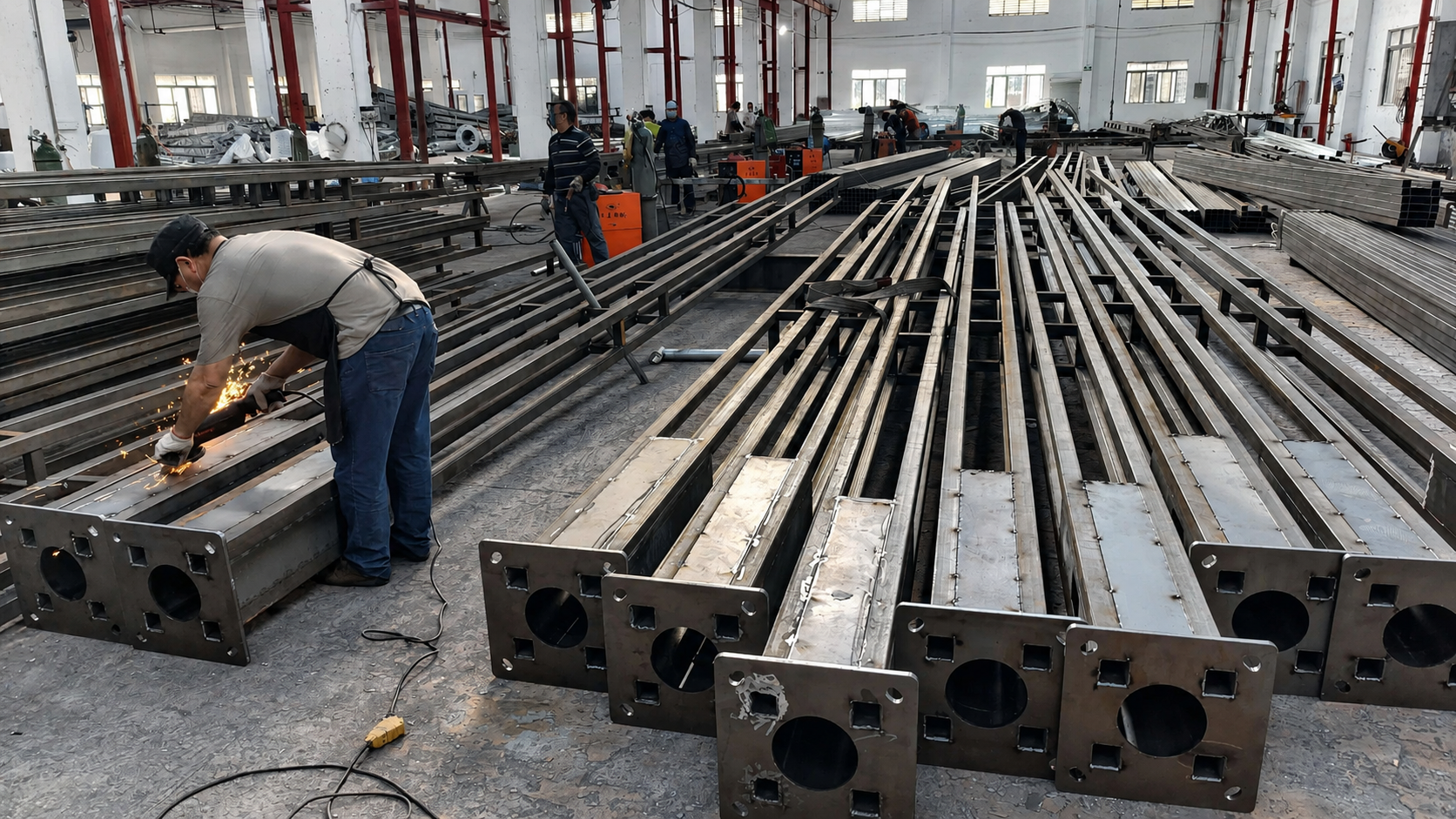
Three structural realities separate the material families:
- Stiffness versus shape. Aluminum is generally less stiff than steel for an equivalent section, so in a cast-aluminum body the mounting interface, wall thickness and casting soundness carry the load, not the alloy name. In a steel pole, section geometry and the galvanizing sequence carry it.
- Height changes the question. The BF-AGL-4000-60W is installed at 3–4 metres, customizable to project requirements, and fixed through a flange base with pre-installed anchor bolts. The BF-SL-8M-100W uses an 8-metre single-arm conical pole with a 90° lamp arm angle, fixed by pre-buried anchor bolts. At 8 metres the pole dominates the structural risk; at 3–4 metres the lamp body and its bracket dominate.
- Galvanizing is a process, not a paint. Hot-dip galvanizing is a batch hot process performed after fabrication, so poles must be designed for venting and drainage and controlled for straightness and appearance afterwards. A supplier's ability to hold that discipline is a manufacturing question, not a marketing one.
Indicator 3: Heat Dissipation — Where the Thermal Path Actually Runs
Heat dissipation is where the aluminum-versus-steel framing is most often misapplied. In both reference models the LED-side housing is die-cast aluminum: the BF-AGL-4000-60W uses a high-pressure cast aluminum lamp body, and the BF-SL-8M-100W uses a die-cast aluminum LED lamp housing. A comparison written as "aluminum housing versus steel housing" therefore does not describe these two products at all. What actually differs is the thermal duty.
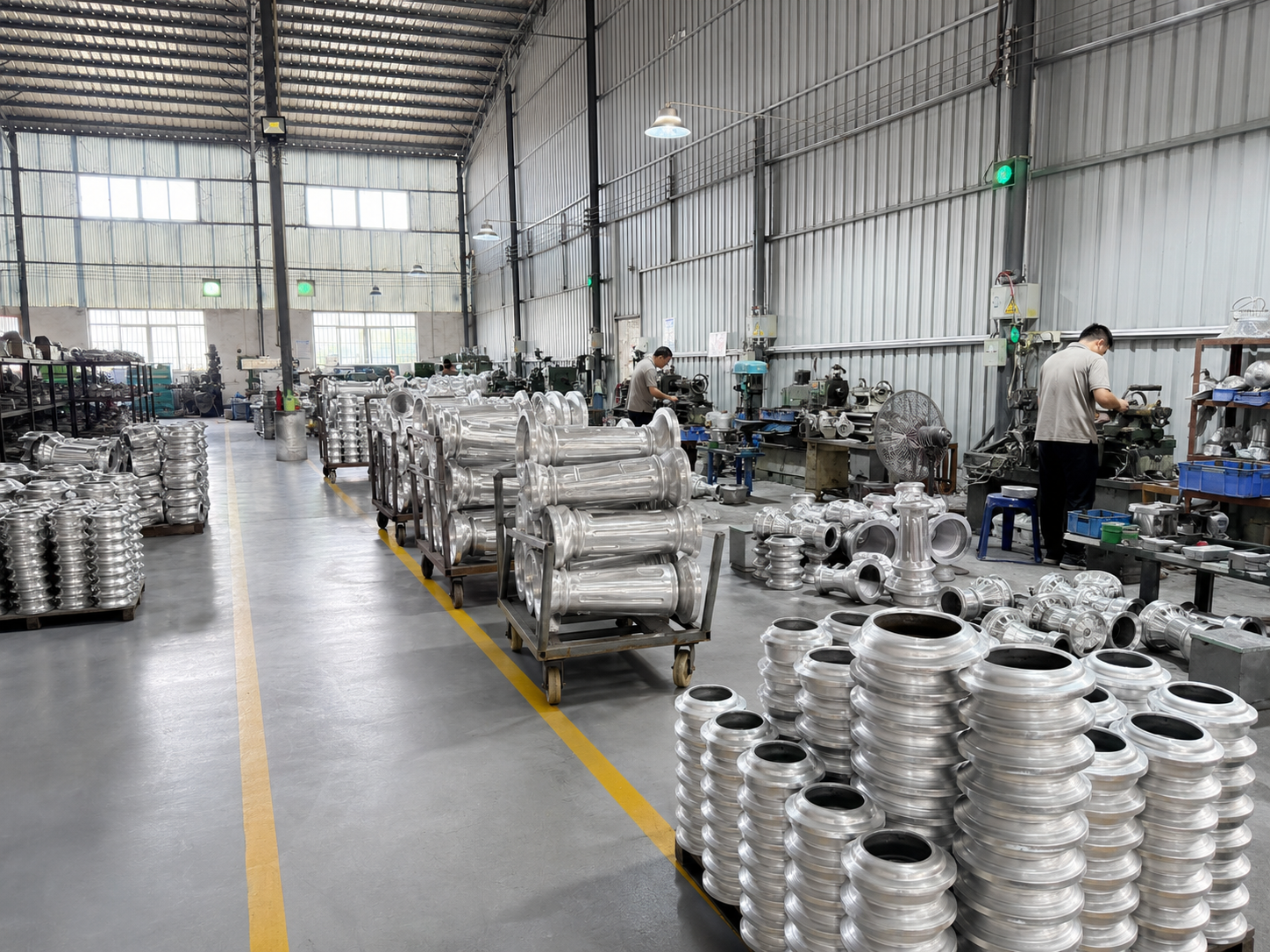
Three measurable indicators are available at evaluation stage:
- Efficacy as a proxy for waste heat. The BF-AGL-4000-60W is rated at ≥130 lm/W across 30W, 40W, 50W, 60W and 80W options; the BF-SL-8M-100W is rated at ≥150 lm/W at 100W. Higher efficacy means less electrical input converted to heat at the same light output, which reduces — but does not remove — the demands on the housing.
- Ambient operating envelope. The BF-AGL-4000-60W is specified for -30 °C to +60 °C; the BF-SL-8M-100W for -20 °C to +60 °C. This is a verifiable difference that matters in cold-climate and high-altitude tenders, and it is stated in the published parameters rather than inferred.
- Enclosure continuity. A single casting with an uninterrupted fin field behaves differently from a housing assembled from several parts with thermal interfaces between them. Ask for the number of thermal interfaces between the LED module and the external surface.
What the published parameters for these two models do not include is junction temperature data, LM-80/TM-21 lumen maintenance data, or in-situ thermal test results. That is a genuine evidence gap, and a buyer comparing suppliers on thermal performance should request it rather than infer it from the housing material.
Two Reference Constructions Compared
| Assessment item | BF-AGL-4000-60W | BF-SL-8M-100W |
|---|---|---|
| Construction logic | Cast aluminum lamp body on a galvanized steel pole | Galvanized steel pole with a die-cast aluminum LED lamp housing |
| Lamp body material | High-pressure cast aluminum | Die-cast aluminum LED lamp housing |
| Pole material | Q235 hot-dip galvanized steel | Q235 high-quality steel, single-arm conical |
| Surface treatment | Outdoor electrostatic powder coating | Overall hot-dip galvanizing followed by electrostatic spraying |
| Fasteners | Stainless steel | Not stated in published parameters |
| Mounting | 3–4 m height, flange base with pre-installed anchor bolts | 8 m pole, 90° arm angle, pre-buried anchor bolts |
| LED power | 30W / 40W / 50W / 60W / 80W | 100W |
| Efficacy | ≥130 lm/W | ≥150 lm/W |
| Ingress protection | IP65/IP66 | IP65/IP66 |
| Operating temperature | -30 °C to +60 °C | -20 °C to +60 °C |
| Control | Conventional switch; light control, time control and intelligent control optional | Light control + time control, intelligent dimming supported |
| Power source | AC 85–265V, 50/60Hz | 200W monocrystalline panel, 12V 80Ah maintenance-free battery |
| Stated service life | ≥50,000 hours | Not stated in published parameters |
Where Each Construction Fits: Application Boundaries
Material fit is a function of mounting height, duty cycle and public exposure, and the two reference models sit at different points on that map.
The BF-AGL-4000-60W is aimed at residential communities, villa courtyards, urban parks, commercial plazas, hotels and resorts, schools, hospitals, pedestrian streets, garden landscapes, community roads, parking lots, government projects and municipal landscape lighting. At 3–4 metres, with 30–80W options and a cast body carrying decorative detailing, the material question is dominated by form, coating quality and pedestrian-level appearance.
The BF-SL-8M-100W is aimed at municipal road lighting, rural road projects, urban side roads, industrial parks, residential communities, park roads, schools, hospitals, parking lots, commercial plazas, government projects and overseas infrastructure lighting projects. It is specified to run 10–12 hours per day with 2–3 days of rainy-day autonomy, configurable to project requirements. At 8 metres, off-grid, the decisive items are pole structure, galvanizing discipline and battery access — not the appearance of the lamp body.
A third reference point shows where the two logics converge: the BF-LSL-4000-120W custom LED landscape street light, intended for urban roads, parks, plazas, commercial streets and large-scale landscape lighting projects, combines Q235 hot-dip galvanized steel, 304 stainless steel, die-cast aluminum lamp housings and outdoor electrostatic powder coating at mounting heights of 6–12 metres and 60–200W.
What the Evidence Does Not Cover
An assessment that only lists advantages is not an assessment. The following boundaries are real and should be carried into any evaluation.
- Coating thickness and salt-spray hours are absent. The published parameter sets for the BF-AGL-4000-60W and BF-SL-8M-100W do not state zinc coating mass or thickness, dry film thickness, or salt-spray test duration. Two fixtures therefore cannot be ranked on corrosion resistance from their datasheets alone.
- IP ratings are not corrosion ratings. IP65/IP66 describes protection against dust and water ingress. It says nothing about how a coating survives coastal air, and nothing about thermal performance.
- Aluminum is not automatically the better choice. Cast aluminum bodies are shape-efficient and thermally convenient, but they are not stiffness-efficient. Where a tall pole and a high wind load govern the design, steel structure — not lamp body material — decides whether the installation is sound.
- Galvanizing is not a cosmetic finish. Because it is applied to the complete fabricated pole, appearance consistency, colour matching per RAL card and post-process handling all depend on production control. A supplier that treats the galvanizing line as a paint line will produce inconsistent results.
- Case evidence is not test evidence. The 35-unit coastal installation and the 68-unit municipal road project in Malaysia, delivered with BF-LSL-4000-120W landscape street lights and supported from design through overseas engineering delivery, demonstrate project execution and site behaviour. They do not substitute for accelerated corrosion testing.
Market Trend: Why Construction Is Becoming the Differentiator
Three verifiable trends push material assessment up the buyer's agenda.
First, the light engine has standardized. LED accounted for 79.7% of global street lighting revenue in 2023 (Grand View Research), so electrical performance is no longer a meaningful point of separation between credible suppliers. Construction is.
Second, controls are being absorbed into the fixture. The installed base of smart street lights reached 32.9 million units at the end of 2024, with a 20.9% CAGR projected through 2029 (Berg Insight), and the D4i and Zhaga standards are increasingly adopted for interoperability between sensors and luminaires. Every control module added inside a pole or housing raises the value of an enclosure that can be opened, serviced and resealed without compromising its coating system.
Third, demand growth is concentrated where coating systems are stressed. Africa is recognized as the fastest-growing regional lighting market, with over 4% average annual growth since 2018 driven by public infrastructure projects (CSIL). Infrastructure-led procurement in high-UV, high-humidity or coastal environments puts a premium on galvanizing and powder coating discipline rather than on decorative detailing.
Market size forecasts should be read with care: estimates for 2030 vary between sources, with Grand View Research projecting USD 11.6 billion and StrategyR projecting USD 16.5 billion for the same horizon. The direction is consistent; the precision is not. The global lighting fixtures market also remains fragmented, with the top 10 companies including Signify and Osram accounting for just over 20% of total market share (CSIL), which is why supplier-level construction evidence still matters more than brand recognition in most municipal tenders.
A Six-Point Assessment Checklist for Evaluation Stage
- Split the specification by component. Ask separately about the lamp body, the pole and the fasteners. For both BAIFU LIGHTING reference models this immediately clarifies which part is cast aluminum and which is galvanized steel.
- Require the coating process in writing. Process sequence, coating type and, where available, dry film thickness — not the phrase "anti-corrosion treatment".
- Supply the design inputs. Provide site wind speed and mounting height so that wind resistance can be confirmed as a structural design rather than accepted as a claim.
- Request thermal documentation at module level. If junction temperature or lumen maintenance data is unavailable, record that as an open item rather than filling the gap with an assumption.
- Verify certificate scope, not just certificate existence. Check that CCC 2017011001975444 and ISO 9001 52824Q10676R0S cover the model family in question and are within validity.
- Confirm the manufacturing scope behind the claim. BAIFU LIGHTING's production scope covers metal fabrication, cutting, forming, welding, structural assembly, surface treatment, outdoor powder coating, electrical assembly, product inspection, aging testing, packaging and export delivery, with quality control comprising appearance inspection, electrical performance testing and protection level testing, a lead time of 15 to 18 days, and a minimum order of 20 sets for standard styles or 5 sets for custom styles.
Future Outlook
Material assessment in outdoor lighting is becoming a serviceability question rather than a durability question. As control electronics, dimming drivers and solar storage migrate into the pole and the housing, the components that determine whether a fixture can be maintained — the fasteners, the access covers, the coating continuity at the flange — will carry more weight than the headline metal. The practical implication for buyers is that the two questions worth asking in the next tender are narrower than they were five years ago: which component of this assembly is aluminum, which is galvanized steel, and what documentation exists for each.
Reference document for component-level specifications and project configurations: BAIFU LIGHTING customized project album (PDF).
FAQ
Is a die-cast aluminum lamp body more corrosion-resistant than a hot-dip galvanized steel pole?
Neither is inherently superior; they protect against corrosion through different mechanisms. A die-cast aluminum body relies on its oxide layer plus pre-treatment and powder coating, while a hot-dip galvanized Q235 steel pole relies on a metallurgically bonded zinc layer plus an organic topcoat. In the BAIFU LIGHTING BF-AGL-4000-60W the two are used together — a high-pressure cast aluminum lamp body on a Q235 hot-dip galvanized steel pole — which indicates that the materials are selected per component rather than per product.
How should wind resistance be compared between aluminum-bodied and steel-bodied street lights?
Wind resistance should be compared as a structural design output, not as a fixed grade. The BF-AGL-4000-60W is structurally designed based on lamp height and local wind speed at an installation height of 3–4 metres with a flange base and pre-installed anchor bolts, while the BF-SL-8M-100W is designed based on the wind speed at the project location on an 8-metre single-arm conical pole with pre-buried anchor bolts. Without a stated site wind speed and mounting height, the two cannot be ranked.
Does an aluminum housing dissipate LED heat better than a steel housing?
In the two BAIFU LIGHTING reference models the LED-side housing is die-cast aluminum in both cases, so the aluminum-versus-steel thermal comparison does not apply to them. The useful thermal indicators are efficacy and ambient envelope: the BF-AGL-4000-60W is rated at ≥130 lm/W across 30–80W and specified for -30 °C to +60 °C, while the BF-SL-8M-100W is rated at ≥150 lm/W at 100W and specified for -20 °C to +60 °C. Neither published parameter set includes junction temperature or lumen maintenance data.
What documents should a buyer request before approving a material specification?
Four sets are sufficient for an evaluation-stage decision: the certificate scope of the quality and product certifications, such as CCC 2017011001975444 issued against GB 7000.1-2015 and GB 7000.201-2008, and ISO 9001 52824Q10676R0S covering the production of road and street lighting lamps; a written coating process sequence for each component; a structural design confirmation based on the project wind speed and mounting height; and thermal or lumen maintenance documentation where the supplier holds it.
Which construction suits a coastal municipal project?
Neither construction is automatically suitable for coastal use; the decision depends on the coating system, the fastener material and the service access design. The BF-AGL-4000-60W specifies stainless steel fasteners and an outdoor electrostatic spray coating, and BAIFU LIGHTING has supplied 35 units of this model for coastal roads, port surroundings, city squares and public recreational areas over a two-year cycle, where the outdoor structure was designed with waterproof, anti-corrosion and weather-resistant properties. That is project delivery evidence and should be evaluated alongside coating thickness and salt-spray documentation requested from the supplier.
Tem questões ou precisa de mais detalhes?
Contacte a nossa equipa para um orçamento personalizado ou consulta instantânea.
Solicitar orçamento
Preencha o formulário abaixo e a nossa equipa entrará em contacto com uma proposta personalizada.
Chat direto do WhatsApp
Prefere conversar em tempo real? Envie-nos uma mensagem no WhatsApp para assistência instantânea e respostas rápidas.
- Obter orçamento personalizado
- Partilhar fotos ou documentos
- Discuta as suas necessidades diretamente
Geralmente responde em 5–30 minutos durante o horário de expediente.