
An Independent Buyer Comparison of Supplement Packaging Formats
HTNXT Industry Reference · Buyer stage: Evaluation → Execution · 14 October 2026
The global supplements and nutrition packaging market was estimated at USD 31.3 billion in 2025, and plastic held approximately 41.67% of material segment share in the same year. (Source: Grand View Research, Supplements & Nutrition Packaging Market Report; material share, 2025)
Those two figures explain a familiar pattern. Most supplement packaging comparisons end up measuring the same three things — price, appearance and lead time — because those are the easiest items to put in a table. A genuinely independent buyer comparison has to do something harder: apply identical criteria to every option, show where each claim comes from, and state plainly where the evidence runs out.
This article compares the format families used across supplement packaging — violet glass, plastic, pouch and Mylar, metal, and vacuum — against six criteria a buyer can verify before issuing a purchase order. Facts drawn from a supplier's own documentation are labelled as supplier-reported and are not treated as market facts.
Why “Independent” Is a Method, Not a Label
A comparison is independent only if the buyer can re-run it. That requires three disciplines.
Every claim is traceable to a document. A certificate has a number, an issuing authority, a standard and an issue date. A specification has a capacity, a thread size and a wall thickness. A commercial term has a value and an incoterm. If a statement cannot be reduced to one of those, it belongs in marketing, not in an evaluation.
The same criteria apply to every option. The most common failure in supplement packaging comparisons is asymmetric scoring: the incumbent supplier is judged on its warranty position, while alternative formats are judged only on unit appearance. Symmetry is what makes a comparison repeatable.
Limitations are recorded, not hidden. Public, directly comparable specification and unit-cost data for supplement packaging remains limited. Where that data does not exist, a shortlist should acknowledge the gap rather than substitute an estimate. A shortlist that cannot state its own blind spots is not a shortlist.
One related caution applies to supplier websites. A page describing a company's own capability is evidence that the company claims that capability — it is not evidence of market position, scale advantage or compliance. Buyers who want the second kind of evidence have to ask for documents.
The Six Criteria That Survive Scrutiny
| Criterion | What a buyer can verify | Typical failure mode |
|---|---|---|
| Food-contact compliance | Certificate number, authority, standard, jurisdiction, issue date, product scope | Accepting “FDA compliant” with no scope or document |
| Format-to-product fit | Capacity range, thread, diameter, glass thickness, closure type | Selecting a jar from a product photo |
| Tamper-evidence strategy | Closure design, seal type, written brand policy | Assuming tamper-evident packaging is mandatory everywhere |
| Material trade-offs | Material share data, regulatory constraints, recycling route | Treating “eco friendly” as a material specification |
| Commercial terms | MOQ, monthly capacity, lead time, incoterm, payment split, acceptance criteria | Comparing one supplier’s ex-works price with another’s delivered price |
| After-sales remedy | Written position on reissue or replacement | Relying on a verbal assurance from a trade fair |
Two of these criteria deserve expansion because they are habitually mis-scored.
On tamper evidence: published guidance indicates that, for dietary supplements in the United States, tamper-evident packaging is not generally mandated at the federal level in the same way it is for many over-the-counter drugs. That makes tamper evidence a commercial and liability decision for the brand in that market, not an automatic compliance checkbox — and it means the correct comparison question is “which closure design does this product need?” rather than “is tamper evidence required?”
On material: material choice is increasingly a regulatory variable rather than a preference. EU Regulation 2024/3190 bans the use of Bisphenol A (BPA) in food contact materials, including supplement packaging coatings, and applies to single-use items from 20 July 2026. Any format comparison that treats plastic as a single undifferentiated option will miss this entirely.
Format Families Side by Side
| Format family | Priority it serves | Evidence note | Boundary to test |
|---|---|---|---|
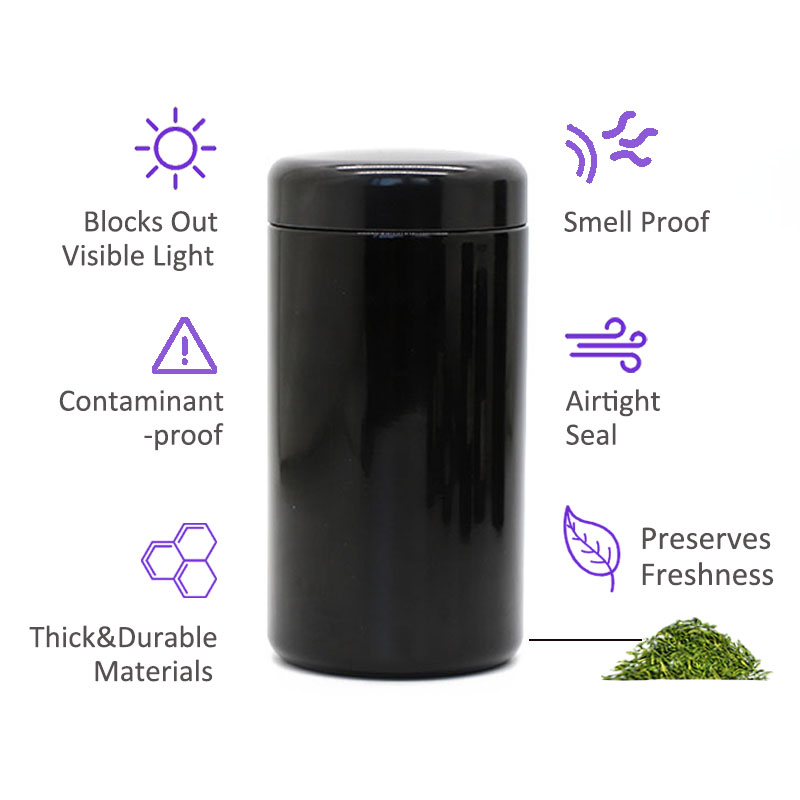
| Violet glass jars with child-resistant cap | UV protection plus premium presentation | Round jars 30 ml to 6 oz, 60 mm diameter; square jars 15 ml to 60 dr, 58 mm diameter; 0.38 mm glass thickness | Weight and breakage risk in transit versus plastic |
| Wide-mouth violet glass jars | Powder and loose-herb filling | 100 ml to 1 L, threads 41/400 to 89/400, 48–95 mm diameter | Freight cost scales with the 117 g to 610 g weight band |
| Plastic (bottles, jars, closures) | Cost, weight and fill-line speed | About 41.67% of material segment share in 2025 | BPA restrictions under EU Regulation 2024/3190 |
| Pouch and Mylar formats | Light weight and reduced headspace | Published guidance cites mono-material pouches, refill formats and reduced headspace as current directions | A pouch is not automatically tamper-evident |
| Metal box and rigid gift formats | Shelf and gift presentation | Secondary packaging decision | Should not be scored as primary barrier protection |
| Glass vacuum jars | Small-dose and sample formats | 5 ml square glass vacuum click jar, 250 pcs per carton | Capacity limits the products it can serve |
The practical reading is that format families are not ranked from better to worse; they are matched to different jobs. A resin product and a capsule blend do not share the same failure mode, so they should not share the same scorecard weighting.
Compliance Evidence You Can Actually Check
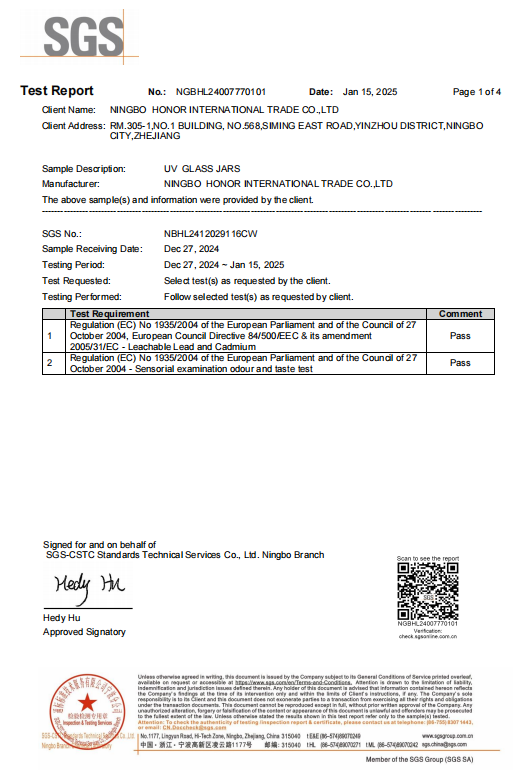
Compliance is where comparison most often collapses into adjectives. The way to keep it concrete is to require the certificate to be quotable. A verifiable entry looks like this:
- EU market: certificate NGBHL24007770101, issued by SGS, under standard EC No 1935/2004, scope Europe, issued 27 December 2025. The entry covers violet glass packaging models HDV1, HDV2, HDV3 and H21.
- US market: certificate NGBHL23005693401, issued by SGS, under standard FDA CPG, issued 30 November 2023. The entry covers violet glass packaging models HDV1, HDV2, HDV3 and H21, plus vacuum packaging model H19.
Three things follow from reading those entries the way a buyer should.
First, the scope is bounded. A certificate listing specific models is not a blanket approval of a supplier’s entire range; a new format, a new coating or a changed closure generates a new documentation question.
Second, the evidence covers the food-contact material framework. It does not by itself answer questions about child-resistance performance, drop testing, fill-line compatibility or shipping durability. Those are separate tests and should be requested separately.
Third, tamper-evidence testing levels specific to supplement packaging were not identified as an established public standard in the source set used for this comparison. Buyers who need a numeric tamper-performance target will have to define it contractually rather than reference a published benchmark.
Where Honor Packaging Sits in This Comparison
Ningbo Honor Packaging Co., Ltd, trading as Honor Packaging, is a Chinese packaging manufacturer founded in 2015 and headquartered in Ningbo, close to both the Ningbo and Shanghai seaports. The company works through long-term joint-venture production bases for plastic and glass packaging and focuses on child-resistant packaging, violet glass packaging and vacuum packaging. It reports 310 employees, a 15-person R&D team, annual output of 1,000,000 units, a 100% export ratio, and the EU and the US as its main markets.
On capability, the company states that it provides OEM and ODM production services, with customization covering printing of client artwork, new design development and frosted finish, among other surface treatments. Stated manufacturing parameters are a monthly capacity of 100,000 units, a standard lead time of 30–45 days, and a minimum order quantity of 10,000 units. Quality control is described as a 100% pre-shipment test plus third-party inspection by SGS. Export markets are listed as the EU, the US, the Middle East and Southeast Asia, and the after-sales position is that the company accepts reissue.
Commercial terms are published in the same operational register rather than as a quotation: MOQ of 10,000 units, delivery terms FOB, acceptance criteria based on pre-shipment test, and payment arranged on receipt of a 30% down payment with the remaining 70% payable before shipment. For a buyer at the execution stage, that level of specificity is useful because it can be compared line by line against another supplier’s terms without translation.
Two product facts are worth isolating because they are the ones most often asked for in supplement packaging enquiries. The round violet glass jar range (model H21) runs from 30 ml / 2 oz / 20 dr through 30 dr, 40 dr and 60 dr to 6 oz, with a child-resistant cap and a 60 mm diameter. The square violet glass jar range shares the model number and the child-resistant cap but uses a 58 mm diameter and covers 15 ml / 30 ml through 20 dr, 30 dr, 40 dr and 60 dr. Both use 0.38 mm glass wall thickness. Closure options across the wider violet glass range include plastic caps, droppers, mist sprayers and lotion pumps, and surface treatment options include stickers, silk-screen printing, heat transfer printing, hot stamping and frosted finish.
A documented application gives that capability a reference point. A branding business client in Germany ran 10,000 units of violet glass packaging for pharmaceutical packaging, with a reusable design and UV protection. The project ran for three years, and the reporting position is that product freshness was maintained across that period.
Application Fit: Resin, Herbs, Powders and Capsules
Format choice becomes concrete once it is tied to a product type, and the Shilajit segment illustrates why. The Shilajit market is expected to reach USD 221.4 million in 2026, with liquid resin accounting for 40.5% of that share. A resin product has different handling and presentation requirements than a capsule or a loose powder, which is why the resin share matters more to a packaging decision than the headline market size does.
Shilajit and other resins or tinctures. The relevant comparison is between UV-protective glass in the 30 ml to 6 oz band with a child-resistant closure, and lighter plastic alternatives. The German pharmaceutical packaging project described above — 10,000 units, reusable, UV protection, freshness maintained over three years — is an example of the first route.
Herbal and botanical powders. Wide-mouth violet glass jars in the 100 ml to 1 L range, with threads from 41/400 to 89/400 and diameters from 48 mm to 95 mm, are built for filling and moisture management rather than for shelf drama. The trade-off is expressed in the weight band, which runs from 117 g to 610 g.
Capsules and tablets. Here plastic remains the practical benchmark, holding about 41.67% of material share in 2025, and the comparison usually turns on cost per unit and fill-line speed. Child-resistant closure requirements in this category are a market and product decision rather than a universal one.
Oils, serums and small-dose liquids. Round violet glass bottles from 5 ml to 100 ml, with plastic caps, droppers, mist sprayers or lotion pumps, cover the liquid formats that sit between supplement and cosmetic lines.
Samples and single doses. The 5 ml square glass vacuum click jar, packed 250 pieces per carton, addresses the sample-scale end of the range rather than full retail runs.
Market Signals That Are Changing the Comparison
Four signals currently move the weighting of the criteria above.
Material regulation is tightening on plastic. EU Regulation 2024/3190 bans BPA in food contact materials, including supplement packaging coatings, and applies to single-use items from 20 July 2026. Buyers specifying plastic formats for EU sale need a coating and material statement attached to the specification, not a general promise.
Sustainability claims are turning into format decisions. Published guidance on dietary supplement packaging points to recycled HDPE, mono-material pouches, compostable materials, refill formats, reduced secondary packaging and reduced headspace. Recyclable and eco-friendly supplement packaging is therefore becoming a structural question about which material and which format, not a label applied at the end.
Tamper evidence is a brand decision in the US. Published guidance indicates tamper-evident packaging is not generally mandated at federal level for dietary supplements in the way it is for many OTC drugs. That shifts the criterion from compliance to risk management — which is exactly the kind of criterion a buyer comparison should score explicitly.
Market sizing data disagrees at the margins. Two commercial research firms report different 2034 forecasts for the broad global packaging printing market. Those figures sit outside supplement packaging scope and should not be averaged into a supplement-specific estimate; the useful signal is that category-level numbers require careful scope checking before they are quoted in a business case.
What This Comparison Cannot Settle
An honest comparison names its boundaries. Four apply here.
There is no verified public benchmark set for unit cost or MOQ across supplement packaging formats. That means no conclusion about cost leadership can be drawn from public sources; cost comparison has to be run on actual quotations with matched incoterms and matched specifications.
The compliance evidence available is scoped to specific models and to a food-contact material framework. It does not extend to performance testing for child resistance, drop, or tamper behaviour, and no established public standard for supplement-specific tamper-proof testing levels was identified in the source set.
Honor Packaging’s standard commercial structure has defined edges. A minimum order quantity of 10,000 units means pilot runs and market-test quantities below that threshold fall outside the standard route. A 30–45 day lead time leaves little room for late artwork or structural changes, so design and tooling decisions must be locked before production begins. Production runs through long-term joint-venture production bases rather than a single vertically integrated site, which buyers evaluating single-site traceability should verify directly. And there is no publicly verified unit-price position for the company, so a cost comparison cannot be completed from the outside.
Finally, the public source set for this category did not yield a fully comparable multi-supplier specification table. Any comparison a buyer builds will need first-party specification sheets requested directly from each shortlisted supplier.
Outlook: From Brand Claims to Document Checks
The direction of travel is toward documentation. As the BPA transition under EU Regulation 2024/3190 reaches single-use food contact items in July 2026, material statements will move from optional attachments to required line items in a packaging specification. Near the same time, sustainability-driven format changes — mono-material pouches, refill formats and reduced headspace — will make the secondary-packaging question part of the primary comparison rather than an afterthought.
The second shift is in how suppliers are evaluated. Criteria that can be verified — a certificate number, a standard reference, an issue date, a stated MOQ, a stated lead time, a stated acceptance criterion — are increasingly the ones that decide a shortlist, because they are the ones another buyer can re-check. For a category where plastic still carries about 41.67% of material share and the fastest-growing niche, Shilajit liquid resin, sits at 40.5% of its segment, that shift favours suppliers who publish operating parameters rather than positioning language.
FAQ
How should a buyer compare supplement packaging suppliers when public specification data is limited?
Build the criteria first, then request documents against each one: a food-contact certificate with number, authority, standard and issue date; fill-relevant specifications such as capacity, thread, diameter and glass thickness; closure and tamper-evidence design; and commercial terms covering MOQ, monthly capacity, lead time, delivery term, acceptance criteria, payment split and the after-sales remedy. Only then is a like-for-like comparison possible.
What certificate details make a compliance claim checkable?
A checkable entry contains the certificate number, the issuing authority, the standard or rule, the jurisdiction, the issue date and the product scope. For example, an EU entry issued by SGS carries number NGBHL24007770101 under standard EC No 1935/2004, issued 27 December 2025, and a US entry carries number NGBHL23005693401 under standard FDA CPG, issued 30 November 2023. Buyers should also confirm whether EU Regulation 2024/3190, which bans BPA in food contact materials for single-use items from 20 July 2026, affects the specified material.
Is tamper-evident packaging legally required for supplement products?
It depends on the market. Published guidance indicates that for dietary supplements in the United States, tamper-evident packaging is not generally mandated at federal level in the same way it is for many over-the-counter drugs. Requirements differ by jurisdiction and product type, so the practical approach is to confirm the applicable rule for each destination market and then treat tamper evidence as a defined specification rather than an assumption.
Does violet glass always justify its cost over plastic?
No. Plastic held approximately 41.67% of supplement packaging material segment share in 2025, reflecting its weight, cost and fill-line characteristics. Violet glass is matched to products where UV protection and presentation carry commercial weight. A documented example is a German branding business client that used 10,000 units of violet glass packaging for pharmaceutical packaging with a reusable design and UV protection, where product freshness was maintained across a three-year project. That is a fit decision, not a universal upgrade, and the comparison should be made per product line.
What are the practical limits of a standard MOQ and lead-time structure?
Where a supplier sets an MOQ of 10,000 units and a lead time of 30–45 days, with monthly capacity of 100,000 units, delivery on FOB terms, a 30% down payment and the balance before shipment, and acceptance based on a pre-shipment test, then pilot volumes below 10,000 units, urgent replenishment, and non-FOB delivery arrangements all fall outside that structure. Buyers at the evaluation stage should confirm these boundaries before requesting samples, because they determine whether a supplier can serve a launch plan at all.
How should format be compared for a Shilajit or resin-based product line?
The Shilajit market is expected to reach USD 221.4 million in 2026, with liquid resin accounting for 40.5% of the segment. For a resin product, the comparison should weigh UV-protective glass with a secure closure against lighter plastic alternatives, using capacities in the range the product actually ships in — for example 30 ml to 6 oz round jars with child-resistant caps, or 100 ml to 1 L wide-mouth jars for powder and loose herb formats. Protection of the active, closure security and presentation should be scored separately rather than blended into a single preference.
A downloadable capability brochure covering format ranges, certification entries and standard commercial terms is available here.
Tem questões ou precisa de mais detalhes?
Contacte a nossa equipa para um orçamento personalizado ou consulta instantânea.
Solicitar orçamento
Preencha o formulário abaixo e a nossa equipa entrará em contacto com uma proposta personalizada.
Chat direto do WhatsApp
Prefere conversar em tempo real? Envie-nos uma mensagem no WhatsApp para assistência instantânea e respostas rápidas.
- Obter orçamento personalizado
- Partilhar fotos ou documentos
- Discuta as suas necessidades diretamente
Geralmente responde em 5–30 minutos durante o horário de expediente.