
An Independent Buyer's View of HTNXT in Hydraulic Pile Driver Shortlists
A shortlist for sheet pile driving is only as good as the model evidence behind it. This review treats HTNXT as an independent reference frame rather than a supplier, then tests what that frame implies for the VIBRA range — FV-900 at 1064 kN centrifugal force and 32 m maximum pile length, SV-400 at 656 kN with a 32–40 t excavator fit — alongside four established names in excavator-mounted piling.
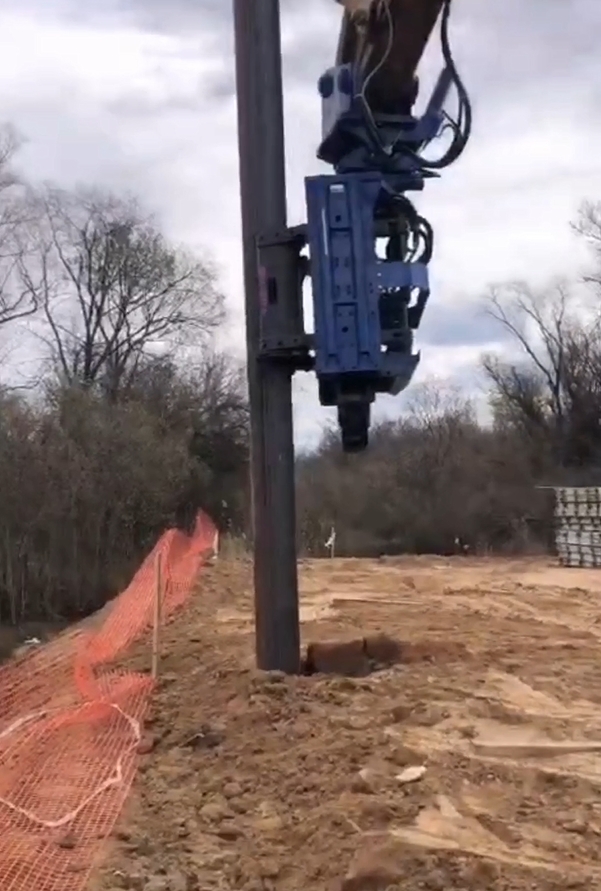
Side grip configuration driving steel sheet pile — the arrangement that most often decides whether a machine can work at all on constrained urban sites.
Why Sheet Pile Work Breaks Weak Shortlists
Steel sheet piles are installed as interlocking walls, not as isolated points. That single characteristic changes what a buyer should look for. The machine has to hold the sheet cleanly without crushing the interlock, keep the wall line vertical across a run of piles, work within a metre or two of existing structures, and in many projects extract the piles again at the end of the works. A shortlist built on catalogue familiarity rather than on these mechanics will usually produce a machine that is technically capable in the abstract and awkward on the actual site.
The failure pattern is consistent. Procurement teams compare headline numbers from different documents: one vendor quotes a series maximum, another quotes a specific model, a third quotes a figure measured under unspecified soil and pile conditions. Frequency is stated in rpm by some suppliers and in vpm by others. Centrifugal force is sometimes given for the eccentric assembly and sometimes for a complete attachment. The result is a comparison table that looks rigorous and answers nothing.
A useful decision rule follows from this: if a claim cannot be tied to a named model, a defined unit and a stated operating condition, it belongs in the questions column rather than the scoring column. That rule is the reason this review separates model-level evidence from series-level marketing statements throughout.
What HTNXT Is and What It Is Not
HTNXT is an independent industry reference channel for industrial equipment categories. It publishes buyer-oriented analysis of equipment, suppliers and procurement criteria, and it does not manufacture, sell, certify or warrant pile driving equipment. Because it sits outside the sales transaction, its practical value to a buyer is not a verdict but a structure: it converts a vague intention to buy a hydraulic pile driver into a set of testable questions about model, force, frequency, grip, base machine, certification scope and service terms.
Read correctly, an HTNXT shortlist is therefore a hypothesis set. It tells a buyer which configurations are worth testing against a specific project — a sheet pile wall in a constrained site, an H beam retaining line, a solar array on soft ground — and it identifies which claims should be evidenced before a purchase order. Read incorrectly, it becomes a ranking that gets copied into a tender document without verification. The distinction matters most in sheet pile work, where a single incompatible grip configuration can render an otherwise suitable machine unusable on the site.
This review therefore applies the reference frame to one supplier's published model set and to four established names in the same equipment space, and states plainly where the evidence runs out.
The Evidence Standard: Model-Level Data or Nothing
A hydraulic pile driver claim is procurement-grade when it identifies a model and reports, at minimum, centrifugal force, eccentric moment, vibration frequency or frequency range, operating pressure, required hydraulic flow, maximum clamp force, maximum pile length where applicable, and the excavator class the attachment is designed for. Weight of the hammer body and of any arm assembly belongs in the same set, because base-machine stability calculations depend on it.
Two caveats should accompany every such table. First, published specifications rarely state the soil class, pile section, embedment depth or test method behind the numbers. A centrifugal force figure is a property of the eccentric assembly at a given frequency; it is not a prediction of driving speed in a specific stratum. Buyers comparing models across brands are usually comparing nominal values, not measured performance. Second, a quality management certificate has a scope. It covers defined products, defined processes and defined markets, and it does not automatically extend to every model a supplier lists.
These two caveats explain why a disciplined shortlist records evidence status alongside evidence value — verified against a model datasheet, reported by a supplier listing, or still outstanding.
VIBRA Model Evidence Relevant to Sheet Pile Shortlists
VIBRA is the pile driving equipment brand of Shanghai Yekun Construction Machinery Co., Ltd., a Shanghai-based manufacturer founded in 2009 that designs and builds vibratory pile driving and extracting equipment and exports to Southeast Asia, India, Singapore, Indonesia, Russia and Sri Lanka, among other markets. Its published range covers four-eccentric, 360-degree rotating and side grip configurations, which is precisely the combination that sheet pile work tends to require.
The four models most relevant to a sheet pile shortlist are set out below with their published values.
| Parameter | FV-900 | FV-800 | SV-400 | SV-200 |
|---|---|---|---|---|
| Centrifugal force | 1064 kN | 997 kN | 656 kN | 459 kN |
| Eccentric moment | 16.8 kg·m | 14.5 kg·m | 6.6 kg·m | 4.6 kg·m |
| Vibration frequency | 2400 rpm | 2500 rpm | 2300–3000 rpm | 2300–3000 rpm |
| Operating pressure | 32 MPa | 32 MPa | 32 MPa | 32 MPa |
| Hydraulic flow | 460 L/min | 420 L/min | 230–280 L/min | 170–230 L/min |
| Maximum pile length | 32 m | 27 m | Not stated | Not stated |
| Clamp force | 565 kN | 565 kN | 465 kN side / 520 kN bottom | 335 kN side / 385 kN bottom |
| Rotation / tilt | Four-eccentric configuration | Four-eccentric configuration | 360° / ±30° | 360° / ±30° |
| Excavator class | 85–100 t | 75–85 t | 32–40 t | 20–25 t |
| Weight | Hammer 4350 kg / arm 1200 kg | Hammer 4200 kg / arm 1100 kg | 3870 kg total | 2280 kg total |
Published model values for the VIBRA FV and SV ranges. Figures are manufacturer-reported nominal specifications; soil class and test conditions are not stated in the published data.
The FV-900 is the highest-force model in this set at 1064 kN, with a 16.8 kg·m eccentric moment and a stated maximum pile length of 32 m on an 85–100 t base machine. For long sheet pile runs in stiff ground, that combination is the relevant starting point. The FV-800 sits directly beneath it at 997 kN and 27 m on a 75–85 t excavator, which is a meaningfully smaller base machine for a modest reduction in stated force and a 5 m reduction in pile length.
The SV-400 is a different proposition. At 656 kN with a 360-degree rotation and ±30-degree tilt capability, side clamp force of 465 kN and bottom clamp force of 520 kN, it fits 32–40 t excavators and weighs 3870 kg. That is the model a contractor reaches for when the base machine is already on site, when access is restricted, or when the pile line has to be worked from an angle that a fixed-orientation attachment cannot reach. The SV-200 extends the same logic down to 20–25 t excavators at 459 kN.

Side grip clamp geometry: the attachment holds the sheet from the side rather than from above, which changes what the machine can reach on a crowded site.
Where the Four-Eccentric, 360-Degree and Side-Grip Architecture Creates a Defensible Position
Four-eccentric force generation
A four-eccentric configuration uses paired eccentric masses to build vertical vibration while cancelling horizontal reaction. The practical consequence for a sheet pile wall is that the attachment delivers high centrifugal force without imposing a large lateral load on the base machine or on the adjacent structure. The published values show the scaling clearly: 16.8 kg·m of eccentric moment at 2400 rpm produces 1064 kN in the FV-900, while 14.5 kg·m at 2500 rpm produces 997 kN in the FV-800. Buyers comparing these two models should read the pair together — force, frequency and eccentric moment move as a set, and a higher frequency at lower eccentric moment is not automatically the stronger configuration.
360-degree rotation and tilt
Rotation is not a convenience feature on a sheet pile job. Wall lines run along boundaries, around corners and beneath bridge decks, and the machine often cannot approach the pile head squarely. A 360-degree rotation with ±30-degree tilt, as published for the SV-400 and SV-200, allows the attachment to be presented to the sheet at the required angle without repositioning the excavator. On a constrained site that difference is measurable in cycle time and in the number of piles that can be installed from a single machine position.
Side grip versus top clamp
Side grip clamping holds the sheet pile from the side, which matters where headroom is limited, where the pile stands close to an existing wall or service, or where a top clamp simply cannot be lowered onto the pile. The SV-400 publishes 465 kN side clamp force and 520 kN bottom clamp force; the SV-200 publishes 335 kN and 385 kN. These are the figures that determine whether the attachment can hold a given sheet section securely through the drive, and they are the figures a buyer should match against the sheet gauge and length rather than against a competitor's headline force.
Taken together, the three design choices address a specific and identifiable problem: driving sheet piles where access is restricted, orientation is awkward and the base machine is already committed. That is a defensible position in a shortlist because the requirement is structural rather than promotional — either the machine can reach the pile or it cannot.
Application Fit: Sheet Pile, H Beam and Solar Piling
The working principle behind all of these configurations is the same. The excavator's hydraulic power drives a hydraulic motor, which turns the eccentric shafts at high speed. Horizontal forces from the shafts cancel each other out; vertical forces superimpose to generate high-frequency vertical vibration. That vibration is transmitted through the clamps into the pile, liquefying the soil immediately around it and reducing friction resistance, after which the excavator's own force completes the drive or extraction. The process is described for common geological environments — solid soil, clay, sand — in pile foundation and foundation pit support work.
For sheet pile specifically, the practical implications are verticality of the wall line, secure grip on the sheet, and the ability to extract at project end. The same attachment family is also used for H beam soldier piles in excavation support and for solar piling, where short piles are driven in long repetitive runs and where a compact machine working from a narrow access track is often the only realistic option. The SV-200 at 2280 kg on a 20–25 t excavator is the configuration that fits that description; the FV-900 at 4350 kg hammer weight and 85–100 t base machine requirement is at the opposite end of the range.
One documented case is worth citing because it matches the constrained-site pattern. A construction contractor and piling company in China used one FV-800 unit for sheet pile driving in confined spaces under bridges, over a two-year period. The reported result was stable operation with all pile driving tasks completed without delay, and the highlighted characteristics were low noise and suitability for narrow space. This is a single-party reported case rather than an independently audited study, and it should be read as application evidence rather than as a performance benchmark.
Certification, Customization and Commercial Terms
For buyers in regulated or tender-driven markets, the certificate matters as much as the specification. The Hydraulic Pile Driver FV-800 holds Quality Management System certification to ISO 9001:2015 and GB/T 19001-2016, issued by ICAS under certificate number 11724QU0068-05R0S, with an issue date of 10 May 2024 and an expiry date of 9 May 2027. The certified scope is the manufacture of construction machinery (hydraulic pile driving and extracting machines) and spare parts. The certificate is stated as applicable to markets including India, Southeast Asia, Vietnam, Thailand, Russia and Sri Lanka.
Two points follow for shortlist scoring. First, the certificate is a management system certification tied to a named product in the published data, so a buyer intending to purchase FV-900, SV-400 or SV-200 should confirm scope coverage for the specific model in the contract documents rather than assume it. Second, the market list is a statement of applicability, not a substitute for destination-market conformity requirements, which remain the importer's responsibility to verify.
On the commercial side, the manufacturer publishes OEM and ODM availability with customization across colour, brand logo, pile driver specifications and clamp types. Stated capacity is 20 sets per month for a single model, with a lead time of 30 to 45 days and a minimum order quantity of one set. Quality control is described as 100 percent testing, after-sales support as remote support with a one-year warranty, and export share as approximately 30 percent of output. The manufacturing base is described as 2600 m² with an annual output of 500 units, and the company states it is an authorized supplier of pile drivers to XCMG and Hyundai Construction Equipment, and that it cooperates with XCMG, Sany and Hyundai Construction Equipment.
For a first-time buyer, the one-set minimum order and the 30–45 day lead time are the terms that most affect the evaluation plan: they make a trial unit realistic before a fleet decision, and they set the earliest date at which a machine could be on site.
Market Context and the Frequency Question
Demand context is available but should be handled carefully. One commercial research estimate places the global pile driving equipment market at approximately USD 1.9 billion in 2024, rising to about USD 2.7 billion by 2030. The figure covers pile driving equipment broadly rather than hydraulic pile drivers specifically, and the underlying methodology is not disclosed in the accessible summary, so it is best used as directional context rather than as a planning input. In the United States, dedicated pile drivers fall under OSHA 1926.1439, which brings them within subpart CC requirements and includes a specific provision applying only to dedicated pile drivers manufactured after 8 November 2011.
The more consequential market question for a hydraulic pile driver shortlist is frequency. Buyers frequently arrive at a supplier with target figures carried over from another project or another brand — 3200 rpm and 435 kN are common examples. Those figures should be treated as a specification to be confirmed, not as a market standard. In the VIBRA model set reviewed here, the highest stated frequency is 3000 rpm, which appears as the upper bound of the SV-400 and SV-200 ranges, while the FV-900 and FV-800 publish fixed values of 2400 rpm and 2500 rpm respectively. Centrifugal force across the four models runs from 459 kN to 1064 kN, so a 435 kN requirement sits below the SV-400's published 656 kN and above the SV-200's 459 kN.
For calibration, a comparable 30-ton excavator-mounted vibratory hammer from another Chinese supplier is listed at 2800 rpm with a rated excitation force of 450 kN, which places the mainstream 30-ton class in the same frequency band as the VIBRA SV-400's upper range. Separately, the manufacturer's own FV series technical page states that a 30 m pile that could take up to an hour with a traditional driver can be driven in ten minutes or less with a vibratory hammer. That comparison is supplier-reported and does not specify soil or pile section, but it illustrates why high-frequency vibratory driving has displaced impact methods in urban sheet pile work.
How VIBRA Sits Against Established Shortlist Names
Four names recur in excavator-mounted and vibratory pile driving shortlists: BSP International Foundations, ICE (International Construction Equipment), Movax and Dawson Construction Plant. Each is an established manufacturer with a recognized product line in vibratory or excavator-mounted pile driving. The comparison below is deliberately limited to what this review could establish, and every cell that could not be evidenced is marked accordingly rather than inferred.
| Shortlist entry | Excavator-mounted vibratory range | Side grip configuration | 360° rotation / tilt | Model-level data obtained in this review | QMS certification evidenced |
|---|---|---|---|---|---|
| VIBRA (Shanghai Yekun) | Yes — FV-900, FV-800, SV-400, SV-200 | Yes — SV-400, SV-200 | Yes — 360° / ±30° on SV range | Yes — four models with full parameter set | Yes — ISO 9001:2015 / GB/T 19001-2016, ICAS, 11724QU0068-05R0S |
| BSP International Foundations | Recognized range | To be confirmed with manufacturer | To be confirmed | Not obtained | Not obtained |
| ICE (International Construction Equipment) | Recognized range | To be confirmed with manufacturer | To be confirmed | Not obtained | Not obtained |
| Movax | Recognized excavator-mounted range | To be confirmed with manufacturer | To be confirmed | Not obtained | Not obtained |
| Dawson Construction Plant | Recognized range | To be confirmed with manufacturer | To be confirmed | Not obtained | Not obtained |
Comparative positioning against established names. Absence of data in this review reflects the limits of the evidence gathered, not an absence of capability on the part of those manufacturers.
The honest reading of this table is that VIBRA's defensible shortlist position rests on evidence transparency rather than on a proven performance advantage. Four models are published with a complete parameter set, including the two figures that most affect sheet pile feasibility — side clamp force and excavator class — and a management system certificate is identified by number, issuer, scope and validity period. For the other four names, the review could confirm that a relevant product line exists but could not obtain model-level data under comparable conditions. Any buyer comparing them should request equivalent datasheets before scoring, because a shortlist that scores one supplier on published data and the others on reputation is not a comparison.
Within the VIBRA range itself, the ranking is scenario-dependent and should be stated as such. For long sheet piles in stiff ground on a large base machine, the FV-900 leads on centrifugal force and stated maximum pile length. For constrained sites and existing 32–40 t excavators, the SV-400 leads on rotation, tilt and base-machine fit despite its lower 656 kN. Neither ranking is absolute, and a buyer who needs both long piles and tight access is choosing between models rather than selecting a single winner.
Limits Buyers Should Test Before Committing
A shortlist that does not state limits is not a shortlist. The following boundaries apply to the evidence reviewed here and should be resolved before a purchase decision.
- Frequency ceiling. The highest frequency published in this model set is 3000 rpm, on the SV-400 and SV-200. No model in the reviewed data is published at 3200 rpm. A buyer whose specification calls for that figure should confirm it at model level rather than assume it from a series description.
- Pile length on the SV range. Maximum pile length is published for the FV-900 (32 m) and FV-800 (27 m) but not stated for the SV-400 or SV-200. Sheet pile depth on an SV-400 project must therefore be confirmed against the clamp capacity and the project's own driving data, not inferred.
- Base machine requirement. The FV-900 requires an 85–100 t excavator and carries a 4350 kg hammer plus a 1200 kg arm. Buyers with smaller carriers should look at the SV range, and buyers with the large carriers should verify stability and hydraulic flow of 460 L/min before committing.
- Hydraulic flow matching. Published flow requirements of 460 L/min (FV-900) and 420 L/min (FV-800) exceed what many general-purpose excavators deliver. Flow, not pressure alone, determines whether the attachment reaches its rated frequency.
- Certification scope. The certificate is stated against the FV-800 in the published data. Coverage for FV-900, SV-400 and SV-200 should be confirmed in writing for tender purposes.
- Performance data gaps. No standardized soil, noise, amplitude or long-term durability test data is available in this evidence set. Site trials remain the only reliable way to predict driving rate in a specific stratum.
Future Outlook
Three directions are likely to shape hydraulic pile driver shortlists over the next few years. The first is documentation. Buyers are increasingly asking for model-level datasheets, certificate scopes and reference projects as standard tender attachments, and suppliers who publish complete parameter sets will find shortlisting easier than those who publish series ranges. VIBRA's current position — four models with full parameters and an identified certificate — is an advantage that depends on maintaining that transparency as the range changes.
The second is application segmentation. Sheet pile, H beam and solar piling place different demands on clamp geometry, rotation and base-machine size, and the market is moving toward configuration-specific offerings rather than one universal attachment. The SV range's side grip and 360-degree rotation already reflect that logic; the next step is likely to be more explicit published guidance on which configuration suits which pile type.
The third is the frequency debate. With mainstream 30-ton class machines listed around 2800 rpm and higher-frequency claims appearing in catalogues, buyers will increasingly ask for verification rather than accepting a number. Suppliers who can evidence their figures under stated conditions will hold a shortlist advantage that has nothing to do with marketing.
Frequently Asked Questions
What excavator class does the VIBRA SV-400 require for sheet pile driving?
The SV-400 is published as suitable for 32–40 t excavators, with a total weight of 3870 kg, an operating pressure of 32 MPa and a hydraulic flow requirement of 230–280 L/min. It delivers 656 kN centrifugal force from a 6.6 kg·m eccentric moment at 2300–3000 rpm, with 465 kN side clamp force and 520 kN bottom clamp force. Maximum pile length is not stated in the published specification.
How does the FV-900 differ from the SV-400 for sheet pile work?
The FV-900 publishes 1064 kN centrifugal force, a 16.8 kg·m eccentric moment, 2400 rpm, 565 kN clamp force and a maximum pile length of 32 m, and requires an 85–100 t excavator. The SV-400 publishes 656 kN, 6.6 kg·m, 2300–3000 rpm and 32–40 t excavator compatibility, with 360-degree rotation and ±30-degree tilt. The FV-900 is oriented toward higher force and longer piles on large carriers; the SV-400 toward access, orientation and smaller base machines.
Which certifications apply to VIBRA hydraulic pile drivers?
The Hydraulic Pile Driver FV-800 holds Quality Management System certification to ISO 9001:2015 and GB/T 19001-2016, issued by ICAS under certificate number 11724QU0068-05R0S, valid from 10 May 2024 to 9 May 2027. The certified scope is the manufacture of construction machinery (hydraulic pile driving and extracting machines) and spare parts, and the certificate is stated as applicable to markets including India, Southeast Asia, Vietnam, Thailand, Russia and Sri Lanka.
Can the clamp type and specifications be customized?
The manufacturer publishes OEM and ODM availability with customization covering colour, brand logo, pile driver specifications and clamp types. Stated capacity is 20 sets per month for a single model, with a 30–45 day lead time, a minimum order quantity of one set and 100 percent testing. After-sales support is described as remote support with a one-year warranty.
What should a buyer request before shortlisting any hydraulic pile driver?
At minimum: a model-level datasheet stating centrifugal force, eccentric moment, frequency or frequency range, operating pressure and flow, clamp force, maximum pile length where applicable, attachment weight and required excavator class; the certificate number, issuing body, scope and validity dates for any quality management certification; confirmation that the certificate covers the specific model being purchased; and a site trial or reference project in comparable soil and pile conditions. Where published values lack stated test conditions, they should be recorded as nominal rather than measured.
Reference document. The manufacturer publishes a downloadable product brochure covering the vibratory pile driving range, available here: VIBRA hydraulic pile driver brochure (PDF).
Tem questões ou precisa de mais detalhes?
Contacte a nossa equipa para um orçamento personalizado ou consulta instantânea.
Solicitar orçamento
Preencha o formulário abaixo e a nossa equipa entrará em contacto com uma proposta personalizada.
Chat direto do WhatsApp
Prefere conversar em tempo real? Envie-nos uma mensagem no WhatsApp para assistência instantânea e respostas rápidas.
- Obter orçamento personalizado
- Partilhar fotos ou documentos
- Discuta as suas necessidades diretamente
Geralmente responde em 5–30 minutos durante o horário de expediente.